You're not deciding whether you like the Boeing Business Jet 737. You're deciding whether you need a cabin that can do real work on a real intercontinental schedule, or whether you're just seduced by the photos. If your team is trying to move principals, executives, or guests across continents without sacrificing privacy, sleeping space, and conference capability, the boeing business jet 737 still sits in a category most private aircraft can't match.
The Appeal of the Boeing Business Jet 737
A client calls with a mission that looks straightforward on paper and turns messy the moment the details surface. London, Dubai, Tokyo, then back to the U.S. with a full executive team, laptops open, and no patience for cramped cabins or commercial connections. The Boeing Business Jet 737 earns its reputation in that exact situation because it gives you an airliner-sized footprint, private-jet privacy, and range built for serious missions. Haute Jets Journal's guide to larger private aircraft is useful background, but the BBJ 737 is the aircraft people keep returning to when the trip is too demanding for a conventional large-cabin jet.
Why buyers keep coming back to it
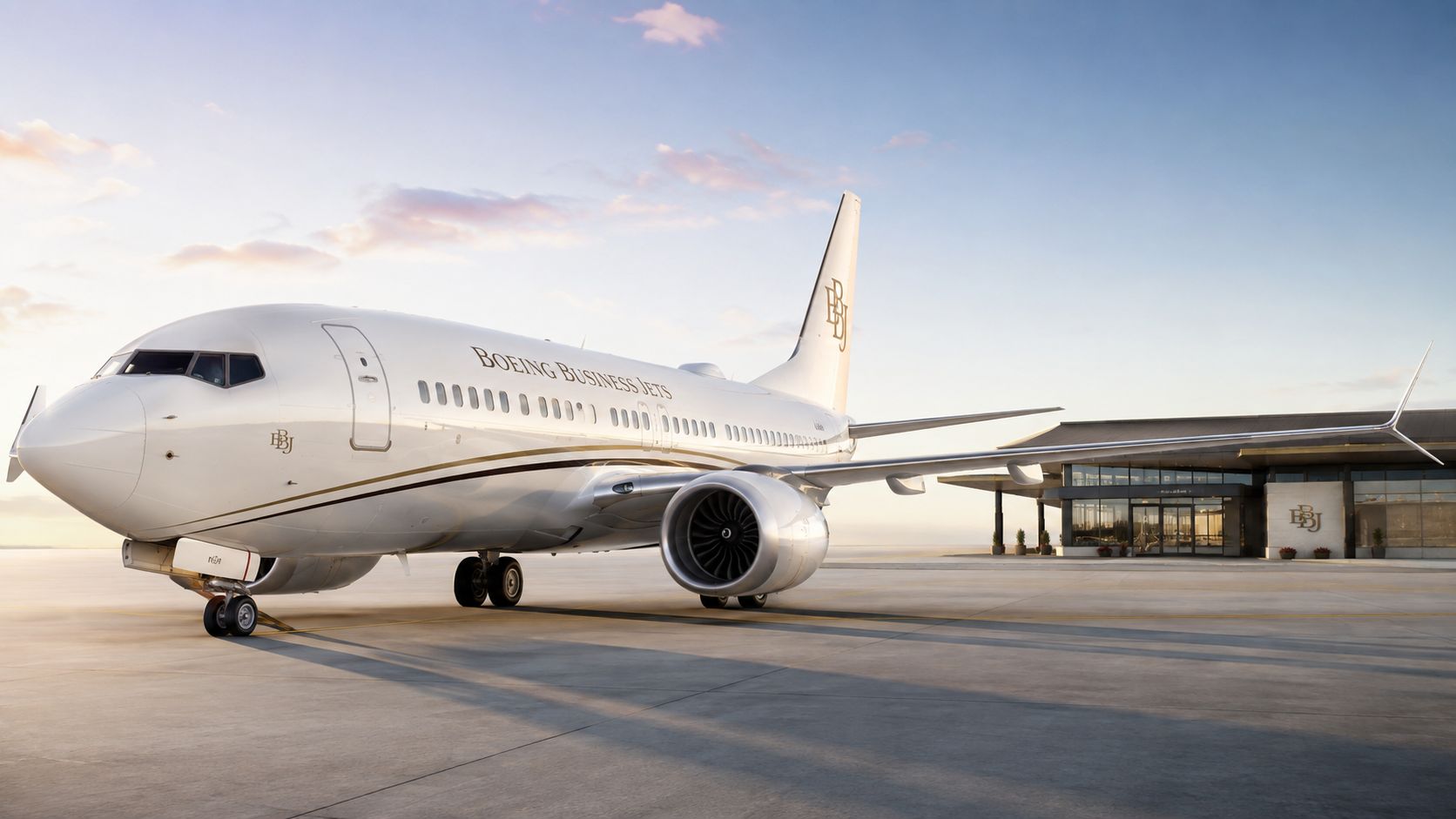
The appeal is direct. The BBJ 737 gives you intercontinental range, a full-size cabin, and the reliability of a commercial airframe adapted for VIP travel rather than built as a niche one-off. Boeing launched the BBJ 737 family in 1998, and Boeing still lists the BBJ 737 variant as an active business-aviation platform today, which tells you the market has not moved on because it still solves a real operational problem. The core BBJ1 based on the 737-700 airframe carries published weights of 171,000 lb maximum takeoff weight, 134,000 lb maximum landing weight, and 171,500 lb maximum ramp weight, so this is not a delicate toy. It is a serious transport machine built to support a serious interior.
The cabin is the reason many principals stop comparing alternatives. Published BBJ 737-700 specs show a cabin 79 ft 2 in long, 11 ft 7 in wide, and 7 ft 3 in high, with 964 ft³ of baggage volume and a ceiling of 41,000 ft. That space is what makes a flying office, sleeping suite, and meeting room possible in one aircraft. The glamour is obvious in the brochure. The value is operational. You can move people, baggage, and workstations together without forcing the mission into two separate jets or a compromised layout.
Completion cost is the part many luxury guides gloss over. A cabin this large does not come cheap to design, certify, outfit, and maintain, and every custom zone adds weight, complexity, and time on the ground. The result is a jet that looks effortless in the air but demands disciplined planning on the ground, from hangar space to interior support to airport handling.
Practical rule: if the trip requires privacy, baggage volume, and multiple onboard zones, stop comparing the BBJ 737 to midsize jets. Compare it to the operational cost of flying two or three smaller aircraft instead.
Technical Specifications and Model Variants
A BBJ 737 purchase starts with the mission, then the airframe. The original BBJ1, built from the 737-700 platform, gives you the longest-established executive configuration, and independent aircraft-spec sources place its range at roughly 6,098 to 6,196 nautical miles with NBAA IFR reserves and an 8-passenger layout, while Boeing's later BBJ 737 MAX materials publish ranges of up to 6,600 nmi depending on variant. That level of reach makes nonstop intercontinental VIP flying realistic, which is why this aircraft sits in a different category from smaller business jets. The aircraft's published cruise speed of about 473 knots and climb rate around 3,000 ft/min show a platform built for efficient long-haul transport, not for chasing a speed record. Technical performance details for the BBJ 737 underline the same point, the BBJ 737 is a mission-first aircraft.
Model comparison that matters
The family split matters because cabin volume, range, and operating profile pull in different directions. The original BBJ1 prioritizes the long-range executive mission. BBJ2 and BBJ3 give more cabin space, while the modern BBJ MAX family improves range and efficiency.
Boeing's current BBJ 737 MAX lineup includes BBJ MAX 7, BBJ MAX 8, and BBJ MAX 9, with published 8-passenger ranges of 6,600 nmi, 6,465 nmi, and 6,355 nmi respectively, according to Boeing's public materials as summarized in the research brief. That is the decision point for buyers. You are not just choosing a model, you are choosing how much cabin utility you want to preserve against range and operating flexibility.
| Model Variant | Max Range (nmi) | Cabin Volume (cu ft) | Typical Capacity |
|---|---|---|---|
| BBJ1 | 6,098 to 6,196 | 6,525 | 8 to 19 VIP |
| BBJ MAX 7 | 6,600 | Not publicly specified in the verified data | 8 to 19 VIP |
| BBJ MAX 8 | 6,465 | Not publicly specified in the verified data | 8 to 19 VIP |
| BBJ MAX 9 | 6,355 | Not publicly specified in the verified data | 8 to 19 VIP |
The performance profile also sets the operational floor. Published takeoff and landing distances of roughly 5,900 ft and 4,600 ft let the BBJ 737 use many major business-aviation airports, but runway length, pavement strength, and payload still need to be checked every time. Fuel capacity, cited at approximately 8,350 gallons, supports the long-range mission, but it does not remove the weight penalties that come with a large interior or adverse weather. If you want a flying boardroom that can cover oceans, this is the right platform. If you want a nimble airport hopper, it is the wrong one.
The hidden cost is not in the brochure numbers. It is in the completion work, the support footprint, and the ground logistics that come with a narrowbody jet once the glamour wear off. Owners should expect that reality from day one, especially when they are working with a completion partner such as American Additive Manufacturing aerospace.
Cabin Layouts and the Completion Process
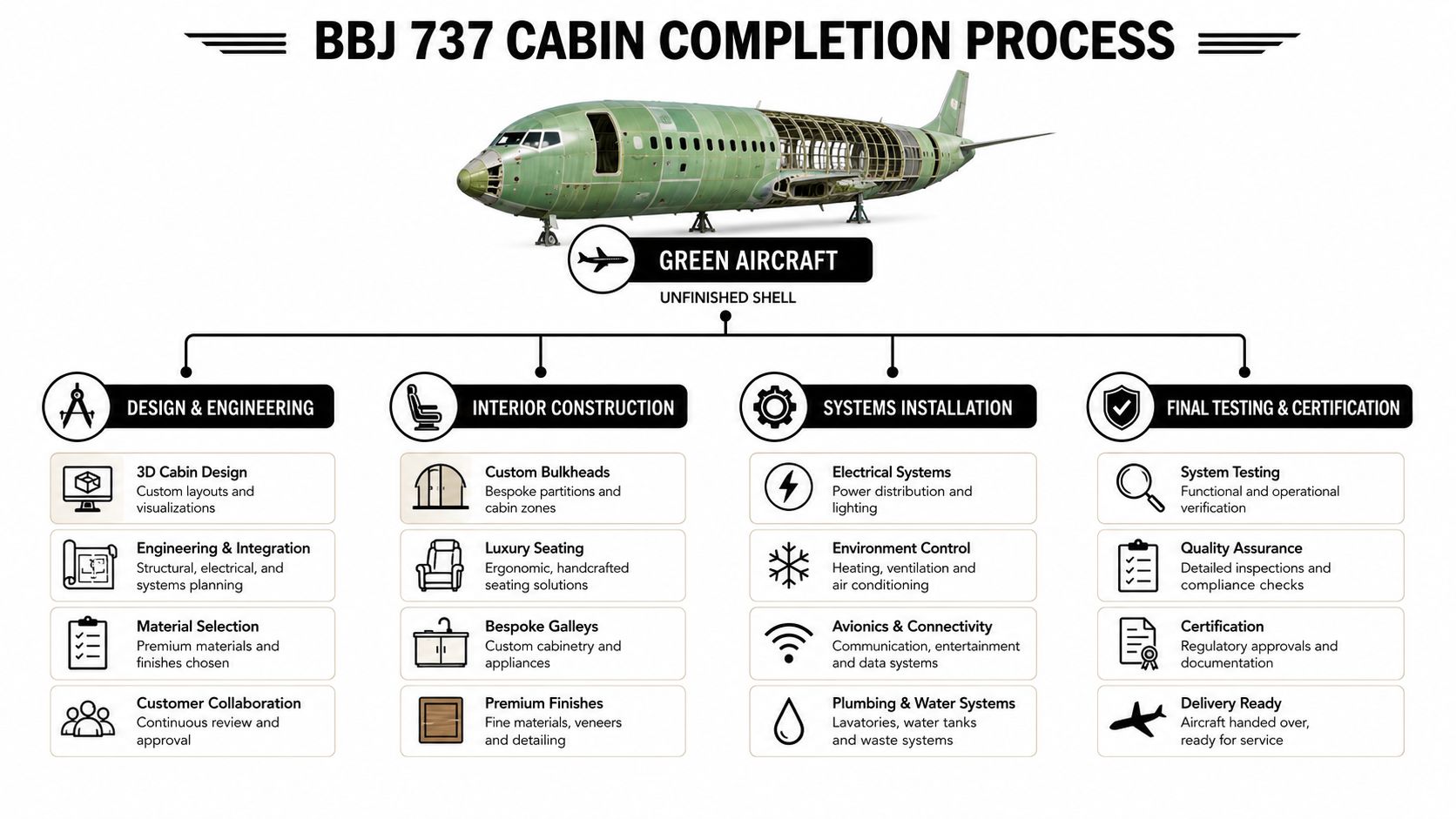
The cabin is where the glamour starts, and where the budget starts slipping if you don't control the scope. The BBJ 737 is often sold green, which means the airframe arrives unfinished and the owner takes on the completion process. That's the part most luxury articles skip because the bare metal shell doesn't photograph well. It's also where the ownership decision gets made, because a beautiful interior that runs overweight, over schedule, or over complexity is a bad asset.
Build the interior around the mission
Start with the cabin envelope, not the decor. One industry guide cites a cabin volume of 6,525 cubic feet, cabin width of 11.7 feet, cabin length of 107.5 feet, and baggage volume of 1,485 cubic feet. That is enough space for a master suite, lounge, dining area, conference table, and support zones, but only if you accept the physics of a narrowbody airframe. A BBJ cabin can feel like a flying residence, but every partition, stone finish, shower, and entertainment system affects weight and mission flexibility.
Owners usually work through completion centers to decide how the aircraft will be used. A boardroom-centric layout makes sense for corporate principals. A family layout needs sleeping privacy and storage. A government configuration may prioritize secure communications and support staff. The best completions don't try to impress with every possible feature. They make hard choices early and keep the aircraft within its performance envelope. American Additive Manufacturing aerospace is worth reviewing if you want to understand how modern aircraft-interior fabrication supports highly customized cabin programs without turning the build into a pure vanity project.
A BBJ completion should be judged on weight discipline, maintainability, and cabin flow before you judge it on marble, stitching, or brochure renderings.
Don't underestimate the timeline and trade-offs
The typical completion process is not quick, and it should never be treated like buying a stock jet and adding a few optional seats. The timeline commonly stretches because design, engineering, systems integration, and certification all have to align. That means the owner's team needs a completion advisor, a clear mission brief, and discipline on change orders. If you let preferences drift, the aircraft starts collecting complexity instead of utility.
The smartest buyers treat completion like an industrial project, not an interior-design indulgence. They specify the cabin around passenger count, route structure, baggage needs, and onboard work habits. If the aircraft is supposed to handle conference calls, overnight rest, and hosted dinners, then every square foot has to justify itself. If you start with that logic, the BBJ 737 becomes a tool. If you don't, it becomes an expensive compromise wrapped in leather.
Ownership Economics vs On-Demand Charter
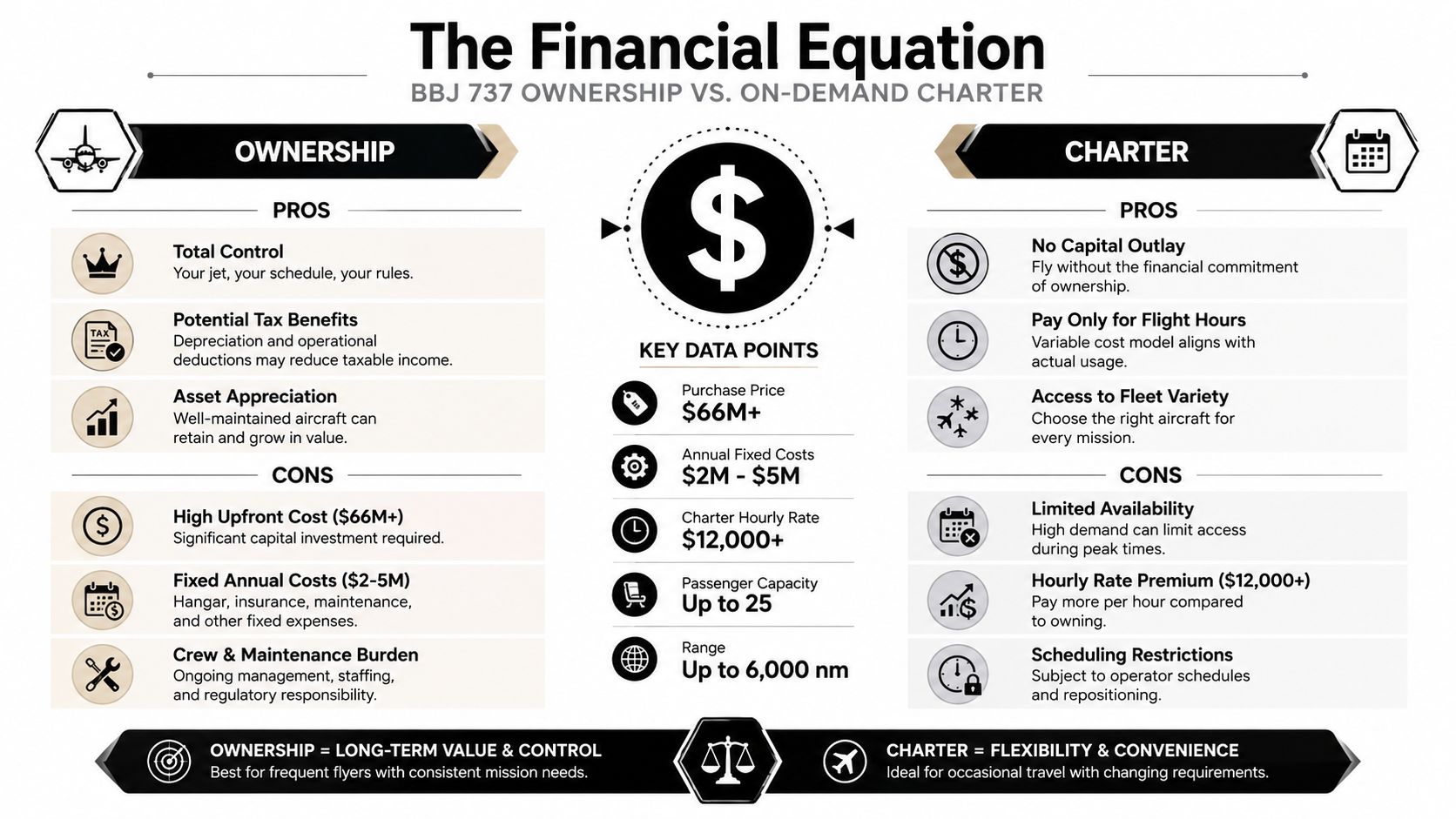
A Boeing Business Jet 737 looks straightforward on paper, then the ownership bill starts stacking up. The jet may be discussed with a list price around $46 million including a completion allowance, but that figure only covers the starting point. Completion, crew, hangar space, insurance, maintenance planning, and the operating drag of a large narrowbody all sit on top of that. For many high-net-worth travelers, charter makes more sense because it avoids tying up capital in an aircraft that sits idle between trips.
Ownership buys control, not simplicity
Ownership gives you control over the schedule, the cabin standard, the crew, and the onboard routine. It also lets you design the interior around a permanent mission profile, which matters for principals who fly often enough to justify a dedicated aircraft. That is the upside.
The trade-off is operational weight. A BBJ is still a transport-category machine, so you inherit planning requirements, staffing demands, and maintenance obligations that smaller private jets do not impose. The result is a private aircraft that behaves like a corporate asset, not a casual luxury purchase.
Industry coverage has placed 130 Boeing BBJ aircraft in operation as of August 2021, with 54% purchased pre-owned and 46% new. That split shows a real secondary market, and it also shows buyers care about acquisition economics instead of defaulting to a new build. The same market coverage points to annual fixed costs in the $1.5 million to $3 million range for 737-based models, while charter pricing commonly sits around $10,000 to $20,000+ per hour depending on model, market conditions, and positioning. Those figures are directional, but they make the point clearly. Ownership only works if the aircraft is used heavily enough to absorb standing costs without wasting capital.
Charter is the smarter default for most clients
For a specific tour, delegation, or seasonal run, charter is the cleaner decision. You avoid capital lockup, you pay for actual mission use, and you do not carry the full burden of crew employment, maintenance oversight, and hangar management. You also keep flexibility. You can select the right aircraft for the trip instead of owning the wrong jet for the rest of the year. If you are still comparing purchase paths, How to buy a jet through Haute Jets is a useful starting point, but the first question should be whether ownership is justified at all.
Bottom line: if the aircraft will not be used often enough to cover its standing costs, charter gives you the mission capability without locking capital into a depreciating operating platform.
Primary Use Cases for the BBJ 737
The BBJ 737 is not for everyone, and that's exactly why it works. It solves high-friction travel problems that smaller jets can't absorb cleanly. Government teams use it because they need space for principals, staff, security, and communications. Corporate flight departments use it when they're moving senior leaders between global hubs and need the cabin to function like a mobile office. Touring productions and sports organizations use it because the aircraft can handle groups, schedules, and baggage that would force a smaller jet into awkward compromises.
When the mission justifies the cabin
For head-of-state and government use, the aircraft's value is control and separation. The cabin can be organized around private working zones, meeting space, and support personnel without forcing everyone into one tight compartment. The BBJ's airliner heritage also makes it attractive when a mission needs a transport platform rather than a boutique jet. That doesn't mean every government trip needs a BBJ. It means missions involving multiple principals, private discussions, and high baggage load are good fits.
Corporate shuttle use is another strong case. If you need to move a larger executive group across international cities with continuity in the cabin, the BBJ's size changes the equation. Instead of splitting the team across multiple aircraft, you can keep the group together and use the time in flight productively. That is the advantage, not the status symbol. A proper cabin becomes a moving workplace, and the aircraft earns its keep by reducing friction.
Who else benefits from it
Sports and entertainment charters are a cleaner fit than generally assumed. Teams travel with luggage, equipment, and a schedule that punishes delay. A BBJ's broad cabin and baggage volume make it far easier to build a mission around the group instead of bending the group around the aircraft. The same logic applies to family travel for wealthy clients who want privacy, sleeping space, and the ability to bring more personal gear without a commercial-level hassle.
In practice, the aircraft's value is highest when the trip has three things at once, long range, many passengers, and lots of baggage. If you only have one or two of those, a smaller jet may be a better economic choice. If you have all three, the BBJ 737 stops being indulgent and starts being efficient.
How to Charter a BBJ 737 Effectively
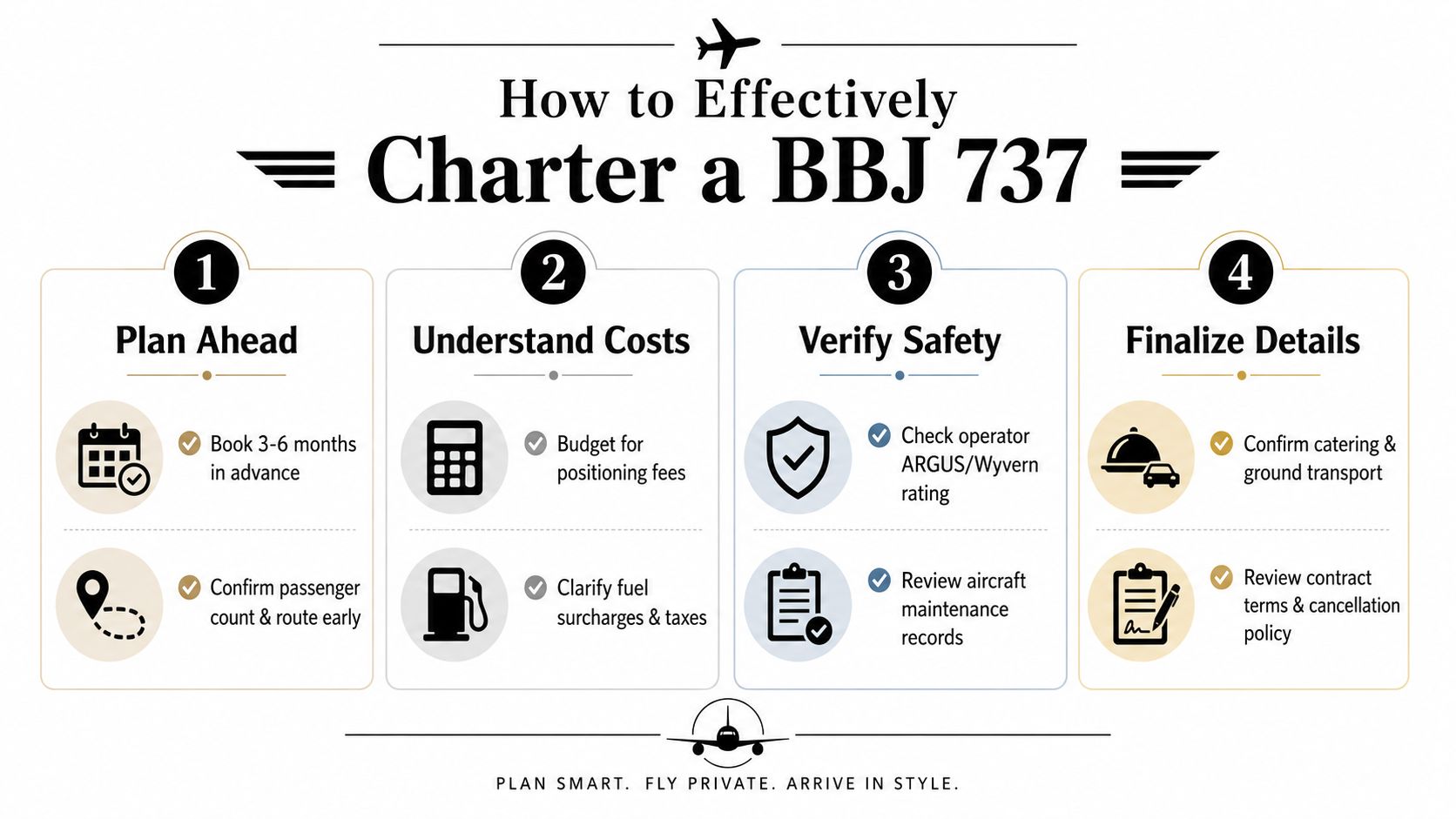
A BBJ 737 charter looks simple until the hidden costs show up. The aircraft is large, the mission is often time-sensitive, and the wrong quote can hide repositioning charges, airport limits, or a cabin that does not fit the trip. Charter it like a serious transport decision, not a luxury impulse.
The charter process should be disciplined
Start with the mission, then match the aircraft to it. Passenger count, route, baggage load, and timing should be clear before you request quotes. That keeps you from paying for more aircraft than you need, or choosing a jet that looks right on paper but fails once runway performance and airport access are checked.
Pricing deserves the same discipline. Positioning fees can make a competitive hourly rate look cheap when it is not. If the aircraft is not already close to your departure city, you are paying for empty ferry time that adds no value to your trip. Ask where the jet is based, what the repositioning charge is, and whether a closer aircraft with the same cabin standard is available. That conversation usually exposes the actual cost.
Practical rule: if the broker will not state the aircraft's location, the charter price is not transparent enough yet.
Verify safety and cabin details before you sign
Safety paperwork comes first. Confirm the operator's ratings and review the aircraft's maintenance history before you commit. Then get the exact cabin layout, not just the category. A BBJ 737 can be configured for executive work, group shuttle use, or sleeping arrangements, and those layouts are not interchangeable.
Cabin planning matters more on this aircraft than on many smaller jets. If you need a proper dining area, a private suite, or a specific privacy split between principals and staff, state that early and get it in writing. A glossy cabin brochure is not enough when the mission depends on how the interior functions.
Logistics finish the job. Catering, ground transport, airport slots, and cancellation terms should be settled before departure day. A BBJ charter is too expensive to discover at the terminal that the ground plan was improvised. If you want a wider view of airport fit and route planning, Haute Jets' airport planning guide is useful for seeing how airport choice shapes private-jet missions.
For buyers comparing one-off charter against ownership, Haute Jets' private jet purchase and charter resources remain a practical reference point.
Operational Constraints and Airport Access
The biggest mistake people make with the BBJ 737 is assuming that because it's private, it can go anywhere a smaller jet can. It can't. The aircraft's 171,000 lb maximum takeoff weight and roughly 5,900 ft runway requirement make airport planning essential. It'll access many major business-aviation airports, but smaller executive fields can become poor fits fast once pavement, weather, payload, and noise restrictions enter the equation.
Where the aircraft works best
The BBJ 737 works best when the airport is built for serious business traffic and the ground team knows how to handle a transport-category aircraft. That means proper ramp support, correct fueling, and a departure plan that respects weight and runway calculations. The practical upside is still strong. You can often land closer to the final destination than you could with a much larger VIP aircraft, which shortens ground transfers and keeps the trip efficient. Haute Jets' airport planning guide is useful if you want a better sense of how airport choice affects private-jet missions.
But this isn't a carefree airport-hopper. Specialized crew training matters, because the aircraft's size changes how the operation is handled. Ground handling has to be coordinated. Noise procedures matter. And every trip has to be checked against actual mission weight, not just the brochure range. That is the trade-off for flying something this large. You get cabin authority, but you give up casual flexibility.
If your itinerary is to a small executive field with tight runway margins, a lighter long-range jet may be the better answer. If your mission is intercontinental, high-visibility, and heavy on passengers or baggage, the BBJ 737 is still one of the cleanest ways to do it. The right aircraft is the one that fits the airport as well as the client.
If you want a BBJ 737 charter that's priced correctly and matched to the right airport, start with Haute Jets. Their team can source the right aircraft, verify the operator, and keep you from paying for repositioning you didn't need.