
Most advice about a private jet for business starts in the wrong place. It treats the aircraft like a luxury purchase, then wonders why executives end up disappointed, overbilled, or underprepared. The better question is simpler: does the flight protect schedule, productivity, and control better than commercial travel, and is the operator fit for the mission?
The Modern Reality of Corporate Aviation
Private aviation isn't just for giant corporations or celebrity travelers. The market is broader, more practical, and more operationally driven than the glossy version people still repeat in boardrooms. A lot of companies use charter because they need direct access to secondary cities, manufacturing sites, investor meetings, or urgent maintenance travel that doesn't fit airline schedules.
The market data backs that up. North America accounted for 64% of global business-aviation flights in 2024, and Europe ranked second with 16.9% of activity, according to ARGUS International's global totals for 4,828,070 business-aviation flights worldwide in 2024 ARGUS International flight activity update. That's not a niche leisure pattern, it's a transport system built for recurring corporate movement.
The shift away from ownership is real
The old default was ownership. That model makes sense only if an organization flies often enough to justify crews, maintenance, scheduling complexity, and aircraft availability risk. For everyone else, on-demand charter gives the control without the fixed burden.
A 2024 NBAA analysis showed the U.S. moving toward flexible access models, with Part 135 charter activity up 7% and fractional operations up 56% compared with September 2019, while Part 91 movements were down 4% NBAA analysis. That's the market telling you something bluntly, companies don't want to own idle aircraft when they can buy access by the trip.
Practical rule: if the aircraft won't be used consistently enough to justify standing costs, ownership is a vanity expense, not a travel strategy.
The smarter corporate buyer thinks in missions, not status. A seasonal executive team, a regional services company, or a mid-market manufacturer can justify charter if the itinerary is time-critical and commercially inconvenient. That's why a private jet for business works best as a scheduling tool, not a trophy asset.
Calculating the True Productivity Return
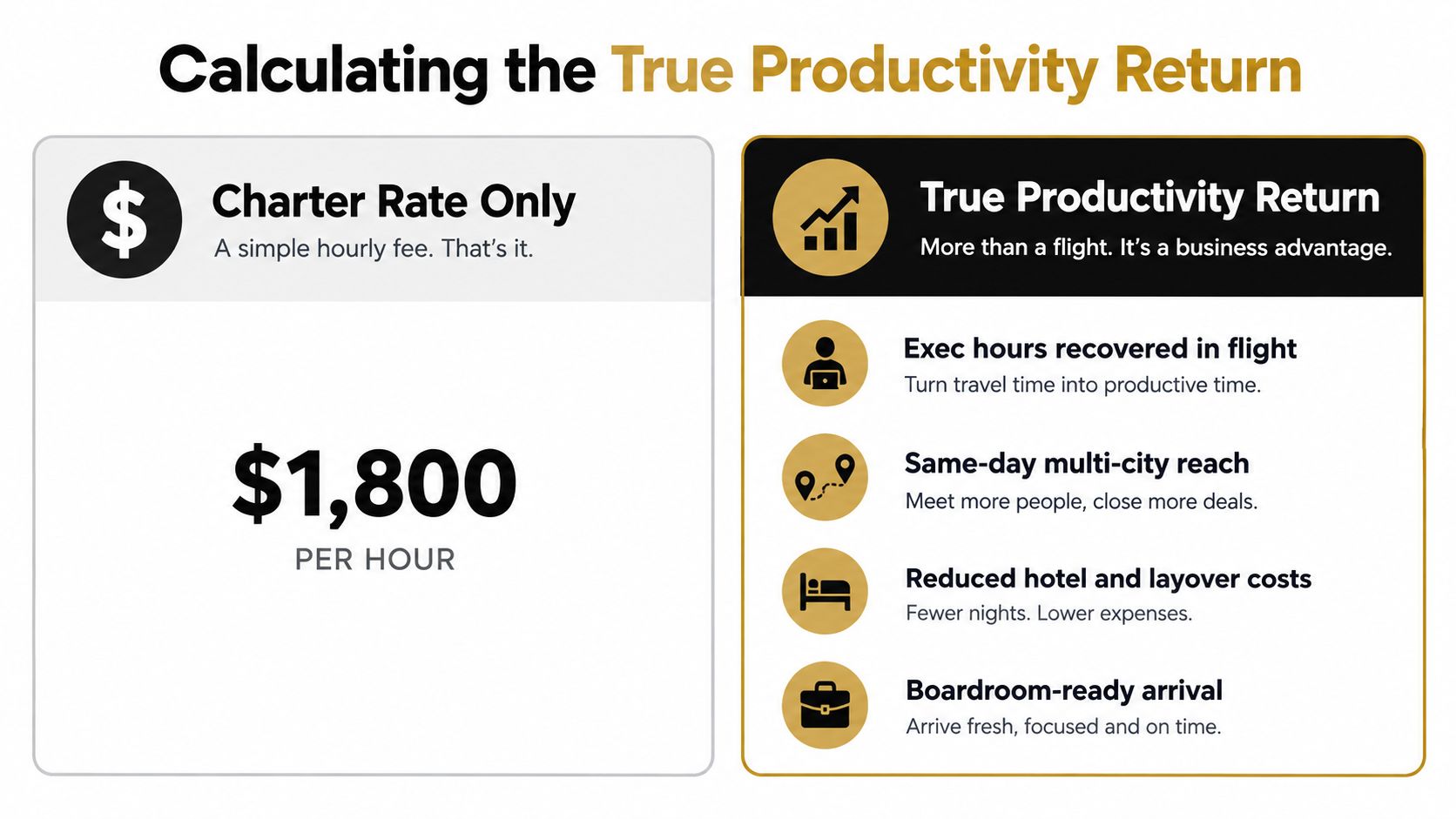
The hourly rate is the wrong starting point. Corporate aviation should be judged by output: protected work time, fewer handoffs, less terminal friction, and better control over the day. If the aircraft lets executives work, rest, or meet en route, it is doing real business work.
Start with door-to-door productive time. Commercial premium travel still forces your team through airport congestion, fixed departure windows, boarding delays, and layovers. A private cabin changes the schedule. The team can leave later, land closer to the destination, and keep working instead of spending the day in terminals.
Judge the route, not the romance
A charter only makes sense when the route supports the mission. That may mean a regional airport near a client headquarters, a field near a manufacturing plant, or a direct itinerary with multiple same-day stops. If the aircraft cuts friction from the day, it earns its place.
The mistake is comparing a private jet to a ticket instead of comparing it to the full travel day. You are buying control over the schedule, the cabin environment, and arrival timing. For the broader cost-benefit logic, see costs vs benefits of delegating, because the same discipline applies here, direct cost matters, but so does the value of delegated execution.
Don't ignore onboard security
A private cabin is not automatically a secure communications environment. Confidential deals, unreleased products, and sensitive executive messages still need device discipline, encrypted connections, and careful passenger-manifest handling. If a team treats the cabin like a floating boardroom without basic controls, it is moving risk into a more expensive setting.
Security also includes the less visible operational layer. Charter work depends on crew vetting, airport access, baggage handling, and how tightly the operator controls passenger identity and trip details. Those points rarely show up in luxury marketing, yet they decide whether the trip protects the company or exposes it.
Use the flight for what it does best, concentrated work, protected conversations, and route efficiency. A charter that saves time but weakens security or adds operational risk is a bad trade. When the trip does not create meaningful productive time or reduce travel complexity, business class is the cleaner answer.
Selecting the Right Aircraft for Your Mission
Choosing the right jet isn't about picking the nicest cabin, it's about matching the aircraft to the job. Passenger count, baggage volume, runway length, and trip distance matter more than leather and brand perception. A light jet that looks appealing on paper can fail a mission if it can't handle the airport or the cargo.
Start with the mission profile. Short regional hops usually don't need a heavy cabin, and transcontinental or international itineraries usually don't belong in a small jet. The wrong aircraft choice creates avoidable costs, from excess capacity to luggage constraints to unnecessary repositioning.
| Aircraft Category | Typical Capacity | Ideal Mission Profile |
|---|---|---|
| Light jet | Small executive group | Short regional trips, day meetings, point-to-point hops |
| Midsize jet | Mid-sized team | Cross-country business travel, multi-stop itineraries |
| Heavy jet | Larger group | Transcontinental, international, cabin meetings, more baggage |
Look at the airport first
Smaller regional airports can be a huge advantage, but only if the aircraft can use them safely and efficiently. Runway performance, baggage load, and cabin layout all matter. A team carrying presentation materials, trade-show equipment, or sensitive samples needs a different setup from two executives flying light.
Cabin layout matters too. Some missions need club seating for a meeting in the air, while others need a quiet cabin for rest. If the flight is supposed to support decision-making, the seats should support that reality. Don't overbuy aircraft size just because the trip sounds important.
For a deeper breakdown of configurations and cabin types, Haute Jets Journal has a useful overview in understanding private jet types.
Match the aircraft to the business outcome
Use a simple test. If the trip is a fast regional visit with minimal luggage, keep it light. If it's a cross-country roadshow with several passengers, move up to midsize. If the itinerary is transatlantic, highly time-sensitive, or carries a larger team, heavy jet territory starts to make sense.
The best buyers don't ask, “What's the most luxurious jet?” They ask, “Which aircraft gets the team there with the right amount of cabin comfort, baggage capacity, and airport access?”
Comparing Access Models and Cost Structures
On-demand charter, fractional ownership, and jet cards are not interchangeable. They solve different problems, and the wrong one can lock a company into payments and restrictions it doesn't need. The market's recent shift toward charter and fractional use shows that flexibility is winning over rigid ownership for many operators and travelers NBAA analysis.
On-demand charter is the cleanest model when travel is irregular. You pay for the trip, not for annual fees, prepaid hours, or a block of inventory you may never use. That makes it easier to align cash flow with actual flight demand.
Charter, fractional, and jet cards are built differently
Fractional ownership gives you an ownership interest and scheduled-use rights. That can work for very frequent flyers who need repeat access and consistent fleet access. Jet cards sit somewhere in between, but they still tend to bring prepayment, rate structures, and program rules that limit freedom.
On-demand charter is the most operationally direct. It lets travel managers source the right aircraft for each trip instead of forcing every trip into the same program mold. That's especially useful when route length, group size, and timing change from one mission to the next.
For a separate breakdown of membership-style pricing, Haute Jets Journal also publishes a relevant overview at private jet membership cost.
The real question is usage frequency
If your team flies occasionally, don't buy inventory you can't fully use. If your team flies constantly on predictable routes, then a more structured model may deserve a hard look. The answer isn't status, it's utilization.
A good charter provider can also reduce hidden waste by sourcing aircraft near departure cities instead of pricing in unnecessary repositioning. That's one reason local sourcing often beats the traditional broker model for corporate travel buyers. Companies should care about the aircraft they're booking, not the program branding around it.
Bottom line: pay for access the same way you pay for any other operating expense, in line with actual demand, not aspirational frequency.
Navigating Safety Ratings and Regulatory Authority
Private aviation safety starts with authority and control, not cabin finish. For a business flight, the first question is simple: who is operating the trip, under what certificate, and with what oversight?
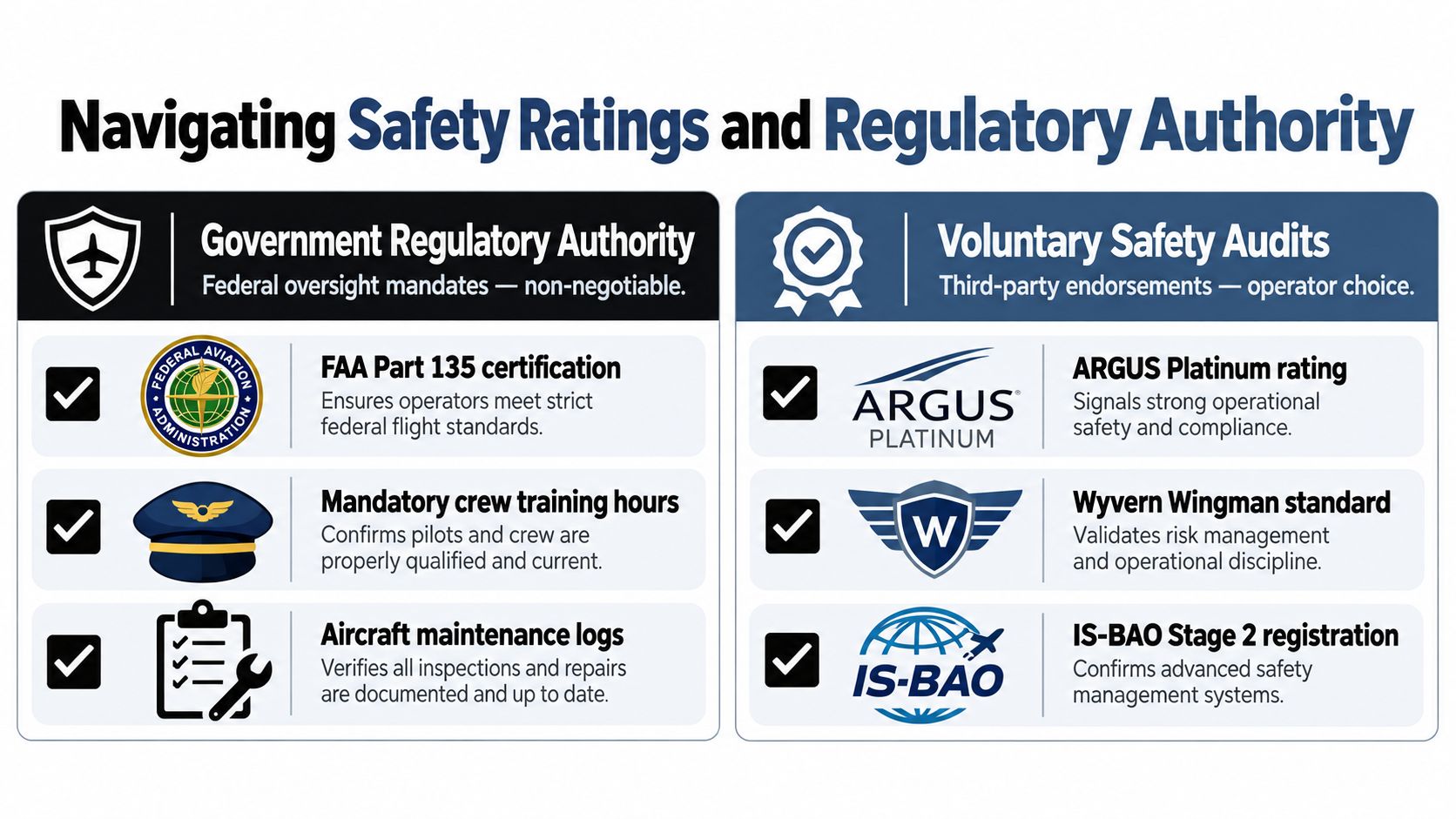
The FAA places on-demand charter under Part 135, alongside Part 119 certification and Part 91 flight rules, and it requires the certificate holder to retain operational control FAA charter operations guidance. That is the carrier you verify. The broker name does not matter if the operator behind it is unclear.
Verify the operating certificate before you book
Ask for the operator name, aircraft registration, and proof of Part 135 authority. If the provider cannot clearly identify the certificate holder, stop there. A sales brand is not the same as the party responsible for the flight.
Crew qualifications, recurrent training, maintenance standards, and dispatch oversight also deserve a direct check. The FAA says on-demand charter uses higher pilot-training and maintenance standards than noncommercial flying, with more frequent checks on pilots, crewmembers, and aircraft FAA charter safety overview. Treat that as the minimum acceptable standard.
Third-party ratings add another layer
Voluntary programs such as Wyvern Wingman and ARGUS Gold or Platinum are not government certification, but they remain useful. They examine crew qualifications, safety-management practices, maintenance, and operating history. If an operator claims strong safety discipline, it should answer those questions without hesitation.
For a closer look at operator vetting, use Wyvern and ARGUS private aviation safety ratings. For corporate buyers, that is basic due diligence, not optional reading.
Use a hard checklist
- Confirm the operator: Get the actual certificate holder, not just the broker name.
- Check the authority: Verify Part 135 for U.S. on-demand charter.
- Review the aircraft: Match the tail number to the quoted trip.
- Ask about training: Make sure crews are current on recurrent proficiency requirements.
- Request safety ratings: Look for Wyvern Wingman or ARGUS Gold or Platinum when available.
If a provider resists these questions, walk away. Corporate travel buyers need a flight that is legal, current, and operationally sound.
Managing Environmental Claims and Empty Legs
Sustainability claims around private aviation get sloppy fast. Too many operators talk about SAF as if it's a simple on-off switch, when the situation is messier. The question isn't whether a flight sounds green, it's what happened to the fuel, the accounting, and the emissions boundary.
Neutral 2025 aviation data shows SAF represented only about 0.7% of global jet-fuel production, while EASA reported 0.53% of global jet-fuel use in 2024 and noted that Europe's ReFuelEU mandate began at 2% in 2025 IATA SAF and emissions data discussion. That tells you why claims need precision. Scarcity changes both price and credibility.
Ask what kind of SAF claim you're buying
There's a big difference between physical uplift, book-and-claim, and offsetting. If SAF wasn't loaded at departure, the claim may still be valid, but only if the accounting method is disclosed clearly. Corporate travel teams should ask whether the benefit is tied to fuel physically on the aircraft, a certificate purchase, or another emissions instrument.
The clean standard is transparency. Don't accept a vague “sustainable” label without knowing the emissions boundary and the verification standard behind it. That's how companies avoid reputational problems later.
Empty legs can save money, but they're less flexible
Empty-leg flights are repositioning segments that can be offered to travelers when an aircraft would otherwise move without passengers. They can work well for flexible schedules, but the route, timing, and aircraft can change if the original mission changes. That makes them a good tactical buy, not a universal answer.
They're also still charter operations, so the applicable Part 135 rules remain in force. The discount comes from aircraft logistics, not from weaker oversight. If a trip is mission-critical or time-fixed, the savings aren't worth the schedule risk.
The Haute Jets Journal piece on empty leg flights explained covers the mechanics from an operator angle, but the business takeaway is simpler. Use empty legs when flexibility is real, not imagined. Use standard charter when the itinerary matters more than the discount.
Executing a Smooth Booking and Pre-Flight Workflow
The booking process should feel routine. If it doesn't, the operator has not done enough groundwork, or the buyer has not asked for the right detail. A disciplined charter workflow removes surprises before they reach the terminal.
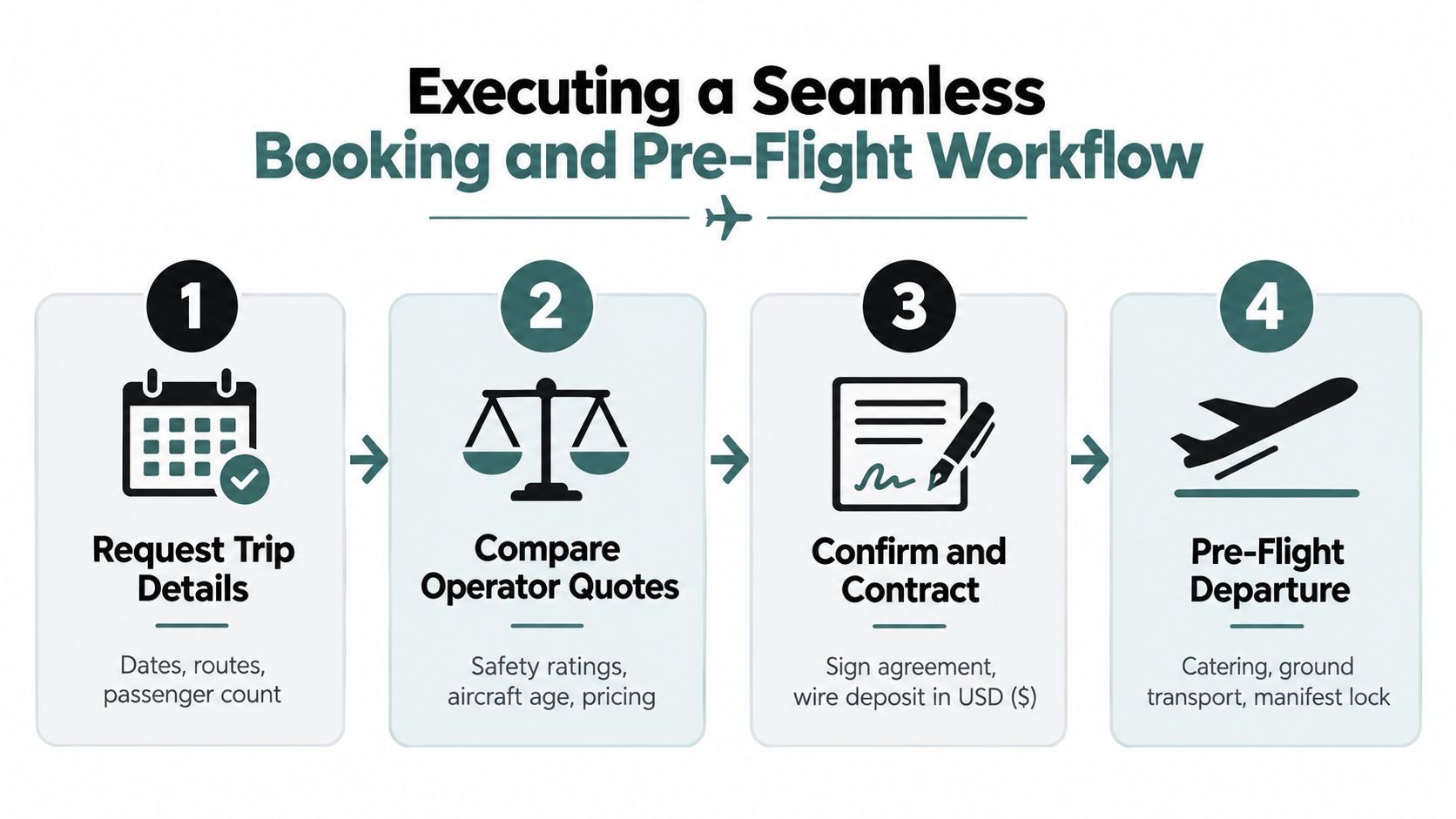
Start with the trip details, then compare operators, then contract, then confirm everything again before departure. The goal is not just to reserve an aircraft, it is to lock the mission. Cabin layout, passenger count, luggage, and timing all need to be fixed before anyone leaves for the airport.
The details that prevent terminal chaos
Ask for the exact tail number, crew bios, weather briefing, and passenger manifest at least 24 hours before departure. That packet should also confirm catering, ground transport, pet policies, Wi-Fi expectations, and any special cabin layout requirements. If the operator cannot produce those details cleanly, it is not ready for executive travel.
Corporate travelers should also think about what they carry. Laptops, samples, presentation boards, and executive bags affect aircraft selection and loading. A practical reference for trip packing is leather travel bags for men, especially for itineraries that combine meetings and overnight stays.
Keep the workflow tight
- Request trip details clearly. Dates, route, passenger count, luggage, and timing come first.
- Compare operator quotes on substance. Safety rating, aircraft registration, and cabin fit matter more than the headline rate.
- Contract with the right specifics. Lock the aircraft type, operator, and any special requests.
- Pre-flight confirmation. Confirm the manifest, crew, weather, and ground logistics before anyone leaves for the airport.
Haute Jets can support this kind of trip management by sourcing aircraft across a wide operator network, confirming the exact aircraft and operating details, and handling the pre-flight coordination that corporate teams need. If you are planning a private jet for business trip and want the charter process handled with operational discipline, visit Haute Jets and start with a quote built around the actual mission, not just the cabin image.