
The most popular advice about a private jet rental in Las Vegas is also the least useful: compare hourly rates and choose the lowest number. That approach ignores the costs that often determine the final invoice, including aircraft repositioning, airport handling, crew time, fuel adjustments, and event-driven demand.
Las Vegas rewards travelers who plan around the aircraft's actual location, the right airport, and the mission profile. A locally positioned light jet can be a better value than a cheaper-looking aircraft that must fly empty into the market. The right quote isn't the one with the lowest hourly rate. It's the one that gives you the right aircraft, airport, schedule, and total trip cost.
The True Cost of Las Vegas Private Jet Rentals
An hourly rate is only one line in a charter quote. It tells you what the aircraft costs while flying, but it doesn't necessarily tell you what you'll pay to place that aircraft under your control.
A broker may quote a light jet at an attractive hourly figure, then add ferry time because the aircraft is based outside the Las Vegas metro area. Industry pricing guidance explains that repositioning flights are billed at the aircraft's normal hourly rate and can add 20% to 50% to a short-trip total when the aircraft isn't already nearby. For a short regional charter, that adjustment can matter more than a small difference between aircraft hourly rates.
Read the quote from the bottom up
Ask for an all-in figure before comparing operators. The quote should identify:
- Aircraft positioning: Confirm whether the jet is already near your departure airport or must fly in empty.
- Airport charges: Request a clear explanation of landing, ramp, handling, and FBO costs.
- Crew and schedule: Check whether crew duty limits, overnight requirements, or schedule changes affect the price.
- Fuel and service items: Ask whether fuel adjustments, catering, ground transportation, and special handling are included.
- Event conditions: Find out whether the quote reflects current availability during a major convention, concert, sporting event, or holiday period.
Las Vegas has a broad aircraft mix. One current industry directory lists 41 aircraft across 4 operators within 50 miles of the city, including light, midsize, super-midsize, heavy, turboprop, and piston aircraft. The same directory shows estimated hourly rates from about $600 to $9,500, with an overall average near $4,300 per hour, demonstrating why a single market-wide “Las Vegas private jet price” is almost meaningless. See the Las Vegas private jet charter cost guide for a broader explanation of the variables that shape a quote.
Local sourcing is the practical cost control
The strongest cost-saving move is simple: ask your broker to source an aircraft already positioned near the departure city. The same pricing guidance indicates that local sourcing can remove one to three hours of ferry time from a quote when the aircraft would otherwise need an empty inbound sector.
That doesn't mean the nearest aircraft is always the right aircraft. It means positioning should be treated as a deliberate commercial decision, not an invisible surcharge. Compare the aircraft's location, category, cabin layout, and total cost together. A slightly higher hourly rate may produce the lower final invoice if it eliminates unnecessary repositioning.
Broker's rule: Never approve a charter based on the hourly rate alone. Approve the aircraft, route, positioning, airport charges, and all-in total as one package.
Navigating Las Vegas Airports and FBOs
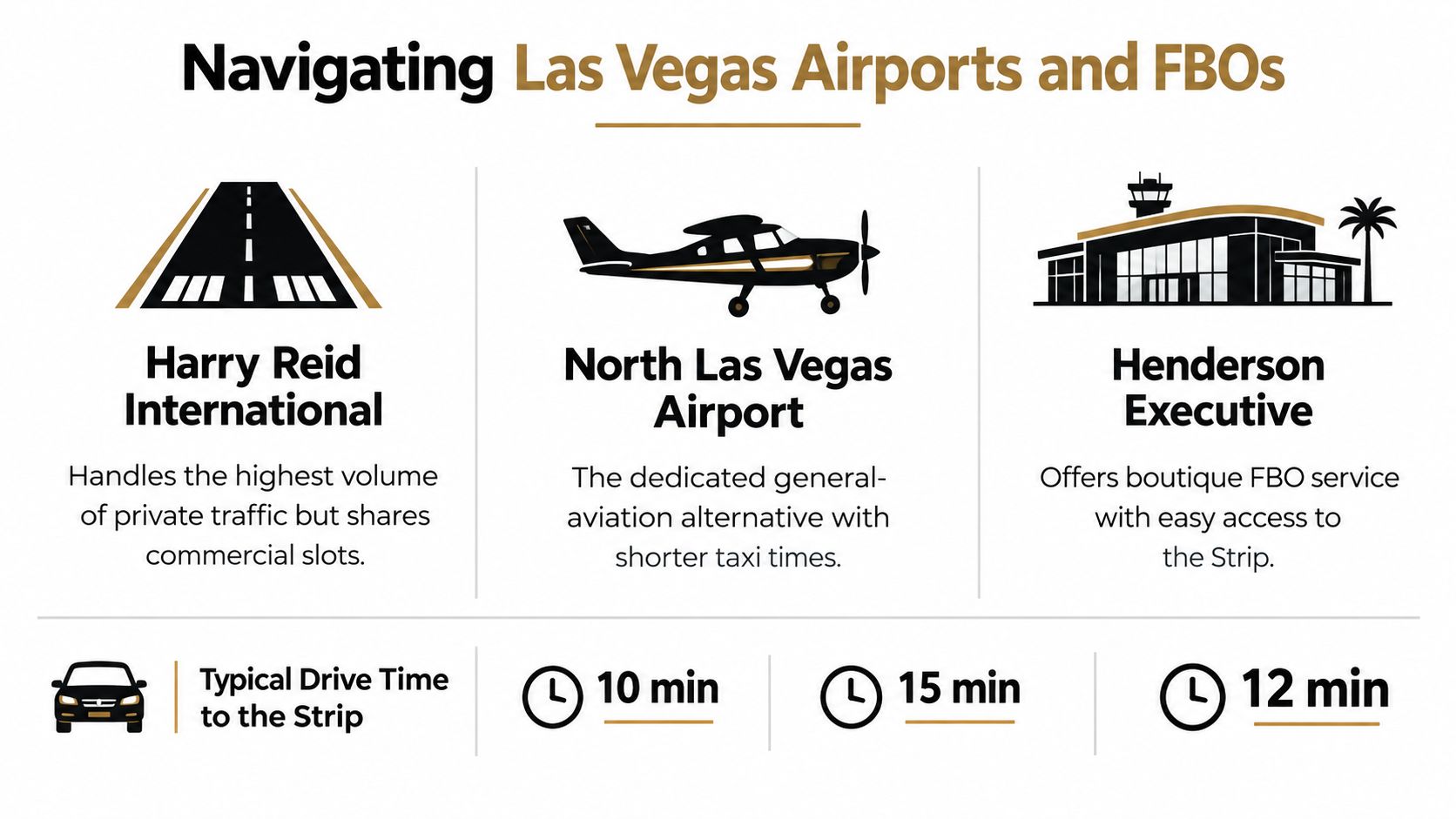
Las Vegas private aviation does not run through one airport. Harry Reid International Airport, North Las Vegas Airport, and Henderson Executive Airport each solve a different access problem. Your broker should choose the field after reviewing the aircraft, customs requirements, runway needs, FBO arrangements, and final ground destination. The cheapest airport fee can still produce the highest total trip cost if it adds ground time or limits aircraft availability.
Harry Reid International Airport
Harry Reid International, identified by KLAS or LAS, is Las Vegas's main high-capacity option for private aviation. It has a 14,510-foot runway, U.S. port-of-entry status, and two dedicated FBOs, according to this Harry Reid private aviation airport guide.
Select KLAS for larger-cabin aircraft, international arrivals, or missions carrying payload that benefits from substantial runway capacity. Las Vegas heat can reduce takeoff performance, especially at higher weights. The longer runway gives the operator more room to manage those conditions than a smaller general-aviation field.
KLAS also supports around-the-clock operations, which makes it useful for late arrivals, customs processing, and schedules tied to major entertainment or corporate events. Its position near the Strip is convenient, but convenience alone should not determine the choice. Confirm the FBO, transfer plan, and all-in quote before booking.
North Las Vegas Airport
North Las Vegas Airport is northwest of downtown and operates its own FBO, as described in this Las Vegas FBO guide. It often fits lighter aircraft, downtown meetings, and passengers who want to avoid routing every movement through the primary commercial gateway.
Give your broker the exact ground destination. “Las Vegas” is not enough. A downtown office, Strip resort, and property in the northwest valley can favor different airports, even when the flight itself is identical. Airport selection changes the transfer, FBO setting, handling arrangements, and aircraft choices available for the trip.
Henderson Executive Airport
Henderson Executive Airport sits south of the Strip and provides a general-aviation alternative with its own FBO. It works well for passengers staying in Henderson or the southern resort area, plus lighter and midsize aircraft that do not need KLAS's larger-airport capabilities.
Use this decision order:
- Confirm customs and runway requirements. International arrivals and heavier aircraft may favor KLAS.
- Match the airport to the aircraft. Avoid a field that creates unnecessary performance, payload, or operating restrictions.
- Map the final destination. Strip, downtown, Henderson, and the western valley create different transfer requirements.
- Compare the total trip cost. A lower airport charge is not a saving if it adds a long transfer, handling complication, or schedule constraint.
Choosing the Right Aircraft for Your Vegas Itinerary
Aircraft selection should begin with the itinerary, not the cabin photograph. A turboprop, light jet, midsize jet, super-midsize jet, and heavy jet solve different travel problems. Paying for unused range or seats is wasteful, but choosing an aircraft that's too small can create baggage, payload, or operational restrictions.
The following estimates reflect independent 2026 industry pricing references and a Las Vegas premium-market source. Rates are directional, not guaranteed quotes, because aircraft availability, positioning, routing, and service level change the final number. The figures are documented in this 2026 Las Vegas private jet pricing reference.
Las Vegas Aircraft Categories and Estimated Hourly Rates
| Aircraft Class | Ideal Vegas Mission | Estimated Hourly Rate |
|---|---|---|
| Turboprop | Short regional hops when efficiency matters more than jet speed | Approximately $2,100 |
| Light jet | Southern California, Arizona, and short leisure trips | Approximately $3,300 |
| Midsize jet | Regional corporate travel with more cabin and baggage space | Approximately $4,800 |
| Super-midsize jet | Longer domestic missions and larger groups | Approximately $5,400 |
| Heavy jet | Large groups, premium service, and demanding domestic missions | Approximately $7,200 |
| Ultra-long-range jet | Long-distance travel requiring maximum range and cabin capability | $9,600 or more |
A turboprop can be sensible for a short hop with a small group and modest baggage. It shouldn't be selected merely because the hourly rate looks lower. Consider the passengers' expectations, airport availability, weather, and whether the longer block time undermines the reason for flying private.
A light jet is usually the natural fit for a Southern California leisure trip, a bachelorette weekend, or a small executive team. It offers a better speed and cabin experience than a turboprop without the excess capacity of a heavy aircraft. For many short Vegas missions, right-sizing creates the clearest value here.
Match the cabin to the mission
Choose a midsize jet when passengers need a more comfortable regional cabin, additional luggage capacity, or a longer range than a light jet provides. A super-midsize jet becomes more appropriate when the itinerary is longer, the group is larger, or passengers need a more substantial work and rest environment.
Heavy and ultra-long-range aircraft make sense for transcontinental or highly demanding itineraries, including large delegations and nonstop corporate travel from the East Coast. They don't make sense for a short hop merely because they look more impressive. The aircraft should carry the people, luggage, fuel, and schedule without paying for capability you won't use.
Payload also matters in Las Vegas. Hot summer conditions and higher takeoff weights can affect aircraft performance, so the departure airport and exact tail number should be reviewed together. Use this short-haul aircraft selection guide when comparing a turboprop and light jet for a regional mission.
Event-Driven Pricing and Seasonal Demand
Las Vegas demand behaves differently from a steady corporate market. Coverage of the local charter market describes traffic as “almost entirely leisure-driven,” with conventions and major events producing sharp availability and pricing changes, as documented in this Las Vegas private jet market overview.
That pattern creates two problems. First, local aircraft disappear quickly when a major event fills hotels, venues, and airport ramps. Second, the remaining aircraft may be positioned elsewhere, which makes ferry costs more prominent in the quote. A traveler who waits until the event is close may still find a jet, but not necessarily the aircraft, airport, or departure time originally wanted.

Plan for the demand window
For CES, Super Bowl weekend, major fights, festivals, and large conventions, begin with the aircraft and schedule rather than waiting for a final hotel decision. A broker can then search for a tail that fits the passenger count and luggage requirements before the most convenient inventory is committed.
Use these tactics during a peak period:
- Request multiple airports: KLAS, North Las Vegas, and Henderson may produce different operational options.
- Keep the aircraft category flexible: A light jet may be ideal, but a midsize aircraft could be more available if the schedule is tight.
- Protect the return leg: Same-day returns require the aircraft and crew to remain available, not just an attractive outbound quote.
- Review positioning explicitly: An aircraft coming from another market may carry a substantial ferry component.
- Build a practical arrival window: A narrow departure request can eliminate otherwise suitable aircraft.
Flying into a secondary airport can also reduce ramp pressure and improve the ground transfer, provided the aircraft and itinerary support it. A networked broker can add value here, because local operators may be sold out while suitable aircraft remain available in nearby markets.
The following video offers useful visual context for the private aviation experience around Las Vegas:
Don't confuse urgency with value. A last-minute charter can work, but the buyer has less power over positioning, aircraft age, cabin layout, and airport choice. Early planning gives you more control over the complete trip rather than forcing you to accept whatever remains.
Sample Itineraries and Short-Hop Strategies
Short-haul charter is where poor planning creates the biggest disconnect between an advertised rate and the actual value. The flight itself may be brief, but the aircraft still has to reach the departure airport, the crew must remain legal for the schedule, and the operator must account for both the outbound and return sectors.
Los Angeles to Las Vegas for the day
A Los Angeles to Las Vegas day trip is a classic example. The traveler wants a morning departure, a productive or social day in the city, and a return that doesn't depend on a commercial schedule. The best aircraft is usually the smallest suitable jet that can carry the group and luggage comfortably.
Start by comparing departure airports in the Los Angeles area with the Las Vegas arrival airport. Then ask whether the proposed aircraft is already positioned near Los Angeles or whether the quote includes an empty inbound flight. The aircraft's location can matter more than a modest hourly-rate difference.
A locally sourced light jet may offer the right balance for a small group. If the passengers are traveling for a dinner, show, or meeting, a turboprop could also be considered when the itinerary prioritizes operating efficiency over jet speed. The final choice should account for the group's tolerance for cabin size, baggage, and schedule constraints.
The return needs equal attention. If the aircraft must wait through the day, the quote may reflect crew duty, parking, and the operator's commitment to keep that aircraft available. If the aircraft leaves and returns later, the operator may need to reposition it again. Ask the broker to compare a same-aircraft day return with an aircraft that can conduct a more efficient local rotation.
Phoenix or San Diego for one meeting
A Phoenix or San Diego executive trip often has a different priority. The traveler may need to land, attend one meeting or dinner, and return without spending the night. In that case, departure flexibility and airport proximity can be more valuable than a larger cabin.
Give the broker the full schedule, including the required ground arrival time and the latest acceptable return. Don't provide only the meeting start time. The operator needs to evaluate aircraft availability, crew duty, airport access, and whether the aircraft can wait or must reposition.
For a small executive group, a light jet may provide enough capacity. Add luggage, presentation equipment, or additional passengers and the decision may change. A midsize jet can offer a more comfortable working environment, but it should be selected for a real cabin or payload requirement, not for status.
The short-hop checklist
Before accepting a regional quote, confirm:
- Departure airport: Choose the field that reduces the ground transfer and supports the aircraft.
- Aircraft location: Identify any inbound ferry segment.
- Waiting plan: Confirm whether the aircraft remains available for the return.
- Baggage: Disclose golf equipment, presentation cases, or oversized items.
- Return flexibility: Price the preferred return and a practical alternate window.
The route may be short, but the operational plan still determines whether the charter is efficient. A good broker shows you that plan before asking you to approve the invoice.
Booking On-Demand Without Memberships or Jet Cards
For occasional Las Vegas travelers, a membership or jet card can impose more structure than it removes. Prepaid hours, annual charges, blackout dates, and fixed aircraft categories may be convenient for some frequent flyers, but they can be a poor fit when every trip has a different passenger count, destination, and cabin requirement.
On-demand charter lets you select the aircraft for the mission in front of you. A short Southern California hop may call for a light jet, while a larger corporate group flying across the country may need a super-midsize or heavy aircraft. Paying per flight avoids committing every future trip to one category.
What to demand from an on-demand quote
A professional booking process should answer practical questions before payment:
- Exact aircraft: Ask for the year, make, model, tail number when available, and cabin layout.
- Operator safety: Restrict the search to operators with recognized third-party oversight, such as Wyvern Wingman or ARGUS Gold or Platinum ratings.
- Included services: Confirm Wi-Fi, catering, pets, ground transportation, and special requests in writing.
- Schedule confirmation: Require the final aircraft, crew, routing, and passenger details before departure.
- Commercial terms: Review cancellation, payment, repositioning, and waiting policies before authorizing the flight.
The exact tail number matters. “Light jet” describes a category, not the aircraft you will board. Two aircraft in the same category can differ in age, cabin configuration, baggage capacity, connectivity, and onboard condition.
Why flexibility beats prepaid capacity
Jet cards can be useful for travelers who fly frequently enough to value standardized access, but they can also limit the buyer's ability to choose the best aircraft for each Las Vegas itinerary. On-demand sourcing keeps the decision open until the route, date, passenger count, and local availability are known.
For a traveler comparing providers, ask whether the company can source from owner-operators near the departure city, provide direct pricing, and disclose the aircraft before the flight. Those answers reveal more about value than a membership brochure.
Don't accept an opaque “guaranteed category” when the itinerary requires a specific cabin. You should know whether the aircraft has the luggage capacity, connectivity, pet policy, and seating arrangement your group needs. You should also know who operates the flight and when the final details will be confirmed.
The right standard: Pay for the flight you need, on the aircraft you approve, with the total cost explained before departure.
Haute Jets offers on-demand Las Vegas charter sourcing from 3,500+ owner-operators across 175 countries, with Wyvern Wingman or ARGUS Gold and Platinum-rated operators, exact-aircraft selection, and a 24-hour pre-flight confirmation covering flight details, crew, weather, and passengers. That model suits travelers who want local sourcing and per-flight booking without annual fees, prepaid hours, or jet card restrictions.
Haute Jets can source a Las Vegas charter around your actual departure city, airport preference, passenger profile, and event schedule, then present the aircraft and total cost before you commit. Visit Haute Jets to request an on-demand quote and compare the right jet for your itinerary without a membership or jet card.