
You've found a jet, picked a departure time, and received a quote that looks surprisingly different from the estimate another broker sent. Both aircraft may be described as “light jets,” yet the totals don't match. In Florida, that's normal. The aircraft's location, the airport you choose, and whether the trip is one-way or round-trip usually matter more than the advertised hourly rate.
Florida has an unusually dense private aviation network, so the right airport can remove positioning time, simplify customs, and put you closer to your actual destination. The wrong one can add ferry legs, handling charges, ground time, and scheduling risk. This guide gives you a practical way to choose the airport, aircraft category, and routing that fit your Florida mission.
Why Florida Is the Center of U.S. Private Aviation
A client flying from Miami to Naples may see a very different quote from one departing Tampa, even with the same aircraft category. Florida's private aviation market is large, spread across many airports, and shaped by where operators base aircraft. That density gives charter clients more choices, but it also makes airport selection and ground logistics part of the planning decision.
In 2023, private jets made 369,838 flights through Florida, about 11.9% of all U.S. private aviation flights, according to Miami-Opa Locka Executive Airport's aviation overview. The state recorded 5.0% fewer flights than in 2022, yet still handled roughly one in eight private aviation flights nationally. Florida supports that volume with 128 public-use airports, 21 commercial-service airports, more than 575 private-use airports, and 11 military aviation facilities. Aviation contributes $336 billion annually to the state economy and supports about two million jobs, according to the same overview.
South Florida is the operational core
For Miami-area charters, Miami-Opa Locka Executive Airport, or OPF, handles the bulk of private jet traffic. Its FBO network, including Signature and Banyan, provides fueling, maintenance, ramp space, passenger lounges, and international handling. That makes OPF a practical starting point when aircraft availability and operator support matter more than using a major commercial terminal.
Fort Lauderdale Executive Airport, or FXE, fits clients bound for Fort Lauderdale, Boca Raton, and the Palm Beach corridor. Miami International Airport, or MIA, remains useful for commercial connections and certain international requirements. MIA operates 24 hours a day, seven days a week, but its commercial-airport setting can mean more coordination and ground activity than an executive airport.
Match the airport to the reason you're flying
Choose the field around the final destination and trip requirements:
- Leisure: Miami, Palm Beach, Naples, Sarasota, and the Keys each offer different combinations of access, FBO service, and aircraft availability.
- Business: Finance, real estate, Latin American headquarters, and cruise operations usually reward proximity to the meeting or port.
- Regional access: Bahamas and Turks and Caicos trips depend on customs capability, aircraft range, and departure procedures.
- Special logistics: Families bringing pets should arrange the arrival plan in advance, including in-home pet care while traveling if the animal stays home.
Give your advisor the exact ground destination first. Then compare OPF, FXE, PBI, Naples, Tampa, Orlando Executive, and nearby fields by aircraft supply, FBO support, customs, and transfer time. That process usually produces a better charter decision than choosing an airport from a map.
What Actually Drives the Cost of a Florida Charter
A Florida charter quote starts with three questions: where the aircraft is based, which airport you use, and whether the aircraft flies one-way or stays for your return. Hourly math matters, but it rarely explains the full price in Florida's demand-heavy market. Recent 2026 pricing pages place common Miami one-way flights around $12,500 to $35,000, depending on aircraft and itinerary. Hourly pricing ranges from roughly $2,000 for turboprops to $18,000 for ultra-long-range jets, according to YAJ Charter's Florida pricing guide.
Repositioning often creates the largest surprise. A jet based at OPF may need to fly empty to pick you up in Naples or Tampa, then return empty after drop-off. One 2026 example puts a one-way midsize charter at $16,000 to $29,500 when the aircraft must return without passengers. You pay for your cabin time, but also for the aircraft's movement to and from its operating base.
Read the quote in the right order
Ask for these details before comparing operators:
- Aircraft location: Where is the jet based before pickup, and where does it go afterward?
- Billable time: Does the total include positioning, daily minimums, or both?
- Trip direction: Will the aircraft remain for your return, or will the operator schedule another repositioning movement?
- Airport charges: Request FBO handling, landing, parking, and international fees in writing.
- Crew requirements: Confirm overnight stays, catering, and itinerary-change charges.
Florida short hops can produce misleading comparisons. A brief flight may still carry a minimum billing requirement. A one-way trip can also cost more when the operator cannot sell or efficiently schedule the return. A round-trip may make better financial sense if the aircraft stays with you and avoids a second pickup operation.
Practical rule: Ask, “How much of this quote moves the passenger, and how much moves the aircraft?” The answer exposes positioning costs quickly.
Demand rises around Super Bowl travel, Art Basel, the Miami Boat Show, and the F1 Miami Grand Prix. During those periods, compare the full mission cost rather than the lowest hourly figure. Haute Jets' guide to private jet charter cost helps separate aircraft time from taxes, FBO charges, and positioning.
Florida's Main Private Jet Airports and FBOs
Airport choice should follow your ground destination and customs needs. OPF is usually the first place I check for Miami because its private aviation concentration supports strong aircraft availability and fast FBO handling. FXE is often more convenient for Fort Lauderdale and Boca Raton, while PBI makes sense for Palm Beach, Jupiter, and the broader wealth corridor.
South Florida also has several around-the-clock options. Sheltair FLL, Signature FLL, and Fontainebleau Aviation advertise 24/7 operations at Fort Lauderdale-Hollywood International Airport, as shown by Sheltair's Fort Lauderdale location. That matters when you need a late arrival, same-day dispatch, or a departure outside normal commercial schedules. National Jets' FLL air center advertises 22,000 square feet of hangar space and expansive ramp parking, details available from National Jets' air center.
Choose by destination, not brand recognition
- Miami-Opa Locka, OPF: Best for Miami, Coral Gables, Brickell, and international charter operations. Confirm the assigned FBO, customs availability, and aircraft parking before assuming a quick departure.
- Fort Lauderdale Executive, FXE: A strong choice for Fort Lauderdale, Boca Raton, and connections toward Palm Beach. It's also a practical Bahamas gateway when the operator has the right customs plan.
- Palm Beach International, PBI: Useful for Palm Beach, West Palm Beach, Jupiter, and coastal estates. Jet Aviation's Palm Beach FBO operates 24 hours a day, seven days a week, according to Jet Aviation's Palm Beach location.
- Miami International, MIA: Choose it when airline connections or a particular international operation outweigh the convenience of an executive airport.
- Naples, APF: The natural choice for Naples and nearby Gulf Coast destinations, especially when the aircraft is already positioned locally.
- Fort Myers, RSW: Practical for the islands and southwest Florida, but confirm private-terminal handling and the ground transfer to your final destination.
- Tampa, TPA, and St. Pete-Clearwater, PIE: Compare the airport against your Gulf Coast destination. Tampa can suit business travel, while PIE may reduce congestion for some west-coast itineraries.
- Orlando International, MCO, and Orlando Executive, ORL: MCO helps with airline connections and larger operations. ORL can be more convenient for private travelers headed into central Orlando.
- Jacksonville, JAX: A sensible northeast Florida gateway for business, coastal resorts, and regional connections.
Runway limits, customs capability, and handling arrangements must be verified for the specific aircraft and date. Don't rely on a generic airport list. Use Haute Jets' guide to flying privately into Miami and discovering Opa-Locka's FBOs as a starting point, then ask your advisor to confirm the actual FBO and operating plan.
Florida Private Jet Airports at a Glance
| Airport (Code) | Primary FBOs | Best For | Runway / Limits |
|---|---|---|---|
| Miami-Opa Locka Executive (OPF) | Signature, Banyan | Miami, international charter, South Florida access | Confirm aircraft performance, parking, and customs for the mission |
| Fort Lauderdale Executive (FXE) | Sheltair, Banyan | Fort Lauderdale, Boca Raton, Bahamas departures | Verify operating hours, customs, and aircraft limits |
| Palm Beach International (PBI) | Jet Aviation | Palm Beach and the northern wealth corridor | Confirm ramp availability and international handling |
| Naples (APF) | Local executive FBOs | Naples and southwest Florida | Check aircraft size, runway suitability, and parking |
| Tampa (TPA) | Airport FBO facilities | Tampa business and Gulf Coast travel | Compare handling, congestion, and aircraft requirements |
| Orlando Executive (ORL) | Executive FBO facilities | Central Orlando and short regional trips | Confirm runway, weight, and operating restrictions |
| Jacksonville (JAX) | Airport FBO facilities | Northeast Florida | Verify FBO access and aircraft compatibility |
Choosing the Right Aircraft for Florida Routes
The right aircraft depends on passenger count, baggage, runway access, and whether the trip continues beyond Florida. For a short intra-state mission, paying for a heavy jet usually buys capacity you won't use. For a longer route with luggage, work requirements, or an international connection, the cheapest category can create unnecessary compromises.
Short hops favor light equipment
Very Light Jets and Light Jets fit routes such as Fort Lauderdale to Naples or Orlando to Miami. They work well for smaller groups, quick departures, and missions where the cabin doesn't need stand-up space. Common Florida examples include the Phenom 300 and Citation light-jet models.
A turboprop can be the smarter choice when the route is short, the runway is constrained, or the destination is in the Bahamas. Treasure Cay and Marsh Harbour operations may make turboprop flexibility more valuable than jet speed. You'll trade some cabin quietness for airport access and often a more practical operating profile.
Upgrade for cabin time and baggage
Midsize and super-midsize aircraft make sense when the journey lasts longer, the group needs more room, or baggage volume matters. A Miami to Destin itinerary, a Palm Beach to Key West mission with substantial luggage, or a multi-stop business day can justify a Citation Sovereign or Challenger 350.
Heavy jets become relevant for Gulf Coast to Northeast travel, international positioning, or a larger group leaving Miami during an event period. A Gulfstream G450 or G550 offers a very different experience from a light jet, but the extra cabin and range should serve a real requirement.
| Aircraft Category | Typical Florida Mission | Range | Best-Fit Trip |
|---|---|---|---|
| Turboprop | Short Caribbean hops, smaller regional fields | Short regional missions | Treasure Cay, Marsh Harbour, and compact groups |
| Very Light Jet | Miami to Orlando, Fort Lauderdale to Naples | Short regional missions | Small parties prioritizing speed and value |
| Light Jet | Intra-state routes and nearby Southeast cities | Regional missions | Four to seven passengers with moderate baggage |
| Midsize Jet | Longer Florida legs and comfortable regional travel | Extended domestic missions | More headroom, baggage, and cabin comfort |
| Super-Midsize Jet | Miami to Destin or longer coastal routes | Longer domestic missions | Groups needing space and nonstop flexibility |
| Heavy Jet | Northeast, international, and event movements | Long-haul missions | Large groups, extensive baggage, and extended comfort |
| Ultra-Long-Range Jet | Transatlantic positioning and global travel | Intercontinental missions | Long international flights with maximum cabin range |
The aircraft category is only the first decision. Haute Jets' aircraft selection guide for short-haul private flights is useful when you need to compare cabin layout, luggage, runway access, and actual passenger needs rather than selecting by brand name.
Popular Florida Charter Routes and How to Plan Them
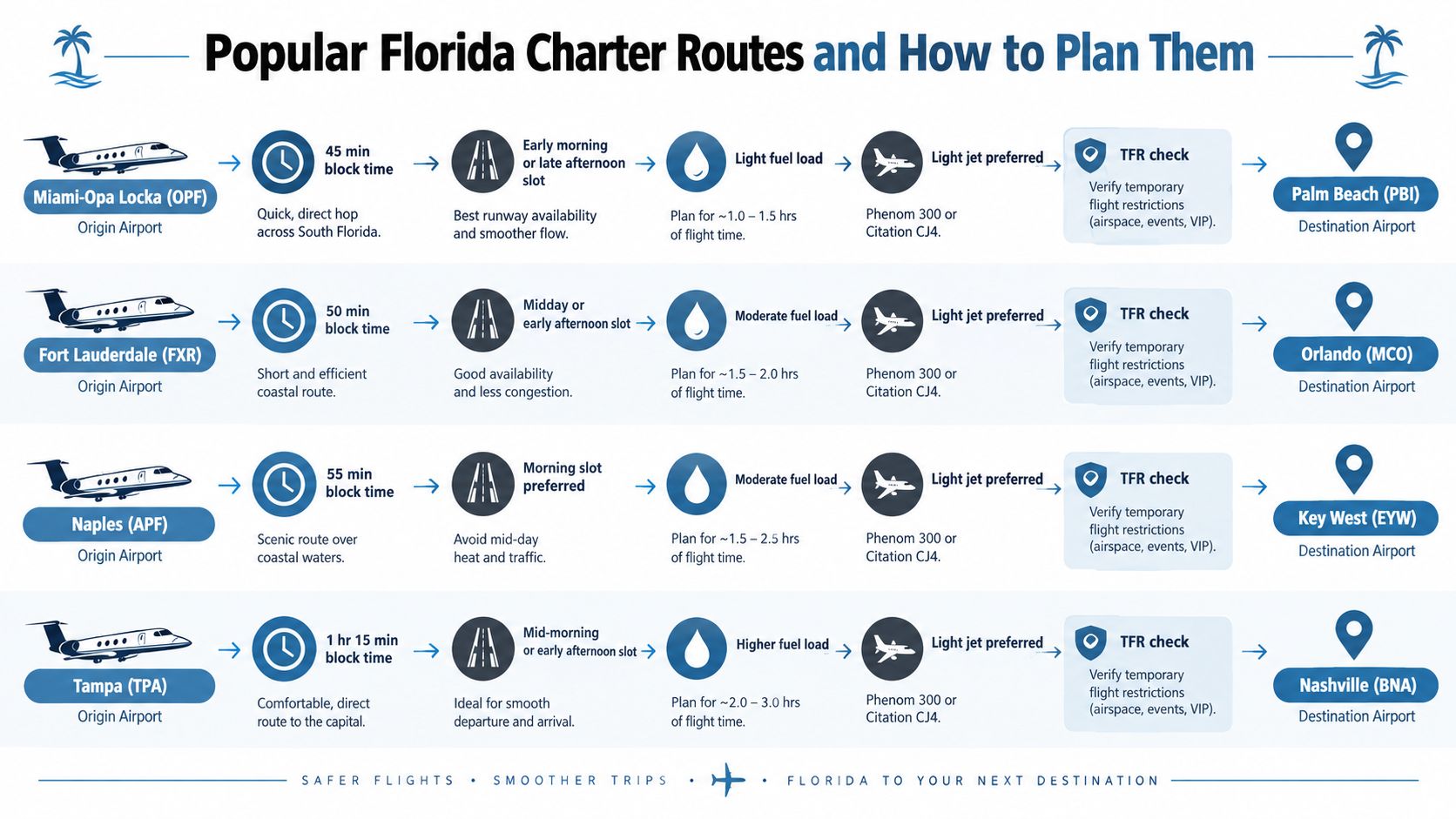
Florida charter desks quote the same corridors repeatedly, but the operational answer changes with the airport and aircraft. Miami-Opa Locka to Palm Beach is a straightforward South Florida hop. Fort Lauderdale to Naples serves the east-to-west coast connection, while Tampa to Key West requires closer attention to aircraft performance, fuel, and weather.
Orlando to the Panhandle is a different mission from Orlando to Miami. A light or very light jet can suit the shorter route, while a super-midsize aircraft may be more comfortable when the group carries substantial baggage or wants a larger cabin for a longer block time.
International planning changes the sequence
For the Bahamas, Fort Lauderdale Executive to Nassau is a common private route. Miami to Marsh Harbour serves Abaco, while Chub Cay and Eleuthera require the same disciplined review of customs, airport hours, fuel, and aircraft capability.
Providenciales is the primary Turks and Caicos gateway. A heavy jet may still require a fuel-stop analysis depending on its origin, payload, and routing. Don't assume that a larger aircraft automatically eliminates every operational stop.
Before confirming an international itinerary, ask your advisor to verify:
- Departure timing: Confirm any airport slot or ramp constraints before selecting a preferred departure minute.
- Customs process: Determine whether the trip can use pre-clearance arrangements or requires island-side clearance.
- Documents: Check passport validity, passenger manifests, and any pet or special-cargo paperwork.
- Airspace: Western Caribbean routings may require overflight permits or a review of Cuban overflight requirements.
- Fuel planning: Ask how payload, weather, reserves, and destination fuel availability affect the aircraft choice.
The best quote is the one that includes the complete operational plan. A nominally faster aircraft may be less convenient if it needs a fuel stop, lacks the required customs arrangement, or departs from an FBO far from your ground transportation.
Seasonal Demand and Timing Your Florida Flight
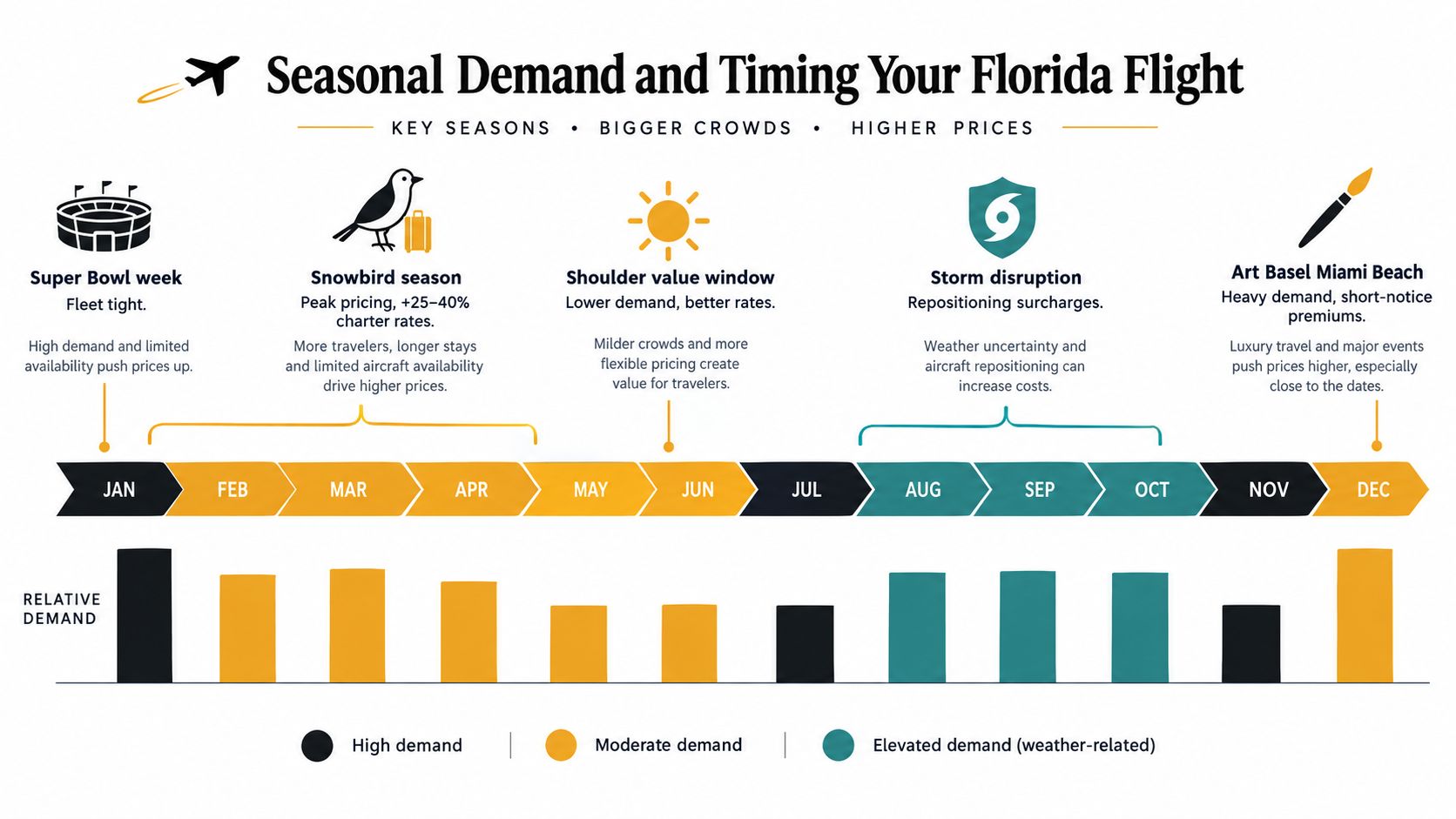
Florida's calendar affects availability in ways that go beyond the simple winter-versus-summer story. Snowbird arrivals from December through April put pressure on aircraft in Miami, Palm Beach, Naples, and other warm-weather destinations. Art Basel Miami Beach in early December, Miami F1 weekend, the rotating Super Bowl schedule, Fort Lauderdale's yacht show season, and college bowl travel through Orlando and Tampa can all compress availability around specific dates.
Book event travel early. For Art Basel and F1, I recommend starting the search six to nine months ahead, especially if you need a particular cabin, tail number, or airport. Short-notice requests can still work, but you'll have fewer choices and may pay for an aircraft positioned farther from your departure point.
Weather belongs in the quote conversation
The hurricane window from mid-August through October introduces a different kind of risk. Operators may reposition aircraft to safer bases, add operational legs, or adjust the itinerary around storm systems. That can affect both availability and the final quote, even when the weather at your departure city appears calm.
Shoulder periods, particularly late April through early June and November, can open more room for planning in Naples, Sarasota, and Key West. Demand may soften, and aircraft basing can improve. For those routes, flexible departure dates often matter more than chasing a nominal hourly discount.
My timing advice is straightforward:
- Event travel: Reserve well ahead and protect the aircraft category you need.
- Hurricane season: Choose flexible cancellation terms and expect weather-driven changes.
- Shoulder weeks: Target them for Naples and Panhandle trips when local basing may produce a cleaner quote.
- Winter travel: Confirm the aircraft location before accepting a low headline rate.
Booking Checklist and Safety Standards for Florida Charters
A polished cabin and familiar broker name don't establish whether a charter is a sound booking. Ask who operates the aircraft, which certificate covers the flight, where the aircraft is based, and which FBO will handle you at both ends.
Paramount Business Jets states that flights to and from Fort Lauderdale Executive are operated by certified direct air carriers meeting FAA Part 135 and Part 121 standards, or foreign equivalents, and that it uses ARGUS third-party safety checks for operators, aircraft, and crews before each flight, as described in its Fort Lauderdale Executive safety information.
Verify the operator and aircraft
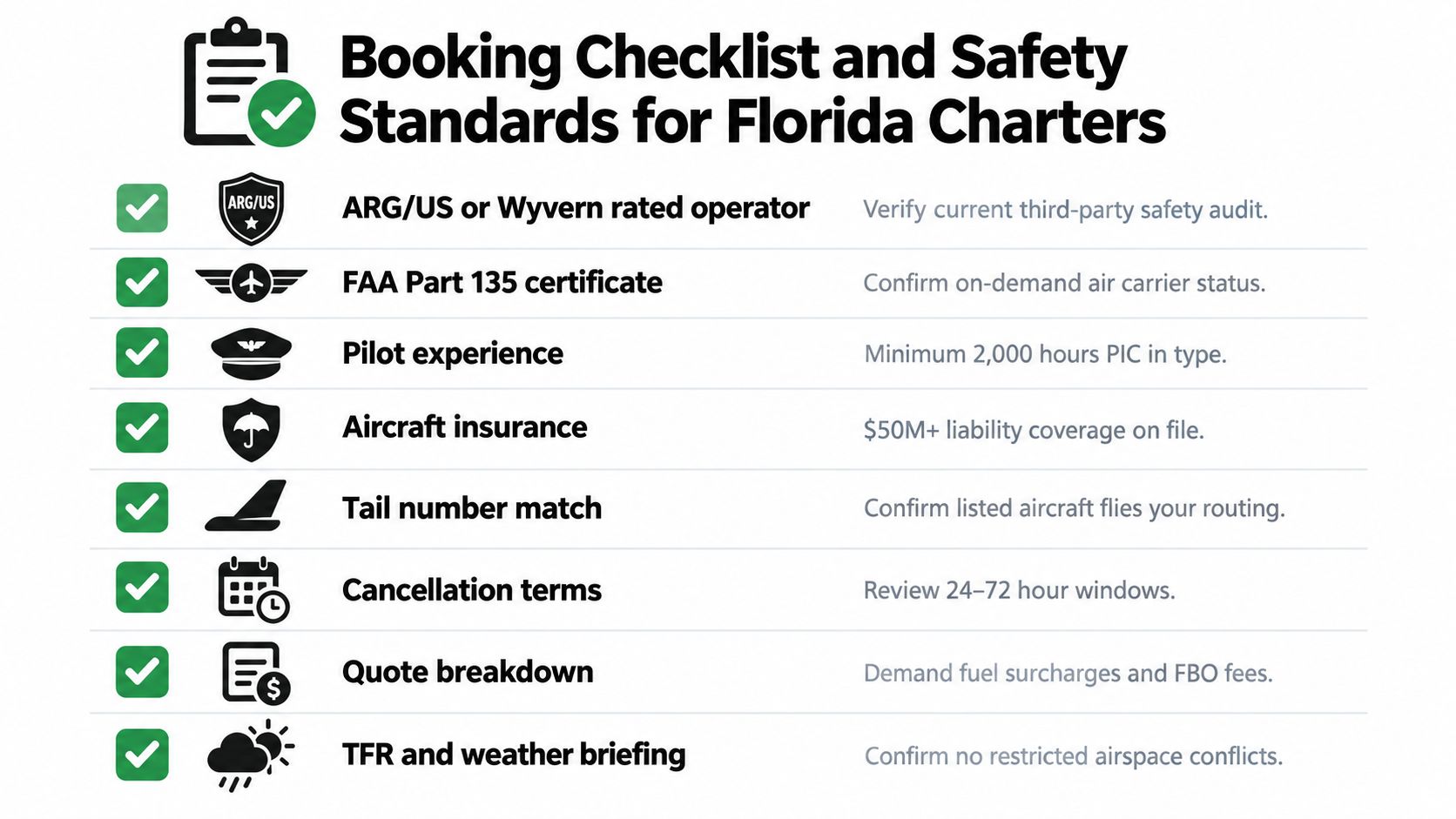
Use this checklist before signing:
- Safety audit: Ask whether the operator currently holds an ARGUS or Wyvern rating, and request confirmation rather than accepting a logo alone.
- FAA authority: Confirm the direct air carrier's FAA Part 135 certificate for on-demand charter.
- Aircraft identity: Require the specific tail number, year, model, cabin configuration, and actual operator.
- Crew information: Ask for crew qualifications and the operating crew assigned to your flight when available.
- Insurance: Request written confirmation of the operator's liability coverage and any limits required by your organization.
Haute Jets can be considered as one booking option for this process. It sources aircraft from owner-operators, provides access to 3,500+ aircraft across 175 countries, and limits its network to operators with Wyvern Wingman or Argus Gold or Platinum ratings, according to the publisher's service information. The practical value is the ability to compare aircraft basing and operator credentials in one conversation, not a reason to skip your own verification.
Demand an itemized trip plan
Your agreement should separate the aircraft rate from fuel surcharges, federal excise tax, passenger segment fees, FBO handling, landing charges, catering, overnight crew costs, and repositioning. Confirm whether the assigned FBO is Signature Flight Support, Atlantic Aviation, Banyan, Jet Aviation, or another facility, then verify ramp access, customs arrangements, parking, and ground transportation.
For Bahamas trips, confirm customs and immigration procedures at OPF or FXE before departure. For every international leg, review passport validity and passenger documentation. If you're traveling with a pet, ask for the airline and destination requirements in writing, and complete the final review of cancellation, weather, and schedule-change terms before payment.
Before flight day, confirm the tail number, crew, FBO address, departure time, passenger manifest, weather plan, ground car, catering, and international documents. That final call prevents the most avoidable surprises.
Haute Jets helps clients compare Florida aircraft by actual basing, airport fit, cabin requirements, and operator credentials instead of relying on a generic hourly rate. Visit Haute Jets to request a customized quote for your Miami, Palm Beach, Naples, Orlando, Gulf Coast, Bahamas, or Turks and Caicos itinerary.