

Private aviation is no longer defined by how wealthy a passenger is. It's defined by how much time, schedule control, and operational certainty that passenger needs. The market now spans occasional charter travelers, corporate teams, fractional owners, jet-card members, and companies managing aircraft fleets, each with very different economics.
The mistake most buyers make is treating private flying as one product. It isn't. On-demand charter, jet cards, fractional ownership, and full ownership solve different problems, and choosing the wrong one can cost far more than the flight itself. This guide breaks down the market, the true cost drivers, safety audits, booking process, and the access model that makes sense for the way you fly.
Why Private Aviation Is No Longer Just a Luxury
Private aviation has become a functioning tier of global transport, not merely an occasional indulgence. One independent market summary valued the global private aircraft market at $36.8 billion in 2025, with North America representing 41.3% of revenue, Europe 26.8%, and Asia Pacific 19.4%. The same summary projects the market to reach approximately $68.4 billion by 2034, at a 7.1% CAGR. Those figures come from the private aircraft market summary.
The point isn't that every traveler should fly privately. Most shouldn't. The point is that the sector now operates at a scale where private flying functions as a serious mobility option for executives, entrepreneurs, production teams, families, and companies whose schedules don't fit commercial networks.
A global fleet estimated at approximately 24,270 aircraft in 2026 and flight activity running 32% above pre-pandemic norms reinforce that shift, according to the same market summary. The United States holds nearly 65% of registered private aircraft fleets in one report, which explains why local aircraft availability and repositioning economics matter so much to American travelers.
The blunt version: private aviation isn't cheap transportation. It can be rational transportation when the cost of delay, missed meetings, lost production time, or commercial routing exceeds the charter premium.
Why first-time flyers are entering the market
Commercial fares, reduced loyalty-program value, limited nonstop routes, and demanding schedules have pushed more senior executives and small teams to evaluate charter as a business expense. A private flight can also reach airports closer to a final destination, avoid commercial connection points, and preserve a workday that would otherwise disappear in transit.
That doesn't make every quote good value. A badly sourced aircraft, an unnecessary repositioning leg, or a membership commitment can erase the financial logic quickly. Travelers researching the point-to-point advantages of private transport can also review this explanation of point-to-point private transportation, especially when comparing private aviation with commercial routing.
The practical question is therefore not, “Can I afford a private jet?” It is, “Which access model matches my flying pattern?” The answer may be a single on-demand charter, a prepaid jet card, a fractional share, or, for a small group of heavy users, a wholly owned aircraft.
How Private Aviation Became a Global Mobility System
The modern business-aviation era began with aircraft designed around executive travel rather than adapted from another mission. The Lockheed JetStar debuted in 1957 as one of the first aircraft built specifically for executive transport, a milestone recorded in this history of business aviation milestones.
Early corporate aviation centered on bespoke aircraft and dedicated flight departments. Ownership meant control, but it also meant paying for an aircraft whether it was flying or sitting on the ramp. That limitation created the opening for shared access.
In 1986, Richard Santulli launched what became NetJets, described in the same industry history as the first practical and effective fractional-share jet operation. Fractional ownership separated access from full aircraft control. Several customers could participate in the economics of one aircraft, while a centralized operator managed scheduling, crew, maintenance, and compliance.
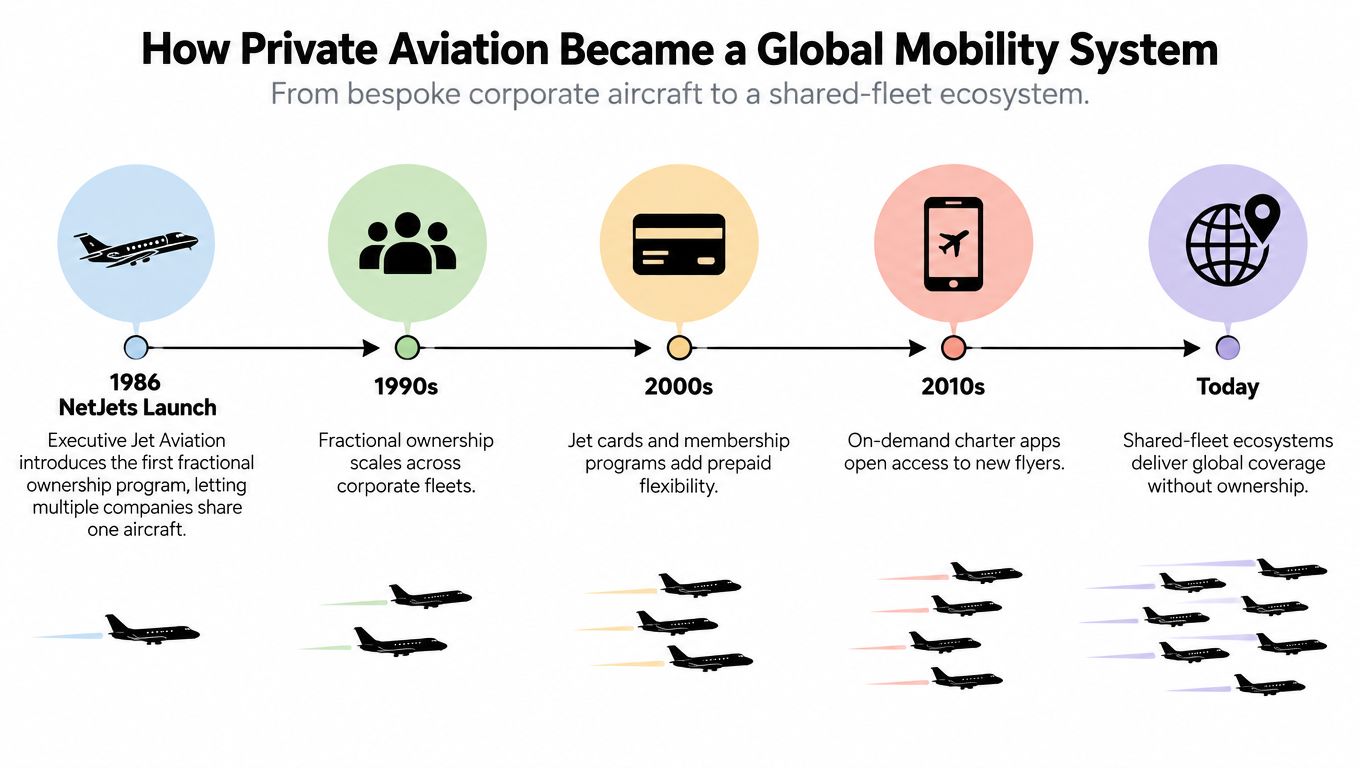
From aircraft ownership to shared inventory
The fractional model changed the buyer's question from “Which aircraft should I own?” to “How much access do I need?” That distinction still separates a rational purchase from an expensive status decision.
The market later developed jet cards, memberships, charter brokerages, operator marketplaces, and digital booking tools. Those layers made fragmented aircraft inventory easier to search and compare. A traveler no longer needed a personal flight department to identify every suitable operator, aircraft, and departure airport.
The economics also shifted toward shared fleets. One investment-banking summary cited in the industry history says 40% of the world's 446,000 private jets are now held by private aviation companies rather than individual owners. The exact figure depends on how the market defines private jets and company ownership, but the underlying direction is clear. More aircraft are being deployed as managed capacity rather than sitting permanently with one owner.
Today, operators reposition aircraft across regions to meet demand, while brokers and platforms match travelers with available inventory. Private aviation has become an on-demand mobility system, but the traveler still pays for the inefficiencies hidden inside that system when an aircraft must travel empty to reach the departure city.
The Four Ways to Access a Private Jet
The four main models are not interchangeable. They differ in capital commitment, scheduling control, aircraft choice, exposure to repositioning, and tolerance for unused capacity.
| Model | Capital Required | Typical Hourly Cost | Availability | Best For |
|---|---|---|---|---|
| On-demand charter | None beyond the booked trip | Quote varies by aircraft, route, and operating conditions | Flexible, subject to inventory | Occasional or variable flyers |
| Jet card | Prepaid commitment | Contracted or program-based rate, subject to terms | Program-dependent | Frequent travelers who value budgeting |
| Fractional ownership | Share purchase plus ongoing fees | Share, management, and occupied-flight economics | Structured access to a managed fleet | Consistent high-frequency users |
| Full ownership | Aircraft acquisition plus major operating expenses | Depends on utilization and total ownership cost | Maximum control | Heavy users with stable, bespoke missions |
On-demand charter
Charter is priced per trip. You select the route, date, passenger count, aircraft category, and service requirements, then pay for that flight without buying an asset or prepaying a block of hours.
This is usually the strongest starting point for travelers with variable schedules. You can choose a light jet for a short regional route, a super-midsize aircraft for a longer trip, or a heavy jet when cabin space and range matter. You aren't locked into the same fleet or aircraft category.
A local aircraft is critical. If the selected aircraft is already near the departure airport, you may avoid a costly repositioning leg. If it must fly in from another region, that empty movement can become part of your quote.
Jet cards
Jet cards trade flexibility for predictability. You prepay for access or hours, then use the program's aircraft and scheduling rules. This can simplify budgeting and provide a defined service standard, but the contract may limit aircraft choice, peak-day availability, cancellation rights, and geographic coverage.
A jet card is useful when your trips are frequent and reasonably predictable. It is a poor fit when your destinations change constantly or when you want to compare the open market for every flight.
Fractional ownership
Fractional ownership buys a share of a specific aircraft or fleet and adds management, maintenance, crew, and operational obligations. It can provide structured access and consistency, but the owner pays for access even during periods of low utilization.
This model makes sense when the buyer flies frequently, values predictable access, and expects to maintain the arrangement over multiple years. It shouldn't be purchased because ownership sounds more prestigious than charter.
Full ownership
Whole-aircraft ownership offers the most control, including cabin configuration, crew standards, operating policy, and aircraft positioning. It also carries depreciation, insurance, hangar, maintenance, crew, management, and compliance costs.
Full ownership only works when utilization, mission consistency, and control requirements justify those fixed expenses. For most high-net-worth individuals and corporate teams, charter or a carefully evaluated jet card is the more disciplined first move. Compare actual flying behavior before buying access you may not use.
For a closer look at program economics, review this breakdown of private jet membership cost.
What Actually Drives the Cost of a Private Flight
A charter quote is not an hourly aircraft rate multiplied by flight time. The final price can include occupied flight hours, aircraft repositioning, fuel-related charges, federal excise tax, segment fees, crew expenses, overnight costs, catering, ground handling, de-icing, international handling, and airport charges.
The first number to identify is the occupied hourly rate, which covers the time passengers are on board. Then ask whether the quote includes the aircraft's movement to the departure airport and its return or onward positioning. A broker may show an attractive occupied rate while passing repositioning costs through elsewhere in the estimate.
Empty-leg pricing demonstrates why aircraft class and route length matter. One industry-tracked marketplace reported a median empty-leg price of $8,600, with 75% of flights under $10,000. The same source recorded examples ranging from $1,505 for a short turboprop trip to $34,400 for a heavy-jet crossing. Those figures are detailed in this empty-leg pricing analysis.
| Aircraft Class | Occupied Hourly Rate (USD) | Typical Empty-Leg Range (USD) | Best Stage Length |
|---|---|---|---|
| Turboprop | Route-specific quote | Can be comparatively low on short repositioning sectors | Short regional trips |
| Light jet | Route-specific quote | Varies sharply with positioning demand | Short to medium routes |
| Midsize or super-midsize jet | Route-specific quote | Increases with aircraft size and stage length | Regional and longer domestic trips |
| Heavy or ultra-long-range jet | Route-specific quote | Can reach the high end of marketplace ranges | Long-haul and transcontinental routes |
How to sanity-check a quote
Ask five direct questions before comparing prices:
- What aircraft is assigned? Get the make, model, year, tail number when available, and cabin configuration.
- Where is the aircraft based? A nearby aircraft may eliminate a repositioning leg.
- What fees are included? Confirm taxes, catering, ground handling, crew expenses, and overnight charges.
- What can change before departure? Review substitution, cancellation, weather, and mechanical-delay terms.
- Who controls the operator relationship? You need a clearly identified carrier and accountable trip manager.
Two identical-looking itineraries can produce very different quotes because one aircraft is already local while the other must travel empty before collecting passengers. Local sourcing is often more valuable than a small discount on the published hourly rate.
For a broader explanation of private jet charter cost, focus on the total trip price rather than the headline hourly figure. That is the number that affects your decision.
Why Safety Audits Matter More Than Marketing Claims
FAA Part 135 certification sets the legal operating floor for a charter carrier. It does not show that every operator maintains the same standard of pilot training, maintenance discipline, safety-management maturity, operational history, or internal reporting. Treat the certificate as a baseline, not a complete safety assessment.
Independent audits give buyers evidence they cannot obtain from a polished website. Wyvern Wingman and ARGUS Gold or Platinum are voluntary third-party programs that examine operator procedures, pilot training records, maintenance practices, and safety-management systems, as explained in this comparison of ARGUS and Wyvern ratings and close analysis of private aviation safety ratings.
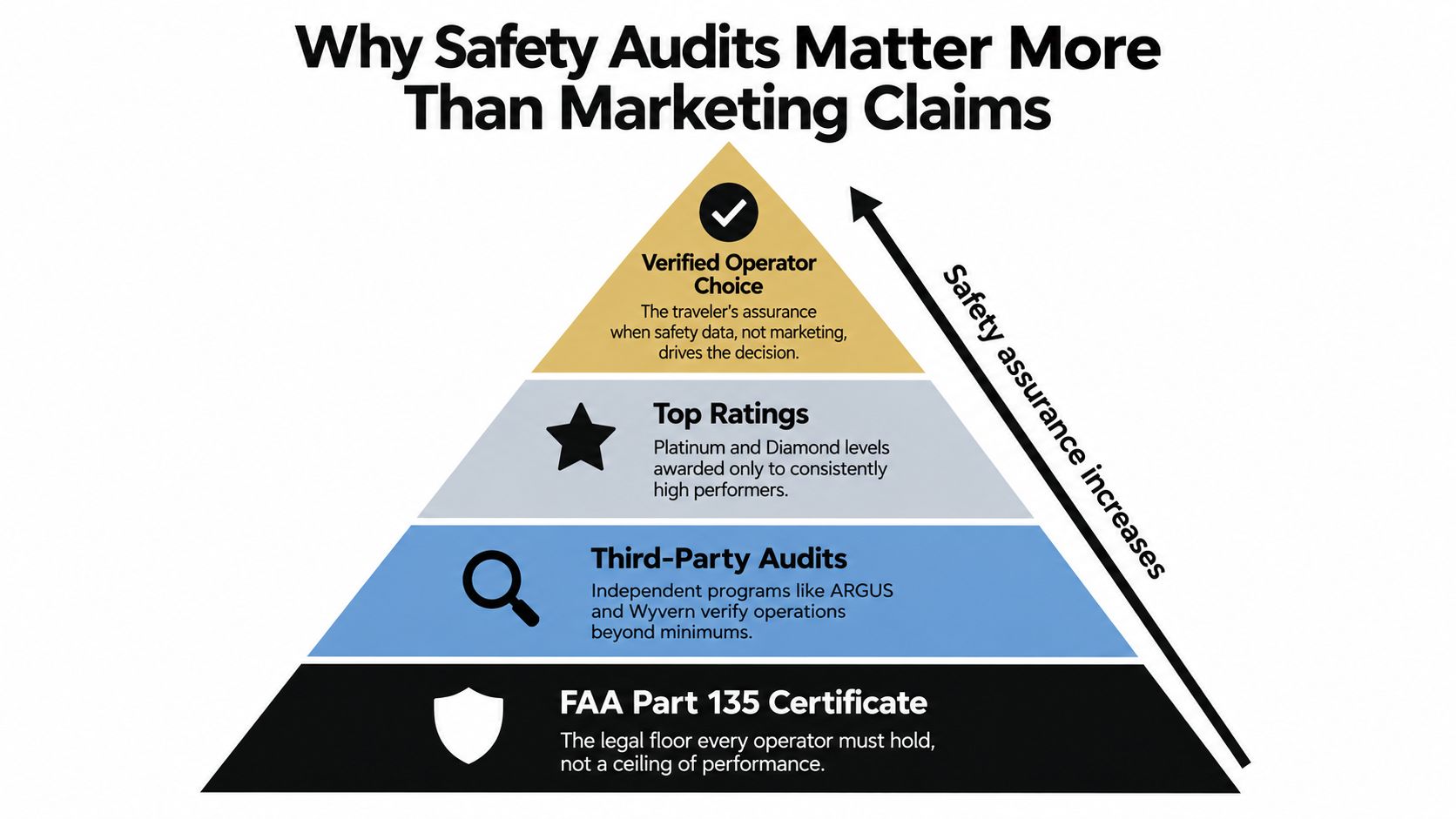
What a serious buyer should request
A credible operator or broker should identify the actual carrier, state its audit status, and provide appropriate documentation. Ask who holds operational control, who supplies the crew, and which entity maintains the aircraft. Those answers matter across every service model, whether you book on-demand charter, use a jet card, or fly through a fractional program.
Higher-tier ratings involve deeper operational review and recurring oversight. They narrow the information gap between a buyer and an operator whose day-to-day performance remains difficult to observe from outside.
Practical rule: If a quote arrives without a clear operator identity and verifiable safety documentation, do not negotiate the price. Discard the quote.
Words such as “premium,” “elite,” and “world-class” reveal nothing about a carrier's safety posture. No audit promises an incident-free flight. What it provides is documented evidence of training discipline, maintenance practice, and safety-management maturity.
Review the audit before comparing catering, Wi-Fi, or cabin finish. For on-demand charter, local sourcing can improve both the economics and the transparency of the booking by keeping the responsible carrier visible. A cheaper aircraft from an opaque source is no saving when you cannot establish who operates your flight.
How to Book a Private Jet From Inquiry to Wheels Up
A well-managed charter should feel simple to the passenger, but several decisions happen behind the scenes. The smoother the process, the more clearly each responsibility is assigned.
Submit the trip request. Provide departure and arrival airports, dates, passenger count, luggage, pets, preferred aircraft class, and any special requirements. Exact airport information matters because a nearby alternate airport may offer better aircraft availability.
Compare complete quotes. Don't compare hourly rates alone. Review the aircraft, operator, positioning, taxes, fees, cancellation terms, and what happens if the aircraft changes.
Execute the agreement. The contract should identify the carrier, payment schedule, itinerary, passenger obligations, cancellation policy, and substitution rights. Never transfer funds against a vague invoice.
Confirm the flight before departure. The final confirmation should include the assigned aircraft, crew information, passenger manifest, weather review, catering, ground transport, and departure FBO, making any unresolved details visible.
The 24-hour pre-flight window is especially important. Aircraft and crew should be locked, operational documentation reviewed, weather and NOTAMs checked, and any substitution presented for client approval rather than treated as a surprise at the terminal.
Same-day travel can work when the aircraft and crew are already positioned nearby. Larger aircraft and longer missions generally require more coordination, especially when international permits, crew duty limits, handling arrangements, or repositioning are involved.
The ground experience
Your trip manager should coordinate the FBO, vehicle access, catering, luggage, pets, international documentation, and departure instructions. A private terminal is not a substitute for clear communication.
Arrive with enough time for the FBO's process, even though private aviation usually avoids the long airport routine associated with commercial travel. Confirm the exact terminal, parking instructions, passenger names, baggage limits, and contact number in writing.
Who Flights Privately and Why the Use Cases Differ
A family flying for a weekend escape has almost nothing in common operationally with a corporate team moving between meetings or a production company transporting people and equipment. Treating all three as generic “private flyers” leads to poor aircraft selection and unnecessary cost.
High-net-worth individuals and families
Families usually value discretion, schedule control, direct access to smaller airports, and a cabin that accommodates children, luggage, or pets. Their travel dates may be flexible, but the itinerary often includes destinations that commercial airlines serve poorly.
For this group, on-demand charter is usually more sensible than ownership. The family can select a light jet for a short trip, a midsize aircraft for additional luggage and comfort, or a larger cabin when the route and passenger count justify it.
Corporate travelers
Corporate travel managers care about more than comfort. They need reliable scheduling, multi-city efficiency, appropriate baggage capacity, secure communications, and a clear process for changes. A single trip may involve several meetings that cannot be connected efficiently through commercial schedules.
A corporate buyer should evaluate whether the same aircraft category is genuinely needed for every mission. Buying a fixed access product can be wasteful if one trip needs a light jet and another requires a larger aircraft. Charter allows the company to match aircraft to mission, while a jet card may help when repetition and budget predictability outweigh aircraft choice.
Entertainment and production teams
Entertainment clients often need rapid schedule changes, multiple staging airports, confidential passenger manifests, and space for specialized equipment. The aircraft is only one component. Ground coordination, passenger privacy, replacement options, and communication discipline matter just as much.
| Traveler Segment | Annual Hours | Typical Stage Length | Preferred Aircraft Class | Key Driver |
|---|---|---|---|---|
| HNWI family | Occasional to moderate use | Short and medium routes | Light, midsize, or super-midsize | Privacy and schedule control |
| Corporate team | Moderate to heavy use | Regional, domestic, and international | Mission-dependent | Multi-city efficiency |
| Entertainment production | Irregular and event-driven | Short, medium, and long routes | Flexible cabin and baggage fit | Confidentiality and rapid changes |
The common thread is not aircraft size. It is mission variability. That is why on-demand charter remains the most adaptable model for travelers whose routes, passenger counts, and timing change from trip to trip.
Choosing the Right Model for the Way You Fly
The correct access model depends on utilization, predictability, peak-day requirements, route profile, and tolerance for operational constraints. Status should have nothing to do with it.
Use this decision framework:
- Occasional flying with variable dates: Start with on-demand charter. You avoid capital commitments and can select the aircraft that fits each mission.
- Frequent, predictable flying: Evaluate a jet card or membership, but compare its restrictions with your actual routes and cancellation behavior.
- Consistent high utilization: Consider fractional ownership if you need structured access, a managed fleet, and a multi-year commitment.
- Very heavy use with bespoke requirements: Analyze whole ownership only after modeling every fixed and variable cost.
The thresholds often used in industry conversations should be treated as decision guides, not laws. The right answer changes when peak-day availability, international range, cabin configuration, pets, equipment, or multi-city scheduling becomes important.
The overlooked value of local aircraft
A locally sourced aircraft can materially change the economics of charter. If the aircraft is already near your departure city, the quote may avoid a repositioning movement. If it must be flown in from elsewhere, the aircraft's empty travel becomes part of the commercial calculation.
Buyers should challenge broad claims about charter being expensive or jet cards being predictable. The comparison is a complete quote for the actual mission, not a brochure rate. Market conditions can also change by aircraft class and route. Recent coverage identified a shift toward larger aircraft and longer stage lengths, with super-midsize activity up about 25% year over year, while North American flight hours rose only 0.3% in August 2026, according to this private aviation market analysis. That mix change can affect local availability even when overall demand appears flat.
On-demand charter remains my default recommendation for a first private flight. After you have a meaningful record of your actual routes, dates, aircraft preferences, and total spend, benchmark a jet card against that history. Consider fractional ownership only when consistent utilization and guaranteed access justify the commitment. Whole ownership belongs at the end of that analysis, not the beginning.
Haute Jets arranges on-demand private jet charter without requiring a membership or jet card, sourcing from 3,500+ aircraft across 175 countries and focusing on Wyvern Wingman and ARGUS Gold or Platinum-rated operators. If you want a quote built around local aircraft availability, exact aircraft selection, and transparent pre-flight details, visit Haute Jets and request an itinerary review.