

Private jet fees almost always run 20% to 120% above the quoted hourly rate once positioning, landing, crew, fuel, and taxes are added. The cheapest quote is rarely the cheapest flight.
That gap is where private aviation invoices become expensive. A broker can advertise an attractive hourly figure, but the aircraft still has to reach your departure airport, use an FBO, carry a crew, meet fuel and weather requirements, and comply with applicable taxes. The product isn't the hourly rate. It's the fully loaded quote, with every pass-through charge identified before you authorize the trip.
For readers of Haute Jets Journal, the practical rule is simple: compare total invoices, not headline rates. Aircraft class matters, but route structure and aircraft location often matter more.
What You Actually Pay for a Private Jet
A charter quote usually starts with occupied flight time. It may then add repositioning, landing and handling, crew expenses, fuel surcharges, de-icing, catering, and taxes. On domestic trips, these pass-through items commonly increase the invoice by about 25% to 35%, while broader charter analyses place the possible increase at 20% to 120% when positioning and operational complexity are substantial. See the 2026 private jet cost breakdown for the way these charges stack.
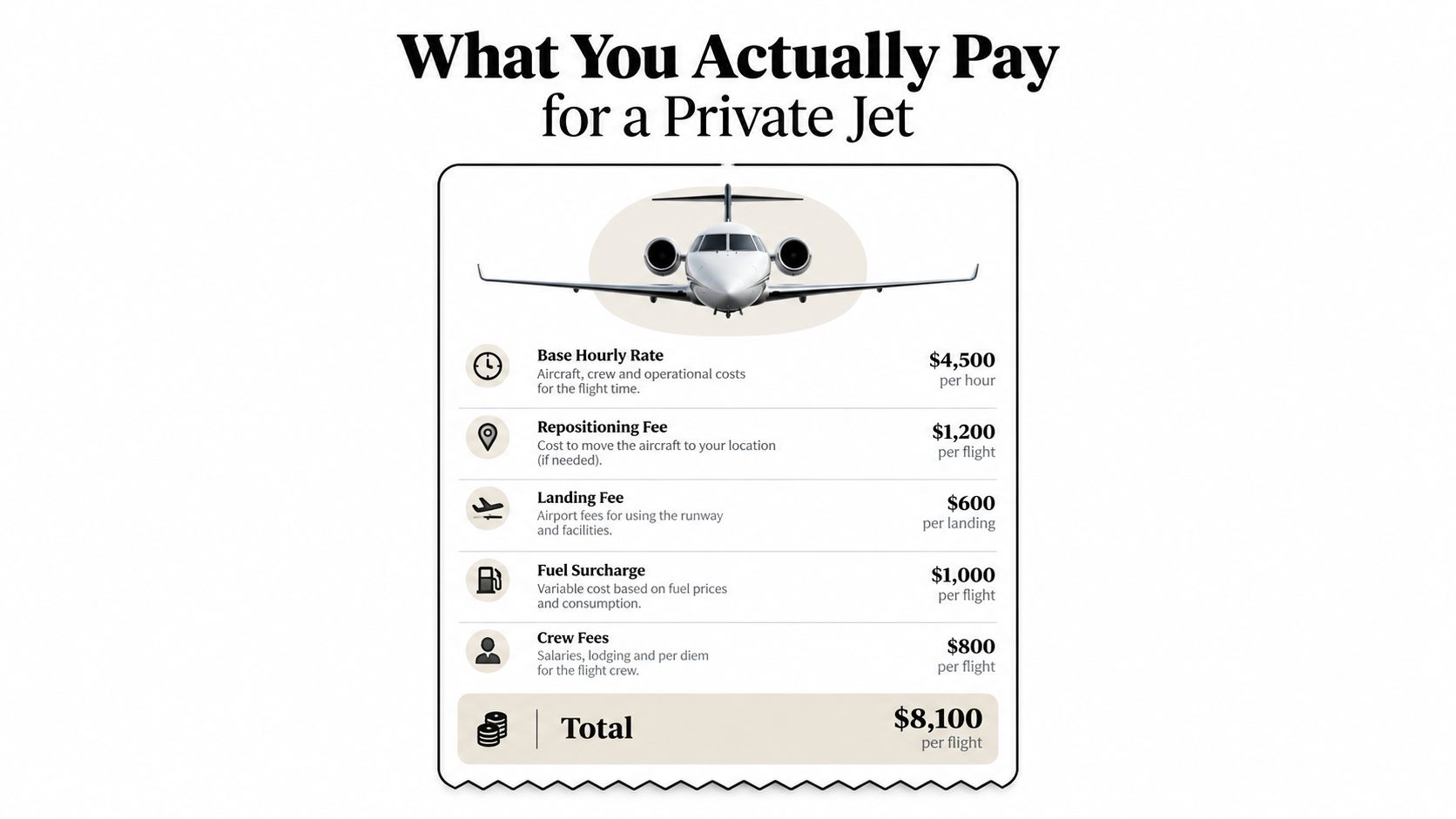
The invoice stack
A typical quote can contain:
- Base flight time: The aircraft's occupied block time, usually calculated from engine start to shutdown.
- Positioning: Empty flying required to bring the aircraft to you or return it to base.
- Airport charges: Landing, ramp, parking, and FBO handling costs.
- Crew expenses: Overnight accommodation, meals, transport, and duty-related costs.
- Fuel adjustments: Surcharges applied when fuel assumptions or route conditions change.
- Winter operations: De-icing or related cold-weather services when required.
- Taxes and services: Federal excise tax, domestic segment charges, catering, and other requested services.
Consider a hypothetical light jet quoted at $4,500 per hour for a 2-hour leg. The occupied flight portion is $9,000. Once a positioning leg, two FBO visits, crew return, fuel, and federal excise tax are layered on, the all-in invoice can reach $11,000 to $16,000. That example illustrates the central problem, but it shouldn't be treated as a universal price. Aircraft location, route, timing, and operator terms determine the actual result.
Practical rule: Ask for a fixed, itemized total before comparing operators. A low hourly rate with vague pass-throughs isn't a low quote.
Hourly Rates by Aircraft Class
Aircraft category sets the baseline for nearly every other fee. A very light jet consumes fewer resources than an ultra-long-range aircraft, and the difference appears in flight time, fuel, crew requirements, airport handling, and minimums.
The broad market commonly sits around $2,750 to $14,000 per flight hour, depending on aircraft class, according to published 2026 charter rate bands. Another market guide places light jets around €3,000 to €5,000 per hour and ultra-long-range aircraft around €22,000 per hour, while warning that hourly figures exclude daily minimums and operational additions. These ranges aren't contradictory. They reflect different fleets, markets, currencies, and quoting practices.
2026 hourly charter rates by aircraft class
| Class | Low /hr | High /hr | Representative Aircraft |
|---|---|---|---|
| Very light jet | $2,750 | $3,500 | Phenom 100 |
| Light jet | $2,900 | $3,500 | Citation CJ3+ |
| Midsize jet | $4,300 | $4,750 | Citation Latitude, Hawker 900XP |
| Super-midsize jet | $5,100 | $6,500 | Challenger 350 |
| Large jet | $7,200 | $9,500 | Gulfstream G450 |
| Ultra-long-range jet | $10,000 | $14,000 | Global 6000 |
These are occupied flight-hour bands, not guaranteed trip totals. Private jet cost-per-hour guidance is useful for establishing a baseline, but the route still determines how much time the aircraft flies empty, where it parks, and which FBO handles the passengers.
The smallest and largest categories in the cited market bands differ by roughly four times at the hourly level. That makes aircraft selection the first serious cost decision. Don't pay for a super-midsize cabin when a light or midsize aircraft meets the route, baggage, runway, and passenger requirements. Conversely, choosing a smaller aircraft that can't complete the itinerary efficiently can create an expensive aircraft swap or additional operational complexity.
Published rates also vary by operator, fleet age, availability, and market conditions. The lowest figure in a category may reflect an older aircraft, limited availability, or a quote that excludes more items than its competitors. Price should be reviewed alongside the operator's safety credentials, aircraft age, cabin configuration, and cancellation terms.
Repositioning and Deadhead Fees
Repositioning is the fee most likely to distort a short charter. The aircraft may be based in another city, so it must fly empty to collect you. The operator still pays for fuel, crew time, landing, handling, and maintenance-hour costs, then bills the movement to the passenger.
Independent aviation explanations place repositioning at roughly 20% to 50% of a short-trip total, while broader analyses say positioning charges can increase an invoice by 30% to 100%, depending on the aircraft's location and route. Some itineraries add roughly one to three billable hours for empty sectors. The operator generally bills that movement using the aircraft's standard hourly rate.
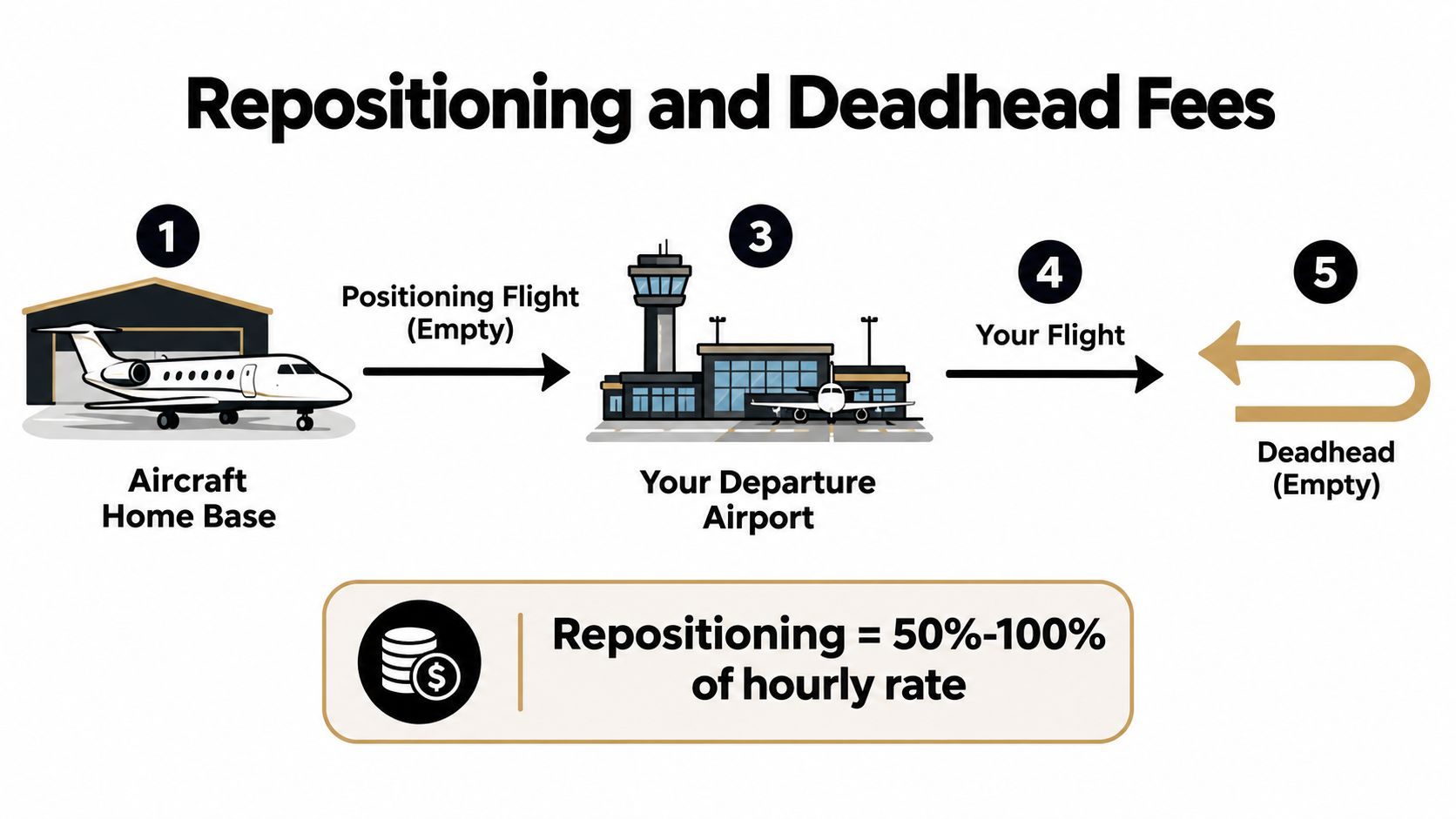
Why short trips suffer most
Suppose a light jet is sitting in Denver and must reach Aspen before taking passengers to the West Coast. A 2.5-hour deadhead from Denver could add $2,500 to $5,000 before the passenger flight begins, based on the scenario's stated assumptions. Ferry fuel, crew expenses, and airport services still apply to that empty sector.
On a same-day round trip from a city where suitable aircraft are already based, repositioning may be limited or absent. On a one-way flight from a remote or seasonal market, it can equal or exceed the occupied flight cost. That's why comparing two hourly rates without asking for aircraft location produces misleading results.
The cheapest hourly quote can become the most expensive itinerary when the aircraft starts several hours away.
The structural fix
You can't negotiate geography away. The reliable solution is local sourcing, meaning the operator or broker finds an aircraft already near the departure airport. Proximity can eliminate the deadhead leg entirely and reduce quote volatility before any discussion of catering or cabin upgrades.
Ask three direct questions:
- Where is the proposed aircraft based before departure?
- Is the positioning leg included in the quoted total?
- Is a return-to-base or post-trip deadhead included?
An answer that only says “positioning included” isn't enough. You need the number of positioning hours, the airports involved, and confirmation that the same aircraft isn't being charged twice under separate line items.
Landing, Handling, Crew, and Seasonal Fees
Pass-through charges can add 25% to 120% to the headline aircraft rate. The aircraft must land, the FBO must service it, the crew may need accommodation, and weather can require de-icing. These costs are legitimate, but an incomplete quote makes the final invoice difficult to audit.
Domestic landing and handling typically range from $150 to $3,000 per sector. Premium international FBO handling can reach $2,500 to $5,000. Fuel surcharges commonly run around $200 to $800 per flight hour when the operator's fuel assumptions are exceeded. This explanation of charter quote components helps separate the base aircraft charge from pass-through costs.
The line items that deserve scrutiny
| Fee type | Typical range or trigger | What moves the charge |
|---|---|---|
| Landing and handling | $150 to $3,000 domestic; $2,500 to $5,000 international | Airport, FBO, aircraft size, and number of visits |
| Fuel surcharge | $200 to $800 per flight hour when assumptions are exceeded | Fuel price, aircraft consumption, and operator assumptions |
| Crew overnight | Itinerary dependent | Crew count, number of nights, lodging, meals, and transport |
| De-icing | $500 to $5,000 per departure | Aircraft, airport, weather, and treatment required |
Premium FBOs may charge roughly $500 to $2,000 per visit for handling alone. Check private jet landing fees against every airport and stop on the itinerary, rather than accepting one combined handling estimate.
Winter costs and crew expenses
De-icing creates some of the largest seasonal swings. Winter treatment can cost approximately $500 to $5,000 per departure, depending on the aircraft, airport, and conditions. Operators may apply fluid despite a clear-looking forecast because frost, residual contamination, or a changing temperature profile can affect dispatch requirements.
Crew expenses may cover lodging, meals, local transport, and duty-related costs when the schedule requires an overnight. Confirm the number of crew members, nights, dates, and hotel assumptions. “Crew expenses” without those details is an incomplete line item.
Domestic U.S. charter pricing can include a 7.5% Federal Excise Tax and a $5.30 Domestic Segment Fee per passenger, according to U.S. private jet rental pricing guidance. Ask whether taxes apply to the full taxable amount and whether segment fees are calculated for each passenger.
Request an itemized estimate before payment. It should identify every airport, FBO, handling visit, overnight, fuel assumption, de-icing condition, service charge, and tax. Treat a large “miscellaneous” line as a prompt for clarification, not as a standard private jet fee.
Empty Legs Versus On-Demand Charter
Empty legs can produce meaningful savings, but they're not guaranteed substitutes for on-demand charter. An empty leg exists because an aircraft already needs to move for another passenger or return to base. The route, date, departure time, and aircraft are therefore constrained by an existing operational plan.
Market snapshots show median empty-leg prices around $7,691 across 4,565 listings in one index and approximately $8,600 in another, with 75% of tracked flights under $10,000 for the whole aircraft. Route examples show a light jet from New York to Miami dropping from about $18,500 on standard charter to approximately $5,800 to $8,200 on an empty leg. Los Angeles to Las Vegas examples fall from roughly $9,800 to $2,900 to $4,400. These figures come from empty-leg pricing data and route examples, where listed prices are buyer-facing totals and operator-confirmed quotes may differ.
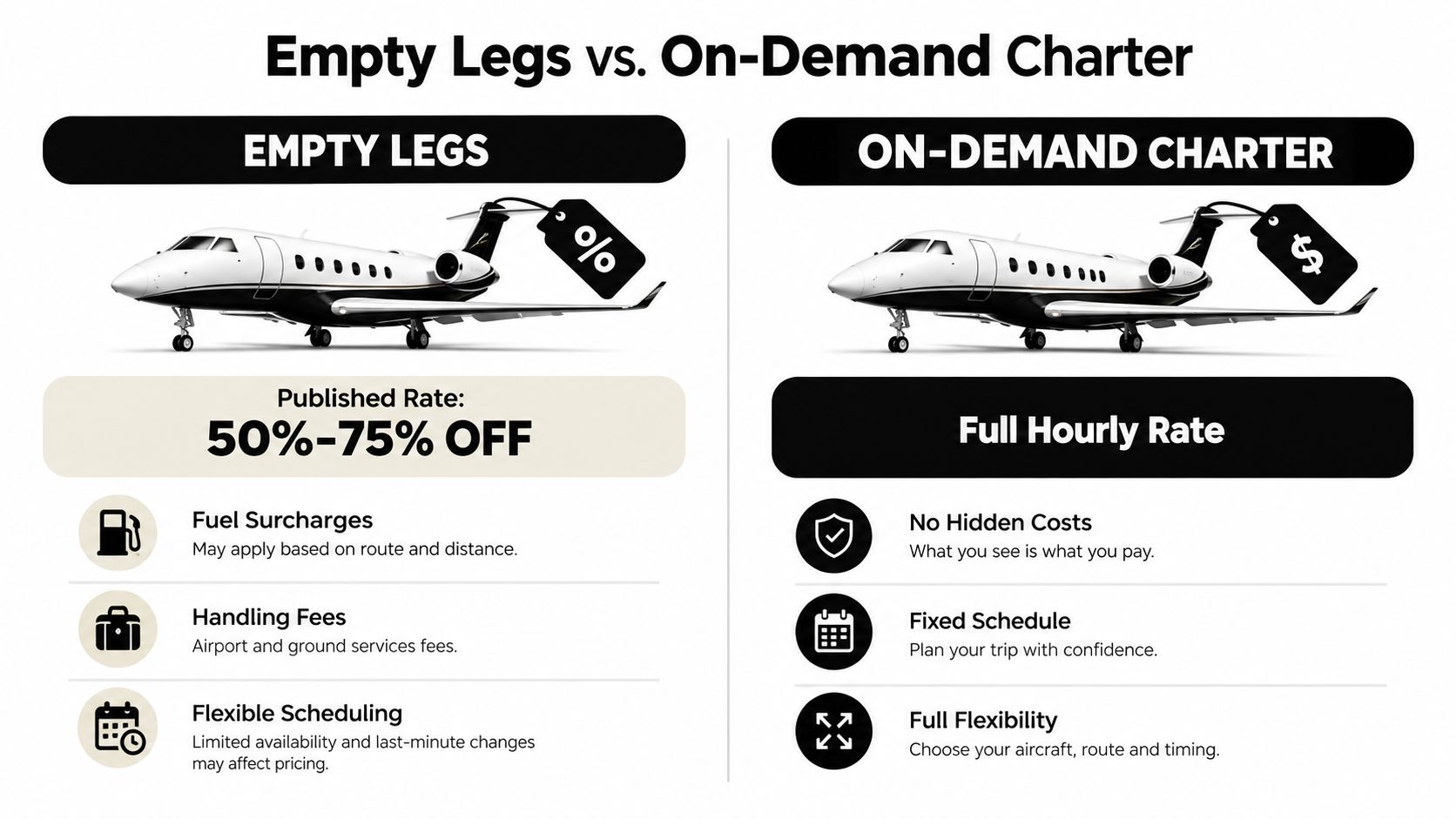
Three practical scenarios
| Situation | Price appeal | Schedule certainty | Recommendation |
|---|---|---|---|
| Confirmed business meeting | Moderate | Low if timing changes | Choose on-demand |
| Flexible leisure trip | High | Acceptable with flexibility | Consider an empty leg |
| Peak holiday departure | Variable | Often difficult | Secure on-demand early |
An empty leg can still carry handling, fuel, de-icing, and other operational charges. The operator may also cancel when the underlying aircraft movement changes, sometimes as late as 24 hours before departure, according to market guidance. That risk matters more than the advertised discount when a meeting, event, or connection is time-sensitive.
Decision rule: If the savings exceed $8,000 and you can shift the trip by a day, an empty leg usually deserves serious consideration. If the schedule is fixed, on-demand charter generally wins once disruption risk and replacement arrangements are included.
Review Haute Jets empty-leg options as inventory rather than as a guaranteed schedule. The right comparison is the confirmed all-in empty-leg price against an on-demand quote, including timing, cancellation terms, and itinerary flexibility.
Smart Ways to Lower Your Private Jet Fees
The strongest savings usually come from changing the operating plan, not negotiating a small reduction in the hourly rate. Start with the aircraft's location, then review airport choice, cabin size, dates, and crew requirements.
Use geography as your first lever
- Source locally: An aircraft already near departure can eliminate the deadhead sector and the related fuel, crew, landing, and handling charges.
- Choose a practical airport: A smaller regional airport may have lower handling costs and less congestion than a major hub, though runway and aircraft requirements still control the decision.
- Match the cabin to the mission: A light or midsize jet can be more efficient when the route, passenger count, baggage, and range allow it.
- Consolidate the itinerary: Combining multiple legs into one duty day can reduce unnecessary crew overnights and aircraft movements.
- Avoid difficult timing: Peak holiday dates and winter weather can increase availability pressure and operational charges.
The verified publisher information states that local sourcing can eliminate repositioning fees that otherwise inflate charter prices by 20% to 40% with traditional brokers and jet card programs. A separate market benchmark says sourcing an aircraft near the departure city can eliminate the deadhead leg entirely. Those are structural savings because they remove a flight sector rather than discounting a line item.
Haute Jets sources aircraft from owner-operators across 175 countries and maintains access to more than 3,500 aircraft, according to its publisher information. Its local-sourcing model is designed to find aircraft near the departure city, while its on-demand structure avoids annual membership fees and prepaid-hour requirements.
Don't optimize only for the lowest aircraft rate. Ask the provider to price two versions of the trip, one using the nearest suitable aircraft and another using the preferred aircraft regardless of location. The difference exposes the cost of convenience and tells you whether the cabin upgrade is worth the positioning expense.
How to Read Any Charter Quote
Read a charter quote like an invoice in progress. Start with the aircraft category, estimated block time, and base hourly rate, then convert every additional line into a percentage of that base. This makes a large positioning charge or vague service fee visible instead of allowing it to disappear inside the total.
The 60-second verification routine
- Confirm the aircraft: Check the category, year, model, cabin layout, and tail number if available.
- Verify the time: Ask whether the estimate uses occupied time or total block time.
- Challenge positioning: Identify every empty sector and confirm it appears only once.
- List the airports: Request the departure, arrival, and FBO names for every movement.
- Check crew costs: Match overnight counts to the itinerary and required duty periods.
- Review variable charges: Ask for fuel assumptions, de-icing conditions, catering, and handling terms.
- Confirm taxes: Look for U.S. Federal Excise Tax, domestic segment fees, EU VAT, UK APD, or other applicable taxes.
- Get cancellation terms: Confirm the cancellation window, empty-leg cancellation rights, and refund treatment in writing.
A fixed all-in price is preferable when the itinerary is settled. If the provider won't offer one, ask which items can change and what triggers the change. A “miscellaneous” charge should have a written definition, and a quote should never contain both a bundled positioning fee and a second unexplained ferry charge.
Ask one final question: “What amount will I pay if the aircraft, route, and weather assumptions remain unchanged?”
The decision isn't “What is the hourly rate?” It's “What is the fully loaded invoice, and which assumptions can move it?” That question exposes the private jet fees before they become an unpleasant surprise.
Haute Jets arranges on-demand charter with aircraft sourced near your departure city, itemized pricing, and access to Wyvern Wingman or Argus-rated operators. Visit Haute Jets to request a quote that shows the full invoice, including positioning, handling, crew, fuel, and taxes, before you book.