

You're probably looking at a New York itinerary with a fixed meeting, a tight departure window, and no appetite for losing time at a major airline terminal. The mistake most travelers make is choosing the airport that appears closest on a map. In New York, the right private plane can still become the wrong trip if the airport, aircraft weight, routing, or repositioning plan doesn't fit the region.
A practical charter decision starts with the entire journey, not the cabin. Airport access, aircraft eligibility, local positioning, weather, ground transport, and safety standards should determine the quote you accept. The closest runway isn't automatically the fastest door-to-door option.
Understanding the New York Aviation Landscape
A New York private flight can lose time before the passengers even leave the ground. The region runs as one tightly managed aviation system, not a collection of interchangeable airports, and that is why airport choice has to be a total-trip decision. The Federal Aviation Administration's overview of New York airspace states that approximately 5,000 commercial aircraft, business aircraft, helicopters, and general-aviation pilots move through this airspace on a typical day. It also includes more than 50 airports, with Teterboro Airport, or TEB, serving as the principal general-aviation facility.
That density matters. A charter flight skips the airline terminal, but it does not skip New York airspace rules, weather, arrival sequencing, or departure flow. The closest runway on a map can still produce the slower day if it adds ground delay, rerouting, or a longer drive on the back end.

Why Teterboro anchors private travel
Teterboro sits in Bergen County, New Jersey, roughly 12 miles from Midtown Manhattan, and it operates primarily as a general-aviation airport rather than a scheduled-airline facility. For Manhattan business itineraries, that usually makes it the first airport to test.
Its role did not develop by accident. New York's 2003 aviation report described growth in corporate and charter activity at general-aviation and commercial-service airports after airlines reduced service in response to nationwide ridership losses. That distinction still matters. Private aviation serves travelers who need schedule control, direct access, and less terminal friction than the airline system can offer.
Still, Teterboro is not the automatic answer. The right decision is the airport that shortens the full trip, protects the schedule, and fits the aircraft cleanly.
For a private plane New York booking, use this order of priorities:
- Start with the final destination. Manhattan, northern suburbs, Long Island, and destinations outside the city can point to different airports.
- Check aircraft eligibility. The aircraft must fit runway, weight, fuel, and payload requirements.
- Compare total ground time. Measure the drive from the FBO, not just the airport's distance from the city.
- Review operational exposure. Weather, congestion, local approach patterns, and operating restrictions affect the departure window.
- Confirm the aircraft's location. A nearby aircraft can produce a cleaner quote and a more reliable schedule.
Clients weighing premium travel options can also review Passport Premiere for private first-class travel guidance for New York. For a real charter decision, though, the label matters less than the airport, the aircraft, and the operating plan.
Choosing the Right Airport for Your Itinerary
Airport selection should be treated as a total-trip optimization problem. Teterboro is often the sensible starting point for Midtown, but Westchester County, Republic, Stewart, Newark, and other regional facilities can make more sense when the aircraft, passenger destination, or traffic conditions point elsewhere.
Teterboro's principal advantage is proximity. Its principal constraint is operational eligibility. The Port Authority states that Teterboro has an airport-wide 100,000-pound operating-weight limit. An aircraft whose actual operating weight exceeds that threshold can't use the airport's surfaces, while heavier aircraft require documented confirmation that the planned operating weight remains below the limit. Fuel, passengers, baggage, runway conditions, temperature, and required reserves all affect that calculation. A heavy or ultra-long-range aircraft may therefore need another New York-area airport even when Teterboro is closer to the client.
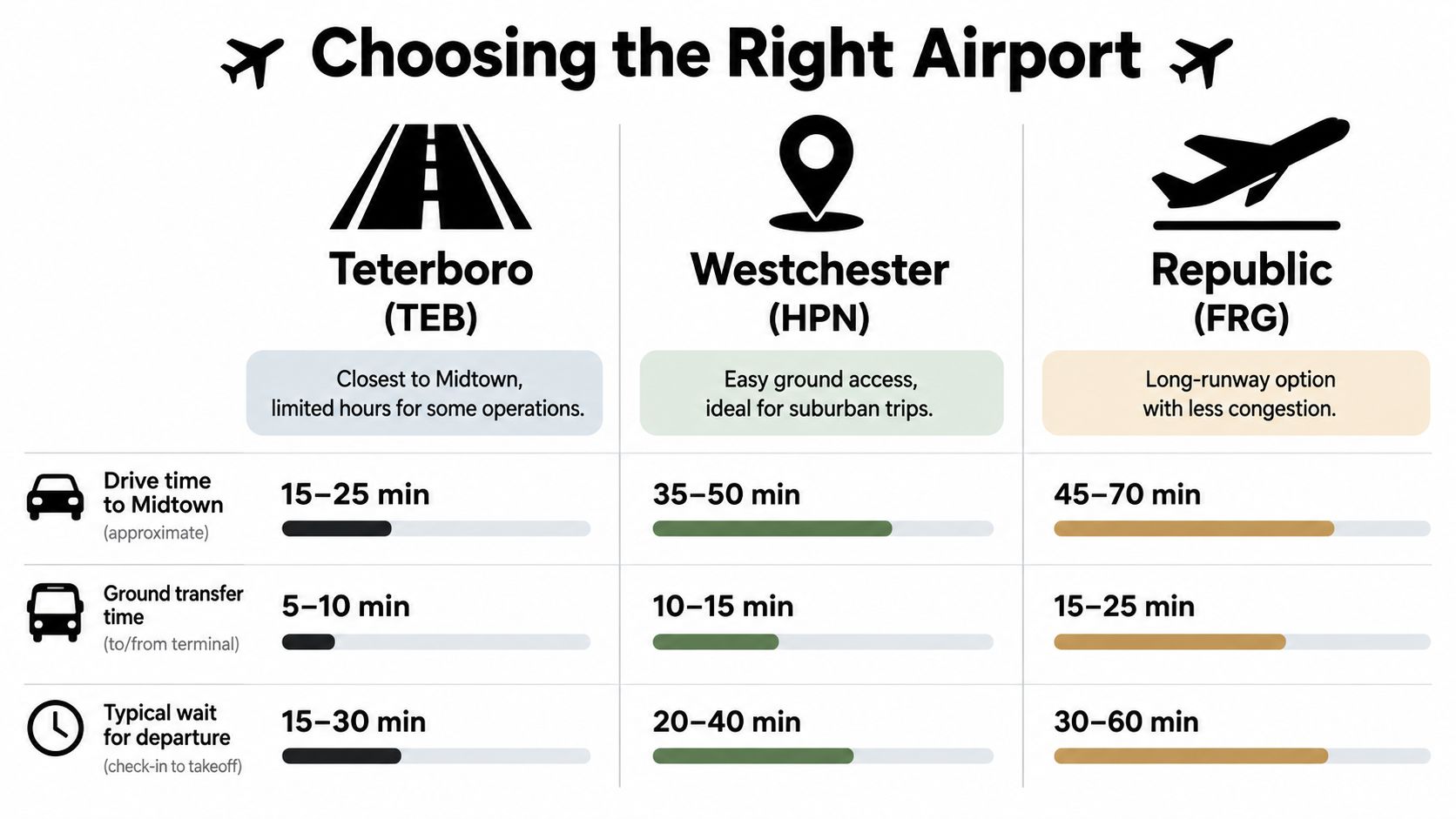
Compare the field, not just the postcode
| Airport | Best fit | Main consideration |
|---|---|---|
| Teterboro, TEB | Midtown, executive, and Manhattan itineraries | Closest in many cases, but aircraft weight and local operating constraints matter |
| Westchester County, HPN | Westchester, Connecticut, and northern suburban destinations | Often practical for clients north of Manhattan and may reduce cross-city ground travel |
| Republic, FRG | Long Island and eastern suburban destinations | Can be a useful alternative when the destination lies east of Manhattan |
| Stewart, SWF | Aircraft requiring different runway or operating characteristics | Farther from Manhattan, but potentially more suitable for heavier aircraft or specific dispatch plans |
| Newark, EWR | Itineraries aligned with New Jersey or commercial-airport connectivity | Commercial-airport environment can introduce different congestion and handling considerations |
The assumption that Teterboro is always fastest is too simplistic. Local officials reported that Teterboro's northern approach was used for more than 67% of traffic over the previous two years, while an FAA-approved approach intended to reduce overflight of homes, parks, and schools was used less than 2% of the time, as reported by TapInto's coverage of Teterboro airport noise. That community impact belongs in the airport discussion, particularly for operators and clients who care about responsible access.
Broker's rule: Choose the airport that produces the fastest reliable door-to-door journey, not the shortest taxi ride from the runway.
Before approving a quote, ask the operator to confirm the aircraft model, operating weight, passenger and baggage load, fuel uplift, runway assumptions, destination fuel requirements, ground-transfer estimate, and local noise or operating considerations. A useful reference for TEB procedures is the Teterboro Airport information page. The right airport is the one that works operationally and geographically.
Decoding Private Jet Charter Costs
A private charter quote is rarely just an hourly aircraft rate. Repositioning is the cost most inexperienced buyers overlook, and it can determine whether a quote is genuinely competitive.
For short flights, light jets are commonly positioned as the economical category. A Haute Jets Journal rental guide describes light jets as suitable for trips under roughly two to three hours, generally with seven or fewer passengers, and gives a starting benchmark of approximately $6,000 to $7,000 per flight hour in its comparison of light-jet categories and costs. That hourly figure is only a starting point. The final trip total can also include aircraft positioning, fuel, crew, taxes, airport charges, and the chosen departure and arrival airports.
The aircraft's location changes the quote
Consider the New York to Washington, D.C. example published in the Haute Jets Journal cost calculator discussion. The four-passenger light-jet itinerary departs from Teterboro, but the assumed aircraft is based in Boston. The aircraft must first ferry empty to Teterboro.
| Quote structure | Aircraft charge | Repositioning | Taxes and fees | Total |
|---|---|---|---|---|
| Traditional sourcing | $12,000 | $8,000 | $900 | $20,900 |
| Local sourcing | $12,000 | $0 | $900 | $12,900 |
The difference is $8,000, or approximately 38%, in that example. The aircraft category and passenger count didn't change. The positioning plan did.
That's why “starting at” pricing deserves scrutiny. A low advertised hourly rate can become an expensive itinerary when the aircraft has to travel empty from another market. Conversely, a locally based aircraft may offer stronger economics even if its advertised category rate looks similar.
What to request before accepting
Ask for a quote that separates:
- Aircraft time: The charge associated with the selected aircraft and route.
- Repositioning: Any empty ferry segment needed to place the aircraft at your departure airport.
- Airport costs: Landing, handling, parking, and terminal charges.
- Crew and trip expenses: Costs associated with the crew's positioning or overnight requirements.
- Taxes and other fees: Itemized rather than folded into an unexplained total.
The private jet charter cost guide can help frame the discussion, but the operator still needs your exact route, dates, passenger count, baggage profile, and aircraft requirements. Don't compare two quotes until you know whether both aircraft are already positioned near New York.
Navigating the Booking and Aircraft Selection Process
A good booking process begins with operational detail, not a vague request for “a private jet.” Give the charter advisor your departure airport preference, destination, travel dates, departure time, passenger count, baggage requirements, and any constraints involving pets, catering, Wi-Fi, or cabin layout.

Build the quote around the mission
Aircraft category should follow the mission. A light jet may suit a short regional flight and a smaller group, while a midsize, super-midsize, or heavy aircraft may be more appropriate when passengers need additional baggage capacity, cabin space, range, or a specific runway capability.
Don't accept a category label as a substitute for aircraft information. Ask for the specific make, model, year, seating configuration, baggage capacity, lavatory arrangement, Wi-Fi availability, and catering plan. If two aircraft appear similar on paper, those details can produce a very different onboard experience.
A simple booking workflow looks like this:
- Submit the trip profile. State the route, dates, preferred times, passenger count, and airport preferences.
- Review aircraft choices. Compare actual aircraft and cabin layouts, not just light, midsize, or heavy labels.
- Examine the complete quote. Check positioning, taxes, airport charges, cancellation terms, and aircraft substitution language.
- Confirm the service plan. Specify ground transport, catering, special assistance, and passenger preferences.
- Approve the aircraft and payment. The trip becomes operationally meaningful only once the selected aircraft and commercial terms are confirmed.
The Haute Jets Journal explains that a booking can be arranged without a membership, annual fee, prepaid-hour commitment, or blackout dates. Its New York charter booking guide also states that travelers provide the route, dates, and passenger count, while the operator handles aircraft selection and pre-departure details. Full confirmation is delivered 24 hours before departure with the aircraft tail number and passenger manifest.
Use the same principle for broader trip planning tools that help travelers book flights and hotels faster, but keep the charter workflow separate from ordinary airline booking. A private operator should be able to answer operational questions directly.
Here's what the final pre-flight process should clarify:
- Exact aircraft: Tail number, model, cabin configuration, and operating entity.
- Crew information: Pilot qualifications and relevant crew details supplied by the operator.
- Weather and routing: The current dispatch outlook and any practical alternatives.
- Ground plan: FBO, pickup timing, luggage handling, and arrival transport.
- Passenger manifest: Names and documentation requirements confirmed before departure.
Leveraging Empty Legs and Sustainable Practices
Empty legs can reduce the price of a private flight, but they're a compromise, not a magic discount. An empty leg is the repositioning segment an aircraft must operate without passengers after completing or before beginning a paid trip. It's also called a deadhead or ferry flight. If the route and timing suit a flexible traveler, the operator may sell that segment rather than fly it entirely empty.
The Haute Jets Journal explanation of empty-leg flights describes availability as highly dependent on aircraft positioning, route, and timing. It cites estimates of as many as 3,000 empty-leg flights worldwide at a given time and approximately 40% of private-jet movements globally, but those figures describe a fluid market rather than a guaranteed inventory pool.
The trade-off is control. Standard on-demand charter lets you choose the departure time, airport, aircraft, and destination around your needs. An empty leg asks you to accept the aircraft's existing repositioning requirement. That can work well for a leisure traveler with flexibility. It's a poor fit for a board meeting, production call, or connecting itinerary where timing matters more than the fare.
Evaluate the alternative, not just the aircraft
Sustainability also requires a complete itinerary analysis. Aircraft type matters, but so do route length, occupancy, aircraft utilization, empty repositioning, and the practical alternative. A short private hop with one passenger should be evaluated differently from a longer trip shared by a full group when rail or scheduled service isn't practical.
A 2026 analysis found that a short-haul private flight between New York and Washington, D.C., can be approximately 105 times more emissions-intensive per traveler than rail and about 12 times more intensive than a commercial flight, according to the High Flyers 2026 analysis. The same analysis reports approximately 2.63 million U.S. private-jet departures in 2025, about 29% above 2019 levels.
Those comparisons make short private hops difficult to defend when rail is a realistic substitute. They don't mean every charter has the same environmental profile. A credible review should ask for:
- Actual passenger load: Per-passenger impact changes with occupancy.
- Aircraft utilization: Determine whether the aircraft would fly empty without your booking.
- Routing: Avoid unnecessary repositioning where local sourcing is available.
- Ground transport: Include the emissions and time from the FBO to the final destination.
- Alternative modes: Compare rail, commercial aviation, and private charter for the specific itinerary.
Newer aircraft and sustainable aviation fuel may improve an operator's profile, but they don't replace transparent route-level accounting. The responsible choice is the one that matches the travel objective while avoiding unnecessary short flights.
Ensuring Safety and Premium Service Standards
The best private departure feels calm because the work happened before you reached the FBO. Your car arrives at the correct terminal, the aircraft is confirmed, the crew is briefed, and the passenger manifest matches the people standing beside the vehicle. That experience depends less on polished branding than on disciplined operator selection.
For high-value or time-critical travel, I recommend limiting the shortlist to operators with Wyvern Wingman or ARGUS Gold or Platinum ratings. These third-party standards don't replace regulatory oversight, but they give a charter buyer a meaningful safety-screening framework. Ask who operates the aircraft, who employs or contracts the crew, how the aircraft is maintained, and whether the proposed operator holds the stated rating.
What a serious pre-departure review includes
A proper vetting conversation should cover:
- Operator identity: The legal operating entity and certificate information.
- Third-party rating: Current Wyvern Wingman or ARGUS Gold/Platinum status.
- Aircraft specifics: Make, model, year, maintenance status, and tail number when confirmed.
- Crew profile: Pilot experience and assigned crew details.
- Operational plan: Departure airport, routing, weather review, alternates, and fuel assumptions.
- Service delivery: FBO handling, catering, ground transport, and communications.
The Haute Jets safety standards page provides a useful benchmark for understanding the level of operator screening a client should expect. Don't accept a generic statement that an aircraft is “safe.” Request the rating, the operating entity, and the aircraft details.

The ground experience matters too, but it comes after operational competence. A premium FBO should make arrival efficient, private, and predictable. It shouldn't distract from the essentials: the aircraft must be suitable for the route, the crew must be properly vetted, the airport must accept the planned operating weight, and the dispatch team must have a credible weather and fuel plan.
Safety standard: If a provider won't identify the operator, explain the aircraft selection, or document its third-party rating, remove that quote from consideration.
Haute Jets offers on-demand charter sourcing from its network of owner-operators, with aircraft selected by specific make, model, year, and cabin layout rather than category alone. For a New York departure, ask the provider to compare Teterboro, Westchester, Republic, and other suitable airports, then verify the full aircraft and safety details before payment.
Haute Jets can source on-demand private aircraft for New York itineraries, compare local positioning against repositioned options, and provide aircraft and pre-flight details before departure. Visit Haute Jets to request a route-specific quote built around the right airport, aircraft, operating weight, and safety standard.