

You've got a Saturday departure from Palm Beach Island, four passengers, luggage for a week, and a meeting that can't move. A broker sends three aircraft options with attractive hourly rates, but the cheapest jet is based outside South Florida. The quote looks competitive until the repositioning leg, crew logistics, and airport handling appear in the final total.
That's the central issue with a private jet charter from West Palm Beach. The aircraft's category matters, but its current location, itinerary, and availability often matter more. This guide focuses on the operating details that shape the final cost, from PBI's runway and FBO network to alternate airports, aircraft selection, and quote verification.
Why West Palm Beach Charter Decisions Start Before You Pick a Jet
Start with the mission, not the cabin brochure. Write down the departure airport you want, the destination, the date, the departure window, the passenger count, and whether you need a one-way or round-trip flight. Those details tell a charter desk which aircraft can perform the trip and where the aircraft needs to be before your departure.
Palm Beach International Airport, or PBI, is the obvious starting point for many travelers. Fort Lauderdale Executive, Boca Raton, Stuart, and other South Florida fields can also work, but the right airport depends on the aircraft's location and your ground itinerary. A jet staged at PBI or FXE may require no meaningful ferry movement, while an aircraft sitting elsewhere can create a repositioning charge before you've added catering, ground transportation, or cabin preferences.
Practical rule: Ask where the aircraft will sleep the night before departure. That answer is often more valuable than the advertised hourly rate.
A Saturday morning flight exposes this issue quickly. South Florida demand can concentrate aircraft around the same departure windows, especially for Caribbean trips, seasonal travel, and major events. If the preferred jet is positioned far from West Palm Beach, the operator may need to fly it empty to your departure field, account for crew positioning, and then return it to its operating base after your trip. The broker may present that as one all-in quote, but you should still ask for the aircraft's base and the ferry legs in writing.
The first evaluation should follow this order:
- Itinerary shape: One-way, round-trip, multi-city, or same-day return.
- Date and departure window: Flexibility can expand the available aircraft pool.
- Passenger and luggage load: These determine the practical cabin and performance requirements.
- Aircraft staging: A nearby aircraft can beat a cheaper advertised hourly rate.
- Airport choice: PBI may be operationally efficient, while an alternate field may reduce surface time.
This approach prevents a common mistake, choosing a jet category before understanding the logistics. A light jet may be perfect for a short Florida hop, but a midsize aircraft already positioned nearby may produce the cleaner quote for a Caribbean itinerary. The best charter decision is the one that fits the complete mission, not the one with the lowest number beside “hourly rate.”
What Makes Palm Beach International a Strong Charter Base
A West Palm Beach charter can look attractive on an hourly-rate comparison and still price poorly if the aircraft is staged elsewhere. PBI reduces that risk because it is a genuine business and general aviation airport, not just a commercial terminal with a private aircraft area. Its position between West Palm Beach and Lake Worth supports air carriers, corporate aviation, and general aviation. This Palm Beach International Airport charter page gives travelers a useful starting point for comparing private operations at the field.
PBI's physical specifications strengthen its case for larger or more demanding missions. KPBI's longest runway measures 10,008 feet, and the airport sits at an elevation of 19 feet, according to KPBI's airport fact sheet. The long runway and near-sea-level elevation give dispatch teams more flexibility with larger aircraft, heavier passenger loads, and warm-weather departures. PBI also holds U.S. port-of-entry status, allowing eligible international passengers to clear customs on arrival instead of repositioning through another U.S. airport.
The FBO footprint changes the experience
PBI has three full-service fixed-base operators, Signature Aviation, Atlantic Aviation, and Jet Aviation, according to the FAA's PBI pilot information. Independent airport information also lists those operators on the field and notes that Jet Aviation and Signature operate around the clock, as reported in PBI's private aviation airport overview.
That choice matters operationally. Operators can compare fueling, parking, crew support, passenger handling, and international coordination instead of accepting whichever facility is assigned by default. It also creates a peak-season constraint. PBI's proximity to Palm Beach Island, Worth Avenue, and major private residences drives demand for ramp space and handling coordination. Require the charter desk to confirm the FBO before accepting the quote.
PBI also has a substantial general aviation role. In August 2021, general aviation represented about 63% of 9,049 flights, while in May 2020 it accounted for 86% of movements, or 5,766 of 6,688 total movements. Those figures appear in the FAA pilot information cited above. The airport recorded 10,211 total aircraft movements in August 2025, including 5,519 general aviation and other movements and 4,692 air-transport movements, according to the U.S. Customs and Border Protection KPBI fact sheet.
PBI, FLL, and MIA serve different missions
| Feature | Palm Beach Intl. (PBI) | Fort Lauderdale-Hollywood (FLL) | Miami International (MIA) |
|---|---|---|---|
| Best charter profile | West Palm Beach, Palm Beach Island, Wellington, Jupiter, and international private flights | Broward County access, flexible South Florida positioning, and selected Caribbean missions | Miami business travel, international connectivity, and passengers already based in Miami |
| Private aviation structure | Three full-service FBOs and a long runway | Strong general aviation alternatives, with airport choice depending on aircraft and handling plan | Large international airport environment with more complex commercial traffic |
| Customs consideration | U.S. port of entry, useful for international arrivals | Confirm customs availability for the specific operation | Broad international infrastructure, but ground and airport complexity can be higher |
| Turnaround consideration | Efficient for Palm Beach-area passengers when the FBO is coordinated early | Can win when the aircraft is already staged there or the passenger is closer to Broward | Can win for Miami-based itineraries, not automatically for Palm Beach departures |
| Main drawback | Peak-season ramp and handling pressure | Longer ground transfer for Palm Beach-area travelers | Congestion and greater surface complexity |
Choose PBI when the passenger is in Palm Beach County, the aircraft needs a long runway, or the itinerary requires international customs handling. FLL can produce the better operational result when the aircraft is already staged there or the traveler starts in Broward. MIA fits a Miami-centered trip, but it is rarely the sensible default for a Palm Beach Island departure.
Choosing the Right Airport and FBO Around West Palm Beach
There isn't one universally correct departure field. The right choice depends on where the aircraft is based, how much ground time the passengers can tolerate, whether customs is required, and whether the aircraft needs a specific runway or handling capability.
PBI should be the default for most West Palm Beach charter requests, but not because every flight must use it. The airport's three-FBO structure provides operational depth, while nearby fields can be more efficient for lighter aircraft or passengers who live closer to another part of the region. Ask the charter desk to price the mission from more than one airport when the itinerary is short and the aircraft is flexible.
A practical decision matrix
| Airport | Best Use Case | Notable FBOs | Drive to Palm Beach Island |
|---|---|---|---|
| PBI | International missions, larger aircraft, Palm Beach-area departures, and customs-supported arrivals | Signature Aviation, Jet Aviation, Atlantic Aviation | Usually the most direct option for Palm Beach Island |
| North Palm Beach County General Aviation Airport | Smaller aircraft, discretion, and selected local departures | Confirm the assigned FBO and handling provider with the operator | Often practical for northern Palm Beach County, less direct for island passengers |
| Lantana | Local private aviation when the aircraft is already positioned nearby | Confirm operator-specific handling | Can be useful for southern Palm Beach County, but ground time varies |
| Boca Raton Airport, BCT | Light aircraft and quick domestic turns | Confirm current FBO assignment | Suitable for southern Palm Beach County, with added transfer time to the island |
| Fort Lauderdale Executive, FXE | Schedule flexibility and aircraft availability in Broward | Confirm the operator's assigned FBO | Longer drive to Palm Beach Island, but sometimes better aircraft positioning |
| Witham Field, SUA | Treasure Coast departures and passengers north of Palm Beach | Confirm local handling and parking | Practical for Stuart-area travelers, inefficient for island-based passengers |
The FBO itself affects the final experience. Handling fees, ramp parking, fuel arrangements, crew services, and customs capability can differ by airport and operator. Don't assume that a lower airport fee produces a lower total. A cheaper ramp charge can disappear once you add a longer car transfer, aircraft repositioning, or a separate customs stop.
If you're new to the terminology, this guide to what an FBO means explains why the fixed-base operator is central to private aviation. In practical terms, the FBO is where the aircraft, crew, passengers, fuel, baggage, and ground vehicles come together.
Airport rule: Leave PBI only when the alternate field materially improves aircraft positioning, schedule flexibility, or passenger access. If it merely looks cheaper on a fee line, it probably adds friction elsewhere.
For a short domestic hop, BCT or a nearby general aviation airport can make sense when the jet is already there. For an international route, larger cabin aircraft, or a Palm Beach Island passenger who values predictable handling, PBI usually remains the cleaner operational choice.
Matching the Aircraft to the Mission
Choose the aircraft after defining the route and payload. A brand name or attractive cabin photograph doesn't tell you whether the jet can carry your passengers, luggage, and required fuel from the departure runway to the destination runway under the day's conditions.
For Florida routes under roughly ninety minutes, a light jet such as a Phenom 300 or Citation CJ3 often fits the mission. These aircraft work well for Boca Raton, Miami, Naples, and Orlando when the passenger group is compact and baggage is reasonable. They also fit the quick-turn operating rhythm common to short regional travel.
The Caribbean requires more discipline. Nassau, Turks and Caicos, and St. Barths can justify a midsize aircraft such as a Citation XLS+ or Hawker 800XP, particularly when passengers want more baggage capacity, extra headroom, or additional fuel margin. The destination runway matters as much as the cabin. An aircraft that looks perfect on paper may not be suitable for the arrival field once runway length, weather, payload, and fuel planning are considered.
Match the cabin to the mission
| Mission | Recommended Category | Example Aircraft | Notes |
|---|---|---|---|
| Boca Raton, Miami, Naples, or Orlando | Light jet | Phenom 300 or Citation CJ3 | Efficient for short sectors and compact passenger groups |
| Nassau or Turks and Caicos | Midsize jet | Citation XLS+ or Hawker 800XP | Better baggage flexibility and cabin comfort for island travel |
| St. Barths | Midsize jet, subject to aircraft and performance review | Citation XLS+ or Hawker 800XP | Destination-airport limitations require careful performance planning |
| Four passengers to Aspen | Super-midsize jet | Challenger 350 | More cabin, range, and baggage capability for a demanding route |
| Four passengers to Teterboro | Super-midsize or midsize, depending on payload and availability | Challenger 350 or comparable aircraft | Positioning, weather, and luggage can change the suitable category |
| West Coast travel | Super-midsize or larger | Challenger 350 or comparable aircraft | Nonstop requirements and payload drive the final shortlist |
Passenger count is only the beginning. Two travelers with golf equipment, skis, or multiple cases can create a different aircraft requirement from six travelers with light carry-on luggage. Tell the broker what you carry, not just how many seats you need.
The correct aircraft is the smallest aircraft that satisfies the route, payload, runway, range, and comfort requirements without forcing the operator into an inefficient positioning plan.
For international or island travel, ask for the aircraft's actual performance review rather than a generic range statement. Headwinds, runway restrictions, fuel reserves, destination access, and return-leg planning can all eliminate aircraft that appear suitable in a brochure. A senior charter desk should reduce the options to a short, defensible list.
Sample Pricing and Flight Times to Popular Destinations
Treat route pricing as an operating estimate, not a menu. The figures below are indicative one-way ranges, and the final quote can move based on aircraft positioning, date, airport fees, fuel, crew requirements, and the structure of the return itinerary.
| Destination | Block Time | Indicative Price Range (USD) | Key Cost Driver |
|---|---|---|---|
| Miami-Executive | 25 minutes | $2,800 to $3,800 | Aircraft location and short-sector minimums |
| Naples | 35 minutes | $3,800 to $5,200 | Minimum flight charges and local positioning |
| Orlando | 55 minutes | $5,200 to $7,400 | Aircraft category and departure timing |
| Nassau | 1 hour 5 minutes | $6,500 to $9,000 | Customs, international handling, and aircraft availability |
| St. Barths | 2 hours 30 minutes | $14,500 to $19,500 | Destination performance requirements and aircraft category |
| Teterboro | 2 hours 40 minutes | $16,000 to $22,000 | Northeast positioning, date, and peak demand |
| Aspen | 4 hours 30 minutes | $26,000 to $36,000 | Long sector, aircraft capability, and seasonal demand |
These route examples should be read alongside a broader explanation of private jet charter cost factors. The hourly rate is only one component. A short flight can still produce a substantial quote because the operator may apply minimum charges, reposition the aircraft, or incur handling costs on both ends.
What moves the number
- Deadhead positioning: An aircraft that starts outside the local market may need an empty ferry leg before your departure.
- Fuel timing: A fuel surcharge week can change the quote even when the route and aircraft remain unchanged.
- Seasonal windows: Ski travel and Art Basel periods can tighten availability and increase the cost of suitable aircraft.
- Crew rest: A long-haul return may require overnight crew rest, additional hotel costs, or a different aircraft plan.
- Round-trip structure: A round-trip discount applies only when the aircraft stays put between the outbound and return legs.
A New York to Palm Beach corridor illustrates the market more concretely. Haute Jets lists charter costs starting at $12,000 for light jets and $16,000 for midsize jets, with sample flight times of about 2 hours 30 to 40 minutes, in its New York to Palm Beach charter coverage. Those figures don't replace a custom quote, but they show why aircraft category and positioning can produce a wide spread on a frequently booked route.
The right question isn't “What's the hourly rate?” Ask, “What is the all-in price for this exact aircraft, from its current base, on these dates, with this return plan?”
Where the Real Cost Gap Comes From
The aircraft's overnight location usually deserves more attention than the broker's brand. A jet staged at PBI or FXE can begin your mission without a material local repositioning leg. A Citation sitting in Boca Raton or Miami may need an empty flight to your chosen departure field before carrying your passengers, and that ferry movement can add $1,500 to $3,000 to the trip according to the market guidance supplied for this article.
Traditional brokers often present a polished aircraft comparison without making the staging economics obvious. You may see the same operator, the same tail number, and the same cabin category through multiple brands. The brand on the email doesn't change the aircraft's location, and it doesn't eliminate the ferry cost.
The four components of the quote
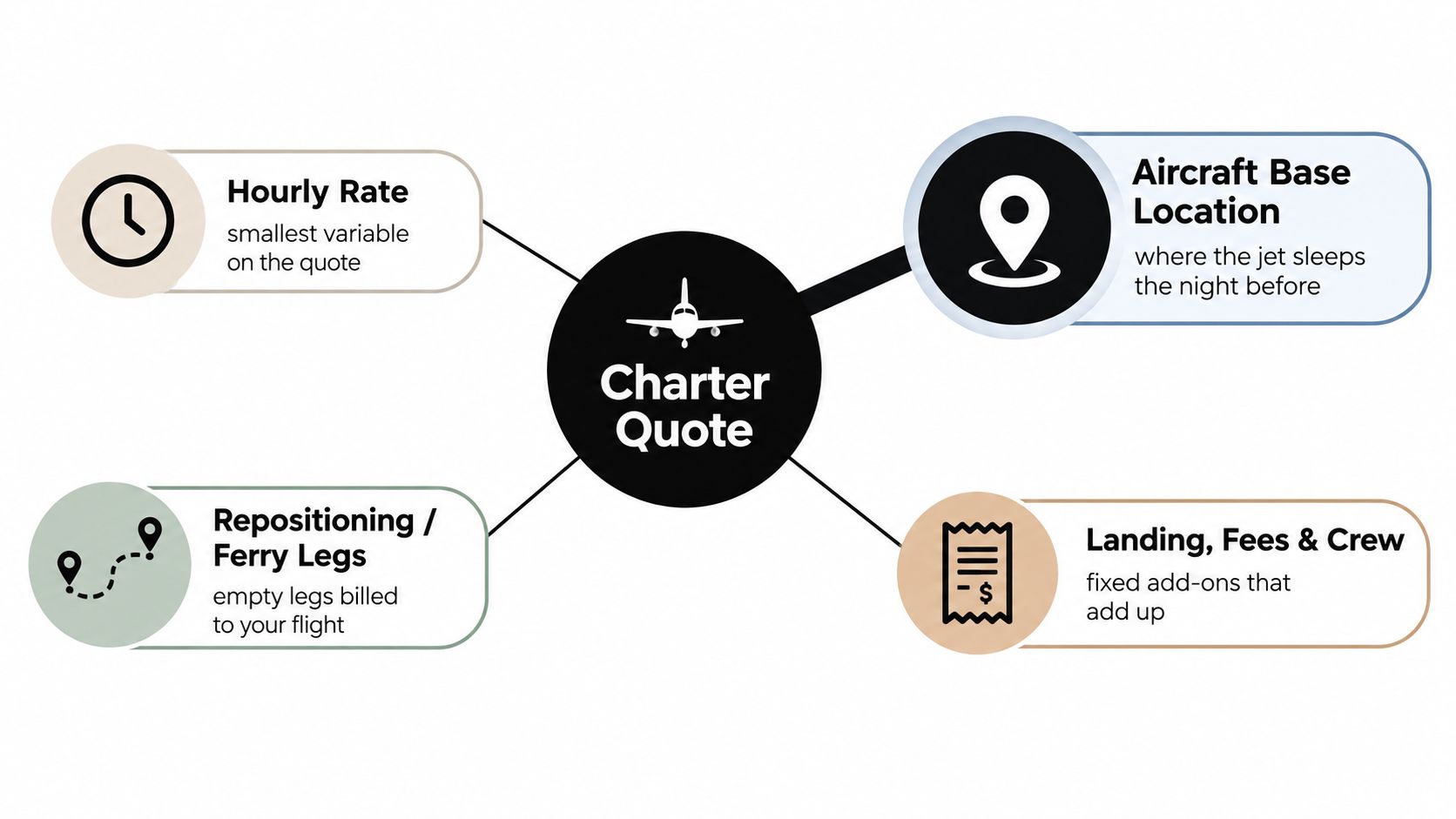
Hourly rate is often the smallest variable. The larger swing can come from aircraft base location, repositioning or ferry legs, landing and handling fees, and crew costs. Fuel pricing at the chosen FBO can also affect variance. Publicly reported September 2026 fuel prices at Signature South list Jet A at $11.326 per gallon and SAF at $13.077 per gallon, as shown on Jet Aviation's Palm Beach location page.
Safety verification still matters more than a low quote. Ask whether the actual operating company is Wyvern-registered, ARGUS-rated, or IS-BAO audited, and confirm that the certificate holder matches the operator named in the agreement. These checks tell you more about operational discipline, maintenance oversight, and crew standards than a broker's marketing language.
Local sourcing also improves short-notice options. When an aircraft already sits near your departure field, a four-hour request can be realistic, subject to crew, maintenance, and airport availability. A distant aircraft may look available in a database but fail once ferry timing and crew duty limits are applied.
The contrarian conclusion is straightforward. Choose the sourcing process before choosing the broker logo. A local desk that checks nearby owner-operator inventory can remove repositioning, improve aircraft choice, and expose the actual operator. Haute Jets is one option that sources aircraft from owner-operators and presents specific aircraft details for on-demand charter, rather than requiring a membership or jet card.
Your Pre-Flight Checklist for a West Palm Beach Charter
Before signing, review the quote as an operating document, not a sales summary. The aircraft, operator, airport, ferry plan, crew, and cancellation terms should all be identifiable.
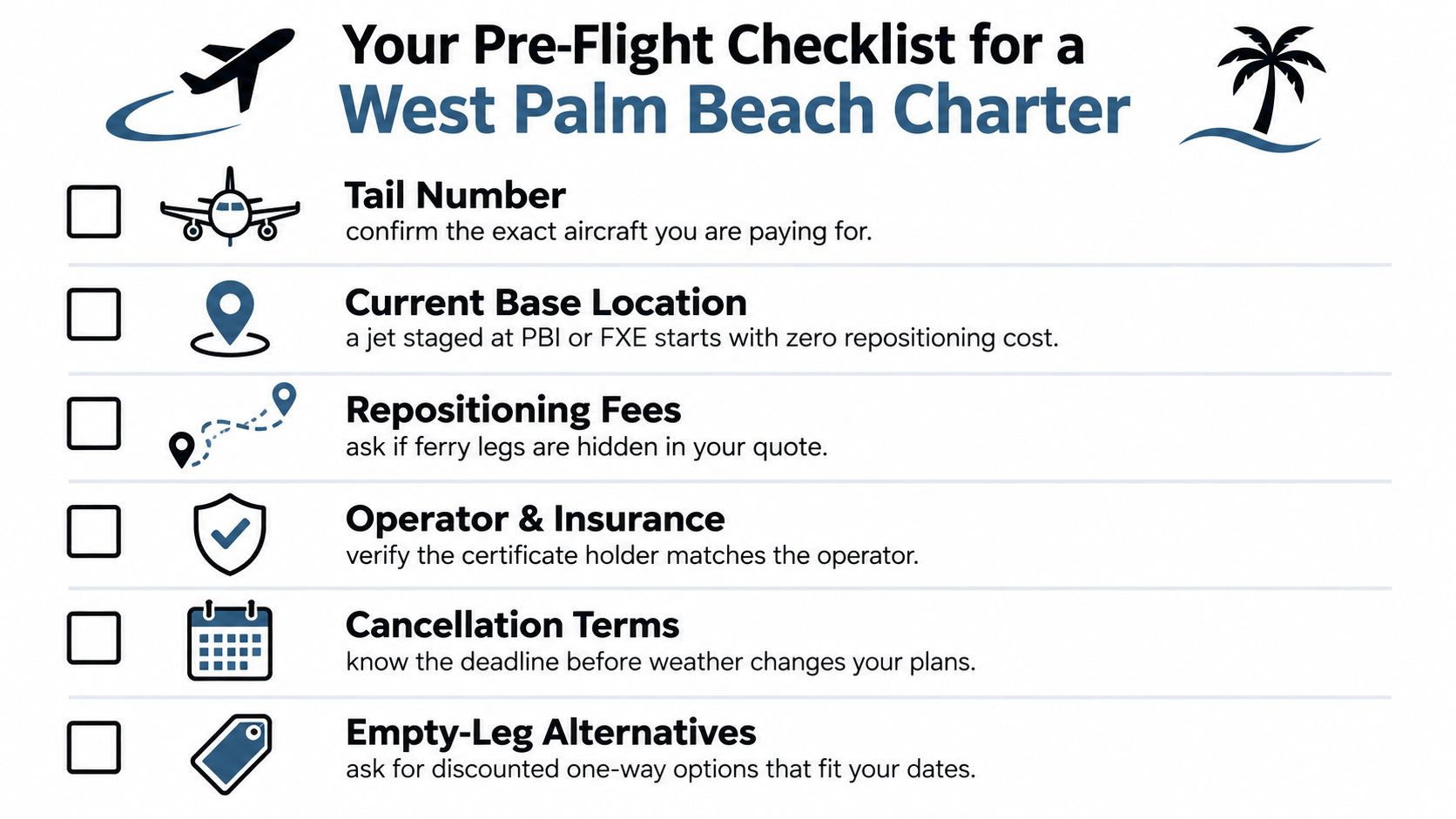
Use this checklist:
- Tail number: Confirm the exact aircraft you're paying for, including its make, model, and cabin configuration.
- Current base location: Ask where the aircraft is staged before departure and whether it must reposition to PBI, FXE, BCT, or another field.
- Repositioning fees: Require ferry legs, parking, handling, and other aircraft-movement charges to appear in writing.
- Operator and insurance: Verify the certificate holder, operating company, safety registration, and insurance details.
- Cancellation terms: Identify the deadline, weather provisions, and charges that apply if plans change.
- Empty-leg alternatives: Ask whether a compatible empty leg can reduce the one-way cost if your schedule is flexible.
Then confirm the FBO assignment. PBI has multiple private-aviation facilities, and the assigned FBO affects where the driver goes, where baggage is handled, and how international processing is coordinated. For Caribbean flights, review crew duty limits, customs handling at the destination, weather-routing procedures, and the plan if the destination becomes unavailable.
Catering and ground transportation should also be confirmed before departure, not left to verbal promises. During hurricane season, ask how the operator will handle airport closures, rerouting, aircraft relocation, and cancellation timing. A quote that looks complete but omits these terms can become expensive when conditions change.
A focused quote review can reveal $2,000 to $5,000 in hidden repositioning or handling fees, according to the verified planning guidance supplied for this article. Don't accept a headline price until you know whether the aircraft is local, whether the return leg keeps it in place, and which fees the operator has included.
Haute Jets helps travelers compare on-demand aircraft sourced from owner-operators, with attention to current aircraft location, operator safety credentials, and exact aircraft details. For a West Palm Beach departure, send your dates, passenger count, luggage requirements, and preferred airport to Haute Jets and ask for an all-in quote that shows repositioning and handling clearly.