
Are you comparing a private charter with an airline by looking at the wrong number? That mistake is common, and it can produce false confidence in one direction or unnecessary alarm in the other. Private aviation safety depends on the operation, the legal operator, the aircraft, the crew, and the mission you're booking.
A broker's brand, a polished cabin, or a rating badge isn't enough. Before you pay, you should be able to identify the operator holding the certificate, the aircraft's tail number, the crew standards, the current audit tier, and the decisions being made about weather, alternates, fuel, and runway performance. The practical framework below is designed for that verification process, not for repeating a slogan.
What Private Aviation Safety Actually Means
Private aviation isn't one operating category. It includes owner-flown aircraft, corporate flight departments, fractional programs, jet cards, and on-demand charter. A light aircraft flown privately by its owner faces a different operating environment from a professionally crewed jet dispatched under commercial rules. Even two charter flights can carry different exposure because of aircraft category, airport choice, crew pairing, weather, and route complexity.
That's why a commercial-airline safety figure can't answer the question, “Is my charter safe?” Scheduled airlines generally operate standardized routes with large fleets, established dispatch systems, and highly structured procedures. Private flights may use smaller airports, fly less standardized missions, and involve light jets, turboprops, or other aircraft with different performance and exposure profiles. The relevant comparison must match the operation type and denominator, not merely the word “aviation.”
Evaluate the flight in layers
Start with the legal operator, not the booking intermediary. Then identify the aircraft promised, the crew assigned, and the operational support behind the trip. A reputable operator should be able to explain how it manages maintenance, recurrent training, flight following, weather decisions, and changes to the itinerary.
For an accessible overview of aircraft categories and safety considerations, review the safest private jets, but don't treat an aircraft list as a substitute for flight-specific due diligence. Aircraft capability matters, yet the people and systems applying that capability matter just as much.
Practical rule: Ask who is legally operating the flight, which aircraft will fly it, who will command it, and what happens if the planned route becomes unsuitable.
The strongest approach treats safety as overlapping controls. The operator's certificate establishes the regulatory foundation. An audit provides an external check. The aircraft's maintenance status, the crew's qualifications, dispatch decisions, and the operator's Safety Management System add further layers. Your job as a passenger is to verify those layers before takeoff.
Reading the Accident Data Without Misleading Yourself
The first rule is simple: never compare rates until you know what the denominator measures. The National Transportation Safety Board reported a U.S. fatal general-aviation accident rate of 1.274 per 100,000 flight hours in 2001, reaching 1.381 in 2005, falling to 0.935 in 2017, and registering 0.951 in 2021. The movement from 2001 to 2021 represents roughly a 25% reduction, according to NTSB testimony on general aviation safety.
The FAA reported an estimated fatal general-aviation accident rate of 0.68 per 100,000 flight hours in fiscal year 2024, with 195 fatal accidents and 337 fatalities. Across 2014 to 2023, the FAA identified loss of control in flight as the leading fatal-accident risk factor, followed by power-system component failure, controlled flight into terrain, inadvertent flight into bad weather, and fuel-related events, as detailed in the FAA General Aviation Safety Fact Sheet.
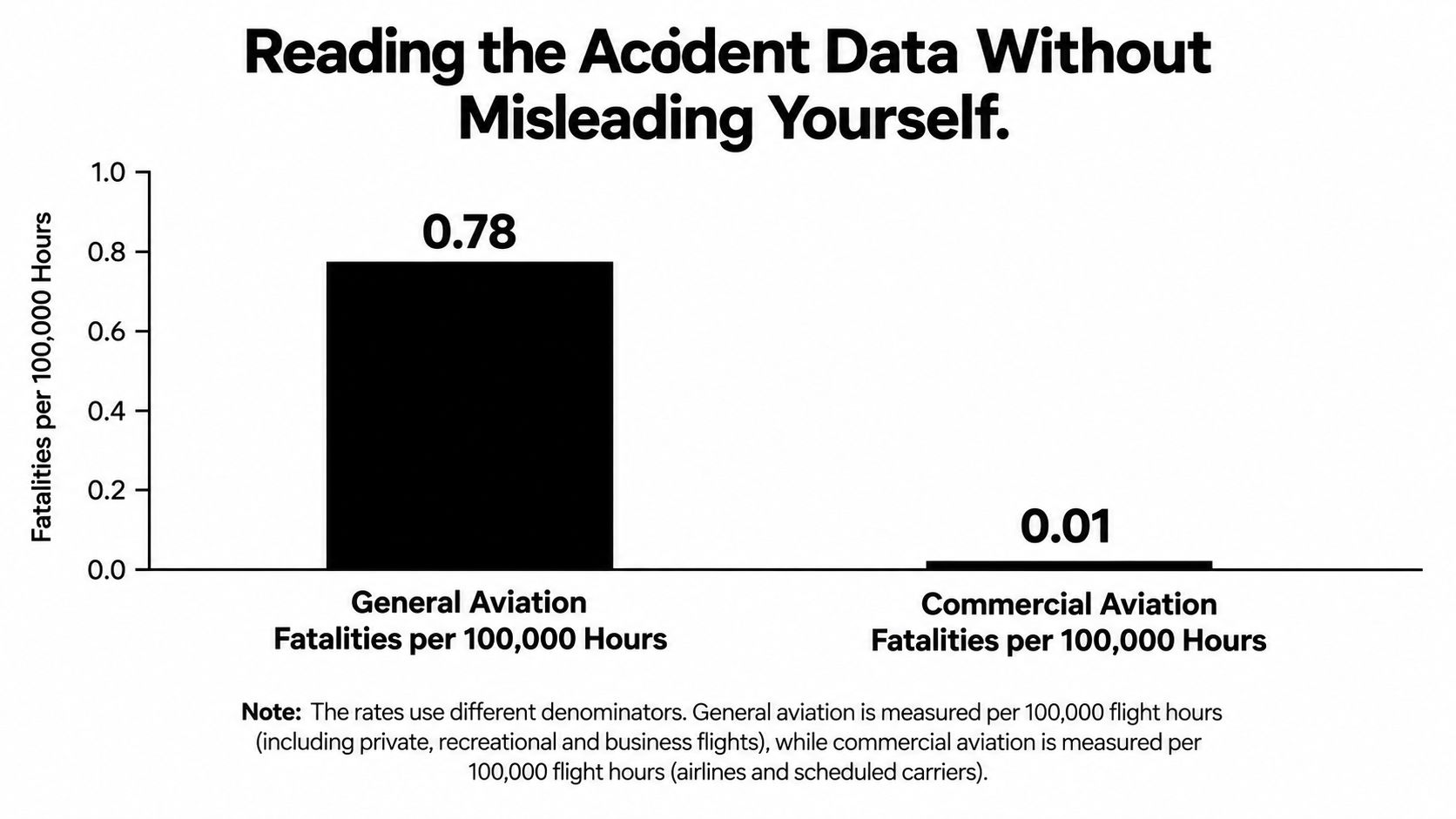
Those numbers describe general aviation broadly, not a specific charter operator or private jet model. The NTSB also reported 376 deaths associated with U.S. civil-aviation accidents in 2021, compared with 541 in 2009, while about 91% of U.S. aviation fatalities in 2021 occurred in general-aviation accidents. The same testimony reported 27 fatalities in Part 135 commuter and on-demand operations, which include charter, air-taxi, air-tour, and air-medical flights.
Match the metric to the decision
IATA's commercial-airline data covered 38.7 million commercial flights in 2025 and recorded 51 accidents, an all-accident rate of 1.32 per million sectors, according to the Flight Safety Foundation's 2025 safety report. A sector is not the same exposure unit as a flight hour, so that figure shouldn't be presented as a private-charter probability.
| Metric | What It Counts | What It Ignores | Useful For |
|---|---|---|---|
| Fatal general-aviation rate per 100,000 flight hours | Fatal accidents normalized by flight hours | Exact operator, aircraft, crew, and mission | Understanding broad GA exposure |
| Commercial airline rate per million sectors | Accidents normalized by airline flight sectors | Differences in flight-hour exposure and operation type | Assessing scheduled airline operations |
| Corporate-jet accident count | Reported accidents involving corporate jets | Fleet size, departures, flight hours, and aircraft categories | Establishing that events occurred, not calculating passenger probability |
| Operator incident history | Events associated with a named operator or registration | Events not publicly reported or not yet investigated | Screening an operator and aircraft |
The question to ask is not “Are private jets safe?” Ask, “Which data applies to this operator, this aircraft, this crew, and this flight?” Then ask what controls address loss of control, system failures, terrain, weather, and fuel. A serious operator should answer with procedures, training, equipment, and decision authority, not a generic assurance.
The Safety Management System Operators Actually Rely On
A rating can expire, a fleet can change, and a mission can become more complicated after an audit. The operator's ongoing Safety Management System, or SMS, is the control that should keep identifying and reducing risk between audits.
ICAO defines SMS as a systematic method for identifying hazards, assessing risk, monitoring operational data, investigating occurrences, and continuously improving safety performance. Its four pillars are safety policy and objectives, safety-risk management, safety assurance, and safety promotion.
Turn the four pillars into questions
- Safety policy and objectives: Who is the accountable manager, and who can stop or delay a flight when the risk is unacceptable?
- Safety-risk management: How does the team assess weather, fatigue, runway conditions, aircraft defects, and route changes before departure?
- Safety assurance: Which internal audits, reports, and performance reviews test whether mitigations are working?
- Safety promotion: How does the operator share lessons with pilots, maintenance staff, dispatchers, and leadership?
An unstable approach is a useful example. If crews repeatedly arrive high, fast, or misaligned, an effective SMS doesn't wait for a runway excursion. The operator records the precursor, assesses its severity and frequency, assigns corrective action, reviews training and approach procedures, and monitors later flights to see whether the pattern improves.
Ask the operator to describe a comparable example without requesting confidential details. You're looking for evidence that reporting is confidential or non-punitive, that named managers own corrective actions, and that safety data changes procedures or training. “We have an SMS” means little if nobody can explain how a report moves from the cockpit to a decision.
Ask this directly: “What recent safety trend changed a procedure, a briefing, or a training module?”
Audits remain valuable. They test records, controls, and compliance at a point in time. An SMS is different because it creates a living feedback loop. That distinction matters when weather changes, a crew member becomes unavailable, an aircraft is substituted, or a maintenance issue appears before departure.
Wyvern Wingman and ARGUS Gold Compared
Which rating tier applies to the operator, aircraft, and legal certificate holder on your booking? Ask that before treating a safety badge as proof. Wyvern Wingman and ARGUS Gold and Platinum are useful screening tools for private-aviation operators, but each rating covers specific records and controls at a particular point in time.
A Wyvern review may examine operational history, pilot training, maintenance practices, procedures, and safety-management processes. That independent review can test the systems behind an operator's marketing claims. Ask whether the designation is current, what it covers, and whether the aircraft and legal operator assigned to your trip fall within its scope.
ARGUS Gold and Platinum are described as the top tiers of the ARGUS operator ratings, as detailed in this analysis of Wyvern and ARGUS safety ratings. The review is presented as an independent examination of operating procedures, training programs, maintenance practices, and compliance records, according to Haute Jets' explanation of Citation X and Challenger 350 safety ratings. “ARGUS-rated” alone isn't precise enough. Require the operator to identify Gold or Platinum status and confirm that it remains valid.
Audit the auditor's information
Request these details in writing:
- Exact designation: Is the operator Wyvern Wingman, or another Wyvern category? Is the ARGUS status Gold or Platinum?
- Current validity: When was the last audit, and when does the rating expire?
- Open findings: Were any findings conditional, and has the operator completed every corrective action?
- Scope: Does the rating apply to the legal operator, the specific aircraft, and the planned operating region?
- Operational changes: Has the operator added aircraft, crews, or bases since the audit?
A rating cannot verify the conditions of your exact flight. It may not reflect a last-minute aircraft substitution, a new crew pairing, changing weather, a demanding runway, or a route change. Ask who has reviewed those current factors and what decision follows from that review.
An audit should increase your confidence in the operator's system. It should never replace checking the exact flight.
Choose the highest precise tier the operator can substantiate, then verify the tail number, legal operator, and current flight arrangements. The right question is, “Show me the controls behind this booking,” not, “Do you have a badge?”
FAA Part 135, ATP Certification, and Crew Standards
Which certificate governs your flight? For a U.S. on-demand charter, start with the legal operator's FAA Part 135 Air Carrier Certificate, or the equivalent international approval for the planned operation. The certificate belongs to the company operating the aircraft, not the broker arranging the reservation, as explained in Haute Jets' private-jet safety overview.
Ask for the operator's legal name and certificate identity before discussing amenities. A broker can arrange the trip, but the certificate holder carries operational responsibility. Vague answers are a reason to pause the booking.
Separate the three controls
Certificate: It defines the regulatory framework for on-demand commercial operations. It does not verify every detail of your flight, so confirm that the certificate holder, aircraft, and planned operation match your booking.
Crew: A two-pilot crew divides cockpit duties and provides staffing redundancy. Haute Jets states that its flights use at least two pilots holding Airline Transport Pilot certificates, the FAA's highest pilot certification level. Ask for the crew's names, certificate status, aircraft qualifications, and recent recurrent training.
A private-pilot certificate does not establish professional charter qualification. Review what the private pilot ACS covers to understand that baseline, then separately verify the commercial credentials and training applicable to your flight.
Dispatch and monitoring: Crew certificates do not replace operational support. Ask who reviews weather, selects alternates, checks runway performance, evaluates fuel contingencies, and monitors the aircraft after departure. Haute Jets describes 24/7 flight monitoring, real-time weather oversight, and reviews of pilot qualifications and maintenance records during operator screening.
Ask who can delay or cancel the flight. If weather falls below the operator's limits, the schedule must lose. That decision shows operational discipline, not poor service. Treat audits and screening as useful inputs, then verify the exact operator, tail number, crew, certificate, and flight conditions assigned to your trip.
How Haute Jets Applies These Standards in Practice
What should a passenger be able to verify before boarding? Haute Jets states that it sources aircraft from owner-operators across many countries and requires operators in its network to hold a Wyvern Wingman or ARGUS Gold or Platinum rating, excluding lower ARGUS categories, according to its safety information.
That threshold gives you a starting point, not a guarantee. Ask which rating applies to the actual operator, whether it remains current, and whether any conditions or findings affect the trip. The company also describes local sourcing, which can place an aircraft nearer to the departure city and reduce unnecessary repositioning.
Verify the booking package
Haute Jets states that each booking provides full flight details 24 hours before departure, including:
- Tail number: The registration identifies the aircraft assigned to your trip. Use it to check that the aircraft matches the promised make, model, and cabin.
- Crew bios: Review the operating crew, not only a generic company profile. Ask whether the listed pilots are the crew who will fly.
- Weather briefing: Confirm that current conditions, route weather, and operational considerations were reviewed before departure.
- Passenger manifest: Accurate passenger information supports loading and operational planning.
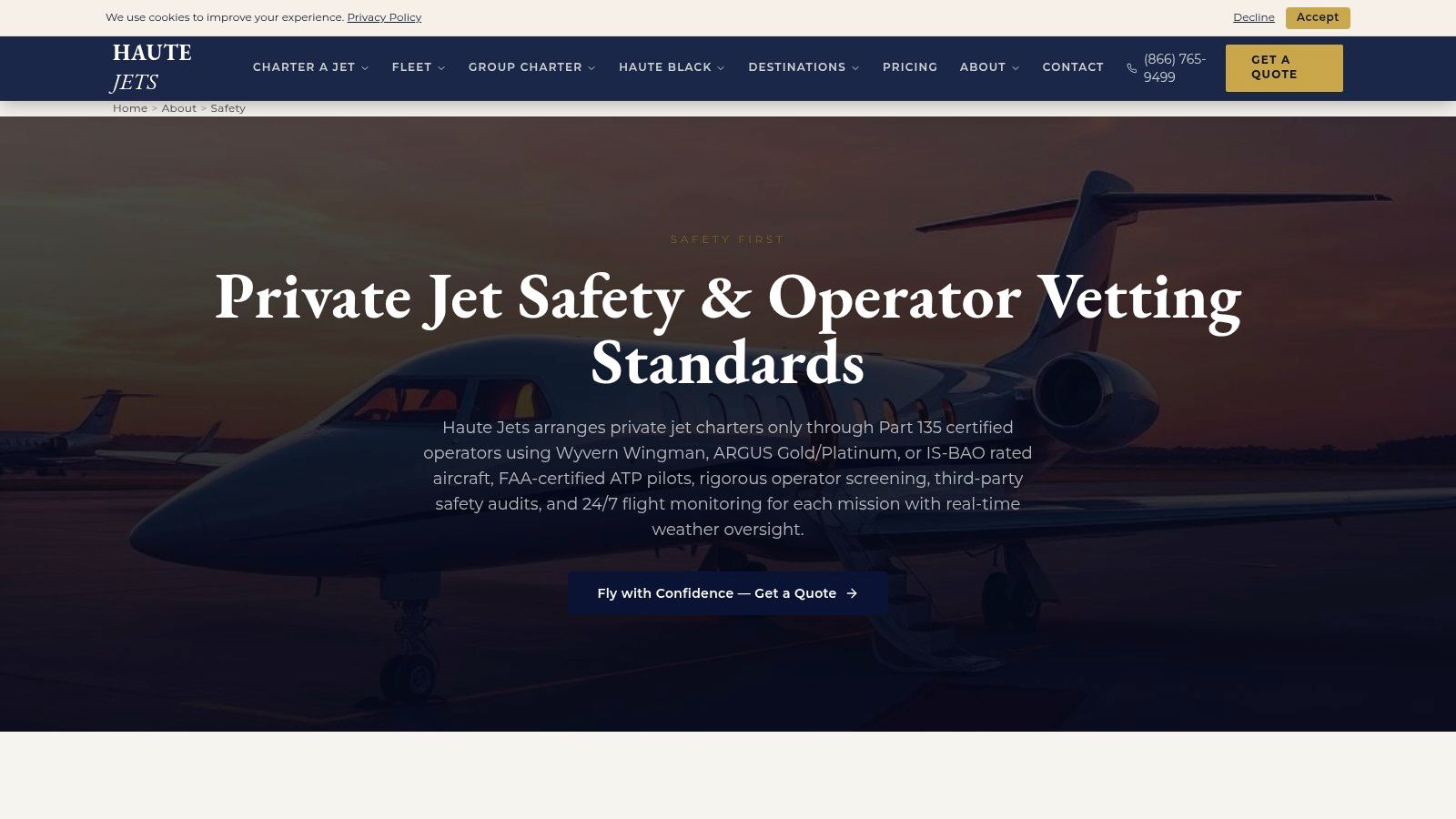
Use Haute Jets' safety page as a reference for the information a transparent booking process should provide. Then ask for the legal operator, applicable operating certificate, exact tail number, crew qualifications, and dispatch contact. If the tail number changes, repeat those checks before accepting the replacement aircraft.
Screening reduces unknowns before booking. It does not replace verification of the aircraft, crew, certificate, and operating plan assigned to your flight. Audits are inputs to your decision, not permission to stop asking questions.
Your Pre-Flight Safety Checklist for Any Charter
Use this checklist with any charter provider, whether you book through a broker, operator, membership program, or direct sales team. Ask for clear answers before payment becomes a reason to accept uncertainty.
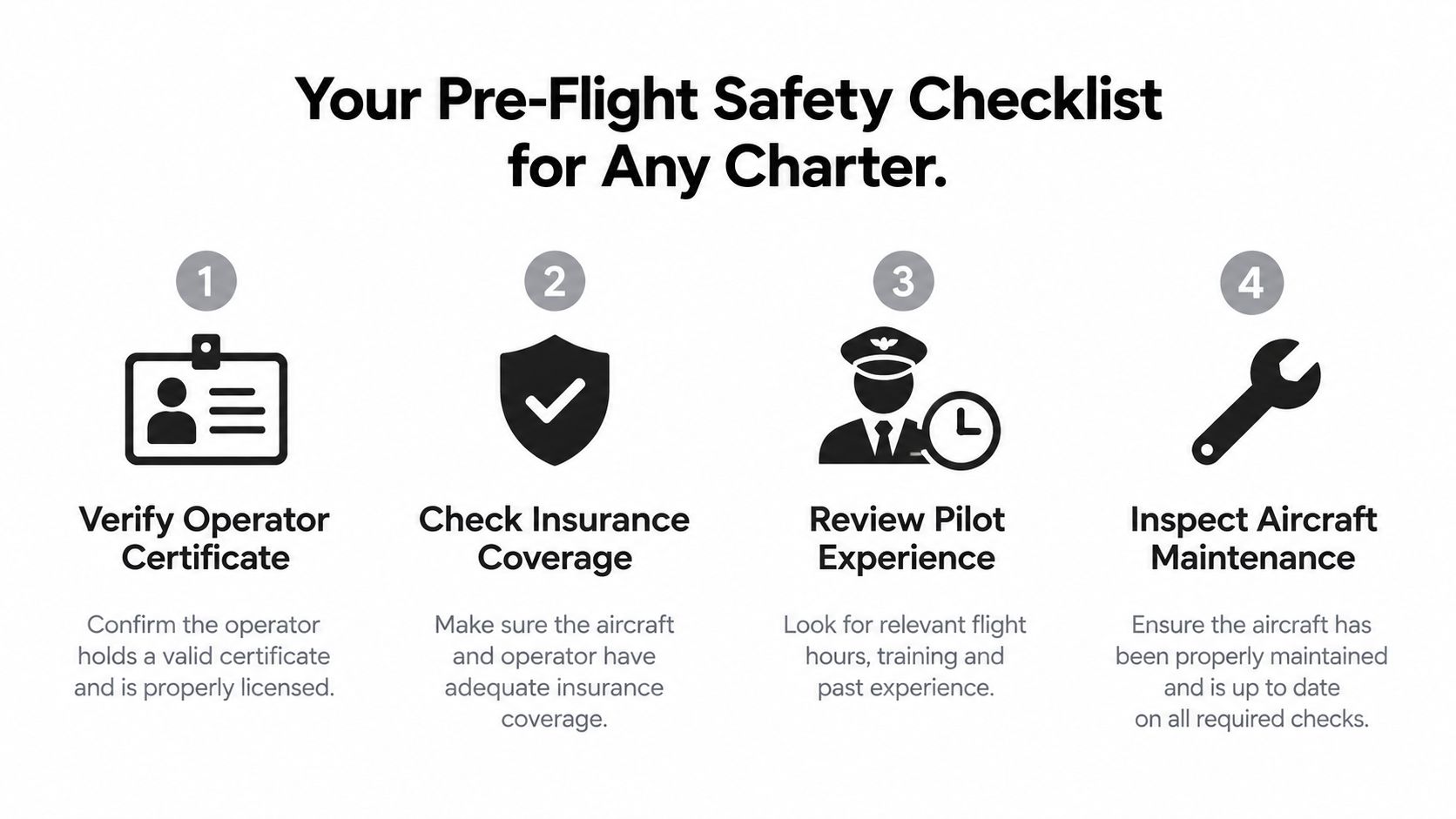
- Confirm the legal operator: Get the operator's legal name and verify that it holds FAA Part 135 authority for U.S. on-demand charter, or the applicable international approval. The booking intermediary isn't the certificate holder.
- Request the exact rating: Ask whether the operator holds Wyvern Wingman or ARGUS Gold or Platinum. Request the current validity date and ask about conditional findings.
- Match the aircraft: Obtain the tail number and confirm that it corresponds to the make, model, cabin, and aircraft promised. If the registration changes, repeat the review.
- Review the crew: Request pilot qualifications, ATP status where applicable, type-specific experience, and recurrent-training recency. Ask whether two pilots will operate the flight.
- Check the aircraft record: Search the registration and operator in the NTSB accident database, the official repository for U.S. civil-aviation accident data and causal factors. The database can include the event date, location, aircraft make and model, registration number, operator information, injury level, investigation status, and probable cause.
- Test the operational plan: Ask for the weather minima, named alternates, runway-performance review, fuel contingencies, and the dispatch decision-making chain.
- Confirm maintenance status: Ask what maintenance information can be shared for the assigned registration and whether any unresolved defect affects the planned flight.
The NTSB record is one input, not a complete safety verdict. An event may be old, minor, still under investigation, or unrelated to the operator's current systems. Use it to generate questions, then ask the operator for current context.
If any critical item can't be produced, don't rationalize the gap because the departure is convenient. Delay the trip, request a different aircraft or operator, or book elsewhere. A high-value itinerary deserves a clear paper trail and a willing answer to every material safety question.
Three Judgments to Carry to Every Booking
Before you book, can you identify the operator, aircraft, crew, and operating certificate governing your flight? Private aviation has no single safety profile. Judge those elements together, then confirm that the certificate applies to the planned trip.
First, treat the specific aircraft and mission as the unit of review. General-aviation data describes a broad population. It cannot approve your charter. Ask for the assigned tail number, crew certificates, and applicable operating certificate.
Second, use audits as evidence, not permission to stop checking. Wyvern Wingman and ARGUS Gold or Platinum status indicate external scrutiny, but they do not replace current maintenance information, crew review, weather decisions, or dispatch oversight. Ask what was reviewed, when, and what applies to today's flight.
Third, verify everything before departure. Request the tail number, crew information, weather briefing, alternates, and pre-departure summary in writing. If the aircraft or crew changes, repeat the relevant checks.
Read the Haute Jets Journal and review the company's safety information before comparing options. Haute Jets arranges on-demand charters through screened operators and provides flight details before departure. Visit Haute Jets to request a charter and confirm the operational details before committing.