
Private aviation safety has improved over time, but that headline alone will not help you choose a safe flight. What matters is where your trip falls on the safety spectrum, because private jet safety is not one uniform standard.
Serious clients should ask a more precise question: how strong is the operator behind this aircraft, this crew, and this specific trip?
That is the difference that changes risk. In private aviation, one operator may do little more than meet regulatory requirements. Another may apply tighter maintenance control, stricter crew training standards, cleaner documentation, and outside audit oversight. Two aircraft that look identical on the ramp can be run to very different standards.
Appearance misleads people. A newer jet, a well-known brand, or a polished cabin does not prove a stronger operation. Safety comes from disciplined systems, repeatable procedures, and management that treats every release to service seriously. The same principle applies in other high-risk environments. ABCO Security Melbourne solutions show why structured oversight and process matter more than surface impressions.
Use this standard from the start: judge the operator first, then the aircraft. That is how experienced buyers stay at the top end of the private jet safety spectrum.
Asking the Right Questions About Private Jet Safety
A polished jet, a famous charter brand, and a newer cabin tell you very little about safety. The quality of the operator tells you almost everything.
Private jet safety sits on a spectrum. At the low end, an operator meets the minimum legal standard and stops there. At the high end, the operator adds tighter maintenance control, stricter crew training, stronger dispatch discipline, better documentation, and independent audit oversight. Two aircraft with the same tail class and similar interiors can sit far apart on that spectrum because they are managed differently.
That is the point serious clients need to understand first.
Structured oversight matters in every high-risk environment. ABCO Security Melbourne solutions offer a useful parallel. Process, supervision, and accountability protect people far better than appearance or marketing.
Safety is a management decision
The strongest operators treat each flight as an operational release, not a simple sale. They know who is flying, who maintained the aircraft, what open items exist, whether the crew is current, and whether the trip fits the aircraft, weather, and airport profile. That discipline is what reduces risk.
A weak operator can still sell a beautiful airplane.
What to ask before you approve a trip
If you want a sharper way to judge 26. private jet safety, ask for evidence on these points:
- Who is the actual operator? Focus on the certificate holder.
- What third-party audit status does that operator hold? Independent audits quickly separate stronger operators from average ones.
- Who maintains the aircraft, and how is dispatch controlled? A strong operator answers clearly and without delay.
- Will you receive the tail number, crew details, and flight information before departure? You should.
Use this filter every time. Judge the operator first, then the aircraft. That is how experienced clients stay at the top end of the private jet safety spectrum.
Private vs Commercial Aviation A Statistical Snapshot
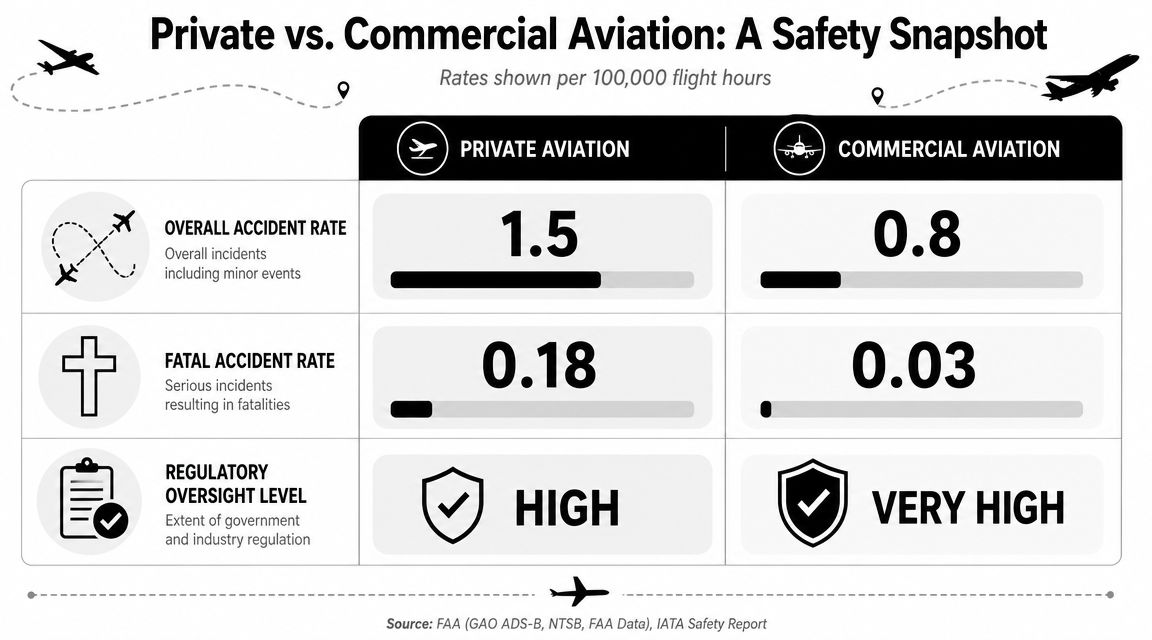
Commercial airlines remain the benchmark for the lowest-risk form of passenger aviation. That part is clear. The mistake is treating all private flying as one safety category.
Private aviation is a spectrum. At one end, you have disciplined charter and corporate operators with formal dispatch control, standardized training, and strict maintenance oversight. At the other, you have owner-flown or loosely managed aircraft operating under very different conditions. If you blur those together, the comparison stops being useful.
What the broad numbers actually mean
Aviation safety summaries often show general aviation performing worse than commercial airlines. That is directionally accurate, but general aviation is a very broad bucket. It includes everything from small piston aircraft and owner-pilots to business aircraft flying under structured company or charter programs.
That distinction matters.
If you are hiring a private jet, the relevant question is not whether general aviation matches the airline system. It does not. The relevant question is where your specific flight sits on the private aviation safety spectrum.
Why charter buyers should narrow the comparison
A professionally managed charter flight has more in common with a controlled operation than with casual private flying. The aircraft may still be private, but the risk profile changes materially when the operator uses formal procedures, recurrent crew training, audited maintenance records, and disciplined flight release standards.
Use this framework:
| Category | What it includes | How to use it |
|---|---|---|
| General aviation | A wide mix of aircraft, pilot experience, and mission types | Useful for broad context, poor for judging a charter trip |
| Professional charter and corporate jet operations | Aircraft run under structured operating standards with trained crews and managed maintenance | The only category that matters when you are booking a jet |
Commercial airlines still sit at the top for consistency because the system is tightly standardized at scale. Private charter can be very safe, but only when the operator belongs to the strongest tier of the market.
The right conclusion
Do not let a simple airline-versus-private comparison make the decision for you. It is too blunt. Use the comparison to set your standard higher.
For a charter client, operator quality is the whole story. You are not buying a category. You are buying one operator's maintenance culture, crew standards, dispatch discipline, and willingness to submit to outside review. That is why independent private aviation safety ratings like Wyvern and ARGUS matter so much. They help you separate average private aviation from the top end of it.
The Gold Standard Third-Party Safety Audits
If you want one filter that improves your odds of choosing well, use independent third-party audits.
In the U.S., charter operators must hold an FAA Part 135 certificate, which sets the legal minimum for carrying passengers. That includes requirements around infrastructure, personnel qualifications, maintenance programs, manuals, and FAA inspections before passengers are carried. Operators also must follow an FAA-approved inspection program with detailed airworthiness recordkeeping and address or properly defer unscheduled defects before flight (Paramount Business Jets on what happens during a private jet safety check).
That's the floor. It is not the gold standard.
Why audits matter more than marketing
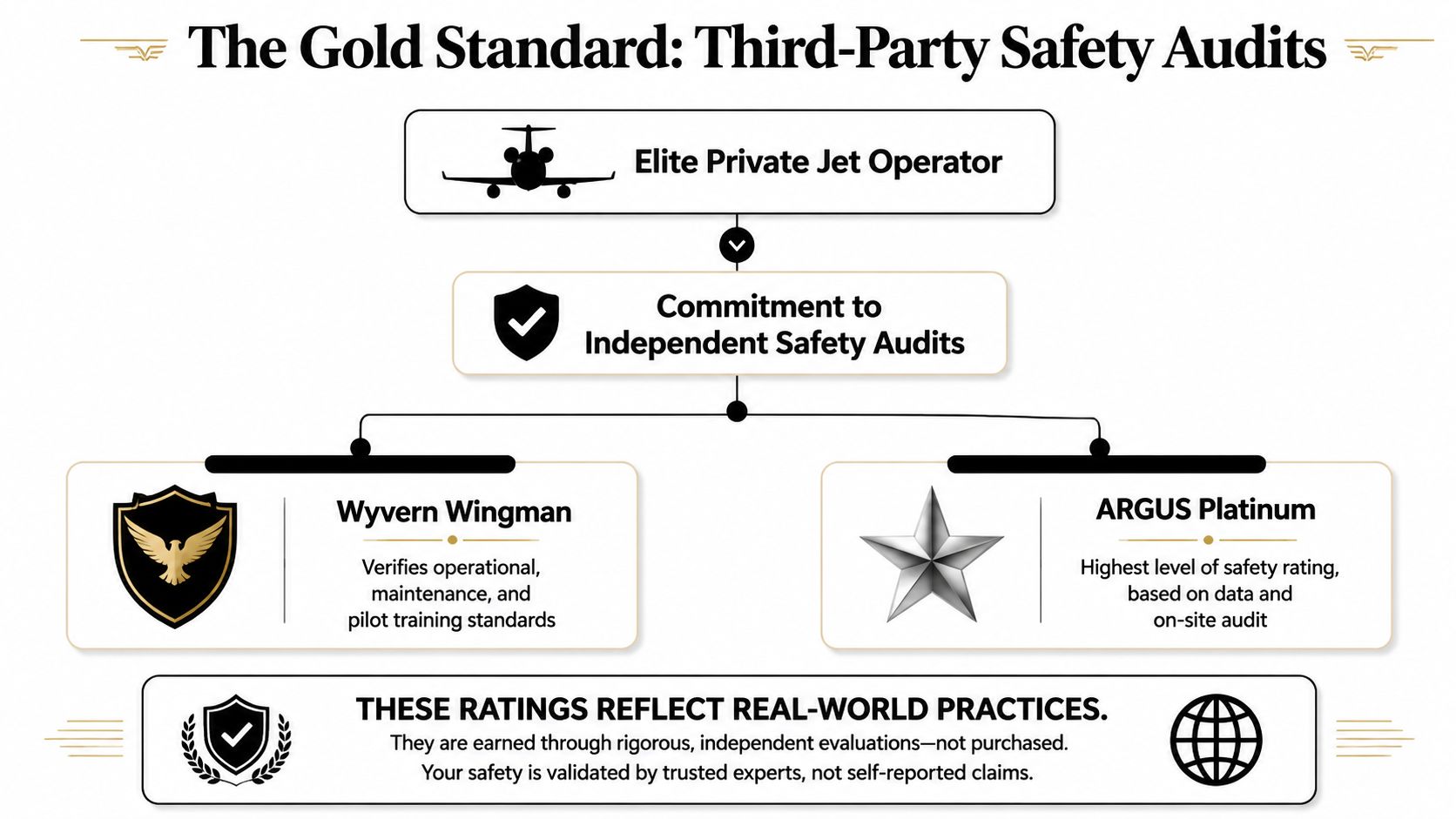
The strongest operators volunteer for scrutiny beyond what the law requires. In practical terms, that means independent auditing bodies review the operator's real-world business practices, not just whether it technically holds a certificate.
The two names clients should know are Wyvern and ARGUS. Ratings such as Wyvern Wingman and ARGUS Gold or Platinum matter because they signal that someone outside the operator has examined the operation more thoroughly.
For a closer look at what those ratings mean, read Haute Jets Journal's guide to Wyvern and ARGUS safety ratings.
What these audits tell you
A strong audit profile helps answer the questions that matter most:
- Maintenance control: Are inspections, repairs, records, and defect resolution handled with discipline?
- Pilot currency: Are flight crews current, qualified, and managed under a controlled system?
- Operational oversight: Does the operator have real procedures, or just paperwork?
- Consistency: Can the company demonstrate the same standard across flights, crews, and aircraft?
What these ratings don't do is guarantee perfection. Nothing in aviation does. But they are one of the most useful ways to reduce uncertainty before you book.
If an operator can't clearly present its audit status, you should assume you need a better option.
What I recommend
For on-demand charter, I'd treat recognized third-party audit status as an absolute requirement. Don't get distracted by a beautiful cabin or an attractive quote if the operator behind it is vague, weak, or unverifiable.
The safest end of private aviation is built on documented systems, not confidence alone.
Inside the Hangar Aircraft Maintenance and Crew Training
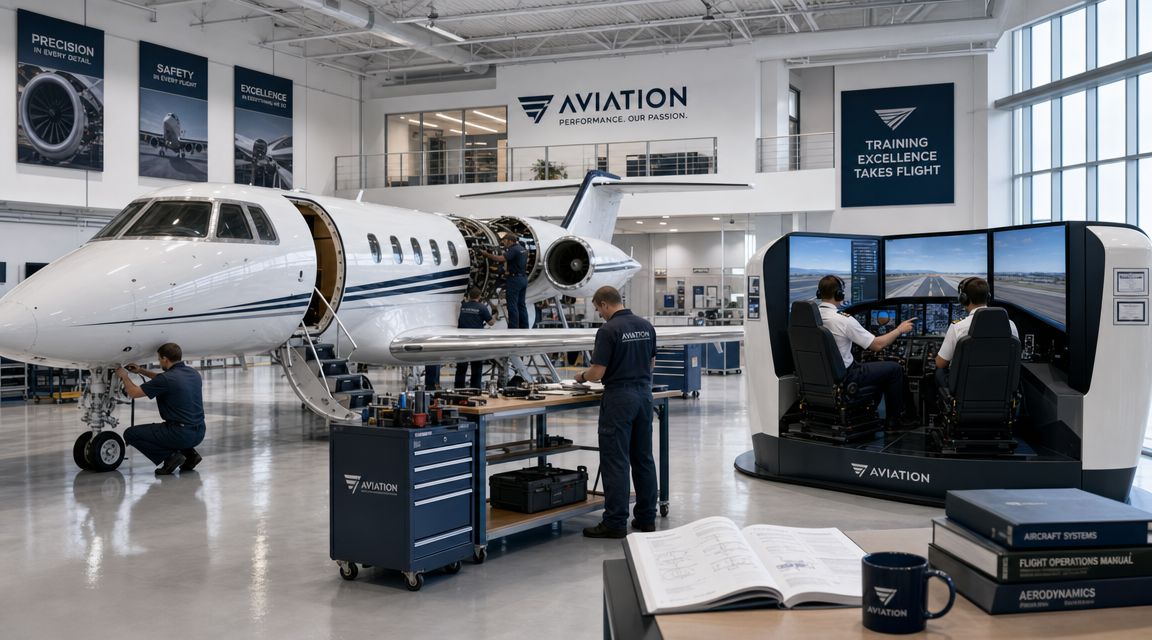
The strongest safety record in private aviation doesn't come from luck. It comes from repetitive discipline inside the hangar and inside the simulator.
That's why professionally managed executive and corporate jets stand out. In 2021, executive/corporate jets recorded about 0.26 accidents per 100,000 hours flown, with a death rate of zero that year, while on-demand air taxi flights were cited at about 0.76 accidents per 100,000 hours and a fatal accident rate of 0.2 (Element Aviation summary citing NTSB and National Safety Council data). The numbers reinforce a simple point. Operational quality changes outcomes.
What strong maintenance looks like
A serious operator doesn't “fix things when needed.” That mindset is too loose for aviation.
Strong maintenance programs track airworthiness records carefully, comply with scheduled inspection programs, handle discrepancies formally, and avoid casual decision-making around deferred defects. Good operators also have clear maintenance control responsibility. Someone owns the process, signs off correctly, and keeps records clean.
If you want a simple analogy, think of surface protection in high-performance equipment. The value isn't the finish. It's the underlying resistance and consistency of the system. The same logic sits behind technical discussions like the benefits of graphene coatings. In aviation, appearance is secondary. What matters is controlled protection, repeatable standards, and documented performance.
What strong crew training looks like
A pilot's license is the starting point. It isn't the full safety story.
I want to see crews who are current on type, trained recurrently, and supported by an operator that treats standardization seriously. The best crews don't improvise process. They brief thoroughly, use checklists properly, manage cockpit workload well, and operate within a company culture that backs conservative decisions.
For a broader look at how these practices support reliability, see maintaining excellence in private jet safety and reliability.
The safest crews aren't the most swaggering. They're the most standardized.
What clients should pay attention to
If you're evaluating a flight, ask less about the leather seats and more about the operation behind the cabin door.
Look for signs of:
- Structured maintenance management
- Clear crew qualifications
- Professional dispatch control
- A company culture that values conservative decision-making
Those are the details that separate a polished sales pitch from a safe trip.
Debunking Common Private Jet Safety Myths
A lot of bad safety thinking comes from visual assumptions. People see a smaller aircraft, an older tail number, or rough weather on the forecast and jump to conclusions. That's not how aviation works.
Myth one: Smaller jets are less safe
Size doesn't decide safety. The operation does.
A smaller private jet flown by a disciplined operator with strong maintenance, current crews, and solid dispatch control is a better safety proposition than a larger aircraft run by a weak operator. Clients often overestimate the meaning of size because it's easy to see. The systems behind the flight matter more.
Myth two: Older aircraft are dangerous
Aircraft age alone doesn't determine airworthiness. Maintenance quality does.
A well-maintained aircraft with complete records, proper inspections, and disciplined oversight can be a sound charter option. A newer aircraft isn't automatically safer if the operator cuts corners. Airworthiness is earned through process, not model year alone.
Buyers fixate on age because it feels concrete. In private aviation, maintenance history is usually the sharper question.
Myth three: Private jets can't handle bad weather
Private jets operate within structured weather decision-making, just as other serious aviation operations do.
Pilots don't “push through” because a client wants to leave. They work within aircraft limitations, company procedures, and real-time operational judgment. Delays, reroutes, and cancellations are not signs of weakness. They're often signs that the operation is doing its job.
Myth four: The aircraft brand tells you everything
A Gulfstream, Bombardier, Citation, or Embraer badge can tell you something about capability and cabin experience. It does not tell you enough about safety on its own.
The same aircraft type can be run under very different standards depending on the operator. If you remember one thing, remember this: the name on the tail matters less than the name on the certificate and the audit file.
Red Flags to Watch for When Booking Your Charter
A weak charter decision usually happens on the ground, during sourcing, vetting, and booking. Private jet safety sits on a spectrum, and the biggest gap is rarely the aircraft model. It is the quality of the operator behind that specific flight.
That is the standard to use when you book. Ask who is operating the aircraft, what safety audit status applies, and whether the documentation matches the exact trip you are buying. General reassurance is not enough.
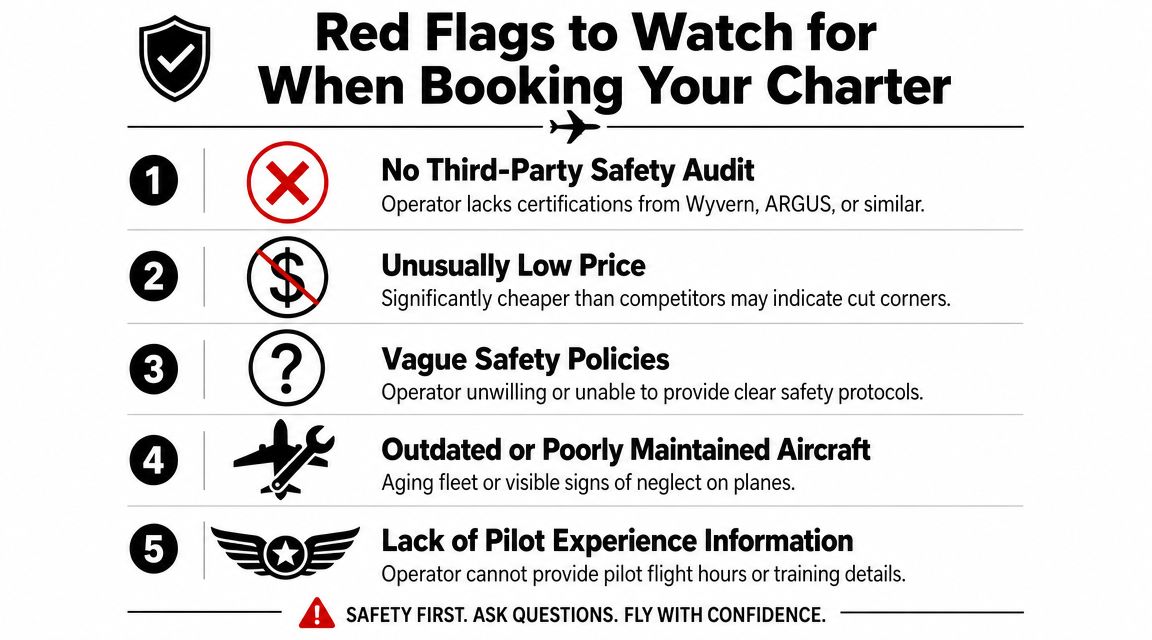
Red flags that should stop the booking
The operator is not clearly identified If a broker will not name the certificate holder flying the trip, stop there. You cannot assess standards, audit status, or operating history without that information.
Audit status is missing, vague, or outdated
Serious operators can state their standing clearly. Evasive answers on Wyvern, ARGUS, or IS-BAO usually mean you are being asked to accept lower visibility than you should.The quote is materially below the rest of the market
Price gaps often point to weaker sourcing, weaker operator quality, or shortcuts in how the trip is being assembled. Charter is one of the few categories where a bargain should make you more suspicious, not more comfortable.You are pushed to approve before receiving documents
Speed is normal in private aviation. Blind speed is not. You should be able to review the operator identity, aircraft details, and safety credentials before you send funds.Answers on crew, maintenance, or dispatch stay generic
Strong operators and disciplined brokers answer operational questions plainly. Polished sales language without specifics is a warning sign.
The booking habit that protects you
Before you approve any flight, ask for three items tied to that trip: the operator name, the tail number, and the current safety standing attached to that operator. That one habit filters out a large share of avoidable risk.
Some advisory platforms screen those standards before presenting options. For example, Haute Jets outlines its operator screening criteria on its private jet safety standards page. Use that as the model. Start with operator quality and third-party validation, then evaluate schedule, cabin, and price.
The Haute Jets Commitment to Uncompromising Safety
A credible safety model has to remove weak options before the client ever sees them. That's the right way to handle charter risk.
Haute Jets Journal exists to make that standard plain. If you're serious about private aviation, safety diligence shouldn't depend on whether you happen to ask the right questions on a busy day. It should be built into the booking process from the start.
What the model should do for the client
A strong charter process should screen for:
- Recognized third-party audit status
- Professional maintenance control
- Current, qualified crews
- Transparent pre-flight documentation
Clients shouldn't have to reverse-engineer an operator's standards from sales language. They should receive clear flight details and know the core diligence has already been handled.
Where to verify the policy
If you want the cleanest summary of the safety standard behind the platform, review the Haute Jets safety page.
That's the right benchmark for any serious private aviation advisor as well. Build safety into sourcing. Don't bolt it on after the quote is accepted.
Frequently Asked Questions About Private Jet Safety
What is a Safety Management System and does my operator have one
A Safety Management System, usually called an SMS, is the operator's internal method for identifying risk, reporting issues, tracking hazards, and improving procedures before problems become incidents.
You should expect a strong operator to run with formal safety processes, not informal judgment alone. If the operator or broker can't speak clearly about how risk is managed operationally, that's not a good sign.
How is bad weather handled on a private jet
Bad weather is handled through operational limits, pilot judgment, dispatch support, and conservative go or no-go decisions. Private jets don't get a free pass because the passengers are important.
A weather delay or diversion can be frustrating. It is also often evidence that the system is working exactly as it should.
Can I verify the safety rating of my specific flight before departure
Yes. You should ask for the actual operator, the tail number, and the relevant safety credentials for that trip.
If you're using a broker or advisor, they should be able to present those details cleanly. If they resist, you've learned something useful.
Does a newer jet automatically mean a safer jet
No. Newer aircraft can bring advantages, but they don't override weak operational discipline.
A well-run operator with strong maintenance and crew standards matters more than a newer aircraft flown under looser controls.
What should matter most when I book
If you reduce the entire decision to one priority, make it this: choose the right operator.
That means verified audit status, disciplined maintenance, current crews, and transparent documentation tied to your specific flight. That is the center of 26. private jet safety. Everything else is secondary.
If you want charter options screened through a safety-first lens, Haute Jets offers on-demand private jet sourcing with operator vetting built into the process, so you can review the exact aircraft and flight details with far more clarity before you fly.