
You've found a private jet for hire, received an attractive hourly rate, and are now wondering whether the aircraft is nearby, whether the quote includes repositioning, and who is responsible if the plan changes. Those questions matter more than the glossy cabin photographs. A charter succeeds when the aircraft, operator, schedule, airport, paperwork, and invoice all line up before you pay.
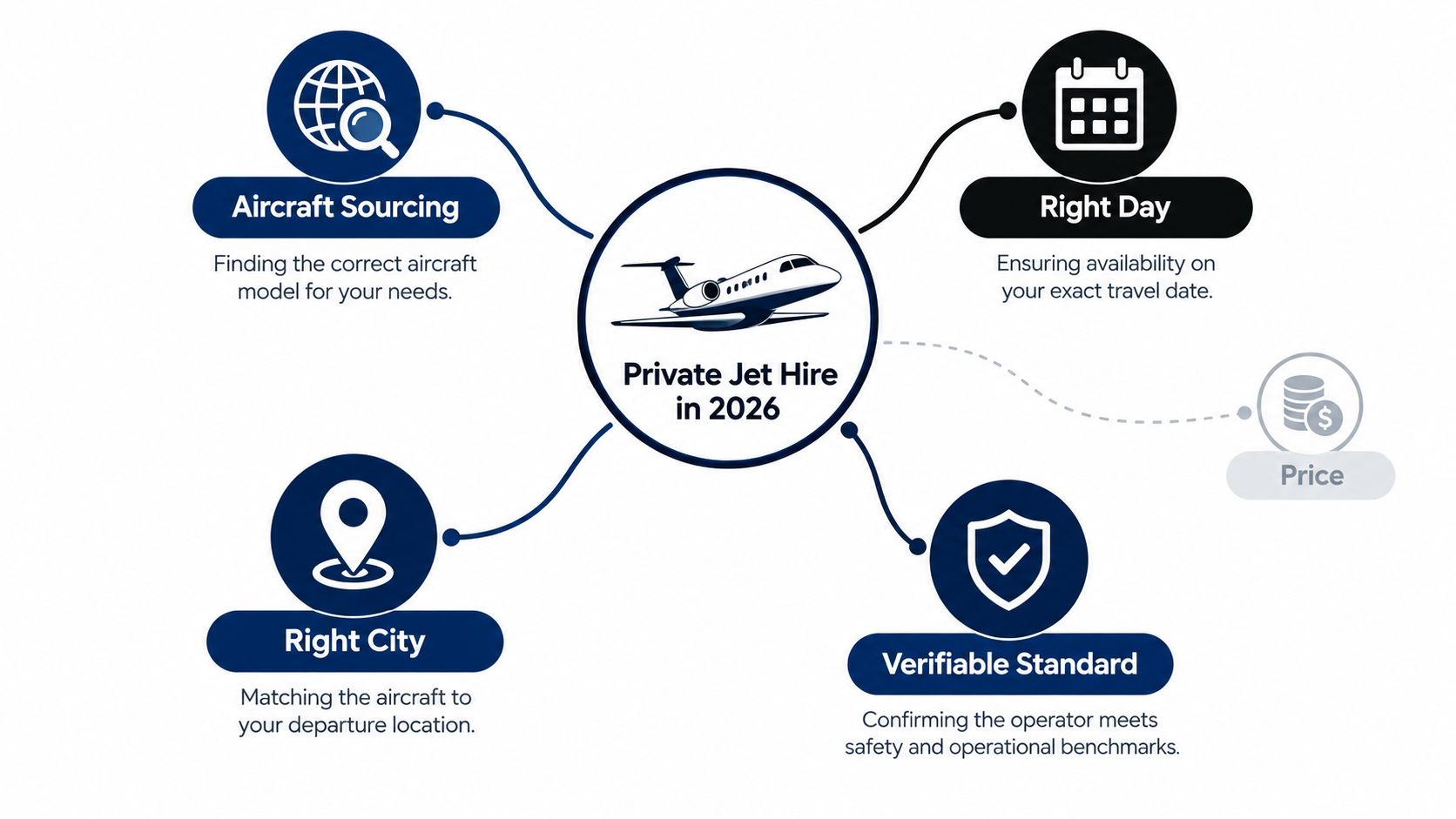
Private aviation is a sourcing decision first and a price negotiation second. The right broker finds an aircraft that fits the mission, confirms who operates it, verifies the standard behind it, and shows you the complete cost rather than a tempting base rate.
What Hiring a Private Jet Actually Means in 2026
A private jet for hire isn't a single product sitting on a shelf. It's a coordinated flight arranged around a specific aircraft, date, departure airport, passengers, and operating company. Your first decision should be whether the aircraft is already close to your departure city. If it isn't, the operator may need to fly an empty positioning leg before collecting you, and that ferry movement can materially change the invoice.
The parties involved should be clear:
- The operator: The FAA Part 135 certificate holder conducts the charter and retains final operational control. That means the operator is responsible for the aircraft, crew, dispatch, maintenance status, and legal operation.
- The charter broker: The broker acts as your sourcing agent. A competent broker compares available aircraft and explains why one quote differs from another.
- The trip support team: Flight planners, permit specialists, catering coordinators, ground handlers, and passenger-service staff turn the booking into an executable itinerary.
This chain matters because the brand on your email may not be the company flying the aircraft. Ask for the legal operator, certificate information, insurance details, aircraft registration, and the precise tail number before accepting a quote.
Access models aren't interchangeable
On-demand charter means you buy one trip at a time. A jet card typically gives you access to prepaid hours under a defined program, while fractional ownership gives you an ownership share in a particular aircraft type and adds management obligations. Commercial first class remains a scheduled airline product, even when the seat and service are excellent. These models differ by access, control, commitment, and aircraft availability, not merely by luxury.
The market has substantial recurring utilization. An industry estimate cited by Forbes reported 3,878,836 global private jet flights in 2025, up 4.6% from 2024, and above the previous record of 3,764,935 flights in 2022 by 113,901 flights (industry flight data). You shouldn't treat availability as unlimited, however. A specific aircraft in a specific city on a peak date may be unavailable, even while other aircraft are open elsewhere.
For perspective beyond the booking desk, readers comparing chauffeur logistics can also find a private hire vehicle for airport transfers and local travel. The same sourcing principle applies: confirm the exact vehicle, pickup point, timing, and total price.
Choosing How to Pay for the Flight
The cleanest buying decision comes from matching the payment model to your actual flying pattern. Don't purchase a jet card because the rate looks tidy, and don't buy a fractional share because ownership sounds prestigious. Review your routes, passenger counts, scheduling consistency, and tolerance for aircraft substitutions.
| Feature | On-Demand Charter | Jet Card | Fractional Ownership |
|---|---|---|---|
| How you buy | One trip at a time | Prepaid block hours at a contracted rate | A share of a specific jet |
| Best fit | Irregular travel and changing routes | Predictable use across a defined aircraft category | High utilization on consistent city pairs |
| Aircraft choice | Usually broad, trip by trip | Limited by program fleet and category | Tied to the owned share and fleet rules |
| Cost behavior | Quote varies by aircraft, location, and date | Rate may be more predictable, with program rules | Adds management costs and occupied-hour charges |
| Commitment | No long-term commitment | Prepayment and program terms | Capital commitment and ongoing ownership obligations |
| Repositioning | Often itemized or included in the trip price | May be absorbed, capped, or passed through | Managed within the ownership program, but not free |
On-demand charter
For travelers flying under 25 hours annually, with irregular routing, on-demand charter usually makes the most sense. You pay for the mission you need and can choose a light jet for one trip, a larger cabin for another, or a turboprop where a jet would be wasteful. You also need to scrutinize positioning, minimum daily time, fuel treatment, taxes, handling, and crew expenses.
A useful starting point is the private jet charter cost guide, but treat any published range as a starting point, not a promise. The aircraft's actual location and the route's operating requirements determine the quote.
Jet cards
Jet cards suit travelers with 25 to 100 predictable hours who value a contracted structure more than maximum aircraft flexibility. Programs commonly sell prepaid hour blocks tied to an aircraft category. Read the rules for peak-day access, daily minimums, cancellation windows, fuel surcharges, catering, and repositioning. A locked hourly rate isn't necessarily a locked trip price if the contract passes through taxes, de-icing, international handling, or unusual airport costs.
Fractional ownership
Fractional ownership can make sense at 100 or more hours on consistent city pairs, especially when the owner values dependable access and accepts the financial obligations. You're paying more than an occupied flight. Management, maintenance reserves, monthly charges, and resale considerations belong in the calculation.
Empty legs deserve a separate warning. Advertised discounts commonly fall between 25% and 75%, and some listings have appeared as low as $300 per person, according to an independent 2026 pricing roundup (empty-leg pricing analysis). Those flights are bargains only when your date, route, passenger count, and flexibility match the repositioning plan. They're poor substitutes for a dependable one-way or return itinerary.
Picking the Right Aircraft for Your Trip
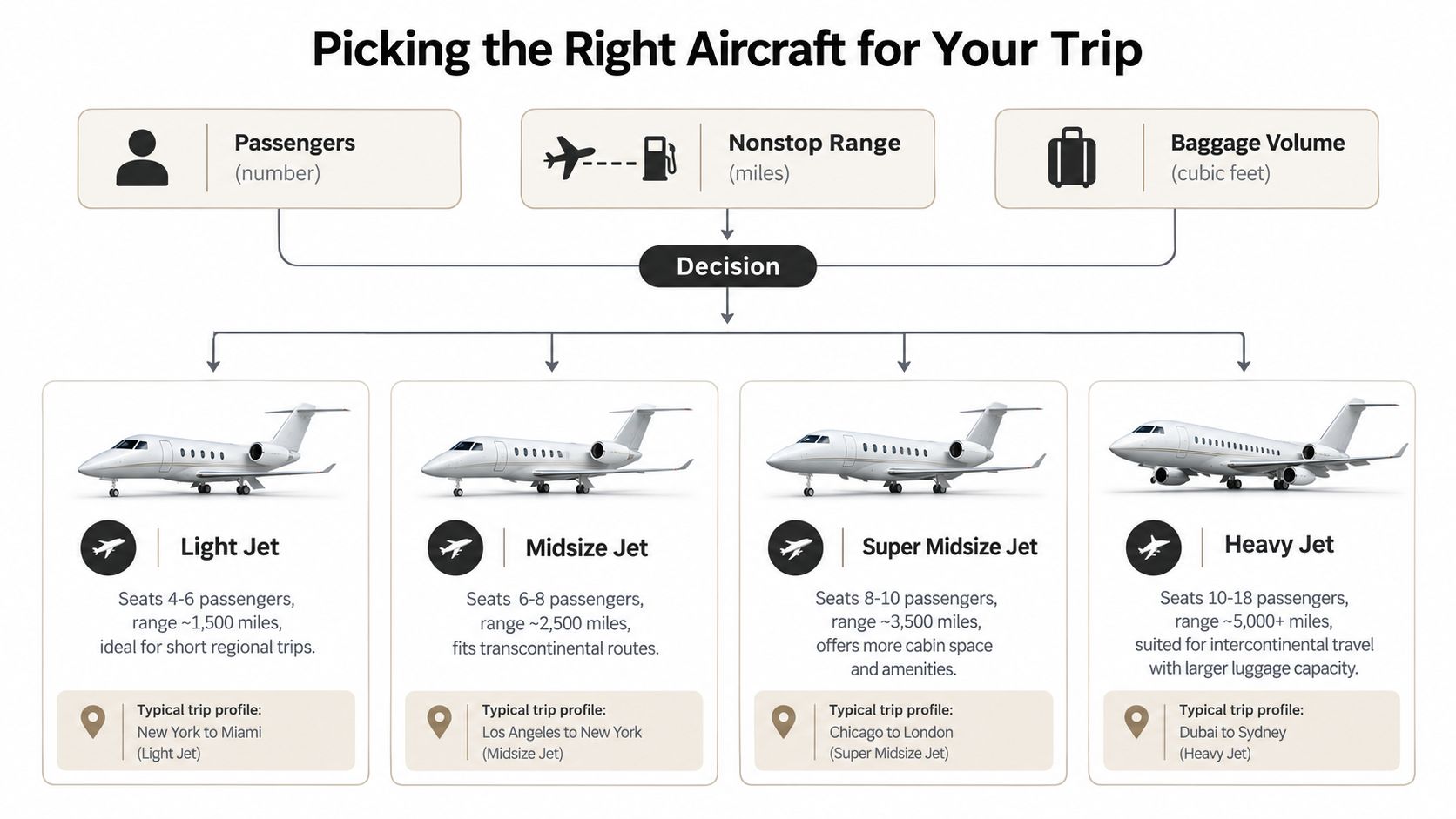
Aircraft selection starts with three questions: How many people are flying? How far must the aircraft go nonstop? How much baggage is coming along? Ignore cabin marketing until those answers are settled. A beautiful aircraft that needs a fuel stop or can't carry your equipment is the wrong aircraft.
Match the mission to the category
A four-passenger New York to Miami trip generally fits a light jet such as an Embraer Phenom 300 or Citation CJ3+. That category can deliver the needed capability without paying for a heavy cabin you won't use. A six- to eight-passenger coast-to-coast or transatlantic itinerary calls for a super-midsize or heavy aircraft, with examples including the Challenger 350 and Gulfstream G450.
For a corporate shuttle carrying 12 or more passengers, look at an ultra-long-range aircraft or an airliner category. A Global 6000 or Boeing BBJ may be appropriate when passenger volume, baggage, cabin movement, and onboard work requirements outweigh the higher operating cost.
Turboprops remain useful for short sectors, remote airports, and rough-field operations. They can be the sensible answer when runway access and local airport proximity matter more than jet speed. Haute Jets pricing lists turboprops at $1,500 to $3,500 per hour and light jets at $5,000 to $7,000 per hour, while its published charter rates start from $3,500 per hour (published aircraft pricing). Those figures aren't comparable without checking the aircraft location, minimum time, and included services.
Cabin details change the decision
A lavatory-equipped aircraft may cost more than a comparable model without one, but that difference can be decisive for families or longer sectors. A wet galley, stand-up cabin, Wi-Fi system, lie-flat seating, and baggage compartment all affect suitability. So does crew configuration. Some Part 135 missions may use a single-pilot-approved aircraft, while others require two pilots because of the aircraft, route, or operator procedures.
The broker should provide the specific year, make, model, cabin layout, tail number, baggage capacity, and nonstop performance for your route. Category names alone aren't enough.
Sourcing rule: Choose the smallest aircraft that comfortably completes the mission, then locate an exact tail near your departure city.
For additional aircraft-selection guidance, review how to choose the right aircraft for short-haul private flights.
Reading a Charter Quote Without Getting Burned
You have found an aircraft near your departure city, and the broker sends one attractive all-in figure. Before approving it, make the quote rebuildable. It should show occupied block time, repositioning, minimum daily time, taxes, airport charges, crew expenses, and optional services as separate lines.
The common pricing error is treating the aircraft's hourly rate as the trip's effective hourly invoice. An $8,000 hourly rate can become a $12,000 effective hourly invoice after repositioning and other charges. That example illustrates the calculation, not a standard market rate. The aircraft can bill for time spent getting to you and returning after the flight, not only for the hours you occupy the cabin.
| Line Item | What It Covers | Negotiable? |
|---|---|---|
| Occupied block time | The aircraft's billed flight time, often measured from movement at the departure airport to arrival movement | Sometimes, depending on minimums and aircraft |
| Daily minimum | The minimum billable time imposed for the aircraft or itinerary | Often worth challenging |
| Positioning or ferry leg | The empty flight required to bring the aircraft to you or return it afterward | Frequently avoidable through local sourcing |
| Federal excise tax | Applicable tax on qualifying U.S. charter transportation | No, when legally due |
| Segment fees | Passenger or sector-related government charges | Usually no |
| FBO handling | Fixed-base operator services, ramp use, parking, and handling | Sometimes |
| International handling and permits | Customs, immigration, permits, and international trip support | Limited flexibility |
| De-icing and weather services | Required winter operations or weather-related services | No, when required |
| Catering | Meals, beverages, special orders, and delivery | Menu and markup may be negotiable |
| Crew overnight | Hotels, meals, transportation, and crew expenses during a layover | Sometimes, through itinerary planning |
Positioning deserves close attention on a one-way trip. An empty repositioning segment is typically billed at the occupied hourly rate and can add about 20% to 40% to the base charter price. Short one-way trips often take the largest hit because the repositioning cost is spread across fewer occupied hours.
Use a direct quote script
Send the broker this request:
“Please itemize occupied block time, minimum daily time, every ferry segment, taxes, handling, permits, crew expenses, de-icing, catering, and ground services. Show the ferry distance and aircraft location used to calculate each charge. Then provide a second option using a suitable empty leg, with its cancellation and schedule-change terms.”
A reliable quote separates occupied time from federal excise tax, crew overnights, FBO handling, fuel surcharges, landing and de-icing fees, permits, and positioning. Composite guidance places these extras at 20% to 40% on domestic charters and 30% to 45% on international routes. Treat those ranges as a review prompt, not a substitute for the actual invoice.
Reject any quote that hides the ferry calculation, leaves minimums unclear, or presents an unexplained all-in total. The best sourcing question is simple: where is the suitable aircraft now, and what will it bill before and after your flight?
Booking, Paperwork, and the Pre-Departure Timeline
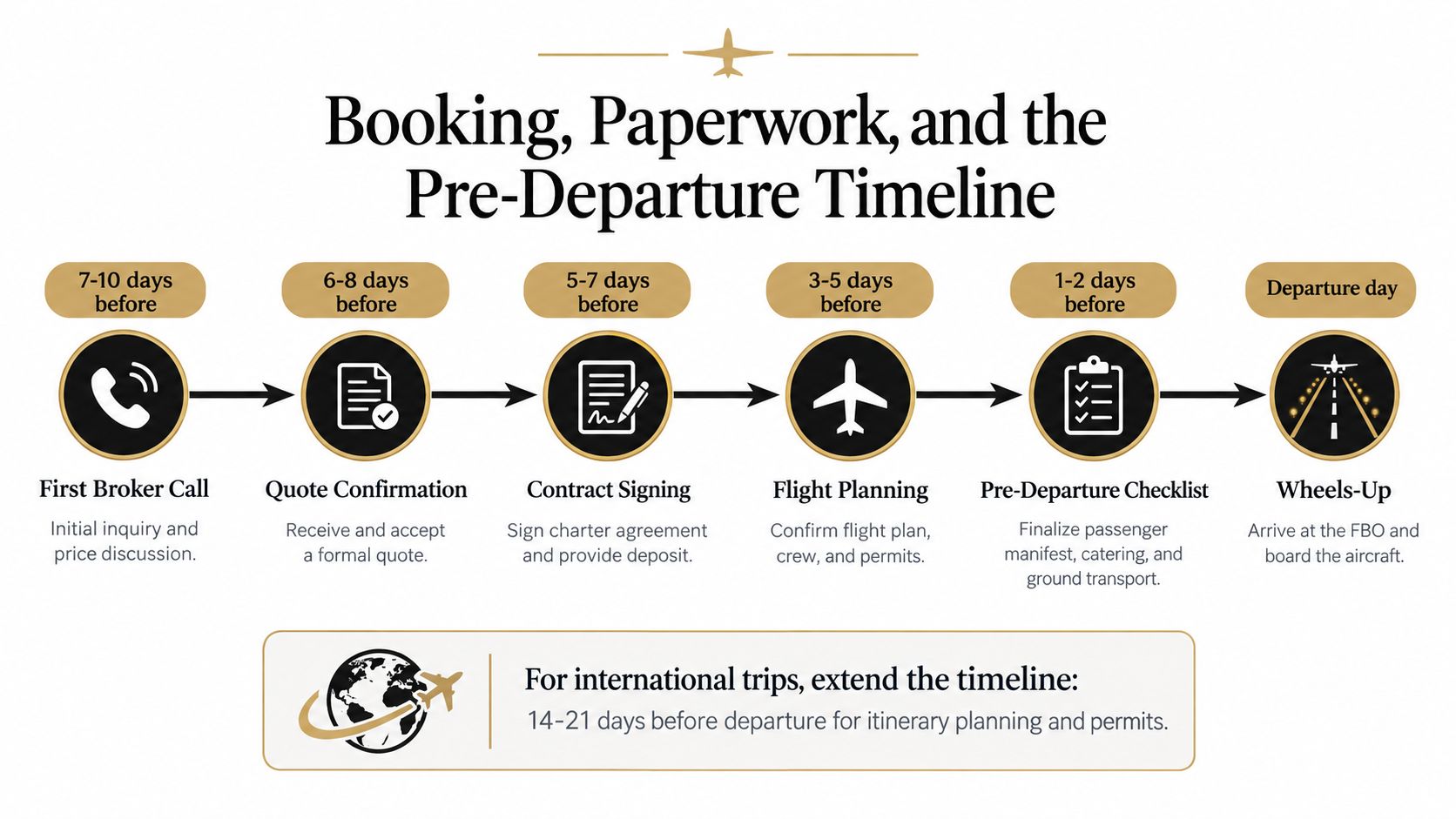
A good charter booking follows a sequence. The broker first identifies aircraft and operator availability, then the operator confirms legality, permits, crew, maintenance, and airport handling. Your job is to provide accurate passenger and itinerary information early, because incomplete details create avoidable changes later.
Start with the right lead time
For a straightforward domestic trip, I recommend beginning within the 7-to-10-day window. International travel, oversized cabins, complex routing, and event dates deserve 14 to 21 days so the team can secure permits, customs support, crew planning, and suitable aircraft. A 12-to-72-hour fast-track booking is possible in many markets, but short notice reduces choice and can carry premium pricing.
Give the broker:
- Exact airports: Include the preferred FBO and acceptable alternatives.
- Passenger details: Names, dates of birth where required, citizenship, and identification information.
- Baggage facts: Include bulky cases, sports equipment, musical instruments, or pets.
- Operating constraints: State whether you need nonstop travel, a specific cabin, Wi-Fi, or a return aircraft.
- Ground requirements: Request chauffeur service, rental car staging, parking, or hotel support.
Paperwork is operational, not ceremonial
Part 135 operators need a complete passenger manifest and Secure Flight information. International legs may require customs and immigration filings, overflight permits for trans-border routes, and a CBP decal for arrivals from international destinations. Requirements vary by route and nationality, so provide valid documents before the flight team asks repeatedly.
Payment terms also need to be written into the booking. Confirm the deposit milestone, final payment deadline, wire instructions, card surcharges, cancellation terms, and the treatment of schedule changes. Don't assume the initial quote explains every post-booking charge.
The formal confirmation should identify the operator, aircraft, tail number when available, crew, routing, FBOs, and services. Use this guide to booking a private jet as a practical reference, then ask your broker to confirm the exact process for your itinerary.
Lock the trip 24 hours before departure
At the 24-hour confirmation call, the team should review the flight plan, crew legality, weather, aircraft maintenance release, passenger manifest, catering, ground transport, and any remaining permits. This is when you should learn whether the tail number changed and why. A substitution can be acceptable, but it shouldn't be a surprise at the FBO.
Ground logistics finish the chain. Confirm ramp parking, FBO access, luggage handling, vehicle staging, and crew hotel arrangements for multi-day trips. Your aircraft may be ready, but an unplanned transfer or missing access instruction can still ruin the first hour of the journey.
Your Pre-Flight Checklist for a Smooth Charter
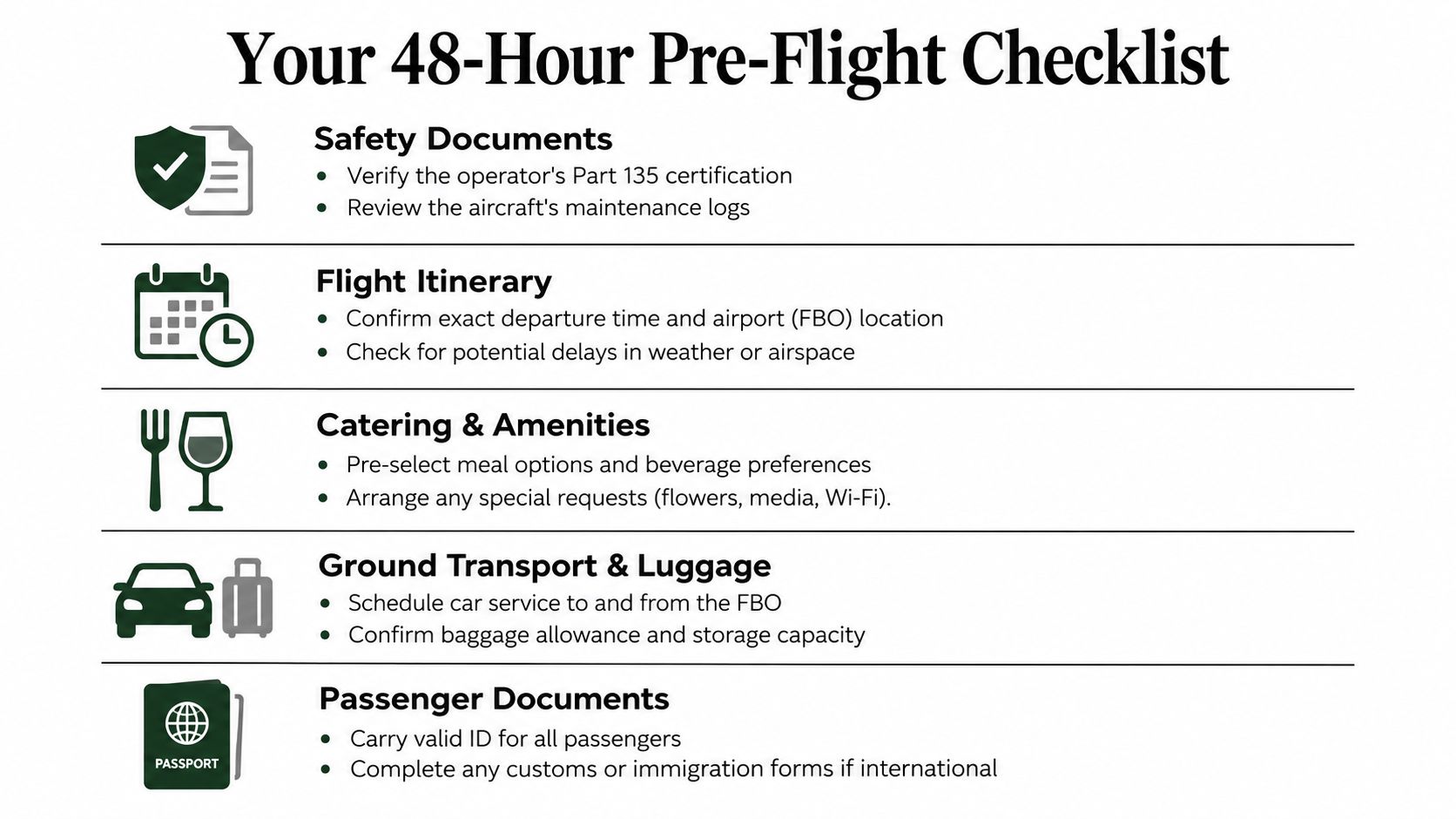
The last 48 hours determine whether a charter feels effortless or improvised. A checklist forces every preference and safety question into the open while there's still time to correct it.
Begin with the operator, not the champagne. Ask for the operator's Part 135 certification and verify a recognized third-party safety audit. ARGUS Platinum and Wyvern Wingman are top-tier on-site audit standards. ARGUS Platinum examines the operator's safety management system, training program, maintenance tracking, and operational control. Wyvern Wingman reviews pilot training, drug and alcohol testing compliance, maintenance practices, and the operator's safety management system (safety rating explanation).
Verify the actual aircraft
A category isn't an aircraft. Confirm the tail number, year, make, model, cabin layout, maintenance status, and pilot assignment. Ask whether the crew meets rest and duty requirements for the planned itinerary, especially when you're requesting an early departure, late arrival, or multi-leg day.
Review the following before departure:
- Safety documents: Confirm the operating certificate, audit status, insurance information, and aircraft maintenance release.
- Itinerary: Check the exact departure time, airport, FBO address, arrival airport, and alternate plan for weather or airspace disruption.
- Passenger records: Make sure every traveler carries valid identification and that international customs or immigration forms are complete.
- Pets: Provide carrier details, vaccination or destination paperwork, service-animal documentation, and any airport-specific requirements. Pet relief areas and FBO policies vary.
- Luggage: Describe oversized or fragile items before the aircraft is finalized. A cabin that seats your group may not hold every bag.
Specify the cabin before catering arrives
Catering should reflect the actual passenger list, including allergies, religious requirements, children, and preferred beverages. Confirm whether Wi-Fi is installed and functional, not merely listed as an available amenity. State your preferred cabin temperature, entertainment needs, flowers, media, or other special requests early.
Ground transport deserves the same precision. Confirm chauffeur meet-and-greet instructions, vehicle access to the FBO, luggage tagging, pickup timing, and the contact who handles a diversion. If the aircraft lands at an alternate airport, your driver needs a contingency instruction rather than a guess.
Pre-communicated preferences prevent surprise costs. Every item you confirm before departure removes one decision from the crew and one potential scramble from your itinerary.
The checklist is also your final invoice check. If catering, ground transport, pet handling, de-icing, or schedule changes weren't included, ask for the expected treatment before wheels-up. A private charter should feel flexible, but flexibility only works when the operating team has accurate information.
Haute Jets arranges on-demand charter flights by matching your route, date, passenger count, and aircraft requirements with available operators, without requiring a membership or jet card. Visit Haute Jets to request a quote built around local aircraft availability, a verified operator, and a clearly itemized trip cost.