

The CRJ-200 plane is a 50-seat regional jet, and the long-range CRJ200LR is listed at about 1,700 nautical miles. That sounds simple until you ask the central question for charter planning, which is how many passengers and how much baggage it can lift from your airport without a technical stop.
Have a trip that looks fine on paper but falls apart once the runway, weather, and payload are real? That's where the CRJ-200 either works well or turns into the wrong aircraft fast.
What Every Charter Buyer Should Know About the CRJ 200 Plane
A buyer can look at a brochure and think the answer is obvious. 50 seats sounds like 50 people, and 1,700 nautical miles sounds like a long nonstop hop, but that's not how charter planning works in practice. The better question is simpler: what can this aircraft carry from your airport on your date?
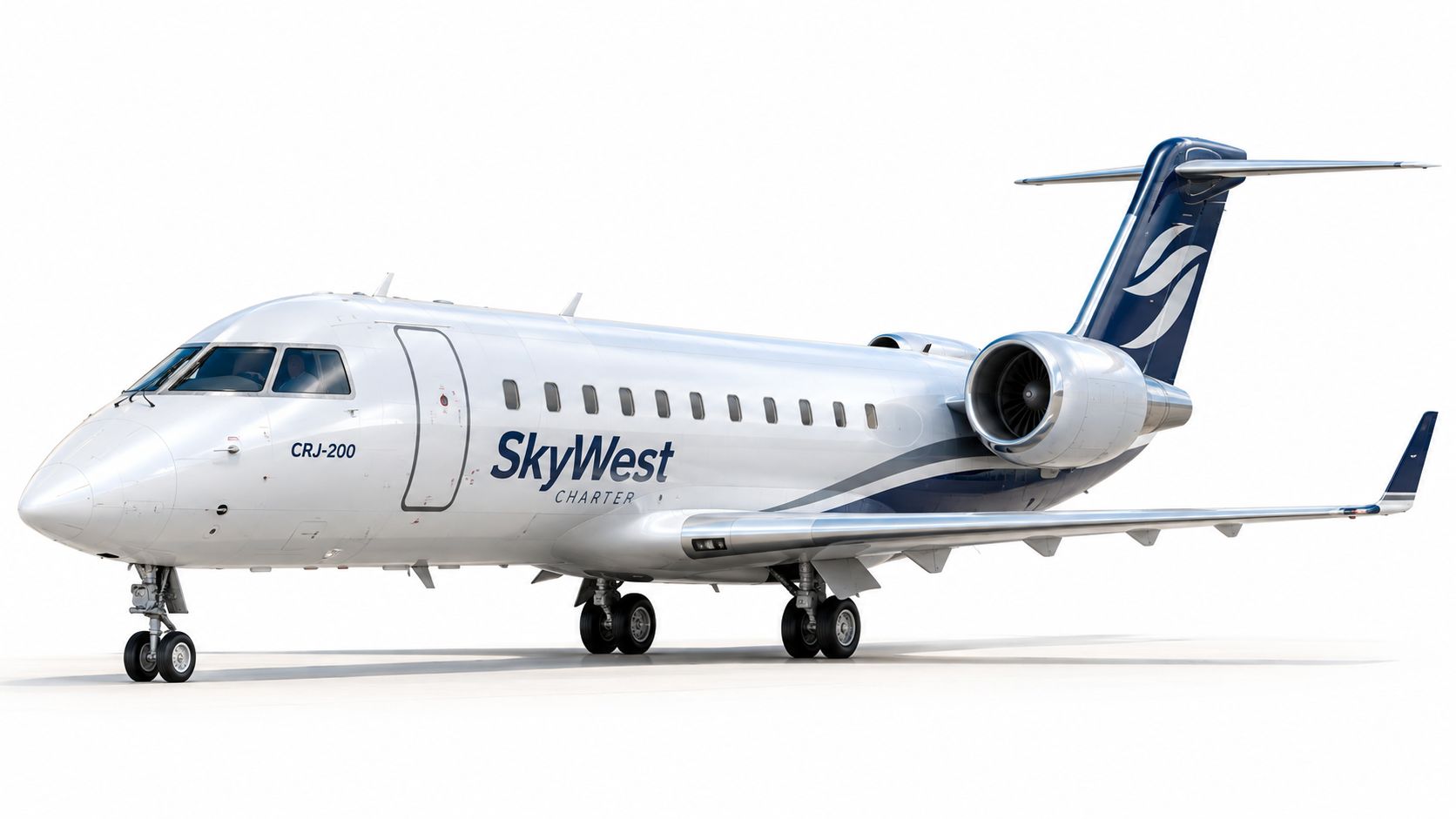
The CRJ200ER is listed at about 1,345 nautical miles, while the CRJ200LR reaches about 1,700 nautical miles at long-range cruise, but those are engineering figures, not guarantees you can count on for every trip (Bombardier CRJ200 overview). Payload, fuel policy, temperature, runway elevation, headwinds, and alternate-airport requirements can all shrink what's usable on the day of departure, which is why the same aircraft can feel generous on one mission and tight on another (CRJ200 charter factsheet).
A practical charter buyer treats the CRJ-200 like a tool, not a myth. If the mission is a regional move with a moderate passenger count and modest baggage, it can be a strong fit. If the trip depends on every seat being filled, every bag making it onboard, and no fuel compromise, you need to check the numbers route by route.
Practical rule: don't buy the brochure range, buy the real departure performance.
That mindset is what separates a smooth charter from a surprise at the airport. The aircraft has a real role, but only when the mission matches its actual operating envelope.
Understanding CRJ 200 Plane Specifications and Performance
How much aircraft do you need for the trip in front of you? The CRJ 200 plane sits in a narrow but useful spot for charter buyers, because it brings jet speed and climb performance to airports that would not suit larger aircraft (FAA aircraft database).
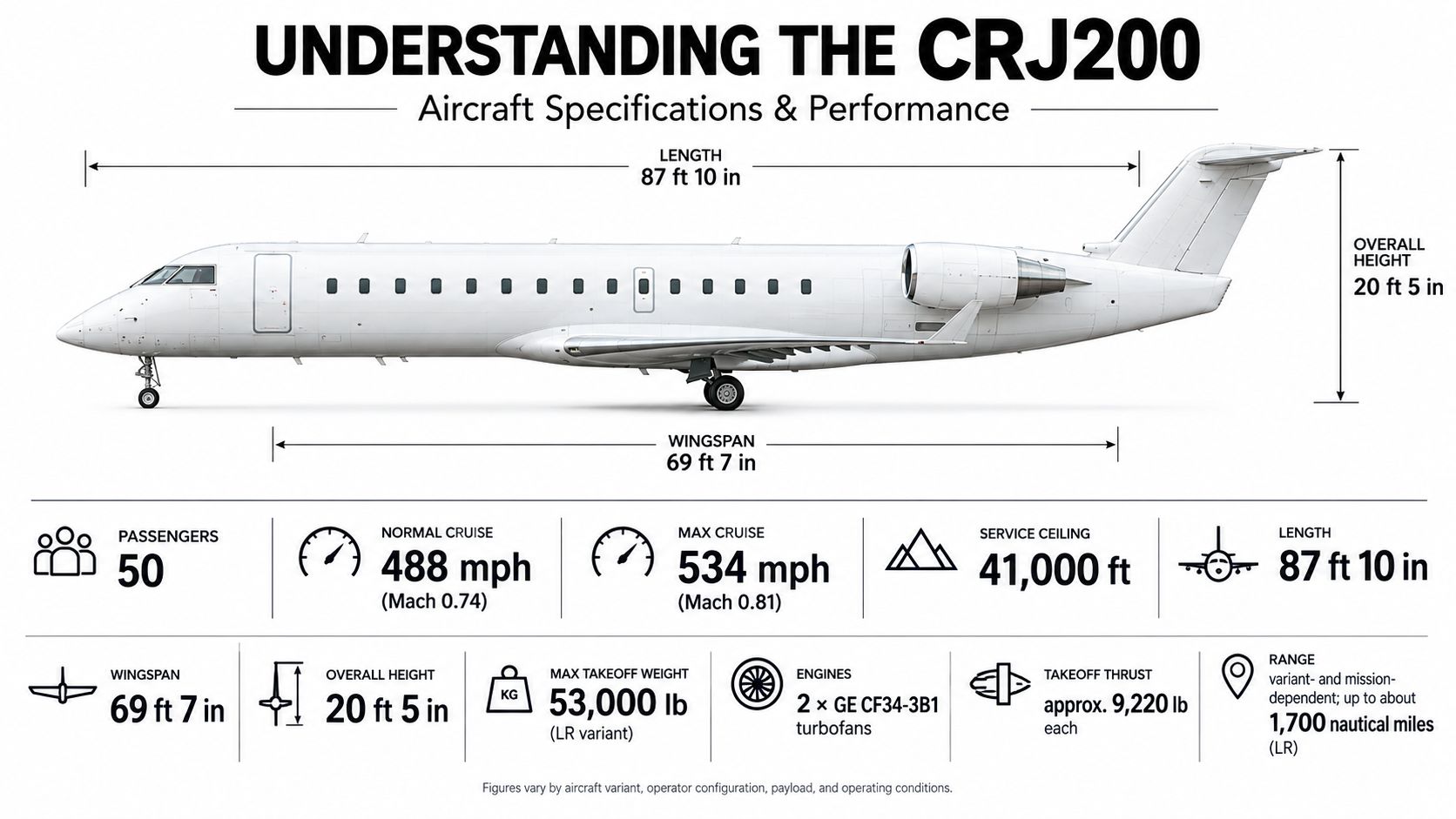
The aircraft uses two General Electric CF34-3B1 turbofan engines, each producing approximately 9,220 pounds-force of thrust (CRJ200 history and specs). It cruises at about Mach 0.81, or roughly 530 miles per hour, with a maximum operating altitude of 41,000 feet (SkyWest CRJ200 fact sheet). In practical terms, that gives it the speed buyers expect from a regional jet, while keeping the aircraft in a size class that can still make sense for shorter airport pairs.
Size and range in real terms
For planning, use the figures tied to the exact tail the operator is offering. The FAA reference data classifies the CRJ-200 as a medium jet and lists a wingspan of about 68.7 feet, an overall length of about 87.8 feet, and a maximum takeoff weight near 47,450 pounds (FAA aircraft database). A SkyWest fact sheet lists a wingspan of 69 feet 7 inches, an overall length of 87 feet 10 inches, and a maximum takeoff weight of 53,000 pounds for the 200LR version (SkyWest CRJ200 fact sheet). If the operator confirms an LR tail, plan against the LR figures.
That distinction matters because the CRJ-200 can look straightforward on paper and still change in practice once payload, fuel, temperature, runway length, and airport elevation enter the picture. A charter that is fine with a light passenger load can become tight once bags, reserves, and departure conditions are added.
The aircraft therefore feels faster and more airline-like than a turboprop, while still fitting a smaller airport footprint. It does not give you business-jet cabin volume, and it does not forgive sloppy trip planning. For buyers comparing categories, this guide to private jet types helps frame where the CRJ-200 fits and where a different aircraft is the better call.
Cabin Layout and Comfort in the CRJ 200 Plane
What does the CRJ-200 cabin give a charter group, and where does it start to feel tight? The answer starts with the layout. The cabin uses a 2-2 layout, so every row has two seats on each side of a single aisle, and United lists a 31-inch seat pitch with 17.3-inch seat width in its economy cabin (United CRJ-200 aircraft page). That arrangement keeps boarding simple and works well for moving a group together, but it does not create much personal space.
On a short regional hop, that cabin size can be perfectly workable. On a charter where passengers expect business-jet comfort, it still feels like an airline cabin, not a private lounge. The main limitation is the narrow fuselage, which affects aisle movement, bag stowage, and how much elbow room people have once seated.
A 12-passenger corporate group with carry-ons only will usually find the cabin workable. The same group with golf bags or other bulky equipment will feel the baggage compromise before they feel any issue with the seat count.
The trade-off is straightforward. A group that values staying together and getting to a smaller airport may accept the tighter cabin, while executives who want privacy, room to talk, or a quieter onboard setting usually do better in a larger business jet. For some short trips, a turboprop can make more sense if runway performance matters more than speed. For a closer look at how cabin finishes and layouts shape the onboard experience, see this private jet interior guide.
The published seat total can also be misleading in charter use. 50 seats does not mean 50 happy passengers. Once you account for baggage, crew needs, and operator rules, the usable layout can shrink fast, so a seating chart without baggage planning is incomplete.
A cabin that feels fine on a quick shuttle can feel cramped on a longer sector if the group expects first-class treatment.
Planning a CRJ 200 Charter Flight That Actually Works
Four checks decide whether a CRJ-200 charter is clean or painful, payload, runway, variant, and operator. Miss one of them, and the aircraft that looked perfect on paper can become a restriction exercise at the airport.
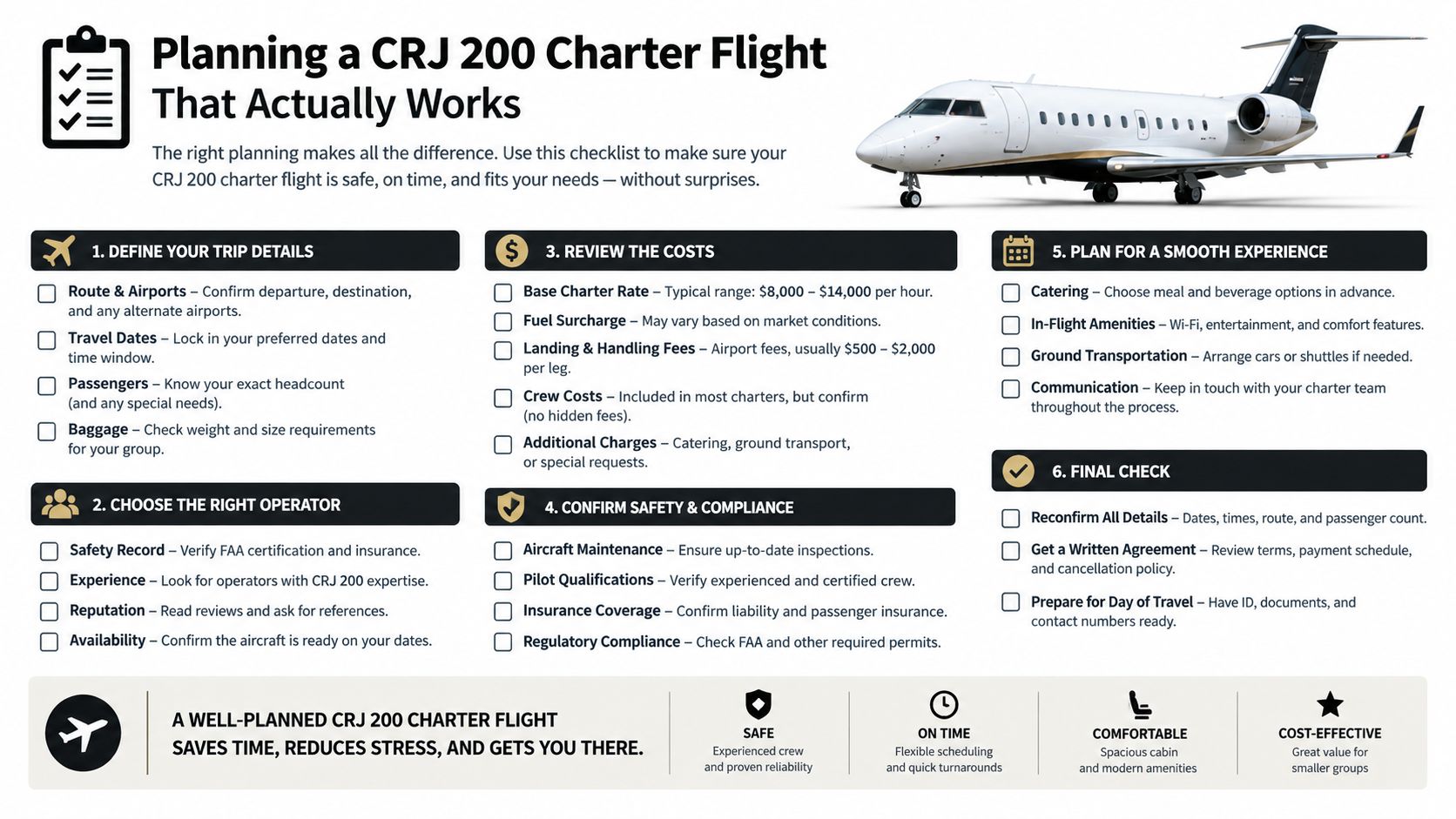
The published maximum payload is approximately 13,100 pounds (CRJ200 charter factsheet). That sounds generous until you divide it among passengers, checked bags, carry-ons, fuel, and crew requirements. In practice, payload is one of the fastest ways a charter quote stops matching the actual trip.
Start with payload, not seat count
If a group is traveling with equipment, skis, instruments, or heavy luggage, the payload conversation comes first. The aircraft can't ignore weight, and neither can the operator. A full cabin with baggage can change fuel planning enough to affect the whole trip.
Then look at runway requirements. The takeoff field length is about 5,800 feet for the ER and 6,290 feet for the LR at maximum takeoff weight, while landing field length is about 4,850 feet (CRJ200 charter factsheet). Those figures matter most at hot, high, or shorter airports, where performance margins tighten fast.
Practical rule: airport performance is a route problem, not an aircraft brochure problem.
Verify the exact variant
The ER and LR are not the same planning tool. One gives you different range behavior, the other different weight and runway implications, and the difference can change whether a nonstop is realistic. A buyer should always ask which tail, which variant, and which cabin configuration is being offered.
The final check is operator selection. Ask for the exact tail number, cabin layout, and operating limitations before you commit. If the aircraft cannot depart with your requested payload without a fuel or runway compromise, the quote needs to be adjusted, not hoped into compliance.
For many trips, that one conversation saves more time than any pricing comparison. It also keeps the charter honest about what the aircraft can really do from your airport on your date.
The CRJ 200 Plane Market and Where to Find One
Where do you find a CRJ-200 that still makes sense for charter work? Start with the operators, not the brochure. The market is still active, but the aircraft now sits in a narrower lane, where regional missions, charter flying, and Essential Air Service work still justify it.

Air Wisconsin shifted away from American's scheduled flying in April 2025, then planned to concentrate its roughly 62-aircraft CRJ-200 fleet on charter and Essential Air Service work, with about 38 active aircraft described in reporting (reporting on Air Wisconsin's shift to charter and EAS work). SkyWest and United also extended an agreement that keeps up to 40 CRJ-200s in United's network into the 2030s, and SkyWest said it expected around 100 aircraft to remain active across contract, prorate, and charter work (SkyWest and United's CRJ-200 extension coverage).
That is the market in practical terms. Airline-branded availability is thinning in some places, while smaller operators still find work for the type because the economics can still pencil out on the right route. Delta had already removed its CRJ-200 fleet by December 2023, which showed how quickly the aircraft can disappear from one network while staying useful in another (Delta's CRJ-200 retirement coverage).
What that means for buyers
Age alone does not decide whether a CRJ-200 is a smart option. Maintenance condition, parts support, crew familiarity, and operator economics carry more weight. Two quotes can look similar and still represent very different levels of operational risk.
Treat availability as an operator question, not just an aircraft question. A well-kept jet with the right crew and the right dispatch standards is the aircraft you want, even if the airframe is older. A tired example with weak support can create delays, payload limits, or unnecessary compromise.
For a charter client, the useful questions are simple. Where is the aircraft based, how is it maintained, and can the operator prove it is ready for your mission from your airport on your date? That is the check that matters, because the right CRJ-200 is the one that can fly the trip you booked.
When to Charter a CRJ 200 Plane and When to Look Elsewhere
The CRJ-200 makes the most sense when you need to move 30 to 50 people on a regional route and you care more about getting everyone on one aircraft than about luxury cabin space. It's also a sensible choice for trips to secondary airports, where jet speed and a compact footprint can beat splitting the group across multiple smaller aircraft.
It can be especially useful on shorter sectors where a turboprop would feel slower and a larger jet would be unnecessary. That's the sweet spot, a practical, efficient group move with enough speed to matter and enough seats to keep the itinerary simple.
Choose the CRJ-200 when
- The route is regional: Short- and medium-distance trips fit the aircraft's operating role best.
- The group is large: One airplane for a bigger team is often easier than coordinating multiple smaller jets.
- The airport is secondary: Compact dimensions help when the destination isn't a major hub.
- The mission is utilitarian: Corporate groups, sports teams, and production crews often care more about schedule control than cabin indulgence.
Look elsewhere when
- The trip is long and load-heavy: Payload and fuel restrictions can turn a nonstop into a fuel-stop itinerary.
- Comfort is the top priority: A larger cabin gives passengers more privacy and space.
- The route is better suited to another jet class: A midsize or super-midsize aircraft can be a better fit when the group is smaller and wants a better cabin experience.
The fastest way to make the wrong decision is to ask only, “Can it fly that far?” The better question is whether it can do the mission with your actual people, bags, and airport conditions. If the answer is yes, the CRJ-200 can be a smart charter choice. If not, another aircraft class will serve you better and probably cost less in frustration.
Booking Your CRJ 200 Charter Through Haute Jets
The cleanest booking process starts with the exact mission, not a generic category. That means route, passenger count, baggage reality, departure airport, and arrival airport all need to be aligned before the aircraft is selected.
If you want the aircraft matched to the trip instead of being sold whatever happens to be available, request a quote here. The value of that approach is simple, it gives you the right year, make, model, and cabin layout for the actual movement rather than a guess based on a label.
A strong charter booking also depends on operator quality and final flight verification. The best process confirms the tail number, crew details, and weather picture before departure, so there are no surprises at the terminal. That matters even more on older regional jets, where the aircraft choice should be deliberate, not accidental.
If your group is considering a CRJ-200 for a regional charter, start with the route and baggage, then work backward to the aircraft. Haute Jets can help you match the mission to the right jet and keep the booking focused on what works for your trip, not just what looks good in a listing. Visit Haute Jets to get started.
If you're planning a CRJ-200 charter, the smartest move is to price the trip against your real passenger count, baggage load, and airport performance. Haute Jets can help you compare the right aircraft for that exact mission, so you don't end up paying for a jet that can't comfortably do the job.