

Private jet cabin heights range from roughly 4 feet 1 inch in very light jets to more than 6 feet in ultra-long-range aircraft. That single measurement determines whether passengers remain seated for the entire flight or can stand upright and move naturally through the cabin.
The broader spread is just as important. Private aircraft can run from very light jets around 30 to 43 feet long to large and ultra-long-range models around 90 to 110 feet, with wingspans ranging from roughly 39 to 104 feet.Private jet size comparisons A category label such as “midsize” or “heavy” narrows the search, but it doesn't tell you whether the aircraft has the luggage access, standing room, cabin zoning, or airport compatibility your mission requires.
For charter planning, cabin volume often matters more than the category name. Height determines whether you can stand, width influences movement and seating geometry, and length determines whether the interior can support separate work, dining, and rest areas. Exterior dimensions then add a second constraint, because the largest cabin may not be the easiest aircraft to position, park, or accommodate at a particular airport.
How Much Private Jet Size Actually Varies
Private jets span more than a single category suggests. A very light jet may provide a compact cabin suited to short regional travel, while an ultra-long-range aircraft can contain separate areas for work, dining, and rest. For charter planning, cabin volume often matters more than the category label, because the interior determines how passengers move and use the aircraft.
At the smaller end, a Bombardier Learjet 35 has a cabin measuring 12.9 feet long, 4.9 feet wide, and 4.3 feet high. Those figures should be verified against Bombardier's aircraft documentation or applicable type-certificate data, rather than a source covering a different aircraft family. At the other end, the Gulfstream G700 publishes a cabin length of 56 feet 11 inches and a wingspan of 103 feet.Gulfstream G700 specifications The difference in usable cabin length is more than tenfold. A client who needs room to work, dine, and sleep therefore cannot select intelligently from the category alone.
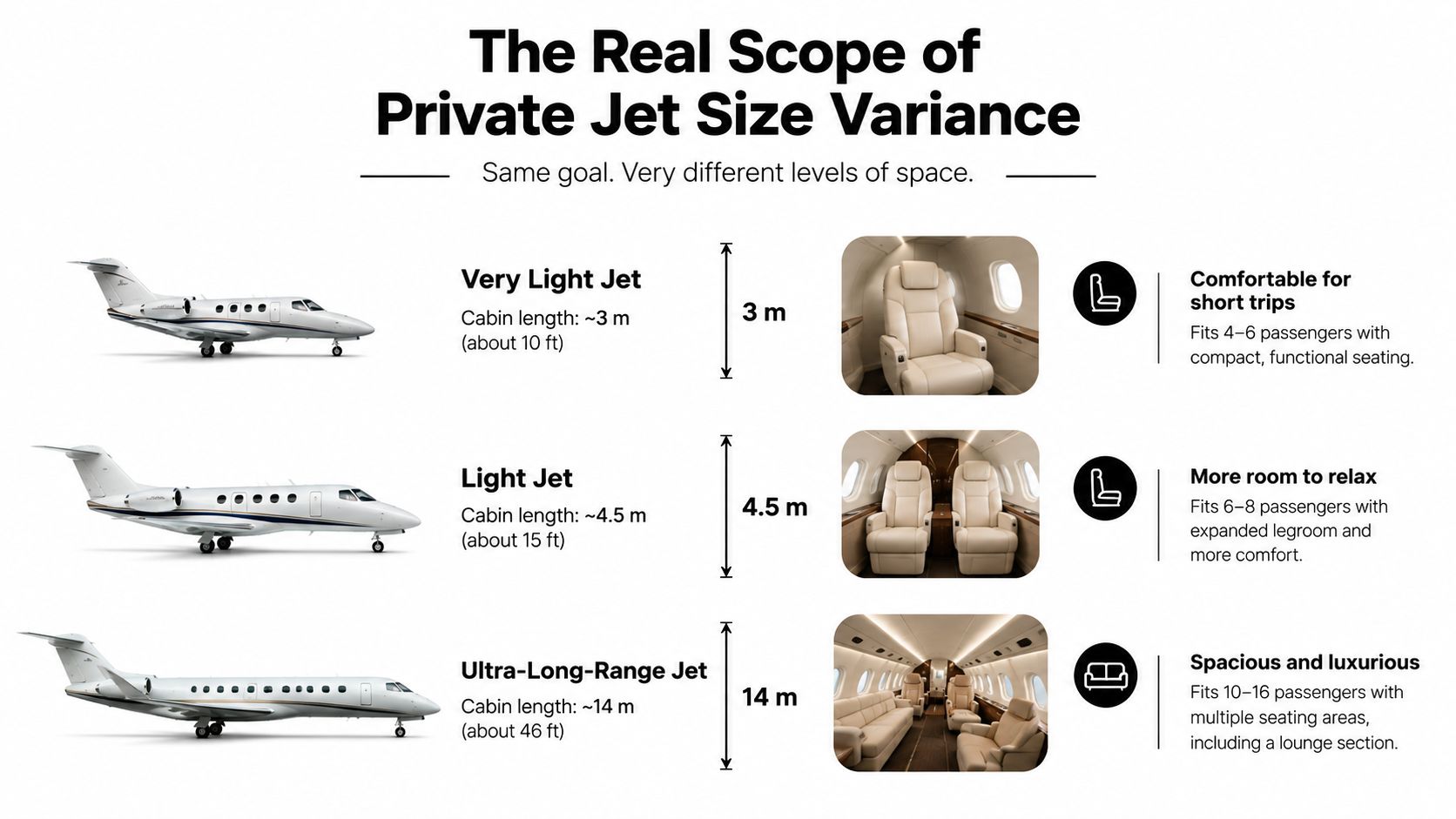
Category labels provide only a starting point
Market categories commonly separate very light, light, midsize, super-midsize, and heavy aircraft. These bands help brokers and operators organize fleets across North America, Europe, and the Middle East, but they remain broad filters rather than mission specifications. A category can identify a general performance class without confirming standing room, luggage access, seating geometry, or usable floor area.
A light jet may suit a short trip with limited luggage. The same class may be unsuitable for a group carrying equipment, requiring a stand-up cabin, or planning a long sector where movement and rest affect the passenger experience. The finished interior, baggage access, and payload capability should be checked before the category becomes the decision.
Length changes the entire layout
Cabin length affects more than comfort. It determines whether designers can separate seating groups, create privacy, add a conference area, or reserve a distinct rest zone. The G700's long cabin shows why two aircraft with similar height can deliver very different onboard experiences.
Compare usable cabin length, finished height, width, baggage volume, and exterior footprint together. An aircraft that appears large in a fleet listing may still be a poor fit if its cabin is short, its baggage door is restrictive, or its wingspan limits airport access. (Private jet size comparisons)
Understanding Cabin Height Width and Length
A very light jet may provide about 1.47 meters of finished cabin height and 1.43 meters of width. A midsize Citation XLS+ reaches approximately 1.73 meters in height, while a Gulfstream G650 offers about 2.59 meters of width.Private jet interior dimensionsPrivate jet interior width comparison These figures show why category labels are only a starting point. The usable cabin depends on how height, width, and length combine inside the finished interior.
Height sets the movement envelope
Cabin height determines whether passengers can stand, change position, reach storage, and use the lavatory without repeated bending. Cabins around or above 6 feet 2 inches generally provide full stand-up comfort, although door surrounds, side ledges, galley areas, and floor changes can reduce the height available in specific locations.
That distinction matters most on longer sectors. A cabin that supports upright movement allows passengers to leave their seats and circulate, rather than treating the interior as a fixed row of seating positions.
Width changes how the cabin operates
The G650's approximately 2.59-meter width is nearly twice that of a very light jet at around 1.43 meters.Private jet interior width comparison The difference affects more than seat spacing. It can permit opposing club seats, broader side consoles, a clearer passage, or a conference arrangement with less interference between passengers.
Width also governs practical service movement. Luggage, catering equipment, and passengers must share the same cross-section, so a wider cabin can reduce conflicts during boarding and meal service. A generous width does not compensate for a short cabin, but it can make each seating area more functional.
Length determines whether zones are possible
The Falcon 6X specifies a cabin height of 6 feet 6 inches, width of 8 feet 6 inches, length of 40 feet 4 inches, and volume of 1,843 cubic feet.Falcon 6X specifications
Length provides the longitudinal space needed to separate work, dining, privacy, and rest. Without enough length, those activities compete for one shared compartment, even when the cabin is tall and wide. Analysts should therefore compare finished height, width, usable length, volume, baggage access, and exterior footprint as one geometric system. The best fit is the aircraft whose interior supports the mission, not just the one carrying the larger category label.
Cabin Geometry and Passenger Comfort Standards
Passenger comfort depends on how height, width, length, and total cabin volume interact. A tall but narrow cabin can provide standing room while restricting circulation. A wide but short cabin may support sociable seating yet lack the depth for separate work, rest, or sleeping areas.
The 6-foot-2-inch threshold provides a practical benchmark for full stand-up comfort when evaluating premium charter aircraft. It does not guarantee standing room throughout the cabin. Galley areas, side ledges, door surrounds, and floor-level changes can reduce the usable envelope. Even so, the threshold helps distinguish cabins designed for upright movement from those where passengers must remain seated or stoop.
Volume is the missing variable
Cabin volume combines the effects of the three primary dimensions. The Falcon 6X publishes 6 feet 6 inches of height, 8 feet 6 inches of width, 40 feet 4 inches of length, and 1,843 cubic feet of cabin volume. The Gulfstream G700 lists 6 feet 3 inches of height, 8 feet 2 inches of width, 56 feet 11 inches of cabin length, and 2,603 cubic feet of volume. These figures show why a lower cabin can still provide more usable space overall when its length and layout support additional zones.
Volume affects furniture placement, storage, service equipment, and passenger circulation. It can allow a conference arrangement to coexist with dining space, or preserve aisle clearance when passengers carry substantial luggage. The figure becomes meaningful only when analysts test how much of that volume remains available around seats, cabinets, galleys, and passageways.
Practical rule: Use cabin volume to test whether the advertised layout is operationally plausible, then use height, width, and length to identify where that volume is located.
Geometry determines how comfort behaves
Linear depth matters most on longer missions. The G700's published cabin length excludes baggage, while its total interior length includes additional aircraft space. That distinction prevents a common comparison error: treating usable passenger cabin length and total interior length as interchangeable.
A spacious cabin also does not guarantee access for bulky luggage. A restrictive baggage door can limit what reaches the compartment, regardless of cabin height or volume. For a closer examination of how layout choices affect the onboard experience, consult this private jet interior guide.
Comparison of Leading Ultra-Long-Range Cabin Dimensions
Cabin volume can differ by hundreds of cubic feet among ultra-long-range jets, and that gap affects how effectively an interior supports separate activities. Height establishes whether passengers can stand comfortably, while width and length determine how much usable space remains around seats, storage, galleys, and circulation paths.
The table provides the canonical comparison for two prominent aircraft:
| Aircraft Model | Cabin Height | Cabin Width | Cabin Length | Cabin Volume |
|---|---|---|---|---|
| Gulfstream G700 | 6 ft 3 in | 8 ft 2 in | 56 ft 11 in | 2,603 ft³ |
| Dassault Falcon 6X | 6 ft 6 in | 8 ft 6 in | 40 ft 4 in | 1,843 ft³ |
The Falcon 6X has the larger cross-section, which can produce more shoulder room and a broader visual impression near passenger seating. The G700 allocates more space along the cabin's length, giving designers greater scope to separate work, dining, and rest areas. It can also place storage away from seating groups and maintain circulation through a multi-zone interior.
That difference changes the aircraft's suitability by mission. Social travel may benefit from width because passengers gather around shared seating. Overnight business travel may favor length because separate activities can continue without turning the cabin into one communal room. Cabin volume therefore offers a more useful starting point than a category label such as “ultra-long-range.”
Exterior scale and operational context
Large private jets can approach the physical scale of narrow-body airliners while carrying substantially fewer passengers. The result is a high amount of exterior aircraft structure per traveler, including wings, landing gear, doors, and fuselage length that still affect airport handling.
Cabin comparison should therefore extend beyond the largest published figure. A longer cabin may support better zoning, but it can also correspond to a larger aircraft footprint and different airport constraints. A wider cabin may improve seating comfort while offering less room for separate rooms or dedicated storage.
Clients reviewing ultra-long-range jet options should match the specification to the intended use. Check whether the charter aircraft has the promised seating plan, usable circulation, baggage access, and zoning, rather than assuming that the tallest or widest cabin will provide the most practical interior.
Comparing Purpose-Built Jets to Converted Airliners
Converted airliners can provide more than ten times the usable cabin length of a small purpose-built business jet. The comparison shows why cabin volume, rather than the aircraft category alone, should guide interior planning.
The Boeing Business Jet family lists cabin lengths from 116 feet 8 inches to 138 feet 2 inches, a wingspan of 117 feet 10 inches, and cabin areas from 884 to 1,120 square feet, depending on the variant. Boeing Business Jet dimensions
That scale supports layouts with boardrooms, bedrooms, conference suites, and lounges. The available floor area also gives designers more freedom to separate quiet work, dining, rest, and social activities. A large cabin can therefore change how passengers use the aircraft, not merely how many seats it contains.
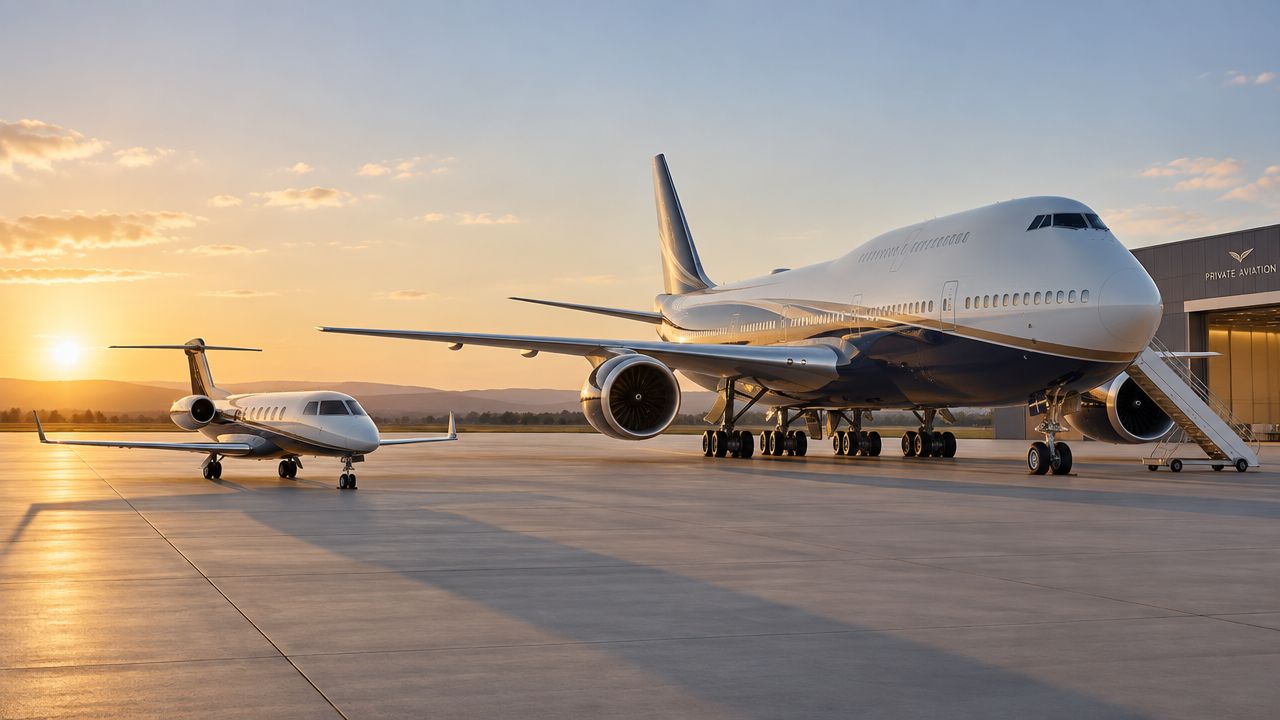
The scale comparison exposes the tradeoff
A smaller purpose-built jet, such as the Learjet 35 discussed earlier, has a cabin more than ten times shorter than the largest converted-airliner interiors. That difference affects zoning directly. In a compact cabin, adding a meeting area may reduce circulation or usable seating. In an airliner-derived platform, several functions can coexist without forcing every passenger into one shared space.
Large volume does not automatically make the aircraft more suitable. The added structure produces a larger external footprint and can demand more space for parking, ground handling, and passenger access. A smaller jet may reach more airports and suit a short mission where a multi-room interior would add little practical value.
A converted airliner fits missions that justify its cabin architecture, while a purpose-built jet can better serve schedules requiring airport access and concentrated cabin functionality. The decision is therefore a tradeoff between interior volume and infrastructure flexibility.
The following video provides a visual reference for how aircraft scale translates into private aviation layouts.
The Critical Role of Baggage Dimensions and Payload
Cabin height, width, and length do not establish whether a charter aircraft can complete the mission. Baggage-door openings, cargo-compartment volume, and route-specific payload often decide that question, particularly when passengers carry sports equipment, production cases, musical instruments, pets, or irregularly shaped luggage.
Baggage capacity combines three separate checks: available compartment volume, payload remaining after fuel, passengers, crew, and required equipment, and the physical path through the baggage door. Baggage dimensions and private jet payload considerations A hard-shell suitcase can satisfy the aircraft's weight allowance yet fail to pass through a narrow opening or fit around the compartment's internal geometry.
Weight and volume create separate limits
Payload and storage volume are different constraints. A spacious compartment may have room for the bags but insufficient payload remaining for the planned route. A lighter load may remain within the weight limit while its dimensions prevent loading.
A passenger count gives a broker only part of the information required. “Several bags” could mean soft garment bags, rigid cases, golf equipment, skis, camera crates, or cases with unusual handles and wheels. Their shape, rigidity, and loading orientation can matter as much as their combined weight.
The aircraft is suitable only when the people, fuel, baggage, and route fit together at the same time.
Ask for a physical loading confirmation
A published baggage-volume figure is useful for an initial comparison involving ordinary luggage. Bulky equipment requires confirmation of the door opening dimensions, compartment shape, loading access, and route payload before the aircraft is accepted.
List each item individually and describe its approximate form in the booking request. The operator can then assess the specific aircraft configuration rather than relying on a generic model specification. Interior refits, seating layouts, and onboard equipment can reduce usable storage even when the aircraft model is unchanged.
The operational question is precise: can this aircraft load these items on this route without compromising fuel or passenger requirements? That check can eliminate an unsuitable aircraft before cabin-comfort comparisons dominate the decision. A detailed luggage and private jet travel guide can help organize the required information for the operator.
How Growing Cabin Sizes Create Airport Constraints
Between 2000 and 2025, flagship private jets grew from roughly 93.5 to 94 feet in wingspan to about 103 to 104 feet. Their cabin volume increased from 1,595 to 2,140 cubic feet to approximately 2,603 to 2,786 cubic feet, according to this comparison of private-jet growth from 2000 to 2025. The interior gain is substantial, but the external increase creates separate ground-handling requirements.
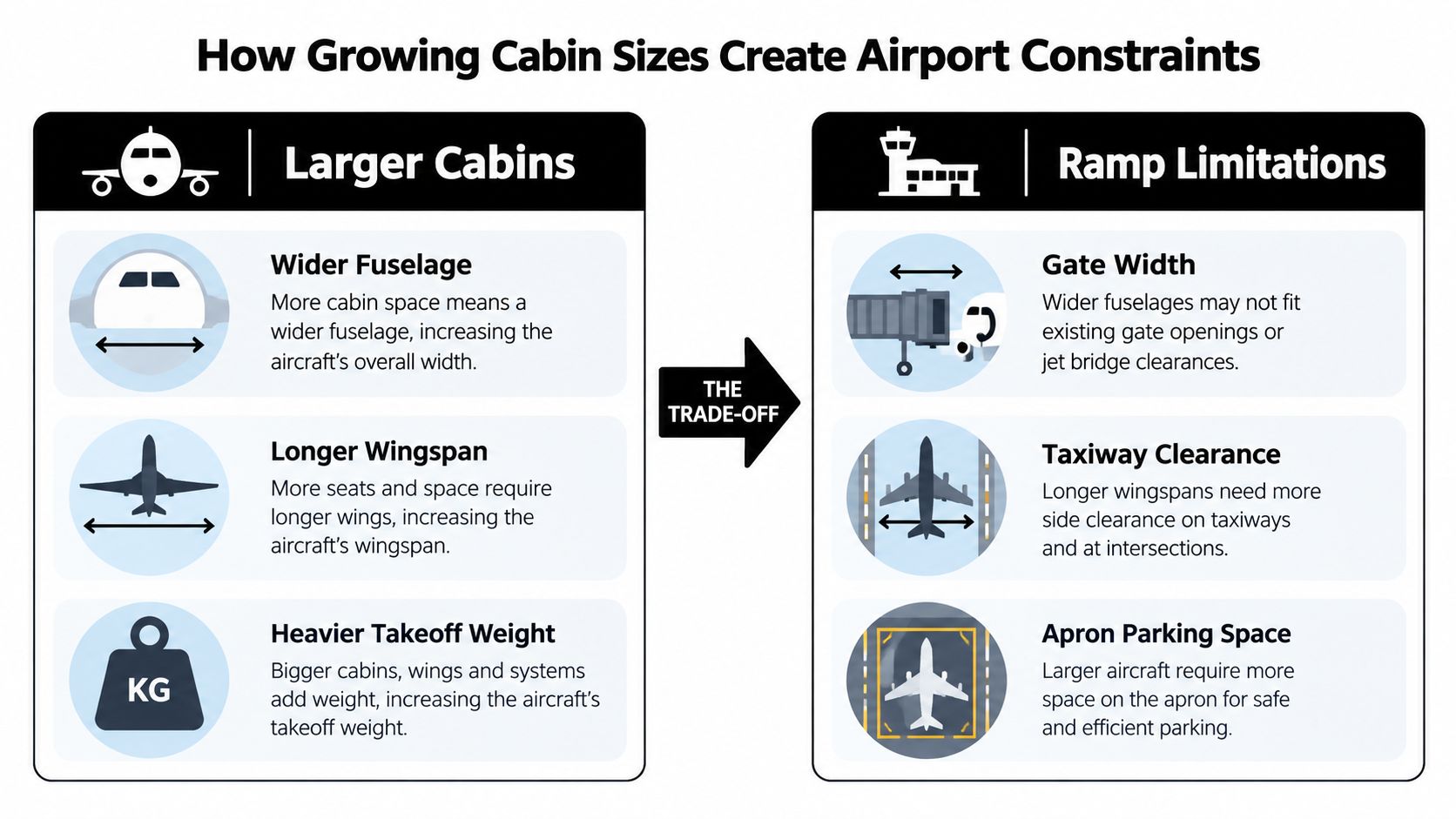
The airport sees wingspan before cabin volume
Passengers benefit from additional cabin volume. Airport operators must accommodate the aircraft's full external envelope, including wingspan, length, landing-area clearance, and towing path. A change of several feet can determine whether the aircraft fits inside a particular hangar, clears parked equipment, or moves safely between the stand and maintenance area.
The constraint often appears after the flight is booked. A large-cabin aircraft may meet the route, range, and passenger requirements yet lack a suitable hangar or ramp position at the destination. Dense business-aviation airports can also require a towing plan that avoids nearby aircraft and ground-service equipment.
Bigger isn't automatically better
A larger cabin can therefore reduce itinerary flexibility. A slightly smaller aircraft may provide adequate standing space and passenger comfort while accessing more airports, hangars, and parking positions.
Consider a charter requiring an overnight stay at an airport with limited hangar clearance. The aircraft with the greater cabin volume may need to remain outside, use a remote position, or be repositioned for storage. A smaller model may keep the same mission practical by fitting the available facility.
Aircraft selection should match cabin requirements to the airport network. Cabin volume determines how passengers use the aircraft, while wingspan and ground clearances determine where the aircraft can operate reliably. That relationship matters more than a category label alone.
Selecting Aircraft Based on Mission and Cabin Needs
Aircraft selection should start with the mission rather than the largest figure on a fleet page. A small group with limited luggage may value airport access and efficient seating. A longer business trip may require usable cabin length, rest areas, and space for baggage. The category label matters less than whether the aircraft supports the actual itinerary.
Cabin geometry affects how that space functions. A wider, shorter cabin can suit social travel, with more shoulder room and better face-to-face seating. A longer cabin gives planners more options for work areas, rest zones, and separation between active and quiet sections. Published volume alone does not show which arrangement will serve passengers better.
Match the geometry to the itinerary
Use four checks:
- Short regional mission: Confirm the airports, passenger count, and baggage first. A smaller cabin may work when passengers will remain seated and the flight is brief.
- Social or family travel: Review cabin width and seating orientation. A layout that supports conversation may be more useful than one with the greatest length.
- Business travel: Examine usable length and zoning. A dedicated work area can matter more than a small increase in seat count.
- Overnight or long-range travel: Verify sleeping arrangements, circulation, galley placement, and baggage access. These functions must coexist without making the cabin difficult to use.
A practical example is a New York to Miami charter for four passengers carrying golf bags. A suitable super-midsize aircraft may provide enough cabin length for comfortable seating while preserving baggage capacity. The decision still requires a check of the baggage-door dimensions and the actual luggage compartment, because golf bags may not fit through a narrow opening even when total baggage volume appears adequate.
Treat layout as a variable
Two aircraft of the same model can have different interiors. Seat count, divan placement, tables, storage, galley configuration, and crew areas change how much published volume passengers experience.
Use the fleet listing as a starting point. Request the actual cabin diagram and confirm that the stated configuration is available for the travel dates. Haute Jets offers aircraft sourcing across owner-operators and can present options by model and layout rather than relying only on broad category labels.Haute Jets aircraft charter options
The right aircraft is the smallest one that meets every mission requirement. That may mean giving up some cabin volume for airport access, or choosing a longer cabin when a wider alternative looks more spacious in photographs.
Frequently Asked Questions About Private Jet Sizes
What cabin width feels comfortable?
Comfort depends on more than the widest published measurement. Check whether the aisle permits movement without disturbing seated passengers, whether seat cushions and armrests leave usable shoulder room, and how much width tables, consoles, and storage consume. A wide cabin can support more flexible layouts, but the installed floor plan determines the space passengers experience.
Review the cabin diagram rather than relying on the aircraft category. A seating arrangement with a central aisle, opposing seats, and accessible tables may feel more practical than a nominally wider cabin filled with fixed furniture.
How many passengers fit in a given cabin volume?
Cabin volume does not set a dependable passenger count. Certification limits, seat pitch, emergency exits, galley and lavatory placement, baggage needs, and the operator's selected configuration all affect capacity.
A dense layout can add seats while reducing room for movement, dining, or sleep. Charter planning should therefore assess passengers plus activities. Travelers who need workstations, rest areas, or frequent access to luggage use the cabin differently from a group taking a short social flight.
Why does external wingspan matter for ramp parking?
Wingspan determines the lateral clearance required around the aircraft. It affects stand separation, hangar compatibility, towing routes, and distance from ground equipment or neighboring aircraft.
The specification belongs in airport planning. A jet with an excellent cabin may still be impractical at an airport without a suitable parking position, towing path, or hangar opening.
Is the longest cabin always the most comfortable?
No. Cabin length helps separate seating, dining, work, and sleeping zones, but it does not describe the whole passenger experience. Height affects standing comfort and visual openness, while width shapes seat geometry, aisle clearance, and movement between zones. The Falcon 6X and G700 illustrate why these dimensions should be reviewed together: the Falcon 6X is identified as the tallest and widest in a separate comparison, at 78 by 102 inches.Private jet cabin comparison
The mission determines which dimension carries the most value. Separate rooms favor length, broad seating and easier circulation favor width, and airports may ultimately limit the practical choice. Review the cabin plan, baggage access, and operating airport alongside headline volume.
Next Steps for Verifying Your Charter Aircraft Specs
Published specifications describe a model, while a charter booking assigns an individual aircraft. Before confirmation, obtain the specific tail number, year, make, model, and cabin layout. These details determine whether the advertised dimensions and amenities apply to the aircraft operating the trip.
Give the operator the mission requirements: passenger count, luggage description, bulky-item dimensions, standing-room needs, seating preferences, and any sleeping or work area. Request the cabin diagram and baggage details in writing. A cabin plan can reveal less usable space than its headline volume suggests.
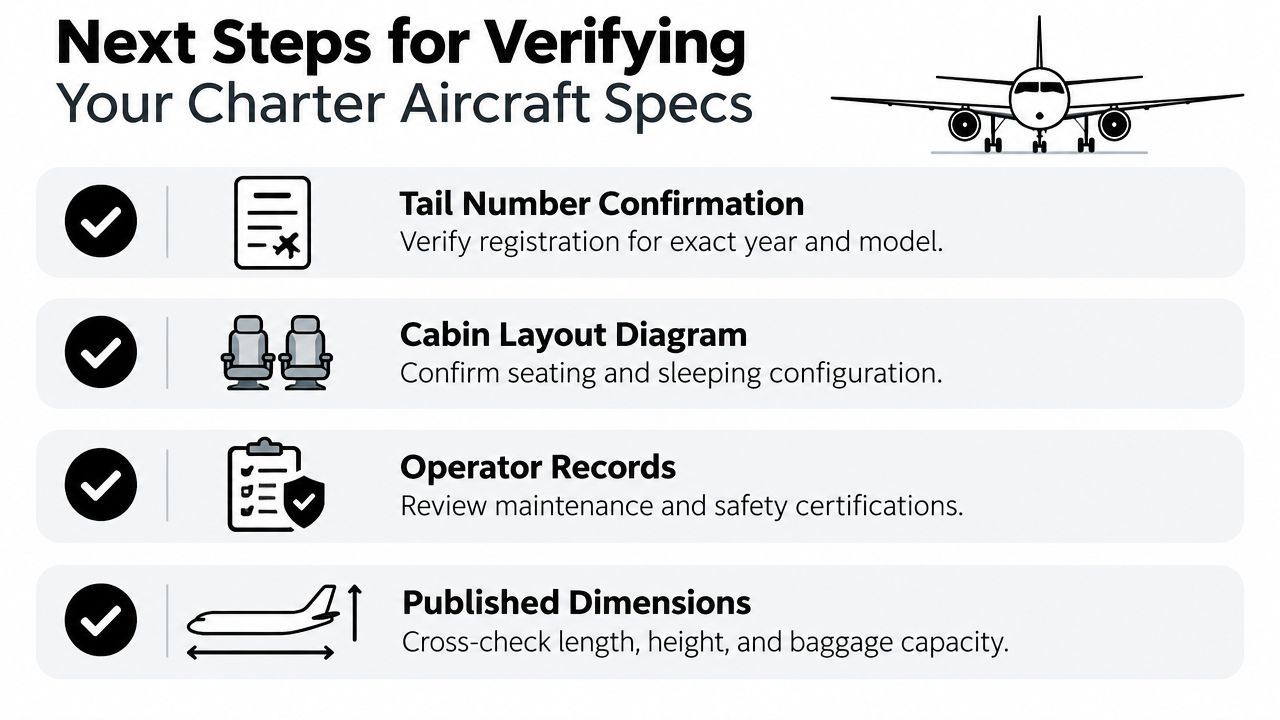
Use a final verification checklist
- Tail number: Confirm the registration, exact model, and aircraft year.
- Cabin layout: Check seating, sleeping, dining, work, galley, and lavatory arrangements.
- Operator records: Review applicable maintenance and safety certifications.
- Published dimensions: Cross-check cabin height, width, length, volume, baggage capacity, and door access.
- Service details: Confirm Wi-Fi, catering, pet policies, and ground transport.
- Pre-flight confirmation: Review the tail number, crew bios, weather briefing, and passenger manifest in the 24-hour confirmation.
Confirm route-specific payload and airport suitability as well. Payload must cover passengers and luggage for the planned route, while the aircraft's external dimensions must fit departure and arrival facilities. Haute Jets compares on-demand aircraft by model, cabin layout, baggage capability, and operator credentials rather than category labels.