
You're standing at a commercial airport with a full day of meetings ahead, but the airline schedule has moved your connection, the nearest airport to your destination isn't served, and every delay now threatens the purpose of the trip. A luxury air charter changes the problem. Instead of fitting your plans around an airline timetable, you arrange an aircraft, departure airport, and schedule around the mission itself.
That flexibility explains why private flying has become more than a status symbol. The global private jet charter services market was valued at USD 16 billion in 2025 and is projected to reach USD 26 billion by 2031, with an estimated historical CAGR of 8.85% from 2020 to 2025, according to Ken Research's private jet charter market analysis. Business travelers use charter for schedule control and direct access, while leisure travelers use it to reach destinations where commercial service adds unnecessary connections.
Introduction to Luxury Air Charter on Haute Jets Journal
A senior executive traveling from New York to a regional business meeting may value a quiet cabin and a direct itinerary more than a larger aircraft. A family leaving Miami for the Bahamas may care most about an airport close to home, flexible departure timing, and room for luggage or pets. In both situations, the aircraft is a tool for solving a travel problem, not merely a luxury accessory.
Luxury air charter means arranging a private aircraft for a specific trip, usually without buying the aircraft, joining a membership program, or committing to prepaid flight hours. You pay for the flight you request. The charter provider or broker coordinates the operator, aircraft, crew, airports, catering, and ground arrangements.

The distinction matters because many first-time flyers assume private aviation always means ownership or a long-term contract. It doesn't. On-demand charter can suit someone taking one important trip, a company arranging recurring executive travel, or a travel advisor building a complex itinerary for a client.
Practical rule: Start with the mission, not the aircraft. Your departure city, destination, passenger count, luggage, timing, and preferred airport should determine the aircraft category.
Haute Jets Journal is the publication context for this guide, alongside its coverage of private jet charter insights for 2026 travel and its separate Private Jet Charter for Executives guide. The aim is practical: explain how the model works, show how quotes are built, clarify what safety verification involves, and compare charter with first class, jet cards, and ownership.
By the end, you'll be able to read a charter proposal more intelligently, identify the questions that affect value, verify meaningful safety credentials, and decide whether an on-demand private flight fits your next journey.
How Luxury Air Charter Works and Why It Is Different
The simplest comparison is ride-hailing versus owning a car. With ride-hailing, you request the vehicle that fits today's journey and pay for that journey. With aircraft charter, you select an aircraft for a particular mission without carrying the capital, maintenance, staffing, and operating responsibilities of ownership.
A charter broker may present aircraft operated by different certified aviation companies. The broker coordinates the transaction and client experience, while the operating company is responsible for the aircraft, pilots, maintenance, and flight execution. Ask who the actual operator is before you approve a booking, because the brand presenting the quote and the company flying the aircraft may not be the same.
Charter compared with membership and ownership
A jet card generally involves prepaid hours or a structured access program. Fractional ownership means purchasing a share of an aircraft or fleet arrangement. Whole-aircraft ownership provides the greatest control, but also brings the most responsibility and capital exposure.
On-demand charter is different:
- Full charter: You book the complete aircraft for a defined itinerary.
- Jet card: You use a prepaid access model with program rules.
- Fractional ownership: You commit to a share of aircraft access.
- Whole ownership: You own and manage the aircraft asset.
Charter works well when your travel pattern changes, your aircraft needs vary, or you don't want unused hours. A short regional trip might call for a light jet, while an international itinerary may require a larger cabin and longer-range capability. The ability to match aircraft to mission prevents you from paying for capacity you won't use.
The airport experience
Private charter commonly uses an FBO, or fixed-base operator, rather than a main commercial terminal. An FBO is a private aviation facility where passengers complete departure formalities, wait in a smaller lounge, and transfer to the aircraft. The experience is designed around a direct transition from vehicle to aircraft, although procedures still depend on the airport, destination, and applicable regulations.
Access also comes from network breadth. Haute Jets describes access to 3,500+ aircraft across 175 countries, creating a broad pool for route, cabin, and availability matching. That kind of network matters because the right aircraft may be based near your departure city rather than at a large hub.
How to Book a Luxury Air Charter From Quote to Takeoff
A smooth booking begins with a useful trip request. Give the advisor your departure and arrival cities, preferred dates and times, passenger count, luggage requirements, pets, special equipment, and any flexibility you have. A request for “a jet from Miami to the Bahamas” is a starting point, but the exact island, airport, baggage, and schedule will shape the viable choices.
Start with the mission
The first proposal should connect aircraft options to your priorities. A smaller aircraft may work for a short trip with limited luggage, while a larger cabin may be necessary for a longer itinerary, additional passengers, or equipment. Don't choose based only on labels such as light, midsize, or heavy jet.
Ask for the exact year, make, model, and cabin layout. Two aircraft in the same category can differ in seating, luggage space, Wi-Fi, lavatory configuration, and interior condition. The proposal should identify those differences instead of presenting a category name as if it describes the whole experience.
The advisor should also explain departure and arrival airport choices. A convenient secondary airport can save ground time, but airport operating hours, runway characteristics, customs arrangements, and aircraft performance may affect the recommendation.
Review the quote and agreement
A credible quote should identify the itinerary, aircraft type, operator where available, passenger assumptions, included services, taxes or fees, and cancellation terms. Ask whether the aircraft is already near your departure point and whether the proposal includes empty positioning sectors.
Use Haute Jets' request-a-quote page when you're ready to submit the route and travel details. Before signing, confirm the payment schedule, passenger documentation, catering instructions, pet arrangements, and ground transportation.
Confirm the operating details
After the agreement, the operations team turns the itinerary into a flight plan. That process may involve crew assignment, airport coordination, catering, customs planning, baggage details, and weather monitoring. Your point of contact should remain available if the schedule or passenger list changes.
At least 24 hours before departure, request a final operational confirmation that includes the tail number, crew biographies, weather briefing, passenger manifest, airport details, and final timings. The tail number identifies the specific aircraft assigned to your trip. It's more useful than a generic promise that you'll receive a particular aircraft type.
Before wheels-up: Confirm the aircraft identity, operator, crew, airports, departure time, catering, Wi-Fi, pet policy, luggage plan, and ground transport in writing.
Private aviation activity remains substantial. Global private jets recorded 80,921 departures in Week 13 of 2026, up 11.3% from the same week in 2025, while U.S. departures represented 57,313 of that total and rose 13% year over year, as reported by Forbes. High utilization makes early detail confirmation valuable, particularly when your itinerary depends on a specific airport or aircraft configuration.
Understanding Luxury Air Charter Pricing and Hidden Fees
A charter quote prices an operating plan, not a seat multiplied by flight time. The total may include passenger flying, crew, fuel, landing and handling charges, catering, overnight expenses, taxes, and the aircraft's movement into position.
The cost most often missed is repositioning, also called a deadhead or ferry leg. If the aircraft is based away from your departure airport, it must fly empty to collect you. It may also need to fly empty after dropping you off. Those sectors still use fuel, crew time, and airport resources, so they can appear in your invoice even though you are not onboard.
Independent aviation guidance explains repositioning economics: empty sectors are billed at the standard hourly rate and can add approximately 30% to 100% to a charter invoice. Separate pricing guidance places repositioning or empty-leg-related additions at about 20% to 40% above a base charter rate in relevant booking situations, as outlined by L'Voyage's pricing explanation. Wholesale sourcing can help avoid that markup when the aircraft is already positioned near your departure city.
Why aircraft position matters more than size
Two aircraft may both suit your itinerary. One is larger but based far away. The other has the cabin you need and is already near your departure city. The nearby aircraft may produce the lower total quote because it avoids unnecessary ferry flying.
That is the central pricing insight: the best-value jet is often the correctly positioned jet, not the biggest jet. A larger cabin can improve comfort, but it can also add operating cost your trip does not require. Aircraft fit, local sourcing, and airport choice often affect value more than brand prestige.
| Cost Component | What It Covers | Typical Impact on Quote |
|---|---|---|
| Aircraft operating time | Passenger legs and required positioning | Can rise when the aircraft starts far from your origin |
| Repositioning | Empty ferry sectors before or after your trip | May add about 30% to 100%, according to the guidance linked above |
| Airport charges | Landing, handling, parking, and facility services | Changes with airport selection and itinerary |
| Crew expenses | Crew duty, accommodation, and related logistics | More relevant on longer or multi-day trips |
| Onboard services | Catering, connectivity, special requests, and supplies | Depends on what you request |
| Taxes and administrative items | Applicable transaction and operational charges | Should be clearly identified in the proposal |
Wholesale sourcing changes the comparison. Rather than starting with the largest available aircraft, a charter advisor can check which suitable aircraft is closest to your origin. That approach can remove unnecessary positioning sectors and keep the quote tied to the flight you need.
Ask three direct questions before accepting a proposal. Where is the aircraft currently based? Which empty legs are included? Could another nearby airport or aircraft model reduce the operating plan without affecting safety or comfort?
For a broader reference point on private jet charter cost, compare the complete itinerary instead of the headline hourly rate. A low hourly figure can become expensive when the aircraft must travel extensively before your passenger leg begins.
Safety Standards Every Luxury Air Charter Flyer Should Verify
Safety begins with the operator, not the brochure. A polished cabin, recognizable aircraft brand, or responsive sales team doesn't prove that the operator maintains strong procedures, training, records, and oversight.
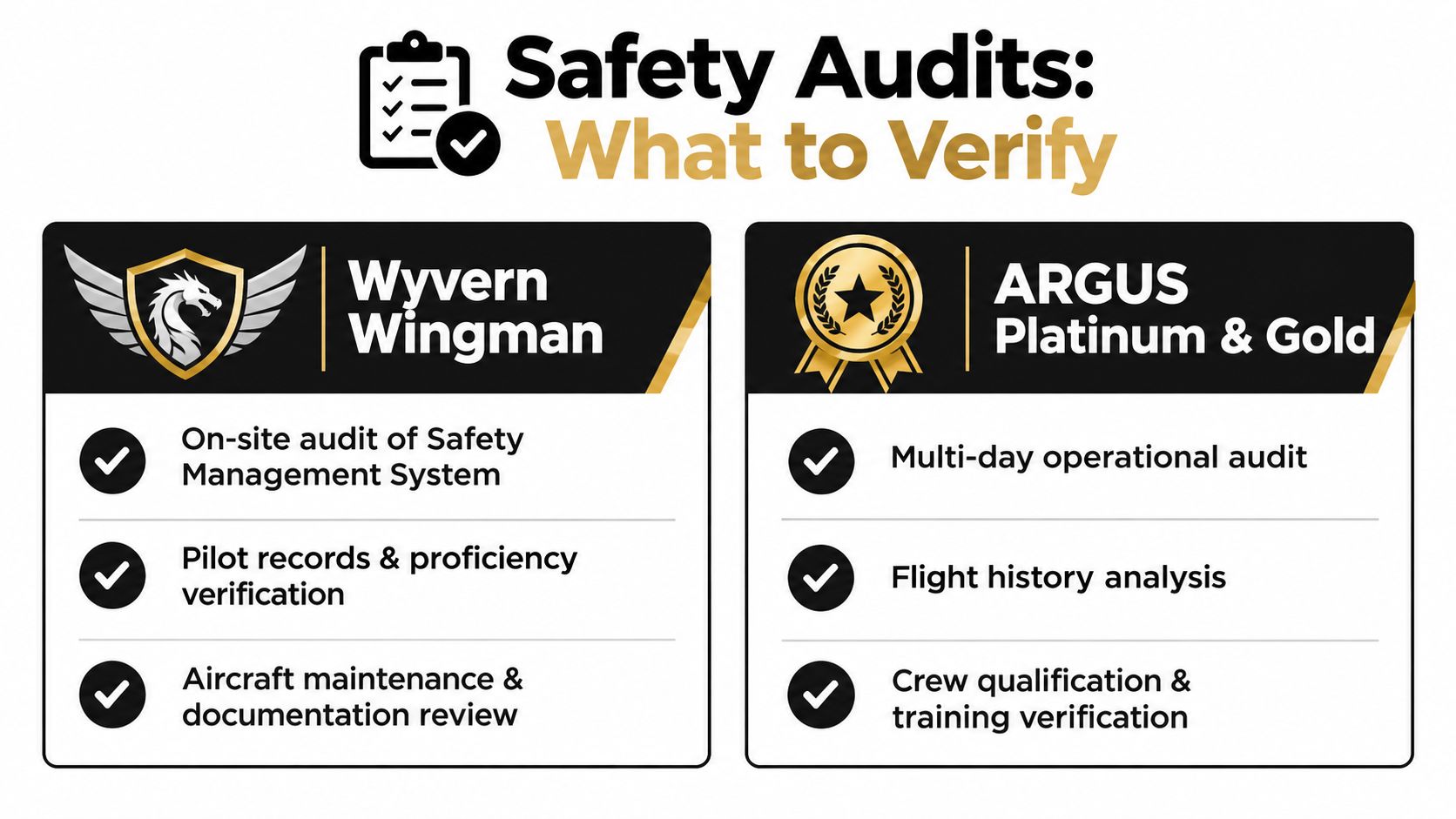
Third-party audits help create a more useful filter. Wyvern Wingman requires an on-site inspection of the operator's base, including review of pilot records, maintenance records, and operating procedures. ARGUS Platinum-style audits are also described as multi-day, on-site reviews of safety management systems, training programs, and procedures, according to SkyAccess's explanation of ARGUS, Wyvern, and IS-BAO ratings.
What the audit labels mean
An audit isn't a permanent badge. Ratings are renewed over time, and the relevant question is whether the operator's status is current for your booking. The audit cycle described in the available guidance is generally two years, and operators may spend roughly £15,000 to £40,000 per audit cycle, which helps explain why meaningful third-party verification involves substantial operational effort.
Wyvern Wingman focuses on on-site operational review and documentation. ARGUS Gold and Platinum programs evaluate operator practices through their own audit frameworks, with Platinum commonly associated with a deeper operational review and functioning safety management system. Ask the broker to identify the exact operator and rating level, not merely to say that the aircraft is “safety rated.”
Compare the operating risk, not just the label
Historical comparisons cited in independent private aviation safety guidance place Part 135 on-demand charter accident rates around 0.2 to 0.9 per 100,000 flight hours, compared with about 0.19 for Part 121 airlines in the referenced comparisons, as discussed in operator-vetting guidance from Hogan iJets. These figures shouldn't be used to judge a specific flight in isolation, but they do support an important conclusion: operator quality matters.
Before booking, request:
- Operator identity: Confirm which company holds the aircraft certificate and controls the flight operation.
- Current rating: Ask whether the operator is Wyvern Wingman or ARGUS Gold or Platinum rated.
- Audit timing: Verify when the rating was last renewed.
- Aircraft records: Ask how maintenance status and aircraft eligibility are checked.
- Crew information: Review the assigned pilots' qualifications and operating experience where provided.
For additional reading, consult Haute Jets Journal's guide to the safest private jets. The most useful safety conversation is specific, current, and tied to the actual operator assigned to your itinerary.
Luxury Air Charter Versus First Class and Membership Models
First class and private charter serve different travel patterns. First class provides a premium seat, lounge access, and the airline's scheduled network. Charter gives the traveler control over departure time, airport, aircraft, passenger list, and cabin environment.
Consider a Miami to the Bahamas trip. Charter may fit better when the group values a private cabin, direct airport access, or a schedule built around the travelers. A New York to London itinerary may favor first class when a scheduled nonstop matches the calendar and the airline's service meets expectations. For a corporate roadshow involving several cities, charter can coordinate the itinerary around the team instead of requiring separate airline schedules.
Aircraft positioning often matters more than aircraft size. A larger jet is not automatically the better value if it must first travel to your departure city. A smaller or midsize aircraft already nearby may reduce the empty positioning required before the passenger flight. Wholesale sourcing can also remove the 20% to 40% repositioning markups that may otherwise be added to the charter price.
A practical decision matrix
| Traveler need | First class | On-demand charter | Jet card | Fractional ownership |
|---|---|---|---|---|
| One-off luxury trip | Often suitable | Highly flexible | May create unnecessary commitment | Usually excessive |
| Changing destinations | Limited to airline network | Strong fit | Depends on program rules | Aircraft access may be structured |
| Exact aircraft choice | No | Strongest option | Program-dependent | Usually tied to ownership arrangement |
| Repeated business travel | Useful if schedules align | Useful for mission-specific trips | Can suit predictable usage | Can suit sustained usage |
| No annual commitment | Yes | Yes | No, generally structured | No, ownership commitment |
| Short-notice flexibility | Depends on airline inventory | Depends on aircraft availability and operator capacity | Program terms apply | Access rules apply |
The quoted passenger-leg time does not always show the full charter cost. Ask whether the aircraft must be repositioned to your departure city, whether it will wait for the return flight, and whether the quote includes those movements. Comparing the complete itinerary is more useful than comparing hourly flight time alone.
Choose the model that matches your travel pattern. Don't buy recurring access for a trip pattern that changes from one journey to the next.
Jet cards and fractional arrangements can suit travelers who value structured access and repeat usage. Their rules may govern aircraft availability, booking windows, and the way trips are priced. On-demand charter lets travelers pay per flight and select an aircraft for each mission, without a longer-term ownership or membership commitment.
A practical rule is simple: use first class when the airline schedule already solves the trip, charter when the itinerary needs control, and membership or fractional models when travel is frequent enough to justify recurring access.
Why Haute Jets Delivers Smarter Luxury Air Charter Value
The aircraft-positioning principle changes how a traveler should evaluate a charter provider. A provider with access to a broad owner-operator network can search for an aircraft near the departure city instead of defaulting to a familiar but distant aircraft.
Haute Jets states that it sources from 3,500+ owner-operators across 175 countries, giving clients access to different aircraft types for different routes and cabin requirements. Its model focuses on flight-by-flight booking, exact aircraft selection, and local sourcing. The publisher also states that nearby sourcing can eliminate repositioning fees that traditionally add 20% to 40% to charter pricing, as described in its product information.
The service model includes several decision points that matter to a first-time flyer:
- Exact aircraft selection: Review the specific year, make, model, and cabin layout.
- Operator screening: Use operators carrying Wyvern Wingman or ARGUS Gold or Platinum ratings.
- Pre-flight detail: Receive the tail number, crew biographies, weather briefing, and passenger manifest before departure.
- Trip customization: Confirm Wi-Fi, catering, pets, luggage, and ground transport in advance.
- Payment structure: Book and pay per flight without relying on a membership or jet-card commitment.
That approach puts the emphasis where it belongs, on the complete operating plan. A smaller or midsize aircraft already positioned near your origin may be more economical than a larger aircraft that has to fly empty across a region before collecting you.
Haute Jets arranges on-demand private jet charter with access to owner-operator aircraft across global markets, exact aircraft selection, and safety-focused operator screening. Visit Haute Jets to request a direct quote built around your route, schedule, passengers, and preferred cabin rather than accepting a generic aircraft category.