A common executive travel problem looks like this. You need to leave New York after a board meeting, stop in Chicago for a client session, reach Dallas for a site visit, and still be in Miami that evening for a financing dinner. Commercial schedules turn that into an overnight exercise with wasted hours, layovers, and too many failure points.
That's where private jet charter for executives stops being a lifestyle purchase and starts becoming a scheduling tool. For a CEO, CFO, founder, or travel manager, the question isn't whether private aviation sounds attractive. It's whether the trip can be completed faster, more securely, and with fewer operational compromises than commercial travel allows.
On Haute Jets Journal, that's the standard worth using. The right charter decision should protect executive time, reduce friction, and make cost structure more transparent instead of less. It should also stand up to scrutiny from finance, legal, and risk teams.
An Introduction to Strategic Executive Aviation

Private aviation is no longer a fringe option reserved for a narrow slice of travelers. That matters because it changes the conversation inside a company.
When a market reaches that scale, buyers start treating it like any other business service. They compare procurement models, examine operational risk, and ask harder questions about actual value delivered per trip.
What executives are really buying
An executive charter itinerary usually solves one of four problems:
- Compressed schedules: Multiple meetings in different cities on the same day.
- Access limits: Secondary airports closer to plants, clients, resorts, or private estates.
- Control: Departure times built around the meeting, not the airline timetable.
- Confidentiality: Sensitive conversations that shouldn't happen in an airport lounge or commercial cabin.
That's why the best charter decisions begin with mission design, not aircraft aesthetics. Who's flying, where they need to be, how much baggage is moving, whether work must continue in flight, and what a delay would cost the business all matter more than glossy cabin photography.
Practical rule: Treat executive aviation like a time-compression tool. If it creates a usable business day that commercial travel destroys, the analysis changes fast.
Security can also shape the trip design. For readers coordinating senior leaders on the ground as well as in the air, this overview of bespoke protection for Melbourne executives is a useful complement to aviation planning because the handoff between aircraft, car service, and personal security often determines whether the trip stays smooth.
Strategic use beats occasional indulgence
The most disciplined buyers don't ask, “Should we fly private more often?” They ask, “Which trips justify charter because the operational return is obvious?” That distinction matters.
The answer is usually yes when a company needs speed, privacy, and routing freedom on a trip where delays have real cost. It's usually no when the itinerary is simple, the travelers are flexible, and commercial service works without major productivity loss.
The Business Case for Private Jet Charters

The strongest case for charter isn't luxury. It's business throughput.
Those two points explain most of the category's corporate logic.
Time value is the primary return
A senior executive doesn't lose only airport time on a commercial trip. The company also loses scheduling control. Once you factor in early airport arrival, hub connections, missed windows, and the inability to adjust departure around a meeting that runs long, the trip often expands well beyond flight time.
Private charter changes that equation in three ways:
- It collapses dead time. The traveler arrives closer to departure and typically lands closer to the actual destination.
- It protects the calendar. Meetings can move without forcing a full itinerary rewrite.
- It preserves working conditions. Teams can review materials, negotiate, or debrief in a closed environment.
For executives managing client relationships, fundraising, M&A discussions, or sensitive board matters, those benefits aren't abstract. They affect how many meaningful decisions fit into a day.
The less visible advantages matter too
Some returns are hard to express in a spreadsheet but still influence policy.
- Confidentiality: A private cabin is a controlled environment for legal, financial, and strategic discussions.
- Reduced fatigue: Fewer handoffs and less airport friction mean the executive arrives ready to perform.
- Team cohesion: When key participants travel together, decisions happen in real time instead of across fragmented calls and text threads.
A travel manager making the internal case for charter should emphasize these operational outcomes, not prestige. That framing tends to hold up better with finance and compliance stakeholders.
If the trip exists to win business, close a negotiation, or inspect an asset under time pressure, the correct comparison isn't private jet versus first class. It's controlled execution versus avoidable delay.
For a deeper breakdown of that ROI logic, Haute Jets Journal's guide to corporate private jet charter benefits is worth reviewing alongside your travel approval criteria.
When charter usually makes sense
A charter request is easier to justify when the mission includes conditions like these:
| Travel scenario | Why charter often wins |
|---|---|
| Multi-city same-day itinerary | Commercial schedules rarely support it cleanly |
| C-suite travel tied to revenue events | Delay carries direct business cost |
| Site visits to less-served markets | Secondary airport access shortens ground transfer |
| Sensitive negotiations | Cabin privacy supports confidential work |
The mistake some companies make is treating every executive trip the same. A straightforward nonstop between major hubs may not need private lift. A dense roadshow with three business-critical stops often does.
Choosing the Right Aircraft for Your Mission
Aircraft selection is where many charter buyers either save the trip or sabotage it. The category label on the quote matters less than whether the aircraft can perform the mission as flown, with your actual passengers, baggage, route, and weather.
A lot of executive travelers gravitate toward a midsize jet because it sounds like the balanced option. Sometimes it is. Sometimes it creates a fuel stop you didn't budget for.
Brochure range and true range aren't the same
On a 2,200 nautical mile flight, that can require a tech stop and add 45 to 90 minutes plus added cost, as outlined in this guide to private executive jet size and mission planning.
That single issue changes how an executive should read a charter quote. A jet that appears less expensive on paper can become slower and more expensive once the mission is flown under real conditions.
Match the aircraft to the mission, not the marketing
Think about aircraft choice in practical bands:
- Light jets: Useful for shorter regional hops with smaller groups. They can be efficient, but they're not the right answer for every coast-to-coast plan.
- Midsize jets: Often a good fit for executive teams needing comfort and productivity on domestic routes.
- Super-midsize jets: Usually the sweet spot for longer U.S. missions where nonstop reliability matters.
- Heavy and ultra-long-range aircraft: Better for larger groups, longer sectors, and trips where cabin space and endurance take priority.
That doesn't mean bigger is always smarter. It means under-sizing the aircraft can cost more than stepping up one category.
Questions that prevent unpleasant surprises
Before approving any charter, ask these questions:
- Can this exact aircraft fly the route nonstop with our actual passenger and baggage load?
- What assumptions support the range estimate?
- If weather shifts, what's the backup plan?
- Will the cabin support the way the team needs to work?
The exact tail matters too. Cabin layout, connectivity, baggage access, and even lavatory configuration can vary within the same aircraft family.
A good charter advisor doesn't just say, “This jet can make it.” They explain under what conditions it can make it, and whether those conditions match your trip.
If you want the aircraft categories explained in plainer language, see Haute Jets Journal's overview of understanding private jet types.
A practical executive bias
For business travelers, I generally favor reliability over theoretical efficiency. If the mission is important and the route sits near the edge of a jet's practical range, choosing more aircraft than you think you need is often the cheaper decision once time, schedule integrity, and executive fatigue are factored in.
Verifying Safety and Compliance in Private Aviation

Most charter providers mention safety ratings quickly, usually with a reference to Wyvern or ARGUS. That's a reasonable starting point, but it isn't enough for a corporate travel policy.
Corporate risk officers increasingly want documented, auditable safety data before departure, including pilot experience, training currency, and aircraft maintenance summaries. Traditional broker models often don't make that information easy to review pre-flight, as discussed in BlackJet's analysis of private charter safety expectations.
What ratings do and don't tell you
Wyvern Wingman and ARGUS Gold or Platinum ratings matter because they indicate that an operator has met recognized third-party audit standards. That helps narrow the field.
But a rating alone doesn't answer the questions a risk manager should ask about a specific trip:
- Who are the assigned pilots?
- Are they current on the aircraft type?
- What does the maintenance posture look like for the exact aircraft being flown?
- Has the operator provided documentation in a form the company can retain?
Those are operational questions, not marketing questions.
The exact aircraft and crew matter
A charter booking is not just an operator selection. It's also a crew assignment and aircraft assignment. That's why generic assurances often fall short when legal, compliance, or family office staff request documentation.
A sound pre-flight review should include:
| Compliance item | Why it matters |
|---|---|
| Assigned crew details | Confirms who is actually operating the flight |
| Training currency | Supports internal risk review |
| Aircraft maintenance summary | Helps validate airworthiness oversight |
| Tail-specific flight details | Reduces last-minute substitution surprises |
For many companies, especially those moving C-suite leadership or board members, this paperwork supports fiduciary discipline as much as travel planning.
Risk standard: Don't settle for “the operator is highly rated.” Ask for tail number, crew bios, and maintenance documentation before departure.
Haute Jets Journal has a more detailed primer on Wyvern and ARGUS safety ratings if you're building an internal review checklist.
What works in practice
The best process is simple. Approve only operators that meet your company's rating threshold, then require pre-flight documentation on the assigned aircraft and crew. If a broker can't produce that cleanly, you've learned something important about the booking model.
What doesn't work is relying on brand familiarity alone. Reputable names still need to provide trip-level transparency when the traveler is senior enough and the organization is serious about compliance.
Charter Models On-Demand vs Jet Cards
Choosing an access model is usually more important than people expect. The aircraft gets attention, but the contract structure often determines whether the company keeps flexibility or inherits friction.
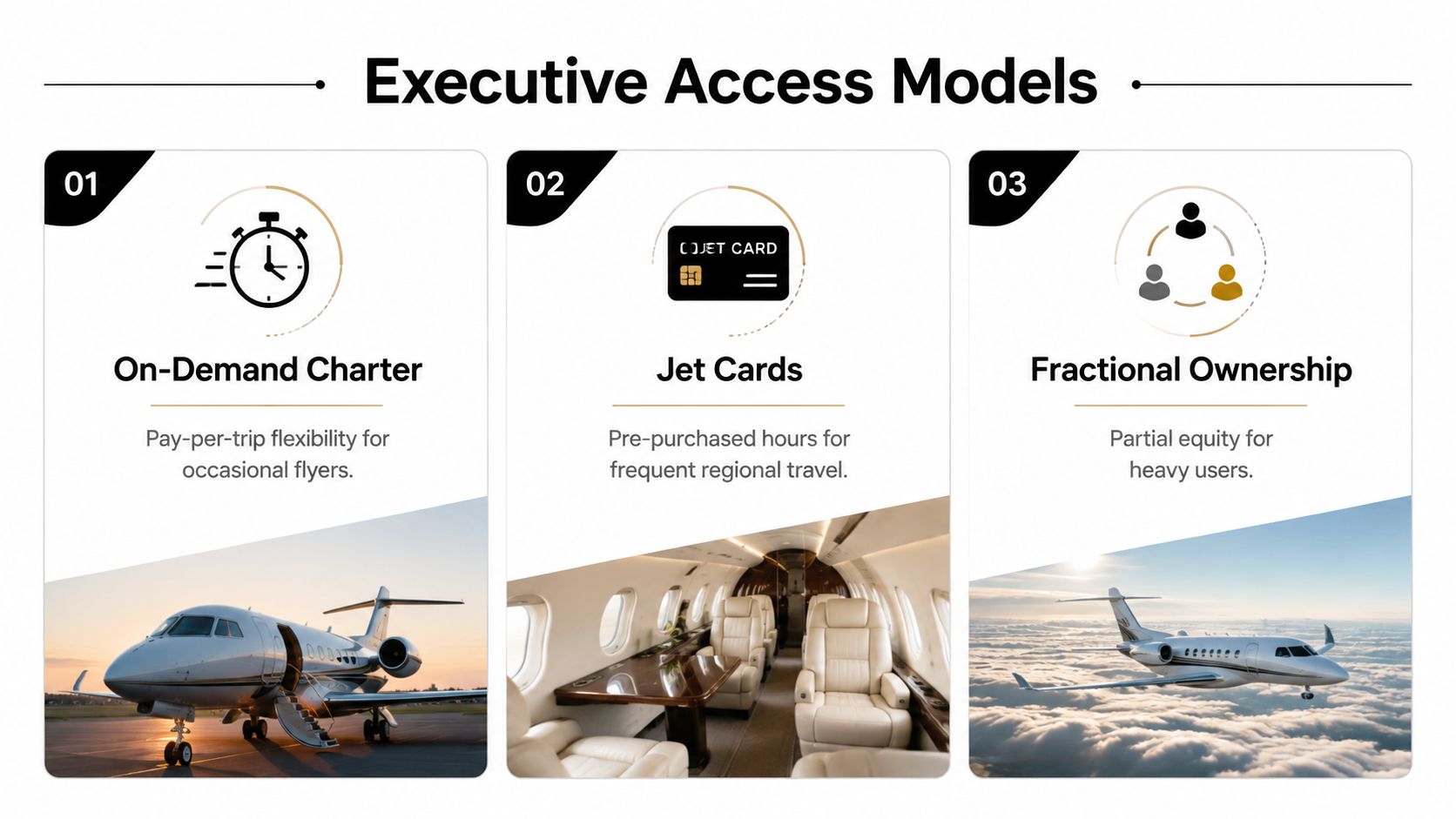
Comparison of Private Aviation Models
| Feature | On-Demand Charter | Jet Card Program | Fractional Ownership |
|---|---|---|---|
| Cost structure | Pay per trip | Prepaid hours or deposit-based access | Equity purchase plus ongoing costs |
| Flexibility | High. Choose aircraft by mission | Moderate. Program terms may limit choices | Lower. Tied to ownership framework |
| Aircraft choice | Broad if sourcing is open-market | Often narrower within program rules | Depends on fleet and interchange rights |
| Balance sheet impact | Minimal | Prepaid commitment | Significant long-term commitment |
| Best fit | Variable or opportunistic flying | Repeat flyers who value program consistency | Heavy users with stable demand |
On-demand charter works well for variable needs
For many executive teams, on-demand is the cleanest model because it matches how corporate travel behaves. Some months are dense. Others are quiet. Some missions need a light jet. Others need a long-range cabin.
The appeal is straightforward:
- No standing inventory problem: You're not trying to use hours you already bought.
- Trip-by-trip aircraft matching: The tool fits the job.
- Simpler internal approval: Finance sees a direct expense tied to a specific mission.
This model tends to work especially well for companies that want charter access without turning aviation into an ownership exercise.
Jet cards offer convenience with strings attached
Jet cards can make sense for travelers who prefer preset terms and who fly often enough on similar missions to value that consistency. But the convenience can come with trade-offs. Those often include upfront capital commitment, program restrictions, and less flexibility when the mission changes.
That doesn't make jet cards wrong. It means buyers should inspect the rules carefully. Availability language, peak-day limitations, interchange terms, and how aircraft substitutions are handled all deserve attention.
Fractional ownership suits a narrower group
Fractional ownership is usually a tool for organizations or individuals with sustained, predictable demand and the appetite for a deeper operational commitment. It can provide consistency and control, but it also introduces longer-horizon cost and governance questions.
If your flying pattern changes quarter to quarter, ownership can solve the wrong problem.
For most companies evaluating private jet charter for executives, the practical decision comes down to this: do you want flexible access to the market, or do you want to pre-commit capital in exchange for a program structure? The answer should reflect flight frequency, procurement preferences, and tolerance for contractual complexity.
A Tactical Guide to Booking Executive Charters
At 4:30 p.m., an assistant needs a CEO in Chicago for an 8:00 a.m. board meeting and back in New York the same day. The first quote looks acceptable, so the team approves it fast. Later, finance learns the aircraft started in another state, the trip required an empty repositioning leg, and the “competitive” rate was not competitive at all.
That pattern is common. Poor charter buying usually comes from incomplete trip data, weak quote review, and limited visibility into where the aircraft is coming from.
Start with a mission brief that procurement can use
A charter request should read like an operating plan, not a calendar invite. If the brief is vague, the quotes will be hard to compare and easy to misread.
Before requesting pricing, define:
- Traveler profile: Who is flying, and who needs to work in flight or hold confidential discussions?
- Routing: Is the trip nonstop, multi-leg, or likely to shift on short notice?
- Payload: Passenger count, baggage volume, special equipment, and pets
- Schedule tolerance: Hard departure windows, meeting end times, and acceptable waiting time
- Ground requirements: Preferred airports, car service, security coordination, and catering
A clear brief improves three things at once. Aircraft fit, quote accuracy, and approval speed.
Ask where the airplane is positioned
This is one of the fastest ways to control cost.
If the proposed aircraft is not already near your departure airport, the quote may include ferry flying. Some providers show that line item clearly. Others bury it inside the hourly rate. The outcome is the same. Your company pays for an aircraft movement that does not carry your team.
That is one reason the sourcing model matters. A wholesale, on-demand approach that searches available aircraft near the point of departure usually produces better economics than a model built around inventory convenience or preset program rules.
Review the quote like an operator, not a passenger
Category pricing is useful for budgeting, but it is weak for trip approval. Corporate buyers should ask for the specific aircraft proposed for the mission. Tail-specific review exposes issues that category-only quotes can hide, including range limits, baggage constraints, cabin differences, and repositioning costs.
Use this checklist before approving any trip:
- Confirm the aircraft's departure base. If it is not local, ask how repositioning is priced.
- Request the exact aircraft, not only the aircraft class. The mission is flown by a real asset, not a category label.
- Verify nonstop capability with your actual load. Passenger count, bags, and weather can change the plan.
- Ask for an all-in price breakdown. Airport fees, crew charges, catering, deicing exposure, and ground transport should be visible.
- Review substitution terms before payment. If the assigned aircraft changes, approval rights should be clear.
This process prevents false savings. A lower quote loses its value quickly if it adds a fuel stop, extends duty timing, or changes the aircraft after approval.
Use a sourcing model that reduces hidden waste
The strongest charter process starts with local aircraft availability, then matches the mission to the specific airplane. That is different from selling access first and solving trip economics later.
Haute Jets is one example of that approach. The relevant point is not branding. It is the operating logic. Exact-aircraft sourcing and local market access can reduce unnecessary ferry costs and give the client better visibility into what is being purchased.
Traditional charter buying often fails in quieter ways too. A quote can look clean while masking operational friction such as long repositioning, soft aircraft holds, or limited transparency on the assigned operator. Those issues affect cost, schedule reliability, and risk review.
The best quote for an executive trip is the one that shows the aircraft location, the operator, the mission assumptions, and the full trip cost before approval.
Final checks before wheels up
Right before departure, the travel manager should confirm five items:
- Passenger manifest
- Tail number and airport details
- Crew information
- Catering order
- Ground transport timing
Done well, executive charter stops being a reactive concierge task. It becomes a controlled procurement process with clear operational standards, lower waste, and fewer surprises on the day of travel.
Building Your Corporate Aviation Policy
A solid corporate aviation policy doesn't need to be long. It needs to be clear enough that finance, legal, procurement, and executive assistants can all make the same decision from the same facts.
The strongest policies treat charter as an approved business tool under defined circumstances, not as an exception that gets renegotiated each time.
Approval rules that hold up internally
Most companies benefit from a simple authorization framework built around mission type. Charter is often easiest to justify for time-critical multi-stop travel, senior leadership movement tied to revenue or governance, travel to locations poorly served by commercial airlines, and situations where confidentiality is central.
Policy language should also define who can approve the trip and what documentation must accompany the request. That reduces friction and keeps decisions consistent.
Operational standards worth requiring
A useful policy usually includes these essentials:
- Safety threshold: Only audited operators meeting the company's required rating standard.
- Trip-level transparency: Assigned aircraft and crew documentation before departure.
- Cost review: Quotes must identify major trip components clearly enough for internal review.
- Aircraft suitability: The chosen aircraft must match the mission without predictable operational compromises.
That last point matters. A cheaper quote isn't compliant with policy if it introduces foreseeable delays or avoidable stops that undermine the business purpose of the trip.
Financial discipline without rigidity
The policy should encourage smart buying, not force one access model for every mission. For many companies, that means preferring flexible on-demand procurement over prepaid commitments when travel volume fluctuates.
It also means instructing travel teams to look beyond hourly rates. The right question is total mission efficiency. If the trip is transparent, nonstop-capable, safely documented, and locally sourced, the company is usually buying well.
Good aviation policy doesn't chase prestige. It protects time, controls risk, and makes cost easier to audit.
Private jet charter for executives works best when the company defines the use case, insists on transparency, and buys each mission with discipline. That's how charter becomes fiscally defensible and operationally effective at the same time.
If your team wants a clearer way to source executive lift, Haute Jets offers on-demand charter access built around exact-aircraft selection, local sourcing, and pre-flight transparency. For companies that want flexibility without memberships or prepaid programs, that model is worth evaluating against your current booking process.