So, what does it actually mean to charter a private jet? At its core, it's like hiring a high-end car service for a specific trip instead of buying the car. You're renting the entire aircraft, on your schedule, without the massive financial headache and long-term commitment of actually owning one.
It’s easily the most direct and flexible way to fly private.
Your Personal, On-Demand Airline
Think of the charter model as having your own airline on standby. Instead of getting locked into buying a block of hours or investing millions in a depreciating asset, you simply pay for the flight you need, when you need it. This gives you total freedom.
The real advantage is gaining access to thousands of aircraft all over the world. Whether you need a small, efficient turboprop for a quick hop to a regional meeting or a spacious heavy jet for a family trip across the ocean, the entire market is at your fingertips.
The Team That Makes Your Charter Happen
Behind every smooth charter flight, there’s a simple partnership between three key players:
- The Operator: This is the FAA-certified company that owns, maintains, and flies the plane. They're the bedrock of your safety and the ones ensuring the aircraft is in perfect condition.
- The Broker: That’s your expert guide in the market (like us at Haute Jets). We sort through thousands of aircraft from different operators to find the perfect, safety-vetted option that fits your trip and budget.
- The Client: This is you. You’re in the pilot's seat when it comes to planning—you call the shots on where you're going, when you're leaving, and what you need.
This collaboration means you get to specify everything from the exact jet you prefer to the catering onboard and the car waiting for you on the tarmac. This level of granular control is what truly sets chartering apart from the more rigid models like fractional ownership or jet cards.
When you charter, you aren't just booking a flight. You're commissioning a completely bespoke travel experience, built from the ground up to fit your exact needs.
This flexibility is why demand has skyrocketed. The private jet charter market is growing fast, jumping from a $24.12 billion industry in 2023 to a projected $45.43 billion by 2030. This boom is being driven by more and more people and businesses looking for a smarter, more efficient way to travel. You can read more about the private jet charter services global market and its impressive growth. It all points to the same conclusion: on-demand charter is the new standard for private aviation.
What Does a Private Jet Charter Really Cost?
When you look at a private jet charter quote, it's easy to focus on the final number. But that price is actually a blend of several different costs, and knowing what they are is the secret to getting the best value for your money. It’s about much more than just the time you spend in the air.
The biggest piece of the pie is always the aircraft's hourly rate. This can swing wildly depending on the jet's size, age, and specific model. A nimble light jet for a short hop might run you $5,000 an hour, while a long-range heavy jet capable of crossing oceans can easily top $15,000 per hour.
But the hourly rate is just the beginning. A few standard operational fees are part of every single flight. These aren't hidden charges; they're simply the necessary costs of doing business in aviation.
The Standard Fees in Every Charter Quote
Think of these as the fundamental building blocks of your trip's cost. You should see them clearly itemized on any transparent quote.
- Landing Fees: Airports charge for the privilege of using their runway. This can be a few hundred dollars at a small regional airport or shoot into the thousands at busy international hubs like Teterboro (TEB) or London Luton (LTN).
- Crew Overnight & Per Diem Costs: If your trip keeps the crew away from their home base overnight, you'll cover their hotel, transport, and a daily allowance for expenses. This is non-negotiable, as it ensures your pilots are well-rested and meet strict FAA safety requirements.
- Federal Excise Tax (FET): For domestic flights in the U.S., the government applies a 7.5% Federal Excise Tax to the charter cost. Simple as that.
While these costs are predictable, there’s one variable that can balloon your final price if you’re not paying attention.
The Hidden Killer: Repositioning Fees
The single biggest factor that unnecessarily inflates charter costs is the repositioning fee, often called a "ferry flight." This is what you pay to fly an empty jet from its home base to your departure airport.
Let's say you're in Miami and want to fly to New York. The broker finds you a great jet, but it’s currently sitting in Atlanta. Before your trip can even start, that jet has to fly empty from Atlanta to Miami to pick you up. And guess who pays for that empty leg? You do. This one fee can easily tack on an extra 20-40% to your total cost.
This is the dirty little secret of the traditional charter model. Many brokers have preferred fleets or limited networks. If the "right" plane isn't local, you pay a massive premium to bring it to you—essentially paying for a flight you're not even on.
This is exactly the problem our model at Haute Jets was built to fix. By tapping into a real-time network of over 3,500 locally-based, safety-vetted aircraft, we nearly always find the perfect jet right where you need it. This local-sourcing approach all but eliminates repositioning fees, passing those wholesale-level savings directly to you.
To see just how much of a difference this makes, let's look at a hypothetical trip.
Sample Charter Cost Breakdown NYC to Miami
The table below shows a typical cost comparison for a mid-size jet, illustrating how simply sourcing a local aircraft can lead to thousands in savings.
| Cost Component | Traditional Broker (With Repositioning) | Haute Jets (Local Sourcing) |
|---|---|---|
| Hourly Flight Cost (2.5 hrs) | $20,000 | $20,000 |
| Repositioning Flight (1.5 hrs) | $12,000 | $0 |
| Landing & Handling Fees | $2,500 | $2,500 |
| Subtotal | $34,500 | $22,500 |
| Federal Excise Tax (7.5%) | $2,588 | $1,688 |
| Total Estimated Cost | $37,088 | $24,188 |
As you can see, avoiding that one empty leg results in a staggering $12,900 in savings on the exact same route and aircraft class. If you'd like to dive deeper, we have a complete guide that offers a more detailed breakdown of private jet charter pricing.
This smarter, more efficient way of booking is why the private charter market is seeing such explosive growth. More travelers are realizing they can have all the flexibility and luxury without the unnecessary costs.
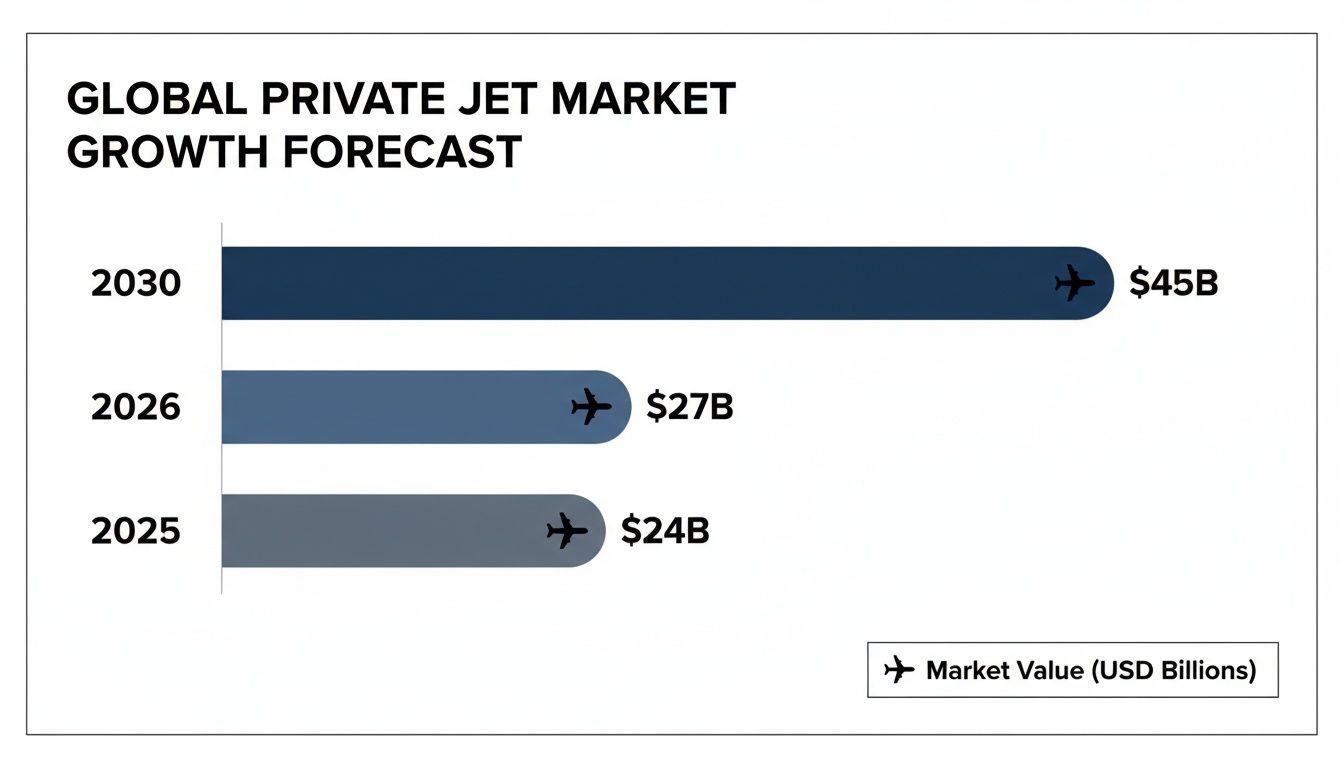
The trend is clear: the market is on track to nearly double by 2030, driven by travelers who demand more intelligent and personalized ways to fly.
Choosing the Right Aircraft for Your Trip
When you charter a private jet, you’re not just booking a flight; you're gaining access to a global hangar of specialized tools. The secret isn't picking the fanciest plane, but matching the right tool to the mission. Thinking like a seasoned pro means looking past the specs and focusing on what each type of aircraft actually does.
The whole process starts by answering a few simple, practical questions about your trip. Get these right, and you'll instantly narrow down the thousands of options to a shortlist of perfect candidates.
Key Questions to Guide Your Selection
Before you even think about specific models, let's pin down the mission. Your answers here are the foundation of a good charter request and will ensure the quotes you get are for aircraft that actually make sense for your trip.
- How many passengers are traveling? This is your starting point. It immediately tells you the minimum cabin size you'll need.
- What is the total flight distance? Are you flying non-stop? A cross-country flight from New York to Los Angeles has totally different requirements than a quick hop from Miami to the Bahamas.
- What level of comfort and amenities do you need? Is a standing-height cabin a must-have? Do you need a galley for hot meals, or are you just looking for a comfortable seat for a quick business trip?
- Are there any non-negotiables? Be upfront about needing things like high-speed Wi-Fi, a pet-friendly policy, or extra room for luggage. It saves a lot of back-and-forth later.
With these answers in hand, you're ready to look at the different classes of aircraft and see which one fits the bill.
Matching Aircraft Categories to Your Mission
Every class of private jet is built with a specific job in mind. Understanding their roles helps you make a smart decision that perfectly balances cost, comfort, and performance for your flight.
Think of it like choosing a vehicle. You wouldn't rent a two-seater sports car for a family camping trip or a big moving van for your daily commute. The exact same logic applies here—the goal is to pick the most efficient and appropriate aircraft for the journey.
Let's break down the main categories.

Turboprops
These are the workhorses of regional travel, ideal for short flights and getting into smaller airports with shorter runways. If you're island hopping or need to reach a remote spot the airlines don't serve, a turboprop is often your best bet.
- Passengers: 4-8
- Range: Up to 1,500 miles
- Best For: Quick regional trips under two hours and cost-effective travel.
Light Jets
For regional business and leisure travel, this is your go-to category. Light jets offer a big step up in speed and comfort from turboprops and can easily connect cities like Chicago and Dallas. This is one of the hottest segments in private aviation right now for a reason—jets like the Phenom 300 deliver incredible performance for the price on regional routes.
- Passengers: 5-8
- Range: Up to 2,000 miles
- Best For: Flights up to three hours, small group business travel.
Mid-Size & Super Mid-Size Jets
This is where you get a fantastic blend of range, speed, and cabin comfort. Mid-size jets are versatile enough for most cross-country flights and usually feature standing-height cabins and proper lavatories, which makes a huge difference on longer trips. The "super mid-size" sub-category pushes that range and speed even further, often performing like a heavy jet on domestic routes.
We cover this in more detail in our guide on choosing the right aircraft for short-haul private flights.
- Passengers: 7-10
- Range: 2,500-4,000 miles
- Best For: Cross-country travel, trips needing more cabin space and amenities.
Heavy Jets
Built for flying across continents, heavy jets represent the peak of space, luxury, and range. You can expect multi-zone cabins, full galleys, and almost always a dedicated flight attendant. These are the aircraft for international business trips or luxury family vacations, capable of flying non-stop from the U.S. to Europe or Asia.
- Passengers: 10-16+
- Range: 4,000-7,500+ miles
- Best For: International flights, large groups, and maximum in-flight comfort.
How to Verify Private Aviation Safety
When you charter a jet, the real luxury isn’t the champagne or the plush leather seats. It’s the unshakable confidence that you’re flying on a meticulously maintained and operated aircraft.
With a major airline, you trust the brand. In private aviation, that trust is placed in your broker to vet every single flight. This is where third-party safety audits aren't just a good idea—they're the only way to operate.
You might assume any plane available for charter is safe, and to a degree, you're right. Every operator must be certified by the Federal Aviation Administration (FAA) to legally fly. But that’s just the starting line. Think of FAA certification as a passing grade in school; it means you met the minimum requirements. The best operators, however, are aiming for a perfect score.
Understanding the Gold Standards: Wyvern and ARGUS
To prove they go above and beyond, elite aircraft operators voluntarily undergo incredibly tough audits from two independent firms: Wyvern and ARGUS. These organizations are the trusted, impartial referees of the private aviation world. Their job is to dig deep into an operator's every move, far beyond what government regulations require.
Getting a top rating from them is no easy task. It’s an ongoing commitment that involves a comprehensive, on-site review of their entire operation.
Auditors will:
- Tear through maintenance logs to ensure every single part is serviced on schedule and every detail is perfectly documented.
- Analyze the company's Safety Management System (SMS), which is essentially the operator’s safety culture—how they train for emergencies, manage pilot fatigue, and proactively identify risks.
- Verify every pilot's experience and training records, confirming they exceed the minimum flight-hour requirements for that specific aircraft and complete frequent, rigorous simulator training.
A Wyvern Wingman or ARGUS Platinum rating is the industry’s seal of approval. It means an operator has passed an exhaustive, in-person audit and maintains a flawless safety history. It’s not a one-time award; it's a continuous proof of excellence.
Why Top-Tier Safety Ratings Are Non-Negotiable
For any reputable charter broker, these elite safety ratings aren't a feature—they are the absolute minimum standard. At Haute Jets, for instance, we exclusively source aircraft from Wyvern Wingman or ARGUS Gold/Platinum-rated operators. There are no exceptions to this rule.
This strict, upfront vetting process completely removes the guesswork for you.
It means that every aircraft option we present has already passed the industry's highest safety benchmarks. The question of safety is already answered before you even see the quote. This changes the conversation from if an aircraft is safe to which of the safest aircraft is the perfect fit for your trip.
To see just how detailed these evaluations are, you can learn more about these private aviation safety ratings in our deep-dive article. Knowing what to look for is the key to flying with total peace of mind, every single time.
The Private Jet Booking Process Explained
So, you’re ready to charter a jet. While it might feel like a big step, the process itself is actually quite straightforward. Think of it less like booking a commercial flight and more like commissioning a bespoke travel experience. It all boils down to a few clear steps designed to get you from inquiry to takeoff, smoothly and without any surprises.
It all starts with your flight request. This is your chance to lay out the blueprint for your trip. We're talking more than just dates and destinations—the key is in the details. How many people are flying? Do you have a preference for a light, midsize, or heavy jet? Are you bringing pets, or do you have specific catering needs? The more information you provide upfront, the better your broker can zero in on the perfect aircraft for you.
From Quotes to Confirmation
Once your request is in, your broker goes to work, tapping into their network to source a handful of safety-vetted aircraft that are a great fit for your trip. You won't be flooded with options; instead, you'll get a curated list. This lets you easily compare different jet models, their amenities, and their price points to find the one that hits the sweet spot between comfort, style, and your budget.
After you've picked your plane, the fun part begins: tailoring the flight to your exact tastes. This is where a charter flight truly becomes your flight.
- Custom Catering: Want specific meals from your favorite restaurant? Or maybe just some light snacks and a particular bottle of champagne? It's all possible.
- Ground Transportation: You can arrange for a car to be waiting for you on the tarmac. To ensure a truly door-to-door luxury experience, consider complementing your private jet charter with a reliable Dubai airport chauffeur service for seamless ground transfers.
- Special Requests: Need child safety seats, specific entertainment loaded, or anything else to make the journey perfect? Just ask.
With all the details locked in, you’ll review and sign the charter agreement. This is an important document that clearly outlines every detail of the flight, from the costs to the terms, ensuring complete transparency.
The Final Itinerary and Peace of Mind
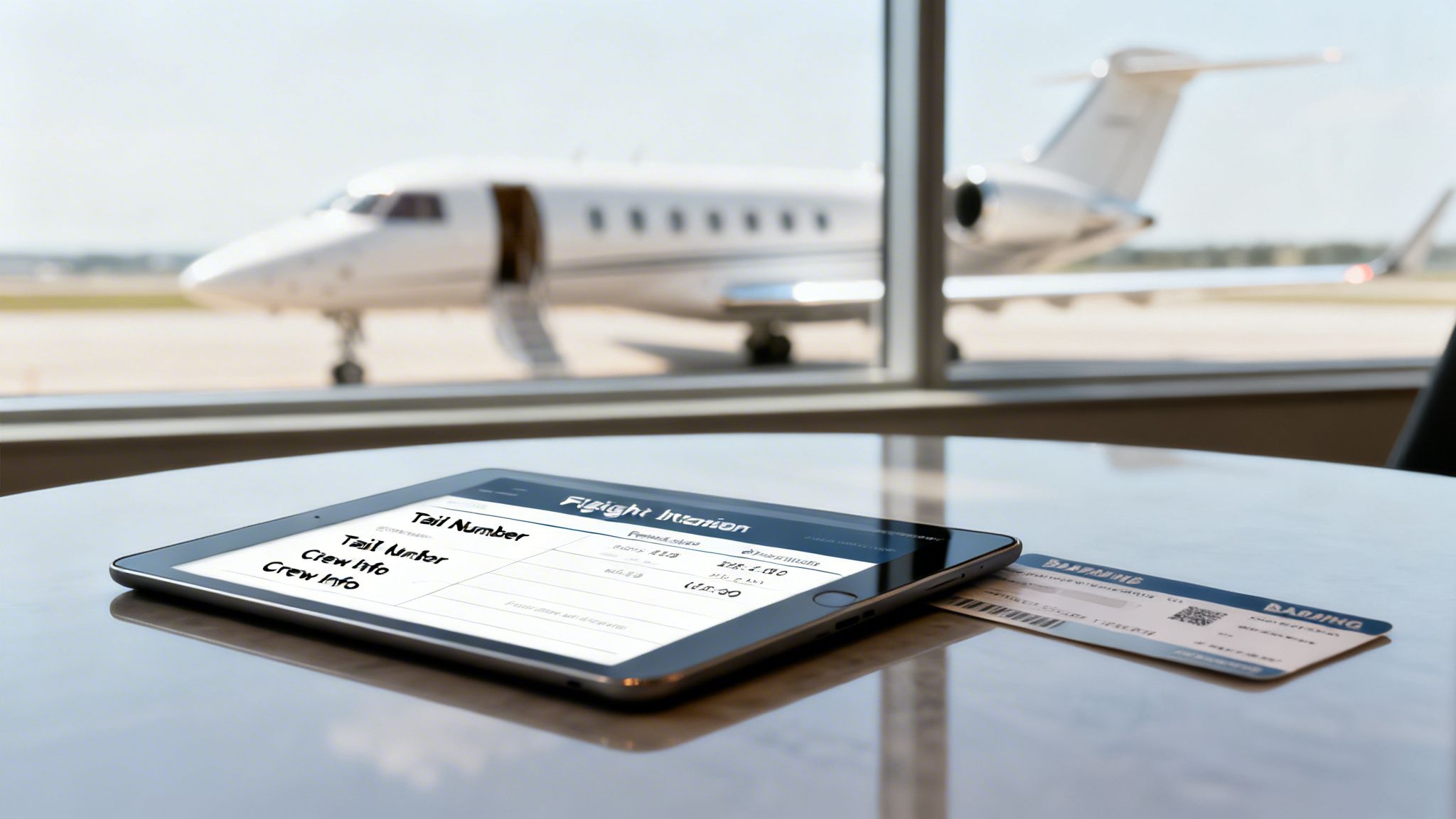
The last piece of the puzzle arrives about 24 hours before departure: your pre-flight confirmation. This isn't just a simple reminder; it’s a comprehensive itinerary that a professional charter operation will always provide for your peace of mind.
Your pre-flight confirmation should be more than just a schedule. It is your complete trip dossier, including the aircraft’s tail number, detailed pilot information, and contact details for the crew and ground operations, ensuring a smooth, secure experience at the airport.
This step-by-step approach is all about putting you in control. By knowing exactly what to expect, you can charter a private jet with the confidence of someone who’s been doing it for years, ready for a flawless trip.
Charter vs Jet Cards vs Ownership
Once you've decided to fly private, you'll find yourself at a crossroads with three main paths to choose from: on-demand charter, jet cards, and outright ownership. Each is a completely different way of accessing private aircraft, and the right choice for you really boils down to how often you fly, your budget, and how much flexibility you need. Getting a handle on these differences is the first step to making a smart decision that fits your life.
Let's use a simple analogy. Full ownership is like buying a supercar—it’s a massive investment that comes with all the headaches of maintenance, storage, and staff. A jet card is more like a long-term lease; you prepay for access, but you're locked into their terms.
To charter a private jet, on the other hand, is the ultimate pay-as-you-go service. It’s like calling for a high-end chauffeured car only when you need it. No strings attached.
On-Demand Charter: The Ultimate Flexibility
On-demand charter is, by far, the most straightforward way to fly private. You simply pay for each trip as you take it. There are no hefty upfront investments, no membership dues, and no long-term contracts locking you in. It’s all about freedom and control.
The real beauty of chartering is the access it gives you. You're not limited to a single fleet of planes. You have the entire global market at your fingertips, which means you can pick the absolute perfect jet for every single trip. Need a light jet for a quick hop to a business meeting? No problem. A heavy jet for a family vacation across the Atlantic? Done. This model is perfect for anyone flying less than 50 hours a year or for those whose travel plans are often spontaneous.
Jet Cards: Prepaid Hours With Hidden Catches
Think of a jet card as a debit card for private flights. You buy a block of flight time—usually 25, 50, or 100 hours—on a certain category of aircraft. For people who need predictable budgeting, the fixed hourly rates can seem very attractive.
But that predictability comes at a price, and it's often more than just the sticker price. Jet card programs almost always require a huge upfront payment, and many come with annual fees, blackout dates, and hefty surcharges for flying on peak travel days. You also lose the power to choose your specific aircraft. Even worse, those "fixed" rates often have repositioning costs baked right in, meaning you could be paying for an empty flight without even knowing it—a problem a good broker is meant to solve.
Key Insight: Jet cards market themselves on simplicity, but their fixed rates often disguise the very same repositioning costs you'd encounter in a poorly sourced charter. You're paying a premium for convenience, not necessarily for better value.
This is a critical point to understand in an industry that's growing fast. The private jet charter market was valued at $16.38 billion in 2025 and is on track to hit $25 billion by 2031. This growth is fueled by a demand for more transparent, flexible ways to fly. As the market expands, knowing the true cost of how you fly becomes more important than ever. You can dig deeper into these trends in this private jet industry report from 2026.
Fractional and Full Ownership: The Highest Commitment
On the other end of the spectrum, you have fractional and full ownership. Fractional ownership is where you buy a share of an aircraft, which gives you a set number of flight hours per year. Full ownership is exactly what it sounds like—you buy the plane outright.
Both options are a massive financial undertaking, starting in the millions of dollars. And the spending doesn't stop there. You're on the hook for ongoing management fees, crew salaries, maintenance, insurance, and hangarage. This path really only makes sense for corporations or individuals flying several hundred hours a year who need a plane on standby 24/7. For everyone else, it’s an incredibly expensive way to own a depreciating asset.
Private Aviation Models Compared
To help you see the differences more clearly, we’ve put together a simple table comparing the three models on the factors that matter most to private flyers.
| Feature | On-Demand Charter (Haute Jets) | Jet Card Programs | Fractional Ownership |
|---|---|---|---|
| Upfront Cost | $0 | $100,000 - $1,000,000+ | $500,000 - $10,000,000+ |
| Commitment | Per-trip basis | 1-2 year term | 3-5 year term |
| Aircraft Choice | Choose exact make/model | Limited to category/fleet | Limited to your owned aircraft |
| Pricing Model | Dynamic, market-based | Fixed hourly rates | Pro-rata share of all costs |
| Flexibility | Highest | Moderate | Lowest |
| Best For | Flying under 50 hours/year | Predictable, frequent flyers | Flying over 150 hours/year |
When you look at the numbers and the fine print, the choice becomes clear for the vast majority of travelers. On-demand charter delivers the luxury and convenience you expect from private aviation, but without the financial chains and inflexibility of jet cards and ownership. It puts you squarely in the pilot's seat, giving you total control over how, when, and where you fly.
Frequently Asked Questions About Private Jet Charters
Dipping your toes into the world of private jet charter for the first time? It’s completely normal to have a few questions. Flying private is a world away from the commercial airline experience, putting you in complete control.
Let's walk through some of the most common questions we hear from new clients. Our goal is to demystify the process and help you book your first flight with total confidence.
How Far in Advance Should I Book a Charter Flight?
The sweet spot for booking is typically one to two weeks in advance. This usually gives you the best selection of aircraft and more competitive pricing.
But the real magic of on-demand charter is its flexibility. Need a jet in a few hours? It’s often possible, especially if you're flying out of a major hub where plenty of aircraft are based.
A word of caution, though: for peak travel times like major holidays or big events (think the Super Bowl or Cannes Film Festival), you'll want to book several weeks, or even months, ahead. This locks in your preferred aircraft before demand skyrockets and availability shrinks.
Can I Bring My Pet on a Private Jet?
Yes, absolutely! For many of our clients, this is one of the single biggest perks of flying private. The vast majority of aircraft are pet-friendly, though the final say always comes down to the aircraft's specific owner.
When you request a quote, just let us know your pet's breed and size. Your charter advisor will then only show you aircraft options where your pet is welcome. They'll travel right alongside you in the cabin, avoiding the stressful and often dangerous experience of being checked into a commercial cargo hold.
Your pet's comfort is a priority. Unlike commercial flights, private charter allows them to remain by your side, transforming what could be a stressful experience into a calm and enjoyable journey for everyone.
What Happens if My Flight Is Canceled?
In aviation, safety is non-negotiable. If a flight has to be canceled—whether for a last-minute mechanical issue or severe weather—your charter provider's job is to get a backup plan in motion immediately.
A reputable broker has access to a huge network of safety-vetted aircraft. This means they can almost always source a recovery aircraft from a different operator to get you on your way with minimal delay. Your charter agreement will outline the specific policies, but the focus is always on finding a safe and swift solution.
Is a Round Trip Cheaper Than Two One-Ways?
This is a great question, and the answer comes down to how long you'll be at your destination.
- For short trips (1-3 days): A round trip is almost always the more economical choice. The aircraft and crew simply wait for you at the destination, which saves you from paying for a whole separate flight to get home.
- For longer stays (4+ days): It usually makes more financial sense to book two separate one-way flights. The costs for having an aircraft and crew sit idle for days on end (known as daily minimums) can quickly add up and become more expensive than just chartering a different jet for the return leg.
A good charter advisor will run the numbers for your specific itinerary and clearly lay out both options, guiding you to the most cost-effective solution.
Ready to experience the freedom of on-demand travel? With Haute Jets, you gain access to a global network of top-tier aircraft without any upfront investment. Get a quote for your next trip and see how our local-sourcing model delivers superior value. Book your next charter flight with Haute Jets.