
You're likely trying to move a real group, not just book a nicer seat map. The pressure is always the same, getting everyone there together, keeping baggage under control, and avoiding the kind of last-minute scramble that turns a premium charter into a mess at the ramp.
Private jet group travel works when the flight is treated like an operation, not a purchase. The aircraft, the manifest, the ground chain, and the safety checks all have to line up, or the convenience disappears fast.
Why Private Jet Group Travel Requires a Different Playbook
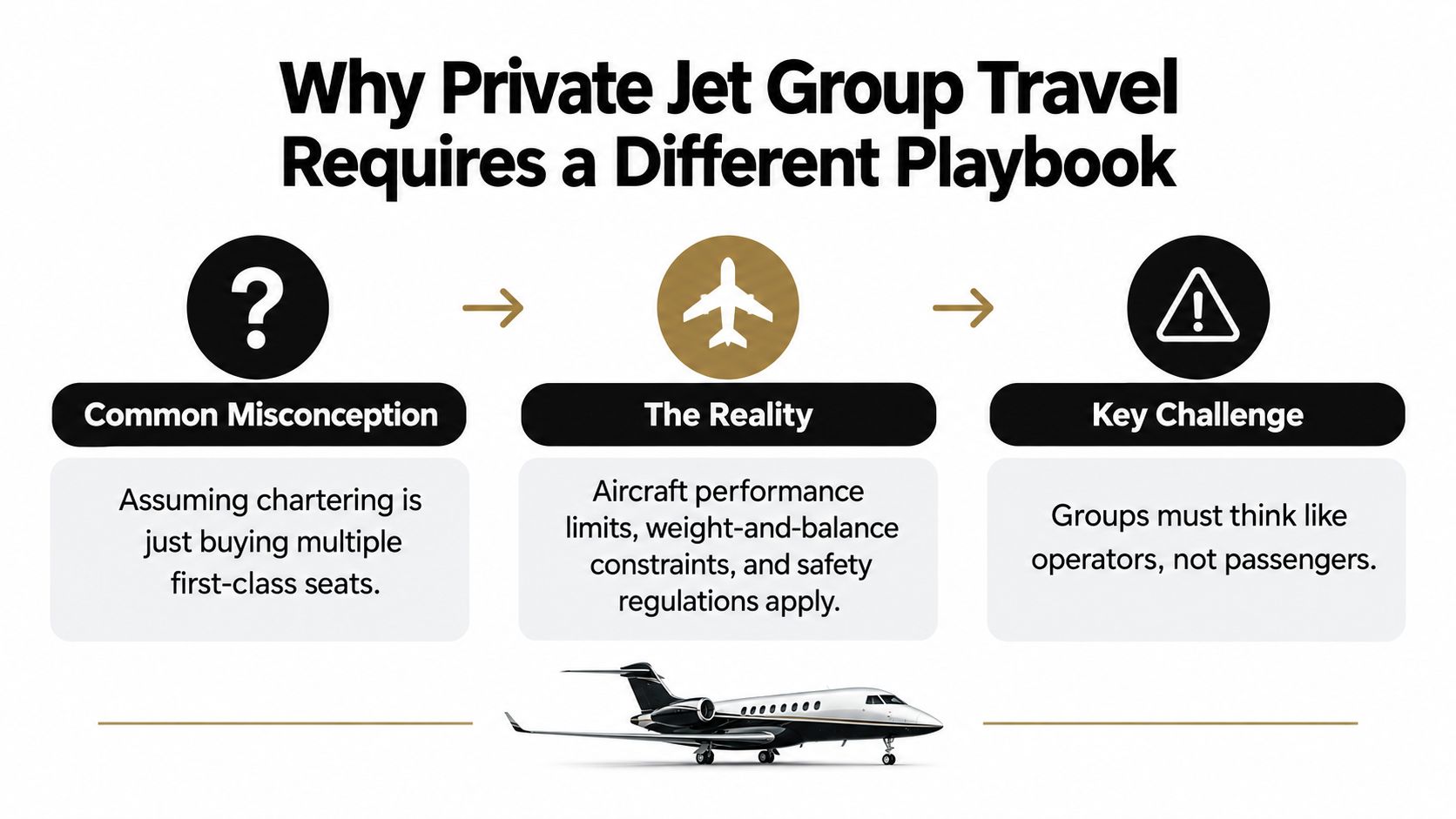
A group charter starts to change the moment baggage, arrival timing, and passenger count stop lining up neatly. A six-person sales team with laptops and checked bags creates a different load problem than a family move or a board trip, even before anyone steps on board.
Private aviation does handle group movement at scale. A 2021 NBAA fact book reported about 120 million passengers on general-aviation flights in the United States in 2018, and it also showed that more than 70% of business-aircraft passengers were non-executive employees NBAA fact book. Another summary of the same research said 86% of business-aviation flights carried marketing and sales personnel, technical and engineering staff, middle managers, or company customers.
That volume matters because the mission decides the aircraft plan. A team moving with cases of equipment, a conference group with carry-ons, and a sports roster with gear all stress the aircraft in different ways, even when the headcount looks similar on paper.
The practical difference
Group charters work only when the operation is built around the mission, not around a generic idea of “private jet travel.” The aircraft, the manifest, the baggage load, and the ground timeline have to fit one another or the schedule starts to slip.
Weight is part of that calculation from the start. Passenger count alone does not tell you whether the trip is workable, because gear, baggage, catering, and fuel all compete for the same margin. A flight that looks simple at booking can become tight at departure if one traveler shows up with more bags than expected or the routing changes late.
Practical rule: start with mission fit, then check the load.
Group-specific safety also needs more attention than many first-time charter clients expect. Families want child restraints and calm boarding. Executive groups need clear seat assignments and arrival sequencing. Sports teams often need stricter cabin discipline around equipment and movement in the cabin. These details are small until they affect the manifest, the balance sheet, or the crew briefing.
These are the questions that keep the flight legal, safe, and on schedule.
Choosing the Right Aircraft for Your Group Size and Mission
The right aircraft isn't the one with the most prestige. It's the one that fits the trip without wasting money or creating operational friction. For group work, cabin layout, range, and baggage volume matter just as much as passenger count.
Most business airplanes seat no more than six people and usually operate on trips under 1,000 miles, while the largest business jets can take more than 20 passengers on intercontinental sectors NBAA fact book. That spread means you're comparing real mission types, not browsing a single product category. A short-haul team hop, a longer route with gear, and a multi-city executive move each call for a different cabin strategy.
Light, midsize, and large-cabin thinking
Light jets work when the group is small, the trip is shorter, and the airports are straightforward. Midsize aircraft make more sense when you need a little more room, more baggage tolerance, or a cabin that can handle working passengers without everyone elbowing each other. Large-cabin aircraft are the tool for longer routes, better privacy, and group comfort on sectors where workspace and onboard flexibility matter.
Aircraft selection gets more complicated once seating layout is concrete instead of theoretical. A jet that looks perfect on paper can lose usable seats once you account for bags, catering, and how people arrange themselves to sit together. I've seen more trips go sideways because of luggage assumptions than because of the route itself.
What usually fails: buying capacity by headline seat count instead of usable cabin space.
The most useful filter is simple. Ask whether everyone must arrive together, whether the group has special baggage, whether the route demands nonstop range, and whether the preferred airport can handle the aircraft size. That usually narrows the field faster than any glossy brochure.
For a practical aircraft-selection framework, this Haute Jets Journal guide is useful when you're comparing short-haul options and trying to avoid paying for more jet than the mission needs.
Understanding Weight Manifest and Passenger Consolidation
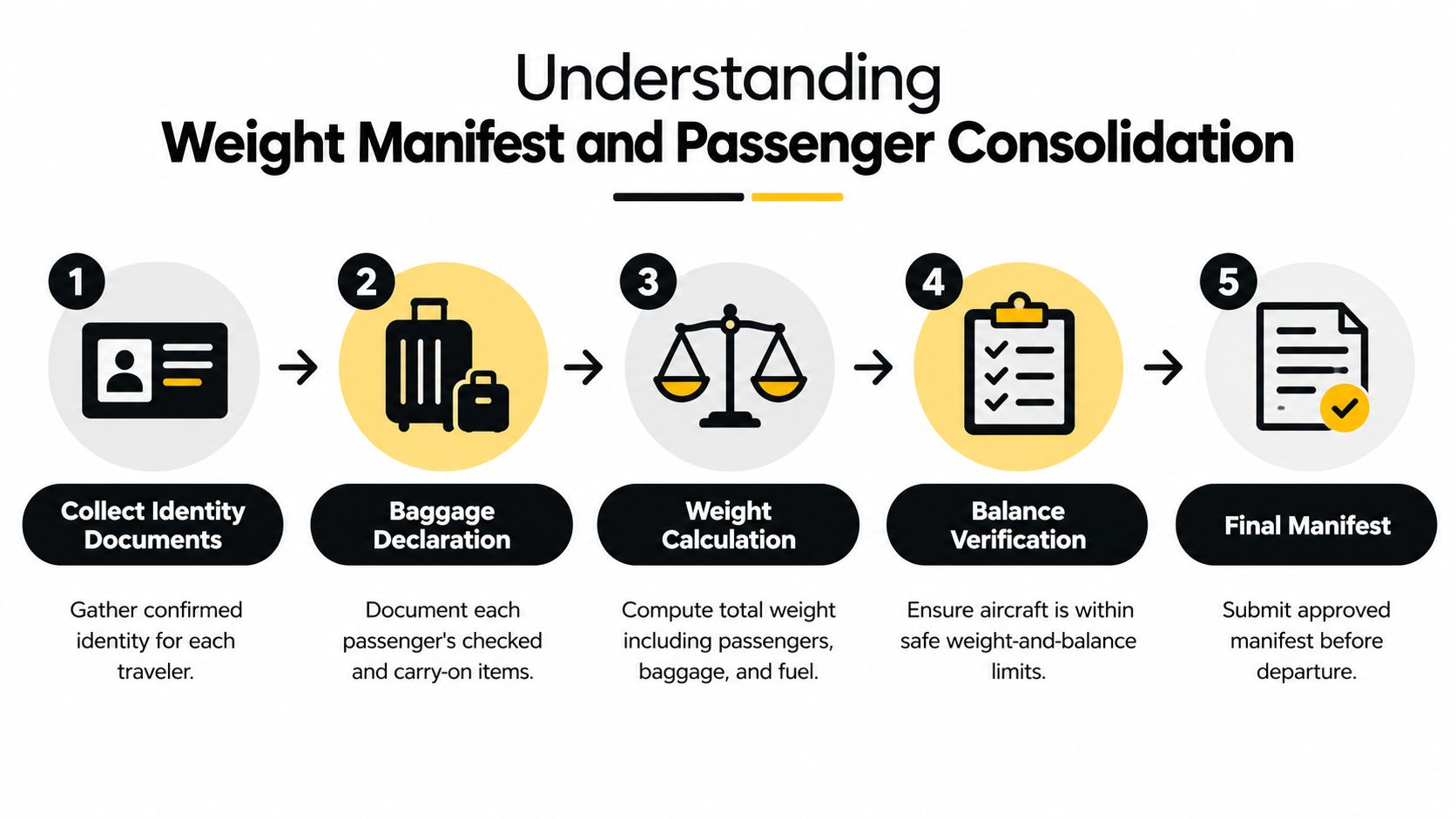
A group can look fine on paper and still fail the weight check on the ramp. Once passengers, bags, fuel, weather, runway length, and alternates are all part of the plan, the margin disappears quickly.
The cleanest workflow starts before the aircraft is even selected. Collect each traveler's confirmed identity, baggage estimate, special equipment, pets, and catering requirements early. If you wait until the day before departure, the operator still has to build the load manifest and verify center of gravity before takeoff, and that is how avoidable changes show up at the worst time.
What the operator has to account for
FAA load-manifest rules under 14 CFR 121.693 require weight to include the aircraft, fuel and oil, cargo and baggage, passengers, and crew. Maximum takeoff weight also has to satisfy runway, en-route, landing-weight, and landing-distance limits, while the aircraft must remain within approved center-of-gravity limits. A seat map alone does not answer any of that.
A common mistake is relying on a nominal passenger count or a rough average weight. FAA guidance allows actual weighing or solicited passenger weights, with at least 10 pounds added to volunteered passenger weight for clothing under the cited guidance. As an illustration, a 10-passenger trip underestimating by 10 pounds per person creates a 100-pound planning error before baggage is even counted.
The discipline that prevents surprises
Ask for operator-approved passenger and baggage figures early, then check them again close to departure. That second look matters most on short runways, hot days, high-altitude airports, or sectors near the aircraft's practical range limit.
“Treat the manifest as a live document that changes with the trip.”
Passenger consolidation works the same way. If the passenger list changes, if someone adds a ski bag, if the fuel load changes, or if the route shifts, the manifest has to be revisited. In group travel, the safest trips are usually the ones where the weight calculation is treated as part of dispatch, not paperwork after the fact.
Splitting Charter Costs Fairly Among Group Members
Cost disputes usually start when the group has already agreed on the trip. That's too late. The split has to be explained before anyone feels surprised by the final number, because different people value cabin space, flexibility, and privacy differently.
Three models work in practice. An equal split is simplest when the group is functionally traveling for one purpose and expects the same cabin experience. A proportional split by seat class fits better when some travelers want more space or privacy than others. A hybrid model works when catering, special baggage, or ground transport should be shared differently from the base charter.
Choosing the split model
The equal split is clean, but it can feel unfair if one passenger takes the lead in arranging the trip and another brings far more baggage. A seat-class split can be more honest for mixed groups, especially when some people value premium seating or extra privacy. Hybrid pricing often works best for corporate or event groups, because the aircraft cost is shared one way while variable extras are assigned separately.
The group size itself changes the math. A Challenger 350 carrying ten fans from New York to Miami would cost approximately $1,400 to $3,500 per person per leg when the aircraft cost is divided among the group Haute Living on the 2026 FIFA World Cup. That range is useful because it shows how quickly per-person pricing can move when the aircraft cost is spread across more travelers.
Peak demand changes the equation
Tournament weekends, especially the quarterfinals, semifinals, and final at MetLife, could carry charter-rate premiums of 20% to 40% above standard summer pricing Haute Living on the 2026 FIFA World Cup. That's not a small adjustment. If the group cares about timing more than perfect savings, the premium may be worth it. If not, the itinerary should be built around less expensive departure windows.
For operators and planners trying to keep the math transparent, this guide to split private jet costs is a useful reference point. For broader budgeting logic around group travel, manage private tour pricing is also helpful because it forces the same discipline around shared and variable expenses.
Coordinating Airports, Ground Transport, and On-Board Services
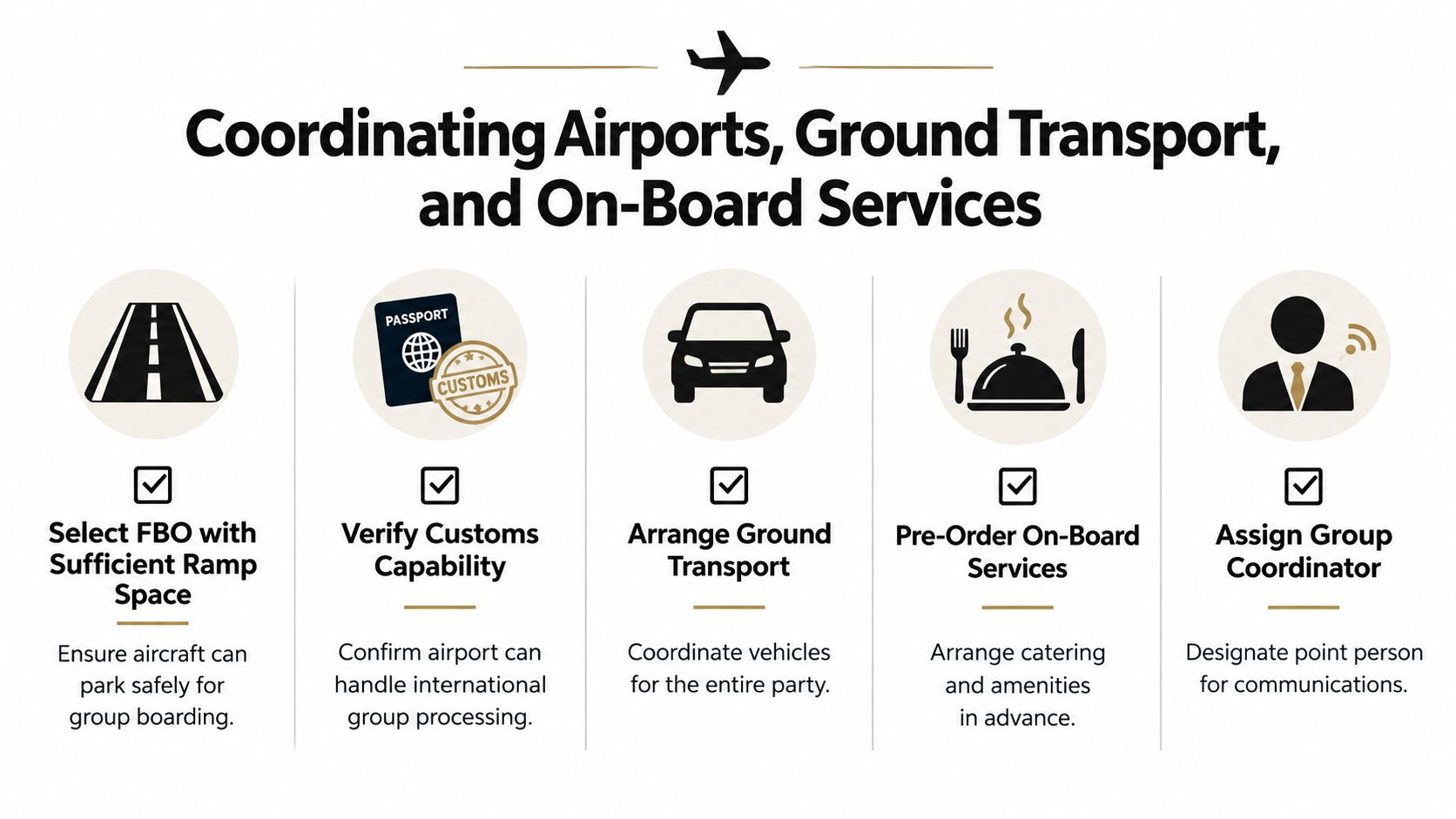
The aircraft is only one piece of the trip. I've seen strong flight plans fail because the airport couldn't handle the group flow, the vans were late, or the catering didn't match the passenger mix. Ground logistics either preserve the schedule or slowly break it apart.
Airport choice matters more for group missions than for solo travel. You want enough ramp space for boarding, enough service capability for the group's needs, and, where relevant, customs support that won't bottleneck arrival. If the airport is awkward for the flight, the rest of the day becomes harder than it should be.
What actually has to be coordinated
The same logic applies to ground transport. A group that arrives on one aircraft should leave in a planned convoy, not as a pile of separate rides. That's especially important for corporate teams, sports groups, and family travel, where the value of the charter is staying together all the way to the destination.
On-board service needs to reflect the purpose of the trip. Corporate teams usually need workspace, charging access, and a cabin setup that supports conversation. Sports teams and production crews need room for equipment. Families often care more about comfort, quiet, and entertainment than anything else.
Operational rule: if the ground plan is vague, the charter isn't finished yet.
The schedule also needs buffers. A premium charter isn't operationally risk-free, and compressed event timing creates avoidable problems. Freeze the itinerary at a defined cutoff, then require documented approval for any later change. That applies to the passenger list, departure time, catering, and transport as much as it does to the aircraft.
For airport-specific planning, this Haute Jets Journal airport guide is a useful companion when you're comparing facilities and trying to avoid bottlenecks at the terminal.
When to Split a Group Across Multiple Aircraft
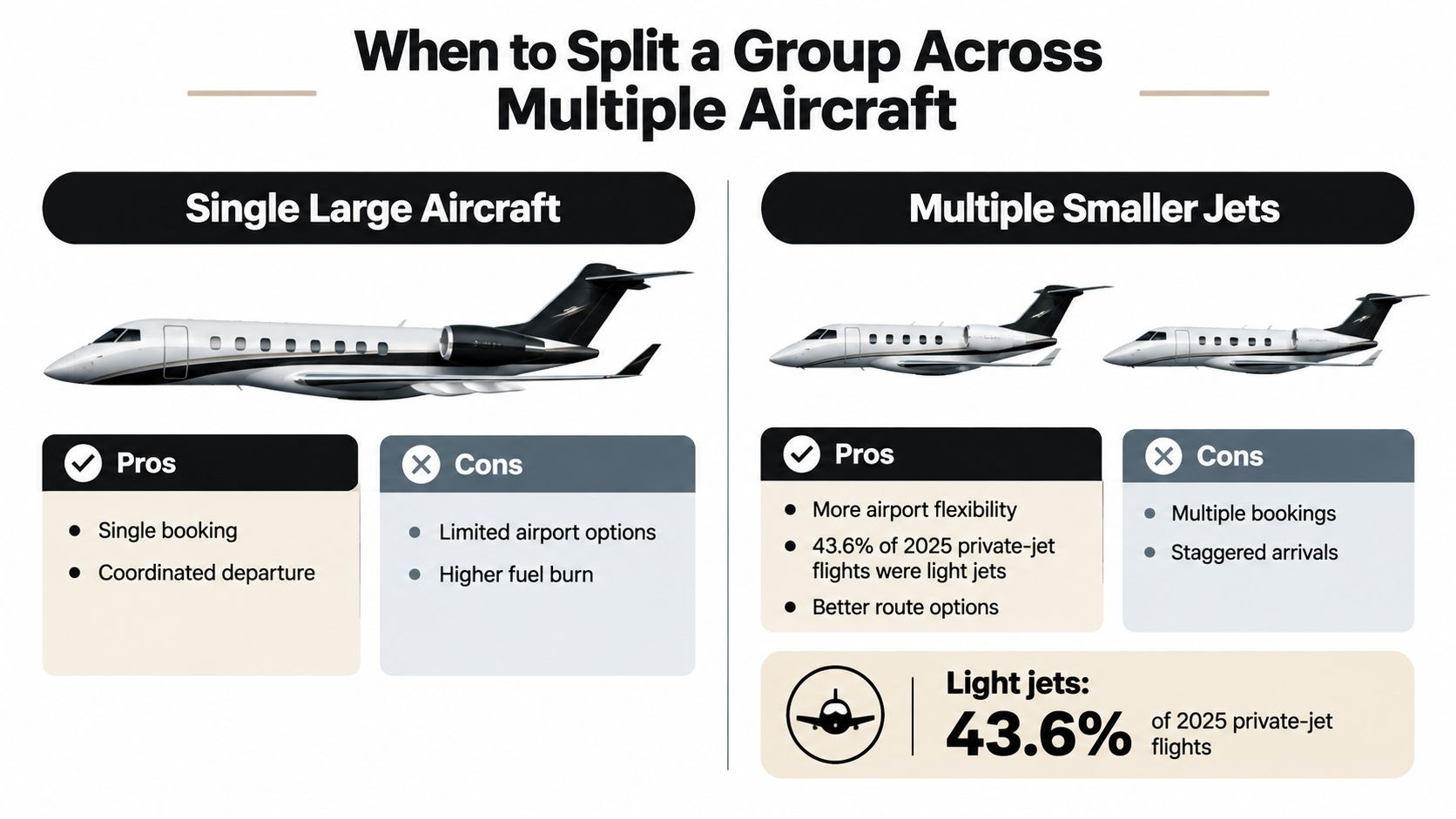
One large aircraft sounds simpler, but simplicity is not always the same as better execution. A 10 to 14 person group may be better served by two smaller aircraft when airport access, baggage volume, or schedule resilience matter more than keeping everyone on one tail.
That's especially true because light jets represented 43.6% of private-jet flights in 2025, which shows that shorter, smaller-aircraft missions still dominate the market Forbes. The recent growth was also concentrated in shorter missions, with U.S. light-jet departures increasing 3.5% year over year in the first half of 2025 and flight hours growing 2.7% Forbes. That makes split operations worth serious consideration, not just a backup plan.
The decision test I use
Ask six questions.
- How many people are flying, really? The answer matters once cabin layout and luggage are counted, not just the invite list.
- How much checked bag volume is involved? Ski gear, golf bags, and production cases change the aircraft choice quickly.
- Does everyone need to arrive together? If not, splitting often improves scheduling.
- What's the nonstop range? A single aircraft may be forced into a worse compromise if the route is long.
- Which airports do people need? Two aircraft can sometimes use more convenient departure points.
- What happens if one aircraft is delayed? Redundancy can be worth more than a slightly simpler booking.
Two light or midsize aircraft can be easier to position, easier to schedule, and less exposed if one tail has a technical issue. One larger aircraft can still win when everyone must move together, when baggage is straightforward, or when the group wants a single coordinated cabin experience. The point is to compare total trip cost per traveler after positioning, landing, crew, catering, and ground transport, not just the charter rate.
Executing Your Group Charter from Planning to Arrival
A real group mission starts with the passenger list and ends with the arrival handoff, not with the booking confirmation. For a group of eight to fourteen travelers heading to specific events, the useful workflow is straightforward, if disciplined. Aircraft selection, manifest submission, cost allocation, and ground logistics all need to be locked before anyone assumes the trip is “done.”
The 24-hour confirmation is where good operators separate themselves from sloppy ones. Tail number, crew bios, weather briefing, and passenger manifest should all be verified before departure. That's also the point where any late passenger change or baggage change should be checked against the approved load plan.
What to confirm before departure
- Tail number and operator details, so the group knows exactly which aircraft is moving.
- Crew information, because the people flying the mission matter as much as the tail.
- Weather and route briefing, so no one is surprised by operational changes.
- Final passenger manifest, so the loading stays compliant.
- Ground transfer timing, so arrival and departure stay synchronized.
Haute Jets sources from 3,500+ owner-operators across 175 countries, and every operator in that network holds a Wyvern Wingman or Argus Gold/Platinum rating. That matters for group travel because the operator selection has to support the mission, not just the seat count. Haute Jets also confirms full flight details before departure, which is exactly the kind of discipline group itineraries depend on.
For a simple execution model, treat the trip as four gates. The aircraft has to fit the group. The manifest has to match the actual people and bags. The ground plan has to move everyone cleanly. And the flight department has to keep the schedule from drifting.
If you're planning private jet group travel and want the logistics handled with the same care as the cabin, Haute Jets can source the aircraft, coordinate the manifest, and align the ground plan to the mission. Visit Haute Jets to review group charter options and build a trip around the exact aircraft and timeline your travelers need.