
You're probably doing what most charter clients do at the start. You ask a simple question like, “How many seats does it have?” Then you look at a cabin photo and assume the answer tells you whether the jet fits your trip.
That works on an airline website. It doesn't work nearly as well in private aviation.
On Haute Jets Journal, the better question is usually not seat count. It's what those seats let your group do. A cabin for four executives flying out and back the same day should feel different from a cabin for a family traveling with children, bags, and a need for rest. The right answer depends on whether the trip is built around work, sleep, conversation, privacy, or getting everyone there comfortably.
Introduction to Seats on Private Planes and Why Layout Matters More Than Numbers
A client books a jet for six people and assumes six seats means a comfortable trip. Then the critical question shows up after boarding. Where do two people open laptops, where does one passenger nap, and where do the parents keep a child close during taxi, takeoff, and landing?
That is why seats on private planes are part of a layout, not just a headcount.
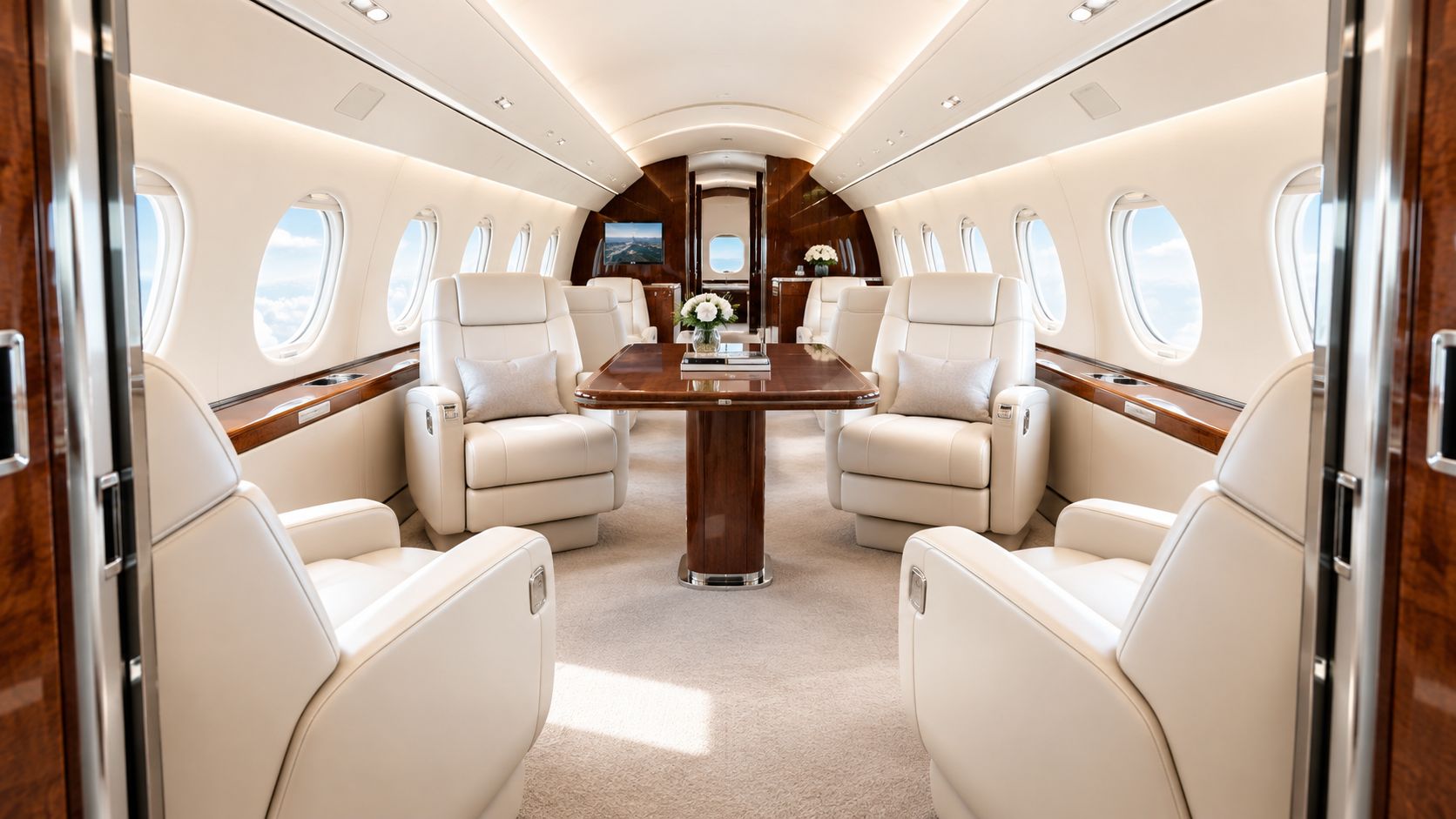
A private cabin works more like a small multipurpose room than a numbered row map. One trip may call for a quiet rest zone. Another may need a face-to-face work zone around a table. A family itinerary may depend on sightlines, easy movement, and approved seating positions during the parts of flight when everyone must be properly seated.
Why airline thinking creates confusion
Commercial travel teaches passengers to compare cabins by row, letter, pitch, and width. That frame helps on an airline site because the cabin is built from repeated seat units. Analysts at Variflight, in its discussion of seat and amenity data, describe structured airline cabin products in exactly that way. A private jet cabin does not behave like a repeated grid, so the same comparison only answers part of the question.
In charter, the better lens is zoning. Ask what part of the cabin supports work, what part supports rest, and what part keeps the group comfortable as they interact. Two aircraft can both list eight passenger seats and feel completely different in use. One may devote more space to a conference-style club arrangement. The other may fit additional seating positions but leave less elbow room, less floor space, and fewer places to shift between tasks.
The best seat on a private jet is usually the seat inside the right layout for the trip.
A smarter way to evaluate a cabin
Start with the mission, then read the seat map through that mission.
For example, an eight-seat layout can look stronger on paper than a six-seat layout. Yet the six-seat cabin may serve a three-hour business flight better if it gives four passengers table access and leaves room for one person to step away for a call or quiet work. The denser option gets more people onboard. The lighter layout often gives each person a better experience once the door closes.
That is the trade-off many first-time charter clients miss. More seats can reduce comfort, privacy, and flexibility. Haute Jets helps match cabin layout to trip profile so travelers choose space for the way they will fly, not just the highest number in the specification sheet.
What a Seat Really Means Inside a Private Jet Cabin
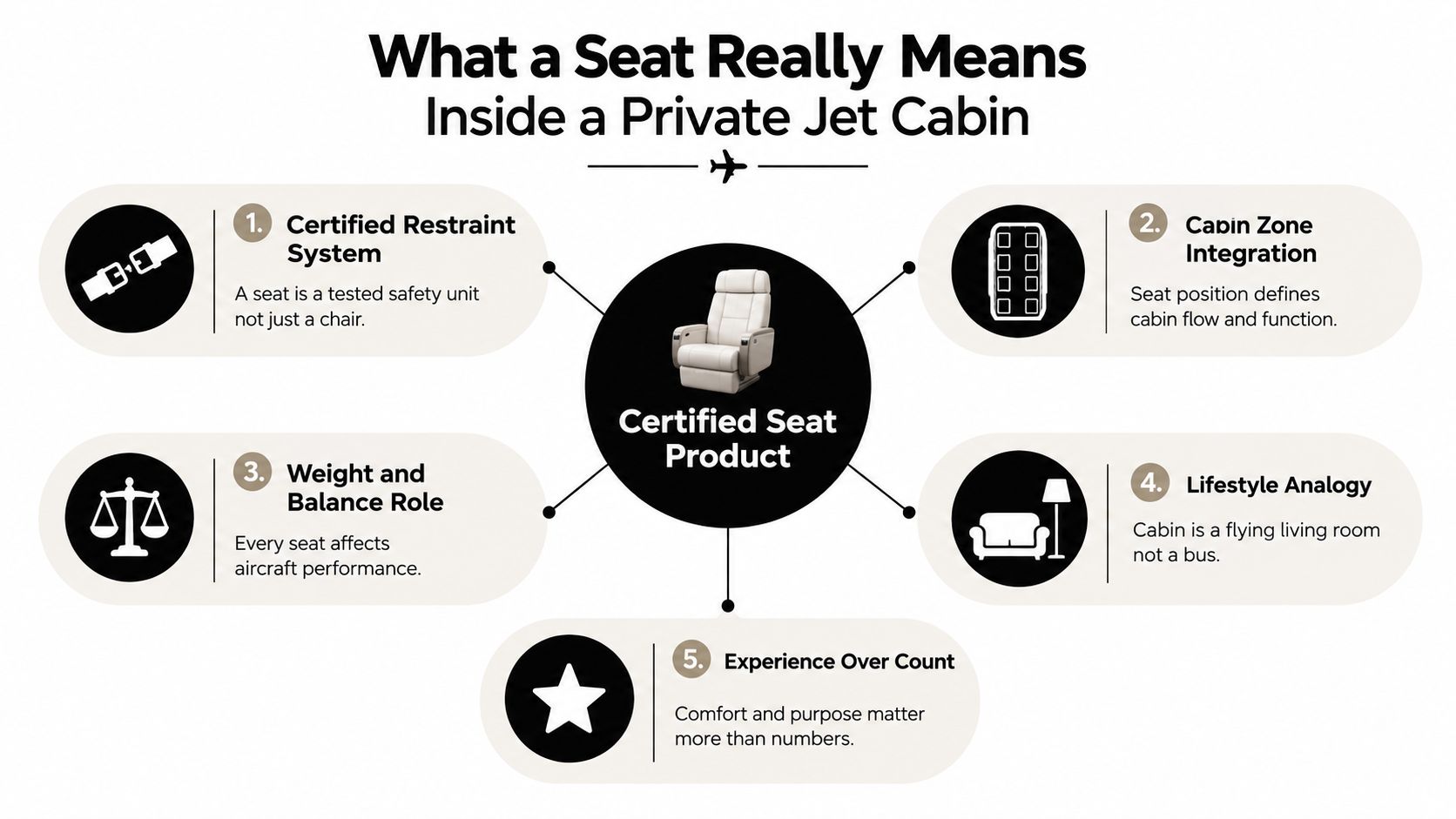
A private jet seat isn't just a chair. It's a certified, restraint-equipped position within a cabin that has to function as part of the aircraft.
That sounds technical, but it helps clear up a lot of confusion.
On an airline, a seat is easy to picture. It's one unit in a row, fixed in place, surrounded by other nearly identical units. On a private jet, a seat is more like a position in a carefully designed room. It may swivel. It may recline. It may sit across from another chair at a table. It may be beside a divan that looks seat-like in photos but serves a different purpose depending on the phase of flight.
Think living room, not theater
A useful analogy is this. Airline seating is like a theater. Every person has a designated place, and the room exists to move many people efficiently. Private jet seating is closer to a living room or boardroom. The furniture has to serve multiple functions in a smaller space.
That's why the same airframe can be arranged for very different missions:
- Executive mission: Four to eight travelers need face-to-face seating, table access, and a setting that supports conversation or laptop work.
- Family mission: Parents may want children close by, easier movement, and surfaces that support snacks, devices, and rest.
- Higher-density charter mission: The operator may favor more usable passenger positions, even if the cabin feels less open.
Why cabin photos can mislead
Photos often show the cabin at its most attractive angle. That's good for aesthetics, but it can blur the difference between what looks occupiable and what's approved for use when it matters most.
Cabin-safety guidance makes an important distinction. Occupants must use approved seats and restraints during taxi, takeoff, and landing, and some berths or other furnishings may not be intended for those phases, as discussed in this cabin-safety explanation on business jet beds and restraints.
Practical rule: Ask which positions are approved seats for taxi, takeoff, and landing. Don't assume every surface shown in a cabin photo counts the same way.
The words brokers use actually matter
A few terms come up often when discussing seats on private planes:
- Club seating means chairs facing each other, often around a table.
- Divan usually means a side-facing couch or bench-style seating element.
- Berth refers to a sleeping position or bed-like setup.
- Forward-facing seat describes a more traditional travel orientation.
Those distinctions affect comfort, workflow, and legal use during different phases of flight. Once you understand that a “seat” is really part of a certified cabin system, the rest of the selection process gets much easier.
How Many Seats to Expect Across Light Midsize and Heavy Jets
If you searched for seats on private planes, this is probably the practical answer you wanted first. The catch is that seat count makes sense only when paired with cabin geometry.
A narrow cabin with the same number of passenger positions as a taller, wider one can feel completely different in use. The seat count may look similar on paper. The onboard experience won't.
What changes as the cabin gets larger
Industry cabin guides show that light jets typically provide about 1.45 to 1.46 meters of cabin width and are configured for 6 to 8 passengers, while midsize cabins expand in height to roughly 1.83 meters and commonly use club-seat or divan layouts that support sleeping or work-oriented zones. Once cabins reach around 2.2 meters and above in heavy-jet width, seats can fully swivel, recline into beds, and allow easier passenger movement, according to Flyius on private jet interiors and cabin dimensions.
That's the practical dividing line. In smaller cabins, every seat placement affects elbow room, aisle clearance, and whether someone can move past another passenger comfortably. In larger cabins, layout starts to feel less compromised.
Typical Private Jet Seating by Aircraft Class
| Aircraft Class | Typical Cabin Width Height | Typical Seat Count | Signature Layout Features |
|---|---|---|---|
| Light Jet | About 1.45 to 1.46 m cabin width | 6 to 8 | Compact club seating, tighter aisle movement, efficient short-trip layouts |
| Midsize Jet | Roughly 1.83 m cabin height | Commonly arranged for small groups | Club-four, divan options, better support for work or rest zones |
| Super Midsize Jet | Larger cabin than midsize, often with improved movement and zoning | Varies by configuration | More separation between conversation and work areas, stronger comfort for longer flights |
| Heavy Jet | Around 2.2 m width and above | Varies by operator and mission | Full swivel, deeper recline, lie-flat potential, easier passing and stand-up movement |
For a broader cabin-class comparison, see this guide to comparing light, midsize, and heavy private jets.
How the same headcount can feel different
Take a group of six.
In a light jet, six passengers may fit the aircraft's intended mission well for a shorter hop. Everyone has a place, but personal space is tighter, movement is limited, and bags must be planned carefully. It can be efficient and pleasant when expectations match the mission.
Put those same six travelers in a midsize or super midsize cabin and the mood changes. Now the cabin may support a working table, a divan, or enough separation that one pair can talk while another pair works.
In a heavy jet, six people often feel less like they are “filling” the airplane and more like they are occupying distinct zones. That difference is especially useful on longer sectors, red-eyes, or trips where some passengers need to work while others rest.
When more seats become less valuable
A denser layout can be useful for certain group movements. It isn't automatically the better choice.
Most consumer content on private aviation explains classes, but not the operational reality that private jets usually don't use commercial-style row and seat-letter numbering. What matters more is the exact layout, the restraint-equipped positions, and whether the aircraft supports work, dining, or sleeping. That's why the better question often isn't “Which seat is best?” but whether the aircraft has a club-four layout, divan, conference table, or stand-up cabin, as discussed in BlackJet's article about airplane rows and private layout logic.
If your mission is a short regional flight with a small group, extra cabin can be unnecessary. If your mission is coast-to-coast with work and rest onboard, buying only by seat count is where people get it wrong.
Comfort Features That Define the Private Jet Seating Experience
A private cabin feels premium because of how the seating works together, not because the brochure lists a certain number of passenger positions.
Travelers usually shift from asking “How many seats?” to asking “What will those hours feel like?”
The features people notice first
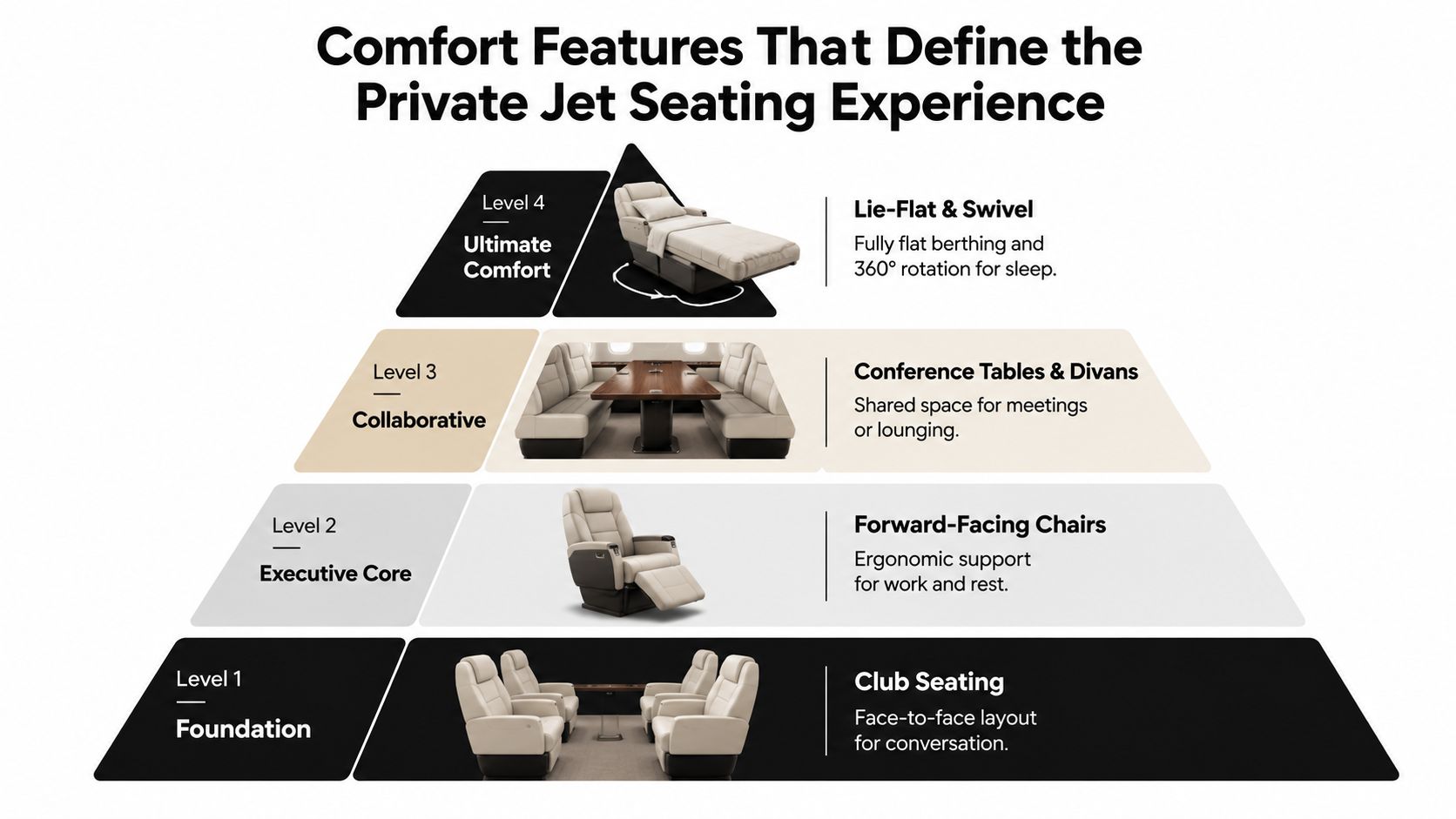
The most recognizable comfort feature is club seating. Four chairs face each other, often with a table between them. For conversation, meals, and informal meetings, it's one of the most natural layouts in business aviation.
Then there are forward-facing executive chairs, which tend to feel familiar and stable to travelers who prefer a traditional seating orientation. These often matter on shorter business sectors, where posture, laptop use, and easy entry matter more than full recline.
Other layouts add more flexibility:
- Divans: useful for lounging, family seating, or creating a softer social area
- Conference tables: better for collaborative work, catered meals, or deal review
- Lie-flat or berth-style arrangements: valuable when the trip requires real rest, not just reclining
Why zoning matters more than luxury language
Two cabins can both be called luxurious. One may still be wrong for your trip.
A four-person management team flying to a same-day meeting may get the most value from a table-centered cabin where everyone can stay engaged. A family of six on a longer journey may care more about visual openness, a place for children to settle, and enough separation that the cabin doesn't feel compressed. The same aircraft category can serve both missions differently depending on the seating plan.
For a closer look at how finishes, layout, and cabin details work together, this private jet interior guide is useful background.
A short cabin walkthrough helps make those differences easier to visualize:
The new comfort layer in 2025 and 2026
Passenger-experience coverage increasingly treats seating as part of a broader environment that supports productivity, rest, and wellness, including circadian lighting, smart cabin controls, and connectivity expectations, as noted in the earlier cabin-safety and interiors discussion.
That shift matters on longer sectors. A seat isn't only a place to sit anymore. It's part of a workspace, a dining setting, and sometimes a sleep setup. Travelers now evaluate whether the cabin helps them arrive ready to present, negotiate, rest, or manage children, not just whether the leather looks upscale.
Some of the most useful comfort isn't decorative. It's the ability to swivel toward a colleague, recline without blocking movement, or separate work from rest within the same cabin.
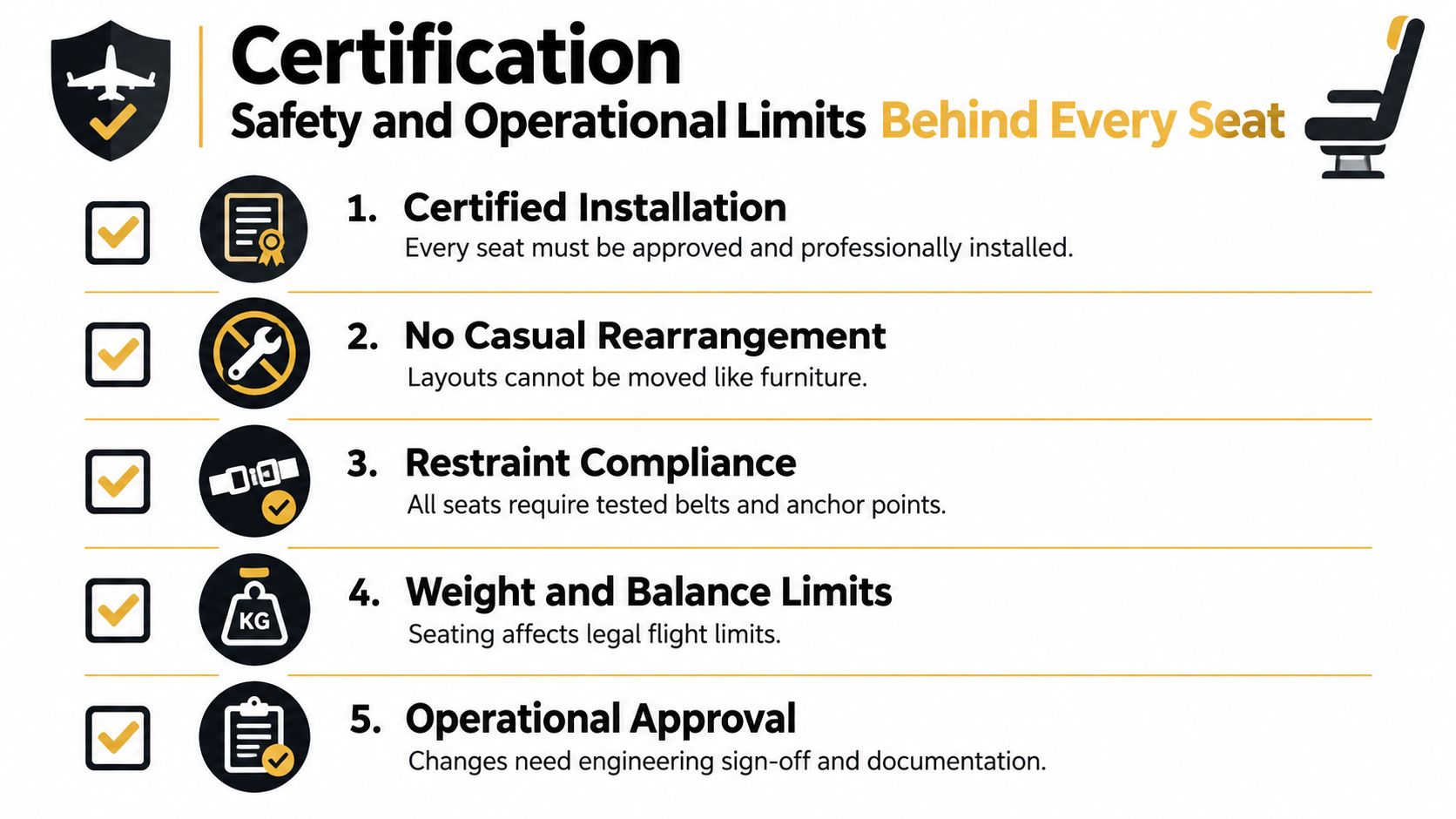
Certification Safety and Operational Limits Behind Every Seat
A client books a jet for eight people, then asks a common question a day before departure: can the operator add one more seat or swap a divan for extra chairs? In private aviation, that request is closer to changing a row in an airliner than rearranging a living room.
Seats on private planes are certified parts of the aircraft. Each one is tied to approved structure, restraint systems, evacuation rules, and operating limits. The cabin may look residential, but underneath the leather and wood, every occupied position has to meet aircraft standards.
Why the seat structure matters
A certified seat does more than provide a place to sit. It has to stay secure under demanding loads, keep the passenger restrained, and work with the structure beneath it. FAA Part 25 also ties seat and berth design to an assumed occupant weight of 170 pounds and to emergency landing load conditions, which is why seat tracks, anchor points, and surrounding structure matter as much as the cushion itself, according to the FAA regulatory text for Part 25.
That matters for comfort planning, too. A “seat” in a brochure can mean a fully certified takeoff-and-landing position, a side-facing divan with specific occupancy limits, or a berth that cannot be used during every phase of flight. For trip planning, those are three different tools.
Why seat location can affect the trip
Cabin layout also affects weight and balance. Every occupied seat is a payload position with a specific place in the aircraft, so who sits where can matter, especially on trips where passengers, bags, and fuel are all competing for margin.
This is one reason charter advisors ask detailed questions before they quote a trip. A family mission with strollers, ski bags, and child seats uses the cabin differently from a four-person business flight with light baggage. On some aircraft, more available seating can mean less practical flexibility once luggage and fuel are accounted for.
Operational limits many travelers never hear about
Some seat thresholds change how an aircraft can be operated under U.S. charter rules.
- In Part 135 charter operations, an aircraft with a passenger seating configuration of more than 19 seats cannot be operated unless a flight attendant is onboard, which makes the 19-seat threshold a real planning boundary, according to Stratos Jets' planning guide.
- For on-demand charter under Part 135, aircraft may be operated with a passenger seating configuration of 30 seats or less and a maximum payload capacity of 7,500 pounds, while commuter service is more restrictive at 9 seats or fewer and excludes turbojet airplanes, according to Air Planning's Part 135 summary.
Those limits shape real booking advice. A cabin that looks ideal for a large group on paper may trigger different crew or operating requirements once the actual certified seating configuration is confirmed.
Safety questions worth asking before you book
Cabin modifications require approval. Seating and cabin furniture must be certified and professionally installed, and layout changes generally require FAA or EASA approval rather than ad hoc rearrangement, as explained in BlackJet's overview of private plane layout rules.
For broader context on aircraft risk profiles, this guide to the safest private jets is a useful companion.
A few questions help separate a good-looking cabin from a usable one:
- For children: The FAA strongly recommends an FAA-approved child restraint system for children under 40 pounds, and acceptable restraints must carry a label stating they are certified for use in motor vehicles and aircraft. The CARES harness is suitable for children 22 to 44 pounds and at least one year old, according to Sky Access guidance on private jet travel with children.
- For sleeping setups: Ask whether any berth or converted bed is approved for occupancy during taxi, takeoff, and landing.
- For group trips: Confirm how many restraint-equipped seats are available in the exact layout being quoted.
A cabin photo shows style. It does not confirm certified occupancy, approved sleeping positions, or whether every passenger has a legal seat for takeoff and landing.
How to Choose the Right Seats on Private Planes for Your Mission
The easiest way to choose badly is to shop by maximum capacity alone.
The better method is to match the cabin to the trip. Think of it as choosing zones, not just seats. Are you building a flying office, a family room, or a rest-focused space between long meetings?
Start with five questions
Before you compare aircraft, answer these:
- How long is the trip? Short sectors tolerate tighter cabins better than longer ones.
- Who's flying? Executives, children, older travelers, and pet owners all use cabins differently.
- What needs to happen onboard? Quiet work, conversation, dining, sleeping, or simple transport.
- How much baggage is coming? Luggage pressure often changes the smart aircraft choice.
- Are there special requirements? Child restraints, pet policies, Wi-Fi, or ground transport can shape the shortlist.
A simple mission-based decision matrix
| Mission Type | What usually matters most | Cabin approach that often fits |
|---|---|---|
| Short regional hop | Fast boarding, efficient seating, no wasted cabin | Light jet with practical club seating |
| Mid-range business trip | Table access, stable work positions, quiet conversation | Midsize or super midsize layout with work-friendly zones |
| Longer family or transcontinental travel | Open feel, rest options, approved seating for all phases, separation | Larger cabin with multiple functional zones |
Ask for the exact layout, not just the category
Experienced charter sourcing makes a difference. Two aircraft with the same category label may present very different cabins.
Ask for:
- Specific year, make, and model
- The exact cabin layout
- Whether Wi-Fi is installed and active
- Approved seating for children or special restraints
- Pet policy
- Ground transport coordination if needed
One practical option is Haute Jets, which lets travelers choose the exact aircraft and confirm details such as Wi-Fi, pet policies, catering, and ground transport while sourcing from 3,500+ owner-operators across 175 countries at wholesale rates and limiting the network to Wyvern and Argus rated operators, based on the publisher information provided for Haute Jets.
Avoid the two common booking mistakes
The first mistake is overbuying. For a short flight with a small group, a much larger cabin may add cost without improving the trip in a meaningful way.
The second is underbuying. A cabin that looks acceptable for a brief hop can feel cramped on a longer mission, especially if passengers expect to work, move around, or rest.
If you keep the mission in focus, the right seat choice becomes much clearer. You're not choosing a number. You're choosing how the cabin will function for the people inside it.
Final Takeaways for Choosing Seats on Private Planes with Confidence
The smartest way to evaluate seats on private planes is to stop thinking like an airline passenger.
Private jet comfort comes from cabin geometry, certified seating, and useful zoning. A six-seat cabin can feel efficient and polished on one trip, then tight and limiting on another. The difference is rarely the number alone. It's the relationship between mission, layout, movement, and onboard function.
The wider business context supports that view. The private aviation market tied to charter and seating continues to expand. One industry forecast values the global private jet charter services market at USD 17.67 billion in 2026 and projects USD 25.79 billion by 2031, up from USD 16.38 billion in 2025, implying a 7.86% CAGR over 2026-2031. Another dataset values the global private jet seat sales market at USD 900 million in 2023 with an expected 4.5% CAGR, according to Mordor Intelligence on the private jet charter services market. That growth reflects something simple. Seating isn't a cosmetic detail. It affects pricing, utilization, and what travelers are willing to book.
For your next inquiry, keep a short checklist:
- Who is flying
- How long the trip is
- What must happen onboard
- Which seats are approved for critical phases of flight
- Whether the quoted layout matches the mission
That's the difference between booking enough room and booking the right room.
If you want help matching cabin layout to trip profile, Haute Jets offers on-demand charter access to exact aircraft and verified layout details rather than a generic category quote. For travelers comparing seats on private planes, that means you can ask the practical questions up front and book around how the cabin will be used.