
Private jet charter usually runs about $2,300 to $17,000 per flight hour for most aircraft, while VIP airliners typically run about $18,000 to $23,000 per hour. For many domestic trips, a practical working estimate is $3,000 to $8,000 per hour, but the answer depends on aircraft class and whether the jet has to reposition before it reaches you.
That's why the question most travelers ask, “What's the average private jet cost?”, often leads to the wrong number. On Haute Jets Journal, the more useful answer is that private jet pricing behaves more like hotel pricing than a flat airline fare. The room category matters. The dates matter. And if the aircraft isn't already near your departure airport, you may end up paying for flying time before your own trip even starts.
A simple example shows the problem. Two travelers can request the same route on the same day and get very different quotes. One quote might use a light jet already based nearby. Another might use a larger aircraft coming in empty from another city. Both are technically correct. Only one is efficient for that mission.
Most confusion starts with a headline hourly rate. It sounds clean, but it rarely tells the whole story. You need to know three things before that number means anything:
- Aircraft class: A turboprop, light jet, midsize jet, and heavy jet live in very different pricing bands.
- Trip profile: A short same-day hop works differently from a coast-to-coast flight or an overnight wait.
- Positioning: If the airplane has to move empty to pick you up, you may be billed for that time too.
Practical rule: Don't ask for one “average” number. Ask which aircraft category fits the route, where the aircraft is based, and what the all-in invoice includes.
Introduction to Private Jet Average Cost Today
Private charter prices can swing by thousands of dollars on the same route, even on the same day, because two variables do most of the work: aircraft class and repositioning.
A client booking New York to Miami might get one quote from a light jet already sitting nearby and another from a larger aircraft that has to fly in empty first. The route did not change. The cost did, because the setup did.
That is the starting point for understanding private jet average cost today. The useful answer is a range, not a single number, and that range widens fast once you account for the type of aircraft and where it is based.
Why the headline number misleads
Many price guides publish a broad hourly range for private charter. That can be helpful as a rough starting point. It becomes misleading when travelers treat it like an all-purpose answer.
Charter pricing works more like booking a hotel than buying a standard airline ticket. The room category sets the baseline. The dates affect availability. If the room you want is not ready where you need it, the final bill changes. Private aviation works the same way. A turboprop, light jet, super midsize jet, and heavy jet do not live in the same pricing world, and an aircraft that must reposition can add meaningful cost before your own flight begins.
This is why the word “average” causes so much confusion.
A short regional trip for four passengers may price efficiently on a smaller aircraft sourced close to the departure airport. A longer trip with more passengers, more bags, or nonstop range requirements can push the quote into a completely different category. Looking only at a published average blends those missions together and hides what drives the invoice.
A more practical way to read private jet cost
The right question is not “What is the average private jet price?” The better question is “Which aircraft fits this trip, and is it already nearby?”
That shift sounds small, but it changes how you evaluate every quote. In practice, I look at three filters:
- Aircraft fit: Passenger count, trip distance, baggage, and runway needs determine the right class.
- Aircraft location: A local aircraft can reduce or remove empty repositioning time.
- Quote structure: The total should show the trip cost, not just an hourly headline.
This is also where many public guides miss the biggest money issue. They focus on aircraft category, but they do not explain how sourcing affects price. If a charter broker has to shop broadly or add layers between you and the aircraft, markup can creep in on top of the actual operating cost. By sourcing locally from owner-operators, the pricing conversation becomes much cleaner. You see whether you are paying for your trip, or for someone else's repositioning and margin.
A useful quote answers two questions clearly: what the aircraft costs to operate for this mission, and what your full trip will cost once positioning and trip details are included.
Travelers rarely overpay because they chose a jet with the wrong paint color or cabin layout. They overpay because the aircraft was not an efficient fit, or because the sourcing path added cost they were never shown.
How Hourly Rates Work by Aircraft Category
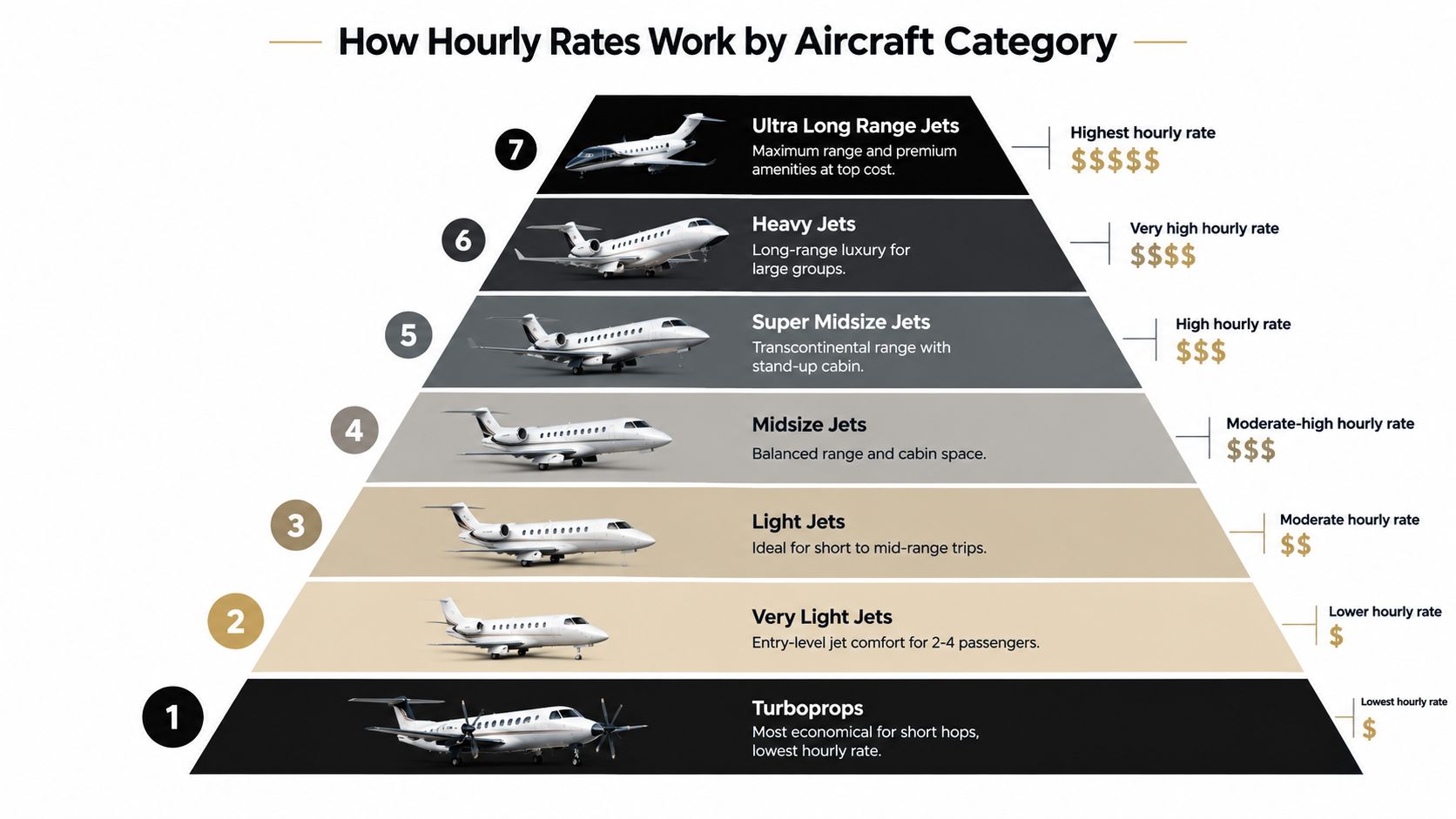
Hourly rates can swing from roughly a few thousand dollars for a short regional aircraft to well into five figures for long-range cabin classes. That wide spread is why the phrase private jet average cost often confuses first-time charter clients. The useful question is narrower: which aircraft class fits the trip, and is that aircraft already close to your departure point?
Each category does a different job. A turboprop is the regional workhorse. A light jet is built for short to mid-range business trips. A midsize or super midsize jet adds cabin room, baggage space, and range. A heavy or ultra-long-range jet is the long-haul platform, with operating costs to match.
The lower end of the market
Turboprops usually sit at the entry point for private charter pricing. They work well for short sectors, smaller airports, and trips where efficiency matters more than maximum speed.
Very light and light jets move into what many travelers picture as classic private aviation. Technical benchmarks published by FlightStratix show about $1,700 to $2,300 per flight hour for very light jets and about $2,400 to $3,300 per flight hour for light jets under annual utilization assumptions, according to this operating cost calculator discussion. Those figures help explain the base economics, but retail charter pricing often comes in higher because the customer is paying for a ready-to-go aircraft, crew, dispatch support, and trip-specific logistics.
For a practical reference point, many short business flights are booked on aircraft in the light jet category, where the balance of speed, cabin comfort, and hourly cost makes sense for one-day or short overnight trips.
Where rates step up
The middle categories are where many clients first notice how fast the budget can change. A light jet and a super midsize jet may look close on a summary list, but they solve different trip problems. One is often chosen for efficient domestic legs. The other is chosen when you need more range, a stand-up cabin, stronger baggage capacity, or better passenger comfort over longer sectors.
Published market guides reflect that spread. The Limitless Sky places light jets around $3,500 to $5,500, midsize jets around $5,500 to $7,500, and heavy jets around $9,500 to $13,000 per hour in this charter pricing overview. Other guides and operator schedules show lower or higher bands within the same class, depending on aircraft age, routing, and sourcing method.
That variation is normal.
Hourly rate tables are like hotel averages by room type. They tell you the general neighborhood, but they do not tell you whether the room is already available, whether it is peak season, or how much gets added before checkout. In charter, the hidden swing factor is often positioning. A local owner-operated aircraft can price very differently from the same category flown in from another airport, even before any broker margin is added.
Why larger aircraft cost more
Three forces usually push rates upward as you move up the cabin ladder:
- Fuel burn: Larger aircraft consume more fuel, especially on longer stages.
- Maintenance reserves: More systems, larger engines, and more complex inspections raise operating cost.
- Crew and support requirements: Longer missions often require more planning, and some trips trigger added crew logistics.
The practical mistake is matching a long-haul cost structure to a short-haul mission. A heavy jet may be the right answer for coast-to-coast travel or larger groups, but it is an expensive tool for a quick regional flight.
That is also why average cost guides can mislead. They organize prices by cabin class, which is useful, but they often stop there. In day-to-day charter booking, aircraft class sets the rate band, and aircraft location often determines whether you stay near the low end or drift 20% to 40% higher once sourcing layers and repositioning are involved. Local sourcing from owner-operators narrows that gap and removes markup that many public pricing summaries never show.
What Your Final Invoice Really Includes
A private jet quote works a lot like a hotel rate. The nightly price gets your attention, but the final bill depends on parking, taxes, room service, and whether you arrived during a busy weekend. Charter pricing works the same way. The hourly rate is the base. The invoice reflects the full trip the aircraft and crew have to perform, not just the time you are on board.
That is why average cost can mislead if you read it as a single number. The range is shaped by aircraft class first, then by where that aircraft is coming from. A locally based owner-operated jet may stay close to the quoted rate. The same cabin category flown in from another airport can end up much higher once repositioning and broker layers are added.
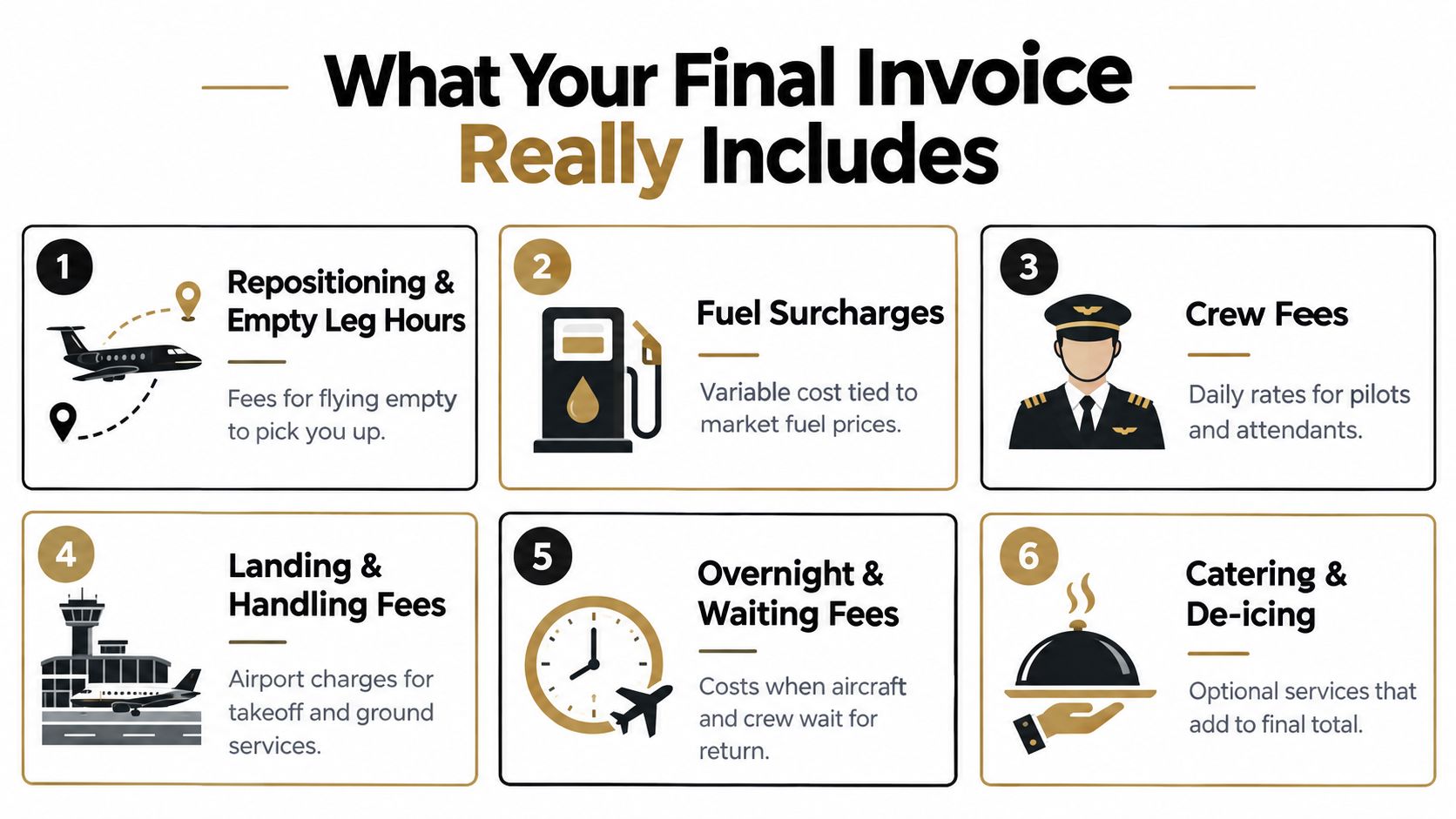
A charter quote often starts with an hourly figure, but the final total usually includes several operating charges, as explained in this charter invoice guide.
The line items that change the total
These are the charges that commonly move a quote above the base hourly rate:
- Repositioning and empty-leg hours: If the aircraft is not already at your departure airport, the operator may bill the empty flight needed to pick you up.
- Landing and handling fees: Airports and FBOs charge for ramp access, parking, and ground support.
- Fuel surcharges: Some trips include fuel-related adjustments based on route, aircraft, or operating conditions.
- Crew charges: Multi-day trips can add hotel, meals, waiting time, or crew transportation.
- Catering and de-icing: One is optional on many flights. The other can become necessary fast in winter markets.
- Taxes: Depending on the route and billing structure, statutory taxes may apply.
Why repositioning changes the math so quickly
Repositioning is the line item travelers miss most often because it happens before they ever step onto the aircraft.
If a midsize jet is based at your airport, you may only pay for your mission. If that same jet has to come in empty from two states away, you may be paying for a plane to reach you, then paying again for your actual trip. That is one reason two quotes for the same route can look far apart even when the aircraft category appears identical.
This is also where local sourcing matters. Booking a nearby owner-operator can remove a large part of that extra cost and avoid the added markup that often sits between the traveler and the aircraft.
How to read a quote like an operator
A good quote should be easy to follow. If it is not, ask for the missing pieces before you sign.
Use this checklist:
- Ask where the aircraft is based. That reveals whether positioning is built into the price.
- Confirm total billable time. Passenger flight time and billed flight time are not always the same.
- Request itemization. Separate the aircraft charge from fees, taxes, and trip extras.
- Check trip length and overnight details. Same-day turns price differently from multi-day stays.
- Review alternate airports. A nearby airport can sometimes cut fees or reduce repositioning.
A low quote is not always a better quote. Sometimes it is incomplete. A high quote is not always overpriced either. You may be seeing the cost of bringing the wrong aircraft in from the wrong place.
Comparing On Demand Charter Jet Cards and Fractional Ownership
The right booking model matters almost as much as the aircraft. Many travelers focus on the flight and ignore the structure behind the price. That's where a lot of unnecessary spend starts.
For irregular flyers, on-demand charter is usually the easiest model to understand. You book the trip you need and pay for that mission. Jet cards add prepaid hours or deposits. Fractional ownership adds a longer commitment and a much heavier fixed-cost base.
A side-by-side cost view
| On-Demand vs Jet Card vs Fractional Cost Comparison | Cost Structure | Best For |
|---|---|---|
| On-Demand Charter | Pay per trip, based on aircraft, route, and availability | Travelers with irregular schedules or changing routes |
| Jet Card | Prepaid access model with program rules and fixed pricing structure | Travelers who value convenience and expect steady flying |
| Fractional Ownership | Ongoing fixed commitment tied to an ownership share plus operating costs | Very frequent flyers with predictable usage |
The biggest divide is between variable costs and fixed costs. On-demand charter keeps more of your spend variable. Jet cards can simplify access, but they still ask you to commit capital in advance. Fractional ownership brings the highest level of commitment.
When ownership starts to make sense
Public 2026 guides put annual private jet ownership at roughly $700,000 to more than $4 million depending on aircraft size, while a midsize jet can cost about $500,000 to $1 million per year to operate before financing and major maintenance events, according to this ownership cost explainer.
That's why the ownership conversation should start with utilization, not aspiration. If you fly constantly, fixed costs may eventually align with how you use the aircraft. If your schedule changes month to month, those fixed costs can become the most expensive part of your travel.
A related issue is replacement economics. One 2026 industry summary cites 854 business-jet deliveries in 2025, an 11.8% year-over-year increase, and projects about 8,500 new business jets worth US$283 billion over 2026 to 2035, implying an average value of roughly US$33 million per new aircraft in this industry price guide. That capital intensity helps explain why access models built around ownership carry so much embedded cost.
For travelers comparing access models, this guide on private jet membership cost is useful background when you want to contrast prepaid programs with pure pay-as-you-go flying.
Fractional ownership can be rational. It just isn't the default answer for most people who ask about private jet average cost.
A simple decision lens
If your routes vary, your dates move, and your aircraft needs change, on-demand charter usually gives the cleanest fit. If your schedule is repetitive and you value preset terms over flexibility, a card may appeal. If you fly enough to absorb fixed costs comfortably, ownership enters the conversation.
Real Route Pricing Examples You Can Expect
A short route can still produce a five-figure quote. The reason is simple. You are not buying miles alone. You are buying a specific aircraft category, plus the cost of getting that aircraft to you if it starts somewhere else.
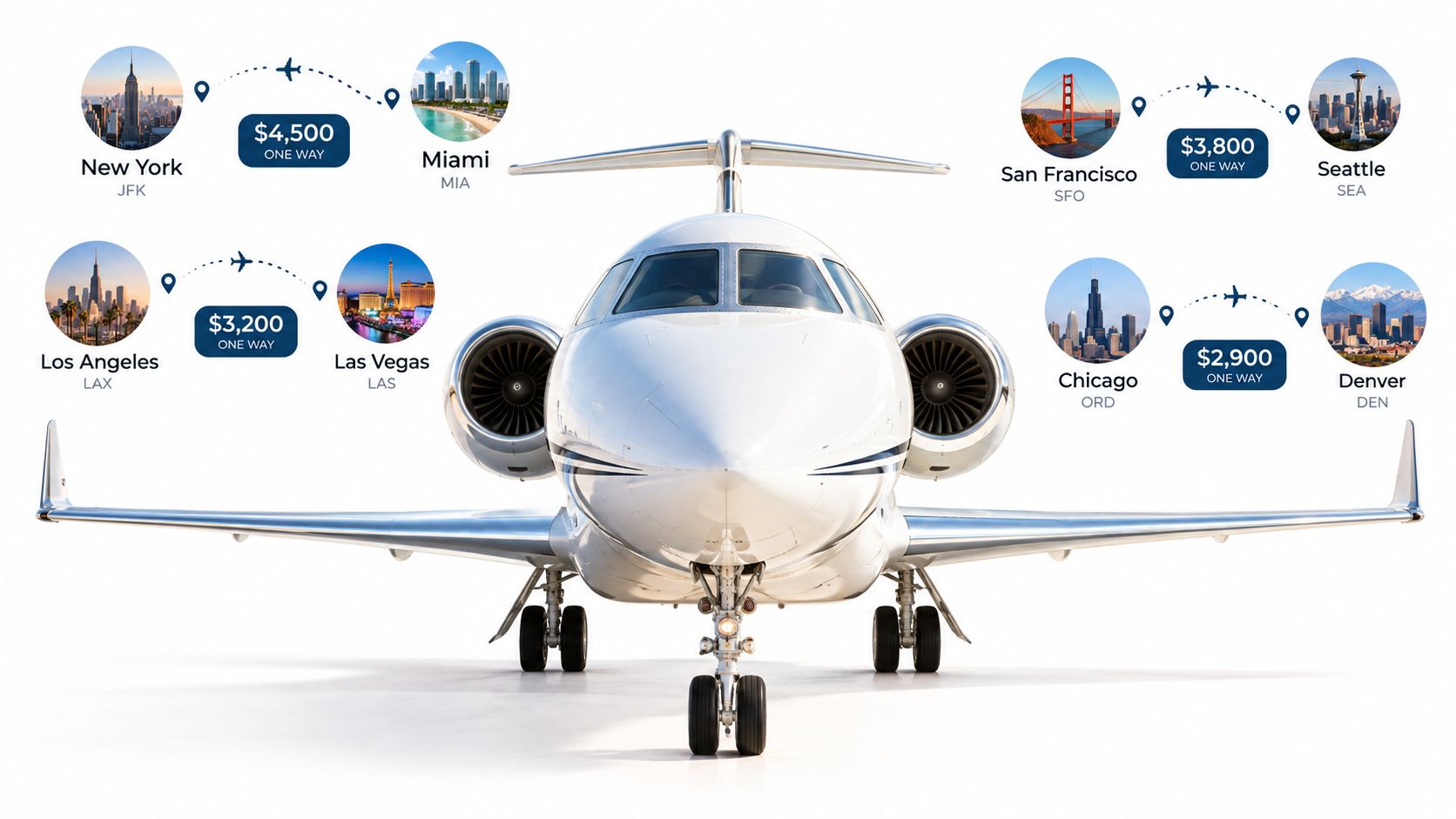
Route examples make the math easier to see.
Short domestic example
Los Angeles to Las Vegas is one of the clearest examples. On paper, it is a short hop. In practice, the total still depends on whether you keep the trip in turboprop, very light jet, or light jet territory.
A one-way quote on this route often lands around $8,000 to $12,000 on a light jet including standard trip fees. Move up to a midsize cabin and the same route may reach $13,000 to $18,000. A heavy jet can push the total past $25,000 even though the flying time is brief.
That gap confuses first-time charter clients. The flight is short, so they expect every quote to be close. Charter pricing works more like hiring vehicles by class. A town car, sprinter van, and motorcoach can all cover the same road, but they do not bill the same way.
Medium domestic example
New York to Miami is where aircraft class starts to separate the budget more clearly. As noted earlier, domestic charter is often discussed with a broad hourly band, but route pricing becomes clearer when you convert that band into actual trip totals.
For this mission, a light jet may quote around $18,000 to $26,000 one way if the payload and range fit cleanly. A midsize or super midsize aircraft often falls closer to $24,000 to $38,000. Large-cabin options can move beyond $45,000.
The hidden swing factor is repositioning. If the aircraft is already in the New York area, the quote may stay near the lower end of the range. If the operator has to bring the jet in from another market, the billed time grows before your trip even begins. That is one reason two quotes for the same city pair can differ so sharply.
International and long-haul thinking
New York to London starts with aircraft capability, not just preference. This route usually requires a heavy jet or ultra long range aircraft, so the category floor is much higher from the start.
Published charter pricing references show a wide range of hourly rates for private aircraft, and BlackJet's private jet price list notes that long-haul and VIP-airliner missions can exceed $50,000 total for a trip. For a transatlantic mission like this, travelers should expect a materially higher total than domestic charter, often driven by cabin category, overnight crew logistics, and airport fees.
A practical way to read any route quote is to separate it into four parts:
- Route length sets the minimum aircraft category
- Passenger count and baggage decide whether you can stay in that category
- Aircraft starting location affects billed flight time
- Airport and international handling fees shape the final total
This short video gives a useful visual sense of how route and aircraft selection shape charter economics.
Miami to the Bahamas and Miami to Aspen show the same pattern. The average cost is never one flat number. It is a range shaped first by aircraft class, then by where that aircraft is sourced. That is why local owner-operator access matters so much. Remove unnecessary repositioning and you often remove the markup many pricing guides leave buried inside the quote.
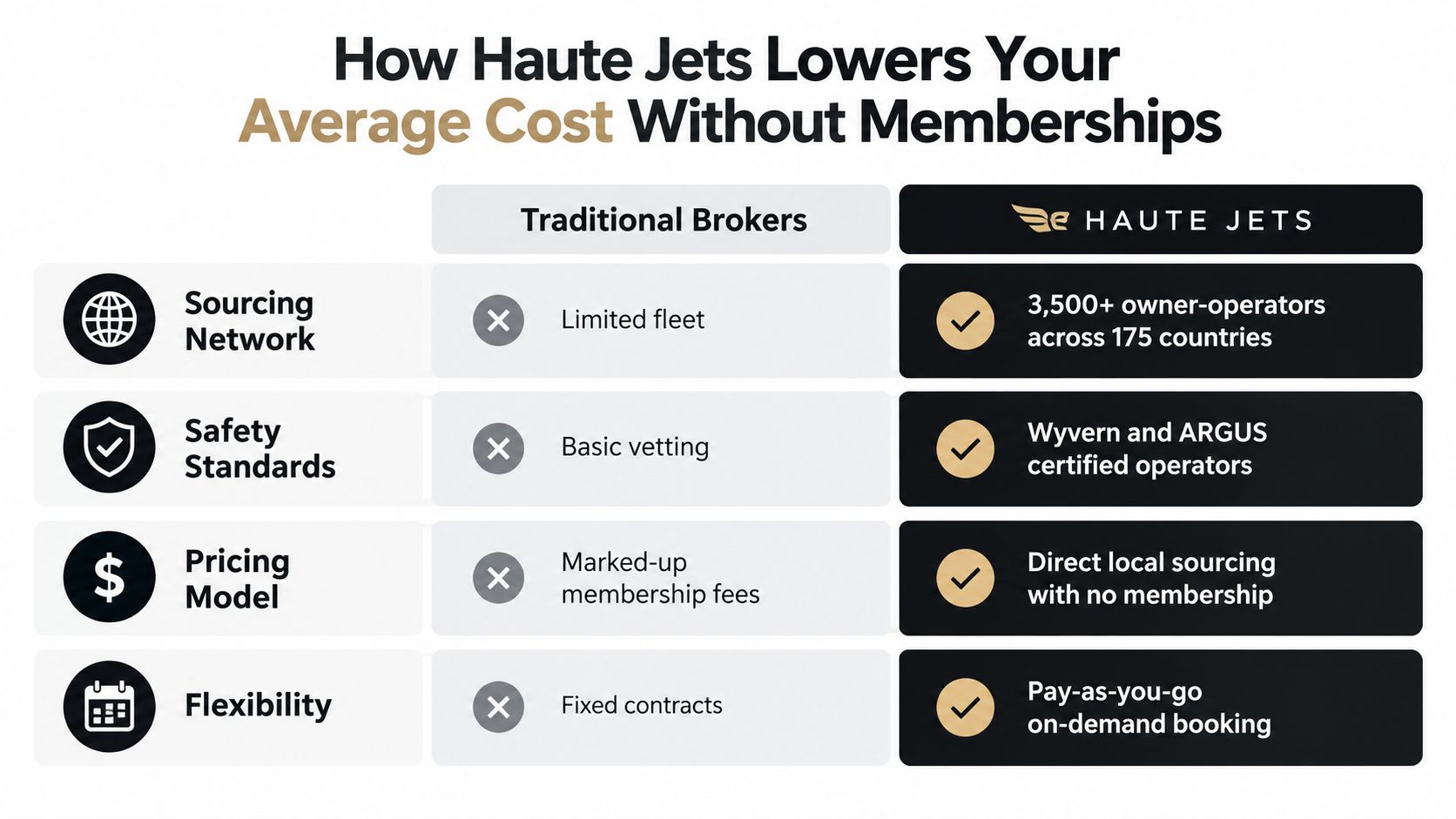
How Haute Jets Lowers Your Average Cost Without Memberships
The biggest hidden driver in charter pricing isn't always the jet itself. It's where that jet starts the day.
That's why sourcing matters. If a broker offers an aircraft from far outside your departure market, you may end up paying for the repositioning built into the quote. If the platform or advisor sources locally from owner-operators, the trip can start with less wasted flying and a cleaner cost base.
Why local sourcing changes the math
Haute Jets was built around that exact pricing problem. The network includes 3,500+ owner-operators across 175 countries, uses Wyvern Wingman or ARGUS Gold/Platinum-rated operators, and works on a pay-per-flight model without annual membership or jet card requirements, as described on its page for private jet charter without membership.
That structure matters because industry guides note that add-ons can raise totals by about 20% to 40%, and repositioning alone can add roughly 20% to 30% domestically, as covered earlier in this article. A local aircraft doesn't guarantee the lowest quote every time, but it often removes one of the biggest avoidable costs from the equation.
What transparency should look like
A useful charter process should let you evaluate more than category alone. The practical details matter:
- Exact aircraft selection: Year, make, model, and cabin layout affect both comfort and value.
- Operator quality: Third-party safety standards should be clear, not vague.
- Pre-flight confirmation: Tail number, crew details, and trip specifics reduce uncertainty before departure.
- No prepaid lock-in: Pay-as-you-go pricing keeps the buying model aligned with actual use.
Good charter buying isn't about chasing the cheapest hourly rate. It's about removing unnecessary billed hours before the quote is even built.
This is also where local sourcing helps first-time charter clients most. It reduces the gap between the number they expected to pay and the invoice they receive.
Choosing the Right Charter Option for Your Needs
The smartest way to use private jet average cost is as a filter, not a final answer. You're trying to match the right aircraft and buying model to your travel pattern.
A simple decision checklist
Ask yourself these questions before requesting quotes:
- How often do you fly? If your schedule is irregular, on-demand charter usually keeps costs cleaner than prepaid structures.
- How far are your typical trips? Short regional missions often favor smaller aircraft. Long-haul routes may require a larger category from the start.
- How many people travel with you? Passenger count, baggage, and comfort expectations can move you up a class quickly.
- Do your routes repeat? Consistent corridors may justify one approach. changing city pairs usually reward flexibility.
- How sensitive are you to repositioning risk? If you want tighter cost control, ask where the aircraft is based before anything else.
The practical takeaway
The wrong question is “What is the average private jet cost?” The better question is “What cost structure fits how I travel?”
For some clients, that means a light jet on demand for domestic business trips. For others, it means stepping into midsize or heavy aircraft only when route length and group needs require it. The best buying decisions come from right-sizing both the airplane and the booking model.
A clear quote should tell you what you're paying for, why that aircraft fits the mission, and whether any empty repositioning is buried inside the total.
If you use that standard, private aviation becomes much easier to budget. Not cheap, but understandable. And once the pricing logic is visible, smart charter decisions get simpler.
If you want a quote that reflects the actual mission instead of a generic industry average, Haute Jets can help you compare aircraft by category, sourcing location, and all-in trip structure. Visit Haute Jets to review on-demand charter options and request transparent pricing based on your route, passenger count, and schedule.