
You've got an important meeting in another city tomorrow, but the commercial schedule forces a connection, an inconvenient airport, or a departure time that doesn't fit. You need to move a small group, carry more luggage than an airline comfortably allows, or reach a destination without adding a full day of travel. On-demand air charter exists for exactly this kind of problem. You request the aircraft for a specific trip, select the option that fits, and pay for that flight without buying a membership, prepaid hours, or an ownership share.

Introduction to On Demand Air Charter Freedom
Scheduled airlines sell seats on fixed routes and timetables. On-demand charter rents the aircraft itself for your itinerary, so the departure time, airport choice, passenger list, and cabin requirements can be arranged around the trip rather than the other way around. That can suit an executive visiting several locations, a sports team traveling with equipment, a family flying with pets, or a traveler facing a short-notice change.
The simplest analogy is the difference between ordering a car for one journey and owning a vehicle. Ownership gives you control, but it also brings capital costs, maintenance, insurance, staffing, and the responsibility of keeping the asset available. On-demand charter gives you access when you need it, while the operator and charter team coordinate the aircraft, crew, flight planning, and operational details.
The model has become a substantial part of private aviation. One market study estimated the global private jet charter services market at USD 16.38 billion in 2025, with a projection of USD 17.67 billion in 2026 and USD 25.79 billion by 2031, implying a 7.86% CAGR from 2026 to 2031. The same study estimated that on-demand charter represented 51.62% of 2025 revenue, making pay-per-flight charter the dominant format in that market (Mordor Intelligence's private jet charter services market analysis).
The core promise
You're not choosing only between “private” and “commercial.” You're choosing how much control and commitment you want.
- Control: Set a schedule that reflects your meetings, event, or holiday.
- Access: Consider private terminals and airports that may be more convenient for the final destination.
- Choice: Compare aircraft by size, range, cabin, baggage capacity, and onboard features.
- Commitment: Pay for the flight you book instead of maintaining a long-term aviation arrangement.
A separate industry estimate placed the global on-demand air charter market at USD 29.8 billion in 2024, projecting USD 56.2 billion by 2033 at a 7.2% CAGR. It also estimated more than 15,000 private flights depart daily across North America, Europe, and Asia-Pacific combined, with 1.5 million charter flights booked globally in 2023 (Business Research Insights' on-demand charter market report). Those figures help explain why the service now supports business mobility, group logistics, and urgent travel at scale, not only occasional leisure.
How On Demand Air Charter Actually Works
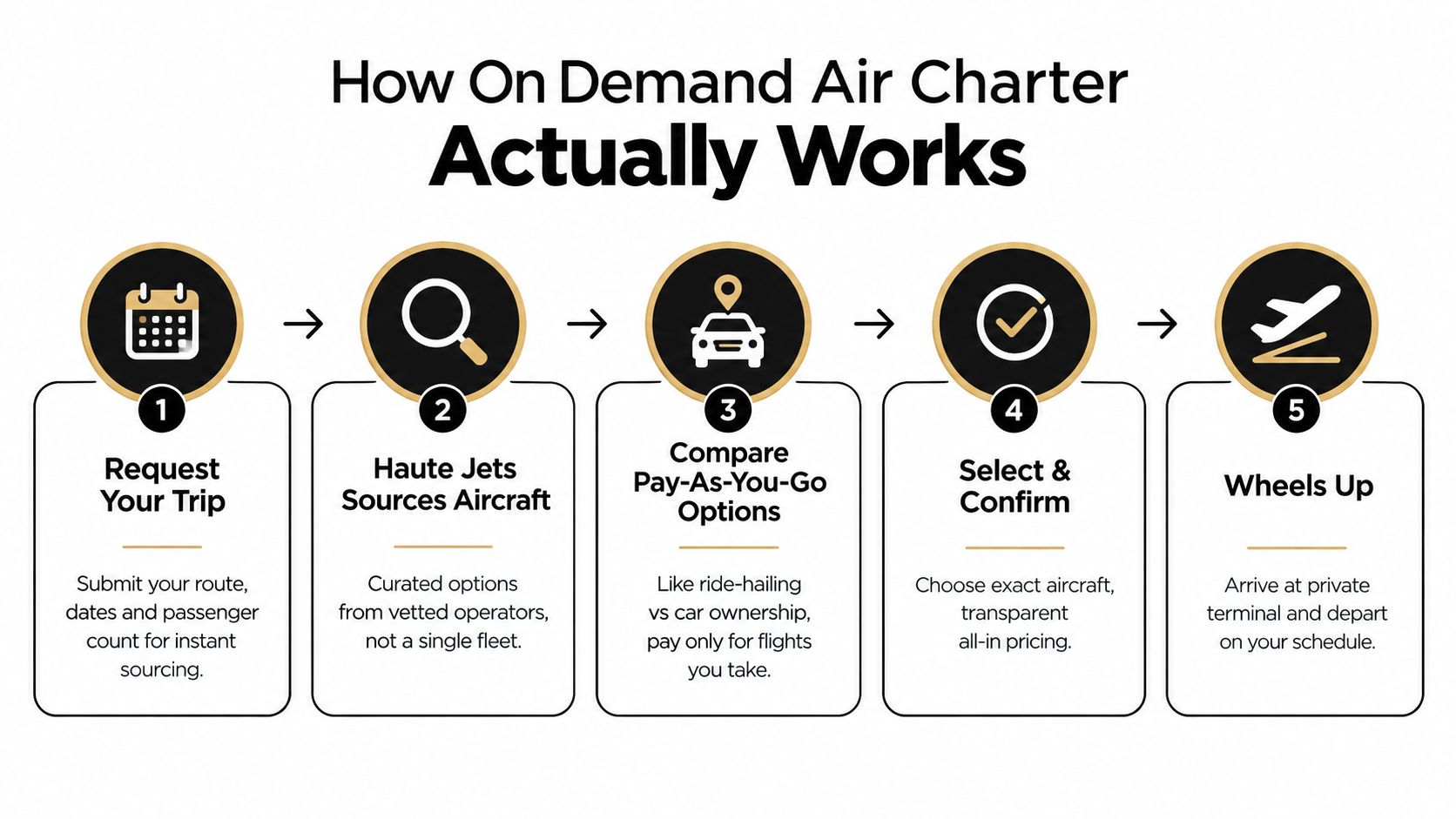
Booking an on-demand flight is closer to ride-hailing than car ownership. You describe the journey, a charter team searches a network of available aircraft, you compare suitable options, and the operating carrier performs the flight. You don't buy the jet, and you generally don't need to commit to future trips.
Haute Jets says it sources from 3,500+ owner-operators across 175 countries, giving its team access to aircraft based in different regions rather than relying on one company-owned fleet. That local availability matters because the aircraft's location can affect both the quote and the time required to arrange the trip.
The booking lifecycle
Request the itinerary. Share your departure city, destination, dates, preferred departure window, passenger count, luggage, and any requirements such as pets, catering, Wi-Fi, or special equipment.
Aircraft sourcing begins. The charter team searches suitable operators and aircraft. The search considers more than passenger capacity. Runway requirements, range, crew availability, aircraft location, permits, and cabin configuration can all change which options are practical.
You compare complete choices. A useful proposal should identify the aircraft category and, where available, the specific aircraft, along with the total trip price and relevant inclusions. A lower hourly figure doesn't automatically mean a lower final cost if the aircraft must travel empty to reach you.
You select and confirm. Once you choose, the charter agreement records the itinerary, aircraft arrangement, passengers, payment terms, and operational conditions. The direct air carrier remains responsible for operating the flight.
The operations team prepares departure. Flight planning, crew coordination, airport handling, catering, ground transport, and international requirements are arranged before you arrive at the private terminal, commonly called an FBO.
The important distinction is that availability is geographic. An aircraft that appears suitable on paper may be positioned far from your departure city. Another aircraft with a slightly different cabin or range may be locally based and create a simpler, more predictable trip. Good sourcing weighs both.
A short visual explanation can also help first-time travelers understand the difference between charter access and ownership:
On Demand Charter Versus Jet Cards and Fractional Ownership
The three models solve different problems. On-demand charter prioritizes freedom for individual trips. A jet card usually asks you to commit to a program in exchange for defined access rules, while fractional ownership gives you a share in an aircraft or fleet structure and brings a deeper financial and administrative commitment.
| Feature | On-Demand Charter | Jet Card | Fractional Ownership |
|---|---|---|---|
| Commitment | Book trip by trip | Program enrollment and prepaid or committed access | Ownership share and related agreement |
| Payment structure | Pay for each confirmed flight | Program fees and flight-hour structure | Acquisition, management, and operating costs |
| Aircraft choice | Compare available aircraft for each itinerary | Choice depends on the provider's fleet and program rules | Primarily tied to the owned or managed fleet |
| Schedule flexibility | High, subject to aircraft availability and operations | Defined by program terms, booking windows, and availability | Strong access rights, subject to fleet and scheduling rules |
| Annual fees | Not inherent to the model | May apply | Management and ownership costs generally apply |
| Prepaid hours | Not required | Common in many programs | Not the central structure, though usage is governed by the agreement |
| Blackout dates | No model-wide rule, but availability can tighten | May exist under program terms | Access rules depend on the ownership agreement |
| Repositioning exposure | Varies by aircraft location and quote | Depends on provider policy and fleet location | Built into the economics of the managed aircraft arrangement |
| Best fit | Occasional or variable travel | Frequent travelers seeking a structured program | Consistent users seeking long-term access and ownership involvement |
A jet card can make sense when your travel pattern is predictable and you value a defined service framework more than trip-by-trip aircraft shopping. It may reduce decision-making, but you'll need to understand its booking windows, aircraft substitution rules, minimum charges, service areas, and what happens when the requested aircraft isn't available.
Fractional ownership is a different category altogether. It may suit a company or individual with recurring demand, a preference for long-term access, and the willingness to absorb ownership responsibilities. The aircraft can feel more like a dedicated business asset, but the arrangement is less adaptable if your travel needs change.
Decision rule: If your routes, dates, passenger counts, and aircraft preferences change regularly, start by comparing on-demand quotes. If you fly on a stable pattern, examine whether a structured program or ownership arrangement justifies its commitment.
Before choosing a membership structure, review the practical economics of private jet membership cost, including the fees and usage rules that sit outside the advertised access promise. The right question isn't which model sounds most exclusive. It's which model matches how often you fly, how much control you need, and how comfortable you are paying for access you may not use.
Booking Your On Demand Flight Step by Step
A smooth charter booking starts with a complete request. Give the advisor the route, preferred departure window, passenger names when available, luggage expectations, and any details that could affect aircraft selection. A family traveling with pets needs a different match from an executive group carrying presentation equipment, even if both trips have the same passenger count.
Five checkpoints before departure
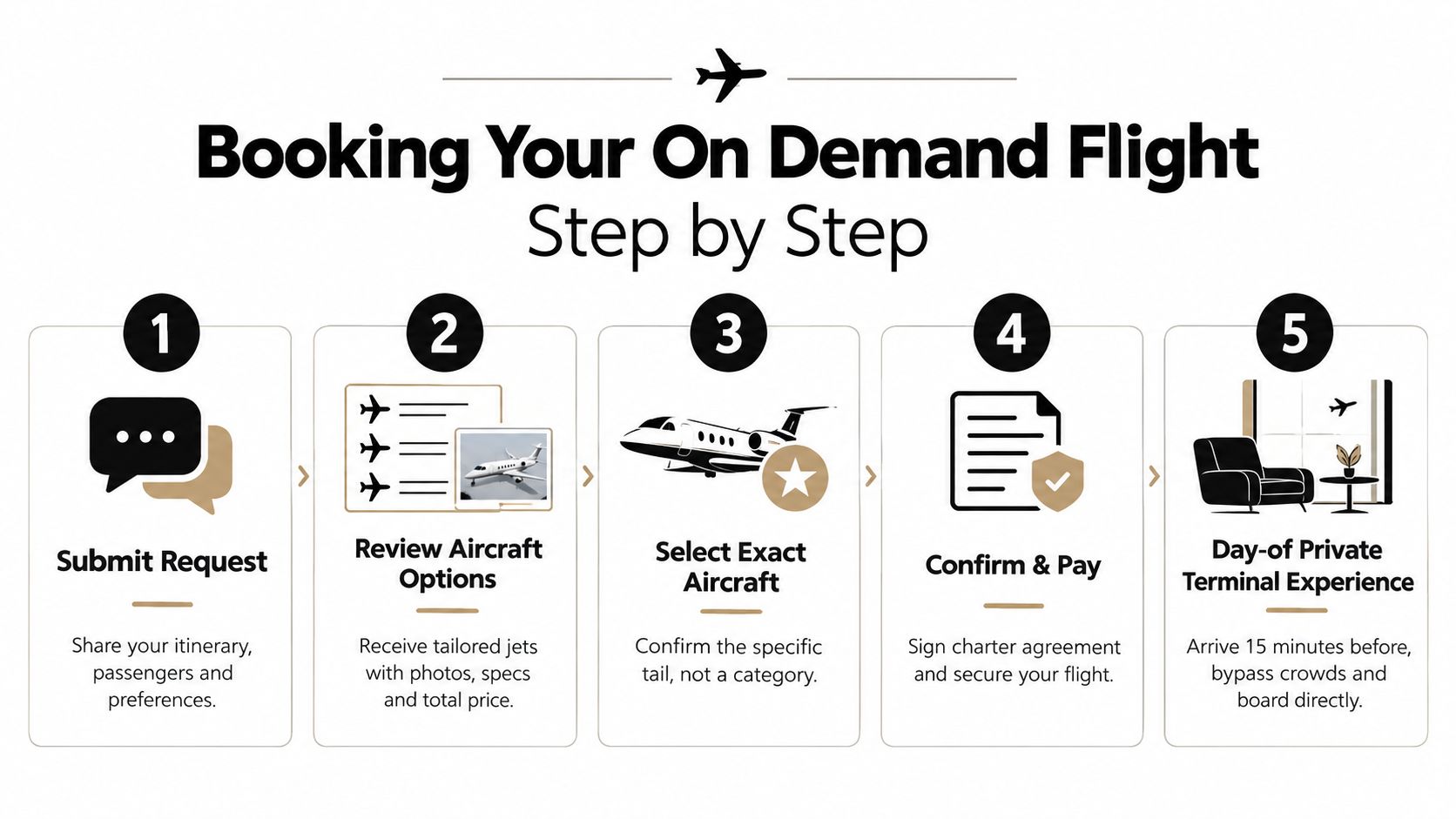
1. Submit the request. Include the departure and arrival cities, dates, passenger count, desired timing, and return or multi-stop details. Mention pets, sports equipment, unusual baggage, catering preferences, Wi-Fi needs, and ground transportation at this stage.
2. Review aircraft options. Ask for photographs, specifications, cabin layout, baggage capacity, amenities, and an all-in price. The phrase “light jet” describes a category, not a guaranteed cabin. Two aircraft in the same category can offer different seating, interior condition, connectivity, and luggage solutions.
3. Select the exact aircraft. Confirm the year, make, model, and specific tail when the operator provides that information. Also verify the cabin configuration, Wi-Fi, catering plan, pet policy, and the departure and arrival airports. These details prevent a category-level promise from becoming a disappointing day-of substitution.
4. Confirm and pay. Read the charter agreement carefully. It should identify the itinerary, price structure, cancellation terms, passenger requirements, operating arrangements, and any extra services. Travelers who prefer digital assets may also want a practical guide to using crypto cards for flights, while confirming accepted payment methods directly with the charter provider.
5. Prepare for the private terminal. Your departure takes place at an FBO rather than the main airline terminal. The experience is usually quieter and more direct, but you still need the correct identification, luggage details, and any documents required for international travel.
The final transparency checkpoint comes before departure. Haute Jets states that it provides full confirmation 24 hours before departure, including the aircraft tail number and passenger manifest, and its Journal material repeats that confirmation process. The stated pre-flight information also includes crew bios and a weather briefing, giving travelers a chance to review the operational picture rather than arriving with only a broad aircraft category.
Ask one direct question before you approve the quote: “What exact aircraft is assigned, where is it based, and what could change before departure?”
What Drives On Demand Charter Pricing
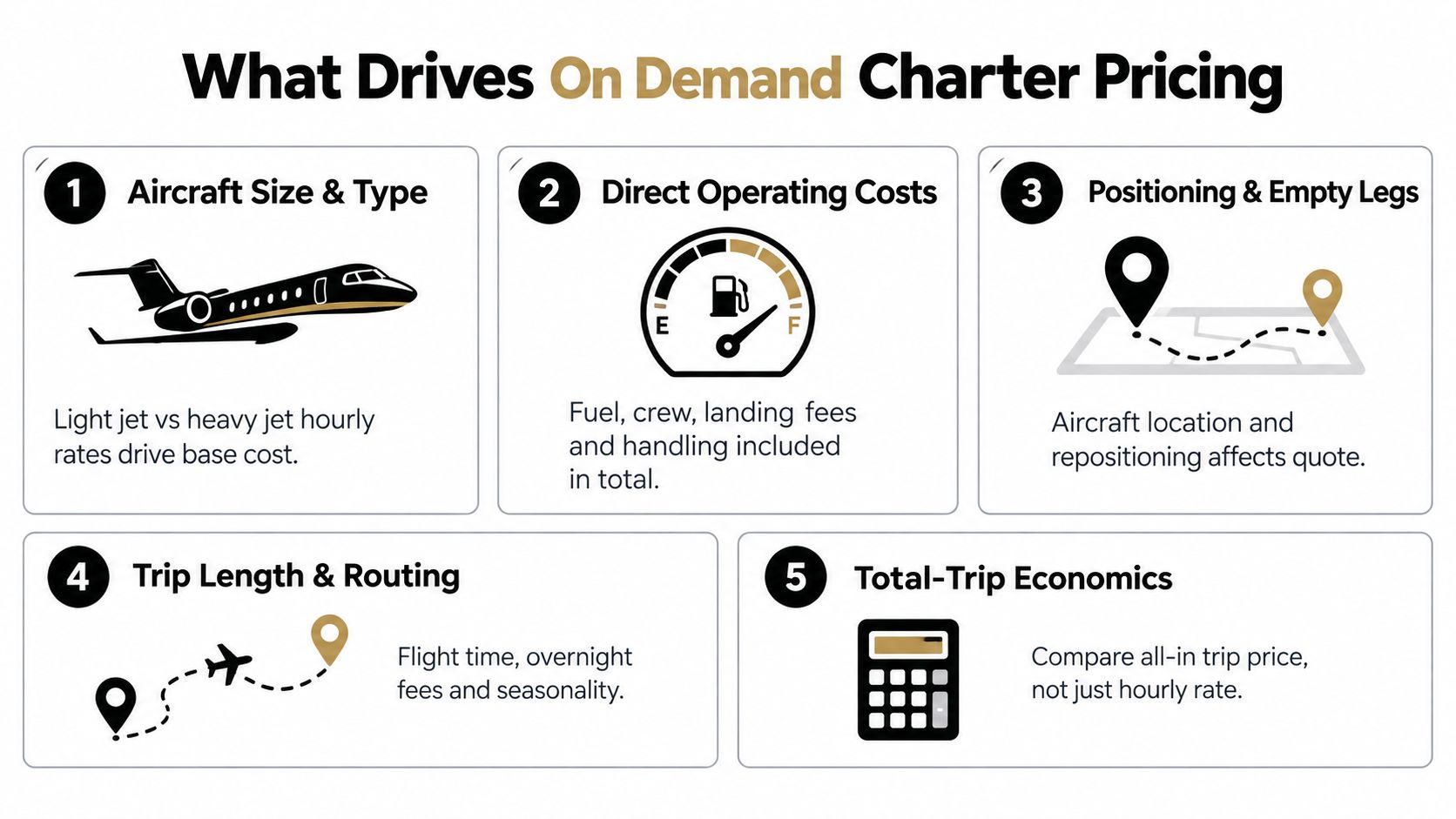
Two quotes for the same city pair can differ because the aircraft, location, crew plan, airport, and routing differ. The hourly rate is only one input. Total-trip economics tells you what you'll pay.
The aircraft sets the base
A turboprop, light jet, midsize jet, and heavy jet have different operating profiles. A larger cabin may be necessary for passenger comfort, baggage, range, or onboard facilities, but choosing a larger aircraft than the mission requires can increase fuel, crew, airport, and handling costs.
Direct operating expenses include fuel, crew time, landing fees, handling, and maintenance-related use. One published industry breakdown estimates the direct operating cost of a heavy jet such as a Gulfstream G650 at about USD 12,000 per block hour, illustrating why aircraft size and flight duration have a powerful effect on a quote (Jet and Keel's business jet charter cost explanation).
Stage length matters too. A short trip may still require aircraft positioning, minimum flight charges, crew planning, and airport services. A longer itinerary can add crew duty considerations, overnight arrangements, international permits, and more complex routing.
Positioning can change the answer
If the chosen aircraft isn't based near your departure airport, it may need to fly empty to collect you. That repositioning leg consumes fuel, crew time, and maintenance cycles without carrying passengers. On domestic itineraries, positioning can add roughly 20% to 30% to the total trip cost, and some operators price the positioning segment at 75% to 100% of the occupied hourly rate (Air Traveler's explanation of private jet charter invoices).
Haute Jets says repositioning is typically passed to the client and can add 20% to 40% to the charter price when an aircraft must fly empty to reach the departure city (Haute Jets' private jet charter cost guide). The exact effect depends on the route, aircraft, operator, and availability. That's why a locally sourced aircraft can be less expensive even when its headline hourly rate looks higher.
How to read the quote
Look for these items before comparing offers:
- Aircraft identity: Is the quote for a category or a confirmed aircraft?
- Positioning: Does the aircraft need to travel empty before or after your flight?
- Crew plan: Are overnight or extended-duty costs included?
- Airport charges: Are landing, handling, parking, and passenger services itemized?
- Routing: Are permits, customs coordination, and planned stops included?
- Extras: Are catering, Wi-Fi, ground transport, and special handling priced separately?
Empty-leg pricing follows a different logic. Operators may recover fuel, landing fees, and handling on the repositioning segment because fixed costs such as crew salaries, depreciation, insurance, and hangar fees are already covered by the primary booking. That can create an attractive opportunity, but the traveler usually gives up control over timing and routing. The discount only works if the itinerary can adapt to the aircraft's existing movement.
Safety Ratings and Operational Resilience Explained
A first-time charter booking can look simple until weather closes an airport or the assigned aircraft becomes unavailable. A safety rating helps you assess the operator before that disruption occurs. It is a screening layer covering areas such as maintenance, crew qualifications, insurance, and operating procedures.
Wyvern and ARGUS are third-party audit systems that examine those areas. Their reviews give buyers more detail than an operator's marketing description, with verification available through the programs for individual flights rather than only through a periodic review. For a closer examination, see Wyvern and ARGUS safety ratings explained and Flygreen's explanation of Wyvern and ARGUS standards.
What the audit does and doesn't tell you
An audit can show that an operator has documented systems and oversight. It cannot promise that every trip will follow the original plan. Weather may close an airport, crew duty limits may require a schedule change, or a mechanical problem may make a substitute aircraft necessary.
Ask who has operational control and which carrier will perform the flight. Confirm how aircraft substitutions work, who approves them, and who contacts you when conditions change. For international travel, ask how the team handles permits, customs, visas, crew rest, and cross-border routing.
Reliability under pressure
Operational resilience matters because aircraft and crews are shared resources. JETNET reported 1.95 million business jet departures in the first half of 2026, up 4.0% year over year. Average aircraft hours reached 21.7, or 9.9% above the first half of 2019 (JETNET's mid-2026 market snapshot). Another JETNET update recorded departures up 4.9% over the previous twelve months and an OEM backlog of USD 61.6 billion, pointing to busy aircraft and limited supply (JETNET's August 2026 market barometer).
Regional conditions can shift quickly. The same update reported Middle East business jet activity falling more than 50% within three weeks after the Iran crisis in March 2026. The planning lesson is practical: local aircraft sourcing, realistic repositioning options, and backup airports can protect both cost and timing when the first plan changes.
Reliability question: Ask what happens if weather, crew duty time, aircraft availability, or geopolitical restrictions disrupt the original plan.
Before paying, ask the charter team to explain backup aircraft, rerouting, alternate airports, passenger communication, and cross-border continuity. That discussion often reveals more about the total trip and its resilience than the aircraft's hourly rate or a polished cabin photograph.
When On Demand Charter Makes Sense and Next Steps
On-demand charter is most useful when the trip is valuable enough that schedule control, direct routing, and privacy justify a customized aircraft. An executive roadshow may involve several cities that don't connect efficiently by airline. A sports team or entertainment production may need coordinated movement for people and equipment. A family may value a pet-friendly cabin and an airport close to a resort more than a standard airline itinerary.
It also fits travelers whose plans change. You might need a same-day departure, a nonstandard return, a multi-stop route, or a specific cabin layout. In those cases, paying per flight avoids committing to a program before you know what your calendar will look like.
Use this decision filter
- Travel pattern: Are your dates and routes irregular?
- Aircraft needs: Do passenger count, luggage, pets, or equipment require a particular cabin?
- Airport access: Would a smaller or more convenient airport materially improve the journey?
- Price comparison: Have you compared the all-in trip total, including positioning?
- Operational confidence: Do you know the operator, aircraft, crew process, and contingency plan?
- Commitment level: Do you want to pay for one trip without annual fees or prepaid hours?
A jet card may be more suitable if you fly frequently on repeat routes and prefer program rules over individual sourcing. Fractional ownership may fit a consistent traveler who wants long-term access and accepts ownership obligations. Neither alternative is automatically better. The right choice depends on whether you're buying flexibility, predictability, or an ongoing aviation asset.
For a first booking, request two or more aircraft options and ask why each one differs in price. Confirm the exact aircraft, positioning plan, airport fees, crew arrangements, onboard requirements, cancellation terms, and final pre-flight documentation. That process turns a private flight from a vague luxury purchase into a service you can evaluate logically.
Haute Jets offers on-demand private jet charter without a membership or annual commitment, sourcing aircraft through its operator network and arranging trip-specific options. To compare an aircraft against your schedule, departure city, and total-trip budget, visit Haute Jets and request a custom quote.