
You've just received a charter quote for a trip your team may take only once, and the number feels painful. Then a membership adviser offers fixed hourly rates, priority access, and a prepaid block of hours that seems easier to justify. The danger is committing capital before you know whether the program fits your routes, aircraft preferences, booking habits, and tolerance for unused access.
That's the question this guide addresses for readers of Haute Jets Journal. Private aviation membership can be valuable, but it isn't automatically cheaper than booking each flight. In many cases, a carefully sourced on-demand charter gives mixed-use travelers more control, especially when they need different aircraft, short-notice international travel, pets, or complex routing.
Introduction Why Private Aviation Membership Deserves a Closer Look
A client recently compared two options for a demanding travel calendar. The first was a membership with a fixed rate and prepaid hours. The second was trip-by-trip charter, sourced around each departure city. The membership looked cleaner on paper, but the client's schedule included regional business flights, longer family trips, and occasional international travel. Those missions didn't consistently require the same aircraft category, and several planned trips were uncertain.
That uncertainty matters. A prepaid balance can feel like a discount, but it also creates a deadline, usage pressure, and a risk that the traveler buys access for flights that never happen. An annual booking membership may have a lower entry point, while a jet card may require a substantial upfront commitment. The correct comparison is not the advertised hourly rate. It's the total cost of access, positioning, aircraft choice, unused funds, fees, and operational convenience.
The market has expanded sharply. One market estimate of private aviation membership places the global market at $47.2 billion in 2025, with a projected rise to $91.8 billion by 2034 at a 7.1% CAGR. Membership clubs are estimated to represent 18.9% of revenue, or about $8.9 billion in 2025, while individual members account for 61.3% of subscribers. North America represents 48.2% of revenue share, making the United States and Canada important anchor markets for membership-style private flying.
The growth doesn't prove that membership is right for every traveler. It proves that many travelers want predictable access and less booking friction. The smarter decision is to identify which part of that convenience you need.
Advisor's view: If your travel is varied, unpredictable, and aircraft-specific, start with on-demand charter. Consider membership only after your real booking history shows that its rules solve a recurring problem.
Understanding Private Aviation Access Models Today
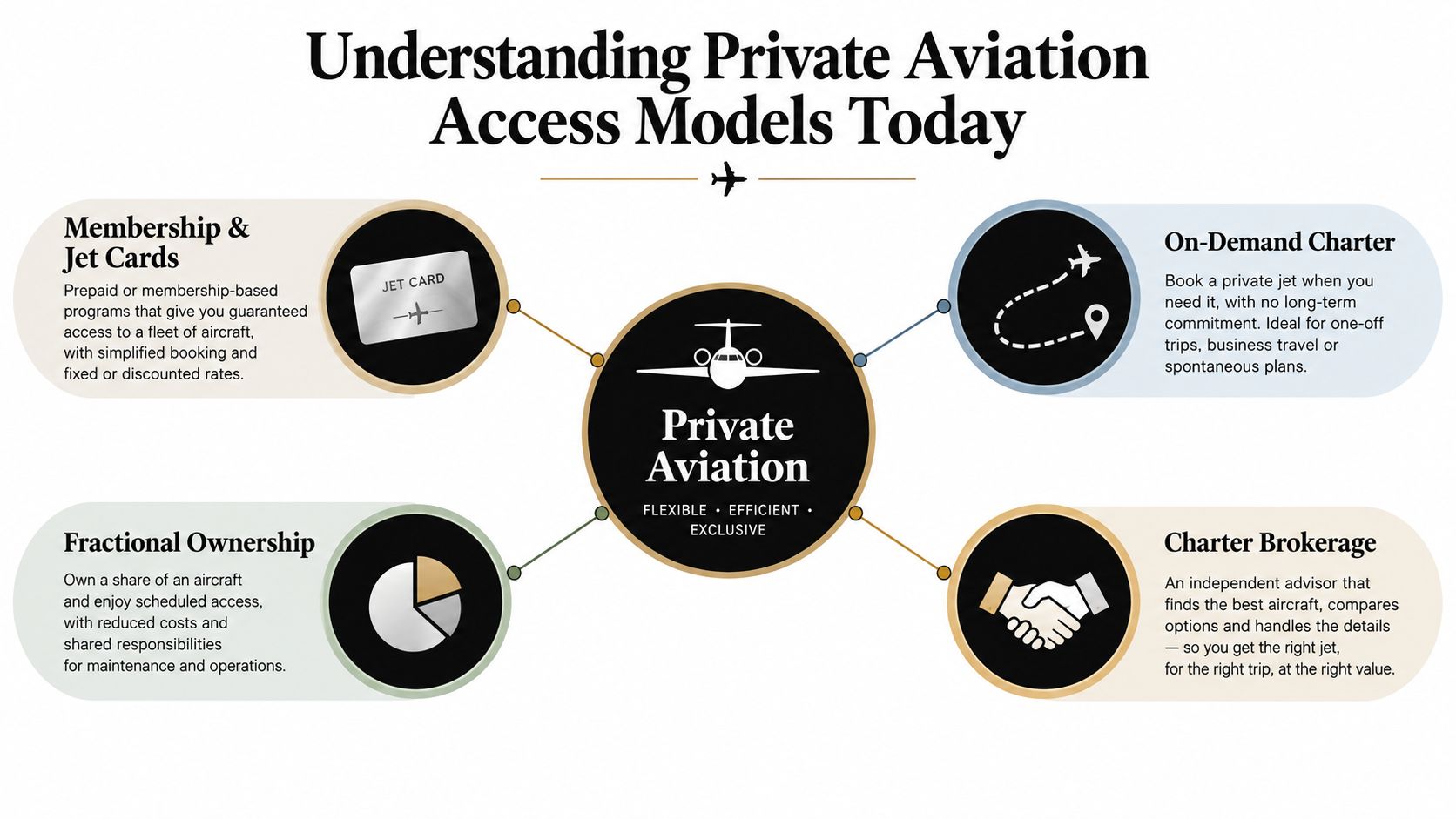
Private flying becomes easier to evaluate once you separate the access models. “Membership” can describe several commercial structures, but the financial and operational obligations differ considerably.
Membership and jet cards
A private aviation membership usually provides access through annual dues, a deposit, or a prepaid block of hours. Jet cards sit inside this broader category. You commit funds in exchange for pricing rules, booking priority, or access guarantees that may apply to specified aircraft categories and routes.
The key benefit is predictability. The key risk is paying for availability you don't use. Jet card and membership programs generally involve prepaying hours or depositing funds under fixed pricing rules, unlike on-demand charter, which is booked trip by trip with no annual commitment, prepaid balance, or membership fee, as explained in this comparison of private flying options.
On-demand charter
On-demand charter is a pay-per-flight arrangement. You request a specific itinerary, a provider sources suitable aircraft, and you approve the quote before funds are committed to that trip.
This model exposes you to market availability, but it also gives you freedom. You can select a light jet for a short regional mission, a larger cabin for a family journey, or a particular aircraft year and layout when the mission justifies it. You aren't tied to one cabin category or prepaid balance.
Fractional ownership
Fractional ownership means purchasing an interest in an aircraft or ownership-style program. It can provide a deeper relationship with a specific aircraft and operating system, but it also introduces capital requirements, management costs, maintenance responsibilities, and a longer commitment.
Fractional ownership makes most sense for travelers who use a consistent aircraft solution frequently and value ownership control more than broad market choice. It's a different decision from buying occasional access.
Charter brokerage and subscriptions
A charter broker arranges flights across operators rather than selling ownership in an aircraft. A subscription may add a recurring fee or booking benefits, but it doesn't necessarily provide the same access rules as a jet card.
If you're evaluating a provider, review its membership website guide for 2026 to understand how digital membership experiences are structured. The platform can make booking simpler, but it doesn't replace questions about operator quality, positioning, aircraft control, or cancellation terms.
How Much Private Aviation Membership Really Costs
Membership pricing becomes misleading when travelers compare only the advertised flight-hour figure. You need to separate the entry cost, the prepaid commitment, the aircraft category, and any charges that affect the usable flight time.
Published market examples show annual booking memberships starting around $2,995 to $3,995, while mainstream 25-hour light-jet cards commonly require roughly $150,000 to $250,000 upfront. A different market overview places private aviation membership entry points from about $1,995 per year to more than $500,000 for fractional-share-style access, showing how little the word “membership” tells you by itself. See this breakdown of private jet membership cost before comparing offers.
| Access Type | Entry Cost | Typical Hourly Rate | Fee Notes |
|---|---|---|---|
| Annual booking membership | $2,995 to $3,995 | Varies by trip | May add per-flight charges and offer limited access |
| 25-hour light-jet card | $150,000 to $250,000 upfront | Around $8,563 per hour | Confirm taxes, validity, minimums, positioning, and unused-hour rules |
| Large-cabin jet card | Varies by program | About $15,612 per hour | Larger aircraft create a much higher commitment |
| Ultra-long-range jet card | Varies by program | About $19,301 per hour | Built for long-range missions and substantial utilization |
| Fractional-share-style access | Up to $500,000+ | Program-specific | May include recurring management fees and ownership obligations |
| On-demand charter | No membership fee | Market-dependent | Pay per trip, with quote-specific positioning and operating charges |
The 2026 North American jet-card market illustrates the premium attached to fixed access. The reported average was $11,314 per hour in Q2 2026, or $11,688 per hour excluding turboprops, compared with a reported $11,426 per hour in Q1 2026, according to the 2026 North American jet-card index. The variation reflects aircraft category mix, but the broader point is clear: a fixed-rate membership can carry a meaningful premium for predictability.
Cost rule: Don't compare a card's hourly price with a charter quote until you've checked aircraft category, billable time, positioning, taxes, minimums, cancellation rules, and whether the aircraft is already near your departure airport.
Recurring fees can further change the economics. Published industry examples include monthly management charges ranging from roughly $1,500 to $22,000, with examples of about $3,000 per month for a 1/16 share and $6,000 per month for a 1/8 share. Some programs advertise no monthly fees, no fuel surcharges, or no taxi-time charges, so the contract language matters more than the headline label.
Repositioning is another major variable. A traditional broker or membership program may quote an aircraft that must travel to your departure airport, while a local owner-operator may already be positioned nearby. That difference can materially change the trip price. On-demand wholesale sourcing is strongest when it reduces that empty positioning exposure without forcing you to prepay for future flights.
Flexibility Blackouts and Aircraft Choice Compared
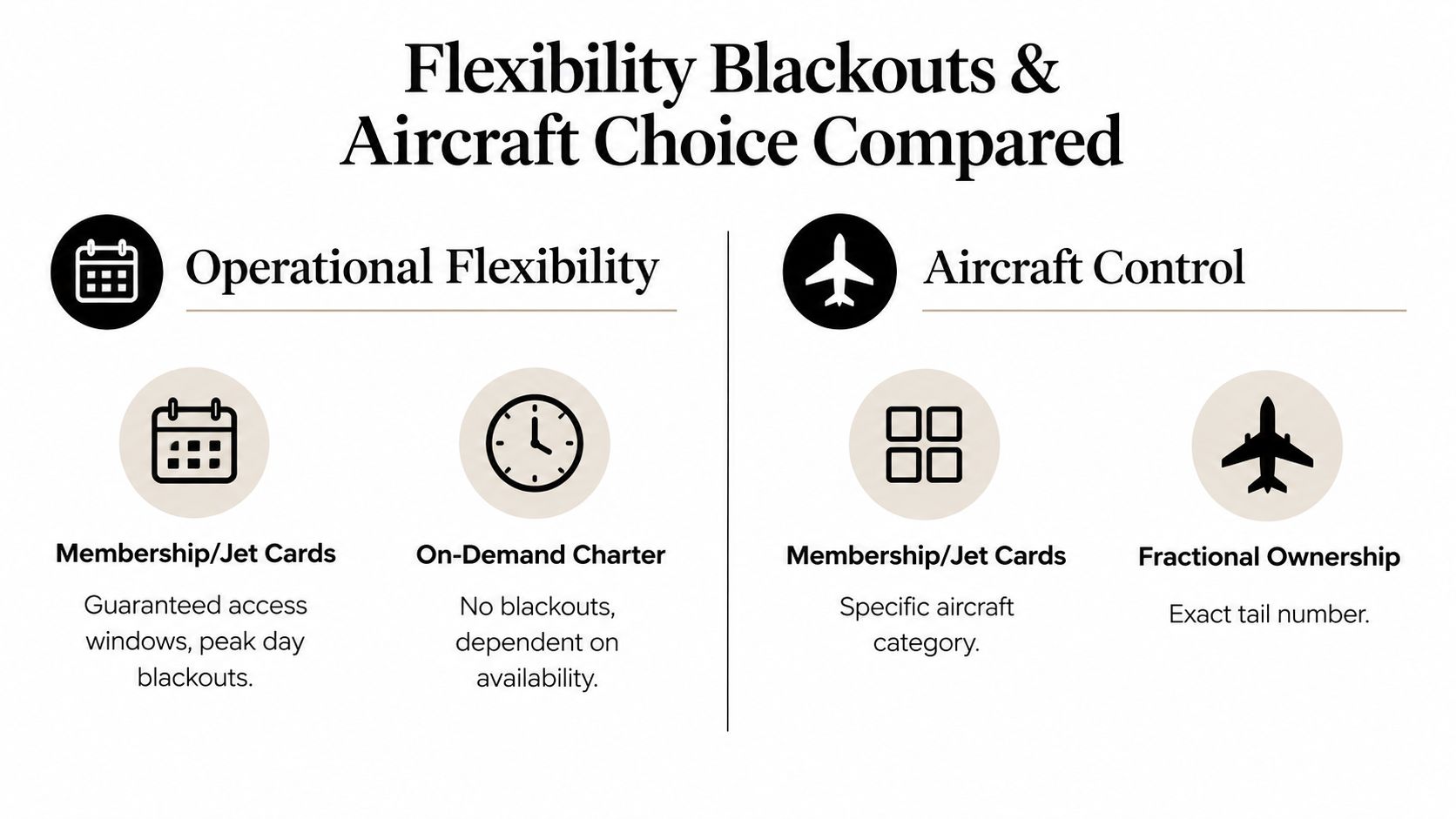
A membership promise usually has conditions. Some products advertise guaranteed access with notice windows such as 10 to 24 hours, while jet cards commonly exchange fixed hourly rates and priority access for upfront commitment, as outlined in this overview of membership availability mechanics.
That can be useful for a traveler who repeatedly books similar missions. It becomes less useful when the traveler's requirements change from trip to trip.
Membership and jet cards
A card may give you a defined aircraft category rather than the exact aircraft you want. Availability can also depend on booking windows, peak travel restrictions, blackout dates, service areas, and cancellation terms.
Fixed pricing is valuable when demand rises or when your team needs to book with confidence. But you may pay for that insurance even when the market has a nearby aircraft available at a lower trip-specific price.
On-demand charter
On-demand charter starts with the mission, not the membership rules. A capable adviser can search aircraft near the departure city, compare operator quality, and present specific year, make, model, cabin, Wi-Fi, catering, and pet-policy details.
That control is particularly valuable for mixed-use travelers. A compact aircraft may be efficient for a short business trip, while a larger cabin may be more appropriate for an international itinerary or a group carrying substantial luggage. One prepaid category may not handle both missions efficiently.
Fractional ownership
Fractional ownership provides the strongest relationship with an aircraft solution, but it can provide less freedom to shop the entire market for every flight. You're paying for access to an ownership structure, not merely selecting the best-positioned aircraft for each individual trip.
Safety transparency should remain separate from membership branding. Ask which operator will conduct the flight, what third-party oversight it holds, and whether the provider will disclose the aircraft and crew details before departure. Wyvern and Argus ratings are useful screening signals, but they should be verified for the operating company assigned to your flight.
The decisive difference: Membership sells certainty around access. On-demand charter sells choice around the mission. Decide which uncertainty causes you more trouble.
The most expensive mistake is confusing a guarantee with a guarantee of the exact aircraft you want. If the program guarantees only a category, you may still receive an aircraft that fails your preferred cabin layout, Wi-Fi requirement, pet arrangement, or baggage needs.
Detailed Comparison of Membership Jet Cards Fractional and On Demand Charter
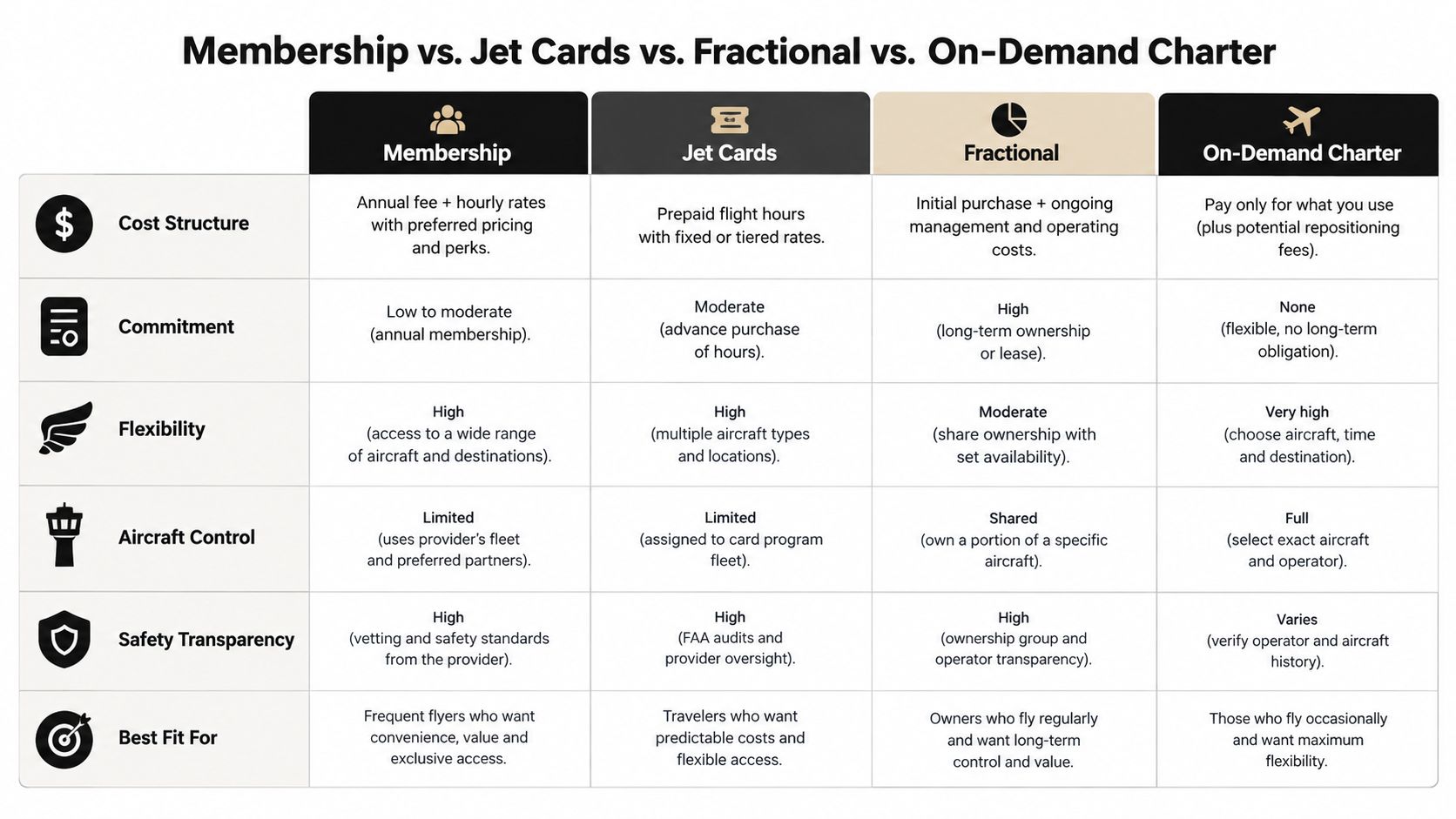
The four models solve different problems. A useful comparison looks beyond price and asks who controls the aircraft choice, who carries the commitment, and how much information the traveler receives before departure.
| Decision Criterion | Membership | Jet Cards | Fractional Ownership | On-Demand Charter |
|---|---|---|---|---|
| Cost structure | Annual fee, deposit, or access charge plus trip costs | Prepaid hours under fixed pricing rules | Share purchase plus operating and management costs | Trip-by-trip quote with no membership fee |
| Commitment | Recurring or contractual commitment | Upfront prepaid commitment | Ownership-style commitment | No annual commitment |
| Flexibility | Depends on program rules and availability | Strong within contracted categories and booking windows | Strong within ownership program rules | Strongest ability to shop each mission |
| Aircraft control | Usually category-level access | Usually category-level access | Greater relationship to a defined aircraft solution | Specific aircraft selection when available |
| Safety transparency | Depends on provider and assigned operator | Often standardized by program, verify the operator | Built into ownership and management structure | Must be checked for every assigned operator |
| Best fit for | Travelers seeking convenience without ownership | Frequent travelers valuing rate and access predictability | High-utilization travelers seeking ownership control | Occasional or mixed-use travelers prioritizing choice |
The modern jet-card segment grew from the launch of Sentient Jet's major U.S. program in 1999, according to industry coverage of prepaid private aviation. That same coverage estimates the global jet-card and membership-program market at roughly $4 billion in 2025, with a projection of about $8 billion by 2034. Sentient Jet marked its 25th anniversary in 2024, reporting more than 1 million passengers, over 2,500 destinations, more than 228 million miles, and nearly 6,700 active card owners.
Those milestones show why the product appeals to repeat users. The model turns private flying into a repeatable service rather than a fresh sourcing exercise every time. But repeatability can become a constraint when your missions vary more than the program expects.
For a deeper side-by-side treatment of the two most commonly confused options, review this guide to private jet cards versus charters.
Decision principle: Choose the model that matches your least predictable trip, not the model that looks cheapest on your most predictable one.
When Private Aviation Membership Makes Sense and When It Does Not

A private aviation membership makes sense when your travel pattern is frequent, repeatable, and sensitive to availability. It can be a strong fit for an executive team that flies similar routes, needs predictable budgeting, and values a consistent booking process more than exact aircraft selection.
It's a weaker fit for the occasional leisure traveler. If your private flying consists of a family holiday, a seasonal trip, and an unplanned business itinerary, a prepaid balance may sit unused while the annual fee continues. Pay-per-flight charter lets you match the aircraft to the trip and keep your capital available.
Traveler profiles that need different answers
Corporate teams with variable routing should examine the number of users, likely aircraft categories, and booking notice. A card can simplify authorization and billing, but a broker with broad operator access may offer better mission-by-mission selection when employees travel to different regions.
Pet owners should confirm the actual aircraft and operator policy before paying for access. A category promise doesn't tell you whether the cabin layout, crew, or owner-operator accepts the animal arrangements your trip requires.
Short-notice international travelers need to examine sourcing depth, permits, customs handling, and aircraft range. Membership priority can help, but it won't make an unsuitable aircraft suitable or eliminate every operational constraint.
High-frequency shuttle users are the strongest membership candidates. If you repeatedly fly similar routes, use a consistent cabin class, and need fixed pricing, the card's premium may buy useful certainty.
Independent trend coverage identifies mixed-use travelers, corporate teams, pet owners, and short-notice international itineraries as underserved decision groups, while also describing movement toward flexible and on-demand models. The 2026 private aviation trend analysis also notes that fractional and ownership-style usage rose from 5% in 2021 to 20% in 2023, suggesting a fragmenting market rather than one universally superior model.
Use this practical test:
- If your routes and aircraft needs repeat, evaluate a jet card.
- If your schedule changes often, request on-demand quotes.
- If your team needs several aircraft types, compare wholesale sourcing against a single program.
- If exact aircraft choice matters, avoid assuming that category access is enough.
A short explanation can help before you review the video:
Membership isn't a status purchase. It's an operating decision. Buy it when its rules remove friction you regularly experience. Don't buy it to solve a single expensive quote.
Choosing Your Best Path to Private Flying
Start with four questions:
- How often will you realistically fly privately?
- Can you comfortably commit funds before the trips are confirmed?
- Do you need an exact aircraft, or is a category sufficient?
- Will blackouts, notice windows, or minimum billing create problems?
If your answer points to repeat routes, dependable usage, and a strong need for fixed pricing, explore a structured Haute Jets membership option alongside competing programs. Read the contract carefully, especially the treatment of unused hours, cancellation, aircraft substitution, fees, and peak-date access.
If your travel is irregular, mixed-use, or aircraft-specific, my recommendation is simpler: book on demand and pay per flight. You'll avoid annual fees and prepaid hours, while retaining the ability to compare aircraft and operators for each mission. That approach is particularly compelling when a nearby owner-operator can reduce repositioning exposure.
Don't ask whether membership is prestigious or whether charter is always cheaper. Ask which model gives you the right aircraft, at the right airport, for the trips you'll take.
Haute Jets offers trip-by-trip private charter sourcing across a broad owner-operator network, with aircraft-specific selection and operator screening rather than a required prepaid balance. Visit Haute Jets to request an on-demand quote and compare the mission cost against private aviation membership before committing.