

You've got a board meeting in Houston tomorrow morning, a family trip to Aspen next week, or a commercial connection through Denver that has already fallen apart. The question isn't whether Omaha has private aviation. It's whether the aircraft you're being quoted is already near Eppley Airfield, or whether you're paying to bring it there empty.
That distinction matters more than a generic hourly rate. In Omaha, positioning can swing the final quote by 20–40%, especially when a broker sources an aircraft from another Midwest city instead of finding one already based close to Eppley. This guide takes the practical view of private jet charter Omaha clients need before they authorize a trip, covering airports, aircraft, pricing, and the questions that expose a weak quote.
Why Omaha Travelers Choose Private Charter
At 5:30 a.m., an Omaha executive is deciding whether to drive to Eppley for a commercial flight, connect through another hub, and hope the return schedule works, or depart directly for a meeting in Houston. A family may face the same calculation before a ski trip to Aspen. The private charter decision usually starts with a deadline, not a desire to fly extravagantly.
Commercial service from Eppley works well when the schedule fits. Charter becomes useful when the schedule is the problem.
Schedule control changes the trip
A private aircraft can be arranged around the meeting rather than around an airline timetable. A 6 a.m. departure and a morning arrival can preserve the same-day itinerary without forcing an overnight stay. The value is measured in recovered working time, fewer connections, and the ability to return when the meeting ends.
That flexibility also helps when weather, delays, or a missed connection disrupt a commercial itinerary. A charter advisor can look for another aircraft or departure window instead of asking you to accept the next available airline seat.
Practical rule: Book private when the schedule or destination matters more than the ticket price.
Routing is often the stronger argument
Omaha isn't limited to the destinations served conveniently by scheduled airlines. Private aviation can make regional destinations such as Lincoln, Scottsbluff, or Kearney part of a practical itinerary, subject to aircraft performance, runway conditions, and airport availability. That matters for executives visiting facilities outside major hubs and families heading closer to a final destination.
The time-to-terminal experience is different as well. You use an FBO rather than the main airline terminal, and the aircraft, crew, and ground arrangements are coordinated around your departure.
The cost gap is real
A charter isn't a replacement for a Southwest ticket. It's a tool for a trip where reaching the right airport, protecting a business day, carrying a group, or avoiding a complex connection justifies the spend. The mistake is treating every quote as a simple hourly multiplication.
The rest of the decision comes down to the details that control the invoice: where the aircraft is based, which FBO handles the flight, what category fits the route, and whether the operator gives you a fixed all-in number before payment.
Eppley Airfield and the Omaha FBO Network
Eppley Airfield, identified as OMA and KOMA, is the primary private aviation gateway for Omaha. It sits three miles northeast of downtown Omaha, according to the Haute Jets Eppley Airfield guide, making it the obvious first airport to evaluate for a metro-area departure.
The airport operates 24 hours a day, seven days a week through its private aviation terminal and FBO support network, and it has an on-site U.S. Customs and Border Protection facility for international, charter, and private flights, as documented in GlobalAir's OMA FBO information. That customs capability is operationally important for cross-border planning, although your broker still needs to confirm hours, clearance procedures, and whether the specific itinerary can be handled as planned.
What happens at the FBO
The FBO is where the private charter experience begins. You'll check in away from the airline terminal, complete the required passenger documentation, and move from the private lounge to the aircraft ramp under the operator's handling procedures. Fuel, ramp support, crew facilities, and passenger handling are coordinated there.
Eppley's private aviation ecosystem includes multiple FBO and aircraft-support resources. AceJet's Eppley airport overview describes an airport open around the clock with private aviation access, ramp space, fuel, and crew amenities. The same source notes 118 aircraft based on the field, spanning single-engine aircraft, multi-engine aircraft, and jets. That density gives charter shoppers more than a convenient departure point. It creates a deeper local sourcing pool.
Compare the Omaha-area choices
| Airport | Code | Primary FBOs | Runway Length | Best For |
|---|---|---|---|---|
| Eppley Airfield | OMA / KOMA | Signature Aviation and other on-field private aviation facilities | Confirm for the selected runway and aircraft | Most Omaha business and leisure departures, larger aircraft, international planning |
| Millard Airport | MLE | Smaller local FBO footprint | Confirm with the operator | Light jets, turboprops, and western Omaha access |
| Lincoln Airport | LNK | Local FBO services | Confirm with the operator | Lincoln-area passengers and a secondary option when Eppley creates friction |
Use the runway-length column as a confirmation point, not a substitute for dispatch review. The operator must verify aircraft performance, payload, weather, runway condition, and airport restrictions for your exact flight.
For western Omaha or Papillion, Millard can reduce the ground transfer when a suitable light jet or turboprop is available. Lincoln can also work for passengers based south or west of Omaha, particularly when the selected aircraft is already there.
Ask before you book: “Which airport and FBO will handle this exact tail number, and is the aircraft already on the field?”
The key benefit is operational simplicity. A private jet parked on the FBO ramp with its crew ready can produce a much faster departure experience than the commercial terminal, but the exact timing still depends on security, passenger documentation, catering, fueling, and dispatch.
Aircraft Options for Omaha Departures
Aircraft selection should follow the mission, not the brochure. A small cabin that works for a short regional hop can become uncomfortable on a longer trip, while a heavy jet can turn a simple business flight into an unnecessarily expensive choice.
Turboprops for short regional missions
A King Air 350 or Pilatus PC-12 makes sense for short trips into Nebraska, the Dakotas, and nearby Midwest destinations. These aircraft are usually the lowest-cost category and can be practical when the destination has a shorter runway or limited jet infrastructure.
The tradeoff is cabin size and speed. Turboprops are efficient tools for regional travel, but they aren't the right answer when passengers need a larger cabin, extensive baggage capacity, or a long nonstop sector.
Light jets as the Omaha workhorses
The Phenom 300, Citation CJ3+, and Learjet 75 suit one-to-four passenger business missions and regional cross-country travel. Omaha to Denver, Chicago, Dallas, or Atlanta can fit this category depending on payload, weather, routing, and aircraft availability.
Light jets provide a strong balance between access and comfort. They're often the first category to check for a small group, but don't assume the cheapest light jet is automatically appropriate. Ask about cabin dimensions, baggage access, lavatory configuration, connectivity, and the aircraft's actual location.
For a deeper aircraft-selection framework, review this guide on choosing the right aircraft for short-haul private flights.
Midsize aircraft for comfort and range
The Citation XLS+, Hawker 900XP, and Learjet 60 offer a stand-up cabin and more room for a small group. They're better suited to longer domestic missions, including Phoenix, New York, or Florida, particularly when five to seven passengers are traveling with baggage.
A midsize jet often becomes the practical choice when the itinerary is long enough for cabin comfort to matter, but not so demanding that a long-range aircraft is necessary.
Long-range cabins for demanding itineraries
The Challenger 350, Gulfstream G450 or G550, and Global 6000 are designed for transcontinental and light international missions. Full galleys, lie-flat seating, larger cabins, and stronger baggage capacity matter when passengers are traveling across the country or carrying equipment for a longer stay.
The repositioning question remains decisive. A Phenom 350 already based at Eppley will produce a different quote from an otherwise comparable aircraft flying empty from Denver to collect you. The model is only one part of the price.
Route Examples and What They Cost
A useful Omaha quote starts with the aircraft's location, not just the itinerary. Category, availability, crew positioning, fuel, routing, and empty repositioning legs can change the total substantially. Ask whether the aircraft is already near Eppley Airfield before comparing hourly rates.
The ranges below are market reference points, not promised quotations. Independent Omaha charter guidance lists hourly figures from roughly $2,000 for turboprops to $10,000 or more for long-range jets, with some quotes beginning around $2,300 per hour and reaching $23,000 per hour for VIP airliners. The Air Charter Advisors' Omaha pricing guide explains that routing, aircraft year, fuel, positioning, and availability affect the final total.
| Route from Omaha (OMA) | Distance (NM) | Typical Aircraft | Flight Time | Estimated All-In Price (USD) |
|---|---|---|---|---|
| Omaha to Kansas City | 150 to 180 | Turboprop or light jet | ~45 minutes | $4,500–$8,000, depending on positioning |
| Omaha to Minneapolis | 250 to 280 | Turboprop or light jet | ~1 hour | $5,500–$9,000, depending on positioning |
| Omaha to Chicago | 500 to 550 | Light or midsize jet | ~1.5 hours | $6,500–$11,000, depending on positioning |
| Omaha to Dallas | 600 to 650 | Light or midsize jet | ~1.75 hours | $8,000–$14,000, depending on positioning |
| Omaha to Phoenix or Florida | 1,200 or more | Midsize or long-range jet | ~3 to 4 hours | $14,000–$30,000 or more, depending on positioning |
These are 2026 market ranges. The operator should disclose positioning separately rather than burying it inside an attractive hourly rate.
For Kansas City or Minneapolis, a turboprop can be the economical choice when passenger count, baggage, and weather support it. Choose a light jet when speed, privacy, or baggage access matters more. On the Chicago route, a midsize aircraft offers a more comfortable stand-up cabin for a larger group, while a light jet can suit fewer passengers. The Omaha to Chicago route guide provides a destination-specific reference.
Phoenix and Florida call for closer attention to cabin comfort and payload. A long-range cabin makes sense when the route, passenger count, baggage, or onboard requirements justify it. The strongest comparison is between an aircraft already near OMA and one flying empty to collect you, because Omaha's central Midwest location can make positioning a major part of the final quote.
Why Local Sourcing Beats Repositioning Fees
Two quotes for the same Omaha trip can differ sharply because the aircraft starts in different places. Before comparing hourly rates, confirm whether the jet is already near Eppley Airfield, or whether it must fly empty to collect you. In Omaha, that sourcing question often determines whether the attractive quote remains attractive after dispatch adds positioning.
A jet coming from Kansas City, Des Moines, or Minneapolis may add 150 to 300 nautical miles of deadhead travel. Depending on the aircraft category, independent charter guidance places that added cost at roughly $2,000 to $6,000 per leg. Aircraft proximity and availability materially affect the final quote, so the published rate alone does not provide a useful comparison.
Where Omaha buyers lose leverage
A national marketplace can produce an aircraft quickly, yet the fastest match may carry a deadhead cost that is buried inside the total. Tell the broker to prioritize aircraft already near OMA, then request a comparison with the nearest suitable repositioned option.
Ask for three disclosures before approving a proposal:
- Aircraft location: Where is the exact tail number before departure?
- Positioning legs: Which empty flight segments are included in the quote?
- Operator and handling: Who operates the aircraft, and which charges come from third parties?
Owner-operators within roughly 200 nautical miles of Omaha can provide a stronger starting position when their aircraft and crew are available. The practical sourcing pool includes Part 135 operators in Nebraska, Iowa, and Kansas, alongside national charter brands.
Treat positioning as a pricing variable
Local sourcing can act as a 20–40% lever on the final number. Treat that range as a comparison point, not a promised discount. Compare an aircraft based near Omaha with a repositioned aircraft that meets the same passenger, baggage, and schedule requirements.
The question that changes the quote: “What would this trip cost if you sourced the aircraft from the closest available base instead of defaulting to the national inventory?”
The broker should show the aircraft's location, empty legs, operator, and third-party charges in writing. If those details are vague, the quote is not ready for approval. Air Charter Advisors' Omaha analysis also underscores why aircraft proximity belongs in the pricing discussion.
Booking and Pre-Flight Confirmation
A good booking request is specific enough for dispatch to price accurately. Send the departure date, preferred departure time, flexibility, passenger count, baggage expectations, destination airport, and any requirements that affect aircraft selection.
Pets, medical equipment, unusual baggage, catering, and accessibility needs should be disclosed immediately. Late disclosure can force an aircraft change, a handling adjustment, or a schedule revision.
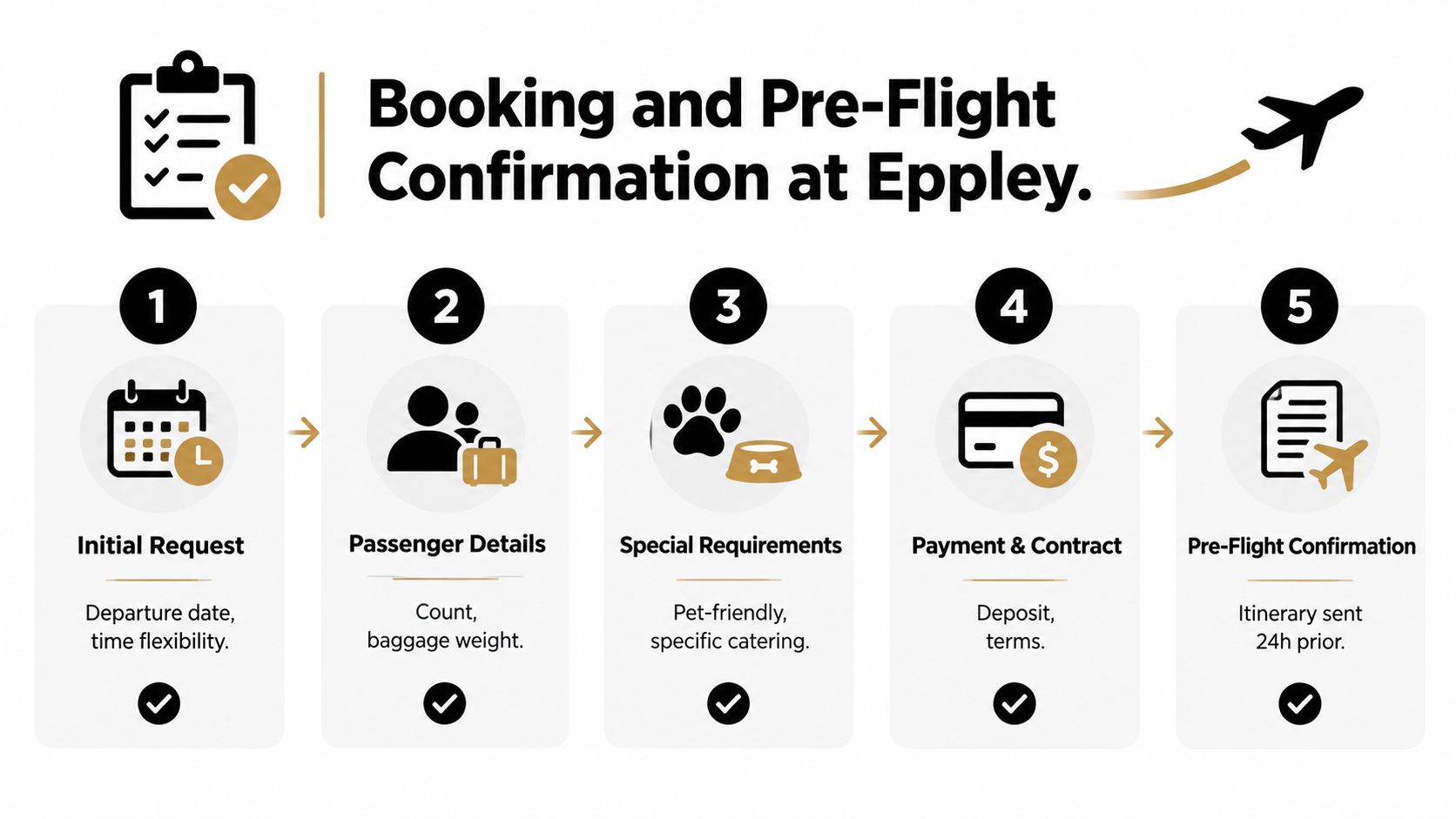
The booking sequence
- Submit the itinerary: Give the broker the route, timing, passenger details, and flexibility.
- Review aircraft options: Compare the exact model, tail number when available, cabin layout, baggage access, and aircraft location.
- Read the trip sheet: Confirm the operator, FBO, routing, total price, taxes, handling charges, cancellation terms, and payment deadline.
- Provide passenger documentation: The operator will need the manifest and identification details required for the flight.
- Receive final confirmation: Expect the operator to verify aircraft, crew, fuel, FBO handling, and flight planning before departure.
The 24-hour pre-flight confirmation is the point where the proposal becomes an operational plan. Ask for the final itinerary, tail number, crew information, weather review, passenger manifest, and FBO details in writing.
Wyvern and Argus ratings are useful screening tools, but they're a floor rather than a complete safety decision. Confirm the operating certificate, review the specific operator, and ask whether the aircraft and crew assigned to your trip match the credentials presented during quoting.
Before sending a wire: Get the final operator name, exact aircraft or substitution terms, cancellation window, FBO, total price, and passenger-document requirements in writing.
Weather and maintenance can change a flight even after confirmation. Your advisor should explain the contingency plan, including how substitutions, delays, cancellations, and additional handling costs will be treated.
Choosing the Right Omaha Charter Partner
The right partner isn't the one that produces the lowest headline figure. It's the one that can explain who operates the aircraft, where the aircraft is based, what safety screening applies, and what happens if the plan changes.
Start with the operator's certificate. Confirm that the flight is being conducted by an appropriate Part 135 operator, then request current Wyvern or Argus information. Those ratings help screen the operator, but they don't replace a review of the assigned aircraft, crew qualifications, maintenance status, and trip-specific operating plan.
Put the aircraft facts in writing
Ask whether the aircraft is based within 300 nautical miles of Eppley. That question is separate from asking whether the broker can find a jet. It tests whether the proposed aircraft is reasonably positioned for Omaha or whether the quote depends on deadhead travel.
Request the following before approving the trip sheet:
- Exact aircraft: Tail number, year, model, cabin layout, and substitution terms.
- Crew details: Qualifications, currency, and whether the assigned crew can legally operate the proposed schedule.
- Maintenance record: Current maintenance status and the provider responsible for the aircraft.
- Complete charges: Positioning, FBO handling, catering, ground transport, taxes, and other pass-through costs.
- Cancellation terms: Notice windows, penalties, weather treatment, and replacement-aircraft provisions.
Avoid the common quote failures
Some brokers substitute an aircraft after quoting without clearly explaining the difference. Others show an attractive one-way price and reveal the positioning cost only after the aircraft is selected. Third-party handling fees can also appear late if the proposal doesn't identify the FBO and operator at the start.
A sample trip sheet is worth requesting because it shows how the provider presents the commercial terms. If the document doesn't identify the operating carrier, the payment recipient, and the cancellation language, don't treat it as a final offer.
Private charter can also serve a very different kind of itinerary, such as exclusive air travel for couples, where privacy and destination flexibility matter more than corporate scheduling. The same diligence still applies. A romantic itinerary deserves the same clarity on aircraft, operator, and total cost as a business flight.
Local owner-operator relationships can outperform a generic national broker search when the aircraft is already near Omaha. Compare the quote, but compare the sourcing logic first. The cheapest proposal often hides the weakest disclosure, the least suitable aircraft, or a repositioning charge that appears only after you commit.
Haute Jets can source on-demand charter options for Eppley Airfield and compare aircraft by category, location, and operator credentials, with the repositioning question kept visible in the quote. For your next Omaha departure, send the route, passenger count, timing flexibility, and baggage requirements through Haute Jets and ask for the exact aircraft location before approving payment.