
Most private jets carry 4 to 10 passengers depending on category, with light jets seating 4 to 7, midsize 6 to 9, super-midsize 8 to 10, and large or ultra-long-range aircraft 10 to 19. That's the number most buyers should start with, not the glossy maximum in a brochure.
The popular advice is wrong because it treats a seat count like a guarantee. It isn't. Private jet passenger capacity changes with cabin layout, luggage, fuel, crew, and route length, and if you ignore those variables you'll book the wrong aircraft, pay for unused space, or force a stop you didn't want.
Why Published Seat Numbers Mislead Charter Buyers
The brochure number is usually the least useful number in the room. A jet that says 10 passengers on paper may be a six-seat aircraft in real life once you factor in comfort, baggage, and fuel for a longer leg. That gap is why first-time flyers keep overbuying or underbuying.
Maximum seats are not practical seats
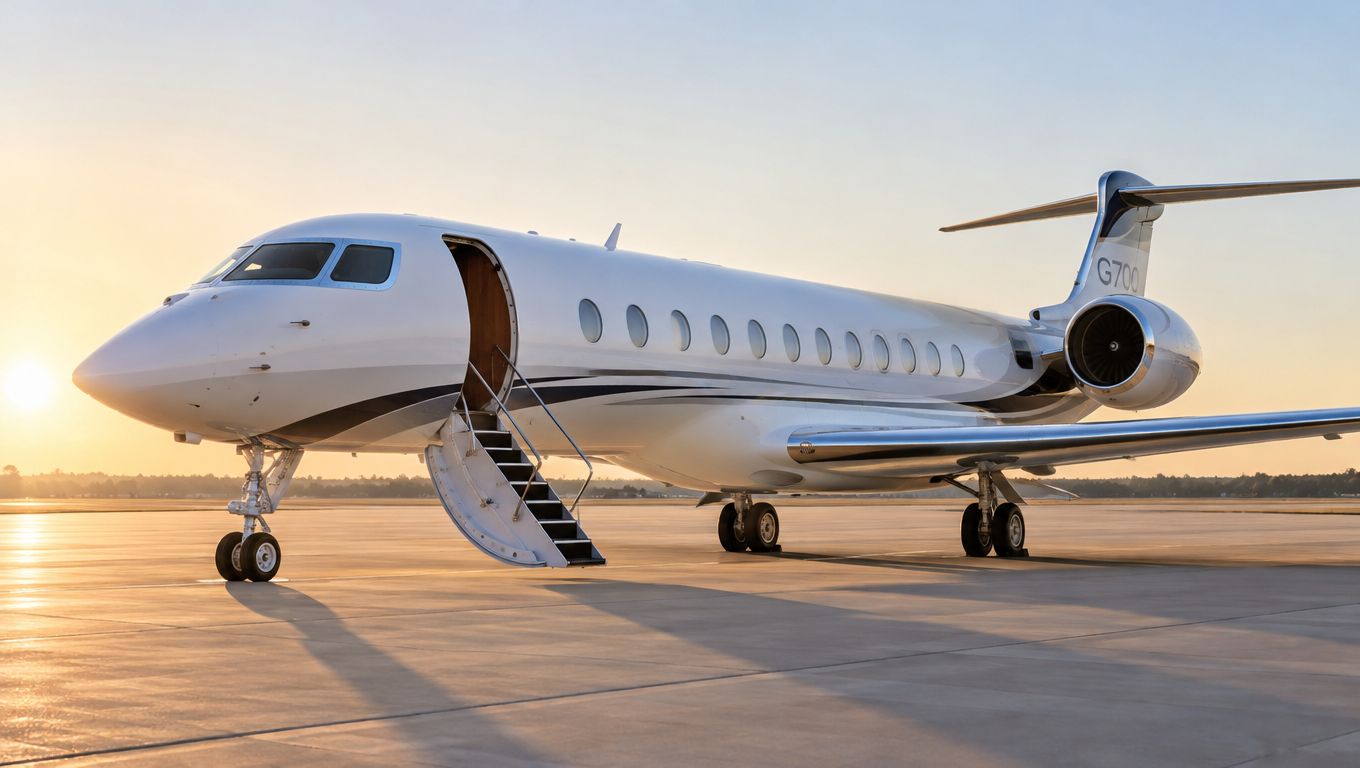
The headline example is the Gulfstream G700, which Gulfstream says can seat up to 19 passengers and sleep up to 13, but its performance figures are based on eight passengers, four crew, and NBAA IFR reserves. Independent charter specs describe about 13 passengers as the more practical figure. That difference tells you everything, if you're honest about how you travel. Gulfstream's G700 specifications prove the point, and this Haute Jets guide to passenger counts is the right place to sanity-check the basics.
The four numbers that matter more than the ad
Think in four layers, not one. First is the certified maximum seat count. Second is the normal charter layout. Third is the actual tail number's seat map. Fourth is the comfortable capacity with luggage.
Practical rule: if the answer starts with “the aircraft can seat,” keep pushing. Ask how many people it can carry on your route with your bags, not in a marketing brochure.
That distinction matters because the same model can be sold with different interiors. One operator may strip out a seat for more lounge space, another may add a divan, and both can still call it the same aircraft family. For charter buyers, the key question isn't “How many seats does it have?”, it's “How many people can ride this exact aircraft well?”
Understanding Aircraft Categories and Their Real Capacity Ranges
Category is the fastest way to stop overthinking seat counts. It won't tell you everything, but it tells you enough to avoid dumb mistakes. A light jet and an ultra-long-range jet are not just different sizes, they solve different missions.
Match the cabin to the mission
Haute Jets' cabin guide puts turboprops at 6 to 9 passengers, light jets at 5 to 7, midsize jets at 7 to 9, super-midsize jets at 8 to 10, heavy jets at 10 to 16, and ultra-long-range aircraft at 12 to 19. It also ties baggage space to the category, with light jets at 40 to 55 cubic feet, midsize at 60 to 80, super-midsize at 90 to 110, and heavy jets at 150 to 225. Haute Jets' private-jet cabin guide is useful because it treats capacity as a category-based decision, not a fantasy maximum.
| Category | Passenger Capacity | Typical Baggage Volume | Best For |
|---|---|---|---|
| Turboprop | 6 to 9 | Not specified in the verified data | Short regional trips |
| Light jet | 5 to 7 | 40 to 55 cubic feet | Small groups on short hops |
| Midsize jet | 7 to 9 | 60 to 80 cubic feet | Business trips with moderate luggage |
| Super-midsize jet | 8 to 10 | 90 to 110 cubic feet | Larger groups and longer domestic missions |
| Heavy jet | 10 to 16 | 150 to 225 cubic feet | Bigger parties and international travel |
| Ultra-long-range | 12 to 19 | Not specified in the verified data | Long-haul, high-comfort missions |
Why range and seating go together
Light jets are commonly used for regional missions, midsize aircraft handle longer business legs, and larger cabins make sense when the trip is international or the group is big enough to need more breathing room. A six-person team flying a few hours doesn't need a cramped cabin just because the aircraft can technically fit six. It needs the right balance of seat count, baggage space, and usable living area.
A good charter broker won't push you toward the highest number on the page. They'll steer you to the cabin that fits the route, the luggage, and the comfort standard you really want. That's the difference between buying an aircraft category and buying a workable trip. This guide to private jet types is the better starting point than any single aircraft listing.
The Payload Equation That Determines Actual Passenger Count
Passenger count is only part of the equation. Fuel, baggage, crew, and cabin layout all reduce what the aircraft can carry, and longer routes make that tradeoff tighter.
How payload limits cut the usable seat count
Under FAA Part 135 rules, on-demand operations can use airplanes with 30 seats or fewer and a maximum payload of 7,500 lb. Aircraft with 10 or more passenger seats also face more extensive maintenance-program requirements than aircraft certified for nine or fewer seats. FAA Part 135 general information makes the point clearly. More seats do not automatically mean more flexibility.
A cabin can have empty chairs and still be overloaded. Heavy bags, a long route, or both can force a charter operator to leave seats unused so fuel and baggage stay within limits.
Ask for the load, not just the model
Use this sequence when you compare options:
- Start with the route. Longer legs need more fuel, and more fuel leaves less room for people and luggage.
- List the baggage type. Golf clubs, ski bags, pets, and oversize cases change the math fast.
- Check the crew requirement. Crew seats are not for passengers, but they still take cabin space and weight allowance.
- Verify the payload allowance. If the aircraft's payload is tight, a larger cabin may be the smarter choice.
A jet that looks right on paper can become the wrong aircraft once fuel and bags are added. This is a planning problem, and the broker can solve it only if you give route details early.
The question is simple. Can it carry eight people, their luggage, the crew, and enough fuel for this route without compromise? If the answer is weak, move up a category or plan a stop. Anything else is wishful thinking.
How Cabin Configuration Creates Capacity Variations Within One Model
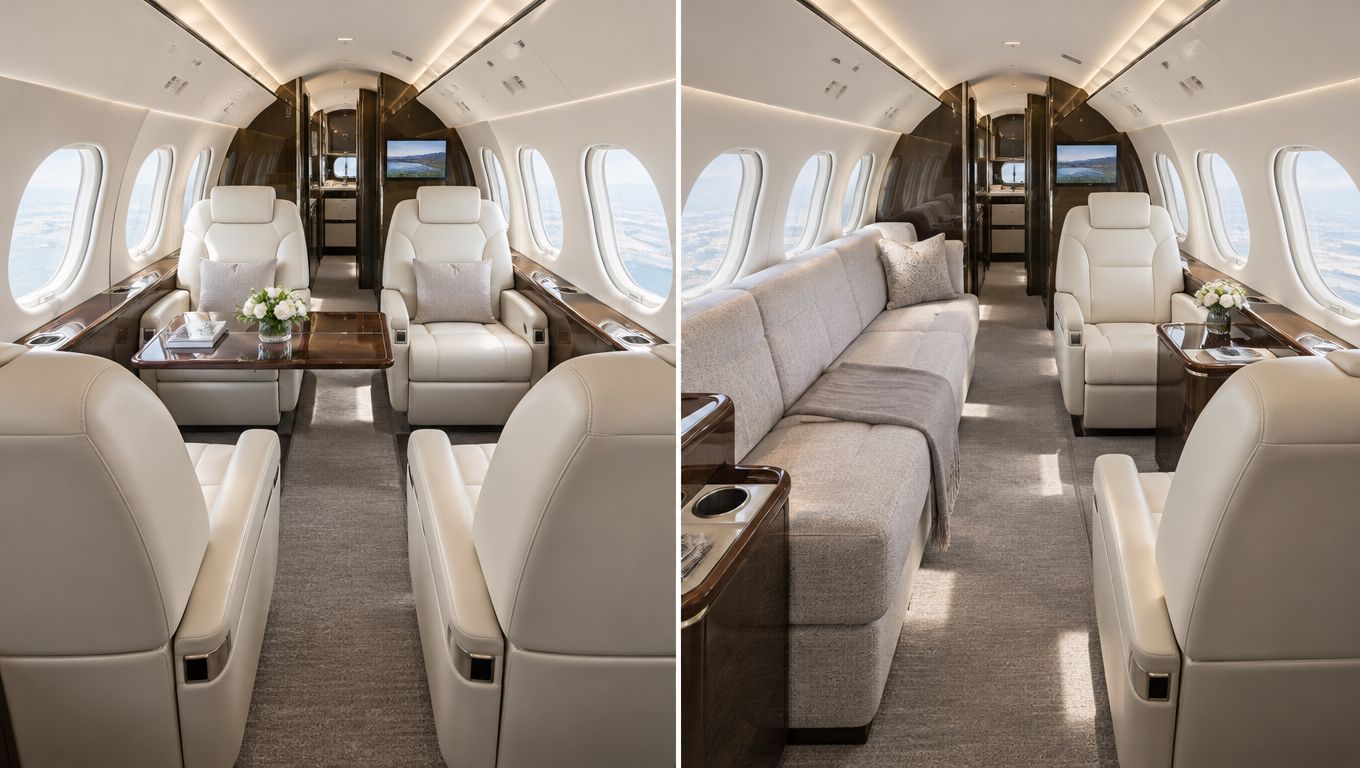
Same model, different interior, different result. That's not a footnote, it's the whole game. A private jet isn't a bus, and interior layout changes how many people can use the cabin without hating the trip.
Comfort beats the marketing max
Haute Jets lists the Learjet 45 as seating up to seven passengers, but says five to six is the optimal comfort range. It also notes that the Gulfstream G650ER can accommodate up to 15 passengers in standard charter configuration, while many aircraft are set up for 13 to give more space. Haute Jets' Learjet 45 page is a clear example of why you should ask for the actual seat map.
The reason is simple. Club seating, divans, galleys, lavatories, and crew-rest space all compete with passenger seats. Add a better layout for conversation or sleep, and the headcount drops. Add a denser layout, and the cabin gets tighter fast.
Ask for the exact tail number
Two aircraft with the same badge can fly very differently. One may be set up for business meetings, another for overnight comfort, and another for maximizing headcount on a short shuttle. If you're booking for a specific group, ask for the exact tail number, the seat map, and the practical seating plan before you commit.
If the trip is a short hop, a denser layout can work. If the route is long or the group needs room to move, I'd rather see fewer seats and better spacing. That's how you avoid landing tired, annoyed, and boxed in.
Matching Group Size and Trip Type to the Right Aircraft
Headcount alone doesn't choose the jet. A family with bags, a corporate team with laptops, and a production crew with gear all need different cabins even when the passenger totals look similar. The right answer starts with who's flying and what they're bringing.
Real trips, real tradeoffs
A Phenom 300E is a good example of why “up to 10” can be misleading. It's marketed as accommodating up to 10 passengers, but its typical configuration is six, with 84 cubic feet of baggage and stowage volume. Flyius' Phenom 300E fleet page makes the practical point clearly, a short flight with light luggage can support more travelers, while winter clothing, golf bags, or pets can make the nominal seat count unusable.
That's why a family of five with sports gear can be a worse fit for a light jet than a six-person business team with slim briefcases. Luggage changes the math faster than many expect.
Use the right category for the job
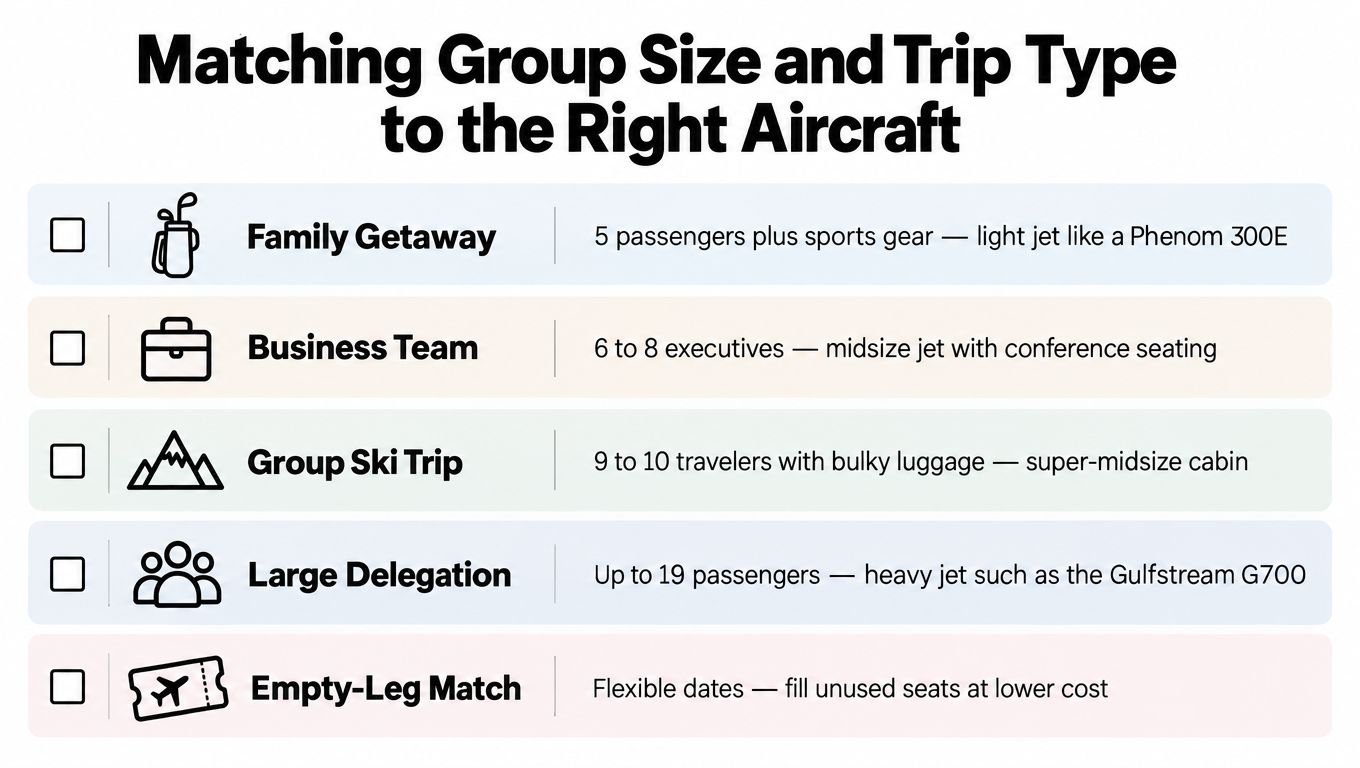
- Family Getaway: a five-person family with golf bags usually fits better in a light jet if the route is short and the luggage is modest.
- Business Team: six to eight executives should look at a midsize or super-midsize cabin, especially if the flight doubles as work time.
- Group Ski Trip: nine to ten travelers with bulky bags are usually better served by a super-midsize or larger cabin.
- Large Delegation: larger groups should look at heavy or ultra-long-range aircraft, especially when comfort matters as much as seat count.
For destination planning, it helps to compare the trip itself before you compare aircraft. If you're weighing locations for a large group, compare large group trip destinations alongside the aircraft category so the itinerary and cabin size don't fight each other. Haute Jets' guide for large groups is also worth using when the headcount starts pushing the upper end of the cabin range.
The blunt rule is this. Start with comfort capacity, then verify luggage, then check route length. If you do it in the opposite order, you'll probably book the wrong jet and try to justify it later.
Questions to Ask Your Charter Broker About Capacity
The wrong question is, “How many passengers does this jet seat?” That invites a lazy answer. The better question forces the broker to prove the aircraft fits your route, your bags, and your comfort standard.
Ask for specifics, not marketing
Use these questions and don't let anyone dodge them:
- What is the certified passenger configuration? That tells you the legal seating ceiling for the exact aircraft.
- What is the planned passenger and baggage payload for this route? If the broker can't answer that cleanly, they're guessing.
- How many crew seats are excluded from the cabin count? Crew space matters on larger aircraft and longer missions.
- What does the actual seat map look like for this tail number? Same model, different configuration is the norm, not the exception.
- Will pets, catering, Wi-Fi gear, or extra ground baggage change usable capacity? Those details can force tradeoffs you'd rather know about early.
Treat capacity as a booking conversation
FAA category limits are useful reference points. Part 23 categories cap normal, utility, and acrobatic airplanes at 9 passenger seats and 12,500 pounds maximum takeoff weight, while the commuter category extends the limit to 19 passenger seats and 19,000 pounds. FAA guidance also distinguishes Part 135 commuter and on-demand operations, with on-demand aircraft allowed up to 30 seats under the applicable payload and certification rules. FAA certification categories gives you the regulatory frame, but the booking question still comes down to the actual mission.
Smart buyer move: ask for the exact aircraft, the exact passenger count, the baggage plan, and the route. If any of those are fuzzy, the quote isn't ready.
Haute Jets works from the aircraft itself, not a vague category, so you can choose the year, make, model, and cabin layout, then confirm the details before departure. That's the right way to buy capacity, because capacity is really a route-specific decision, not a number on a brochure.
If you're ready to size the right cabin for your next trip, review your passenger list, your baggage, and your route first, then book through Haute Jets with the exact aircraft that fits the mission. Don't settle for a headline seat count when the true answer depends on how you travel.