A one-way private jet typically runs from roughly $10,000 for a short domestic light-jet sector to well over $100,000 for a transatlantic heavy or ultra-long-range flight. The actual figure is driven more by the aircraft's location than by the advertised hourly rate.
You may be looking at two quotes for the same departure and arrival airports, wondering why one provider's “cheaper” jet produces the larger invoice. That happens because you aren't buying a seat or just multiplying airborne minutes by an hourly number. You're paying to move a complete aircraft, crew, and operating system to your departure airport, carry you to the destination, and then position the jet for whatever comes next.
That's why the right question isn't only, “What does a private jet cost one way?” Ask instead: Where is the aircraft now, what empty legs will I pay for, and what exactly is included in the total? A well-positioned jet with a higher hourly rate can beat a lower-rate aircraft that must deadhead hundreds of miles before pickup.
What Drives a One Way Private Jet Price
You get two quotes for the same city pair. The jet with the lower hourly rate comes back with the higher total. That is normal in charter, and it is where buyers waste money.
A one-way price is driven by aircraft position and invoice transparency before hourly rate ever becomes useful. Charter companies price the entire aircraft, not a seat, so the total usually stays tied to the jet, the routing, and the operating plan whether one person is flying or the cabin is full within approved limits. Haute Jets explains one-way pricing as a mix of the aircraft's hourly market rate, flight time, and route-specific operating costs, with published rates starting around $3,500 per flight hour and light-jet examples around $5,000–$7,000 per hour (Haute Jets' one-way pricing overview).
Two things decide whether your quote is reasonable. First, the aircraft has to fit the mission. Second, it has to be close enough to your departure point that you are not paying for someone else's ferry flight.
Aircraft capability and mission
Aircraft category still matters. A turboprop can be the right answer for a short regional leg. A light jet buys speed and a better cabin. A midsize or super-midsize aircraft may be the practical choice when range, baggage, or passenger count rises. Heavy and ultra-long-range jets cost more because they support longer missions and higher operating demands.
Mission details change the number fast. Flight time, departure and arrival airport, international handling, crew requirements, and any fuel stop affect the operating plan. A short flight can still produce a substantial invoice when the operator applies a minimum billable block or adds repositioning.
Aircraft location at booking
This is the bigger driver on one-way pricing. If the aircraft is already near your departure airport, the operator may only need to quote your passenger leg plus standard trip costs. If the aircraft sits far away, the provider may need to fly it in empty, fly you, then move it again after drop-off.
That empty movement is not abstract. It burns fuel, uses crew duty time, adds maintenance reserves, triggers airport services, and can create overnight costs. On shorter trips, those fixed costs often matter more than the time you spend onboard.
Practical rule: Do not compare one-way quotes by hourly rate alone. Compare aircraft position, billable hours, empty legs, fees, taxes, and cancellation terms.
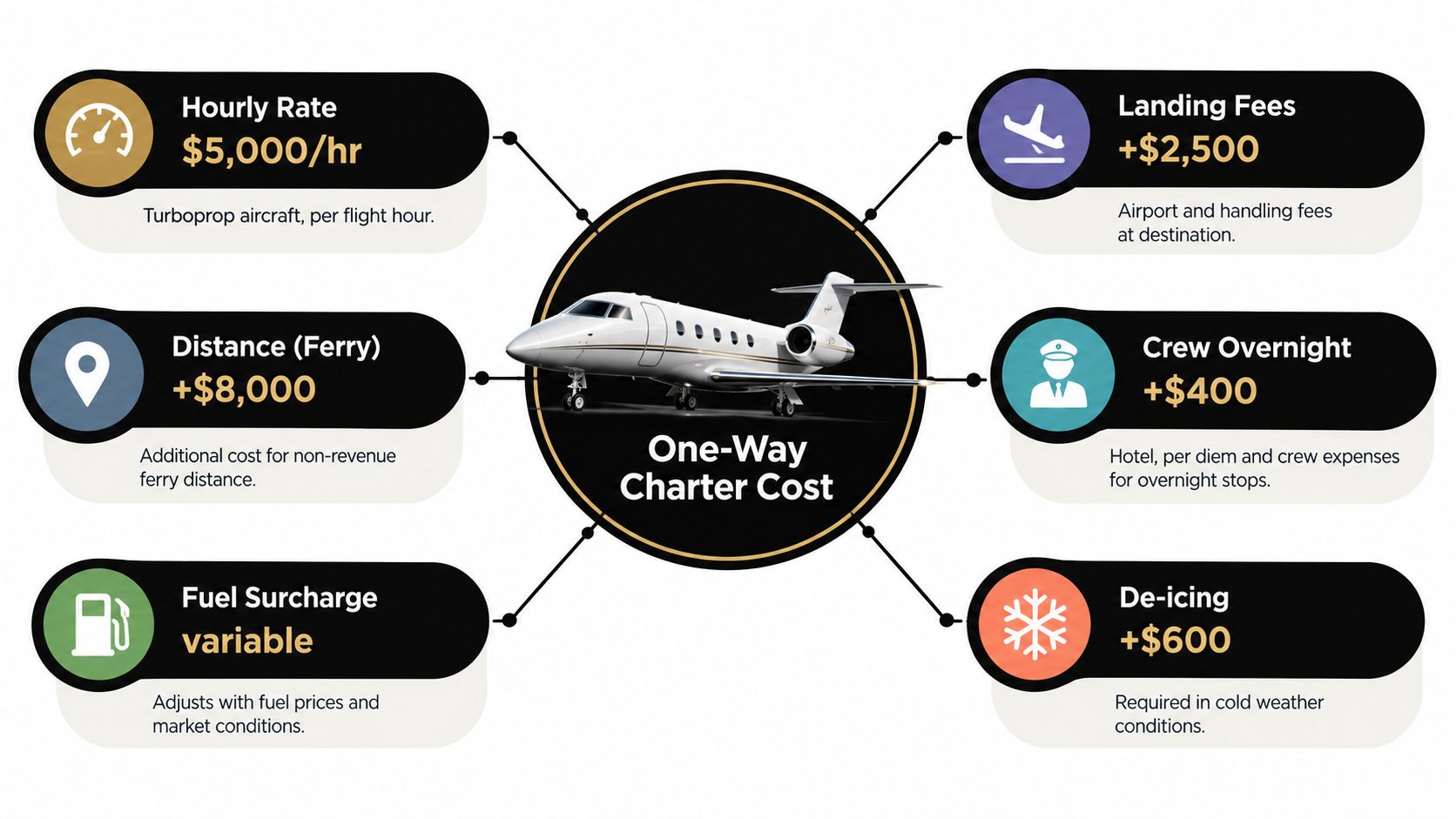
A useful quote makes its pricing basis obvious. It should tell you whether you are looking at an hourly indication, a base aircraft estimate, or an all-in trip total. It should also state the aircraft category and passenger capacity so you can see whether the proposed jet matches the trip, instead of paying for unnecessary range or cabin size.
How a One Way Charter Invoice Is Built
A charter quote resembles an itemized restaurant bill more than a single menu price. The aircraft's hourly rate is the main course, but the final check can include transport before pickup, airport charges, taxes, crew expenses, and services you requested.
Start with the aircraft rate and billable flight time. The operator estimates the passenger sector, then applies its billing method. A short flight may be subject to a daily minimum, while a longer itinerary accumulates more flight time and operating cost. Some pricing methodologies also account for operations, fuel taxes, inspections, engine overhauls, and crew expenses, not just minutes in cruise (FAA operating-cost methodology).
The line items that matter
Read the quote in this order:
- Aircraft and hourly rate: Identifies the category, aircraft, and base rate used for the calculation.
- Passenger-sector flight time: Shows the time billed for your actual journey.
- Minimum daily hours: Applies when the flight is shorter than the operator's minimum billing block.
- Positioning legs: Covers empty flights needed to bring the jet to your departure airport or move it afterward.
- Airport and handling charges: Includes landing, ramp, terminal, and local handling costs where applicable.
- Crew expenses: May include overnight accommodation and related duty costs when the itinerary requires the crew to stay away from base.
- Fuel and operating costs: Standard fuel is commonly built into the hourly rate, but the quote should state the assumption.
- De-icing, permits, and catering: These may be included, excluded, or charged only if required or requested.
- Taxes: Domestic and international tax treatment depends on the jurisdictions and itinerary.
For U.S. domestic charter, the federal excise tax is commonly identified as 7.5% in published cost models, and it should appear clearly rather than emerge after you've accepted a headline price (CharterClear's private-charter cost model). International itineraries can add separate handling, permit, customs, passenger, and airport charges.
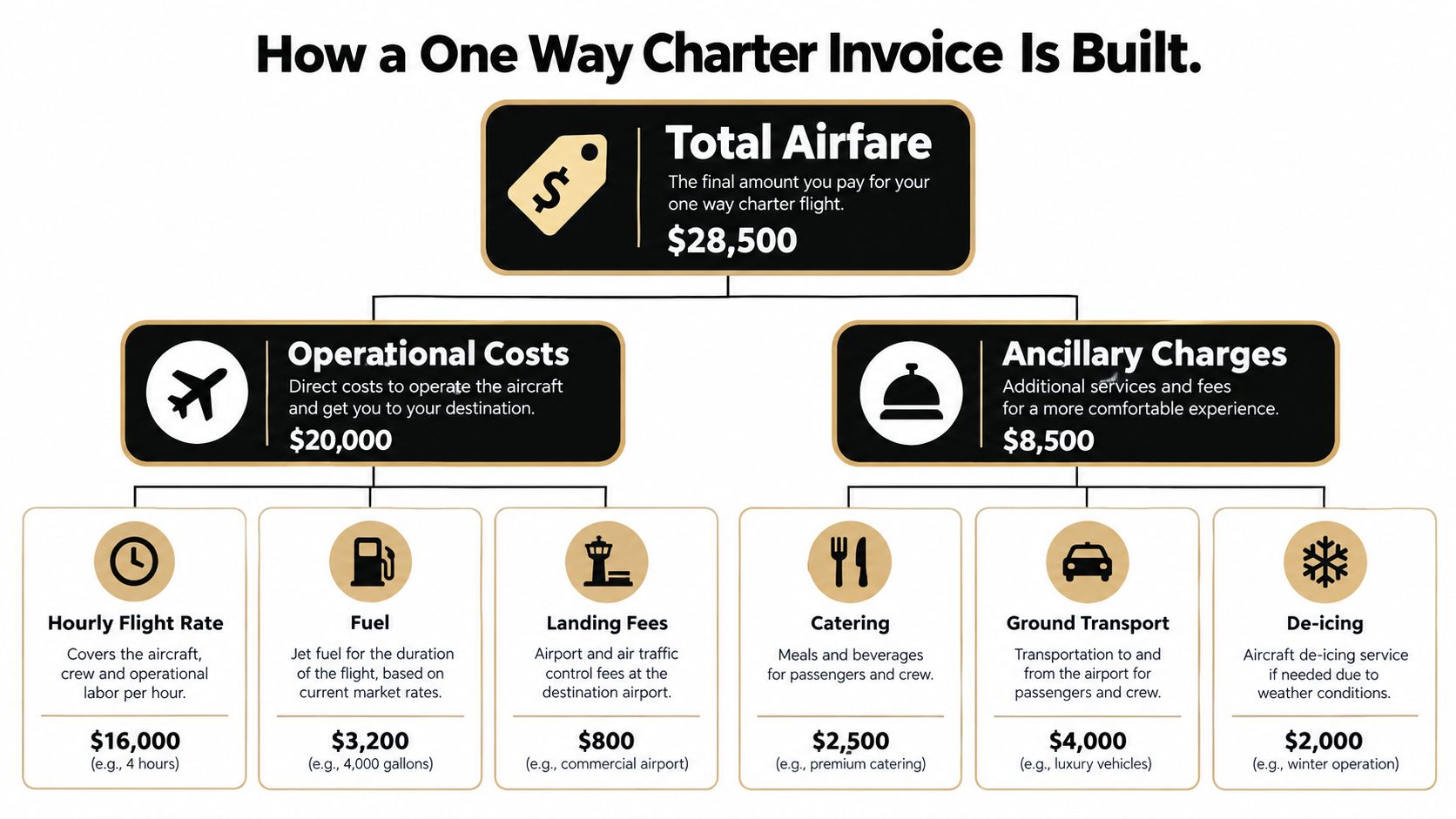
The distinction between included and excluded matters more than the headline rate. Crew and standard fuel may be included in the base aircraft rate, while landing fees, catering, taxes, repositioning, and overnight costs may sit outside it. The final quote should define those assumptions in writing.
For a broader reference on the cost structure, review Haute Jets' private jet charter cost guide. Then ask the provider to present the number as an all-in total, not just an attractive hourly starting point.
Why Repositioning Changes the Final Number
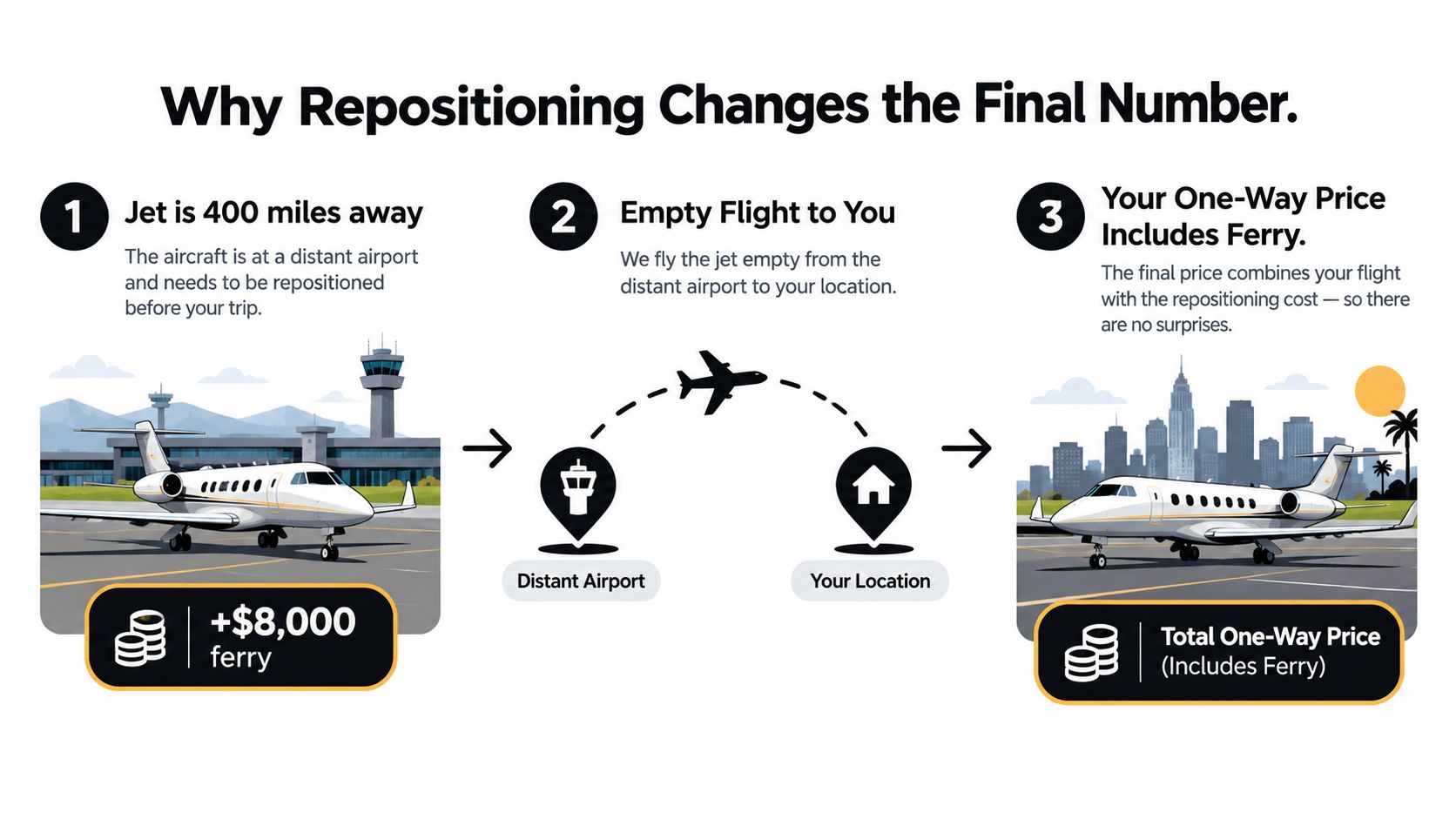
You find a jet with a lower hourly rate, approve the quote, and then the invoice jumps because the aircraft is sitting 400 miles from your departure airport. That is where one-way pricing gets distorted. The true question is not “What is the hourly rate?” It is “How close is the airplane, and how clearly is the ferry time shown?”
If the jet is not already near you, the operator has to move it empty to pick you up, and may have to move it empty again after drop-off. Those legs are part of the trip economics even though you never sit in the cabin. They still burn fuel, use crew duty time, create maintenance exposure, and trigger airport costs.
The cost of a distant aircraft
Published charter guidance puts positioning, landing charges, and seasonal surcharges in the broader range of 20%–40% of base charter rates, depending on aircraft availability, airports, and whether the operator can sell a follow-on leg (aircraft positioning cost guidance). The same guidance also notes that broader trip structures can run 30%–60% of the round-trip equivalent. In practice, expect the smaller figure on simple domestic sectors and the larger one when the aircraft must ferry a long distance or overnight with crew.
The worked example is what makes this real. A 90-minute empty positioning flight on a midsize jet priced at $7,000 per flight hour adds approximately $10,500 before your passenger leg even starts (repositioning and invoice guidance). That extra cost can wipe out the apparent savings from a lower advertised hourly rate.
A $5,000-per-hour aircraft that needs a long ferry can easily cost more than a $7,000-per-hour aircraft already close to your departure airport.
Ask every broker or operator three direct questions:
- Where is the aircraft based before my flight?
- How many empty positioning hours are included in the quote?
- Where will the aircraft go after dropping me off?
If they cannot answer those cleanly, the quote is not transparent enough. A nearby aircraft can remove paid ferry time. An operator with a floating fleet may also avoid sending the jet back to a fixed base, especially on busy routes. Compare quotes on the same all-in basis and ignore headline hourly rates until repositioning is spelled out.
For a plain-language breakdown of what a private-jet repositioning fee covers, review the charge itself before accepting any one-way quote.
Typical One Way Prices by Aircraft Category
Category still matters, but not in the way many first-time buyers assume. The wrong comparison is hourly rate versus hourly rate. The right comparison is all-in mission cost on an aircraft that is already close to you and sized correctly for the trip.
A jet with a higher hourly rate can still be the cheaper one-way option if it is nearby, fits the route cleanly, and avoids extra ferry flying. A cheaper-looking aircraft in the wrong category often loses money fast once minimums, airport charges, and operating constraints show up on the quote.
| Category | Hourly Rate (USD) | Typical Seats | Indicative Short One-Way |
|---|---|---|---|
| Turboprop | $1,500–$3,500 | Varies by aircraft | Miami to the Bahamas, approximately $3,500–$7,000 |
| Very light jet | $2,500–$3,500 | 3–4 | Miami to the Bahamas or similar sub-300-mile sectors, approximately $5,000–$9,000 |
| Light jet | $3,000–$4,500 | 5–7 | Miami to New York, approximately $12,000–$18,000 |
| Midsize jet | $4,000–$6,000 | 7–9 | Longer domestic sectors with more cabin and baggage space |
| Super-midsize jet | $5,500–$8,000 | 8–10 | Long domestic or international sectors requiring greater range |
| Heavy jet | $8,000–$14,000 | 10–14 | Transatlantic missions that can exceed $100,000 |
| Ultra-long-range | $10,000–$18,000 | 12–19 | Transatlantic and intercontinental missions that can exceed $100,000 |
Use those ranges as planning numbers, not quote promises. The final invoice still moves with aircraft location, schedule, airport fees, taxes, and availability.
The route examples make the point clearly. Haute Jets lists a Miami to New York light-jet estimate of approximately $12,000–$18,000 one way, and a turboprop example for Miami to the Bahamas at approximately $3,500–$7,000 (Haute Jets aircraft-class and route examples). Those are useful reference points because they connect aircraft class to real mission types instead of treating category as a status choice.
Choose for the route, not the image
For a short regional hop, a turboprop may be the smarter buy if the airports and passenger load suit it. A very light jet works on short sectors when you want jet speed and the cabin limits are acceptable. Light jets cover many domestic city pairs well. Midsize and super-midsize aircraft start to make sense when the mission needs more range, a larger baggage hold, or better cabin comfort for a longer leg.
Heavy and ultra-long-range jets earn their keep on long flights. On short domestic sectors, they often just add cost.
Passenger count matters because the charter price is spread across the group, but seat count alone is a bad buying rule. Range, runway limits, baggage volume, weather capability, and whether the trip can operate nonstop matter more than the brochure category.
My recommendation is simple: book the smallest aircraft that can complete the trip safely, comfortably, and nonstop, then compare quotes based on where that aircraft is coming from. That is how you control a one-way bill.
One Way Versus Round Trip and Empty Legs
A one-way charter isn't automatically more expensive than a round trip, and a round trip isn't automatically the bargain. The deciding factor is what the aircraft and crew must do between your outbound and return movements.
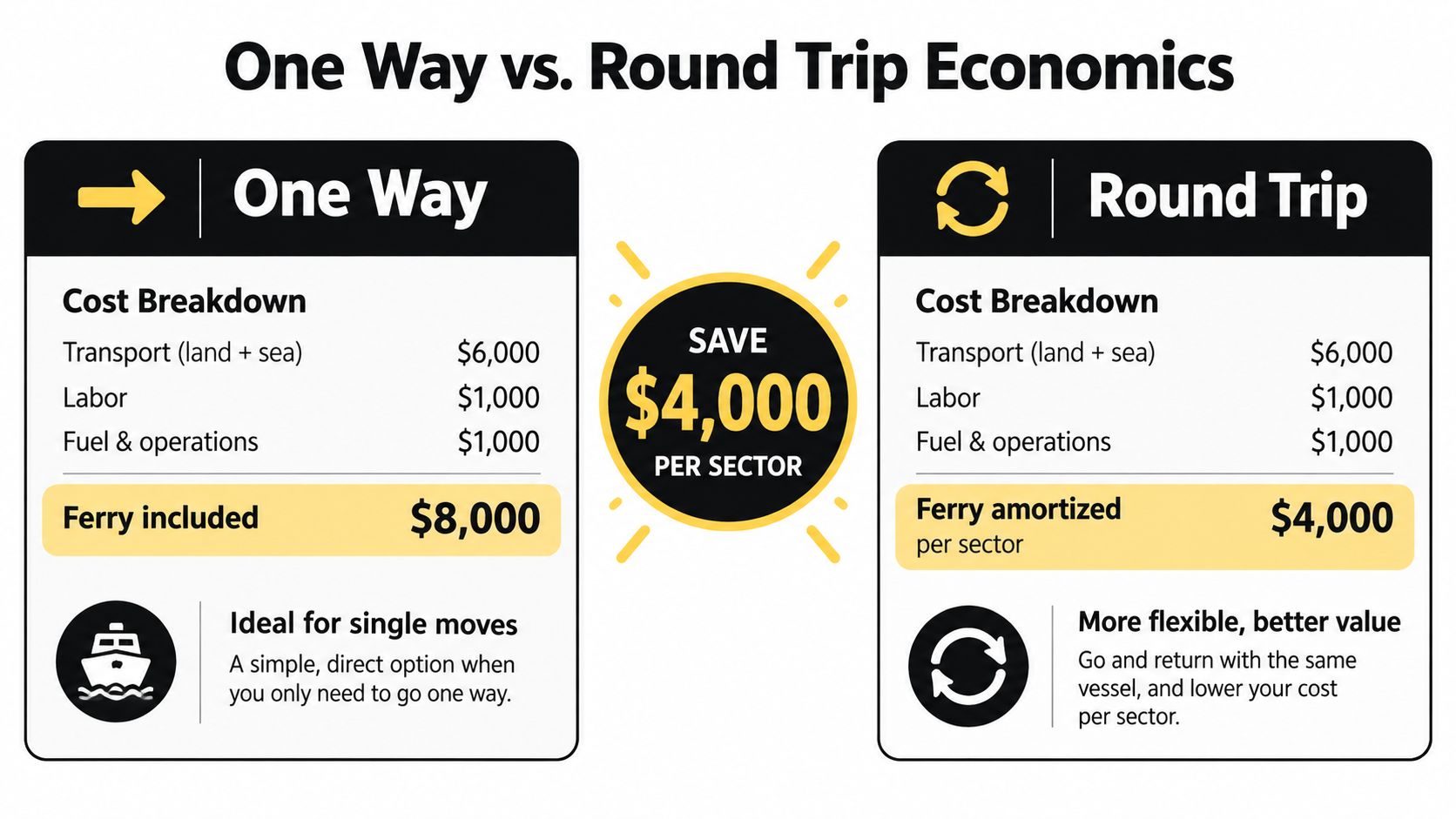
A round trip gives the operator two paid passenger sectors and may let the aircraft remain at the destination instead of flying home empty. The operator can spread positioning and crew logistics across the itinerary. If you're returning soon, that structure often makes sense.
A one-way trip is different. The operator may need to bring the aircraft to you, then find another assignment from the destination or return the jet to its base. That's why a one-way booking can approach the cost of a round trip when the aircraft is poorly positioned. Published industry reporting places one-way positioning in some structures at roughly 30%–60% of the round-trip-equivalent cost, with the result varying by route, aircraft location, and schedule (one-way fleet and repositioning economics).
Which structure fits your trip
- Round trip: Usually the cleaner choice when your return timing is predictable and the jet can wait for you.
- One way: Makes sense for an asymmetric itinerary, relocation, corporate travel with a different return plan, or a route where a nearby aircraft is available.
- Empty leg: Works for travelers who can accept a fixed route and flexible timing. An empty leg is an aircraft repositioning flight that the operator is trying to fill at a discount.
An empty leg can be attractive because the operator already expects to move the aircraft. You're helping monetize a sector that would otherwise carry no passengers. The trade-off is control. Departure times, aircraft availability, route changes, and cancellation risk can make an empty leg unsuitable for a time-critical meeting or event.
The best booking process prices the same itinerary three ways: one-way, round trip, and empty-leg availability. Don't assume a discounted empty leg is available when you need it, and don't assume a one-way must be inefficient. A floating fleet or a jet already near the origin can make the one-way structure competitive.
For available repositioning opportunities, review Haute Jets empty-leg flights, then compare any offer against a firm on-demand quote with matching airports, passenger count, and service inclusions.
Hidden Line Items That Quietly Raise the Invoice
The invoice usually becomes expensive through ordinary charges, not mysterious ones. The problem starts when a provider shows a base aircraft figure without defining which predictable costs remain outside it.
For a U.S. domestic trip, ask where the 7.5% federal excise tax appears. The quote should also identify any applicable passenger or segment charges. International travel can add permits, customs coordination, handling, and jurisdiction-specific taxes.
Demand these answers before paying
- Positioning: Are empty ferry sectors included in the total, and how many billable hours do they add?
- Minimum billing: What daily minimum applies if the passenger flight is shorter than the operator's minimum block?
- Landing and handling: Which departure and arrival airport charges are included?
- Crew overnight: Will the crew stay at the destination, and are accommodation costs included?
- De-icing: Could weather create a separate charge before departure?
- Catering: Is standard catering included, or does a premium menu create an additional charge?
- Permits and international handling: Are these already priced for cross-border travel?
- Ground transport: Is the vehicle service included or arranged separately?
- Cancellation: At what point does the booking become non-refundable or subject to a fee?
A published private-jet cost guide identifies federal excise tax, repositioning, daily minimums, overnight crew fees, catering, fuel surcharges, and international handling as items that can sit behind the headline estimate (private-jet cost component guide).
Two apparently similar quotes can therefore differ because one includes taxes and handling while the other only displays aircraft time. Never approve a quote that doesn't separate the aircraft cost from ancillary charges. You don't need every amount to be fixed in advance, but you do need to know what is included, what is estimated, and what can change if weather or routing changes.
How to Find True One Way Value
Start with the departure airport, not the aircraft photo. Ask the provider to search for aircraft already near your origin, including suitable secondary airports. A nearby aircraft can remove paid ferry time and may beat a lower-rate jet based far away.
Then request an itemized quote with these fields:
- Exact aircraft and configuration: Include the make, model, year, cabin layout, and passenger capacity.
- Aircraft location: Name the current base or airport and identify every empty positioning sector.
- Billable hours: Separate passenger flight time, taxi or block assumptions, and minimum daily hours.
- Trip charges: Show landing, handling, permits, catering, de-icing, and crew overnight assumptions.
- Taxes: State the domestic or international tax treatment and whether it's already included.
- Operating details: Confirm the operator, crew, tail number when available, safety credentials, and cancellation terms.
Compare at least three offers only after standardizing the inputs. The same departure airport, arrival airport, date, passenger count, luggage requirement, catering request, and aircraft capability must appear on each quote. Otherwise, you're comparing different products disguised as similar prices.
Ask whether the provider operates a floating fleet, can place the aircraft on a paid return sector, or can source from an owner-operator close to your departure city. Ask for one-way specials on underserved routes too. A provider may find a practical repositioning match that a conventional quote misses.
Haute Jets sources aircraft from owner-operators near the departure city and states that local sourcing can eliminate repositioning fees that inflate charter prices by 20%–40% with traditional brokers and jet card programs (Haute Jets local-sourcing model). That's one option to evaluate, not a substitute for comparing the actual aircraft and all-in invoice.
The right one-way charter isn't the quote with the lowest hourly rate. It's the quote that exposes the aircraft's real movement, operating assumptions, taxes, and fees, then gives you a suitable aircraft at the lowest transparent total.
Haute Jets connects travelers with on-demand aircraft sourced from owner-operators across a broad international network, with options ranging from short-hop turboprops to ultra-long-range cabins. If you want a route-specific one-way quote that accounts for aircraft proximity and itemized costs, visit Haute Jets and request a comparison for your departure city, destination, dates, and passenger count.