Private jet cost hire typically ranges from roughly $2,600 to $13,000 per flight hour depending on aircraft category, and a five-hour light-jet trip commonly lands between $15,000 and $27,500 in aircraft time alone before repositioning and fees. The glossy advice that starts and ends with a headline hourly rate is incomplete, because the invoice is built from positioning, fuel, landing and handling, crew, and tax.
The right way to price a charter is to reverse-engineer the bill, not admire the brochure. Two identical city pairs can land wildly apart because the aircraft's home base, the route structure, and the operator's fee stack matter more than the headline rate sheet ever admits.
Why the Hourly Rate Misleads
The hourly rate is the easiest number to quote, and the least useful number to trust. Private jet cost hire is a layered invoice, and the base rate is only the first line item. Real pricing starts once you add the rest of the trip economics.
Aircraft time is only the beginning. Fuel surcharges, landing and handling fees, crew expenses, overnight costs, daily minimums, and the 7.5% U.S. federal excise tax can push the final invoice far above the headline rate. On a one-day round trip, the aircraft rate may account for only about 55–65% of the total payment, which is why the private jet cost per hour guide is useful only as a starting point, not a buying guide.
Read the quote as a stack of charges
A cheap-looking quote can still be expensive if the aircraft is based far from you. That is the first thing to check, before cabin photos or polished sales copy.
Practical rule: If a quote does not show aircraft type, estimated flight time, minimum billable hours, taxes, operational fees, and whether repositioning is included, it is not a serious quote.
For a clean benchmark, use the published private jet charter cost framework and ignore any pitch that starts with a single “from” number.
The pattern is familiar in other transport categories. Vehicle shipping quotes often look tidy until routing, handling, and access costs are added, and private aviation works the same way. A rate sheet that ignores positioning is brochure math, not invoice math.
The Core Factors That Determine Private Jet Cost Hire
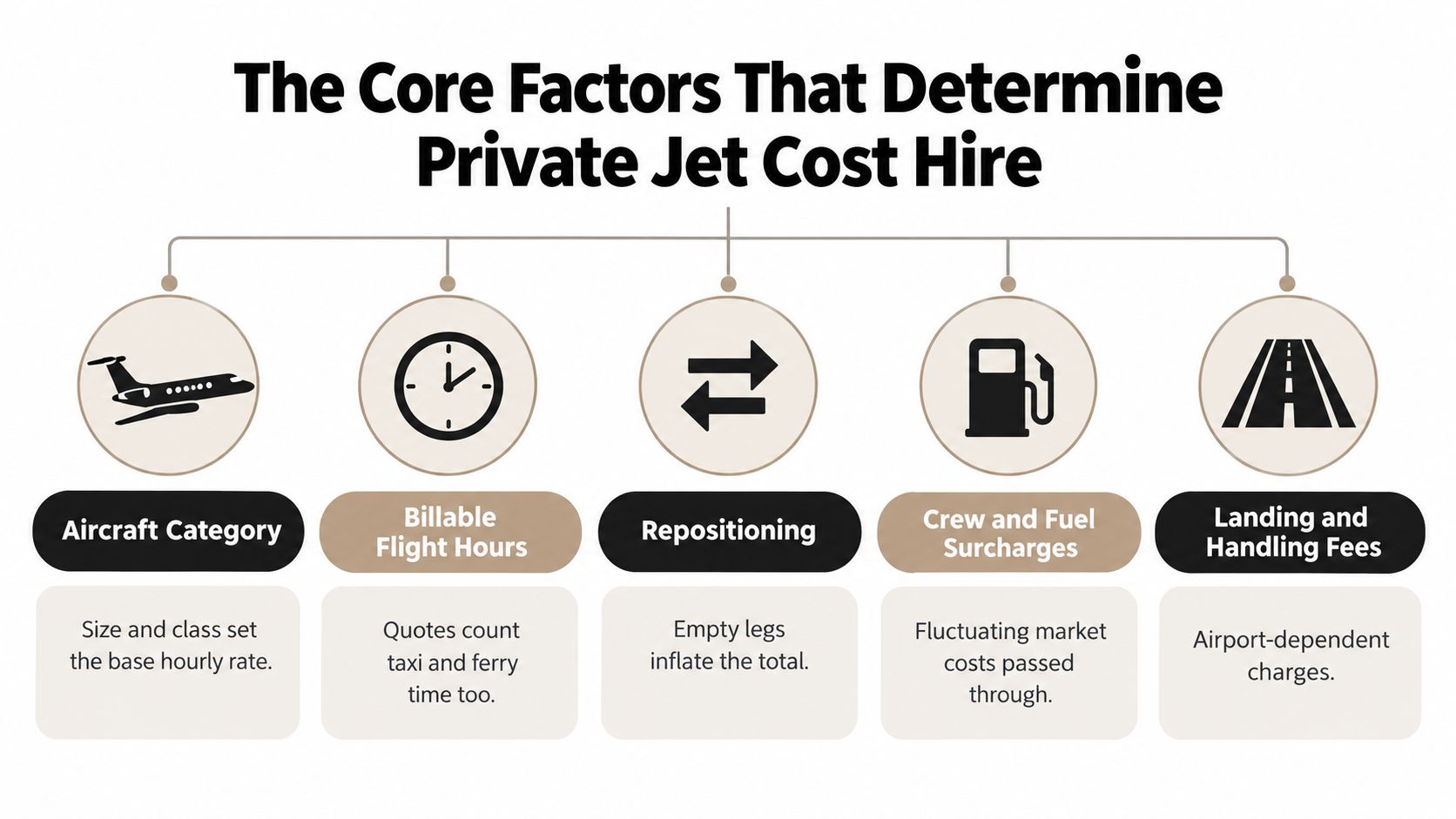
There are five drivers on every charter quote, but they do not carry equal weight. Aircraft category and where the aircraft is sitting usually move the total most. Billable time, fees, taxes, and timing come after that.
Rank the drivers before you request quotes
Start with the aircraft. If you ask for more cabin than the mission needs, you pay for it in every line of the invoice.
Then check the clock. Operators bill more than cruise time, and short hops make taxi and ferry time look expensive fast.
Repositioning is where glossy rate sheets fall apart. If the aircraft has to fly empty to reach you, that movement sits on your tab, even when the headline hourly rate looks clean. The guide to pet travel costs shows the same basic pattern in another premium service, route and handling change the bill more than the brochure suggests.
Build your budget around the actual line items
Fees and taxes come next. Landing, handling, crew, overnight, and de-icing are routine additions on many trips, not exceptions. Busy dates make it worse because nearby aircraft get scarce and operators protect availability. For a useful benchmark, use a private jet charter cost framework that shows the full trip economics instead of a single “from” number.
The cleanest quote is the one that shows aircraft type, estimated flight time, minimum billable hours, taxes, operational fees, and repositioning up front. If those pieces are missing, the quote is cosmetic.
Do not let a rate card distract you. The invoice is built from aircraft choice, location, and added charges, not from the first number a broker puts in bold.
Aircraft Categories and Hourly Rate Ranges
The aircraft choice sets the floor for the invoice. Pick too much cabin or too much range, and you pay for empty seats, heavier fuel burn, and higher operating costs you never use.
| Category | Hourly Rate (USD) | Typical Range | Best For |
|---|---|---|---|
| Turboprop | About $1,200 to $3,500 | Short regional missions | Short hops, runway-sensitive airports |
| Light jet | About $2,600 to $3,500 | Smaller cabin, lower trip spend | Two- to four-hour point-to-point trips |
| Midsize jet | About $3,373 to $8,000 | Flexible cabin and range | Coast-to-coast domestic trips |
| Super-midsize jet | About $5,238 and up | More range and comfort | Longer nonstop domestic missions |
| Heavy jet | About $8,000 to $13,000 | Larger cabin, higher operating cost | Full teams, longer sectors, more baggage |
| Ultra-long-range | Over $20,000 possible | Top-end long-haul aircraft | Transatlantic and high-comfort missions |
A light jet makes sense for short business trips where speed matters more than cabin width. A midsize jet is the cleaner buy when you need room without paying heavy-jet economics. The direct operating cost model and Haute Jets Journal pricing ranges both point in the same direction, the price steps up fast as the aircraft gets larger and more capable.
Buy the smallest aircraft that still fits the mission
That rule saves money because the cost stack changes with the airframe. Fuel burn, maintenance reserves, cabin size, and range all push the quote higher as you move up the category ladder.
Use the smallest aircraft that still covers the trip cleanly. A light jet is enough for short, direct missions. A super-midsize or heavy jet only makes sense when the route, passenger count, baggage, or nonstop requirement justifies the jump.
The same logic applies to how much vehicle shipping costs. Route, size, and handling determine the invoice, not the headline service.
How Repositioning Doubles Some Quotes
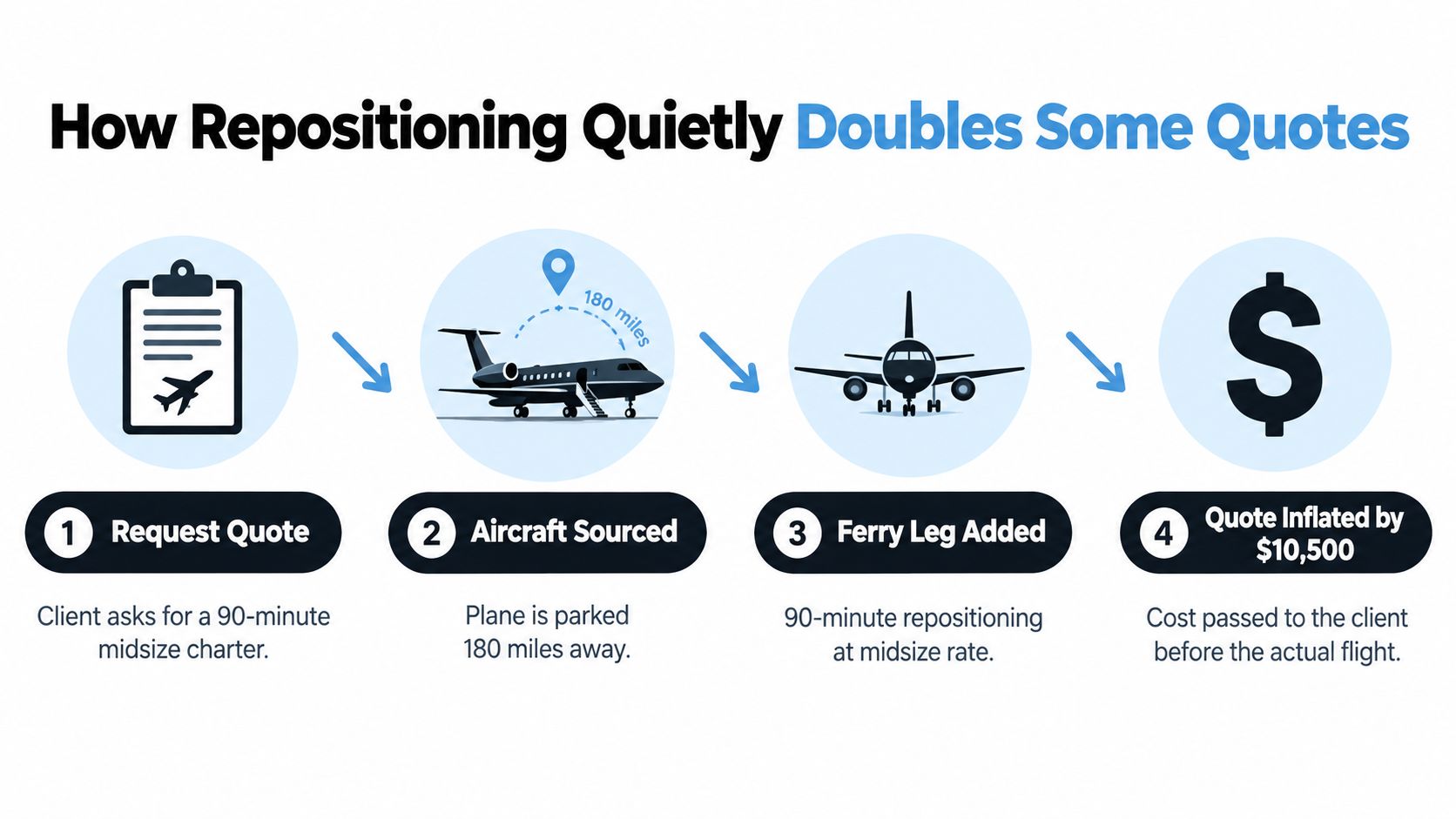
Positioning is the hidden line item that wrecks cheap-looking charter offers. If the aircraft is not already near your departure airport, you pay for its empty move before your flight even starts.
Why one-way itineraries get hit hardest
A 90-minute positioning leg on a midsize jet priced at $7,000 per hour adds roughly $10,500 before the passenger flight even begins (repositioning quote example). That is how the same route can look reasonable in one quote and brutal in another.
If the aircraft has to move to you, operators often bill that relocation at the same hourly rate. If the trip ends away from base, the return move can land on your invoice too. Multi-day trips can also stack crew expenses and an aircraft-away fee on top.
Any quote that hides the aircraft's home base is a teaser.
Domestic and international pain points are different
Inside the U.S., positioning can add about 20–30% when it is needed, and total extra fees can run about 25–40%. International trips usually climb higher because permits, customs handling, and extra crew or duty costs get layered in.
The fix is simple. Ask where the aircraft is based, whether it is already nearby, and whether the quote includes every empty sector. If the operator can source a local aircraft, the gap between quotes narrows fast.
Reading a Real Charter Quote Line by Line
A real quote should be auditable line by line. If it isn't, you're being asked to trust a number that may not survive the final invoice.
Take a New York to Miami round trip. A transparent all-in structure on one side and a low base-rate estimate on the other can differ by $8,000 because the cheap-looking version leaves out the repositioning sector, taxes, and fees (worked charter cost example).
Ask for the invoice, not the sales pitch
Your quote needs to show the aircraft hourly rate, billable time, fuel surcharge, landing and handling, crew expenses, overnight charges, repositioning sectors, and taxes. If those items aren't broken out, the broker is making it harder for you to compare actual value.
Use this audit order:
- Base aircraft charge, confirm the category and the hourly rate.
- Billable time, check whether taxi or ferry time is included.
- Positioning sector, ask where the aircraft is coming from.
- Fees and taxes, confirm landing, handling, crew, overnight, and tax treatment.
- Add-ons, ask about de-icing, catering, hangar, and international permits.
A lot of glossy pricing sheets hide this structure behind pretty aircraft photos. You want the mechanics, not the marketing.
Spot the missing costs quickly
A quote that seems lower may be less honest. The strongest tell is when the broker gives you a base rate but avoids naming the empty leg, overnight, or permit exposure.
If you're comparing offers across vendors, insist on the same format from each one. That makes the route cost, not the sales language, do the talking.
Memberships, Jet Cards, and Why You Probably Don't Need Them
Jet cards and membership programs are built for frequency, not for value. If you fly only a handful of times a year, prepaying for convenience usually costs more than paying per trip.
Traditional brokers and jet card programs often push repositioning costs onto the client, and that is where many inflated quotes start. A sourcing network that finds aircraft near the departure city avoids the empty-sector pass-through that often drives the higher quote ranges discussed earlier.
Pay per flight unless you're flying constantly
If you value locked-in availability and you fly often, a membership can make sense. If your goal is lower invoice cost and flexible aircraft choice, per-flight pricing usually wins.
Under roughly ten flight hours per year, per-flight pricing is the better cost move. Above that, compare the guaranteed-availability premium against your real schedule instead of the brochure promise.
For clients who want the numbers laid out plainly, this membership cost guide is the right place to compare the trade-offs.
Safety doesn't change with the pricing model
No matter how you buy, the operator still needs strong safety standards. Look for Wyvern Wingman or Argus Gold/Platinum ratings, because a prepaid program does not cover weak operator vetting.
Haute Jets says it sources from 3,500+ owner-operators across 175 countries and focuses on aircraft based near the departure city to avoid repositioning waste. Local sourcing is what removes that pass-through cost, because an aircraft already based near the departure city has no empty sector to bill.
That sourcing logic matters more than a glossy card program.
Empty Legs, Aircraft Size, and the Emissions Trade-Off
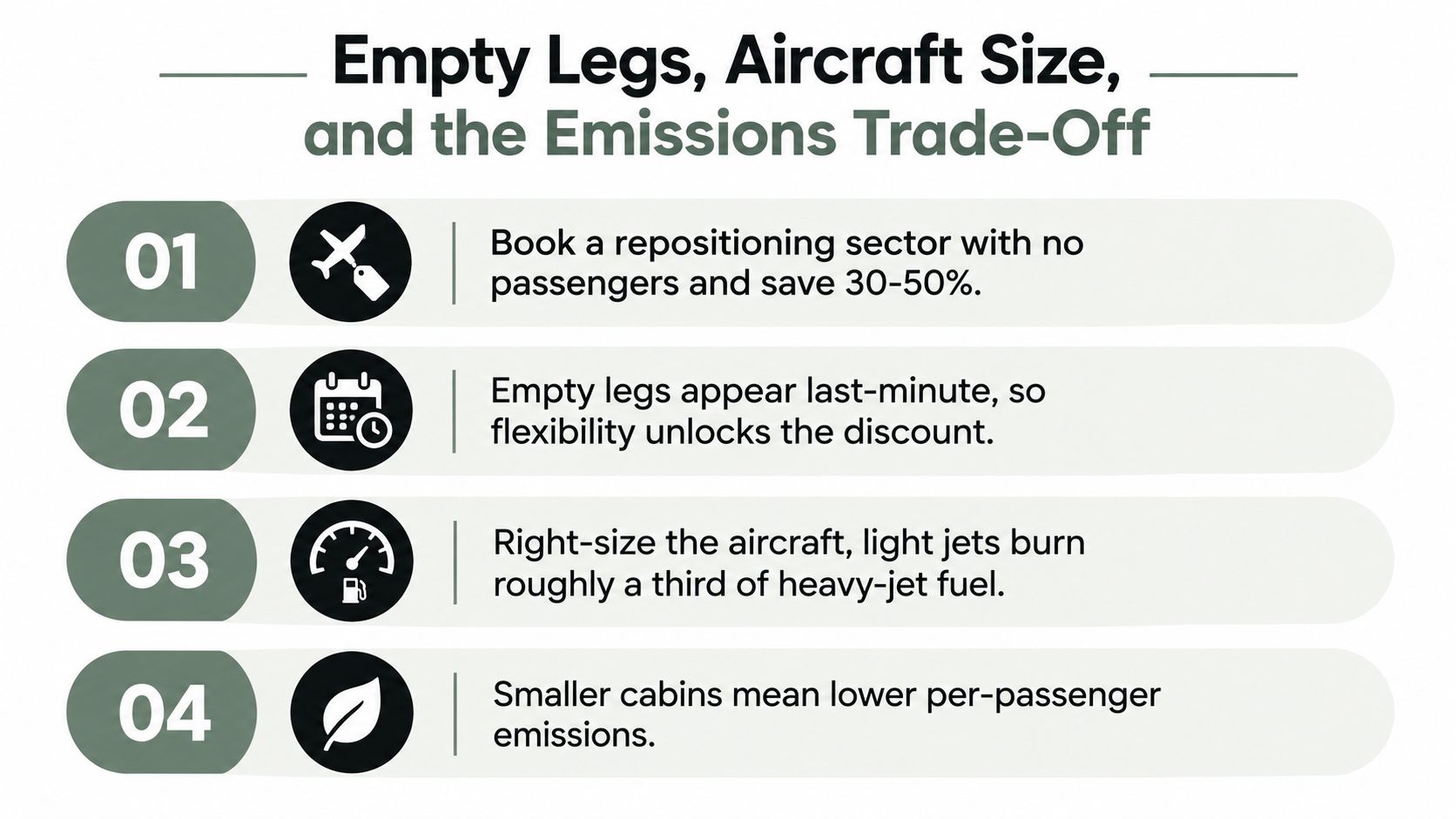
Empty legs are the cleanest way to get a real discount if your schedule is flexible. They happen when a plane has to move without passengers, and operators often price those sectors far below standard charter rates.
Discounted positioning can be a smart buy
Haute Jets Journal estimates that 30% to 50% of privately chartered flights operate as empty legs, and those sectors can sell at up to 75% below standard charter pricing (empty-leg pricing guide). The Miami to Charleston turboprop example shows how dramatic the gap can be, though you give up flexibility.
Flexible travelers should treat empty legs as opportunistic inventory, not a guaranteed product. If your timing can move, the savings can be meaningful.
Size affects both price and emissions
Aircraft selection also changes the emissions conversation. Research cited in the brief puts direct private aviation CO₂ at 15.6 million tonnes in 2023, with emissions rising 46% between 2019 and 2023, and links that footprint to 25,993 private aircraft and more than 18.6 million flights (private aviation emissions analysis).
A smaller jet usually burns less fuel, but a larger cabin can still be the rational choice for a full team or a multi-city itinerary. The smart question isn't “Which jet is smallest?” It's “Which jet completes the mission with the fewest empty seats and the least deadhead waste?”
Your Quote Audit Checklist Before You Book
A charter quote deserves the same scrutiny you'd give any serious procurement decision. If you want the actual price, ask the provider to show you the whole structure.
Use this checklist every time
- Confirm the exact aircraft: Ask for the category, year, make, model, and tail number if available.
- Verify the home base: If the aircraft isn't near your departure city, expect positioning to matter.
- Request minimum billable hours: Short trips can get distorted by minimums.
- Break out repositioning: Separate the ferry leg from passenger flight time.
- List every fee and tax: Landing, handling, crew, overnight, catering, and tax treatment should all appear.
- Check operator safety ratings: Look for Wyvern Wingman or Argus Gold/Platinum.
- Read cancellation terms carefully: Last-minute changes can create new charges.
- Compare two structures side by side: Base rate only, and fully loaded all-in price.
If a broker won't put these items in writing, walk. That's not a pricing strategy, it's a warning sign.
Haute Jets applies the sourcing logic that matters most here, aircraft near the departure city, no membership drag, and per-flight pricing tied to the actual jet you're booking. If you want a cleaner quote process and a harder look at the actual invoice, visit Haute Jets and ask for a charter comparison built around the trip, not the brochure.