
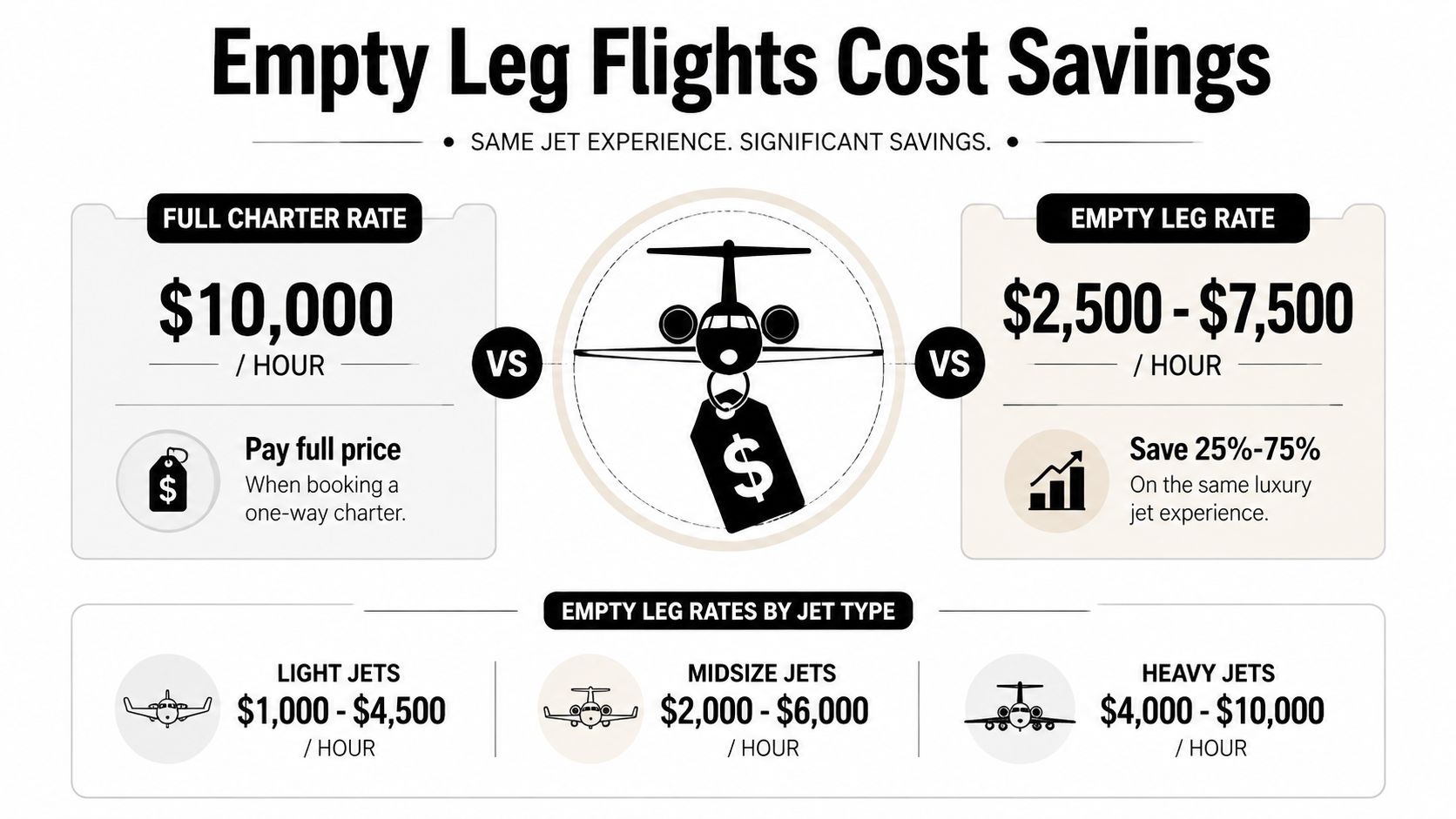
Empty leg flights typically cost 25% to 75% less than the equivalent full charter, with a light jet often priced at roughly $1,000 to $4,500 per flight hour versus $2,000 to $6,000 for standard charter. That discount can narrow once fees, taxes, and repositioning expenses add 10% to 20% to the base price.
The important distinction is that an empty leg is a discounted private flight, not a commercial-style bargain seat. You're buying the entire aircraft, accepting the operator's route and schedule, and taking on more uncertainty in exchange for a lower price.
The most useful way to judge an offer is to compare the all-in price for the same aircraft and route, not the percentage shown in a listing. A light jet at $3,000 per hour may be excellent value on a convenient route, while a cheaper quote can become poor value if it requires costly ground transfers, excludes handling, or leaves you stranded without a practical return.
What Empty Leg Flights Really Cost
Empty legs are typically priced at 25% to 75% below the equivalent full charter rate on the same aircraft and route, according to SkyAccess's 2026 empty-leg market pricing. The discount exists because the aircraft already needs to fly that sector for operational reasons. The operator would rather collect partial revenue than move the aircraft without passengers.
For light jets, the practical comparison is clear. Empty-leg listings commonly fall around $1,000 to $4,500 per flight hour, compared with $2,000 to $6,000 for standard charter. Midsize jets commonly run $2,000 to $6,000 per hour as empty legs versus $4,000 to $8,000 for regular charter, while heavy jets can cost $3,500 to $9,750 per hour versus $7,000 to $13,000.
Broker's rule: Compare the quoted empty leg with a standard charter for the same aircraft, airports, departure window, and service level. Comparing unlike flights produces meaningless savings claims.
Hourly rates don't tell the whole story
A flight-hour rate is only a starting point. The final invoice can reflect airport handling, landing charges, parking, taxes, catering, and weather-related services. On longer missions, aircraft category and total flight time matter more than the headline hourly figure.
Empty legs also rarely fit a rigid itinerary. You may find a highly attractive price, but only if you can use the fixed route and departure window already created by another client's charter. If you need a specific time, airport, return, or guarantee against schedule changes, a standard on-demand charter may be the more rational purchase.
The practical answer to “what do empty leg flights cost?” is therefore two-part: expect a substantial reduction against a comparable charter, but budget for a premium whole-aircraft experience with operational conditions attached. The discount is real. It rewards flexibility rather than eliminating the cost of private aviation.
Why Empty Legs Exist and How They Are Priced
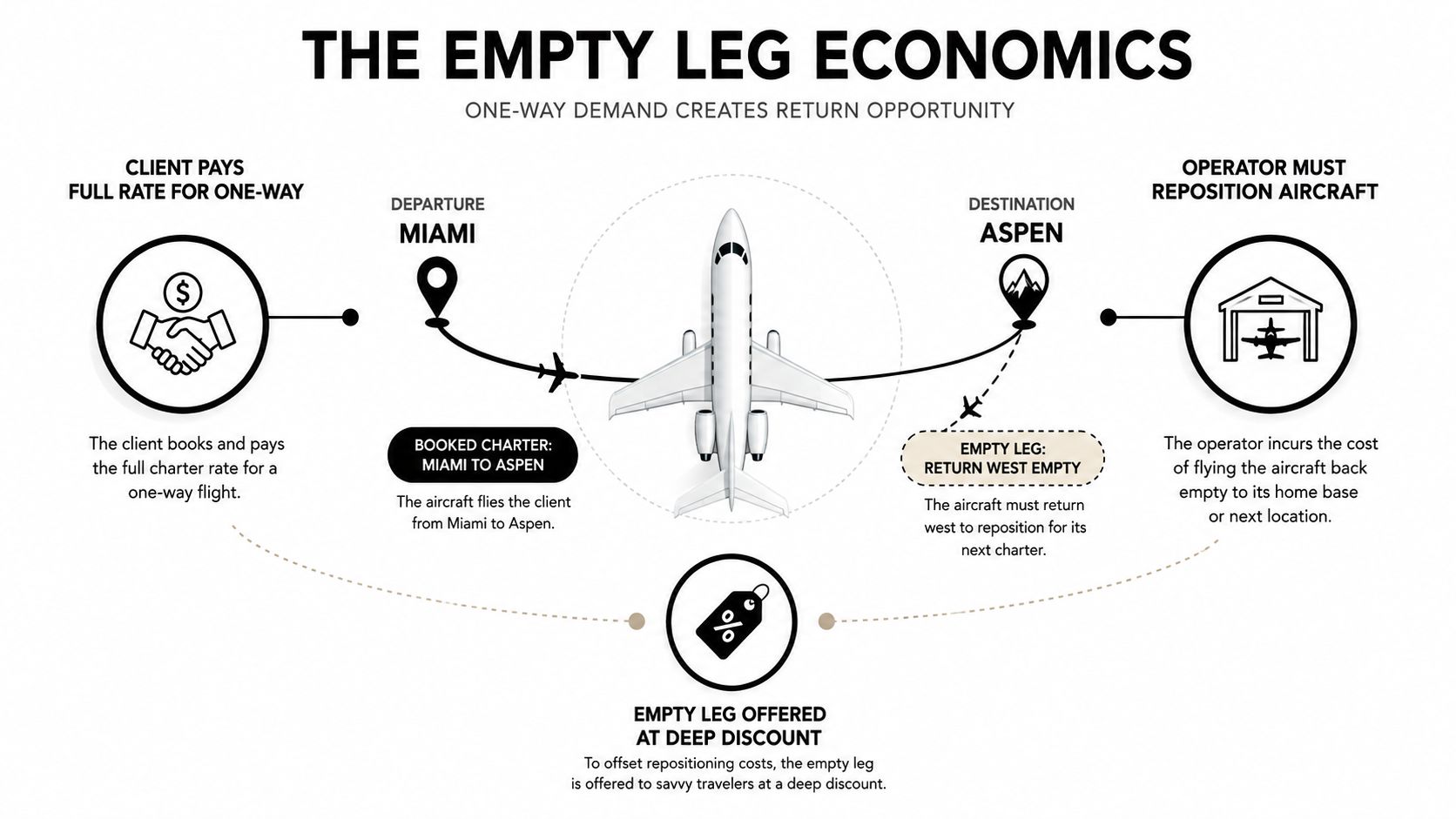
An empty leg is the sector an aircraft flies without the original charter passengers. Suppose a client books Miami to Aspen. After dropping that client in Aspen, the aircraft may need to return west or reposition toward its next assignment. That return is an empty leg if the operator offers it to another customer.
The aircraft's movement was already required, so the operator isn't creating a completely new mission for the empty-leg passenger. Any revenue from the additional booking can help offset the cost of a sector that might otherwise carry no passengers. That's why the same aircraft can receive very different quotes depending on its route, timing, and current demand, as explained in this empty-leg pricing guide.
A simple analogy is a taxi returning to its base after dropping off a passenger. The taxi still has to make the trip. A rider who can use that exact return journey may pay less, but the rider can't dictate the destination or departure time.
Three variables determine the quote
Route comes first. An aircraft repositioning between airports that suit your plans creates a genuine opportunity. If you need a detour, a different airport, or a new destination, the operator may need to treat the flight as a custom charter instead.
Aircraft category controls the underlying operating economics. A turboprop, light jet, midsize jet, and ultra-long-range aircraft carry different costs and capabilities. The discounted percentage doesn't make a large aircraft inexpensive in absolute terms.
Timing determines how urgently the operator needs to fill the sector. A leg approaching departure can become more attractive because the aircraft will fly whether or not passengers board. A leg identified earlier may have less pricing pressure if the route is commercially useful or demand is strong.
Travelers who want to understand the terminology in greater depth can review Haute Jets' guide to what an empty leg flight is. Once you understand the operational reason for the flight, the pricing becomes easier to evaluate. For the ground experience, it's also sensible to compare airport lounge options, especially when an empty leg uses a private terminal or an airport away from your usual commercial hub.
Real-World Empty Leg Prices by Aircraft Type
The most useful pricing benchmark is the whole-aircraft mission price, because empty legs are normally sold as private charters rather than individual airline seats. A 2026 guide places indicative empty-leg prices across the following aircraft categories, with the final quote determined by mission length, route, timing, and aircraft availability. The category figures are summarized in this private-aviation pricing guide.
| Aircraft Category | Typical Empty Leg Price | Discount vs Full Charter |
|---|---|---|
| Turboprop | $2,500 to $7,500 | Typically 25% to 75% lower |
| Light jet | $5,000 to $15,000 | Typically 25% to 75% lower |
| Midsize jet | $9,000 to $22,000 | Typically 25% to 75% lower |
| Super-midsize jet | $13,000 to $32,000 | Typically 25% to 75% lower |
| Heavy jet | $22,000 to $55,000 | Typically 25% to 75% lower |
| Ultra-long-range jet | $40,000 to $110,000+ | Typically 25% to 75% lower |
These figures work best as a screening tool. A short regional hop may fall around $1,500 to $5,000, while a heavy or ultra-long-range transcontinental empty leg commonly runs $20,000 to $45,000 for the whole aircraft, according to the same guide. The aircraft's range, cabin, crew requirements, and route length all influence where an offer lands inside the bracket.
How to bracket your own trip
Start with the mission, not the aircraft label. A short regional trip may be well suited to a turboprop or light jet, while a larger group or a longer sector may require a midsize, heavy, or ultra-long-range aircraft. Selecting more aircraft than the route requires can erase much of the value created by the empty-leg discount.
Then compare the quote against the alternative you'd take. On many routes, an empty leg can still rival or exceed a commercial business-class itinerary once you account for the whole aircraft price, taxes, fees, and the number of travelers. That doesn't make the flight poor value. It means the benefit is often privacy, airport access, time efficiency, and group convenience, not the lowest possible transport cost.
A low number deserves questions. Ask whether the price covers the complete aircraft, whether airport charges are included, and whether the quoted aircraft is confirmed or only being held as a potential repositioning option. A responsible quote should make those conditions clear before you pay.
The Hidden Costs That Shrink Your Discount
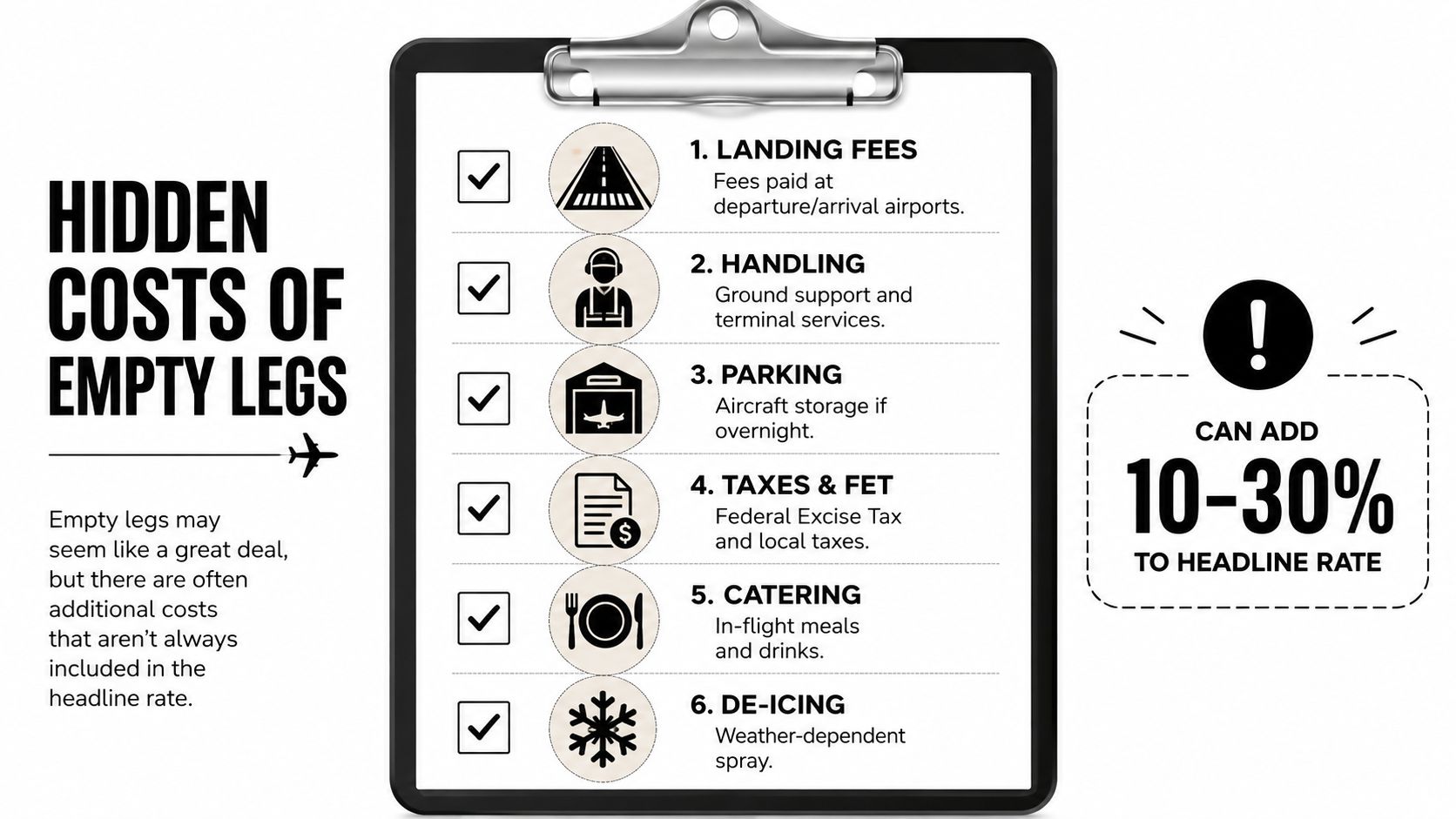
The advertised rate is rarely the complete financial picture. Landing charges, handling, parking, taxes, catering, and, in some cases, de-icing can sit above the base empty-leg price. A pricing guide notes that taxes, fees, and repositioning logistics can add 10% to 20% on top of the base price, which is why the apparent discount can shrink on the final invoice.
Operators also account for the aircraft's wider movement. If the jet must be ferried into position before serving your trip, repositioning can add roughly 30% to 100% to a normal charter invoice, according to SkyAccess's overview of empty-leg operating costs. The empty leg itself is discounted because the aircraft would otherwise fly that sector without passengers, but a separate ferry movement creates a different cost problem.
Ask for the all-in number
Before accepting a quote, ask these questions in writing:
- Airport charges: Are landing, handling, and parking included at both ends?
- Taxes: Which federal and local taxes appear on the invoice?
- Catering: Does the price include a standard service, or is catering separate?
- Weather services: Would de-icing or related winter operations create an additional charge?
- Positioning: Does the aircraft need an outbound or inbound ferry sector to operate your trip?
- Cancellation: What happens financially if the primary charter changes and your empty leg disappears?
The distinction between base rate and total cost matters more than a dramatic percentage on an advertisement. A quote that includes the relevant operating charges may be better than a lower headline price that adds every service later.
For a broader benchmark, review the private jet charter cost guide, then request an itemized comparison rather than relying on an hourly figure alone.
This video provides another visual explanation of the cost structure:
How to Book an Empty Leg at the Best Price
The strongest empty-leg deals go to travelers who can adapt quickly. You're not commissioning a flight from scratch. You're matching your plans to a sector an operator already needs to fly.
Use timing as a pricing lever
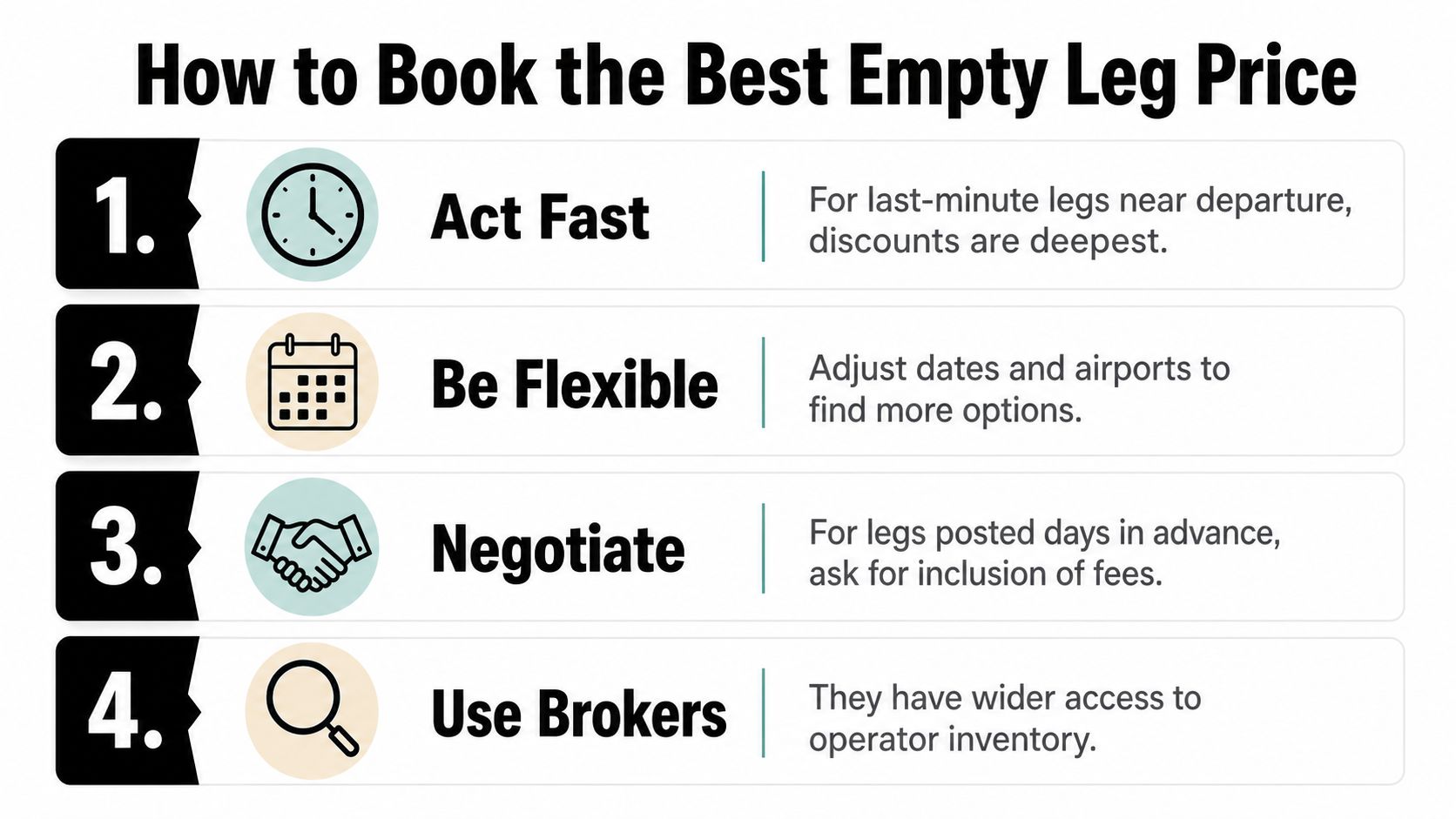
When a leg is close to departure, move decisively. Operators face greater pressure to fill an aircraft that's already scheduled to reposition, and the discount may widen as departure approaches. The trade-off is that you'll have less time to arrange ground transport, accommodation, and backup plans.
For a leg identified well before departure, ask whether the broker can improve the all-in terms. Fee inclusion may be more valuable than a nominal reduction in the base rate. Get the complete price before comparing offers.
Build the trip around the aircraft
Don't start with an immovable route and expect an empty leg to reproduce it. Start with a corridor you can use, then consider nearby departure airports, alternative arrival airports, and a broader travel window. An empty leg that requires a long transfer can be worse value than a slightly higher quote from a convenient airport.
A useful booking sequence looks like this:
- Set your essentials. Identify the latest acceptable arrival, passenger count, luggage needs, and aircraft minimum.
- Open the flexible variables. Consider nearby airports and a wider departure window before rejecting a viable sector.
- Request a complete quote. Confirm the aircraft, route, operating carrier, inclusions, and cancellation terms.
- Decide quickly when the fit is strong. A good empty leg can disappear when the surrounding charter changes or another traveler accepts it.
Use broad market access
Scanning one operator's listings limits your options. A broker with access to multiple operators can search for an aircraft already positioned near your departure airport rather than forcing an expensive ferry movement. Independent private-aviation coverage also places typical empty-leg discounts at 25% to 75% below equivalent standard charter rates, with the final result shaped by notice period, route, aircraft category, and booking handling, as described in this empty-leg discount guide.
The best recommendation is simple. Be flexible on the variables that don't affect your purpose, insist on an all-in price, and compare the offer with a standard charter before you commit.
Risks and Limitations of Empty Leg Travel
The low price exists because the flight wasn't created around your schedule. That constraint is the central risk, not a minor footnote.
An empty leg depends on another client's charter. If the original passenger changes the itinerary, delays the departure, or cancels the mission, the repositioning sector may change or vanish. You can lose the convenient flight even after planning your ground transport and accommodation around it.
The trade-off is operational control
You generally accept the route, airport pairing, and departure window already determined by the aircraft's movement. You may also face tighter cancellation terms than with a custom charter, depending on the operator and booking agreement.
Empty legs work well for flexible leisure travel, opportunistic weekend plans, and trips where arrival timing has room to move. They're a poor fit for a board meeting, court appearance, production call time, or any event where a missed arrival creates a serious business cost.
Decision rule: Book an empty leg when the savings justify the uncertainty. Book a standard charter when the meeting cannot move.
You should also evaluate the return before booking the outbound. An attractive one-way leg doesn't solve the trip if the return requires a full-price charter or an inconvenient alternative. Treat the itinerary as a complete travel plan, not as an isolated deal.
A careful broker should explain what happens if the surrounding charter changes, identify whether the aircraft is confirmed, and show the fallback options available. If those answers are vague, the price isn't yet clear enough to accept.
Finding Empty Legs With Haute Jets
Haute Jets sources from 3,500+ owner-operators across 175 countries, which gives its team access to a broad pool of repositioning sectors. Local aircraft sourcing is especially relevant to empty-leg pricing because an aircraft based near your departure city may avoid the additional repositioning movement that inflates charter prices by 20% to 40% with traditional brokers and jet card programs.
The company works with operators holding Wyvern Wingman or Argus Gold/Platinum ratings, and it offers on-demand booking without membership fees or jet cards. You can select the specific aircraft, then receive full pre-flight details, including the tail number, crew information, weather briefing, and passenger manifest, 24 hours before departure.
That model suits buyers who want the flexibility of an empty leg without relying on a single public listing. The useful question isn't whether every flight will be discounted. It's whether the broker can locate an aircraft that's already moving in the direction you need and show the total cost clearly.
Review the current Haute Jets empty-leg options with your route, acceptable airports, passenger count, and flexible dates ready. Ask for both the empty-leg quote and the comparable standard charter price so you can judge the actual saving.
Haute Jets connects travelers with repositioning opportunities across its owner-operator network, with exact-aircraft selection, safety-rated operators, and on-demand booking rather than a membership commitment. Visit Haute Jets to request an itemized empty-leg quote and see whether a current sector matches your route and schedule.