

The popular advice is wrong: you don't find an empty leg the way you find a cheap airline seat. You find it by fitting your trip into an aircraft's existing mission, then verifying that the operator can legally and reliably fly it. The discount is real, but so is the possibility that the flight disappears when the original charter changes.
That distinction separates a useful opportunity from an expensive travel mistake. Empty legs work for flexible travelers who can accept a fixed route, a narrow departure window, and short notice. They work poorly for weddings, executive meetings, international connections, and any itinerary where arriving late costs more than the aircraft savings.
What Empty Leg Flights Actually Are
An empty leg flight is a private aircraft's repositioning segment without the paying passengers from its primary charter. The jet may need to return after a one-way trip, move to another airport to collect its next customer, or ferry for an operational reason. The Federal Aviation Administration's safety notice distinguishes positioning flights from ordinary revenue flights and includes empty legs, maintenance ferry flights, and tail-end ferry operations in that category.
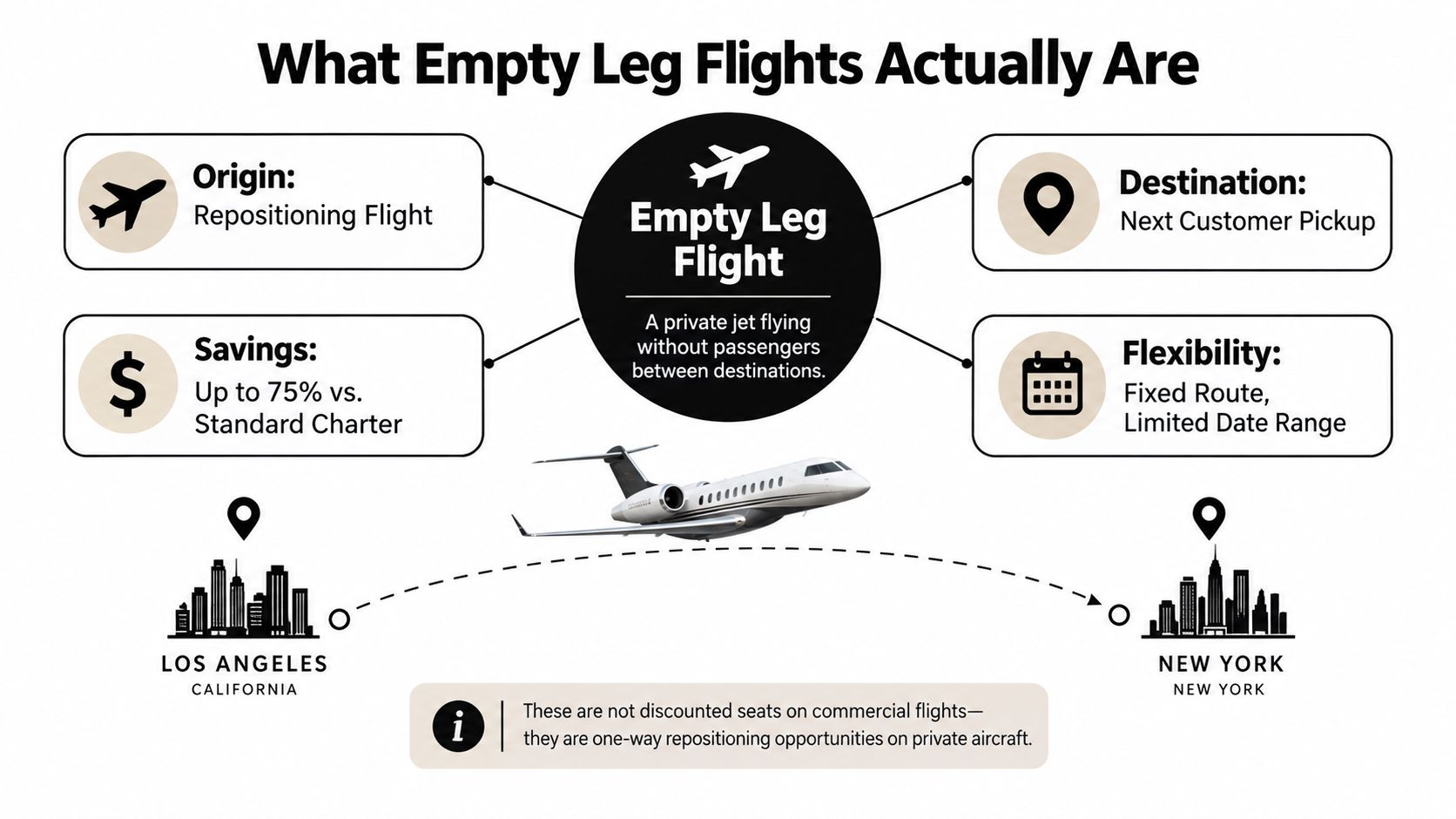
The certificate holder creates and controls this inventory. A broker can market the opportunity, but the broker doesn't own the aircraft's operational decision. The aircraft already has somewhere to be, and your job is to decide whether that movement happens to serve your route.
That explains the pricing. The operator has an unavoidable repositioning cost, so carrying your group can recover part of an expense that would otherwise produce no passenger revenue. You aren't buying a discounted seat. You generally receive the cabin for your group, subject to the aircraft's passenger and baggage limits.
Practical rule: Treat every listing as conditional until the operating carrier confirms the aircraft, schedule, and contract in writing.
The underlying charter can change minutes before departure. A customer may alter the primary route, maintenance may take the aircraft out of service, or crew and weather limits may force a different plan. The listed empty leg can therefore move, reroute, or vanish even when it looked confirmed online.
A listed segment is especially worth watching on routes with substantial one-way business or leisure demand. Major business links and seasonal resort corridors produce more repositioning activity than isolated markets. But an empty leg remains aircraft-specific inventory, not a scheduled product you can reliably request for any date.
Where to Find Empty Leg Inventory
Start with a charter desk that can see aircraft movement beyond a public listing page. Direct owner-operator sourcing can produce a clean match when the operator has an aircraft near your departure airport, while a traditional broker may search a wider supplier network. Aggregator apps are useful for discovering broad geography, but treat their listings as leads until an authorized operator verifies the movement.

Give every channel the information that affects aircraft matching:
- Departure area: Name your preferred airport and nearby alternates, including business-aviation airports within practical driving distance.
- Destination range: Provide the exact destination plus acceptable alternatives. A repositioning match may use a different airport serving the same metropolitan area.
- Date flexibility: Use a range instead of a single day. Operators release inventory around aircraft movements, not around your preferred calendar alone.
- Aircraft category: State whether a light jet, midsize jet, super-midsize jet, or larger cabin is acceptable. Don't reject a workable aircraft before you understand its layout and baggage capacity.
- Departure tolerance: Give a maximum acceptable window and say whether the window is firm or negotiable.
- Passenger details: Include the group size, baggage expectations, pets, and any catering requirements at the first contact.
The most useful alert isn't “show me cheap private jets.” It identifies a route, nearby airports, a date range, and the latest acceptable departure time. Ask the provider to notify you by phone or text when a viable aircraft appears, because a public listing can become stale while you wait for an email.
A repeat traveler should keep a route watchlist and maintain current passenger documentation. If your travel also involves changing countries, arrange connectivity before departure. For travelers moving across borders, prepaid plans for multi-country trips can prevent a separate communications problem from undermining a short-notice booking.
Public inventory can help you understand what is moving, but it shouldn't replace operator verification. Review the Haute Jets empty-leg service alongside direct operator and broker conversations, then ask who holds operational control of any flight you might purchase.
Use alerts, not endless browsing. The strongest opportunity may appear only after the primary passenger flight is confirmed, and the provider may release the repositioning sector close to departure.
The channel matters less than the quality of the confirmation. A responsive desk that can identify the aircraft's actual location, operating company, and cancellation terms is more valuable than an attractive app filled with unverified routes.
Reading the Price the Right Way
The advertised discount is a starting point, not a conclusion. Empty legs are commonly marketed at approximately 25% to 75% below an equivalent full charter, according to the 2026 repositioning market benchmark. That range is uneven, and a large headline reduction doesn't tell you whether the trip is a sound purchase.
Compare an all-in empty-leg quote with a protected on-demand charter for the same city pair and practical travel requirements. The empty leg may have a lower price, but the on-demand option usually gives you more control over departure time, routing, aircraft selection, and disruption planning. The correct question isn't “How much is the discount?” It's “How much control am I giving up for the final saving?”
| Cost Driver | Effect on Final Price | What to Ask |
|---|---|---|
| Aircraft type and cabin size | Larger aircraft generally carry different operating and staffing costs | Which exact aircraft and cabin layout are included? |
| Route and repositioning distance | The aircraft may need another movement before or after your flight | Is any additional repositioning included in the quote? |
| Landing and airport fees | Airport and FBO charges can vary materially between alternatives | Which airports, FBO, handling, and landing charges are included? |
| Crew duty limits | Timing can require a crew change, overnight, or revised schedule | Are crew costs and duty-related changes covered? |
| Permits and border requirements | International sectors may require operational approvals | Are permits and handling included, and who obtains them? |
| Weather and seasonal conditions | De-icing or disruption handling can affect the final plan | Who pays for de-icing or weather-related changes? |
Route economics, aircraft size, fuel range, crew costs, permits, airport fees, and the timing of the return sector all influence the final figure. A quote that excludes handling, catering, pets, or ground transportation isn't comparable to a fully itemized charter quote.
Get the private jet charter cost guide as a second reference point, but don't let any guide replace a written comparison for your exact itinerary. The provider should show what the empty-leg price includes and what remains conditional.
The best buyer is comfortable with a short booking window and a fixed itinerary. If the route and timing are mission-critical, the cheaper quote can be the more expensive decision once disruption, replacement travel, and missed commitments enter the calculation.
A Realistic Search and Booking Workflow
Empty-leg hunting works when you prepare before the alert arrives. Decide your acceptable airports, date range, aircraft categories, and maximum departure window first. If you wait until an aircraft is available to consider those questions, somebody else may claim the opportunity while you're still checking baggage capacity.
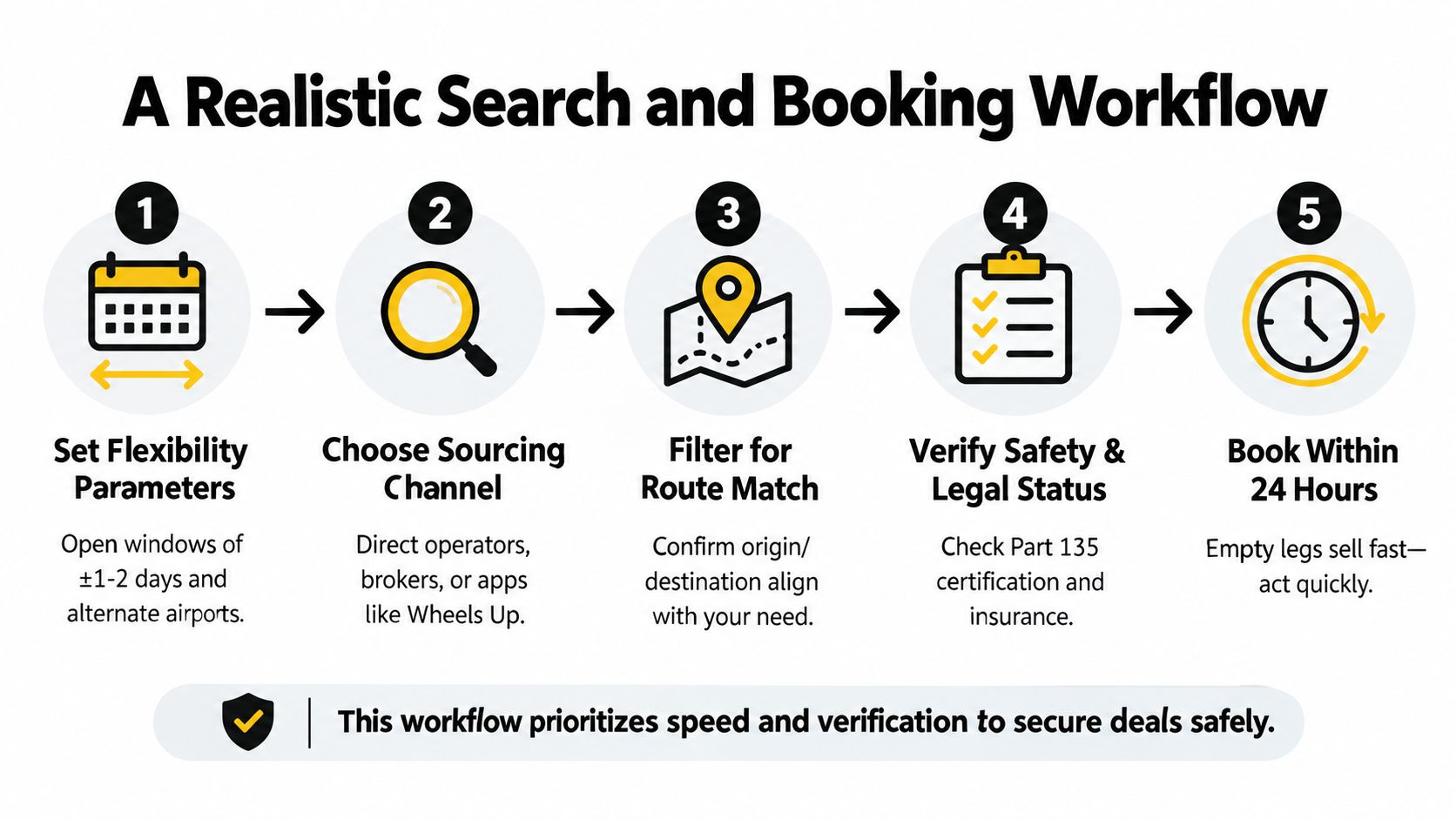
Set the search parameters
Write the request as an operator would plan it:
- Origin and alternates: Include your preferred airport and nearby business-aviation airports.
- Destination and alternates: State which arrival airports are acceptable.
- Travel window: Offer a date range rather than one fixed date.
- Aircraft tolerance: Identify the smallest and largest acceptable category.
- Departure limit: State the latest time you can leave and whether an earlier departure works.
- Passenger and baggage profile: Include people, luggage, pets, and special requirements.
That flexibility creates more usable matches than asking for the lowest fare.
Monitor several channels
Use a direct operator relationship, a reputable charter desk, and a public listing source if useful. Ask each provider to confirm whether it is the operating carrier, an agent, or a broker. The person sending the quote may not be the entity responsible for dispatching the aircraft.
Empty legs often appear only 24 to 72 hours before departure, according to the documented booking methodology. Keep payment authority, passenger names, passports for international travel, and decision-makers ready during that window.
Verify before paying
Request the actual tail assignment, operating company, operational-control entity, crew arrangements, maintenance status, fuel range, permits, and passenger-legal status. Ask for the departure airport and FBO, not just the city name. Confirm catering, pets, baggage, and weather-disruption handling in writing.
A provider that says “the details will follow” without identifying who legally operates the flight deserves scrutiny. The underlying revenue charter can change, so ask whether the proposed sector is confirmed or merely indicative.
Read the contract
The contract should state the cancellation policy, payment terms, liability terms, replacement-lift obligation, and what happens if the primary charter changes. It should also identify the aircraft or explain precisely when the tail will be assigned.
Don't accept “we'll find another jet” as a promise unless the agreement says who pays, what standard applies, and how quickly the replacement must be offered. A conditional opportunity and a guaranteed transport contract aren't the same product.
Before sending money, ask one direct question: If the original charter changes, do you refund me, provide replacement lift, or simply cancel the opportunity?
This workflow is fast by design. You can prepare it on Monday, monitor alerts, and respond promptly when a verified match appears. Speed matters, but speed without legal and operational checks is just a faster way to buy the wrong flight.
When a Full Charter Is Actually the Better Deal
The lowest advertised fare isn't automatically the lowest-risk fare. Empty-leg cancellation rates are reported around 10% to 15% in the supplied industry methodology, so the possibility of losing the movement must be part of your comparison, not buried in fine print. The FAA's Part 135 requirements also make clear that on-demand unscheduled charter belongs within an authorized commercial operating framework.
Choose a full charter when the trip has consequences that exceed the saving. A wedding group can't treat the ceremony as a flexible departure window. A sports team can't casually accept a reroute before a match. An executive with a fixed board meeting, or a traveler connecting to another international flight, needs protected timing more than an attractive listing.
Score the trip using four questions:
- Route flexibility: Can you use nearby airports at both ends?
- Schedule tolerance: Can you leave earlier, later, or on another day?
- Backup availability: Could you arrange another aircraft or commercial route quickly?
- Disruption cost: What would a missed arrival cost in money, reputation, or opportunity?
If you answer “no” to the first two and don't have a practical backup, request a conventional on-demand charter. If the disruption cost is high, don't allow a discount to dictate the booking method.
A full charter also wins when you need a specific cabin configuration, exact baggage capacity, bespoke catering, or a coordinated return. The operator plans the mission around you instead of asking you to accept the aircraft's existing mission.
Empty legs still make sense. Flexible leisure travelers, people near several private airports, and groups traveling on a one-way route with a forgiving schedule can obtain strong value. The 2026 Gulf inventory analysis recorded 4,873 empty-leg flights involving Gulf airports over the preceding year, with 3,297 involving a UAE airport, and Dubai alone accounted for 2,762. The reported Gulf route analysis identified Dubai to Riyadh, Dubai to Doha, and Dubai to Kuwait City among the busiest city pairs in that market.
That data supports a focused search, not a guarantee. Dense corridors create more chances, but your aircraft, date, and timing still have to align.
A discounted empty leg is a good purchase only when your trip can absorb the conditions that created the discount.
Verifying Safety and Legal Operation
A lower fare doesn't lower the operating standard. In the United States, a paid passenger charter must be conducted by an appropriately authorized commercial operator. The FAA's Part 135 guidance states that private pilots may not act as pilot in command while carrying people or property for compensation or hire.
The certificate holder controls dispatch and the flight. A broker may arrange the transaction, and an aircraft owner may provide the jet, but neither role substitutes for the authorized operating carrier. Ask for that carrier's legal name before discussing the discount.
Send this verification checklist
- Operating identity: Request the legal name of the certificate holder and confirm that it matches the proposed itinerary.
- Authority: For a US flight, request confirmation of the active Part 135 authority. For international travel, ask for the relevant operating authority and cross-border approvals.
- Aircraft identity: Obtain the registration and actual tail assignment, then confirm that the aircraft belongs to the named operating arrangement.
- Operational control: Ask which entity dispatches, controls, and accepts responsibility for the flight.
- Safety audit: Request current independent audit information, such as Wyvern Wingman or Argus Gold/Platinum status, where applicable.
- Contract terms: Read cancellation, liability, insurance, refund, and replacement-lift provisions before paying.
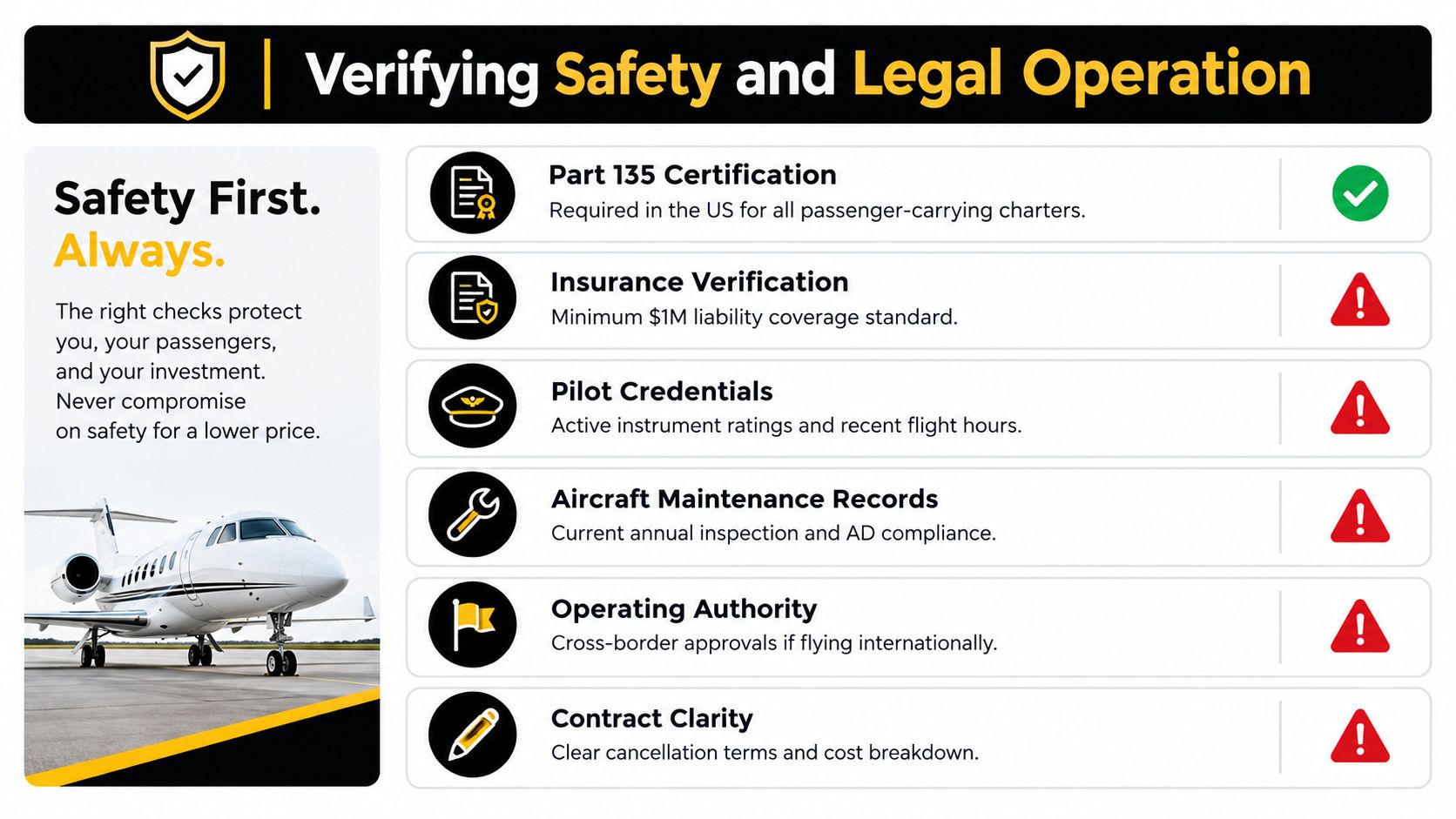
Don't confuse a broker's polished website with proof of legal operation. A gray charter can obscure who is carrying the passenger, who holds insurance, and who is accountable when something goes wrong. If the provider won't name the operator or explain the operating certificate, stop the transaction.
Pet owners should apply the same discipline to animal handling, documentation, and safety procedures. A practical safety guide for pet owners can help you prepare questions about transport requirements, but the charter operator still needs to confirm its own pet policy, cabin rules, and liability terms.
Haute Jets describes its sourcing network as limited to operators holding Wyvern Wingman or Argus Gold/Platinum ratings. You can review its explanation of Wyvern and Argus private aviation safety ratings, then independently verify the proposed operating company rather than relying on an intermediary's statement.
Safety depends on the authorized operator, operational control, maintenance program, crew standards, and jurisdiction. The label “empty leg” says nothing by itself about whether the arrangement is legitimate.
Quick Answers and Your Decision Framework
How far in advance do empty legs appear? Many are released only after the primary passenger flight is confirmed, often within 24 to 72 hours of departure. Build alerts early, but expect the actionable offer to arrive close to travel.
Do you pay per seat or per aircraft? Listings typically quote the total aircraft price, not a per-seat fare. Confirm the passenger limit, baggage allowance, and whether the cabin is reserved for your group.
What happens with luggage and pets? Ask for written baggage limits, pet acceptance, carrier or cabin requirements, and any documentation. Never assume that a large aircraft automatically accepts every item or animal.
Can repeat customers get earlier access? A direct relationship can help a provider understand your routes, airports, and timing limits, but it doesn't create aircraft inventory. Stay ready with current passenger details and a clear decision process.
Use this decision framework:
- Protected on-demand charter: Choose it when timing, routing, aircraft choice, or a downstream commitment is fixed.
- Verified empty leg: Choose it when you can flex the date, airport, and departure window and have a backup plan.
- Aggregator inventory: Use it for discovery only until the operating carrier, aircraft, and contract are verified.
Empty legs are a legitimate way to reduce charter cost, but they aren't guaranteed bargains. They work when you match your plans to a real repositioning movement and understand exactly what happens if that movement changes.
Haute Jets helps travelers compare empty-leg opportunities with on-demand charter options, using a network of owner-operators and verified aircraft information. Visit Haute Jets with your route, date flexibility, passenger count, and maximum departure window, and ask for an all-in comparison before you commit.