

You need to leave Houston soon, your schedule can move by a few hours, but the cost can't move in the wrong direction. Then a broker mentions that a private jet is already repositioning from Houston with no passengers aboard. The aircraft, route, and departure window are largely set, but you may be able to occupy that otherwise unused segment at a meaningful discount.
That opportunity is real. It also disappears quickly. Empty leg flights from Houston are perishable inventory, not ordinary charter deals waiting patiently for the right buyer. The travelers who succeed usually prepare before the listing appears, accept practical airport and timing compromises, and make a decision while the aircraft is still available.
What Empty Leg Flights From Houston Actually Are
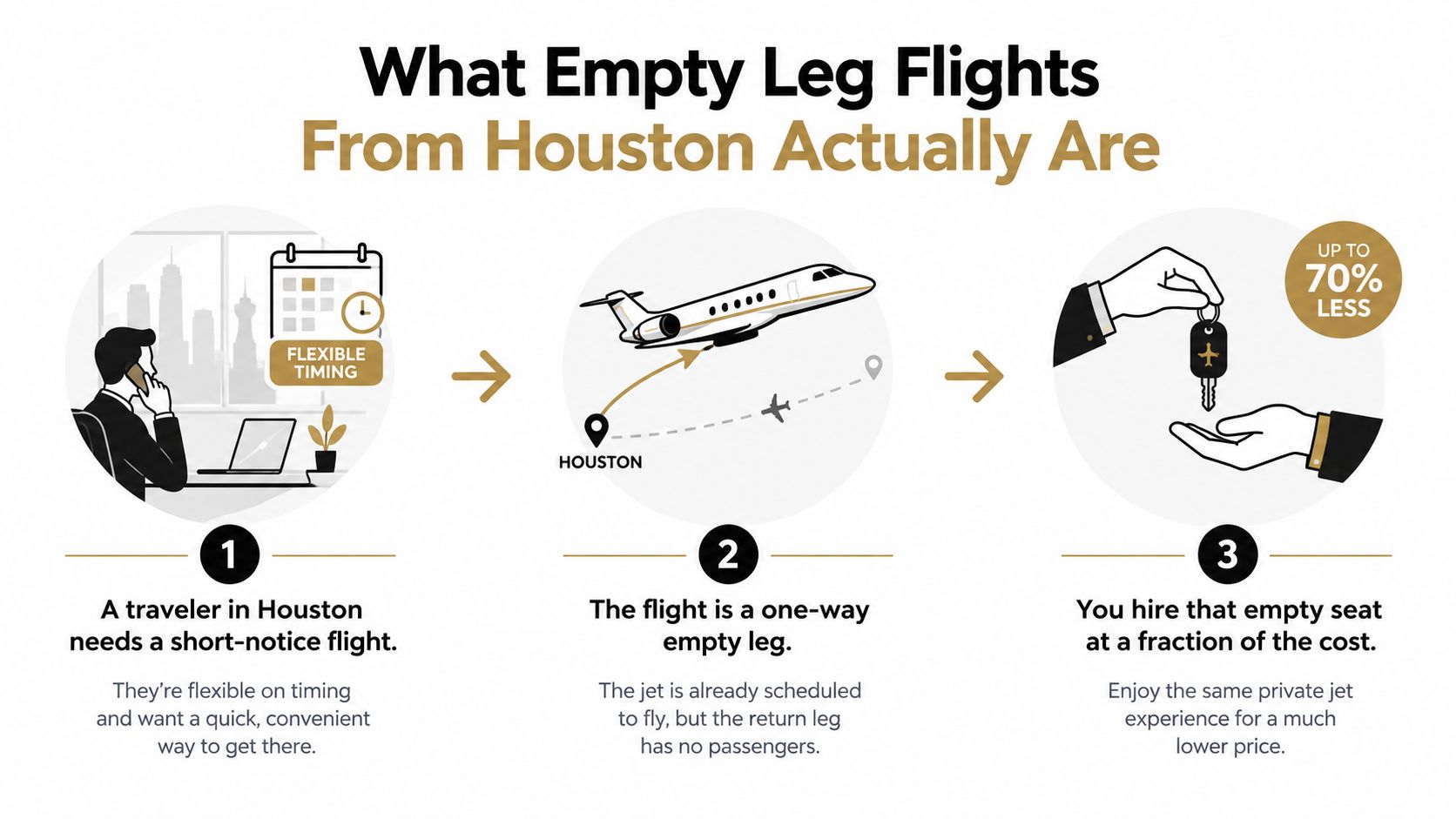
An empty leg is a one-way positioning flight that a private aircraft must operate without passengers. The jet may be moving to its next paid charter, returning to base, or reaching another airport for an operational reason. Operators already face the fuel, crew, and airport costs, so they may sell the open segment rather than fly it completely empty. A neutral guide to empty leg mechanics describes the route, aircraft, and approximate departure time as being shaped by the operator's existing schedule.
Houston produces this kind of movement because its private aviation demand follows the energy sector and corporate travel. Business traffic regularly connects Houston with Midland, Odessa, the Eagle Ford region, other Texas hubs, Mexico, and Canada. That creates repositioning pressure around the city's airports, especially when a corporate aircraft drops passengers in one market and needs to continue elsewhere.
The booking constraint that matters
You aren't commissioning a custom itinerary. You're buying access to the leg the aircraft was already going to fly.
That means the destination, departure window, aircraft category, and sometimes the routing are predetermined. You generally can't add a stop, move the departure to suit a meeting, or ask the operator to bring the jet back for your return. An empty leg isn't a group discount on a normal charter, and it isn't a guaranteed schedule.
For Houston, the practical calculation is simple:
- Start with the operator's route. Decide whether the destination works before discussing the discount.
- Accept a time window. A flexible departure is more valuable than a perfect headline price.
- Confirm the aircraft and terms. Passenger count, baggage, cancellation rules, and airport pair all matter.
- Book only when the trade-off works. The savings come from solving the operator's positioning problem, not from giving you control over the aircraft.
For a deeper explanation of the operating model, see this guide to what an empty leg flight is. The deal can be excellent, but it remains perishable inventory. If your preferred schedule is rigid, a conventional charter is usually the more honest product.
How Empty Leg Pricing Really Works
Empty-leg pricing starts with a practical question: what can the operator recover from a flight the aircraft must already make? It doesn't begin with a standard charter quote and then apply a universal discount.
The final figure reflects the aircraft's category, route distance, fuel requirement, landing and handling charges, and whether the crew needs an overnight stay. A light jet moving between Texas cities has a different cost structure from a heavy jet crossing the Atlantic. An Aspen trip can also price differently from a comparable-distance route because airport access, seasonal demand, and aircraft availability change the operator's options.
The variables behind the quote
Aircraft size sets the floor. Light jets usually cost less to operate than midsize, super-midsize, or heavy aircraft, but a larger cabin may be necessary for passenger capacity, baggage, or range.
The route sets the workload. Longer sectors consume more fuel and may require different crew planning. An arrival airport with higher handling costs can raise the total even when the aircraft is already moving in that direction.
Timing changes urgency. A freshly posted leg may be priced to fill quickly. A late posting, unusual departure time, or operational need can create a sharper offer, but it can also leave less time to organize passengers and payment.
Demand can work in either direction. A popular destination may attract more buyers, while an inconvenient departure window may encourage the operator to accept less. Same-day availability isn't automatically cheaper. If several travelers want the same aircraft, the price can remain firm.
One Houston inventory page reported listed prices from $1,198 to $16,700, with an average listed price of about $6,386. Its category averages were $5,288 for light jets, $7,345 for midsize jets, and $4,975 for turboprops. Those figures are listings, not promises, and they show why category and route need to be evaluated together. Houston empty-leg pricing data provides the relevant market snapshot.
Typical Empty Leg Pricing From Houston by Aircraft Category
| Aircraft Category | Typical Hourly Charter Rate | Empty Leg Range | Common Houston Routes |
|---|---|---|---|
| Light jet | Varies by aircraft and route | $1,198 to $16,700 in listed Houston inventory | Texas business corridors and short regional trips |
| Midsize jet | Varies by aircraft and route | $1,198 to $16,700 in listed Houston inventory | Longer domestic business routes and leisure destinations |
| Turboprop | Varies by aircraft and route | $1,198 to $16,700 in listed Houston inventory | Short regional sectors and smaller-airport access |
| Super-midsize or heavy jet | Varies substantially by range and operating needs | Can reach the upper end of listed inventory | Long domestic, international, and high-capacity routes |
The table's range is deliberately broad because empty legs don't behave like a fixed menu. Treat the quoted amount as a response to an aircraft's immediate positioning need, not as a standard Houston fare.
The Houston Airports Behind the Listings
Houston's airport choice can determine whether an empty leg is useful before you even compare prices. IAH, HOU, and HRL serve different patterns, and the listings feed reflect those differences.
George Bush Intercontinental, or IAH, is the natural place to look for longer domestic and international repositioning. Its location serves major corporate activity around the Energy Corridor and Memorial City, while its facilities support larger aircraft and longer missions. If your search begins at IAH, you'll generally encounter more long-range and corporate-oriented possibilities.
William P. Hobby, or HOU, tends to suit shorter domestic sectors and lighter aircraft. It works well for regional business travel and leisure trips toward the Gulf Coast, including Galveston-area demand. Travelers often value the faster ground experience, but the airport isn't the first place to search for every heavy-jet or international option.
Valley International in Harlingen, or HRL, acts as a southern anchor for South Texas activity. Aircraft serving oil-and-gas work, regional corporate travel, or seasonal leisure demand may reposition through the area. A traveler willing to consider HRL can sometimes find an aircraft moving back toward Houston, although the airport adds ground logistics that must be priced into the decision.
Why the Energy Corridor matters
The Energy Corridor concentrates offices, executives, contractors, and corporate travel patterns in one side of the metro area. That concentration creates repeat movement rather than isolated leisure demand. Aircraft may arrive for a meeting-heavy business itinerary, then reposition to another Texas market or a national corporate center.
Don't search only for “Houston” and assume every result is interchangeable. Ask which airport the aircraft uses, how long the ground transfer will take, and whether the arrival airport is genuinely convenient. The Houston private jet charter overview is a useful starting point for understanding the city's airport geography.
The correct airport can be worth more than a modest fare reduction. A cheap leg from the wrong field becomes expensive once you add traffic, ground transport, and missed time.
Typical Routes Out of Houston
Houston empty legs follow the city's established business and leisure flows. The strongest opportunities usually appear where operators already have reasons to move aircraft, not where a traveler happens to want a unique city pair.
The Texas triangle is the first place I'd look. Dallas, Austin, and San Antonio connect Houston to corporate offices, energy projects, private equity activity, and regional meetings. Those routes can support frequent repositioning because aircraft often serve more than one city in a business itinerary. Houston also connects with Midland and Odessa when energy work drives aircraft demand across West Texas.
Louisiana adds another practical corridor. New Orleans and Lake Charles attract energy, industrial, and leisure traffic, so aircraft moving between the Gulf markets can create one-way opportunities. These legs may be more useful for travelers who can adjust the exact airport or departure period than for someone who needs a fixed commercial-style schedule.
The Northeast corridor is driven by corporate travel. New York, White Plains, and Boston can draw larger aircraft and more complex positioning, especially when a Houston-based client itinerary continues through several business centers. Long-range trips require closer scrutiny of aircraft category, baggage capacity, weather, crew planning, and international handling.
Leisure demand changes the picture. Aspen, Miami, Cabo, and the Bahamas can generate repositioning when travelers move between Houston and seasonal destinations. Those routes may look attractive, but they can also become competitive during peak travel periods. A broker should confirm whether the aircraft is truly available for your passengers or whether the listing is only an initial indication.
Common Houston Empty-Leg Corridors at a Glance
| Route | Approx. Flight Time | Demand Driver |
|---|---|---|
| Houston to Dallas | Short regional sector | Corporate travel and Texas business connections |
| Houston to Austin | Short regional sector | Executive travel, technology, and state business |
| Houston to San Antonio | Short regional sector | Energy, corporate, and regional traffic |
| Houston to Midland or Odessa | Regional sector | West Texas energy activity |
| Houston to New Orleans | Regional Gulf route | Energy, industrial, and leisure travel |
| Houston to Lake Charles | Short Gulf route | Energy and industrial activity |
| Houston to New York or White Plains | Longer domestic sector | Corporate and financial travel |
| Houston to Boston | Longer domestic sector | Corporate and institutional travel |
| Houston to Aspen | Longer leisure sector | Seasonal resort demand |
| Houston to Miami | Longer domestic sector | Business, leisure, and onward Caribbean access |
| Houston to Cabo | Longer leisure sector | Resort travel and seasonal demand |
| Houston to the Bahamas | Longer leisure sector | Vacation and luxury travel |
The data supports the importance of these flows. One live Houston view reported 130 empty legs touching Houston, split between 71 departing and 59 arriving, with San Antonio and Austin each appearing with 13 departures, and Dallas with 6. Another tracked view recorded 197 departing and 211 arriving repositioning legs across 12 active months, for 408 total tracked legs, with Dallas, Teterboro, Fort Worth, and Scottsdale among the most frequent destinations. Houston repositioning inventory shows why the city behaves more like a corporate repositioning hub than a purely leisure market.
Where to Find Houston Empty Leg Listings
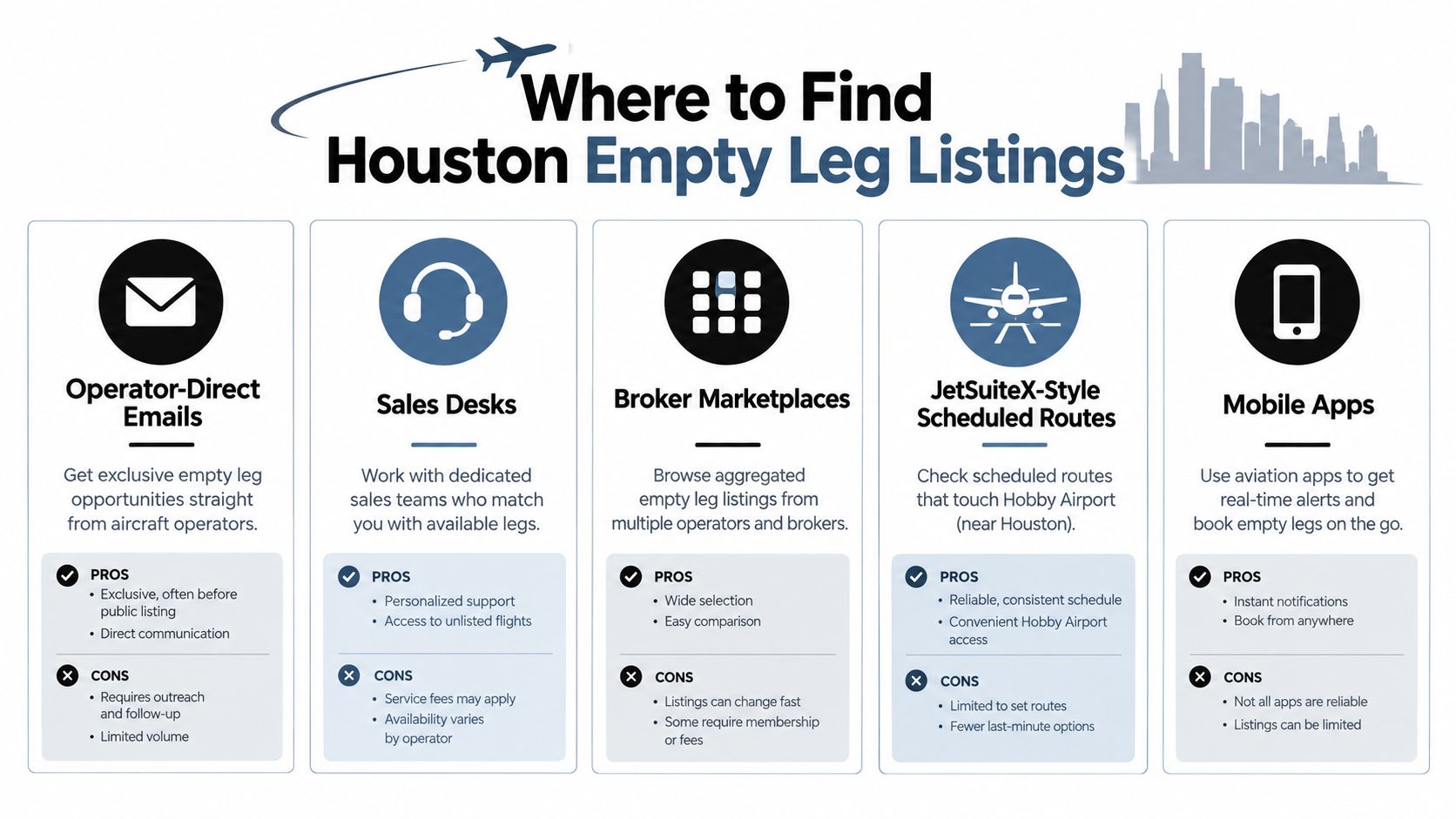
Public listing pages are useful, but they aren't complete. Empty legs can be offered directly by an operator, circulated through a broker's sales desk, placed on a marketplace, or shared privately with repeat clients before they reach a public feed.
Start with operator-direct channels if you already know which fleets serve KIAH, KHOU, or KEFD. Direct emails and sales desks can surface aircraft that aren't broadly advertised, particularly when the operator has a short window to fill seats. The trade-off is coverage. One operator can show you only its own aircraft.
Broker marketplaces expand the search across multiple fleets. Services associated with PrivateFly, Victor, or JetSmarter-style marketplace models may make comparison easier, but availability can still move before the page refreshes. Aggregators appear broad because they display many routes, yet they may lag behind a broker's live confirmation.
JetSuiteX-style scheduled routes touching Hobby belong in a separate category. They're scheduled services, not necessarily empty legs, so they can provide a useful fallback when the positioning inventory doesn't match your timing. Treat them as a schedule option rather than assuming they carry the same aircraft or booking terms.
A sourcing process that works
- Set route alerts. Watch Houston to Dallas, Austin, San Antonio, New Orleans, New York, and your priority leisure destinations.
- Use more than one channel. Combine operator contact with a marketplace or intermediary that monitors several fleets.
- Ask for live confirmation. A published price isn't enough. Get aircraft status, airport pair, departure window, passenger capacity, and cancellation terms.
- Keep a fallback. If the empty leg disappears, compare a standard one-way charter or a scheduled alternative immediately.
A sourcing intermediary can save time by filtering multiple fleets instead of forwarding every speculative listing. Haute Jets consolidates available channels into a shortlist for travelers comparing Houston repositioning options. You can also review its empty leg flight listings as one source in the search process.
Use the video below as a visual introduction to how these options are typically presented, then verify every operational detail with the booking party.
Smart Booking Tactics for Houston Departures
The winning strategy is preparation. A Houston empty leg may be listed at a useful price, but the broker still needs to confirm passengers, payment, aircraft availability, and contract terms before the operator can close the booking.
Build your response package first
Keep a short passenger list ready. Include full legal names, approximate baggage needs, and any relevant travel details. Have an approved payment method available, because a slow internal approval process can cost you the aircraft.
Give the broker a route hierarchy rather than one rigid request. For example, you might prefer Houston to Dallas Love, accept Addison, and consider Austin if the price and ground transfer make sense. Route elasticity turns a narrow search into a workable one.
Practical rule: Decide your acceptable airport, arrival window, and maximum spend before the listing appears.
Keep two or three backup dates open whenever possible. Empty legs depend on another charter's schedule, so a traveler with movable dates has a meaningful advantage over someone who can fly only at one precise time.
Be flexible about the field
IAH, HOU, and Ellington can produce different inventory. If the aircraft sits at the wrong airport, calculate the full trip, including ground transport and meeting logistics, before rejecting it. A short drive may preserve a significant saving, while a long transfer can erase the benefit.
Early-monitor and late-evening departures can be easier to match than the most popular morning business banks. You shouldn't accept an unsafe or impractical schedule, but you should avoid treating one preferred departure time as the only acceptable option.
Move when the terms are clear
A listing is not a booking. Ask for written confirmation of the aircraft, departure airport, arrival airport, passenger limit, baggage allowance, price, deposit, cancellation language, and expiration time. Then decide quickly.
One Houston source reported 111 to 114 available flights on recent dates, with starting prices from $2,070 and upper-end prices reaching $36,685. The same source said 96 to 102 Houston empty legs had been posted and expired in the prior week, and that most were gone within 48 hours. Current Houston listing activity makes the operational lesson clear: don't spend hours comparing a leg that may no longer exist.
The Real Risks and Contract Details
An empty leg isn't a discounted scheduled airline flight. The operator's primary obligation is usually the aircraft's broader charter program, and your booking exists only while that positioning segment remains operationally and commercially available.
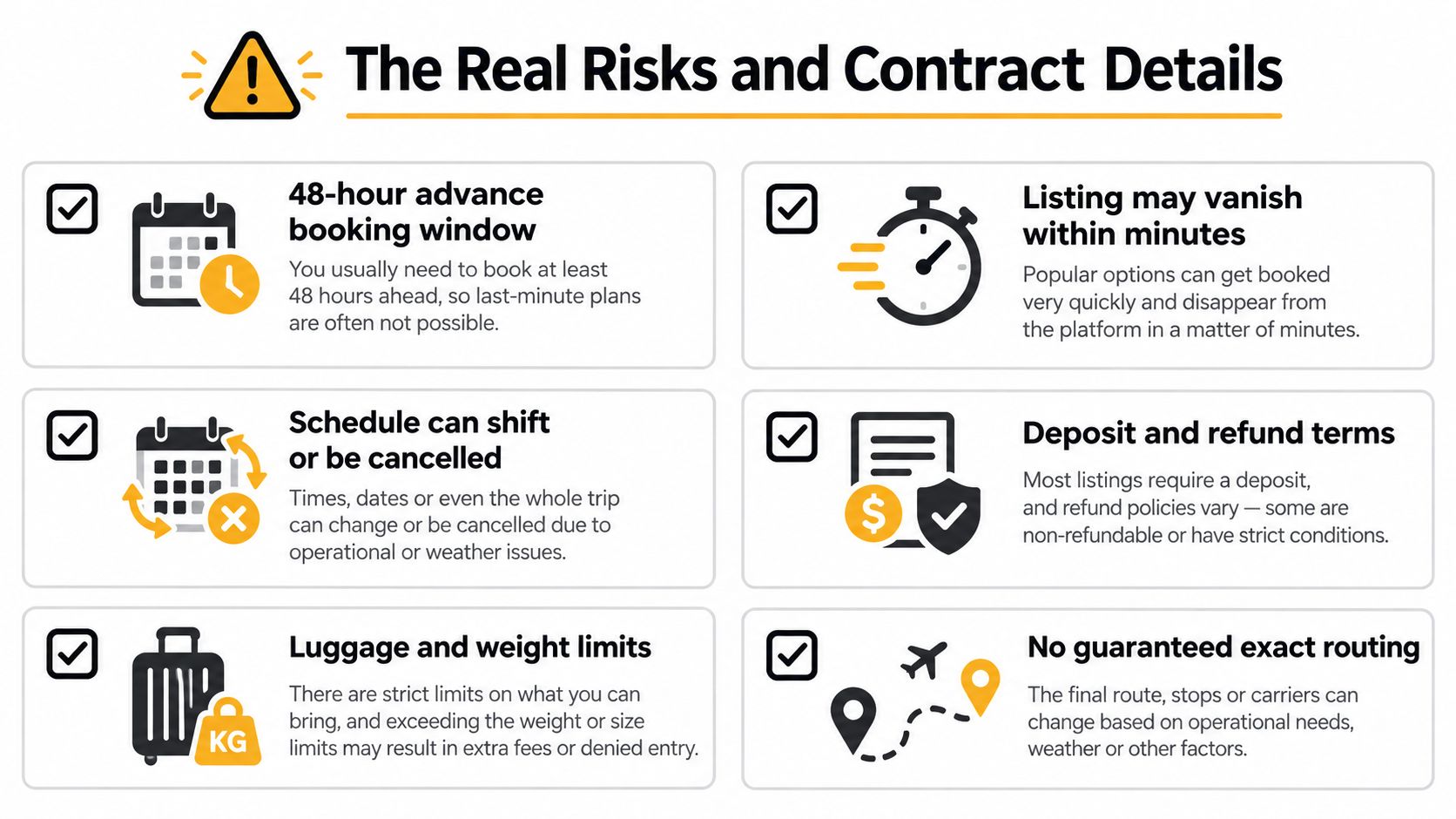
The practical booking window is often tight. A Houston listing source reported that most available legs disappear within 48 hours, while broader market coverage describes a typical booking window of 48 to 72 hours and cancellation rates of 10% to 15%. Industry coverage of empty-leg reliability frames the issue directly: the opportunity is attractive because it is temporary, and that same temporary structure creates uncertainty.
What can change
The primary charter client may adjust the itinerary. Weather may affect the route. Crew duty limits, maintenance, airport restrictions, or a change in the aircraft's next assignment can force a delay or cancellation. A broker can't eliminate those operational variables.
Operators may also retain the right to sell the aircraft to a full-paying charter customer before departure. That clause matters because your discounted booking may be displaced by a higher-priority commercial movement. Deposits are often non-refundable, so don't transfer money until you understand exactly what happens if the operator pulls the leg.
What you can't customize
Expect firm limits on:
- Routing: You generally can't add a stop or change the destination.
- Airport: A request to switch from IAH to HOU may require a different aircraft and quote.
- Departure time: The window can move with the primary charter's schedule.
- Passenger count: The operator must account for seats, weight, and balance.
- Baggage: Heavy or oversized bags may exceed the aircraft's limits.
- Catering: Special catering can have minimums, fees, or lead-time requirements.
Read the protection language
A reputable broker should identify the operator, explain the cancellation hierarchy, verify the aircraft's status, provide a backup path, and state whether any refund or credit applies. The traveler still accepts that an empty leg can disappear, but the broker should prevent avoidable surprises.
Ask these questions before paying:
- Is the aircraft confirmed, or is this only a soft hold?
- What event allows the operator to cancel?
- Is the deposit refundable, transferable, or forfeited?
- What happens if the departure time changes?
- Are ground transfers, catering, and repositioning costs included?
- What backup charter options can be quoted if the leg is pulled?
Cheap is useful only when you can absorb the disruption. If missing the meeting, wedding, or connection would cost more than the saving, book a conventional charter instead.
Deciding if an Empty Leg Fits Your Travel Style
Empty legs fit travelers who can bend. They work poorly for travelers who need the aircraft to bend around them.
Use three filters. Schedule flexibility asks whether you can depart within a changing window. Destination precision asks whether a nearby airport or alternate city works. Change tolerance asks whether you can handle a late schedule adjustment or sudden replacement plan without damaging the trip.
Travelers who usually benefit
Energy consultants moving between Houston and Midland, Odessa, San Antonio, or the Gulf can often align with existing corporate flows. Their work already follows the same corridors that generate repositioning, and nearby airports may be practical.
Weekend travelers heading toward Aspen, Cabo, Miami, or the Bahamas can benefit when the destination matters more than the exact departure hour. Families with firm but movable dates are another strong fit, especially when they can travel from HOU instead of IAH or accept an alternate return plan.
The strongest candidate usually has:
- A flexible departure window
- A preferred route plus acceptable alternatives
- A passenger list ready to submit
- No essential connection immediately after landing
- A budget that rewards speed but doesn't require the lowest possible quote
Travelers who should choose a full charter
A rigid corporate schedule is a warning sign. If you must leave Houston at a precise time, land at one specific airport, and return on a fixed date, an empty leg may create more stress than value.
Multi-city itineraries also weaken the case. Empty legs are one-way positioning segments, so building a complex trip around them can leave you exposed between sectors. Anyone traveling for a critical appearance, board meeting, medical appointment, or time-sensitive event should prioritize control over the discount.
| Decision filter | Empty leg fits | Empty leg probably doesn't fit |
|---|---|---|
| Schedule | You can move the departure window | You need an exact wheels-up time |
| Route | You accept IAH, HOU, HRL, or nearby alternatives | You need one exact airport pair |
| Party size | Your passenger and baggage details are settled | Your group may change at the last minute |
| Risk | You have a backup plan | A cancellation would cause serious damage |
| Price | You value savings enough to accept limits | Certainty matters more than the quote |
Haute Jets monitors IAH, HOU, and HRL inventory, pre-qualifies operators, and can present backup legs for requested corridors rather than relying on one speculative listing. That model suits travelers who want the savings opportunity but don't want to manage every listing feed alone.
My recommendation is straightforward: use empty legs from Houston when your route is common, your dates can move, and you have a backup. If any of those conditions fail, price a standard charter first and treat an empty leg as a bonus, not the foundation of the trip.
For Houston empty leg searches, Haute Jets can source available repositioning aircraft, compare IAH, HOU, and HRL departures, and present practical alternatives when a listing expires. Share your preferred route, flexible dates, passenger count, and acceptable airports by visiting Haute Jets, then ask for a live shortlist rather than a stale public listing.