

Denver is generating 66 live empty-leg listings at an average advertised price of about $8,545, and most disappear within 48 hours. That makes empty leg flights Denver a real, fast-moving buying opportunity, not a standing menu of discounted private flights.
The reason is operational rather than promotional. Aircraft arrive in Colorado with passengers, drop them near the ski resorts or business centers, and then need to reposition for the next assignment. If your schedule matches that aircraft movement, you can occupy a flight the operator already needs to operate. If it doesn't, the discount won't compensate for the loss of control.
Denver International Airport handled 82.4 million passengers in 2024, an increase of 5.8% from the prior year, while the FAA ranked DEN at 37,863,967 enplanements in calendar year 2023. That commercial scale helps explain why Denver produces a recurring stream of private aircraft repositioning opportunities. Denver International Airport's official traffic information provides the underlying airport figures.
What Empty Leg Flights Are and Why Denver Has So Many
An empty leg flight is a one-way private aircraft sector flown without the passengers who paid for the aircraft's primary charter. The aircraft may have just delivered a client to Aspen, Eagle, or Denver, then needs to continue to another airport for its next assignment or return toward its operating base. Industry terminology also includes dead leg, deadhead, ferry flight, and repositioning flight, as explained by IBC Aviation's overview of empty-leg flights.
That distinction matters. An empty leg isn't a coupon, a shared commercial seat, or a speculative flight that may never operate. The aircraft, crew, route, and operational plan already exist. You're buying access to a fixed sector, subject to the primary charter's schedule and the operator's final confirmation.
Why Denver generates repositioning supply
DEN's commercial volume creates a broad flow of inbound and outbound travel, and private aviation supply often follows that intensity. Denver also functions as a mid-continent gateway for ski travel, corporate trips, fractional fleets, and leisure routes into Colorado. During winter, aircraft may arrive with passengers from coastal markets, complete a mountain drop-off, and leave without passengers when the original travelers continue by ground or stay at the destination.
The Denver region adds several private aviation departure points. Centennial Airport, Rocky Mountain Metropolitan Airport, and airports serving mountain destinations give operators options for positioning aircraft close to clients. Eagle County Regional Airport also plays an important role when aircraft serve Vail and nearby resorts.
Practical rule: Treat the aircraft's next obligation as the source of the opportunity. Your preferred itinerary is secondary.
A flyer who understands that operating logic has a realistic chance of finding a suitable sector without paying for a membership. The Haute Jets guide to what an empty leg flight is offers useful background, but the booking decision still comes down to whether your timing and destination match the aircraft's repositioning requirement.
The Denver Empty Leg Market Right Now
The current Denver marketplace shows 66 available empty legs, with listed departure prices from $1,590 to $15,870 and an average listed price near $8,545, according to the Denver empty-leg listings from Ace Jet. The same marketplace reported 83 Denver empty legs posted and expired during the prior week, with most listings disappearing within 48 hours.
That snapshot gives buyers a more useful baseline than a generic promise of savings. A short regional repositioning can sit near the bottom of the range, while a larger aircraft on a longer route can approach the top. The board also showed 21 midsize jets, 20 super-midsize jets, 9 light jets, 9 heavy jets, and 4 turboprops, so Denver supply isn't limited to one cabin category.
Denver empty-leg listings current snapshot
| Metric | Value |
|---|---|
| Available listings | 66 |
| Listed price range | $1,590 to $15,870 |
| Average listed price | About $8,545 |
| Listings posted and expired in the prior week | 83 |
| Typical listing disappearance | Most within 48 hours |
| Midsize aircraft listings | 21 |
| Super-midsize aircraft listings | 20 |
| Light jet listings | 9 |
| Heavy jet listings | 9 |
| Turboprop listings | 4 |
The figures are volatile by design. An empty leg may appear only after a primary charter is confirmed, and it can vanish when another traveler books it or when the underlying itinerary changes. That's why a Denver buyer should judge a quote against the aircraft class, route, and notice period rather than against an average marketplace number alone.
The practical conclusion is simple. Supply is broad but perishable, and the best opportunity may be gone before a buyer finishes comparing every public board.
Common Empty Leg Routes Out of Denver
Denver's route patterns reflect where passengers want to go and where operators need aircraft next. The ski corridor is the clearest example. KASE Aspen, KEGE Eagle and Vail, and private or regional facilities serving Telluride can produce aircraft movements that don't align neatly with the passenger's return schedule.
A common winter pattern starts with strong inbound demand late in the week. Travelers arrive for ski weekends, retreats, or resort stays, and the aircraft may leave after the drop-off to meet another obligation. Sunday and Monday repositioning sectors can therefore be more practical for a flexible traveler than a fixed Friday departure.
Mountain routes
Consider a representative Denver to Eagle sector on a Citation XLS priced at $4,200. That flight works when the operator needs the aircraft in the Vail Valley and the traveler can accept the scheduled departure from a suitable Denver-area airport. It won't work if the buyer needs a different departure time, a round trip, or a stop on the way.
Aspen and Telluride follow the same operational logic, although the available aircraft and airport conditions differ. A light jet or turboprop may suit a short mountain sector, while the operator still has to account for the performance requirements of high-altitude airports.
California and Texas corridors
California leisure and business routes can appear when Denver-based aircraft position toward KAPC Napa, KSFO San Francisco, KSQL San Carlos, or KLAX. Technology, entertainment, and leisure demand can create one-way movements in either direction, but the aircraft's next client determines which direction becomes available to an empty-leg buyer.
The Texas business axis includes KDFW Dallas, KHOU Houston, and KEDC Austin. Mid-week corporate travel can leave an aircraft in Texas after a Denver departure or bring it back toward Colorado without passengers. These sectors are more attractive to business travelers who can finish the return independently than to executives with a fixed meeting schedule.
Mountain leisure beyond Colorado
Salt Lake City, Tucson, Sun Valley, and Jackson Hole can also appear as mountain or seasonal leisure destinations. Demand changes by season and event calendar, so no route should be treated as guaranteed inventory. The correct approach is to submit several acceptable destinations, then compare the aircraft, departure field, and cancellation terms when a real sector surfaces.
How Pricing and Timing Actually Work
Empty-leg pricing starts with the cost of operating the aircraft on the planned route, then reflects how much of that cost the operator can recover from a new passenger. The resulting price is commonly 25% to 75% below the equivalent full charter rate, although the actual discount depends on aircraft category, route length, and departure proximity. SkyAccess explains the discount mechanics and timing of empty-leg flights.
The strongest reductions generally appear close to departure, often inside a 72-hour window, because fuel, crew time, and aircraft time are already committed. A buyer who waits may find a sharper price, but may also lose the route altogether. A buyer who needs a particular Friday afternoon should expect less room to negotiate than someone who can leave the same day or the following morning.
Typical empty-leg discounts by time to departure
| Time to Departure | Typical Discount | Example Light Jet Price |
|---|---|---|
| Inside 24 hours | 25% to 75% below equivalent charter | Varies by route and aircraft |
| 24 to 72 hours | 25% to 75% below equivalent charter | Varies by route and aircraft |
| More than 72 hours | Discount depends on operator and itinerary | Varies by route and aircraft |
Treat those percentages as a range, not a promise. Another SkyAccess explanation of empty-leg pricing also describes discounts commonly ranging from 25% to 50%, depending on aircraft type and route.
The Denver marketplace illustrates the spread clearly. Current listed prices run from $1,590 to $15,870, with an average near $8,545, while aircraft mix ranges from turboprops to heavy jets. Haute Jets' private jet charter cost guide can help establish a full-charter comparison, but the relevant benchmark is always the same route, airport pairing, aircraft class, and operating date.
A listing's shelf life is usually short. The documented Denver board showed most postings disappearing within 48 hours, and operators may remove, reprice, or replace a listing when the underlying revenue itinerary changes. Don't interpret an expired listing as a failed market. Interpret it as evidence that the buyer needs to be ready to contract quickly.
How to Find and Book a Denver Empty Leg Safely
Start with live inventory, not a static article or a social media post. Public marketplaces such as JetSuite, Avinode, and PrivateFly may expose Denver departures, while direct operator websites can show sectors that never reach a public board. A broker or sourcing desk can also search unpublished inventory when you provide a flexible date and airport range.
Haute Jets offers a direct-to-operator sourcing option for travelers seeking Denver empty legs without a membership or jet card. It can be considered alongside public marketplaces, especially when the buyer wants a quote comparison against a conventional on-demand charter.
Use this booking workflow
Search several Denver airports. Include Centennial, Rocky Mountain Metropolitan, and DEN where appropriate. A route that isn't available from one field may exist from another.
Give a flexible date window. State the earliest acceptable departure, the latest acceptable departure, and whether the destination can change. Flexibility gives the broker a usable search brief instead of a single impossible combination.
Confirm the actual aircraft. Ask for the aircraft type and, when available, the tail number. A category label alone doesn't tell you the cabin layout, baggage capacity, Wi-Fi setup, or age of the airframe.
Verify the operator. Check the operator's Part 135 certificate information through the FAA. Request the certificate of insurance and ask for the documentation naming you as an additional insured when applicable.
Read cancellation language before paying. Many empty-leg contracts become non-refundable close to departure, and changing the date or time may be treated as a cancellation rather than a minor amendment.
Pay only after the paperwork is complete. Use a wire transfer only after you have the signed contract, insurance documentation, final itinerary, and identified aircraft information.
Before sending funds: Keep the quote email that names the route, departure field, aircraft, tail number when available, crew details, price, and cancellation terms.
A seller who can't provide basic documentation promptly deserves caution. Don't rely on urgency alone. A low price doesn't remove the need to confirm who operates the aircraft, who holds the contract, and what happens if the primary charter changes.
For a deeper operational checklist, use the Haute Jets guide to booking empty-leg flights. The most reliable buyers move quickly, but they don't skip verification.
The Honest Trade-offs Most Buyers Overlook
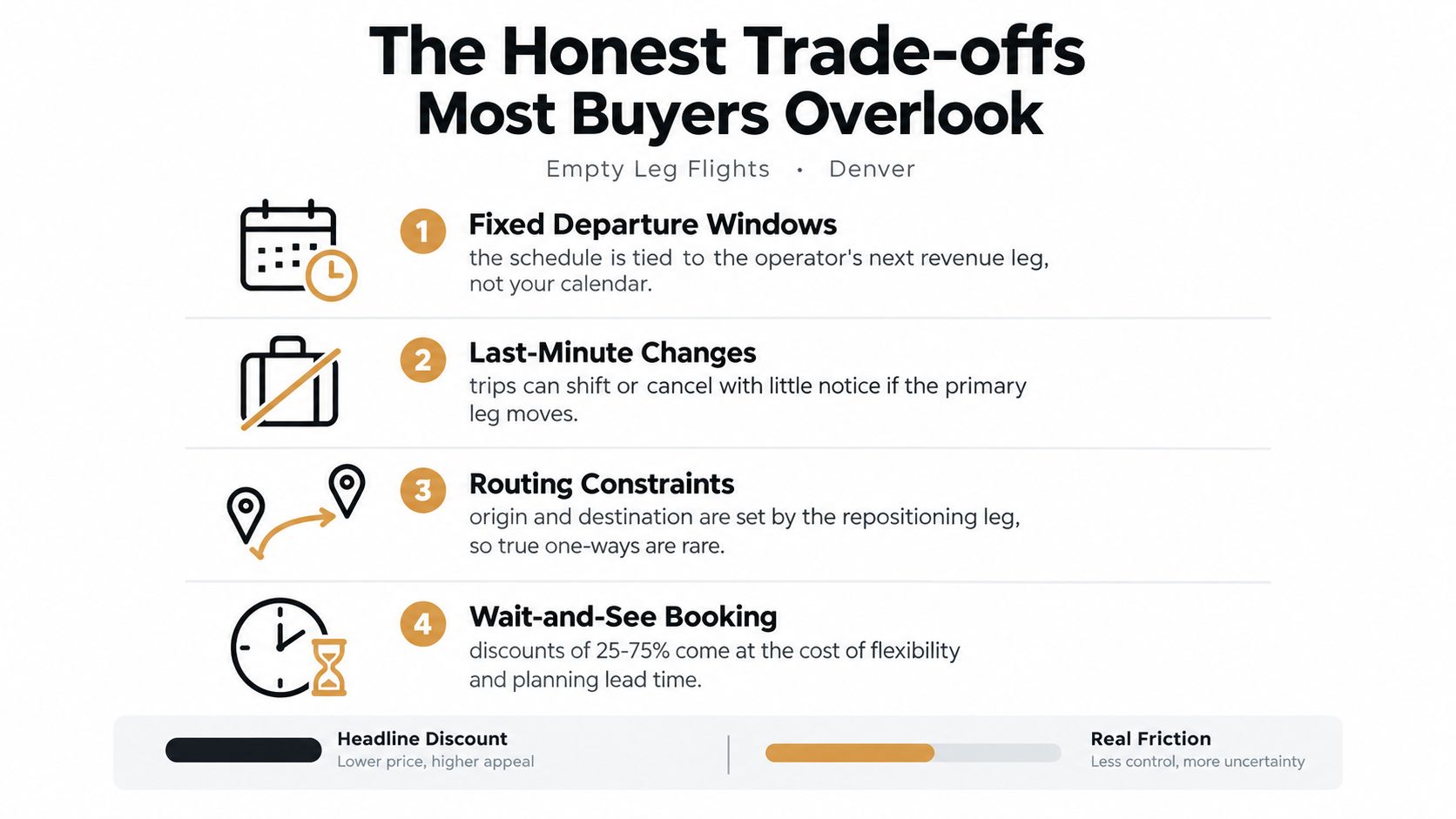
The discount is real, but so is the friction. An empty leg follows the operator's next revenue requirement, not the passenger's preferred itinerary, so the departure time, FBO, and even the departure airport can change after the initial quote.
The schedule belongs to the aircraft
If the originating charter moves, your empty leg may move or disappear. If the primary passenger cancels, the repositioning sector may no longer exist. Depending on the contract, the buyer may receive a refund, a partial refund, or a rebooking option that carries a fee. Never assume the discount includes schedule protection.
Routing is equally restrictive. Denver to Aspen may be available because the aircraft must reach Aspen, but Aspen to Denver isn't automatically available afterward. Adding a stop usually turns the arrangement into a conventional charter because the aircraft must follow a different operational plan.
Comfort still has limits
The aircraft's baggage capacity applies whether you occupy one seat or every seat. A four-passenger light jet still has light-jet luggage limits, and a larger group may need a different category even if the published price looks attractive.
Pet requests, preferred catering, ground transport, and specific Wi-Fi requirements can be difficult to add to a posted sector. The aircraft may already be positioned, stocked, and crewed for another client, leaving little room for customization.
The right question isn't “How large is the discount?” It's “Can I accept the aircraft's plan without needing to rewrite it?”
That question separates a genuine bargain from a frustrating purchase. Empty legs suit travelers who value access and price over control. They work poorly for anyone whose meeting, connection, luggage, or return flight can't move.
When an Empty Leg Makes Sense and What to Do Next
Empty-leg flying is one tool in a Denver private aviation plan, not a universal replacement for on-demand charter. It makes the most sense when your schedule can move with the aircraft.
Three situations deserve a serious search:
- Flexible ski travel: A weekend to Aspen, Telluride, or Eagle works well when you can shift departure by a day or more and accept whichever Denver-area airport appears.
- One-way business travel: A trip to Houston, Dallas, or Phoenix can fit when you need reliable outbound access but can arrange the return separately.
- Shoulder-season leisure: California coastal destinations can be attractive when you can accept the available aircraft and don't require a specific departure slot.
A standard charter is usually the better tool for a tight round trip, a multi-leg itinerary, a larger cabin requirement for more than eight passengers, or travel during a peak holiday period when waiting for an empty sector creates too much risk. It also makes more sense when a client needs a particular aircraft, fixed catering, guaranteed ground transport, or a confirmed return.
A practical Denver search plan
Define a date window of at least three days, then shortlist three to five acceptable airports and destinations. Include Centennial, Rocky Mountain Metropolitan, and Fort Collins-Loveland if they work for your ground itinerary. Ask the broker to compare the empty leg with a same-day on-demand charter rather than evaluating the discount in isolation.
Request operator records through ARGUS or Wyvern, confirm the refund policy in writing, and ask when the tail number, crew, and final schedule will be confirmed. If the empty leg requires compromises that create additional ground travel or a risky return, the standard charter may have the lower total cost in time and stress.
The best Denver buyer stays flexible on date, aircraft, and airport while staying strict on safety documentation and contract terms. That combination lets you use the market's volatility without allowing it to dictate an unsafe or impractical trip.
Haute Jets can source Denver empty-leg opportunities and compare them with on-demand private charter options, without requiring a membership or jet card. Visit Haute Jets with your preferred route, flexible date window, and acceptable Denver-area airports, then request a documented quote comparison before placing a deposit.