

The popular advice is simple: find an empty leg to Miami, take the advertised discount, and enjoy private aviation for a fraction of the usual price. That advice is incomplete. An empty leg isn't automatically a bargain. It's a fixed aircraft movement with a discounted price, and the value can disappear when the departure time, airport, or route doesn't fit your plans.
Miami makes that distinction especially important. The city generates substantial repositioning traffic, but inventory is uneven across Miami International, Opa-locka, Fort Lauderdale, Palm Beach, and Miami Executive. One live source reported 135 empty legs touching Miami at a single snapshot, with 71 departures and 64 arrivals. Another reported 197 empty-leg flights departing Miami on one day, while an airport-specific page showed only 6 live deals compared with 159 across the broader Miami metro area. Those figures come from different live snapshots, so they shouldn't be treated as a permanent count. They do prove the operational point: availability changes quickly and airport coverage matters.
The right question isn't, “How much is the discount?” It's, “How much flexibility am I trading for that discount?” This guide explains how to evaluate empty leg flights to Miami, where to search, when the economics make sense, and when a normal charter is the smarter purchase.
The Empty Leg Promise That Almost Nobody Questions
Empty legs are often marketed around savings of 25% to 75% versus standard charter pricing, a range cited by industry market guides such as this overview of empty-leg flight statistics. That headline is attractive, but it encourages the wrong comparison. A discount only has value if the flight's timing and routing work for you.
An empty leg exists because the aircraft already needs to move. It may be returning to base, heading to maintenance, or repositioning for a later charter. The operator isn't creating a new trip around your preferred schedule. The aircraft's movement comes first, and your booking becomes possible only if your plans fit the existing itinerary.
That means the listed price usually reflects the operator's need to cover a flight that would otherwise operate without passengers. It isn't a guaranteed measure of what you would have paid for a comparable charter built around your preferred departure. If the leg forces you to leave a day early, use a distant airport, or book an overnight hotel, the discount may be less meaningful than it looked online.
Miami magnifies the tradeoff
South Florida is a major private aviation hub, so the region produces frequent aircraft movements. The same concentration creates more opportunities, but it also creates uneven inventory. A Miami-bound leg might depart from New York, arrive at Fort Lauderdale Executive, and disappear when the originating charter changes.
The complete guide to what an empty leg flight is is useful for understanding the basic model, but Miami buyers need a stricter test. You should value the schedule first, the aircraft second, and the discount third.
Practical rule: If you can't move your departure time, airport, or travel date, don't treat an empty leg as your primary plan.
The strongest empty-leg buyer is flexible, decisive, and comfortable with a one-way opportunity. The weakest buyer has a fixed meeting, a wedding, a cruise departure, or a connecting itinerary that can't absorb disruption. In Miami, the cheapest available aircraft can become the most expensive choice once schedule risk enters the calculation.
Why Miami Has More Empty Legs Than Almost Any Other City
An empty leg is a one-way repositioning flight without passengers. The jet still has to move because its next assignment, maintenance requirement, or return-to-base plan requires it. The operator may sell that existing movement rather than fly the aircraft with an empty cabin.
Miami attracts this activity because several private aviation patterns overlap. Aircraft arrive from the Northeast, move through South Florida for leisure and business travel, continue toward Latin America or the Caribbean, and reposition between the area's many airports. Miami International, Opa-locka, Fort Lauderdale Executive, Miami Executive, and Palm Beach each serve different operating needs, so “Miami” is better understood as a metro network than a single airport.
The traffic patterns that create inventory
Northeastern aircraft frequently reposition toward South Florida during high-demand leisure periods. Caribbean and Latin American routes also generate aircraft movements through the region, while larger aircraft may reposition toward Fort Lauderdale for servicing or onward international operations. These movements don't create predictable airline-style schedules. They create opportunities that appear when a particular operator has an imbalance to solve.
That explains why Miami usually offers deeper inventory than a secondary city. A smaller market may have occasional repositioning flights, but it won't necessarily have enough inbound and outbound activity to produce a steady stream of usable options. One live market snapshot recorded 135 Miami-touching empty legs, divided between 71 departures and 64 arrivals, which illustrates how concentrated the available movement can be at a given moment. See the Miami private jet charter market for the broader airport and charter context.
The busiest departure corridors from Miami in that market data were New York, Los Angeles, and Houston. Those routes make operational sense because they connect Miami with major business and leisure gateways, but they don't guarantee availability on your date.
Why the inventory remains volatile
Operators release empty legs only after the primary charter or aircraft schedule creates a repositioning requirement. If that underlying trip changes, the empty leg can move, reroute, or vanish. That's why a listing board is a lead source, not a promise.
Search the entire South Florida corridor rather than MIA alone. A Miami-bound traveler who accepts OPF, FXE, TMB, or another nearby airport will usually have a better chance than someone demanding one terminal and one arrival time.
What Empty Leg Flights to Miami Actually Cost
Price depends on the aircraft class, route, timing, and the operator's repositioning requirement. A 2026 industry report gives broad empty-leg operating benchmarks of $1,000 to $4,500 per flight hour for light jets, $2,000 to $6,000 for midsize jets, and $3,500 to $9,750 for heavy jets. Those figures are not fixed Miami fares, and they shouldn't be presented as a quote for a specific itinerary. They show why aircraft category matters before you compare offers.
For Miami planning, New York to Miami is a useful reference corridor. A commonly cited benchmark places that route at roughly $7,000 on an empty leg versus $15,000 or more for conventional charter, implying more than 50% savings in that example. The published benchmark appears in the 2026 empty-leg market report, but the actual price can change with aircraft availability, airport, date, and passenger requirements.
Use the aircraft category as your first filter
The following ranges are the figures requested for this planning comparison. They should be treated as editorial planning ranges, not guaranteed quotes. The source material supports the New York to Miami benchmark and aircraft-hour benchmarks, but it doesn't independently verify each route-level class range below.
| Aircraft Class | Empty Leg Price Range | Discount vs. Full Charter |
|---|---|---|
| Light jet | $8,000 to $15,000 | Typically below full charter, with the exact discount varying by leg |
| Midsize jet | $12,000 to $22,000 | Typically below full charter, with the exact discount varying by leg |
| Super-midsize jet | $18,000 to $30,000 | Typically below full charter, with the exact discount varying by leg |
| Heavy or long-range jet | $28,000 to $55,000 | Typically below full charter, with the exact discount varying by leg |
The table's price bands should never override a live operator quote. A heavy aircraft may appear at a compelling rate, but if you only have a small group, its total cabin price may still be excessive. Conversely, a midsize aircraft can make strong sense when the group fits comfortably and the departure window is acceptable.
Why first-class comparisons miss the point
Empty legs are generally sold as the whole aircraft, not as individual seats. That makes the economics different for groups, particularly when several passengers are sharing the cabin. A first-class comparison can understate the value of privacy, airport access, baggage control, and schedule compression, but it can also hide the fact that you must pay for the entire aircraft.
Seasonality changes the calculation. December through April can bring heavier demand and tighter availability, while May through November may produce more opportunities when operators need to reposition aircraft. Don't assume a low advertised fare remains low after ground transfers, hotels, changed return arrangements, or a required backup flight.
The empty-leg glossary makes the operational limitation clear: the operator controls the route and schedule, and the underlying charter can change. Your real cost is the quoted aircraft price plus the consequences of accepting a schedule that doesn't match your trip.
How to Find and Book Empty Leg Flights to Miami
Booking an empty leg requires a different workflow from ordering a conventional charter. You aren't commissioning an aircraft. You're matching your plans to an aircraft that already has somewhere to be.
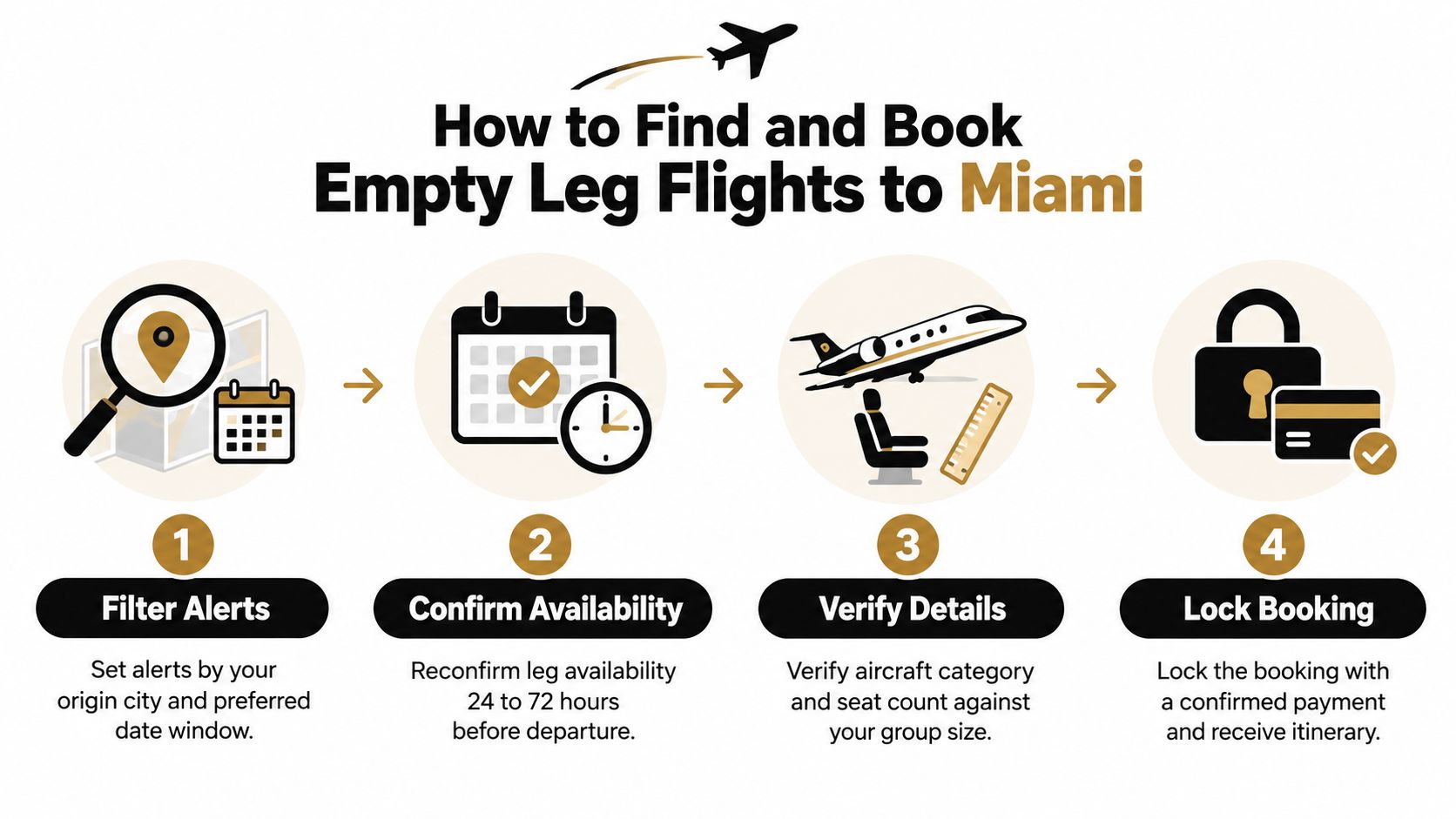
Start broad, then narrow quickly
Set alerts for your origin city, Miami metro airports, and a realistic date window. Search inbound and outbound movements separately. If you're looking for a flight into Miami, don't restrict the search to MIA. Include Opa-locka, Fort Lauderdale Executive, Miami Executive, and Homestead when the ground plan allows it.
Live inventory reviewed for Miami showed a sharp difference between airport-specific and metro-wide coverage. One page displayed 6 live deals for a single Miami airport, while a broader Miami page showed 159 live deals. Those counts are snapshots, not a standing inventory promise, but they demonstrate why airport filtering can hide usable aircraft. The Miami empty-leg listings illustrate the need to inspect coverage rather than assume the airport name tells the whole story.
Empty legs may appear well ahead of departure, but many are only actionable inside 24 to 48 hours, according to industry reporting. Some inventory can surface earlier, yet the operator may not confirm the final schedule until the primary charter is stable. Treat early listings as possibilities, not locked itineraries.
Confirm the details that cause failures
Before paying, ask for the aircraft category, passenger capacity, departure airport, arrival airport, estimated departure window, luggage limitations, and cancellation terms. Confirm whether the aircraft can carry your entire party without splitting the group. Whole-aircraft inventory doesn't help if the cabin or baggage capacity doesn't fit.
You also need a ground plan. OPF, FXE, TMB, and X51 serve different parts of South Florida, and the “Miami” label can conceal a substantial transfer requirement. Price the car service and travel time before you accept the aircraft.
Finally, confirm the operator's repositioning timeline. Ask what happens if the originating charter moves, how quickly you'll be notified, whether payment is refundable or transferable, and what backup options the broker can offer. Empty-leg payment terms may require a fast deposit because the operator is trying to fill an existing movement, not hold an aircraft for an extended negotiation.
Booking discipline: Never release your backup plan until the operator confirms the itinerary and explains the change policy in writing.
Where to Source Miami Empty Leg Inventory
There are three practical sourcing channels, and each solves a different problem. Alert platforms provide breadth, brokers provide coordination, and direct operator relationships can provide access to inventory that isn't publicly listed.
Compare the channels before you commit
| Channel | Notification Speed | Price Markup | Best For |
|---|---|---|---|
| Dedicated alert platforms | Fast alerts, with speed depending on membership tier and listing release | Pricing structure varies by platform | Travelers who can act quickly and accept changing inventory |
| Broker networks | Fast when the broker has an active operator relationship | Some market commentary cites 5% to 10% broker margin, though the actual structure varies | Buyers who want one contact to compare aircraft, airports, and backup options |
| Direct operator relationships | Potentially immediate for repeat clients and preferred accounts | May reduce intermediary layers, but terms vary by operator | Frequent flyers who value priority matching and already know trusted operators |
Dedicated platforms such as JetSuiteX, Victor, and PrivateFly can make discovery easier. Their weakness is accountability. A listing may show an attractive route, but you still need to identify the operating carrier, verify the aircraft, and understand who controls the final confirmation.
Broker networks, including Clay Lacy, Apollo Jets, and Air Charter Service, can be useful when your requirements are complex. A broker can compare OPF, FXE, MIA, and nearby airports while arranging transfers and fallback charter options. The extra coordination may justify the margin when a cancellation would disrupt a corporate or family itinerary.
Direct operator contacts work best for repeat travelers. Operators at OPF, FXE, and MIA may share emerging availability with preferred clients before publishing it broadly. That access isn't guaranteed, and it requires you to maintain relationships, understand safety credentials, and manage the booking details yourself.
The guide to flying privately into Opa-locka and its premier FBOs helps explain why airport choice matters. Same-day Miami legs are most likely to appear through active alerts or a broker already monitoring local movements. Direct relationships can surface opportunities quickly, but only if the operator's schedule fits your route.
I recommend alerts for spontaneous leisure travel, a broker for time-sensitive or multi-airport planning, and direct relationships for frequent flyers who repeatedly use South Florida.
Real Scenarios for Booking an Empty Leg to Miami
The cleanest way to understand the tradeoff is to look at how the booking behaves in real situations. The savings are never separate from the schedule. Flexibility creates the opportunity.
A December holiday traveler leaving Aspen wants Miami on Friday. A Challenger 300 becomes available on Tuesday at a price representing a 60% saving, but the traveler refuses to move the departure. That isn't a successful empty-leg booking. The aircraft is cheap because the traveler accepts the operator's schedule, and the Friday requirement eliminates the core condition that created the discount.
An Art Basel attendee has more flexibility. A Citation Latitude from Teterboro becomes available 36 hours before departure, and the traveler can leave on short notice. The booking works because the origin, aircraft category, group size, and arrival window align. The traveler isn't buying a guaranteed Friday-to-Sunday transportation plan. They're accepting an opportunity that happens to serve the event.
A corporate team of eight has a different calculation. A repositioning G450 converts a conventional $38,000 charter into a $12,000 leg. That price gap is meaningful, but only if the team can accept the fixed departure window, the aircraft's route, and the risk that the underlying charter changes. For eight passengers, whole-aircraft pricing can be more compelling than a per-seat comparison with commercial first class, but the group still needs a backup plan.
The schedule is the real price
Travelers who can move by 48 hours can access deeper discounts than travelers locked to a single departure date, based on the operational nature of empty-leg inventory. A fixed-date customer may end up paying close to a normal charter rate, waiting for a matching leg, or accepting an airport that creates additional cost.
The right calculation is simple. Compare the quoted saving with the cost of an extra hotel night, changed ground transport, missed meeting, replacement flight, or disrupted return. If the schedule change consumes most of the price difference, the empty leg didn't save money. It merely shifted the expense into less visible parts of the trip.
When an Empty Leg Wins and When It Backfires
An empty leg wins when the aircraft's existing movement fits your trip with minimal compromise. It backfires when you need the aircraft to behave like a conventional charter.
Book one when your dates are flexible, your group fits the available cabin, and you can accept South Florida airports beyond MIA. A departure-time window of more than four hours gives the operator room to adjust the movement without immediately destroying your plans. Empty legs also make more sense when Miami is your final destination and you don't need the same aircraft to return you.
Avoid one for a rigid business itinerary, a wedding, a cruise departure, or a multi-leg journey that requires precise positioning. Peak holiday periods, including New Year's Eve, can also reduce the chance of finding an attractive discount because operators may have strong demand for the aircraft. If cancellation would leave you without a workable replacement, the low fare isn't enough.
Printable decision checklist
- Date flexibility: Can you shift the trip without losing the purpose of travel?
- Time flexibility: Can you accept a departure change of more than four hours?
- Airport flexibility: Will OPF, FXE, TMB, or another South Florida airport work?
- Group fit: Does the aircraft accommodate everyone and their luggage?
- Route fit: Does the leg end where you need to arrive?
- Backup plan: Can you replace the flight if the underlying charter changes?
- Return plan: Have you arranged transportation back from Miami separately?
- Total cost: Have you included hotels, transfers, and schedule-related expenses?
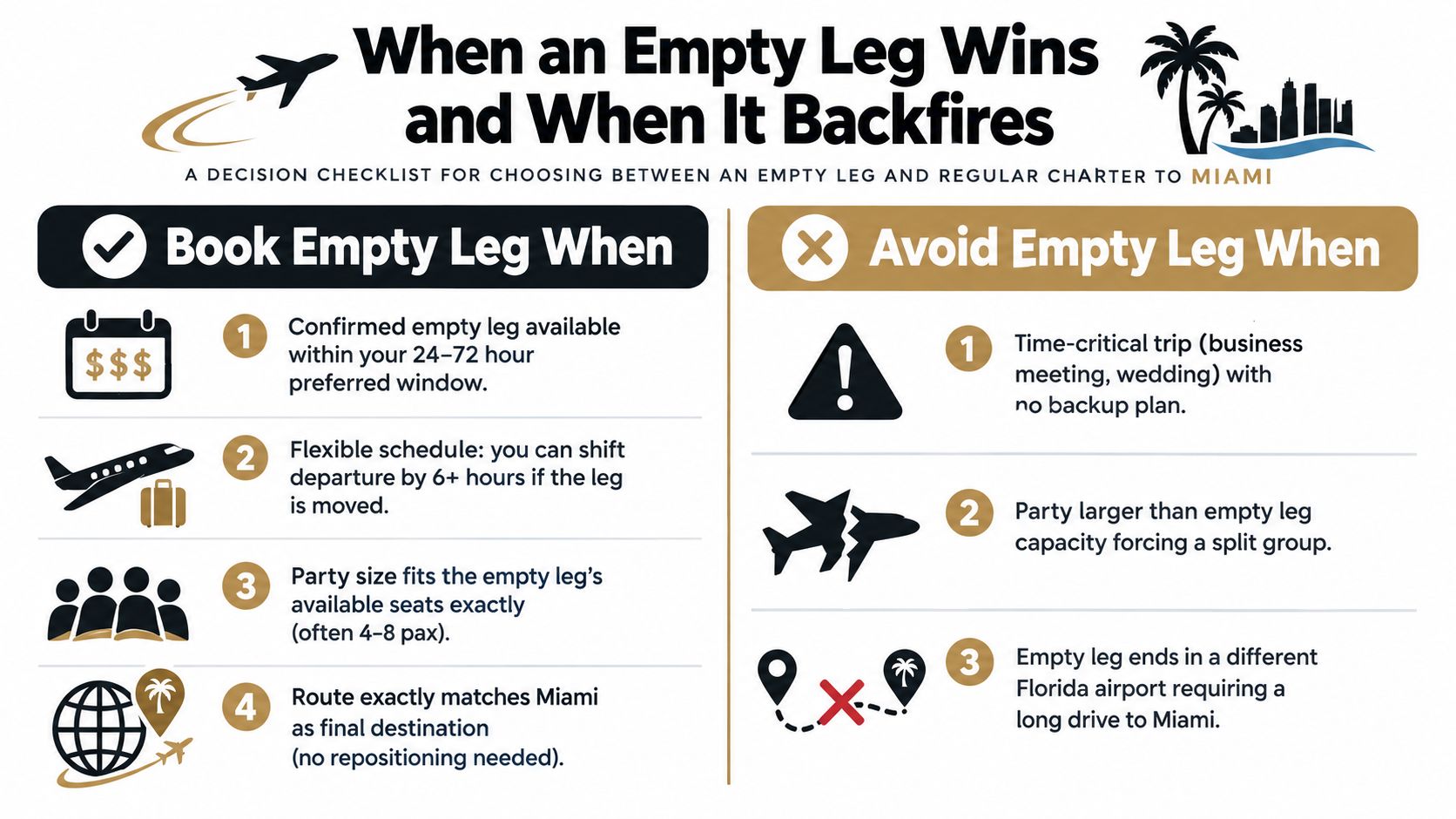
Assign your trip a flexibility score before searching. If you can move the date, accept alternate airports, fit the aircraft, and maintain a backup plan, search empty-leg inventory aggressively. If any of those conditions fail, request a regular charter quote at the same time.
Haute Jets can help you compare Miami empty-leg opportunities with on-demand charter options across its operator network, including flights that use South Florida airports beyond MIA. Visit Haute Jets with your origin, passenger count, preferred dates, and flexibility window, then ask for both the available empty legs and a reliable full-charter fallback.