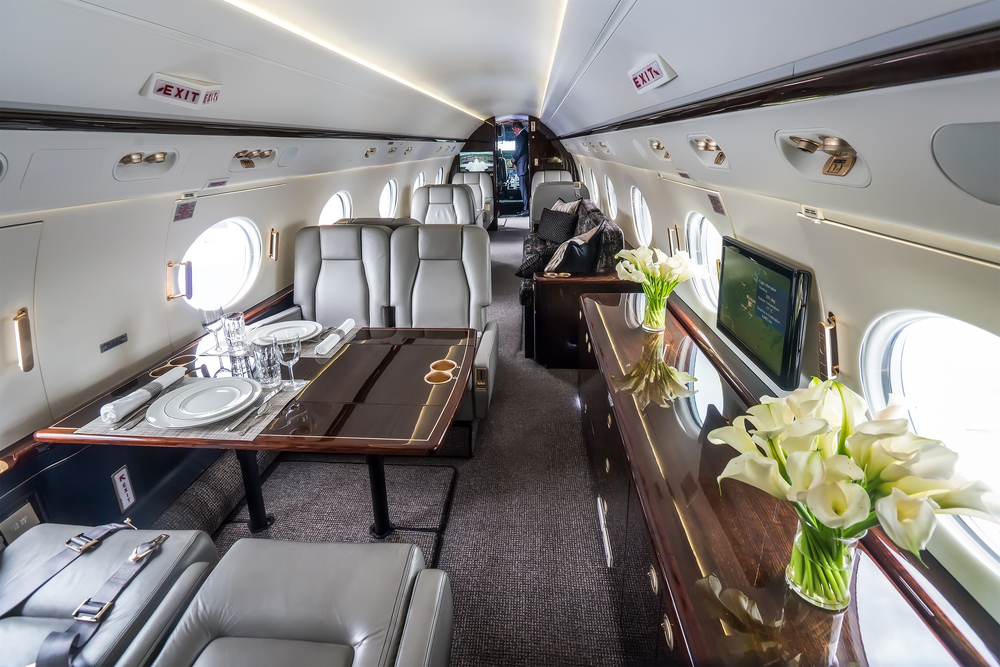
Booking a private jet is actually quite simple. You give your trip details to a charter provider, pick an aircraft from the options they send back, and then confirm with payment. The real trick is finding a provider like Haute Jets that knows how to source locally-based aircraft, which helps you sidestep extra fees and makes the whole experience more affordable than most people imagine.
Why Flying Private Is More Accessible Than Ever

When you hear "private jet," you might picture over-the-top luxury from a bygone era. But the reality of private aviation today is far more practical and efficient. The industry has evolved, leaving behind the stuffy, old-guard models for something much more dynamic, opening the doors for executives, entrepreneurs, and even families to fly on their own terms.
We're seeing a major move away from rigid, high-cost commitments like fractional ownership or restrictive jet cards. Those programs often lock you into a single fleet and come with significant annual fees, whether you fly or not.
The Rise of On-Demand Charter
The new industry benchmark is on-demand charter. It’s a straightforward, pay-as-you-fly model that gives you complete freedom. You can book a jet for a single trip with absolutely no long-term financial strings attached, and it’s this flexibility that’s driving the industry’s incredible growth.
And the market isn't just growing—it's booming. Valued at USD 16.38 billion in 2025, the private charter industry is on track to hit USD 25.79 billion by 2031. On-demand charters have already captured over 51% of the market revenue in 2025, proving that savvy travelers prefer efficiency and freedom. You can dive into the full industry growth report to see just how fast this trend is accelerating.
This model is perfect for all kinds of travel needs:
- Business Agility: Imagine an executive team hitting three different cities for meetings in one day. That’s simply not possible flying commercial.
- Personal Convenience: Families can travel without stress, bringing pets in the cabin, bulky ski gear, or extra luggage without a second thought.
- Urgent Travel: When time is critical for a family emergency or a last-minute opportunity, a private jet can be wheels-up in just a few hours.
Avoiding the Biggest Hidden Cost
One of the most important cost-saving developments in on-demand charter is the ability to dodge repositioning fees. These nasty surprise charges pop up when your broker books a jet that isn't based near your departure city. You end up paying for that empty flight to come pick you up, which can inflate your bill by 20-40%.
The secret to avoiding this is working with a provider who has deep market access. At Haute Jets, we tap into a vast, live network of owner-operated aircraft to find a jet that’s already parked near your departure point. This eliminates repositioning fees and ensures you get true, direct pricing.
This local sourcing strategy is a complete game-changer. It means you can book your flight knowing you’re only paying for your trip—not the logistical headache of ferrying an empty plane across the country. It’s all about making private aviation smarter, more efficient, and finally, truly accessible.
Matching the Right Aircraft to Your Mission

Before you get caught up in specific models or cabin layouts, the first—and most important—step is to define your mission. The goal isn't just to find a jet; it's to find the right jet for your exact trip. Taking a "mission-first" approach is what separates a good flight from a seamless, perfectly executed experience.
This really comes down to a few key questions that act as a filter, instantly narrowing the market from thousands of planes to the handful that truly fit your needs.
Defining Your Mission Parameters
A good charter advisor will walk you through these, but having the answers ready will make the process infinitely faster.
- Who is flying? The number of passengers is the most obvious starting point.
- Where are you going? This determines the required flight range. A non-stop flight is always the goal, so the aircraft must have the legs to make it without a fuel stop.
- What airports are you using? Smaller, regional airfields can have shorter runways or weight restrictions, which can limit the size of aircraft that can safely operate there.
- What do you need on board? Think about the purpose of the flight. Do you need a quiet cabin and high-speed Wi-Fi to conduct business? A full galley for a specific dining experience? Or maybe you just need to make sure the family pet is welcome.
Think of this not as a checklist, but as building a profile of your ideal flight. When you provide this level of detail, your charter advisor can source options that are genuinely right for you, not just what happens to be available.
With this profile in hand, you can start looking at the different classes of aircraft and see which one aligns with your mission.
Choosing the Right Jet Category
Private aircraft are grouped into categories based on their size, range, and amenities. For a complete breakdown, our guide to understanding private jet types is a great resource, but the categories generally tell you what kind of mission an aircraft is built for.
Light jets, for example, are seeing a huge surge in popularity for regional travel, with a projected 7.92% CAGR. Efficient models like the Embraer Phenom 300 are making private flights more accessible for everything from executive day trips to urgent medical transport.
The industry as a whole is expanding. Forecasts show a demand for 8,500 new business jets by 2035, a market valued at nearly $280 billion. North America is expected to receive 66% of these new aircraft, a testament to the region's robust demand. You can dig into the numbers yourself in the full private jet market analysis on GlobeNewswire.
Private Jet Category Comparison
Use this quick-reference guide to select the ideal aircraft category for your trip based on key mission parameters.
| Jet Category | Typical Passenger Count | Approx. Range (Nautical Miles) | Best For |
|---|---|---|---|
| Turboprops | 4-8 | 1,500 | Short, cost-effective trips to smaller airports. |
| Light Jets | 6-8 | 2,000 | Regional business meetings or family getaways. |
| Midsize Jets | 7-9 | 3,000 | Coast-to-coast flights with more cabin comfort. |
| Heavy Jets | 10-16 | 6,000+ | International travel with stand-up cabins. |
This table gives you a solid starting point for understanding which category fits your flight.
Just remember that with a modern charter provider like Haute Jets, you aren’t limited to just a category. You have the ability to pinpoint the exact make, model, and year of manufacture you prefer. This ensures the cabin layout, technology, and overall feel of the aircraft are precisely what you had in mind.
Decoding Charter Costs and Eliminating Hidden Fees
When you get a quote for a private jet, you need to know exactly what you’re paying for. A good charter quote isn’t just one big number—it’s a clear, itemized breakdown of all the costs involved. Getting this transparency upfront is the only way to make sure there are no surprises when the final bill arrives.
The bulk of your cost, of course, comes from the aircraft's hourly rate. This covers the big-ticket items like fuel, crew salaries, and maintenance. But several other line items, both required and optional, will round out the final price.
Breaking Down the Core Costs
Every quote you see will have a few standard components built in. Once you know what to look for, you can quickly assess whether you're getting a complete picture. Beyond the aircraft's base hourly rate, you should always see:
- Federal Excise Tax (FET): This is a mandatory 7.5% tax on all domestic flights within the United States. It's non-negotiable.
- Landing and Handling Fees: Airports charge for everything from using the runway to parking and FBO services. These can vary dramatically from a small regional airfield to a major international hub.
- Segment Fees: A small per-passenger tax applied to each leg of your journey.
- Catering and Amenities: Anything you request beyond the standard onboard stock—think specific champagne, a multi-course meal, or premium Wi-Fi—will appear here.
A trustworthy provider won't hide anything behind vague "service charges." They’ll give you a detailed breakdown so you can see precisely where every dollar goes.
Understanding these details is the first step to becoming a savvy flyer. You can dig even deeper with our complete guide to private jet charter pricing.
The Number One Hidden Fee to Eliminate
Of all the potential charges, the most frustrating and expensive one is the repositioning fee. It's also the most avoidable.
This fee gets tacked on when your broker books a jet that isn't based near your departure airport. You end up paying for that aircraft to fly empty—what we call an "empty leg"—just to get to you. It's like paying a taxi driver for their commute to your house.
These fees can easily inflate your total cost by 20-40%, turning a good deal into a needlessly expensive trip. It’s a common problem when working with brokers who have a limited network or are pushed to sell specific aircraft.
The simplest way to sidestep this is by using a service with direct, real-time access to a wide range of aircraft. At Haute Jets, we tap into a network of local owner-operators, which means we can almost always find a plane already positioned at or near your departure city. This approach completely dodges the 20-40% repositioning markups you'll see elsewhere. You get a direct, pay-per-flight wholesale rate without memberships or pre-paid hours, a trend noted in recent private aviation activity analysis.
It's a smarter, technology-driven way to book that puts efficient, transparent pricing first. You're not just chartering a flight; you're accessing the most cost-effective option for your specific trip.
Vetting Operator Safety Before You Book
While the perks of private aviation are undeniable—the comfort, the privacy, the speed—none of it matters if the flight isn't safe. Safety is the bedrock of this industry. It's the one non-negotiable element that underpins every single trip.
But as a client, how can you be sure the operator you're choosing meets the highest standards? You aren't expected to be an aviation mechanic or a regulatory expert. That's where independent, third-party safety audits come into play. These aren't just a glance at a company's paperwork; they are deep, rigorous evaluations of an operator's entire culture, from pilot training and maintenance records to their internal safety management protocols.
The Gold Standard in Safety Ratings
When it comes to these audits, two names carry all the weight in the industry: Wyvern and Argus. If an operator has earned a top rating from one of these organizations, it tells you they’ve voluntarily gone above and beyond the standard government regulations.
They've invested significant time and money to prove their commitment to safety. Here’s what to look for:
- Wyvern Wingman: This is Wyvern's highest seal of approval. It means the operator has successfully passed an exhaustive on-site audit, confirming they adhere to the most stringent safety and operational practices.
- Argus Gold & Platinum: Argus uses a tiered system. A Gold rating is a solid mark, based on a thorough review of the operator's safety history. The Platinum rating, however, is the pinnacle. It requires a comprehensive, in-person audit to verify that their processes are not just documented but flawlessly executed.
Think of these ratings as an objective seal of approval. They provide data-backed assurance that you are flying with an operator who has a proven, top-tier safety infrastructure and culture. It’s genuine peace of mind.
This isn't just a "nice-to-have"—it's a critical checkpoint in the booking process. At Haute Jets, for example, we have a strict policy: every operator in our network must hold a current Wyvern Wingman or Argus Platinum rating. There are no exceptions.
This mindset of diligence extends beyond just air travel. Whether you're booking a jet or a bus, the core principle remains the same, which is why vetting operator safety is a universal best practice for any charter service.
By insisting on an operator with these elite credentials, you're doing more than just feeling safer—you're making an informed choice to fly with the absolute best in the business. To really get into the details, our guide to Wyvern and Argus safety ratings is an essential read for any serious private flyer.
Navigating Your Flight Day from Arrival to Takeoff
This is where all the planning pays off. Flying private completely changes what a travel day feels like, starting with the moment you arrive. Forget the commercial airport chaos—you’ll be heading to a private terminal, known as a Fixed-Base Operator (FBO), and you only need to show up 15 to 20 minutes before takeoff.
That relaxed arrival window is a game-changer. There are no long security lines to snake through or crowded gates to navigate. You’re greeted personally, your bags are handled for you, and you move through a quick, discreet security screening in just a few moments.
Your Pre-Flight Checklist
The day before you fly, usually about 24 hours out, your charter provider will send over a complete pre-flight itinerary. This document clears up any final questions and lets you know everything is locked in. It should always include:
- Tail Number: The registration number of the exact aircraft you'll be flying on.
- Crew Bios: A little background on your pilots, which is always a nice touch for peace of mind.
- Passenger Manifest: A final list confirming everyone in your travel party.
- Catering Details: A quick summary of your food and drink order.
- Ground Transportation: Confirmation for any car services you’ve arranged at either end of the trip.
Think of this pre-flight confirmation as more than just an itinerary. It’s the final green light, assuring you that every detail—from the Wi-Fi password to the specific brand of champagne you asked for—has been confirmed and is ready for your arrival.
We take this level of detail seriously. Long before you even book, we’re vetting every operator to ensure they meet our standards for safety and quality.
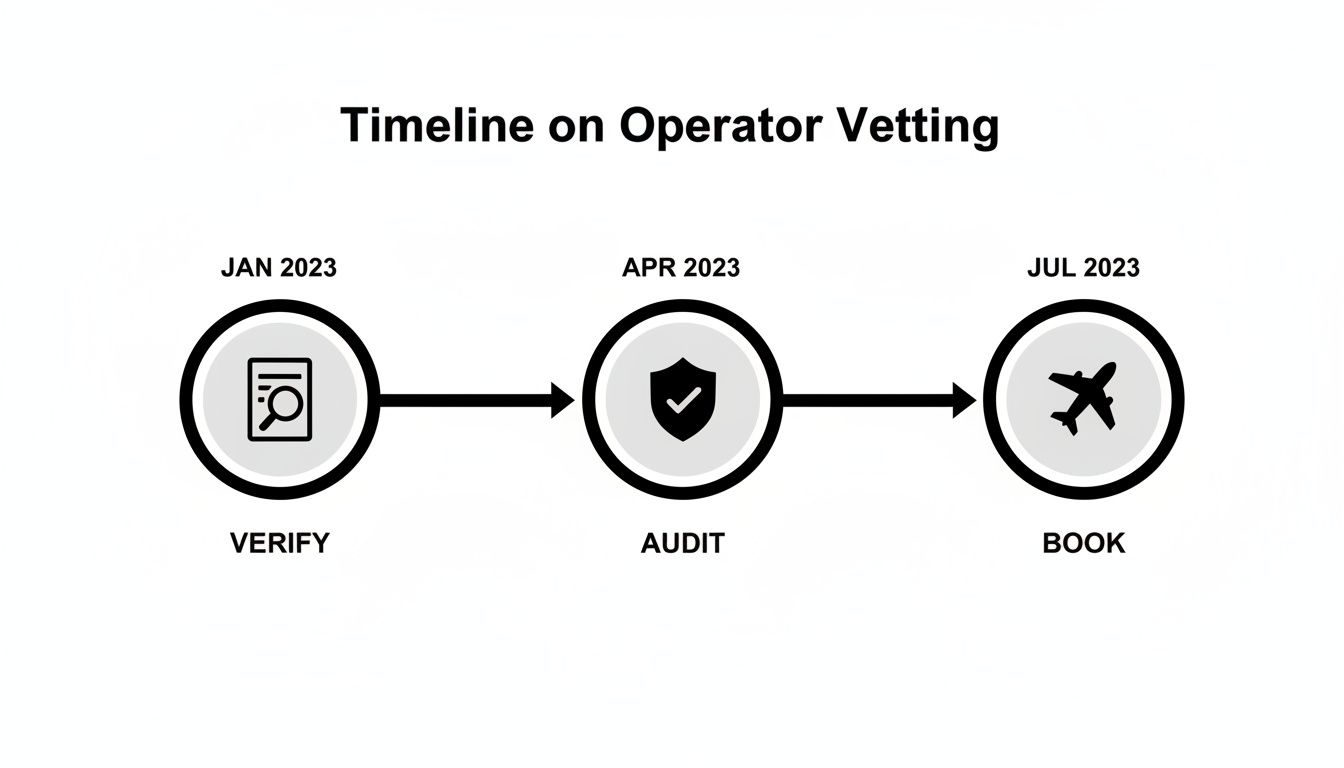
This process ensures that by the time you're ready to book, the groundwork for a safe, high-quality flight has already been laid.
From the FBO to the Aircraft
When you arrive at the FBO, you’ll be directed to a comfortable private lounge. Honestly, you probably won't spend much time there. Your captain will typically come out to greet you, give you a quick weather update for the flight, and see if you have any last-minute questions. From there, it’s a short walk or drive right to your aircraft.
This efficient ground experience is a cornerstone of private aviation, which is a surprisingly busy sector. Just look at the first week of 2026, when there were over 36,204 private jet departures globally. North America led the pack with 27,308 of those flights, which really speaks to how common this mode of travel is. You can dig into these trends in the latest private jet industry analysis.
Once you're on board, the crew will give a quick safety briefing, and then you're free to get comfortable. The door closes, the jet heads for the runway, and you’re in the air—often just minutes after you stepped onto the tarmac. The whole experience is built for efficiency, getting you to your destination feeling relaxed and ready to go.
Got Questions? We've Got Answers
Even after you’ve got the basics down, a few practical questions always pop up when it's time to actually book a jet. I get it. This is where the real-world details matter most. Let's walk through some of the common things clients ask me right before they pull the trigger.
How Far in Advance Should I Book?
My best advice? If you're planning to travel during a peak time—think the Super Bowl, Art Basel, or around Christmas—try to book 2-4 weeks ahead. It gives you the best shot at securing the exact aircraft you want at a fair price, especially if you have your heart set on a specific model like a G650.
But the beauty of on-demand charter is its flexibility. I've had clients call me on a Tuesday morning needing to be in London for a meeting that afternoon. We can, and often do, arrange flights for same-day departure. Unlike jet cards or fractional ownership, there are no blackout dates to worry about. If a plane is available, it’s yours.
Can I Really Pay with Cryptocurrency?
Yes, absolutely. We get this question a lot, especially from our clients in tech and international business. We make it easy to handle transactions securely with major cryptocurrencies.
For many, it’s simply a more convenient and private way to do business. We see it as just another part of offering a truly personalized service, from the initial quote all the way through to payment.
What Happens if My Aircraft Becomes Unavailable? It's rare, but it happens. A bird strike during a previous flight, a sudden mechanical flag from a sensor, or an unexpected crew issue can ground an aircraft at the last minute. This is precisely where a good broker's network becomes your safety net. Instead of scrambling, we immediately tap into our vetted network of over 3,500 Wyvern and Argus-rated aircraft to find a comparable—or even upgraded—replacement. We handle the logistics behind the scenes so your trip continues with little to no disruption.
Is a Round Trip Cheaper Than Two One-Ways?
For short trips, it almost always is. If you're flying out and back within 1-2 days, booking a round trip where the aircraft and crew wait for you is the most economical option.
Think of it this way: you’re only paying for the jet to fly one round-trip cycle. If you book two separate one-ways, you’re paying for two distinct flights, which often includes the cost of the aircraft returning to its home base after dropping you off (the dreaded repositioning fee).
When we look at your itinerary, we'll run the numbers for you. Whether it’s a true round trip, a multi-city tour, or two separate one-ways spread far apart, we’ll map out the most cost-effective structure for your specific trip. It’s one of the best ways we help clients optimize their budget.
Ready to see how simple this can be? The team at Haute Jets can put together a transparent, all-in quote for your next trip, finding the perfect aircraft from our global network of top-rated operators. Get your instant charter quote today.