
You're likely facing a familiar challenge. You need a jet that can handle a demanding business itinerary or a high-comfort leisure trip without pushing you into a larger cabin aircraft you don't need. You want nonstop capability on the routes that matter, a cabin that works for meetings or rest, and a charter process that doesn't bury avoidable costs inside a polished quote.
That's exactly where a challenger 350 charter makes sense.
I recommend the Challenger 350 when a client wants the sweet spot. It's large enough to feel substantial, fast enough to keep schedules tight, and efficient enough to avoid the waste that comes with overbuying aircraft. A significant mistake isn't choosing the aircraft. It's choosing the wrong way to source it.
Why the Challenger 350 Dominates Private Charter
You need to leave Teterboro tomorrow morning, add a same-day meeting in Chicago, and keep the option to continue onward without upgrading into a heavier, more expensive aircraft. In that situation, the Challenger 350 is usually the right tool. It gives you the range, cabin volume, and operating efficiency that make private charter practical instead of excessive.

Its position in the market is not marketing hype. Bombardier has repeatedly highlighted the Challenger 350 program's strong delivery pace and category leadership in its aircraft updates and press materials, which is why the jet remains one of the safest recommendations in super-midsize charter for clients who value proven demand and deep fleet availability. Popularity matters here for a simple reason. The more active tails in service, the better your odds of finding the right aircraft close to your departure point.
That last point affects your cost more than many clients expect.
Why clients keep choosing it
The Challenger 350 stays in demand because it fits real charter missions better than many alternatives in its class:
- It covers the trips people book: executive travel, family travel, multi-city schedules, and short-notice departures.
- It feels substantial without becoming wasteful: you get a true stand-up cabin and strong luggage capacity without paying heavy-jet operating economics on flights that do not require it.
- It is widely placed in charter fleets: that improves sourcing options and helps reduce avoidable ferry exposure.
- It supports a better onboard experience: the cabin features available on Haute Jets charters matter because comfort only has value if the aircraft category still makes financial sense.
My recommendation is straightforward. If you regularly fly with a small group and want one aircraft category that handles serious business travel without wasting money on unnecessary cabin size, start with the Challenger 350.
The real advantage is how you source it
Aircraft selection is only part of the decision. Sourcing strategy determines whether the quote is efficient or padded.
A traditional broker or jet card program often shows you a clean hourly rate, then adds repositioning cost because the assigned aircraft is not local to your departure airport. That is how a sensible super-midsize charter turns into an overpriced booking. A global, on-demand network such as Haute Jets changes the economics by sourcing from a broader pool of nearby certified operators, which cuts down on hidden ferry legs and gives you more accurate trip pricing from the start.
That is a material advantage, not a sales detail. On a Challenger 350 charter, local aircraft sourcing can preserve the value proposition that made you choose this jet in the first place.
Inside the Challenger 350 Cabin and Cockpit
The reason clients return to the Challenger 350 isn't just range. It's the onboard experience. This aircraft feels designed for people who use the cabin, not just compare specifications.
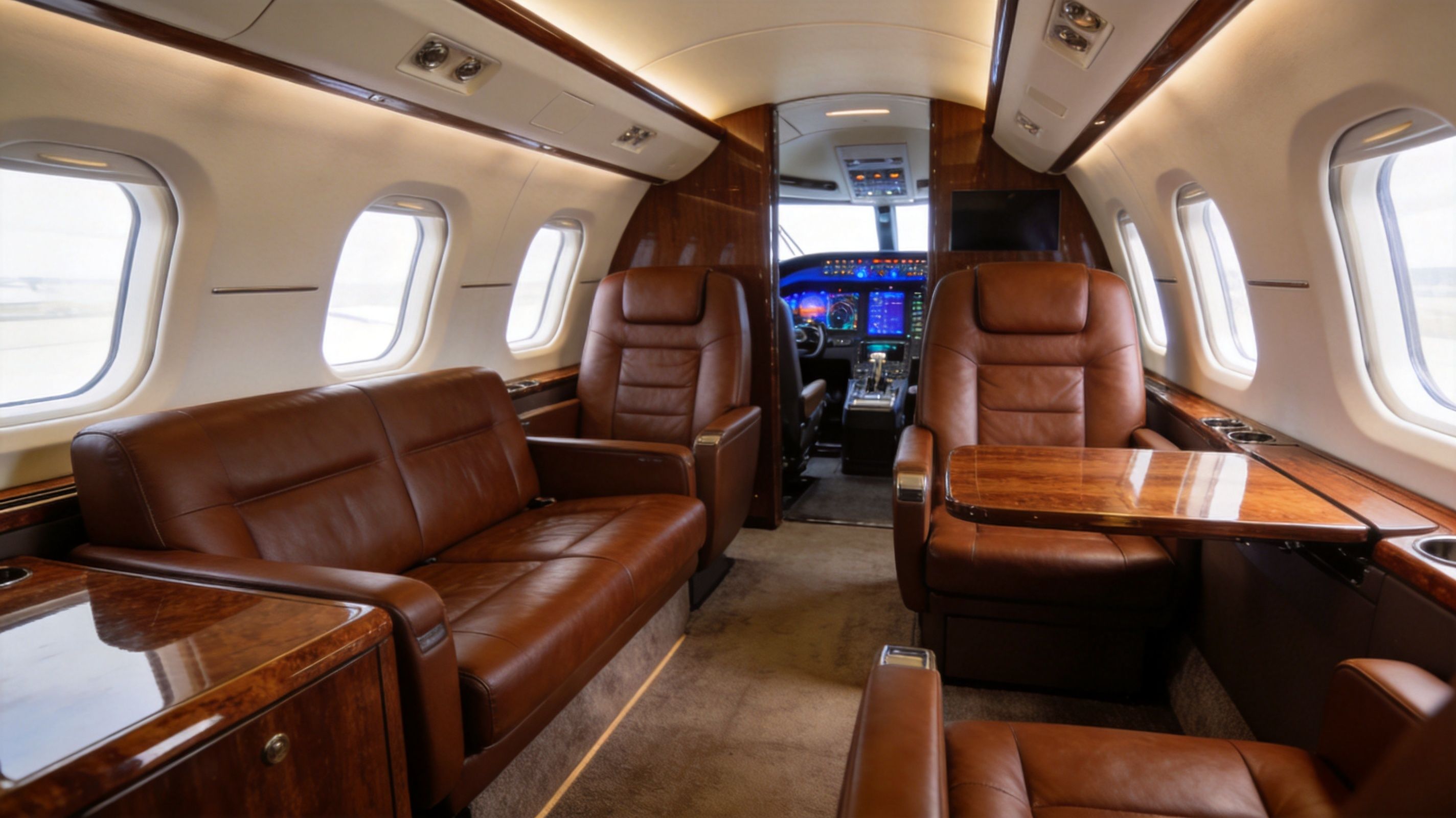
A typical configuration works well for eight to nine passengers. The cabin measures 28.5 feet in length, and the seating converts into up to four beds for overnight flights, based on the aircraft overview from Air Charter Advisors. That matters more than people realize. On a longer sector, the difference between “seat” and “sleep-capable seat” is the difference between arriving ready and arriving depleted.
What matters in the cabin
The cabin works because it gets the fundamentals right.
- Flat-floor layout: You can move through the aircraft comfortably. That sounds basic until you've spent enough time in cabins that force everyone into awkward posture.
- Real working environment: The space supports conversation, laptop use, and in-flight meetings without the cramped feel of smaller jets.
- Overnight practicality: Seat-to-bed conversion gives the aircraft more utility than many clients expect from this category.
- Baggage support: It can handle about 10 suitcases, which makes it workable for business travel, longer leisure trips, and mixed passenger needs.
For travelers comparing cabin details across categories, Haute Jets has a useful overview of private jet cabin features and what actually matters onboard.
Why the cockpit matters to you
Passengers don't need to memorize avionics names. You do need to understand what cockpit quality changes in practice.
The Challenger 350 uses the Rockwell Collins Pro Line 21 suite, with features that include synthetic vision and weather radar across much of the fleet, as discussed in the earlier source background on operator standardization. In plain English, that means better situational awareness for pilots and smoother decision-making in challenging conditions. You'll notice that as confidence, consistency, and fewer operational surprises.
The cockpit doesn't need to impress you with acronyms. It needs to help the crew make calm, accurate decisions when the weather turns or the destination gets demanding.
Here's a closer visual look at the aircraft:
My advice on cabin fit
Choose the Challenger 350 when you want one aircraft that can handle:
- A business team during the day.
- A couple or family on a comfort-first leisure trip.
- A mixed mission where baggage, productivity, and rest all matter.
That versatility is why this jet holds its value in charter planning.
Mapping Your Journey with Challenger 350 Range
Selecting a jet based on headline range is a common error, as travelers often discover the trip requires a fuel stop, a longer ground transfer, or a repositioning leg that increases the quote. The Challenger 350 succeeds because its performance matches the trips clients buy, and a global on-demand sourcing model enhances that benefit by locating an aircraft already positioned near your departure point.

Bombardier lists the Challenger 350 with a 3,200 nautical mile range under standard conditions, which puts it in a very useful operating band for premium charter clients who want transcontinental U.S. flying, many East Coast to Western Europe missions, and strong flexibility across the Middle East and Europe, according to Bombardier's Challenger 350 aircraft specifications. In practice, smart planning matters more than brochure optimism. Passenger count, bags, weather, runway limits, and alternates all affect what is realistic on a given day.
What the range means for your actual itinerary
Use the Challenger 350 for missions where nonstop capability saves meaningful time and avoids stepping up to a larger, more expensive jet class.
Good fits include:
- New York to London, with the usual caveat that westbound and payload-sensitive days require disciplined planning
- Los Angeles to Miami, where the aircraft gives you real cabin comfort on a long domestic leg
- Paris to Dubai, depending on winds, payload, and airport specifics
That is the right way to assess range. Start with the mission, not the marketing line.
Airport performance matters just as much
Clients often overpay because they focus on cabin category and ignore airport practicality. That is backwards.
The Challenger 350 is attractive because it can cover a wide band of missions while still working into airports that punish larger, less flexible jets or force inconvenient alternates. If your schedule includes mountain airports, resort destinations, or constrained business airports, field performance becomes a time and cost issue, not just an aviation detail. Every extra ground transfer adds friction. Every forced reposition adds cost.
This matters even more if you book through a network model like Haute Jets. Sourcing from a broad base of local operators improves the odds of matching the right Challenger 350 to the exact airport pair, instead of bringing in an aircraft from another market and passing that repositioning expense back to you. If you want a clear view of how those trip variables affect the invoice, read this breakdown of private jet charter pricing and cost components.
My view on route fit
I recommend the Challenger 350 for clients who want one aircraft type that covers three high-value use cases well.
| Mission type | Why the Challenger 350 fits |
|---|---|
| East Coast to Europe | Strong nonstop potential on the right day, with better economics than moving into a larger cabin class |
| Coast-to-coast U.S. | Enough range and comfort to keep the trip productive from wheels up to arrival |
| Resort and secondary-airport access | Better flexibility than many super-midsize alternatives, which can reduce total trip time door to door |
The economic advantage is straightforward. A jet with the right range and airport capability already positioned near you is usually the smarter buy than a bigger aircraft flown in from somewhere else. That is where on-demand global sourcing beats traditional broker habits and many fixed-program models. You are paying for your trip, not someone else's repositioning problem.
Understanding Challenger 350 Charter Costs and Savings
Many charter clients are misled by focusing solely on the hourly rate, only to be surprised when the final quote increases. The hourly figure represents only the starting point of the total cost.
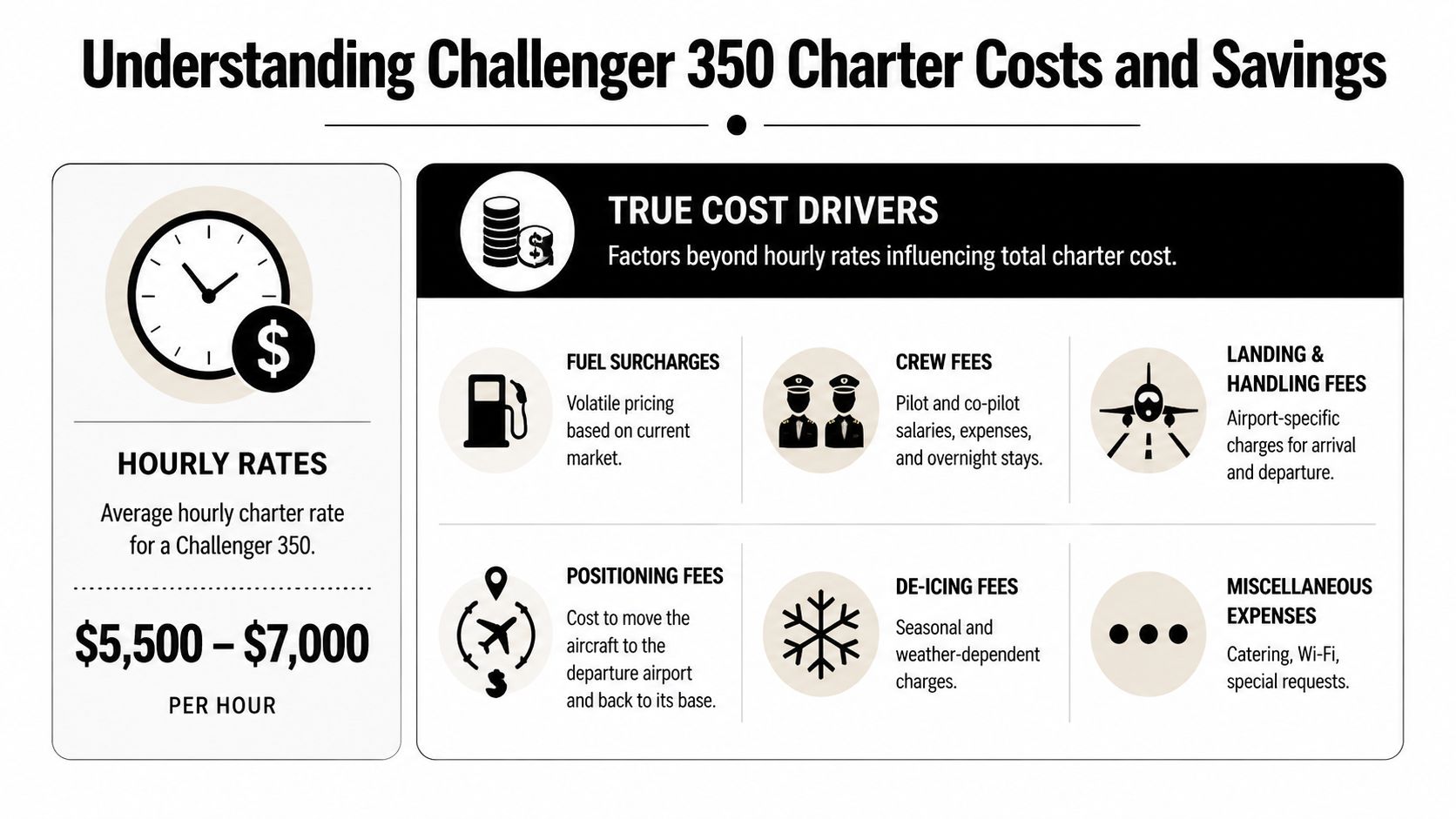
Typical Challenger 350 charter pricing averages around $5,950 per hour, but the final bill can increase by 20% to 40% when traditional brokers add repositioning costs. A sourcing model built around 3,500+ local owner-operators worldwide is designed to remove that inefficiency, as outlined in this analysis of Challenger 350 charter economics.
The hourly rate is real. It's just incomplete.
That average hourly rate is useful for rough budgeting. It is not a final trip price.
You also need to account for common cost drivers such as:
- Aircraft positioning
- Crew-related expenses
- Landing and handling charges
- Fuel-related adjustments
- Seasonal operational items like de-icing
- Catering, Wi-Fi, and special requests
For a broader look at how these variables shape private charter invoices, this Haute Jets Journal piece on private jet charter pricing and cost breakdowns is worth reviewing.
Repositioning is where clients overpay
Repositioning is simple. If the aircraft isn't already near your departure airport, someone has to pay to move it. Traditional brokers often pass that cost through to you. Sometimes it's explicit. Often it's buried inside the quote.
That's why two quotes for the same route can look wildly different even when the aircraft category appears identical.
Advisor's view: If you don't know where the aircraft is coming from, you don't know whether the quote is efficient.
A global, on-demand network changes that equation by sourcing an aircraft near your point of departure instead of chasing a tail from another market. That's the practical value of the Haute Jets model. It searches across a large owner-operator network to reduce or eliminate avoidable ferry costs rather than forcing clients into prepackaged card economics.
Traditional broker vs local sourcing
Here's the comparison I'd use with a client evaluating a challenger 350 charter:
| Cost Component | Traditional Broker Estimate | Haute Jets Estimate |
|---|---|---|
| Base flight time | Charged | Charged |
| Repositioning flights | Often added into quote | Reduced or avoided through local sourcing |
| Aircraft choice | Often category-based | Specific aircraft can be selected |
| Pricing model | Can include embedded inefficiencies | On-demand sourcing based on nearby availability |
| Membership obligation | Often tied to cards or programs | No membership required |
What this means for your trip
If you fly occasionally, prepaid jet cards often create the illusion of simplicity while hiding flexibility tradeoffs. If you fly frequently, they can still become expensive when your routes don't match the provider's fleet positioning.
I recommend judging every quote on three points:
- Where is the aircraft based relative to departure?
- Are you seeing the exact aircraft or only a category promise?
- Is the quote built around your mission or around a provider's inventory problem?
That's the difference between paying for a flight and paying for someone else's logistics.
Ensuring Your Safety with Certified Operators
Cost matters. Safety matters more.
Private aviation has a language problem. Too many clients hear terms like Wyvern Wingman and Argus Gold and assume they're just marketing labels. They aren't. They're independent third-party safety benchmarks that help separate serious operators from the rest of the market.
The Challenger 350 benefits from broad use among Wyvern-Wingman and Argus-Gold-rated operators, and its standardized Rockwell Collins Pro Line 21 avionics suite supports stronger crew availability and dispatch reliability for time-critical charter flying, according to Stratos Jets' Challenger 350 overview.
What those ratings mean
You don't need to become an auditor. You do need to know what to ask for.
- Wyvern Wingman: Focuses on operational safety standards, pilot qualifications, training, and procedural discipline.
- Argus Gold or higher: Reviews operator systems, records, and operational controls through an independent framework.
- Modern fleet standardization: A widely flown type like the Challenger 350 benefits from more consistent training and operational familiarity.
If you want a deeper explanation, Haute Jets has a clear primer on Wyvern and ARGUS safety ratings in private aviation.
Why the aircraft itself helps
The Challenger 350's safety proposition isn't only about the operator. The platform itself contributes.
A modern, standardized fleet reduces friction. Crews are more familiar with the type. Maintenance ecosystems are more mature. Dispatch teams see fewer surprises than they do with obscure or highly fragmented aircraft platforms. That doesn't eliminate risk. It improves consistency, which is what you want in business aviation.
Choose the operator first, then the aircraft, then the cabin details. Clients often reverse that order and make worse decisions.
My recommendation
Insist on audited operators. Insist on documented standards. And don't let anyone distract you with luxury language before they answer the safety question directly.
A polished cabin never compensates for weak operator discipline.
The Modern Booking Process from Search to Takeoff
A modern charter process should feel precise, not theatrical. You shouldn't need a membership, prepaid block, or generic fleet promise just to book a capable aircraft.
The old model still lingers in private aviation. You pay upfront for access, accept category-based substitution, and hope the provider's terms fit your actual travel pattern. I don't recommend that unless your flying is unusually predictable and the provider's service area aligns tightly with your routes.
What an efficient booking flow should include
For a challenger 350 charter, the process should let you confirm the details that affect the trip:
- Exact aircraft selection: Year, make, model, and cabin layout.
- Operational details: Wi-Fi status, baggage suitability, and pet policy.
- Payment flexibility: If you prefer alternative payment methods, ask early.
- Pre-flight transparency: Tail number, crew details, and operating information should be confirmed before departure.
For crypto-forward travelers, one differentiator in 2026 is the ability to book a Challenger 350 with operators who accept cryptocurrency, a capability discussed in Monarch Air Group's Challenger 350 charter overview.
Jet cards versus on-demand booking
To be direct: jet cards are often oversold.
They can work for a narrow client profile, but many travelers are better served by on-demand booking because it preserves flexibility. You're not locked into prepaid hours. You're not paying annual fees for the privilege of asking for a quote. And you're not forced to consume a program that may not match your actual routes.
Here's the practical difference:
| Model | What you give up |
|---|---|
| Jet card | Flexibility, aircraft-specific choice, and often pricing efficiency |
| Membership program | Cash tied up in advance and terms that may not fit every trip |
| On-demand charter | Less predictability in theory, but often more control in practice |
What I tell clients before they book
Ask these questions before you approve anything:
- Can I choose the exact tail or only the category?
- Can the advisor confirm cabin Wi-Fi and pet policy in writing?
- Will I receive full pre-flight details before departure?
- Does the payment structure fit how I travel?
The right booking process should give you control without burden. If it feels opaque, restrictive, or unnecessarily prepaid, keep looking.
Sample Challenger 350 Itineraries with Haute Jets
The Challenger 350 proves its value when you apply it to real travel patterns. Not hypothetical missions. The trips clients take.
Corporate mission from Los Angeles to Miami
This is a classic use case. A leadership team needs to leave after a full business day, work in the air, arrive with enough energy to handle meetings the next morning, and avoid the inefficiency of connecting through airline schedules.
The Challenger 350 fits because the cabin supports productive in-flight time and the baggage capacity handles business travel cleanly. On a route like this, the key economic question isn't whether the aircraft can do it. It can. The question is whether the quote includes avoidable positioning.
My recommendation: if you're flying coast to coast, insist on a quote built around a locally sourced aircraft. Otherwise, you may pay a premium for an aircraft that spent part of the day flying empty before you ever stepped onboard.
Family leisure trip from Miami to Aspen
This mission is different. You care less about onboard meetings and more about airport performance, comfort, and luggage practicality.
The Challenger 350 works well because it balances a comfortable cabin with the operational profile needed for demanding destinations. For a ski trip, that matters. You want an aircraft that can support the airport choice, not one that forces compromises at the last minute.
A family charter should feel simple. If the aircraft choice creates baggage anxiety, airport limitations, or cabin discomfort, it's the wrong aircraft.
Executive hop from New York to London
For the right passenger count and mission profile, this route shows why the Challenger 350 remains so attractive. It gives clients an aircraft that feels serious without pushing them into a larger category solely for image.
This is also where booking discipline matters most. Confirm the exact aircraft, verify onboard connectivity, review the operator's safety credentials, and make sure the quote reflects the actual mission rather than a generic transatlantic markup. Done correctly, the aircraft delivers a sharp balance of capability and cost control.
What ties these trips together
Across all three examples, the same advisory logic applies:
- Match the aircraft to the mission, not to ego.
- Eliminate unnecessary repositioning where possible.
- Confirm operator quality before cabin preferences.
- Book the exact aircraft details, not a vague class promise.
That's how a challenger 350 charter should be handled if the goal is efficiency, not theater.
If you want a Challenger 350 quote built around the actual aircraft available near your departure city, not a padded category estimate, request a trip review through Haute Jets. You'll be able to evaluate the aircraft, operating profile, and booking details against your specific itinerary before committing.