
A board meeting runs late in Manhattan. Your CFO needs to be in Miami the next morning, your general counsel has to join by midday, and the commercial options no longer work. The last nonstop is gone, the first flight out lands too late, and connecting through a hub turns a simple trip into an operational risk.
That’s usually when people start looking up how to charter a private jet.
For a first-time flyer, the industry can feel more difficult to understand than it should. The aircraft categories sound similar. Quotes can look clean until extra charges appear. Safety language gets thrown around loosely. And a lot of providers still make the booking process feel opaque, as if confusion is part of the business model.
It doesn’t have to work that way. A well-run charter is straightforward when you focus on the right things: the mission, the aircraft, the operator, the actual cost structure, and the booking controls that protect your schedule.
Beyond First Class Your Guide to Private Jet Charters
A meeting slips past 7 p.m., the last practical commercial option is gone, and the trip still has to happen. At that point, private charter is less about comfort and more about control over a schedule that cannot move.
Commercial first class gives you a better seat. It does not give you the departure time, airport flexibility, privacy, or trip control that many executive and family itineraries require. For a traveler heading to a secondary market, moving with colleagues, carrying time-sensitive materials, or trying to avoid an unnecessary overnight, charter often solves a business problem that the airlines cannot.

When private charter makes sense
The right way to view a charter is as a trip-specific decision. A New York to Miami routing may look simple until practical constraints show up. The meeting ends late. The travelers need to depart together. Bags include presentation binders, samples, or golf clubs. The arrival window is tight, and losing half a day to airline schedules costs more than the flight difference.
The same logic applies to personal travel. Holiday weekends, pets, multiple children, or a house that is still two hours from the nearest major airline airport can turn a routine commercial itinerary into a draining one. Charter gives you direct control over the departure window and often gets you closer to the actual destination.
One rule helps first-time flyers frame the decision. If the cost of being late, split up, rerouted, or forced into an overnight is high, private aviation starts to make practical sense.
What separates a smart charter from an expensive one
Price is where many first-time clients get surprised. The hourly rate matters, but it is not the whole number. In practice, the biggest gap between a disciplined charter and an overpriced one often comes from sourcing. If the aircraft is not already near your departure airport, you may be paying repositioning costs before your trip even begins. Those charges are real, sometimes necessary, and often poorly explained.
At Haute Jets, that is where I tell clients to slow down and read the quote line by line. A lower posted hourly rate on a distant aircraft can still cost more than a slightly higher rate on a local one. Strategic sourcing changes the total trip cost because it reduces empty repositioning time, and that usually matters more than headline pricing.
Payment options also deserve a plain-English conversation. Wire transfers remain common, but many travelers now want the ability to close a booking with cryptocurrency, especially on short notice or outside normal banking hours. That can be built into the booking process without making the transaction feel improvised, provided the operator and broker have clear verification and settlement procedures.
Good charter decisions come down to clarity. You should know which aircraft is being sourced, where it is coming from, whether repositioning is included, which costs can still move, and how payment will be handled before the trip is confirmed. If you are still weighing private aviation against premium airline service, this guide to private jet versus first class travel gives a useful side-by-side view of the trade-offs.
A well-run charter feels simple because the work was done upfront. That is the standard worth expecting.
Choosing the Right Aircraft and Operator
A first-time charter client often starts with the wrong question. They ask for the nicest cabin in budget, then discover too late that the aircraft cannot take the bags, needs a fuel stop, or carries a repositioning cost that wipes out the apparent savings.
The better approach is simpler. Match the aircraft to the trip, then match the operator to the aircraft.
Start with the mission, not the category
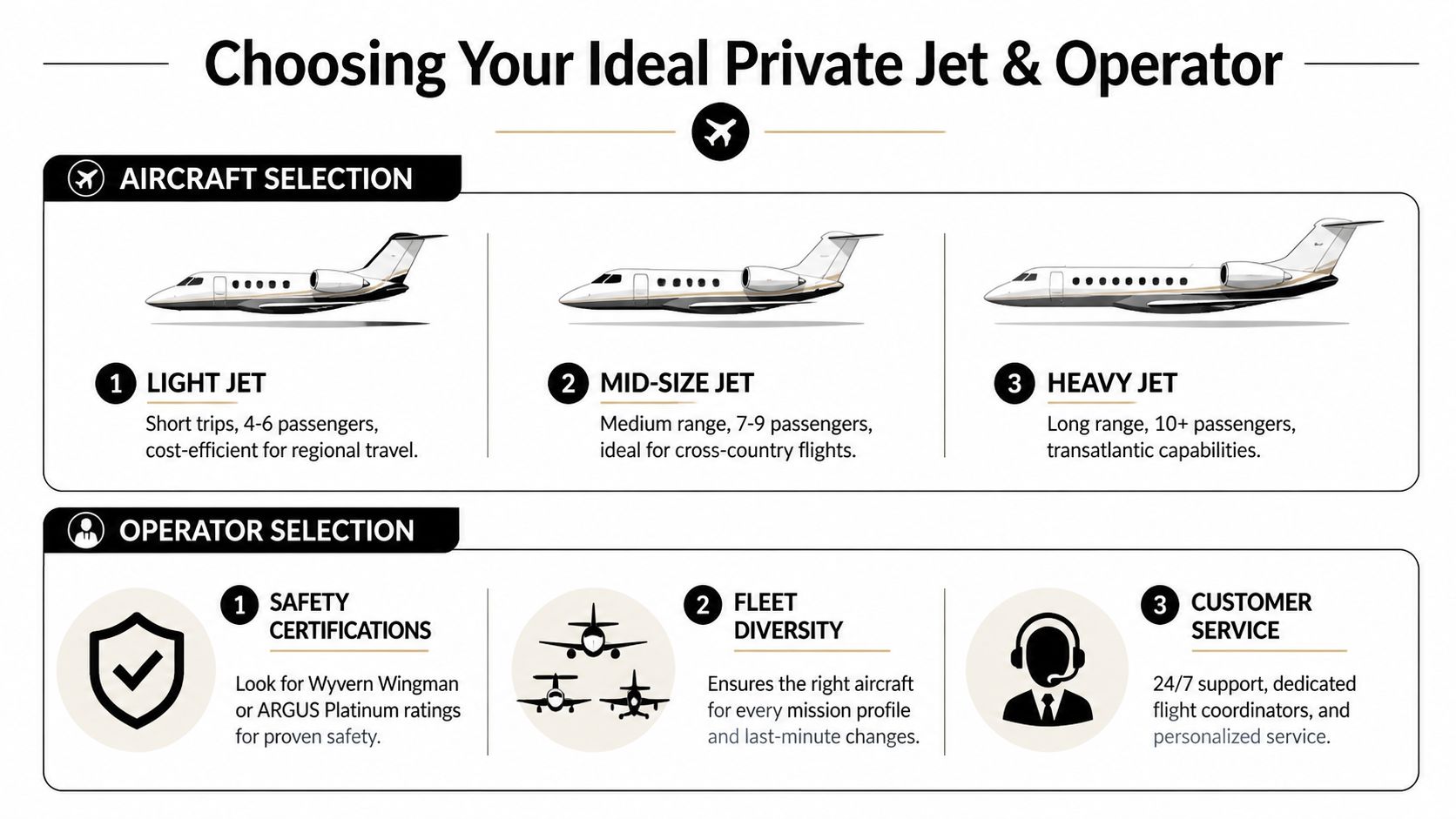
Aircraft categories are a shortcut, not an answer. A light jet can be exactly right for one New York to Miami trip and the wrong choice for another if the passenger count, bags, or airport conditions change.
I look at four inputs first: passenger count, route length, baggage profile, and airport pair. Those four usually decide the conversation before cabin finishes or catering requests matter. A short regional meeting run has one set of priorities. A long international itinerary has another, including range, cabin endurance, and crew requirements.
Use this quick framework:
| Mission type | Best fit to consider | What matters most |
|---|---|---|
| Short regional trip | Light jet | Airport access, operating efficiency, enough baggage space for the group |
| Cross-country business trip | Mid-size or super-midsize jet | Stand-up cabin comfort, luggage capacity, nonstop coast-to-coast performance |
| Long international route | Heavy or ultra-long-range jet | Nonstop range, cabin space, international cabin support, crew duty planning |
Demand patterns across charter reflect that mix. Large-cabin aircraft stay popular because they solve more missions cleanly, while on-demand charter remains attractive for travelers who want flexibility without the cost structure of ownership or fixed programs, as noted earlier.
Details that first-time clients often miss
The aircraft type is only the starting point. The actual decision sits at the tail level.
Ask for the specific make and model when available, and look closely at cabin layout, Wi-Fi status, baggage compartment access, lavatory configuration, pet rules, and runway performance at your departure and arrival airports. Two aircraft sold under the same category can feel very different in actual use. One midsize jet may handle six executives with roller bags comfortably. Another may force compromises the moment golf clubs, ski gear, or a bulky product case gets added.
Mountain and resort flying exposes these gaps quickly. A jet that works well for a summer business itinerary can become a poor fit for Aspen in winter because payload, runway, and weather margins tighten.
The best aircraft solves the trip on paper before anyone approves the interior photos.
If you want a clearer sense of how categories differ in real use, this guide to understanding private jet types is a useful reference before you compare options.
Operator, broker, and sourcing model
Choosing the aircraft is only half the job. The operator behind it matters just as much, and the sourcing method affects both price and reliability.
Some charter firms present a category and source an aircraft later. That can work, but it also leaves more room for substitutions, weaker transparency, and pricing that looks sharp until trip logistics are added. I prefer a quote built around the actual aircraft being offered, where routing and availability have already been checked. That is also where hidden cost control starts. An aircraft based near your departure airport often produces a better total number than a cheaper headline rate on a distant plane that has to reposition in.
Haute Jets uses a direct sourcing model across a broad network of owner-operators in multiple countries. For the client, that means more precise aircraft matches and a better chance of finding a local or better-positioned option. In practice, that can lower total charter cost because the aircraft assignment is driven by mission fit and positioning logic, not just category label.
A good operator choice should answer a few plain questions without hesitation. Who is flying the aircraft. Where is the plane coming from. Is the quoted aircraft the likely aircraft. Are there airport or baggage limitations that could change the recommendation. If those answers are vague, keep asking.
Private charter works best when the airplane, the crew, and the routing all fit the trip from the start.
Decoding the Price Tag From Hourly Rates to Hidden Fees
Most first-time clients fixate on the hourly rate. That’s understandable, and it’s often where the sales conversation starts. It’s also where a lot of confusion begins.
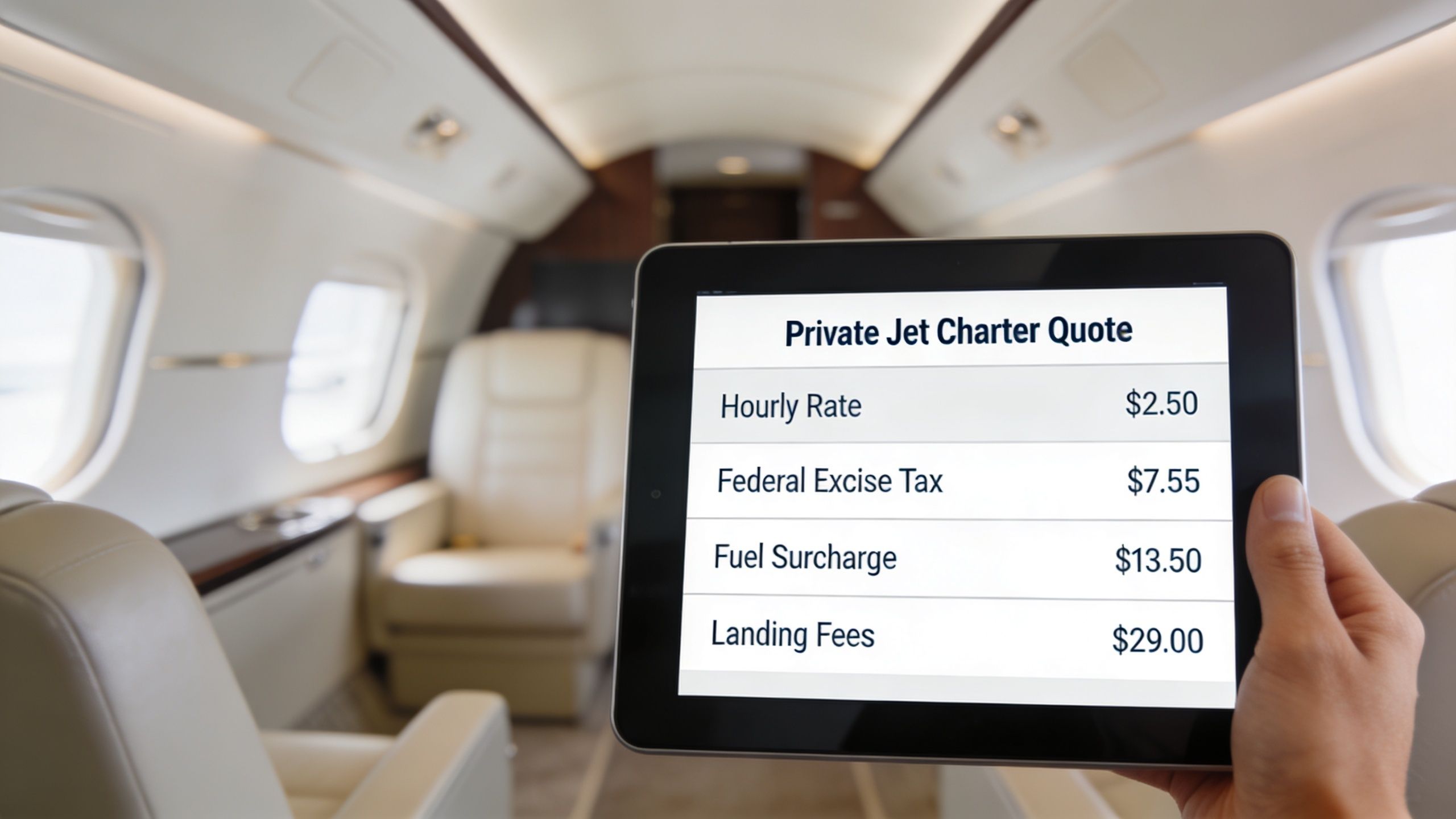
A private charter quote is rarely just one number multiplied by flight time. The hourly figure matters, but the total cost usually reflects several components, including aircraft time and trip-specific operating charges. If the quote seems unusually low at first glance, there’s often a reason.
What belongs in a clean quote
A professional quote should be understandable without a phone call to decode it. At minimum, you want the aircraft identified, the routing shown clearly, and the major cost elements separated enough that you can see what you’re paying for.
Look for clarity around:
- Aircraft assignment: The exact aircraft or, at minimum, a precise aircraft commitment.
- Routing logic: Where the airplane starts, where it picks you up, and whether it remains with you or repositions.
- Trip charges: Items tied to the route, airports, and operating conditions.
- Policy terms: Cancellation terms, timing, and what changes if your schedule moves.
What doesn’t work is a single all-in number with no explanation of how the airplane is being sourced. That makes comparison shopping almost impossible.
The hidden line item that changes everything
The biggest pricing mistake I see is clients comparing two quotes without asking where the aircraft is based.
That matters because a large share of charter inflation comes from repositioning fees. These are the costs of flying the aircraft empty to your departure airport before your trip begins, and in some cases moving it again afterward. Traditional brokerage models often pass those costs through to the client. According to Element Aviation’s analysis of charter pricing trends, repositioning fees can inflate total charter prices by 20% to 40% in traditional models.
This is similar to hiring a car service and paying not only for your trip, but also for the driver’s unpaid commute from another city.
If the airplane isn’t already near you, someone is paying for that ferry flight. Too often, that someone is the client.
Here’s where sourcing discipline matters more than negotiation skill. A provider with access to a distributed network can look for an aircraft already positioned near your departure city, which can remove or sharply reduce those deadhead costs.
To see the economics explained visually, this short video gives a useful overview:
What works and what doesn’t
What works is asking a direct question: “Is this aircraft local to my departure airport, or am I paying to position it?” A serious charter team should answer plainly.
What doesn’t work is assuming a membership program or jet card automatically protects you from inefficient sourcing. In many cases, those structures still rely on aircraft positioning, but the cost is embedded rather than highlighted.
Private charter can be cost-efficient. But only when the quote reflects your trip, not someone else’s fleet logistics.
Prioritizing Safety Wyvern ARGUS and Part 135 Compliance
Safety in charter aviation has layers. The legal baseline matters, but it isn’t the whole picture.
Any operator conducting on-demand charter flights in the United States needs to meet Part 135 requirements. That’s the threshold for legal charter activity. Clients should expect that as a starting point, not as the full answer to the safety question.

Why the FAA list isn’t enough by itself
Many travelers assume they can verify an operator by checking the FAA’s published charter list and treating that as definitive. In practice, that’s not sufficient.
According to Private Jet Card Comparisons’ reporting on FAA Part 135 list accuracy, the FAA’s published list of approximately 1,800 Part 135 operators has been found to be only 85% to 90% accurate. That gap matters. An outdated listing can create false confidence about whether an aircraft or operator currently holds valid charter authorization.
This is why discerning buyers ask for current documentation from the operator and don’t rely on a static public list alone.
The standard worth insisting on
The stronger screen is independent third-party auditing. Wyvern Wingman and Argus Gold or Platinum are widely treated as the highest outside safety audits in this corner of aviation. Those designations go beyond basic legality and examine operational discipline in a way first-time clients rarely see from the outside.
A serious review should account for items such as:
- Pilot qualifications: Training history, recency, and aircraft-specific competency
- Maintenance oversight: Aircraft records, compliance, and operating discipline
- Operational culture: Procedures, dispatch quality, and documented safety management
If a provider can’t tell you which standard the operator meets, that’s useful information in itself.
Safety diligence starts before the quote is accepted. It doesn’t begin on the ramp.
Travelers with high visibility often need to think beyond the aircraft as well. If your itinerary includes public exposure, family movement, or sensitive business travel, the handoff between aviation logistics and ground protection matters. In those cases, guidance on protecting employees from threats can help frame the security side of the trip without treating it as a separate issue.
For a deeper look at how these audits differ and what they verify, this breakdown of Wyvern and Argus safety ratings is a strong companion read.
From Quote to Takeoff A Seamless Booking Timeline
The booking process feels intimidating until you see it in sequence. In practice, a clean charter moves through a small set of decisions, each of which should give the client more control, not less.
Step one is the request, but precision matters
A vague request produces vague options. Give the charter team the full mission up front: passenger count, baggage profile, origin and destination airports, target departure window, return timing, pets, Wi-Fi requirements, catering needs, and whether ground transport needs to be coordinated.
That level of detail protects you later. It reduces the risk of getting an aircraft that fits the route but not the people on it.
A good first response should do two things. It should present the aircraft options clearly, and it should explain why each option works for the mission.
The aircraft selection stage is where clients keep leverage
This is the point where many travelers accidentally hand over too much discretion. If possible, ask to review the exact aircraft being proposed, not just the category.
That means confirming the actual cabin, the baggage arrangement, the age of the aircraft if relevant to your preference, and the operational details that affect comfort. Wi-Fi is a common example. So are pet policies, galley capability, and whether a specific airport pairing creates any compromises.
A useful checklist at this stage looks like this:
- Confirm the exact aircraft you’re approving, not just “light jet” or “heavy jet.”
- Verify the client-facing details such as connectivity, cabin layout, baggage, and onboard service.
- Review the operator credentials and any trip-specific terms before payment is sent.
Payment options have modernized
Wire transfers remain common because they’re efficient and familiar. Credit cards are convenient for some clients, especially for shorter-notice trips, though the economics may differ depending on the provider’s policies.
Cryptocurrency has moved from novelty to practical option in some parts of the market. According to BlackJet’s review of private aviation payment trends, crypto adoption in luxury travel surged 45% in 2025, and 28% of private flyers under 40 prefer digital assets. For certain travelers, paying in Bitcoin can simplify cross-border payment timing and reduce friction around traditional banking windows.
That doesn’t mean every booking should be funded that way. It means the option is now real enough that clients should ask how it’s handled, when pricing is locked, and what documentation is required.
Some travelers choose crypto for speed and privacy. Others prefer wire because treasury controls are simpler. The right answer depends on who is paying and how quickly funds need to clear.
The last twenty-four hours should feel boring
That’s a compliment in this business.
By the day before departure, you should have a final itinerary, aircraft tail number, crew details, manifest confirmation, and any special service notes locked in. If there are weather considerations, airport operating notes, or a ground transport handoff, those should already be communicated.
The best charter experience doesn’t rely on day-of improvisation. It relies on calm confirmation. By the time you arrive at the terminal, every meaningful decision should already be made.
Expert Answers to Your Charter Questions
What is an FBO and what should I expect there
An FBO, or Fixed-Base Operator, is the private terminal side of the experience. You don’t move through the main commercial flow. You arrive at a dedicated facility, check in with the flight team or desk staff, and are escorted to the aircraft when it’s time to board.
The atmosphere is typically quiet and efficient. For first-time flyers, the main adjustment is psychological. Everything happens faster, so it’s worth arriving prepared, with identification, passenger details, and any last-minute requests already settled.
Can I bring pets on a private jet
Often, yes. But don’t assume every aircraft or operator handles pets the same way.
The right time to raise it is during the first request, not after the aircraft is assigned. Pet size, carrier expectations, cleaning requirements, and route-specific considerations can all shape which aircraft is practical. If you’re traveling with an animal that needs space or has a specific comfort requirement, that should influence aircraft selection from the start.
Is on-demand charter better than a jet card or fractional ownership
For many travelers, yes. Especially if you don’t fly often enough to justify prepaid commitments or ownership-style structures.
According to Flycraft’s private jet usage statistics, on-demand chartering provides maximum flexibility for users flying under 150 hours per year, while fractional ownership involves more commitment even as it continues to grow, with North American departures rising 10.3% year over year in the first half of 2025. That’s the practical divide. If your flying pattern is irregular, route needs change often, or you want to match the aircraft to each trip, pay-as-you-go charter is usually the cleaner fit.
What’s the biggest mistake first-time charter clients make
They focus on the cabin before they verify the structure behind the trip.
A beautiful aircraft doesn’t fix a weak operator, a vague quote, or an itinerary built around a repositioning problem. The strongest bookings come from clients who ask direct questions and expect direct answers.
If you’re ready to charter a private jet and want a clearer view of aircraft options, pricing structure, and booking logistics, Haute Jets is a practical place to start.