A charter flight Miami to Bahamas is typically under an hour, and entry-level private charters start at about $4,400 one way. If you’re flying this route for the first time, that’s the number and timeline that matter most, because this trip is far easier and more attainable than it is often assumed.
Most clients who ask about this route are in the same position. They want to leave Miami in the morning, land in the Bahamas before lunch, and avoid turning a simple island hop into a full day of airport friction. That instinct is right. This is one of the rare private aviation routes where speed, simplicity, and pricing line up.
The mistake is focusing only on the headline charter quote. On this corridor, the primary difference between a smart booking and an overpriced one usually comes down to aircraft choice, departure airport, and whether repositioning costs were buried into your price. That’s where first-time charter clients overpay.
This Haute Jets Journal guide is the practical version. No fantasy pricing. No vague “luxury travel” filler. Just how to book a charter flight Miami to Bahamas with the right airport, the right aircraft, and the right cost structure.
From Miami to Paradise in Under an Hour
You finish breakfast in Miami, head to a private terminal, walk a few steps across the ramp, and lift off. By the time a commercial passenger is still dealing with boarding groups, you’re already descending over clear Bahamian water.
That’s why this route is so popular. The Miami-to-Bahamas charter market is defined by an exceptionally short trip of 161 nautical miles with a typical flight time of about 40 to 50 minutes, which makes it one of the most accessible private aviation corridors for luxury travelers, according to Air Charter Advisors on Miami to the Bahamas flights.

What matters in practice is how this feels on the day of travel. You’re not planning for a long-haul cabin experience. You’re buying time, convenience, privacy, and control. For a weekend escape, quick business trip, or yacht connection, that’s exactly what private charter should do.
Why this route works so well
The Miami to Bahamas corridor is short enough that private aviation solves a real problem instead of just adding polish. You skip the usual airport drag and turn an international trip into something that feels almost local.
A few situations where this route makes obvious sense:
- Weekend escapes: Leave after work or first thing in the morning and still have most of the day in Nassau or another island destination.
- Family travel: You avoid commercial terminal stress, tight boarding windows, and the usual luggage hassle.
- Yacht and villa connections: Private charter makes timing much easier when you need to meet a vessel, resort transfer, or estate staff on arrival.
Practical rule: If your goal is “be in the Bahamas fast, with no wasted motion,” this route is one of the strongest use cases for private charter in the region.
If Nassau is your arrival point and you want to get your bearings before heading to the resort or marina, this guide to find beaches close to Prince George Wharf is a useful reference. It helps first-time visitors understand what’s nearby once they land.
Your Guide to Miami and Bahamas Airports
The airport you pick matters almost as much as the aircraft. On a short route like this, a bad airport choice can erase the time advantage you’re paying for.
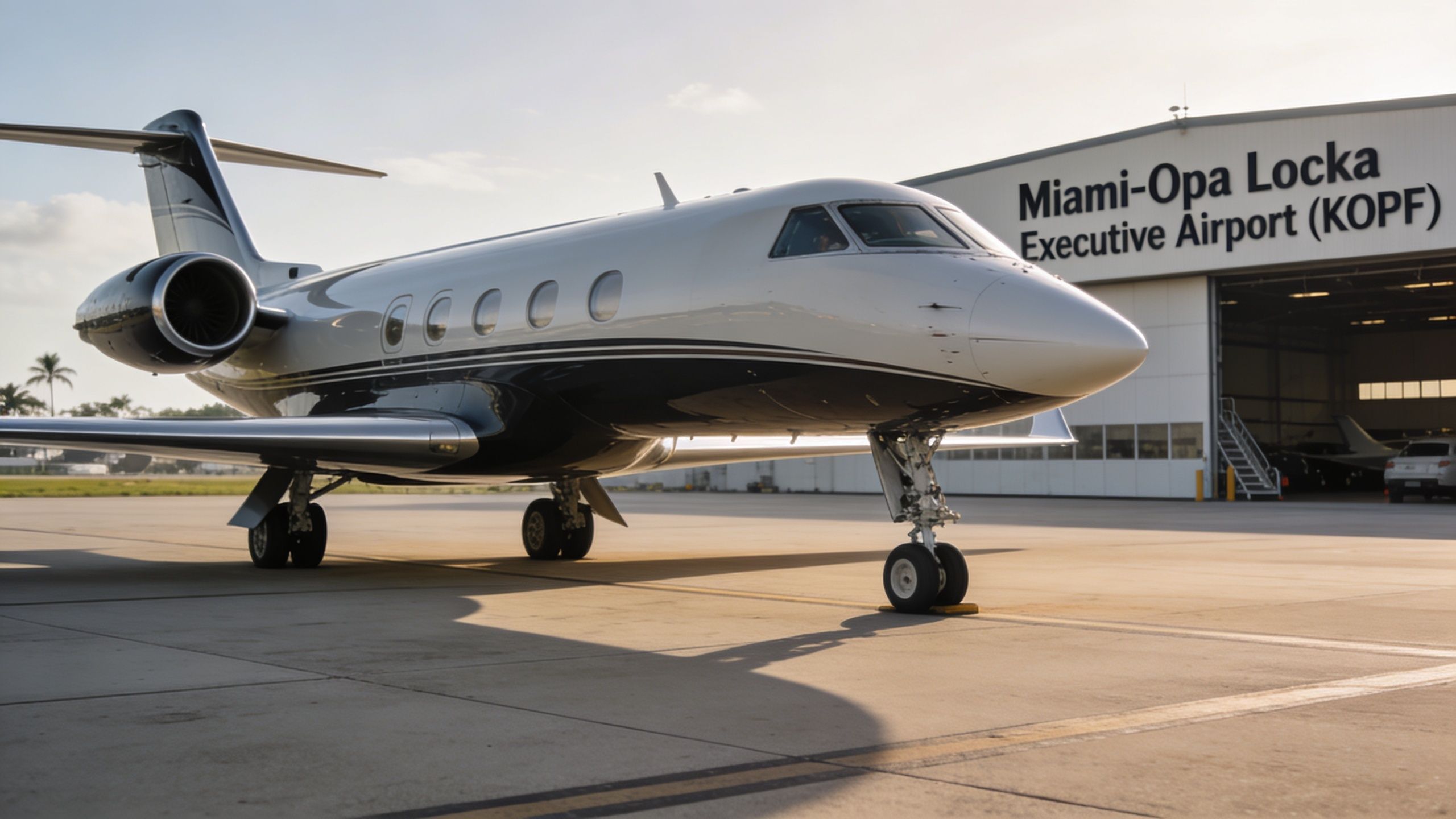
The Miami-Bahamas route benefits from a developed FBO ecosystem across five Miami-area departure facilities and five Bahamas destinations, with Miami-Opa Locka Executive Airport (OPF) processing approximately 98% of short-haul Bahamas charters because congestion is lower there, as noted by Mercury Jets on the Miami to Bahamas route.
Why OPF is usually the right departure choice
If you’re booking a charter flight Miami to Bahamas, OPF is usually the default answer. Not because it sounds glamorous. Because it works.
An FBO, or fixed-base operator, is the private terminal side of the airport. That means a quieter lounge, faster curb-to-aircraft timing, more privacy, and a cleaner boarding process than what you’d deal with at a commercial terminal.
For most clients, OPF is the right call because:
- Less congestion: You spend less time sitting behind airline traffic.
- Cleaner access: Drop-off, check-in, and boarding are straightforward.
- Better charter rhythm: Crews, dispatchers, and handling teams are used to these short Bahamas turns.
If you want a route overview with aircraft options and airport pairings, Haute Jets keeps a dedicated page for Miami to Bahamas private charter flights.
Other Miami-area departure options
OPF isn’t your only option. It’s just usually the smartest one.
You may also see flights depart from MIA, FLL, FXE, or PMP. Those can make sense if your home, office, or yacht location makes one of those airports materially easier on departure day. But don’t choose based on habit. Choose based on actual drive time, congestion, and aircraft availability.
A first-time client often asks for the “closest major airport.” That’s usually the wrong question. The right question is which private terminal gets you airborne with the least friction.
Here’s a quick look at the airport environment before you board:
Choosing the right Bahamas arrival airport
Your Bahamas airport should match your real destination, not just the most familiar city name.
For many first-time travelers, Nassau is the obvious starting point because Lynden Pindling International Airport is the main gateway. But if your trip is centered on another island, flying direct there can save ground transfer time and keep the whole trip cleaner.
Use this logic:
- If you’re staying in Nassau or connecting to a marina there, fly direct to Nassau.
- If you’re heading to a more specific island property, choose the closest viable airport instead of defaulting to Nassau.
- If runway and aircraft limitations are in play, let performance drive the match.
Some island airports are ideal for turboprops. Others may require a larger aircraft category depending on runway and mission details. That’s not a detail to gloss over. It directly affects both cost and convenience.
Choosing the Right Aircraft for Your Trip
Most first-time clients overbuy the airplane. They assume “jet” automatically means smarter. On this route, that’s often wrong.
For Miami to the Bahamas, the key decision is usually turboprop versus light jet. According to Paramount Business Jets on Miami to Nassau charter pricing, turboprops like the King Air 90 operate at approximately $4,500 one way, while light jets like a Citation CJ2 cost around $9,000 one way. That’s a 50% cost differential for only about 25 minutes of flight time difference.
The practical choice most clients should make
If your group is small, your bags are manageable, and your priority is value, book the turboprop. On a route this short, paying materially more just to shave a small amount of airborne time often doesn’t make sense.
If your priority is cabin feel, a quieter ride, or a more “jet-like” arrival experience, move into a light jet. That can be worth it. But make it a conscious comfort decision, not an automatic upgrade.
Here’s the clean comparison.
Aircraft Comparison Miami to Bahamas
| Aircraft Category | Example Aircraft | Passengers | Flight Time (avg) | Est. One-Way Cost |
|---|---|---|---|---|
| Executive Turboprop | King Air 90 | 5 to 8 | About 1 hour 15 minutes | About $4,500 |
| Light Jet | Citation CJ2 | Up to 8 | About 50 minutes | About $9,000 |
| Executive Turboprop | Pilatus PC-12 | 5 to 8 | Qualitatively similar short-haul fit | Entry-level turboprop pricing is commonly in the lower range for this route |
| Light Jet | Phenom 300 | Up to 8 | Qualitatively aligned with light jet performance on this route | Light jet pricing commonly falls above turboprops on this route |
How to choose without wasting money
Use the mission, not ego.
- Choose a turboprop if: you want the lowest sensible cost, you’re flying a short daytime hop, and your group doesn’t need a jet cabin for optics or client-facing travel.
- Choose a light jet if: you care more about cabin atmosphere, faster block time, and a more polished executive feel.
- Move up only when the mission requires it: larger groups, specific baggage needs, or runway and destination constraints can justify a bigger cabin category.
A lot of clients think of turboprops as a compromise. On this corridor, they’re often the rational answer. Aircraft like the King Air 90 and Pilatus PC-12 are well suited to short island sectors.
Don’t ask, “What’s the nicest aircraft available?” Ask, “What’s the right aircraft for this exact trip?”
If you want a broader framework for evaluating cabin type, mission fit, and tradeoffs on shorter sectors, this guide on how to choose the right aircraft for short-haul private flights is a useful companion.
What else should influence the choice
Beyond price and flight time, think about these real-world factors:
- Baggage profile: A couple of soft bags is easy. Golf clubs, dive gear, and bulky luggage can change the equation.
- Passenger mix: Families, executives, and couples don’t all value the same cabin layout.
- Arrival tone: If this is a personal leisure trip, efficiency may win. If you’re traveling with clients or senior leadership, optics may matter more.
Don’t let anyone sell you category labels without discussing the actual aircraft. Year, make, model, cabin configuration, and baggage setup matter more than a generic “light jet” line item.
Understanding Your Charter Flight Cost
A charter quote is never just one number. It’s a bundle of aircraft economics, airport handling, crew logistics, and market behavior. If you don’t know what’s driving the price, you can’t tell whether the quote is fair.
The Miami-to-Bahamas charter market ranges from $4,400 for executive turboprops to $22,100 for super-midsize jets, according to EvoJets pricing for Miami to Nassau private charters. That same source notes this is a mature, high-frequency route where local sourcing can eliminate the 20% to 40% repositioning markups charged by traditional brokers.
What actually drives the quote
Start with aircraft type. That’s the biggest lever.
Then look at the rest of the quote structure:
- Aircraft size and class: The larger and more premium the aircraft, the faster the quote climbs.
- Airport-related charges: Handling and landing costs vary by airport pair.
- Crew logistics: Even on a short route, crew scheduling and aircraft positioning affect the total.
- Trip shape: One-way and round-trip structures can price differently depending on aircraft availability.
What you shouldn’t accept is a number with no explanation.
The repositioning fee trap
At this stage, many buyers lose money without realizing it.
A repositioning fee is the cost of moving an empty aircraft into place before your trip begins. If your broker sources a plane that isn’t already near your departure airport, you may end up paying for that deadhead movement one way or another.
On this route, that’s especially frustrating because Miami has deep charter availability. In plain terms, many travelers should not be paying inflated baseline pricing for an aircraft that had to come from somewhere else.
The cheapest-looking quote isn’t always the best quote. If the aircraft has to be ferried in, you may be paying for inefficiency, not value.
What to ask before you approve a quote
Ask direct questions and expect direct answers.
- Is this aircraft already positioned in South Florida?
- Does this price include any repositioning cost?
- Am I seeing the exact aircraft, or just a category estimate?
- If I switch from a light jet to a turboprop, what changes besides flight time?
If the answers are fuzzy, slow down. This route is too competitive for vague pricing to be acceptable.
Jet cards can create the same problem in a different wrapper. They may offer simplicity, but they can also hide the true unit economics of a short-haul trip. On a route like this, pay-per-flight pricing is often the cleaner move because you can judge the mission on its own merits.
Navigating Customs Permits and Onboard Policies
First-time international private flyers usually worry about the wrong part of the trip. They fixate on customs, permits, and paperwork. In reality, the process is manageable when the operator handles it properly.
Your job is simple. Provide accurate passenger information early, make special requests upfront, and show up on time. The operator should handle the flight planning, documentation flow, manifest coordination, and the airport-side process.
Customs and immigration without the usual airport drag
Private international travel still requires customs and immigration compliance. What changes is the experience.
Instead of being pushed through a crowded commercial terminal sequence, you typically move through a more controlled FBO environment with dedicated handling. That means less confusion, fewer unnecessary touchpoints, and a faster handoff from aircraft to arrival formalities.
For a useful backgrounder on what that process looks like in private aviation, read the customs and immigration process when flying overseas in a private jet.
The details you should settle before departure
Don’t leave the small stuff until the last call. On private charter, those details are part of the service, but only if you raise them early.
Use this pre-flight list:
- Passenger names exactly as shown on travel documents: Small errors create avoidable delays.
- Pets: Ask for pet policy confirmation before you sign the agreement.
- Catering: Short flight or not, specify what you want onboard.
- Wi-Fi: Don’t assume it’s installed or active on every aircraft.
- Ground transport: Confirm who’s meeting you on arrival and where.
What a professional operator should provide
A serious charter process includes clarity before departure, not surprises at the ramp.
You should expect:
- A clear itinerary
- Aircraft details
- Crew confirmation
- Passenger manifest review
- Guidance on arrival timing at the FBO
If you have to chase basic flight details the night before departure, the booking process wasn’t managed properly.
This route is short. That makes organization even more important. There’s not much margin for last-minute confusion when wheels-up timing is part of the value you’re buying.
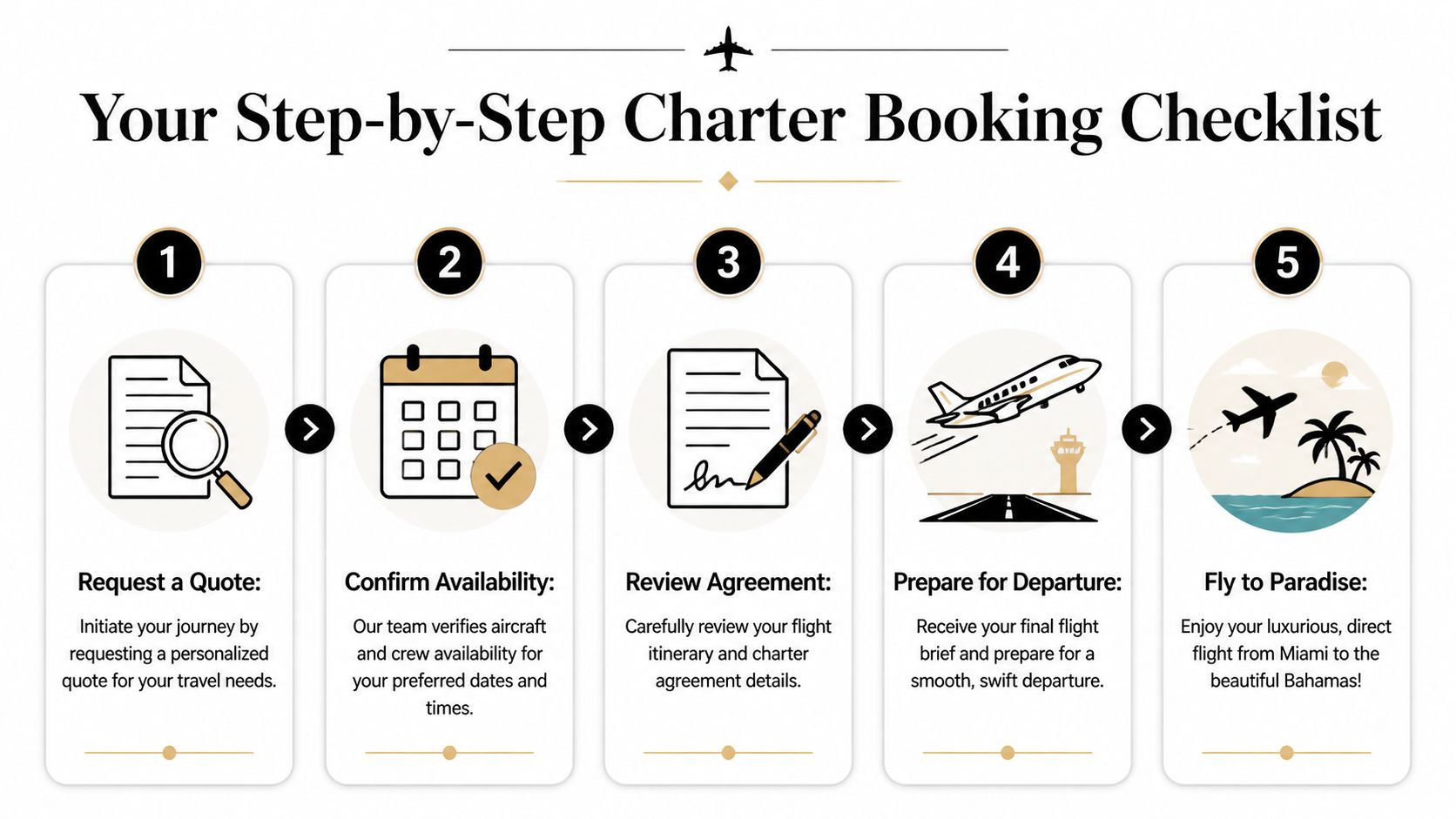
Your Step-by-Step Charter Booking Checklist
Booking well is mostly about asking the right questions in the right order. The process should feel controlled from the first quote request to the moment you board.
For this route, I’d keep it disciplined and simple.
Step 1 and Step 2
Start with the mission. Give the charter advisor your exact travel date, preferred departure window, passenger count, luggage profile, and destination airport. If you need Nassau, say Nassau. If you need a different island airport, say that instead of forcing a later transfer.
Then confirm real availability. Not category availability. Actual aircraft availability. You want to know what can fly your mission, from which airport, and under what schedule.
Step 3 and Step 4
Review the agreement like a buyer, not a browser. Check the aircraft details, routing, cancellation terms, included services, and any notes about timing or operational limits. If anything is vague, ask before payment.
Push for pre-flight transparency. This matters. You should know the exact aircraft you’re getting, not just a broad category. You should also receive a final flight brief before departure with the tail number, crew details, weather context, and passenger manifest.
Step 5
Prepare for a fast departure day. Private charter works because there’s less friction. Don’t reintroduce friction by arriving disorganized. Bring the right documents, confirm luggage, and know your FBO location the day before.
Here’s the checklist I’d use every time:
- Request the quote with full trip details.
- Confirm the exact aircraft options that can operate your route.
- Review the charter agreement carefully before approving payment.
- Verify onboard requests like pets, catering, Wi-Fi, and transfers.
- Read the final flight brief and confirm everyone on the manifest.
“Choose the exact aircraft, not just the category estimate. That’s where control starts.”
The best booking processes give you visibility without forcing you to manage operations yourself. That’s the right balance. You stay in control of the decisions, while the flight team handles the mechanics.
The Haute Jets Advantage for Miami Flights
On this route, the main pricing mistake isn’t failing to find an empty leg. It’s accepting a baseline charter quote that already includes avoidable positioning cost.
As Sky Access explains on the Miami to Bahamas route, many services market empty leg deals, but the deeper issue is that traditional brokers often build 20% to 40% repositioning costs into the standard quote. A local-sourcing model that connects clients to aircraft already positioned in Miami removes that hidden markup entirely.
That distinction matters more than most buyers realize.
Why local sourcing beats chasing “deals”
An empty leg can be useful when timing aligns. But it doesn’t fix a structurally inflated quote. It just discounts a market that may have been overpriced at the baseline.
For a route this active, the smarter move is to source aircraft already near the departure point. That changes the economics before the discount conversation even starts.
Haute Jets fits that model. It sources from 3,500+ owner-operators across 175 countries, focuses on aircraft near the departure city, and works on a pay-per-flight basis rather than forcing memberships or jet cards. For a charter flight Miami to Bahamas, that means the conversation can start with mission fit and operator quality instead of prepaid program logic.
Safety and control should not be optional
Price matters. Safety matters more.
Every flight should be operated by a provider with serious third-party oversight, and every booking should give you clear visibility into the aircraft and crew before departure. If a company can’t tell you exactly what you’re flying and who is operating it, that’s not a premium service. That’s a black box.
This is also where a lot of frequent-flyer style private aviation products fall short for short routes. They simplify payment, but they don’t always improve mission-level value. On Miami to Bahamas, flexibility and transparency are usually worth more than a prepaid structure.
My recommendation
If this is your first time booking the route, keep the priorities in the right order:
- Start with the right airport
- Choose the right aircraft for the mission
- Ask directly about repositioning
- Insist on operator quality and aircraft clarity
- Avoid paying for “convenience” that masks inefficiency
That’s how experienced clients book this corridor. Not by chasing hype. By controlling the variables that drive the outcome.
If you want help booking a charter flight Miami to Bahamas without hidden repositioning costs, Haute Jets gives you a direct, pay-per-flight option with exact aircraft selection, clear pre-flight details, and access to locally sourced operators for this route.