

A long-haul charter usually starts with a simple question that isn’t simple at all. Can this aircraft do the trip non-stop, the way I need it to be flown?
That question comes up when an executive wants to leave New York after a full day of meetings and wake up ready for business on arrival. It comes up when a family wants to avoid splitting an international trip with a fuel stop, a terminal wait, and the disruption that turns private travel into something far less efficient than it should be. In those moments, the gulfstream g550 range matters, but not as a brochure number. It matters as mission planning.
The G550 earned its reputation because it was built for serious international work. It’s one of the defining ultra-long-range business jets of its generation. But clients make mistakes when they assume the published range is the same thing as the range available for their exact trip, on their day, with their passenger count, bags, routing, reserves, and comfort preferences.
That gap is where good charter decisions are made. A G550 can be the perfect answer. It can also be the wrong aircraft if the mission assumptions are off by even a little.
The Dream of the Non-Stop Flight
A client is looking at a trip like New York to Tokyo, or a family is planning London to the U.S. West Coast, and the goal sounds straightforward. Leave once, arrive once, skip the fuel stop, keep the schedule intact.
That’s exactly the kind of mission that made the G550 famous. It was designed to connect major business and leisure markets without forcing passengers into the compromises that often come with shorter-range aircraft. The attraction isn’t only speed or cabin comfort. It’s continuity. You board, settle in, work, dine, sleep, and arrive without breaking the rhythm of the trip.

What clients usually want to know, though, is more practical than aspirational. They aren’t asking whether a G550 is a long-range jet. They’re asking whether this specific G550 mission works non-stop without cutting too close on reserves, without stripping out payload, and without discovering halfway through planning that the quoted performance assumed ideal conditions.
Practical rule: Non-stop capability isn’t a marketing term. It’s a flight-planning conclusion.
That distinction matters most on flights that are long enough to be easy on paper and demanding in actual operation. The G550 often handles those missions beautifully. But a smart charter decision starts with understanding where published capability ends and mission-ready capability begins.
Understanding the G550s Published Performance
The official baseline is strong. The Gulfstream G550 was introduced in 2003 and has a maximum range of 6,750 nautical miles, with that improvement of 250 nautical miles over its predecessor attributed to drag reduction. It’s powered by two Rolls-Royce BR710 C4-11 turbofan engines and carries 41,300 pounds of fuel, according to the Gulfstream G550 aircraft summary.
Those numbers explain why the aircraft became such a staple in ultra-long-range charter and corporate transport. The design gives the G550 the legs to connect major city pairs that are beyond the reach of many other large-cabin jets.
What supports that published range
Range doesn’t come from one feature. It comes from the combination.
- Engine performance: The twin Rolls-Royce BR710 C4-11 engines provide the thrust needed for long-haul work while supporting efficient cruise.
- Aerodynamic cleanup: The published gain over the earlier model came from drag reduction, which is exactly the kind of engineering change that extends useful long-range performance.
- Fuel capacity: A fuel load of 41,300 pounds gives planners the foundation for serious intercontinental missions.
- Cruise profile: The G550’s long-range cruise is associated with Mach 0.80, while high-speed cruise is Mach 0.85, and maximum operating speed is Mach 0.885 in the verified data.
What the brochure number actually means
Published maximum range is best understood as a capability under favorable assumptions. It shows what the airplane can do when flown in a range-optimized profile. It does not automatically mean every charter mission can reproduce that result.
That’s the first mistake many buyers make. They see 6,750 nautical miles and treat it as a fixed operational promise rather than a planning benchmark.
The brochure tells you what the airframe is capable of. Dispatch reality tells you what your trip is capable of.
The G550’s published performance still deserves respect. It’s one reason the aircraft remained in production from 2003 to 2021, with over 600 units produced in the verified data. Few aircraft become that established without delivering on their core mission. But for charter clients, the useful question isn’t whether the platform is capable. It’s how much of that capability remains once the mission gets real.
Beyond the Brochure Factors That Define Real-World Range
The biggest planning error in long-range charter is assuming the brochure figure survives unchanged once people, bags, winds, routing, and reserves enter the picture. In practice, they don’t.
The key real-world insight is this. A G550’s practical range can shrink by 15% to 25% from the advertised maximum because of factors such as high-speed cruise, headwinds, and full passenger loads, according to the G550 charter range discussion.
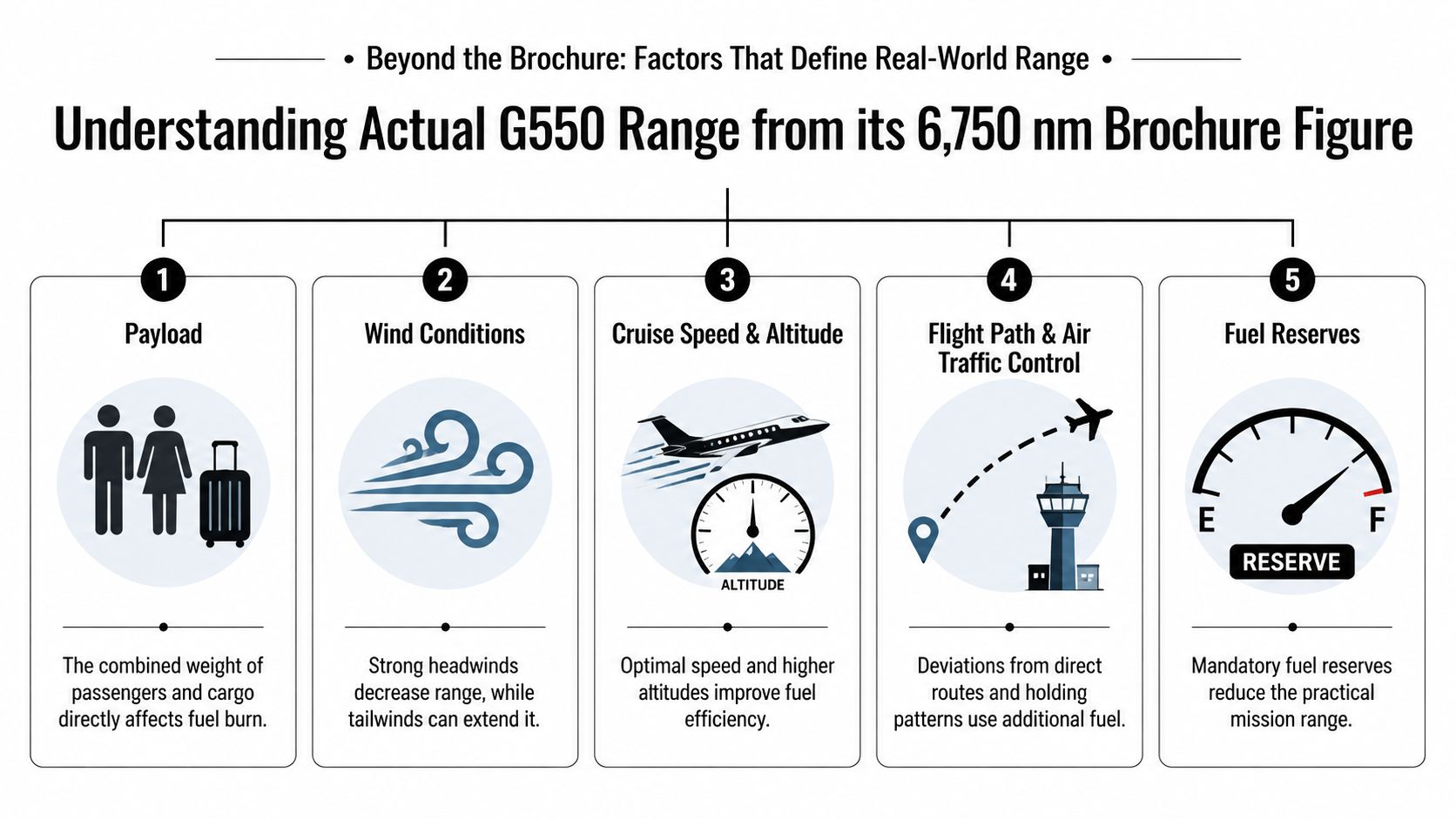
Payload changes the mission first
Passengers don’t just fill seats. They change the fuel and performance equation. Add a fuller cabin, more luggage, and longer-haul supplies, and the aircraft has less flexibility to carry fuel in the way a lightly loaded mission might.
That’s why a route that works cleanly with a smaller group can become marginal with a fuller passenger list. On long sectors, that margin matters more than clients often realize.
Speed costs range
A lot of clients understandably prefer the idea of getting there faster. The issue is that the G550’s best range is associated with Mach 0.80, not its faster cruise settings.
At Mach 0.85, the aircraft gives up range for time. Push toward Mach 0.885, and the range reduction becomes more material. That’s often the right trade on shorter missions. On an already long international leg, it can be the difference between a clean non-stop and a fuel stop you didn’t plan for.
Winds and routing aren’t minor details
The atmosphere rarely cooperates with brochure assumptions. Headwinds can erode usable range, and real routings often differ from the map line clients picture when they first ask for a quote.
Air traffic control, weather avoidance, and altitude constraints all shape the actual mission. None of that means the G550 underperforms. It means the mission has to be planned as flown, not as imagined.
Reserves are not optional range
Clients sometimes talk about range as if every mile of fuel is available for forward progress. It isn’t. Reserve fuel, alternate planning, and conservative margins are part of professional dispatch, not excess caution.
That distinction is exactly why practical range and published range are different concepts.
A flight that only works by using the last slice of theoretical range is not a good charter plan.
The mission-ready mindset
When I look at a long-haul request, I don’t start with the advertised number. I start with the route, then test the assumptions:
- How many passengers are traveling
- What baggage and special items are going
- Which cruise profile suits the trip
- What the wind pattern is doing
- How much flexibility the client wants on comfort and schedule
That’s how the gulfstream g550 range should be evaluated. Not as a single fixed number, but as a mission-specific performance envelope.
Visualizing the G550s Global Reach
The G550 remains compelling because even after applying real-world discipline, it still opens up a huge part of the world in one hop. That’s why it became such a fixture in international business aviation.
The cabin helps. The aircraft offers 1,669 cubic feet of cabin volume, is typically configured for 12 to 16 passengers, and can operate missions like New York to Dubai non-stop with up to 19 passengers, according to the Liberty Jet G550 profile. For group travel, that’s a serious combination of reach and usable cabin space.
Example routes that define the aircraft
The examples commonly recognized are the ones that explain the airplane’s place in the market. Verified data for the G550 specifically references non-stop capability on routes such as New York to Dubai, London to Singapore, and Tokyo to Los Angeles. Those pairings tell you what class of aircraft this is.
Here’s a practical way to visualize that reach.
| Departure City | Arrival City | Distance (NM) | Estimated Flight Time |
|---|---|---|---|
| New York | Dubai | 6,750 | Long-haul non-stop mission, timing varies by conditions |
| London | Singapore | 6,750 | Long-haul non-stop mission, timing varies by conditions |
| Tokyo | Los Angeles | 6,708 | Long-haul non-stop mission, timing varies by conditions |
| Los Angeles | Tokyo | 6,708 | Long-haul non-stop mission, timing varies by conditions |
| New York | London | Within G550 mission profile | Typical transatlantic mission, timing varies by conditions |
For travelers considering classic premium routes such as private jet service from New York to London, the G550 often sits in the sweet spot. It offers a large-cabin experience with true intercontinental capability, yet it doesn’t require the mission profile of the very newest flagship aircraft to make sense.
Why these routes matter to clients
This isn’t only about distance. It’s about preserving the day.
For executives, that can mean holding a meeting before departure, flying overnight, and arriving in shape to work. For family or leisure travel, it means keeping children settled, avoiding a second handling event, and turning a complex itinerary into a smoother one.
On the right mission, the G550 doesn’t just cross oceans. It removes interruptions.
That’s why the aircraft still matters. It gives charter clients access to city pairs that change how they use time.
Chartering a G550 The Haute Jets Advantage
The right way to charter a G550 is to interrogate the assumptions behind the quote. Long-range aircraft planning can look polished on the first pass. The quality shows up in the details.

Questions sophisticated clients should ask
A serious charter buyer should ask direct questions, and a serious charter team should answer them without hedging.
- Which cruise assumption is behind this quote: Is the mission being planned at long-range cruise or at a faster cruise profile that eats into range?
- What payload assumptions are you using: Are you modeling the actual passenger count, actual bags, and any special cargo?
- How much routing flexibility is built in: If winds shift or routing lengthens, does the trip still work non-stop with proper margins?
- What reserve philosophy is being used: A professional answer should reflect dispatch realism, not optimistic sales math.
- Is this specific aircraft the right one: Not just the category, but the exact airframe, configuration, and operating profile.
Those questions matter because the gulfstream g550 range can look very different depending on how realistically the mission is built.
Comfort is part of performance planning
Long-range charter isn’t only a fuel exercise. Passenger comfort choices affect the plan too.
The G550 can maintain a 6,000-foot equivalent cabin pressure at 41,000 feet, and clients can request cabin altitude strategies to reduce fatigue, but that choice affects fuel burn and effective range, according to the Aviation Week G550 overview.
That’s the kind of trade-off a knowledgeable charter advisor should surface early. If a client prioritizes arriving as fresh as possible, that preference belongs in the planning conversation. It should not appear later as a surprise operational limitation.
A closer look at the aircraft itself helps when those decisions get specific. The Gulfstream 550 charter page is a useful reference point for clients comparing cabin layout and mission fit.
What works and what doesn’t
In practice, a few habits consistently lead to better outcomes.
What works
- Being honest about passenger count: “We might add a few more later” is one of the fastest ways to turn a clean plan into a compromised one.
- Choosing the mission, not the ego speed: On a long sector, a range-optimized profile often protects the non-stop objective.
- Planning for the day of your flight: Seasonal winds and routing conditions matter. They shouldn’t be treated as afterthoughts.
- Discussing comfort priorities in advance: Cabin pressure strategy, rest needs, and onboard setup can all influence the best operating plan.
What doesn’t
- Treating maximum range like guaranteed dispatch range
- Assuming every G550 mission is interchangeable
- Accepting a quote that doesn’t explain the operating assumptions
- Waiting until the day before departure to resolve payload details
This short walkthrough gives a helpful visual feel for the aircraft and cabin environment before those planning conversations get more detailed.
Why transparency matters on long-range trips
The farther you fly, the more expensive bad assumptions become. On shorter domestic trips, a small mismatch in planning may be an inconvenience. On an international long-haul mission, it can mean a stop, a delay, a schedule shift, or an aircraft that was never the best fit in the first place.
Clients should never have to reverse-engineer a quote to understand whether the trip really works.
That’s why the best charter outcomes come from teams that disclose the mission logic, not just the final number.
Is the G550 the Right Jet for Your Mission
The G550 is still one of the most credible answers for intercontinental private travel. It combines large-cabin comfort with proven long-range capability, and its operating record gives clients confidence that the platform is built for serious work.
Its formal benchmark remains strong. The aircraft has an NBAA IFR range of 6,708 nautical miles with 8 passengers and has logged over 50 city-pair speed records, according to the Altivation G550 performance review. That’s why it still sits comfortably in the conversation whenever a mission involves oceanic or transcontinental flying.
A simple decision framework
The G550 is usually the right fit when:
- You want a large-cabin jet for long international sectors
- Your route falls comfortably inside the aircraft’s mission-ready envelope
- You value a mature platform with a deep reputation in charter and corporate service
A different aircraft may be worth considering when:
- Your route is at the edge of what the day’s conditions allow
- You want more margin for headwinds and payload on the longest sectors
- Your trip is much shorter and a smaller aircraft would be the more rational choice
If you’re weighing the platform against a newer Gulfstream, this comparison of the Gulfstream G550 and G650 private jets helps frame where each aircraft makes the most sense.
The right answer isn’t “the longest-range jet available.” It’s the aircraft that can fly your mission cleanly, comfortably, and without relying on optimistic assumptions.
Frequently Asked Questions About the G550
Is the G550 still relevant now that newer jets exist
Yes. The G550 remains highly relevant because it sits in a very strong operational middle ground. It offers true ultra-long-range capability, a spacious cabin, and a long service history that operators, crews, and flight departments know well. For many missions, that makes it a practical choice rather than a legacy one.
Can the G550 really fly non-stop on headline routes
It can on the right missions, and that distinction matters. The aircraft is associated in verified data with route examples such as New York to Dubai, London to Singapore, and Los Angeles to Tokyo. But whether your specific trip works non-stop depends on the actual planning variables discussed earlier, not only the brochure figure.
How many people can it carry comfortably
The G550 is typically configured for 12 to 16 passengers in the verified data, though some configurations can accommodate more. For charter clients, the meaningful question isn’t maximum seating. It’s how many passengers you want to carry while preserving the mission profile you expect.
Does flying faster always make sense
Not on long-haul sectors. Faster cruise can be worth it when time matters more than range margin. But when the mission is close to the aircraft’s practical limit, speed becomes expensive in fuel terms and can be the reason a trip no longer works non-stop.
What should I ask before booking a G550 charter
Ask which cruise profile the quote assumes, what payload was modeled, how the trip is being planned for reserves, and whether comfort preferences such as cabin altitude strategy were considered. Those answers tell you whether you’re looking at a realistic flight plan or an optimistic one.
If you’re planning a long-haul mission and want a clear answer on whether a G550 is the right aircraft, Haute Jets can help you evaluate the route, the payload, the comfort trade-offs, and the best available aircraft without the usual charter guesswork. The goal is simple. Give you a transparent, mission-ready quote based on the trip you are flying.