
Most advice about chartering a Gulfstream G650 starts with the hourly rate. That's the wrong place to start. The number on a rate card rarely reflects aircraft positioning, handling, crew overnights, taxes, payload limits, or the difficulty of finding the right tail in the right market.
A G650 remains one of the most capable private aircraft for transatlantic and intercontinental travel, but brochure range doesn't equal dispatch certainty. In 2026, limited availability can make the aircraft more expensive to source, while a poorly positioned jet can add a substantial ferry cost before your passengers even board. If you want to charter a Gulfstream G650 intelligently, evaluate the aircraft, the mission, and the live logistics together.
The True Cost of Chartering a Gulfstream G650
The hourly rate is not the price of the trip. Public references place G650 charter rates around $12,000 to $16,800 per flight hour, while some operators quote broader ranges reaching approximately $19,500 to $22,000 per hour. Demand, aircraft positioning, and cabin configuration all affect the figure. These Gulfstream G650 charter rate references provide useful benchmarks, but they do not establish your final invoice.
The aircraft-hour figure also leaves room for repositioning, ground handling, crew accommodation, catering, international fees, and taxes. A 2026 pricing guide reports that a domestic round trip can finish 20–25% above the quoted hourly rate after additional fees, as outlined in this G650 charter pricing guide. Two identical-looking itineraries can produce different totals because the aircraft and crew may start in different locations.
Why the departure airport matters
The largest hidden variable is aircraft positioning. A G650 already near your departure airport may fit the operator's schedule with limited ferry flying. A jet based elsewhere requires ferry legs for the aircraft and crew, and those sectors can raise the quote by 20–40%, depending on the circumstances, according to this overview of aircraft repositioning costs.
Local sourcing is the strongest practical lever for controlling price. Ask brokers to search for available G650 aircraft near your departure airport before comparing hourly rates. A technically suitable jet positioned far away can cost more than a comparable aircraft ready nearby.
Practical rule: Do not approve a G650 quote until the proposal identifies every positioning leg and states whether those costs are included.
Scarcity can increase the pressure on pricing. Market intelligence for the first quarter of 2026 recorded only six G650/G650ER listings, compared with 24 a year earlier, a 75% decline and the lowest first-quarter reading in that series since 2016. The same 2026 business jet market report reported public asking prices between $30.5 million and $37.5 million, with active listings averaging 269 days on market. Fewer available aircraft mean less flexibility when your schedule is fixed.
How to read a quote properly
Request a line-item proposal, not a single aircraft-hour figure. It should identify the tail number, aircraft location, estimated flight time, ferry requirements, airport fees, crew costs, catering assumptions, taxes, and cancellation terms.
For a broader explanation of pricing components, review this guide to private jet charter cost. The clearest buying rule is simple: the cheapest G650 quote is often the one with the most assumptions hidden inside it.
Range and Performance for Transatlantic Missions
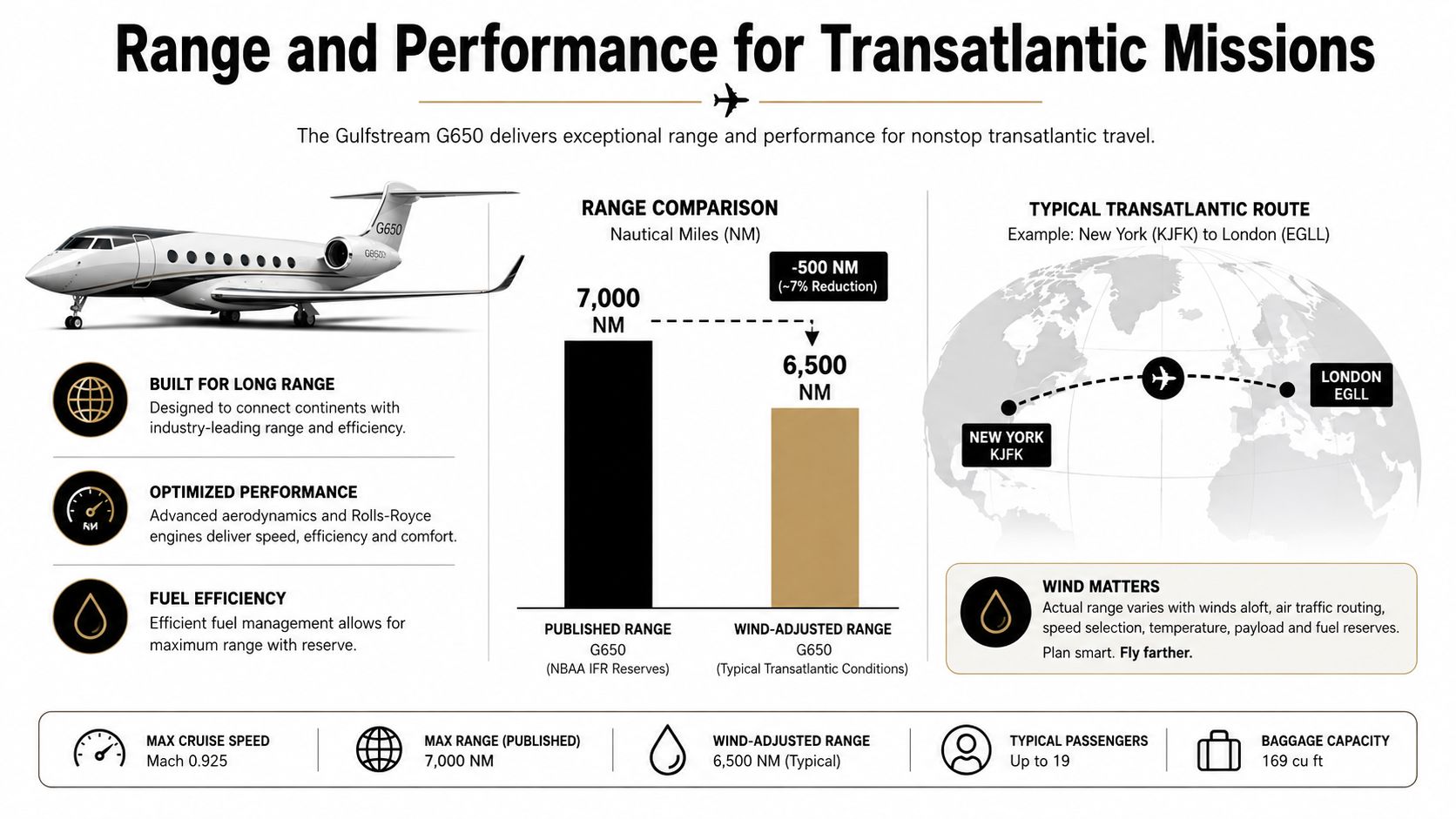
A G650's brochure range does not guarantee a nonstop charter. The aircraft first flew in November 2009 and received FAA certification in September 2012. Jetcraft reported 190 G650 aircraft had been produced by March 2022, with production beginning in 2012. A typical configuration carries 16 passengers and four crew. Published specifications cite approximately 6,912 nautical miles with eight passengers under NBAA IFR conditions, plus a cruise ceiling of 51,000 feet. These figures are summarized in the Gulfstream G650 aircraft overview.
The published maximum operating speed is Mach 0.925, and maximum cruise altitude is 51,000 feet, according to this G650 performance reference. Those numbers support long-haul missions, but dispatch depends on the aircraft's actual payload, departure runway, weather, alternates, fuel reserves, and positioning schedule.
Published range versus dispatch range
A G650 charter is commonly assessed against a published NBAA IFR range of about 7,000 nautical miles, or 12,964 kilometers. At a high-speed cruise profile of Mach 0.90, the cited range can fall to approximately 6,000 nautical miles. Passenger count, baggage, headwinds, alternate airport requirements, and fuel reserves can materially change the planned result.
One published data set lists approximately 5,912 nautical miles at maximum payload and fuel burn of about 3,862 pounds per hour on a 600-nautical-mile mission profile. Use those figures as planning benchmarks, not as a quote or dispatch guarantee. The underlying range trade-offs appear in this Gulfstream G650 performance analysis.
Ask one operational question: can this exact aircraft, with this payload, leave from this runway and complete the route under today's wind, alternate, and reserve requirements? That answer matters more than the headline range.
Runway limitations can decide the itinerary
Published landing-distance figures cluster around 3,000 to 3,182 feet, while takeoff distance at maximum takeoff weight is commonly listed near 5,858 to 6,000 feet. Short runways, hot-and-high conditions, and contaminated surfaces can remove an airport from consideration even when the city pair falls within the aircraft's stated range.
Before approving a firm quote, require the broker or operator to review the payload-range chart, runway analysis, weather assumptions, alternates, and fuel-stop contingency. A nonstop flight remains valuable only if dispatch can preserve the required payload and departure airport.
For extended-range planning, review this Gulfstream G650ER long-range guide. It helps separate aircraft capability from the practical limits imposed by mission planning.
Cabin Features and Passenger Configuration
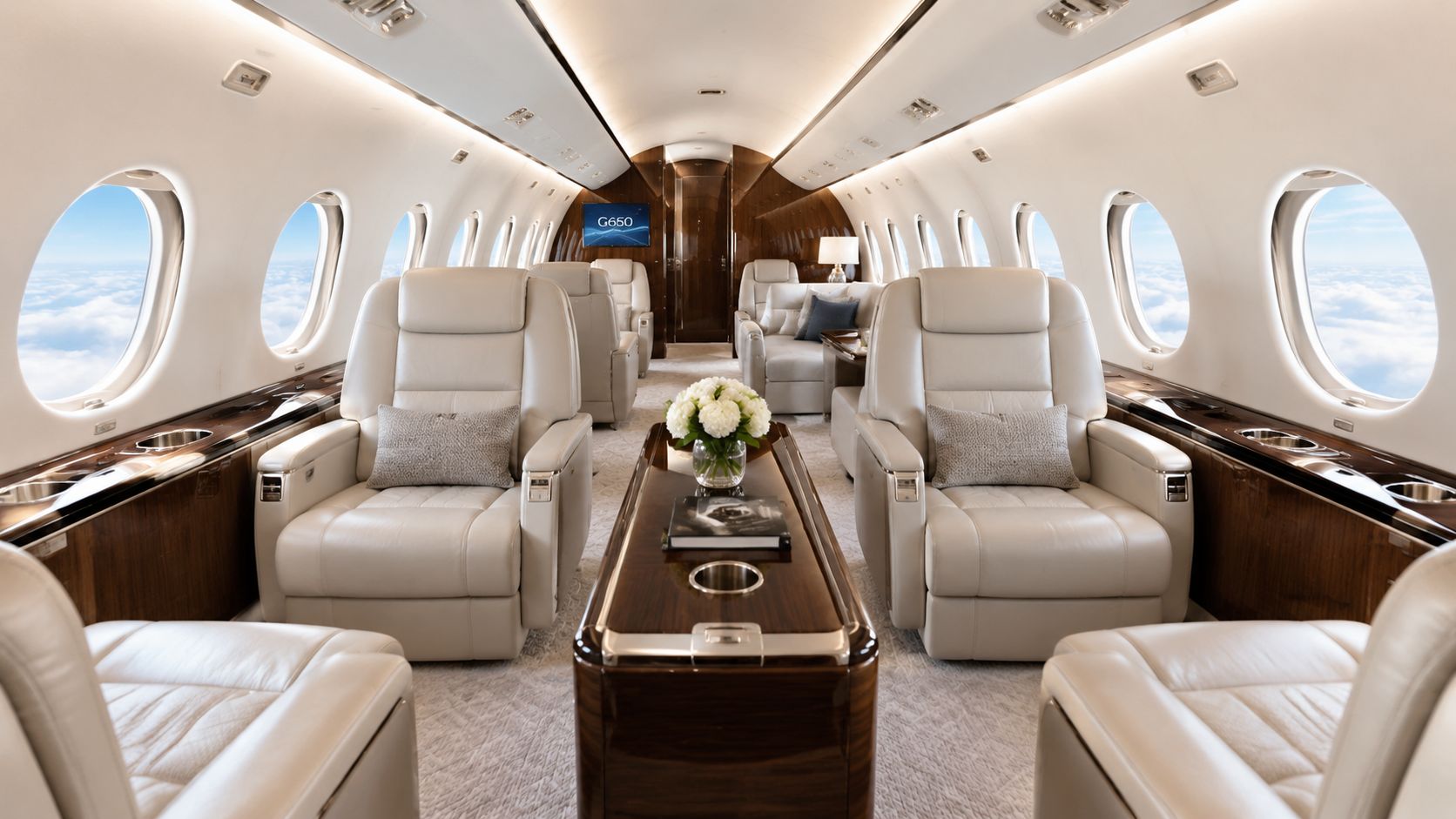
The G650 cabin's value is measured in usable space, not its maximum seat count. Its commonly listed interior dimensions are approximately 46 feet 10 inches long, 8 feet 2 inches wide, and 6 feet 3 inches high, giving passengers room to work and move during an intercontinental flight. Some layouts accommodate up to about 18 passengers, while the standard arrangement is closer to 16 passengers with four crew. Confirm the exact cabin plan against the G650 aircraft specifications before accepting a quote.
Comfort should come before seat count
A denser arrangement works for a group traveling with light luggage. It is a poor choice for passengers carrying formal clothing, equipment, gifts, or several days of personal items. Keep payload margin rather than filling every available seat.
The cabin experience includes more than occupied seats. Baggage, catering, fresh supplies, and onboard equipment all use payload capacity. On a route near the aircraft's practical range limit, additional passengers or luggage can change fuel planning and create pressure for a technical stop.
Give the broker a precise cabin brief:
- Passenger purpose: Business travelers may need conference seating and work areas. Leisure groups may value reclining seats and sleeping arrangements.
- Baggage profile: State the number and type of bags, including oversized cases, sports equipment, instruments, or wardrobe trunks.
- Catering plan: Confirm that the galley and catering setup can support the menu without consuming needed storage space.
- Connectivity needs: Verify the exact aircraft's Wi-Fi system. Equipment can differ between aircraft.
- Pet or special-service requirements: Confirm policies before selecting the aircraft and signing the contract.
Choose the layout for the mission
A small executive group flying nonstop across the Atlantic with substantial luggage and a full-service meal should not automatically choose the maximum-seat layout. Extra seats can reduce room for work, rest, and baggage. A lower-density configuration may produce a better trip, even when the aircraft technically offers more seats.
The correct question is how many passengers the aircraft can carry comfortably, with their bags and the required fuel margin, on the specific route. Request the cabin layout, baggage assumptions, and payload calculation in writing. If those details are missing, the advertised seating capacity tells you very little about the aircraft available for your charter.
Sourcing the Right Aircraft and Avoiding Ferry Fees
A successful G650 search begins with a live aircraft search, not a generic request for “any G650.” The aircraft's tail number, current location, maintenance status, crew legality, and availability determine whether the quoted trip is efficient or burdened with unnecessary repositioning.
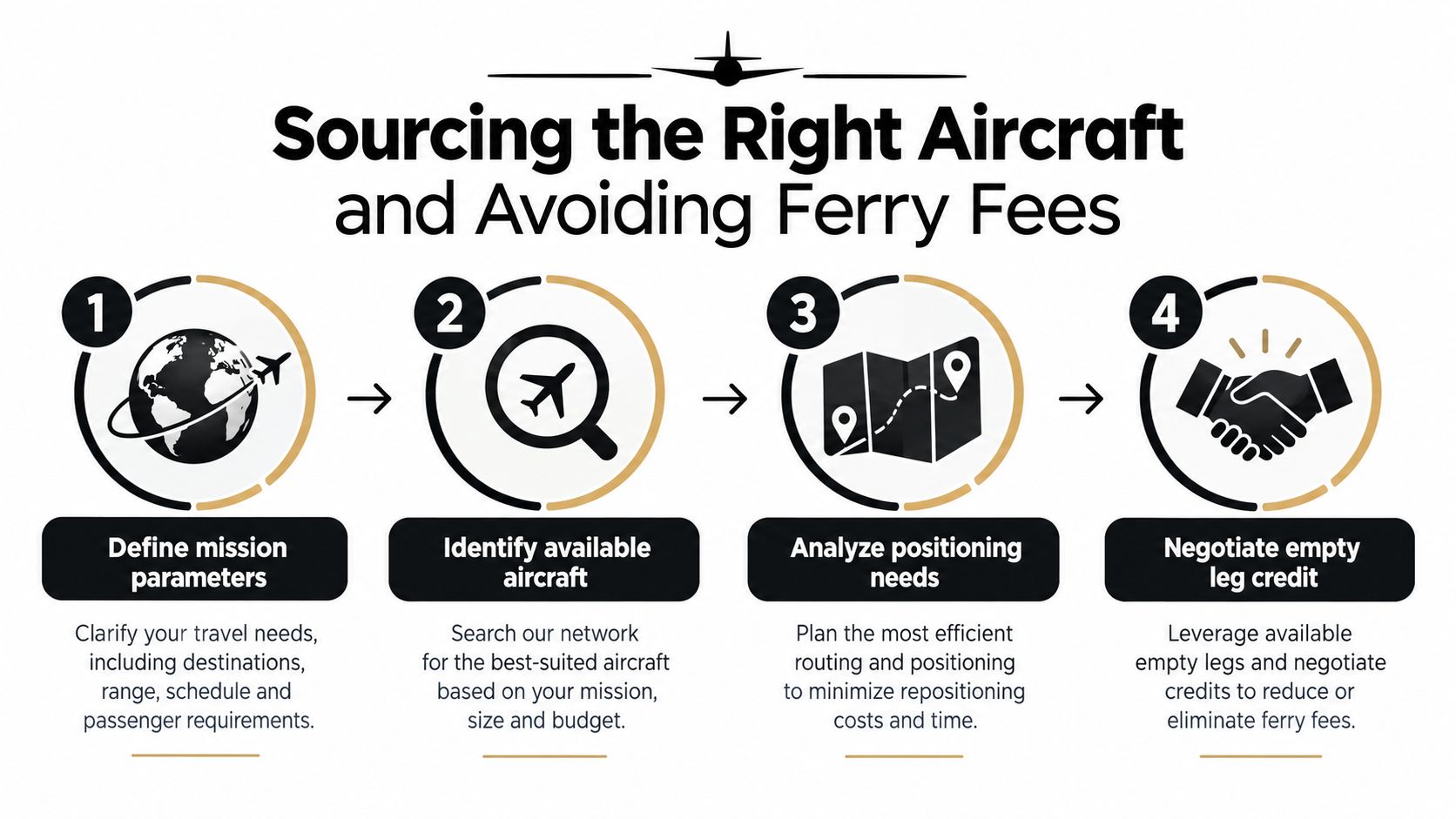
Use this workflow before accepting a proposal.
Define the mission before choosing the tail
Provide the departure airport, destination, preferred departure window, passenger names or count, baggage expectations, pets or special services, catering requirements, and any runway restrictions. The operator can't assess positioning or payload accurately without those details.
Identify aircraft that are already nearby
Ask which G650s are based near the departure airport or can reach it through an existing schedule. Don't rely on a broker's statement that an aircraft is “available.” Request the tail number and its current base so you can distinguish genuine local availability from a jet that must be ferried into position.
Verify operational readiness
The aircraft's age and cabin appearance matter, but dispatch readiness matters more. Confirm maintenance status, crew legality, insurance, international operating permissions, and the operator responsible for the flight. If the operator can't provide clear answers, move to another aircraft.
Negotiate the positioning structure
If a ferry leg is necessary, ask whether the operator can credit an empty leg, combine the positioning with another scheduled mission, or source a different G650 closer to your airport. The correct comparison is between all-in trip totals, not between isolated hourly rates.
Ask for this before signing: tail number, current location, operator name, maintenance status, crew status, positioning legs, and a complete fee schedule.
Local sourcing doesn't mean compromising on safety or aircraft quality. It means matching the mission to an aircraft that's operationally convenient. A network that works with owner-operators across multiple markets can compare nearby inventory instead of pushing a single distant aircraft.
Haute Jets is one option that sources aircraft from owner-operators and presents specific aircraft choices rather than only a broad category. Its stated network includes 3,500-plus aircraft across 175 countries, but the important step for any client is still verification of the exact aircraft and operator before payment.
Navigating Market Scarcity and On-Demand Pricing
A G650 quote can rise sharply even when the aircraft's brochure range and hourly rate look attractive. In 2026, limited availability makes the aircraft's current location, dispatch timing, and return plan as important as its performance. A distant aircraft may require repositioning before pickup and another empty leg afterward, turning an apparently competitive quote into a much larger trip total.
The first-quarter 2026 market data listed only six G650/G650ER aircraft, compared with 24 in the prior year's first quarter. It also projected approximately 30–40 G650/ER deliveries in 2026 before the production line shuts down. That smaller supply pool increases the effect of airport location and schedule pressure. Ask for the aircraft's current location before comparing quotes.
On-demand versus membership models
For occasional or route-specific G650 travel, on-demand charter generally gives you better control than a jet card or fractional arrangement. You pay for the defined mission instead of committing to prepaid hours, annual fees, or an ownership structure. That matters when you want a particular G650 or G650ER, rather than whichever aircraft a program can assign.
| Feature | On-Demand Wholesale | Jet Card / Fractional |
|---|---|---|
| Aircraft selection | Can focus on the exact available tail and cabin | Often subject to program fleet and availability |
| Payment structure | Pay per flight | Typically involves membership, prepaid hours, or ownership commitments |
| Positioning | Evaluated trip by trip | May be embedded in program pricing or operational rules |
| Schedule flexibility | Negotiated around the requested mission | Governed by program terms and availability |
| Best fit | Occasional, bespoke, or aircraft-specific travel | Repeated travel with predictable program usage |
A jet card suits travelers who value standardized booking procedures. Fractional ownership fits recurring demand and a willingness to accept long-term financial commitments. Neither removes the core dispatch problem: locating the right G650 near the right airport at the required time.
What to do in a scarce market
Send the complete mission brief early, including departure airport, schedule, passenger count, cabin requirements, and return plan. Require the exact model, tail number, current location, cabin layout, positioning legs, cancellation terms, and the name of the operating entity before approving a substitute.
Then compare all-in trip totals. If a local G650 is unavailable, price the repositioning against a G650ER or another ultra-long-range aircraft already nearby. A slightly different aircraft can cost less overall when it avoids empty ferry legs.
Scarcity rewards preparation, not blind urgency. A precise brief lets the sourcing team check multiple owner-operators and expose hidden positioning costs before you pay a deposit.
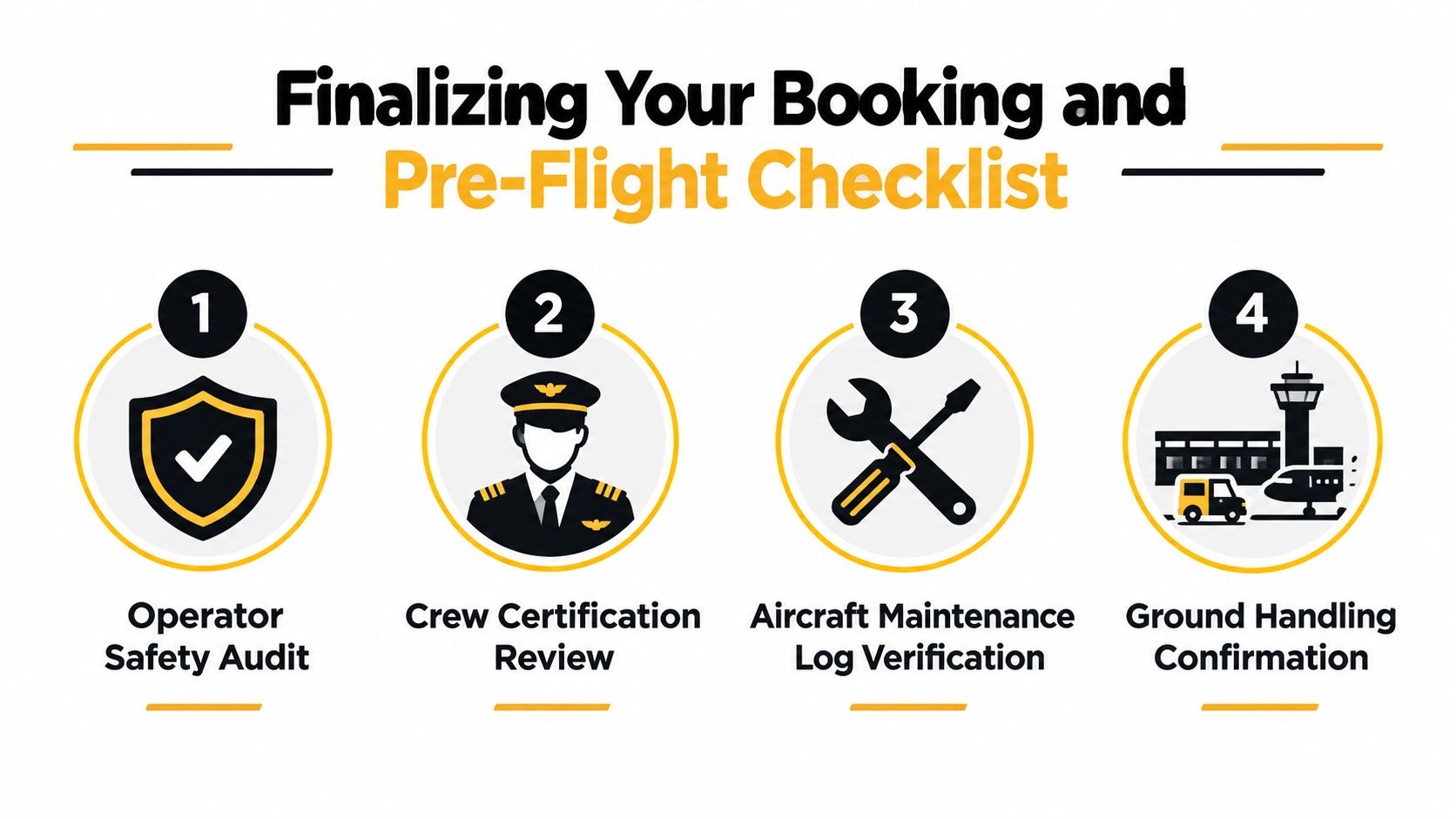
Finalizing Your Booking and Pre-Flight Checklist
The booking isn't complete when the deposit is paid. It's complete when the operator, aircraft, crew, routing, and ground handling have been verified against the written itinerary.
Start with third-party safety oversight. Every operator in our network holds a Wyvern Wingman or Argus Gold/Platinum rating, the two highest third-party safety audits in private aviation. Ask which rating applies to the operating entity for your flight, and confirm that the certificate belongs to the actual operator rather than an intermediary.
Review the operational file
Before departure, request the following:
- Operator safety audit: Confirm the current Wyvern or Argus status of the operating company.
- Crew certification review: Receive crew names, roles, relevant qualifications, and confirmation that the crew is legal for the planned operation.
- Aircraft maintenance verification: Confirm the tail number, maintenance status, and any operational limitations affecting your itinerary.
- Ground handling confirmation: Verify the FBO, arrival time, passenger procedures, vehicle access, catering delivery, and international documentation.
- Passenger manifest: Ensure every passenger's legal name matches the required travel documents and manifest.
- Weather and routing briefing: Review expected conditions, alternates, fuel planning, and any runway or airport restrictions.
The final 24 hours
A professional charter process should give you clear flight details before you reach the FBO. That should include the tail number, crew bios, weather briefing, and passenger manifest. Confirm catering, baggage handling, ground transportation, and departure procedures at the same time, because small omissions become expensive when the aircraft is already scheduled.
For a broader booking framework, use this guide on how to charter a private jet in 2026. The standard should be visibility, not reassurance. If the broker can't show you what aircraft is operating, who is flying it, how it's positioned, and what the quote includes, you don't yet have a reliable charter.
A G650 is an outstanding choice when the mission needs its range, speed, cabin, and nonstop capability. It's a poor choice when the selection is driven only by prestige or brochure figures. Price the complete operation, validate the aircraft's real performance, and treat positioning as a primary commercial variable.
Haute Jets can source on-demand Gulfstream G650 and G650ER charter options from its owner-operator network, with attention to aircraft location, operator safety ratings, and the full trip structure. Visit Haute Jets to request a mission-specific quote and compare the exact aircraft, positioning plan, and pre-flight details before you commit.