You're probably looking at a trip that sits in the awkward middle. Too far for a small cabin if you want to arrive fresh, too expensive to justify a heavy jet, and too important to gamble on the wrong aircraft. That's where most charter mistakes happen.
Clients often ask for a category when they should be asking for a mission match. A mid size private jet can be the right answer, but only if it fits the route, the passenger count, the baggage, and the airport. If it doesn't, the label won't save you from a fuel stop, a cramped cabin, or a quote padded by the wrong aircraft choice.
Why "Midsize" Is More Than a Label
A common call goes like this. A client wants to fly from one major city to another with colleagues or family, wants a real cabin instead of a tight tube, and doesn't want to pay for space they won't use. They've already ruled out the smallest jets because the trip feels too long and the cabin too limiting. They've also ruled out a heavy jet because the mission doesn't justify it.
That's the sweet spot a mid size private jet was built for.

This isn't a niche corner of business aviation. Airbus Corporate Jets' analysis reported 14,632 private jets in the United States, and 20.5% of them are classified as midsize, which implies roughly 3,000 midsize aircraft in the U.S. alone. The same analysis also noted strong concentrations in states such as Texas, Florida, and California, which matters for charter because local aircraft concentration usually means better availability and less friction for on-demand departures. You can review those fleet figures in Air Cargo Week's summary of the U.S. private jet fleet.
Why clients keep landing in this category
Most travelers don't care about category names. They care about practical outcomes.
- Cabin comfort: You want enough room to work, talk, relax, and move without feeling boxed in.
- Trip efficiency: You want an aircraft that can handle the route cleanly without paying for capability you don't need.
- Airport flexibility: You want access to useful airports, not a forced compromise because the jet is too limited or too large for the mission.
Broker view: The right aircraft choice starts with the trip, not the brochure.
If you're still sorting out how private aircraft classes differ, Haute Jets Journal has a useful primer on understanding private jet types. Read it once, then stop shopping by label alone.
Defining the Midsize Private Jet Sweet Spot
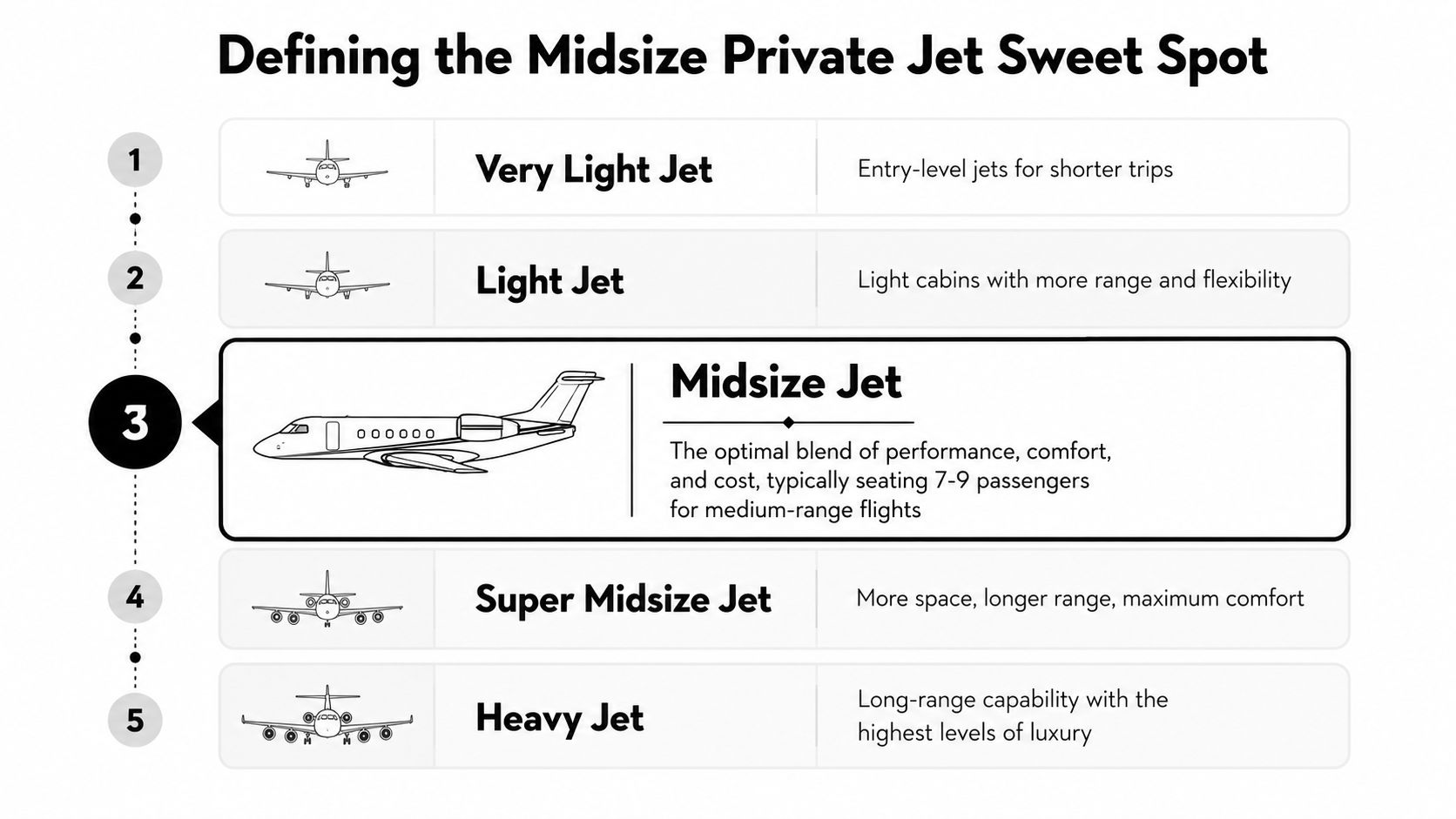
A mid size private jet is the private aviation equivalent of a luxury SUV. It gives you more space, better comfort, and more mission flexibility than a light jet, but it doesn't drag you into heavy-jet pricing and unnecessary cabin volume.
That balance is exactly why this category keeps getting booked.
Industry sources describe midsize jets as typically seating 6 to 8 passengers, with ranges of about 2,000 to 3,500 nautical miles and typical speeds around 470 to 530 miles per hour. In 2025 charter benchmarks, midsize aircraft such as the Citation XLS and Challenger 350 were placed at roughly €6,500 to €8,000 per flight hour, compared with €3,000 to €5,800 for light jets and €9,500 to €12,500 for heavy jets, according to Privaira's comparison of mid-size and super mid-size jets.
What those numbers mean in real life
Specs are only useful when you translate them into travel decisions.
A midsize jet usually makes sense when you want:
A cabin that feels substantial
Enough room for a small group to travel comfortably without everyone fighting for shoulder space.A route that's beyond the natural comfort zone of a light jet
Not every trip demands a larger aircraft, but longer sectors tend to make clients appreciate cabin size and luggage flexibility fast.A middle-ground charter budget
You're paying for meaningful capability, not flagship excess.
The real sweet spot
The category works best for travelers who care about comfort and efficiency in the same sentence. That's the key. If your trip profile sits between “quick regional hop” and “full long-range cabin experience,” a midsize aircraft often gives you the cleanest answer.
For a quick side-by-side category breakdown, this Journal piece on light jets vs midsize jets is worth your time.
Don't treat midsize as a prestige step up from light. Treat it as a deliberate buy for the right mission.
Midsize Jets vs Other Aircraft Classes
The easiest way to pick the wrong aircraft is to compare categories by image instead of mission. Clients do this all the time. They assume bigger is safer, smaller is cheaper, and midsize is just a vague middle. That's not how charters work.
The useful comparison is simple. What are you gaining, and what are you giving up?
When a light jet is enough
If you're flying a short sector with a small group and you don't care much about cabin room, a light jet may be the smarter buy. You keep costs lower and often get efficient access for straightforward regional flying.
But there's a point where that savings starts to feel false. The route gets longer. Bags become a constraint. The cabin gets tiring. The lavatory setup matters more than it did when you first requested the quote.
A midsize jet becomes the upgrade you feel, not just the one you see on paper.
When midsize is the better answer
This category earns its value when the mission has competing demands. You want decent range, a comfortable cabin, reasonable economics, and enough flexibility to avoid unnecessary compromises.
Choose midsize when these factors matter at the same time:
- You have a real group: Six to eight passengers is where cabin comfort starts to matter more.
- You want fewer trade-offs: Longer domestic routes and shorter international sectors often fit well here.
- You want a proper cabin experience: More room, better flow, and usually a more settled trip than a small aircraft gives you.
A midsize jet is often the first category where clients stop feeling like they're “making do” and start feeling like the aircraft actually fits the mission.
When to move up to super midsize
Some trips stretch beyond what standard midsize aircraft handle elegantly. That's where super midsize jets enter the conversation. You move up when nonstop range becomes more important than hourly economy, or when the passenger expectation rises with the route.
You also move up when the trip needs more margin. Not theoretical margin. Operational margin. More route flexibility, more baggage confidence, more room for weather and planning variables.
When a heavy jet is justified
A heavy jet should solve a real problem. It shouldn't be a reflex.
Book heavy when you need a much larger cabin, a more expansive onboard experience, or mission capability that clearly exceeds the midsize and super midsize envelope. If you don't need those things, heavy can be expensive dead weight.
Here's the blunt version:
| Aircraft class | Best use case | Main compromise |
|---|---|---|
| Light jet | Shorter trips with fewer passengers | Less cabin space and less mission flexibility |
| Midsize jet | Balanced comfort, range, and cost | Not every aircraft in the category handles long missions the same way |
| Super midsize jet | Longer nonstop flying with more cabin capability | Higher charter cost |
| Heavy jet | Large-cabin missions and long-haul needs | Easy to overbuy |
Profiling Popular Midsize Jet Models
Clients frequently misstep here. They ask for “a midsize jet” as if every aircraft in the category performs the same way. They don't. Some are better for runway flexibility. Some are better for longer-range missions. Some feel better in the cabin for the kind of trip you're planning.
According to Essex Aviation's discussion of mid-size private jets, the category now spans a broad range of capability. Newer models like the Praetor 500 and Gulfstream G280 push longer-range performance, while established Citation models remain known for strong runway performance. That same market overview also notes new aircraft prices spanning roughly $11.0 million to $30.0 million, which tells you something important. “Midsize” isn't one product. It's a band with very different mission profiles inside it.
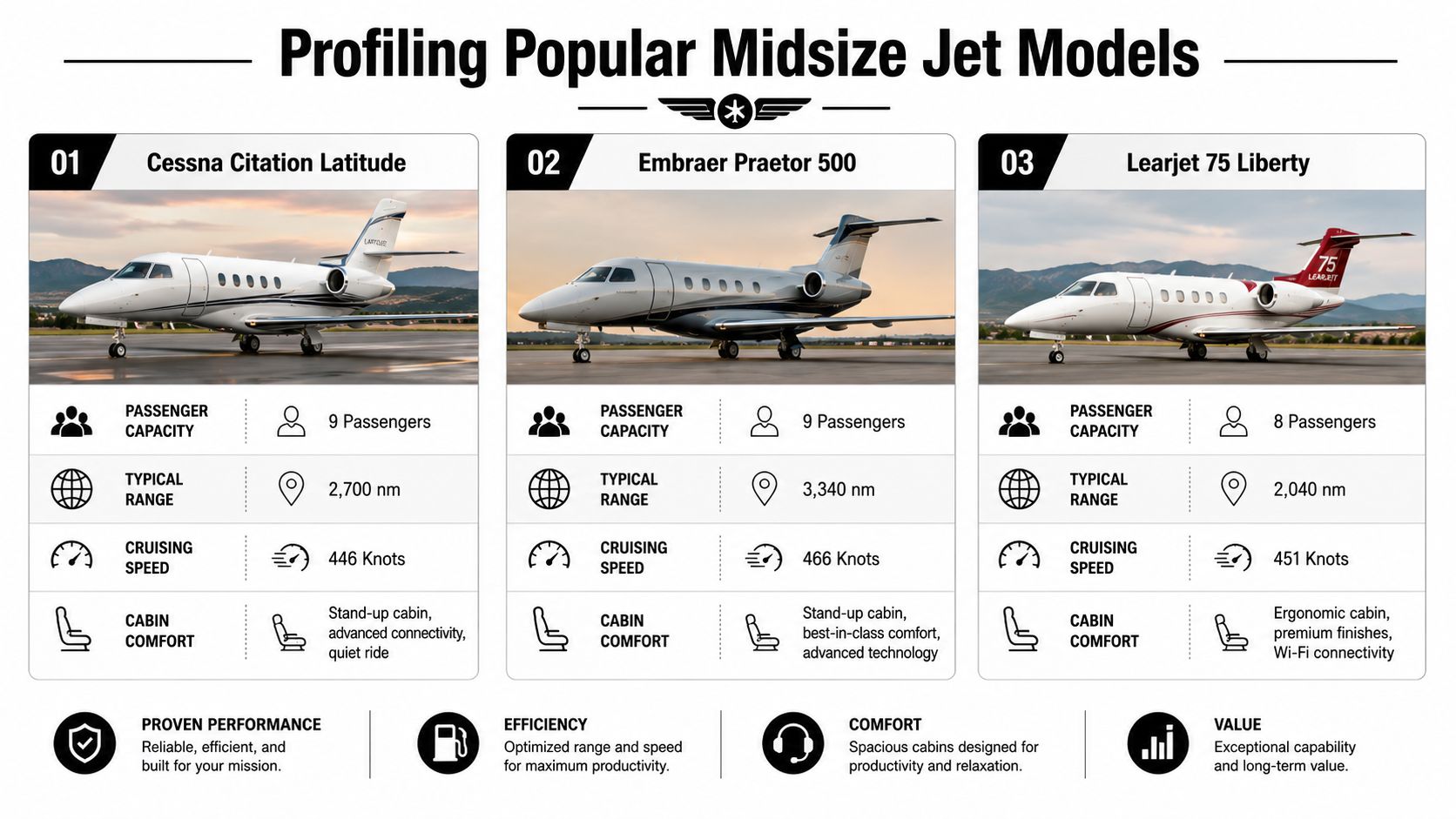
Citation Latitude
If your priority is cabin comfort with practical mission utility, the Citation Latitude gets my attention quickly. It's the kind of aircraft that works well for clients who care about how the trip feels, not just whether the route can be completed.
Its appeal is straightforward. The cabin experience tends to be strong for this segment, and it's often a smart choice for travelers moving up from smaller aircraft who want more space without jumping into a much larger charter bill.
Challenger 350
The Challenger 350 is often the answer when a client wants a polished cabin and a strong all-around mission profile. It tends to satisfy business travelers who want comfort, speed, and a cabin that feels credible for executive use.
This aircraft is often a good fit when you don't want to gamble on a borderline mission. It's a serious traveler's airplane. If the route and budget support it, it usually deserves a close look.
A deeper look at longer-range options in this segment is available in Haute Jets Journal's guide to luxury midsize jets offering the longest flight range.
Praetor 500
The Praetor 500 is for clients who want the newer edge of the category. It's the aircraft I discuss when the mission may stretch farther and the traveler wants more than “good enough.”
The mission-fit conversation is paramount. If you charter a Praetor 500 for a route that doesn't need its added capability, you may be paying extra for bragging rights. If you need that capability, it can be exactly the right tool.
Before comparing models, watch this short overview:
Midsize Jet Model Comparison
| Model | Typical Passengers | Range (NM) | Cabin Height | Best For |
|---|---|---|---|---|
| Citation Latitude | Varies by configuration | Varies by mission setup | Stand-up style cabin commonly associated with the model | Comfort-focused domestic and business travel |
| Challenger 350 | Varies by configuration | Varies by mission setup | Spacious executive-style cabin | Travelers who want a refined all-around charter option |
| Praetor 500 | Varies by configuration | Longer-range leaning within the category | Modern cabin environment | Clients who need more mission reach |
The wrong midsize aircraft usually doesn't fail dramatically. It disappoints quietly through extra cost, reduced comfort, or an avoidable stop.
Common Routes and Realistic Charter Costs
Clients always ask the same question first. What does it cost? Fair question. The problem is that a route alone doesn't produce a serious charter quote. The aircraft position, crew schedule, airport choices, and day-of-operation details matter just as much.
That's why two quotes for what looks like the same trip can come back very different.
What a midsize quote is really pricing
When you request a midsize aircraft for a route like New York to Miami, Los Angeles to Las Vegas, or Miami to Aspen, the quote isn't just buying flight time. You're buying the aircraft assignment, crew, operating plan, and the logistics around your specific mission.
The final number usually moves because of factors like these:
- Aircraft positioning: If the airplane has to come to you from another city, the cost rises.
- Crew duty and overnight planning: Some trips fit into a simple same-day schedule. Others don't.
- Airport and handling fees: These vary by airport and mission complexity.
- Weather-driven extras: De-icing and similar operational requirements can change the quote.
- Special trip requests: Catering, pets, Wi-Fi confirmation, ground transfers, and schedule changes all matter.
Route examples clients ask about
I'll keep this practical.
For a route like New York to Miami, midsize often makes sense because clients want a meaningful cabin without stepping into a much larger aircraft than necessary. For Los Angeles to Las Vegas, a midsize jet can still be a valid choice if the priority is cabin experience rather than bare-minimum trip economics. For Miami to Aspen, the mission gets more nuanced because airport conditions, baggage, and seasonal operating realities matter more than the category label.
If you want an accurate charter number, ask for the total trip solution, not just an hourly rate.
How to avoid paying for the wrong quote
A smart buyer looks at sourcing before looking at cabin photos. A locally based aircraft often produces a cleaner quote than a prettier aircraft that must be repositioned. That's one reason some charter clients use marketplaces and brokers that focus on nearby aircraft availability. Haute Jets, for example, states that it sources aircraft near the departure city to reduce unnecessary repositioning and also confirms the specific aircraft assigned before departure.
That's the cost lesson. Don't shop for a midsize jet as a category alone. Shop for the aircraft that fits your route cleanly and starts close to where you are.
Your Smart Booking Guide for Midsize Jets
Price matters. Safety and clarity matter more.
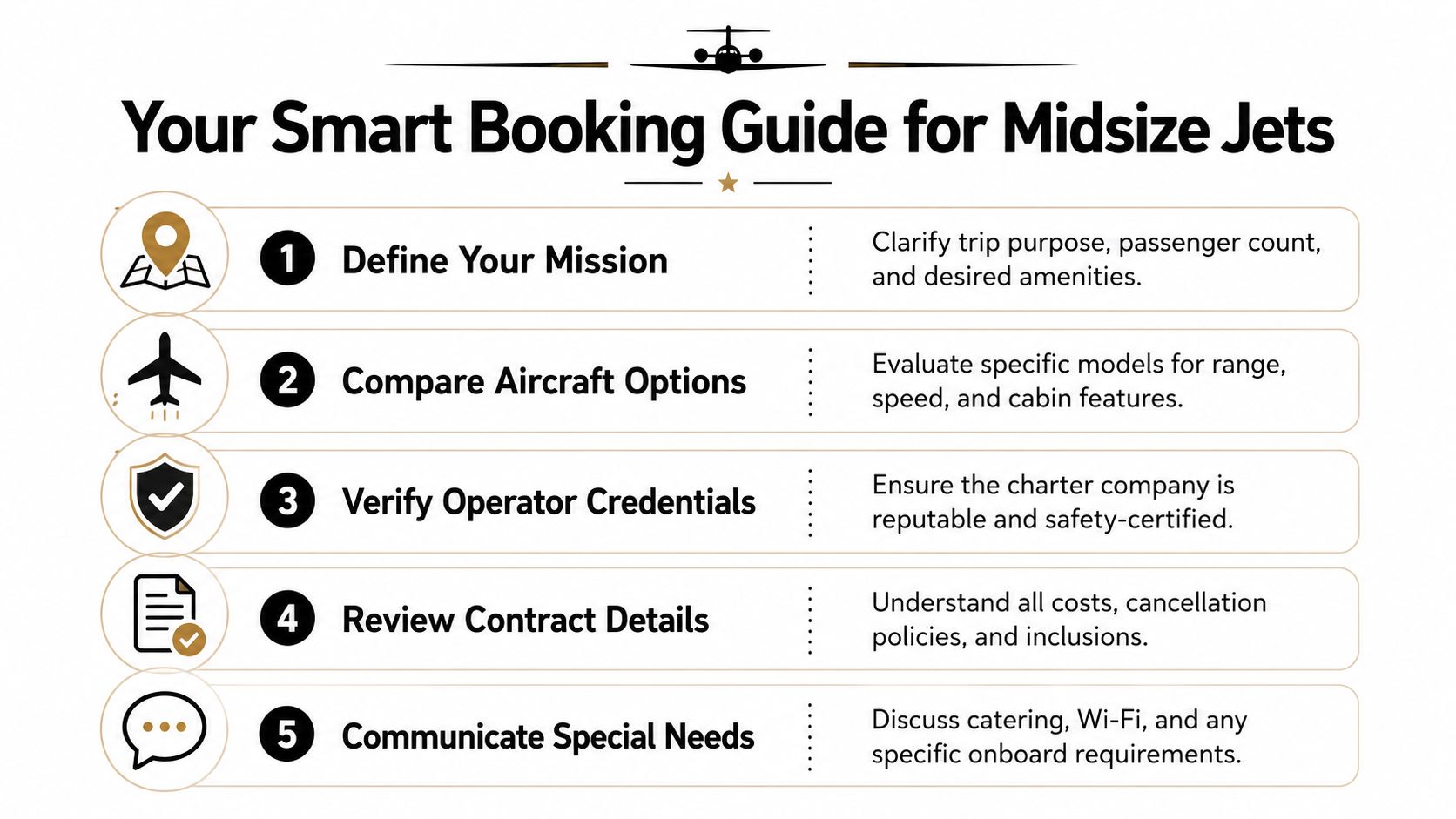
The worst booking decisions usually come from clients who focus on cabin photos and ignore operator standards, contract details, and trip assumptions. A smart charter process is boring in the right places. It asks the questions that prevent ugly surprises.
What I'd verify before approving any midsize booking
- Operator credentials: Ask whether the flight is operated by a carrier with third-party safety credentials such as Wyvern Wingman or Argus Gold/Platinum. If the answer is vague, move on.
- Exact aircraft assignment: Don't accept “or similar” language casually. You should know the actual make and model being proposed.
- Cabin essentials: Confirm Wi-Fi, pet policy, baggage fit, catering, and lavatory setup before payment.
- Schedule realism: Ask whether the quote assumes repositioning, crew overnight, or any likely operational restriction.
- Cancellation terms: Read them. Charter flexibility isn't the same thing as consequence-free cancellation.
Empty legs are useful, but they're not magic
Clients love the idea of empty legs because the pricing can look attractive. Sometimes they are a good fit. Often they are not.
An empty leg works best if your schedule is flexible. If you need fixed departure timing, fixed return timing, and zero risk of a change, don't build your travel around someone else's aircraft repositioning plan.
One hard rule: Never take a cheaper empty leg if missing the trip would cost you more than the savings.
The right questions to ask your broker
Ask these plainly:
- Is this the exact aircraft or a placeholder quote?
- Is the aircraft already near my departure airport?
- Are all likely fees included?
- What safety credentials does the operator hold?
- What happens if weather or aircraft availability changes?
That list is simple on purpose. If a broker answers those questions cleanly, you're dealing with someone who understands charter execution, not just charter sales.
The Haute Jets Advantage for Your Next Flight
The smartest way to book a mid size private jet is to ignore the category hype and focus on mission fit. That means matching the route, passenger mix, comfort expectations, airport profile, and operating realities before anyone talks you into a bigger cabin or a lower headline rate.
That's also where most buyers need an advisor, not just a booking form.
A useful charter partner should do four things well. First, source an aircraft that starts near your departure point whenever possible. Second, show you the exact aircraft being proposed. Third, ensure safety standards are paramount. Fourth, make the quote understandable enough that you know what you're buying.
If a provider can't do that, the problem usually shows up later as repositioning cost, a substituted aircraft, or a trip that looked cheaper than it really was.
The practical takeaway is simple. Don't ask, “What's your midsize jet?” Ask, “What aircraft fits this trip best, and why?” That one question changes the whole booking process.
If you want help matching the right aircraft to your route, Haute Jets can help you compare exact charter options without a membership model, so you can book for the mission instead of guessing by category.