You're coordinating a trip for six to eight people, and the itinerary looks simple until you count the airline connections, airport transfers, and lost working time. A midsize jet charter can often provide the nonstop transcontinental reach your group needs without moving up to a heavy aircraft designed for longer missions and larger cabins. The important question isn't “What's the hourly rate?” It's whether the aircraft fits the route, passenger load, luggage, comfort expectations, and positioning requirements.
This guide, prepared for Haute Jets Journal, builds that decision from the ground up. You'll learn what defines the midsize category, how its range translates into practical city pairs, why quoted prices can vary sharply, and which operational details deserve confirmation before departure. You'll see when midsize is the efficient choice and when a larger cabin can prevent a false economy.
Introduction to Midsize Jet Charter Value
Suppose your group needs a nonstop domestic trip, useful luggage space, and room to work, but the route does not justify a larger cabin. A midsize jet charter can fit that mission without paying to carry capabilities you will not use. Its value comes from matching the aircraft to the trip, not from selecting the largest option on the quote.
Midsize aircraft sit between light jets and larger-cabin models. They generally provide more distance and cabin capability than many light jets, while avoiding the added size, cost, and unused capacity of super-midsize or heavy aircraft. For a group flying a domestic transcontinental route, that balance may be more practical than choosing a larger aircraft because it offers more room.
A typical midsize mission involves six to nine passengers and a nonstop journey of approximately 2,000 to 3,000 nautical miles, according to Private Jet Directory's midsize aircraft overview. That profile suits roughly two- to four-hour domestic trips, although aircraft type, routing, weather, payload, and airport conditions can change the result.
Practical rule: Choose the aircraft for the mission you're flying, not for the category name printed on the quote.
The decision usually balances range, cabin comfort, and operating economics. Industry tracking identified medium jets as a growth leader in 2026, with activity rising 7.0% year to date versus 2025 and 7.3% versus April 2025. The worldwide business jet fleet had also expanded from about 11,000 aircraft in 2001 to roughly 25,500 by April 2026, as reported in the 2026 JETNET and WINGX market monitor.
Midsize is not automatically the lowest-cost choice. A longer route may make a super-midsize or heavy cabin more efficient if it avoids a fuel stop, baggage compromise, or cramped workspace. Conversely, a nearby midsize aircraft may reduce repositioning charges and keep the itinerary simpler.
The practical test is mission fit: route, passengers, luggage, comfort, and aircraft availability must work together.

What Defines a Midsize Jet Charter Aircraft
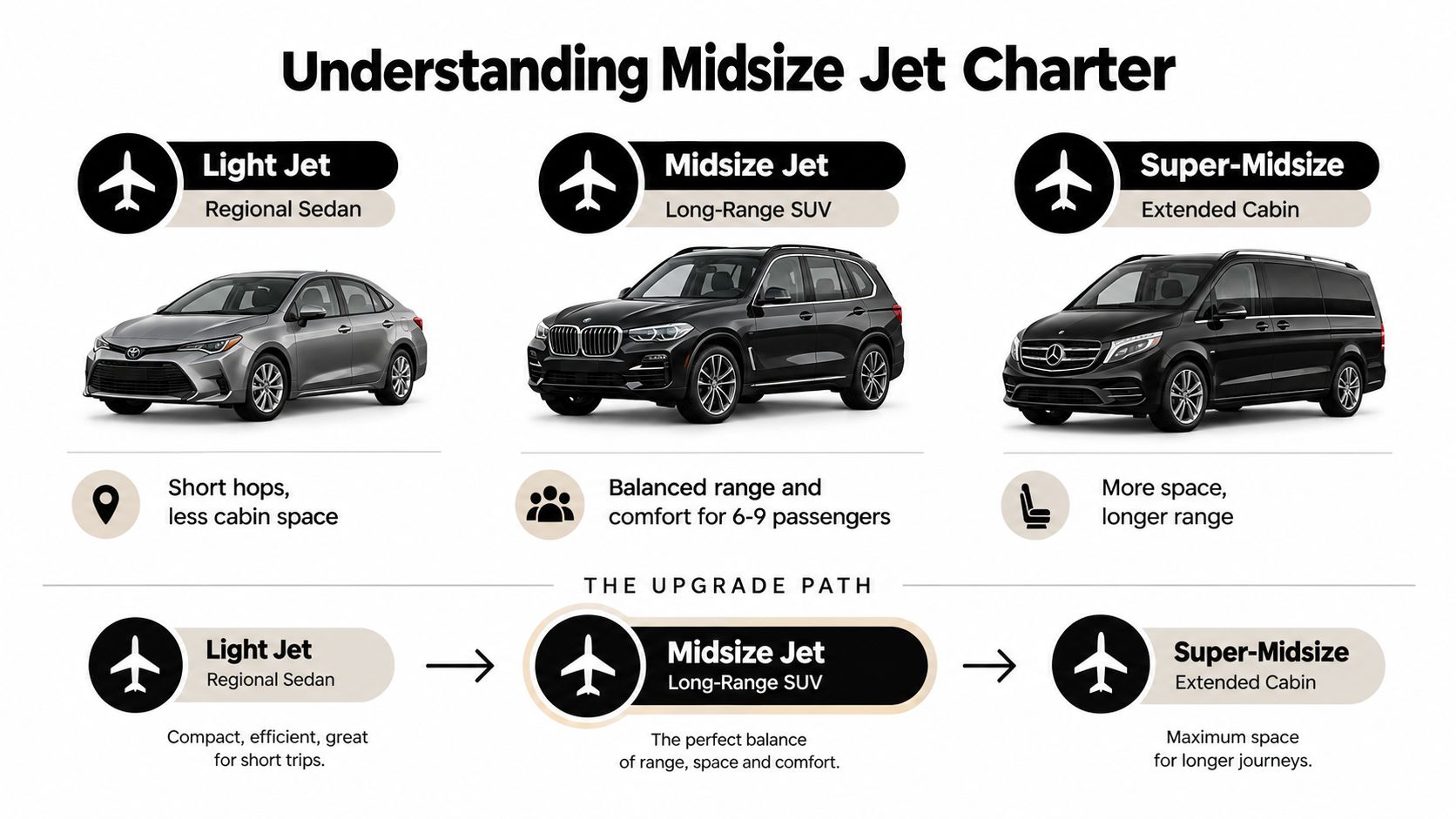
Private aircraft categories suit different journeys. A light jet works like a regional sedan for shorter routes and smaller groups. A midsize jet is closer to a long-range SUV, pairing useful distance capability with room for conversation, personal space, and practical luggage. A super-midsize aircraft adds a larger cabin and stronger long-range capability.
Passenger capacity provides a starting point. Midsize jets generally seat six to nine passengers, according to Private Jet Directory. JetVia's midsize jet guide describes the category as commonly carrying seven to nine passengers and reaching about 3,000 miles or 2,700 nautical miles nonstop, depending on aircraft type and operating conditions.
Cabin expectations
The seat count does not describe the full experience. Some midsize cabins allow passengers to sit upright comfortably, while others offer limited standing room. Ask whether the aircraft has genuine stand-up space or a higher roofline than a light jet. That difference affects longer flights, particularly when passengers need to move, work, or change seats.
An enclosed lavatory is common, though layouts vary. Wi-Fi, seating, refreshment equipment, and storage depend on the specific aircraft, its year, and the operator's interior choices. A quote listing “midsize jet” does not guarantee a particular cabin.
Performance and operating logic
Midsize jets typically cruise at approximately 430 to 490 knots and operate around 41,000 to 45,000 feet. These capabilities can help operators route above much commercial traffic and weather, although winds, air traffic control, payload, and routing still affect flight time.
Midsize aircraft often operate without a dedicated flight attendant. That can simplify operations compared with larger-cabin aircraft, while making advance planning more important if passengers expect substantial catering or onboard service. The cabin may offer a comfortable working environment, but it is not automatically configured like a heavy jet.
For a short group trip, midsize can provide enough room without paying for unused cabin volume. A longer mission with more luggage, additional passengers, or a need for greater onboard service may justify a super-midsize or heavy cabin, especially if it avoids a fuel stop or a cramped layout. The right category follows the mission rather than the hourly label.
Popular Midsize Jet Models and Cabin Capabilities
Once you've decided that midsize fits the mission, the next decision is more specific. A Citation Latitude, Challenger 350, Hawker 800XP, and Learjet 60 may all be presented as midsize options, but they won't deliver the same cabin, luggage, age, or onboard technology.
The table below is a practical starting point rather than a substitute for an aircraft-specific quote. Exact seating and range depend on configuration, payload, weather, routing, and operating restrictions.
Midsize Jet Models at a Glance
| Aircraft Model | Typical Seats | Nonstop Range | Standout Cabin Feature |
|---|---|---|---|
| Citation Latitude | 7 to 9 | About 2,000 to 2,700 nautical miles | Modern cabin design and enclosed lavatory options |
| Challenger 350 | 8 to 9 | About 3,000 nautical miles | Spacious cabin and strong long-range midsize capability |
| Hawker 800XP | 7 to 8 | About 2,400 nautical miles | Proven cabin layout and practical baggage access |
| Learjet 60 | 6 to 8 | About 2,400 nautical miles | Fast cruise performance and efficient executive layout |
For a current look at aircraft commonly offered in this category, review the Haute Jets midsize jet fleet options. Treat the model name as the beginning of the conversation, not the final specification.
Why the same model can feel different
A newer Citation Latitude with installed Wi-Fi and a carefully maintained interior may feel very different from an older aircraft of the same model. The same applies to seating orientation, table placement, entertainment systems, and baggage access. A group traveling with garment bags, presentation materials, sports equipment, or pet carriers should discuss storage before accepting a generic aircraft description.
The Challenger 350 can make sense when cabin volume and range carry more weight than the lowest possible hourly quote. The Hawker 800XP may suit a practical domestic itinerary when its location, maintenance record, and layout align with the trip. A Learjet 60 can appeal to travelers who value speed and a compact executive cabin, but passenger count and baggage should be reviewed carefully.
Ask for four details in writing:
- Exact aircraft: Confirm the year, make, model, and tail number when available.
- Cabin layout: Request the seat map, lavatory description, and baggage information.
- Onboard features: Verify Wi-Fi, power, catering capability, and entertainment equipment.
- Operational limits: Ask whether passenger count, luggage, weather, or runway conditions could affect the planned route.
That level of specificity prevents a common booking mistake, choosing a category and assuming every aircraft inside it offers the same experience.
Range and City Pair Examples That Show Real Reach
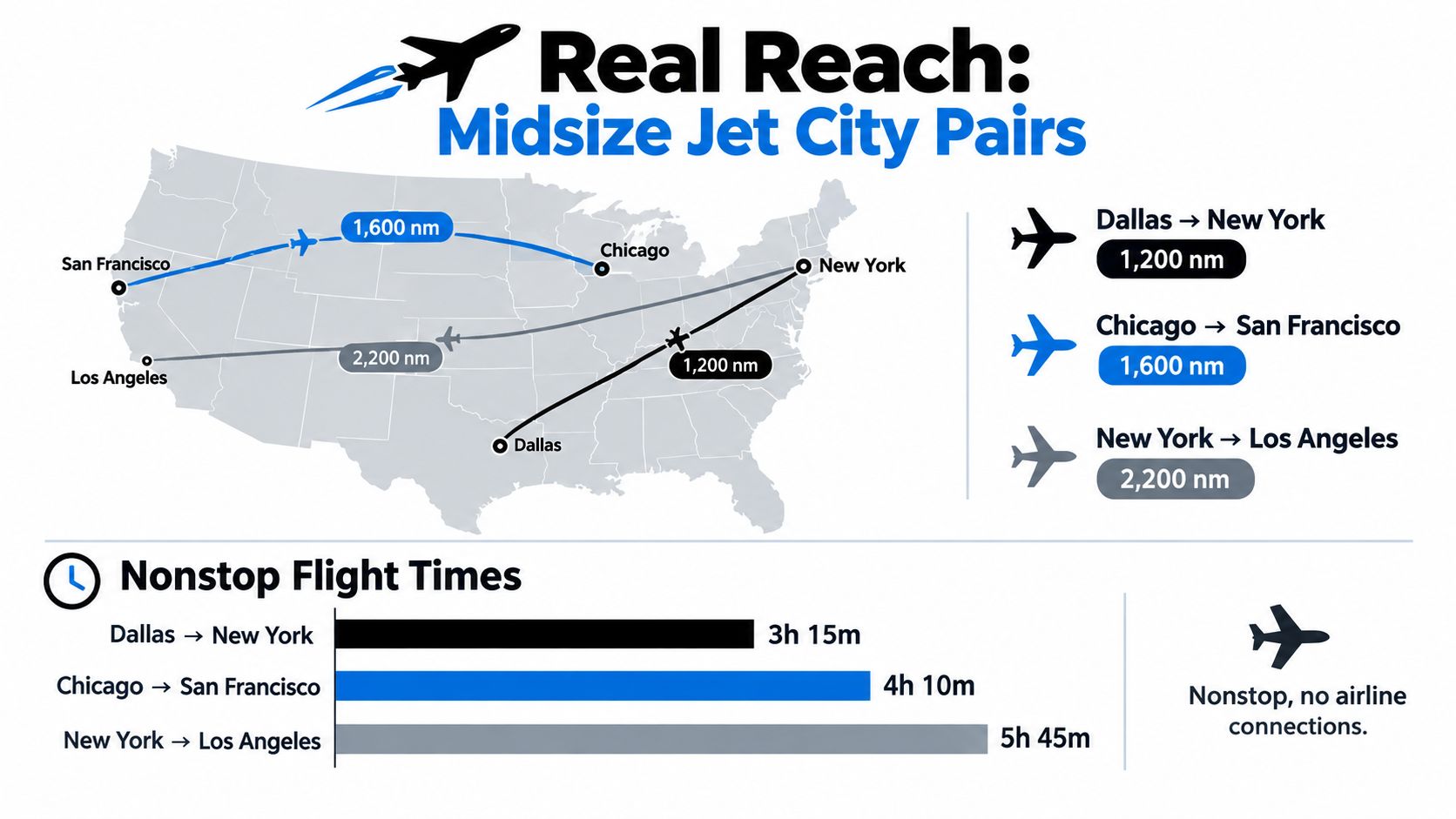
Range becomes easier to understand when it's attached to a route. Midsize jets generally operate in the approximate 2,000 to 3,000 nautical mile nonstop band, which supports many longer domestic missions. That capability can turn a connection-heavy airline itinerary into a direct flight, while regional airport access may shorten the ground journey at either end.
Dallas to New York, Chicago to San Francisco, and New York to Los Angeles are useful examples of the type of city pairs buyers often consider. The exact feasibility depends on the selected aircraft, passenger and baggage load, winds, routing, fuel planning, and airport conditions. A published range figure is not a promise that every passenger configuration can fly every route nonstop.
How payload changes the answer
Range and payload work together. More passengers and heavier luggage increase the aircraft's required performance, while strong headwinds can affect fuel planning. A midsize jet may technically cover a route but require a more conservative loading plan, a fuel stop, or a larger aircraft to preserve schedule reliability.
Regional airports can also improve the door-to-door calculation. A private aircraft may use an airport closer to the final destination than the major commercial gateway, but airport suitability still depends on runway length, aircraft performance, operating hours, customs requirements, and weather.
Ask for a route review, not just a range number. The broker or operator should explain whether the proposed aircraft can carry your people and luggage nonstop under the expected conditions.
A nonstop midsize flight can be valuable even when its airborne time resembles a commercial flight. The private itinerary removes airline connections, reduces terminal friction, and lets the group travel together. But if the route is near the aircraft's practical limit, a super-midsize option may deliver a more dependable schedule with better baggage flexibility.
For additional aircraft context, compare the longest-range luxury midsize jet options. A route quote should state the planned airports, estimated block time, fuel assumptions, and any conditions that could trigger a change.
Midsize Jet Charter Pricing and What Drives Total Cost
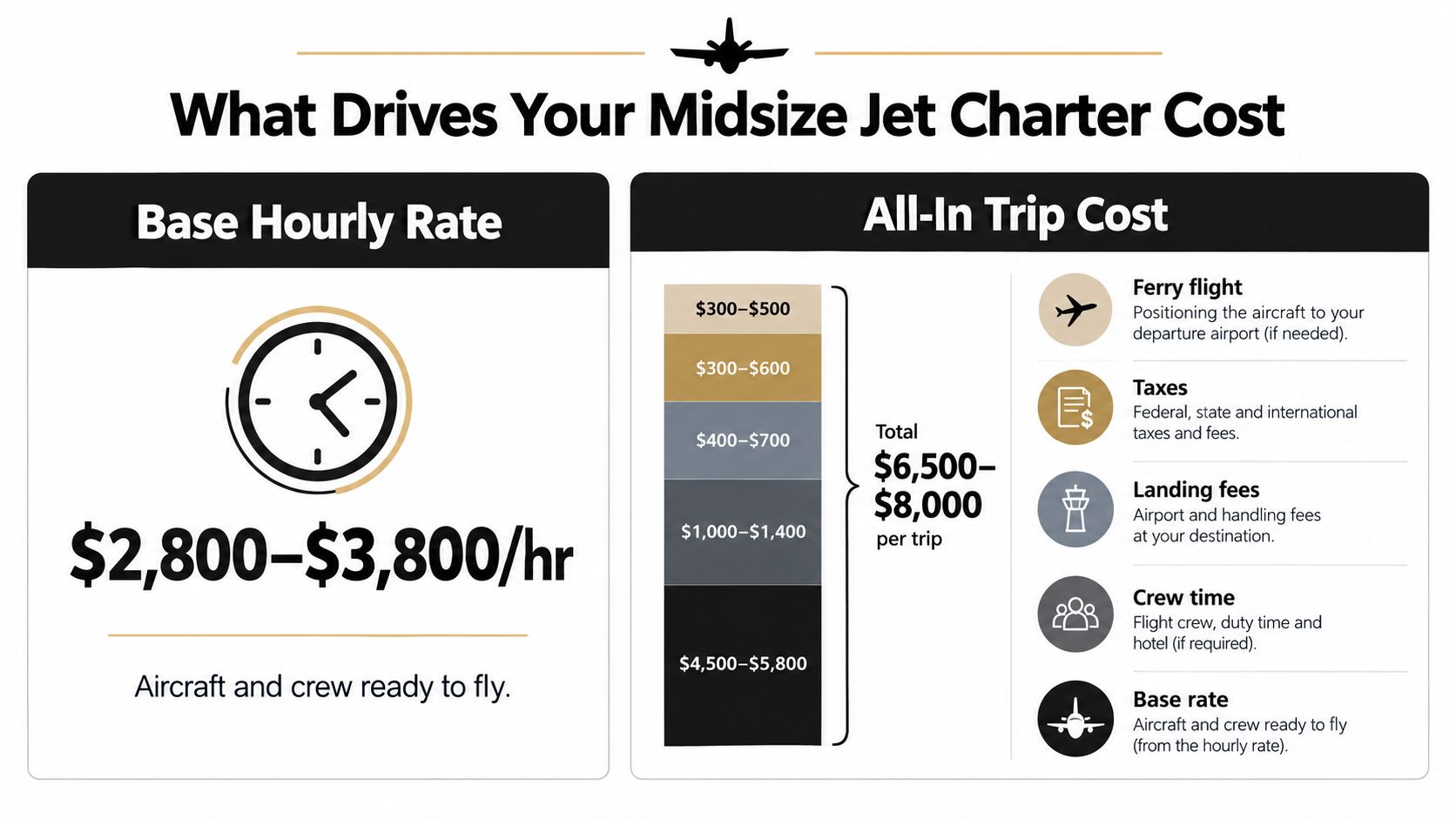
A midsize charter quote can look attractive until the surrounding costs are added. Published references place many midsize aircraft around $2,800 to $3,800 per hour, while another working range puts all-in pricing around $6,500 to $8,000 per hour. Both ranges may be accurate because they use different pricing bases, aircraft, markets, and inclusions, as explained in EvoJets' midsize charter pricing guide.
A route example shows why the hourly figure is only a starting point. Some 2026 pricing guidance places a New York to Los Angeles midsize trip at approximately $28,000 to $38,000, depending on operating details, according to Paramount Business Jets' private jet rental cost guide. The final amount can include block time, aircraft positioning, taxes, landing fees, crew time, and other charges. In practice, multiplying the advertised hourly rate by airborne time rarely gives the complete answer.
The repositioning question
An aircraft based far from your departure airport may need to fly empty before collecting your group. That ferry, deadhead, or positioning leg can be charged at the aircraft's standard hourly rate. One charter-cost explanation estimates that repositioning may add 20% to 50% to a short-trip total, while another industry source describes positioning increases of 30% to 100%, depending on the route and aircraft base location, as detailed by My VIP Aviation.
Ask whether the aircraft is already local, where it will come from, and whether the quotation includes the return or ferry segment. A lower hourly figure can disappear when the aircraft must travel a long distance before pickup.
Reading the quote line by line
Request a written breakdown that identifies:
- Aircraft and crew: The selected model, crew arrangement, and included flight hours.
- Positioning: Ferry, deadhead, or repositioning legs connected to departure.
- Airport charges: Landing, handling, parking, and terminal-related fees.
- Crew costs: Duty time, overnight expenses, and accommodation where applicable.
- Taxes and extras: Applicable taxes, catering, ground transport, deicing, and special requests.
Compare the total trip price, not two hourly figures placed side by side. Ask for a locally based aircraft as a separate option, since proximity may affect the final total more than a modest difference in the advertised rate.
For broader context on quote components, review the Haute Jets private jet charter cost guide. The practical goal is a mission-fit quote. A midsize jet may cost less and simplify a trip when its range, cabin, and baggage capacity match the itinerary. A super-midsize or heavy cabin can be the better financial choice when a midsize aircraft would require positioning, restrictive loading, or a fuel stop.
Passenger Experience and Booking Best Practices
A smooth midsize trip begins before passengers enter the private terminal. Your broker or operator should confirm the aircraft, airport, departure time, catering, Wi-Fi expectations, pet rules, and ground transportation. Private aviation removes many airline procedures, but it doesn't remove the need for accurate coordination.
The private terminal is usually an FBO, or fixed-base operator. It handles passenger reception, security procedures, ramp access, fueling, and aircraft coordination. Your transfer vehicle may drive directly to the aircraft, but the exact process varies by airport and operator.
Comfort details worth confirming
Cabin amenities can change the experience more than the model name suggests. Confirm whether the aircraft has working Wi-Fi, power at the seats, an enclosed lavatory, the requested catering, and enough baggage space for every traveler. If you're traveling with pets, request the operator's rules in advance because acceptance, carrier requirements, and cabin procedures can differ.
Ground transport deserves equal attention. If the trip connects with a complex itinerary in the United Arab Emirates, for example, reviewing fleet options for a Dubai chauffeur service can help coordinate the vehicle portion separately from the flight.
The twenty-four-hour confirmation checklist
Before departure, request a final packet that includes:
- Tail number: Confirm the aircraft assigned to the trip and ask about any substitution.
- Crew information: Review pilot names and relevant operating details provided by the operator.
- Weather briefing: Check the expected conditions, routing, and any possible operational impact.
- Passenger manifest: Verify every traveler's name and required identification details.
- Airport plan: Confirm the FBO address, arrival instructions, parking, and ground transfer.
- Service requests: Reconfirm catering, Wi-Fi, pets, special baggage, and accessibility needs.
Safety credentials should also be specific. Wyvern Wingman is described as a full audit that includes an on-site inspection of the operator's base, along with reviews of pilot logs, maintenance records, and operating procedures. Wyvern Registered represents a baseline verification, while Wingman is the higher audit tier, according to SkyAccess's explanation of ARGUS and Wyvern ratings.
A safety label should lead to a verification question. Ask which operator holds the rating, what tier applies, and whether the aircraft in your quote is operated under that approved structure.
Choosing the Right Midsize Jet Charter for Your Mission
A family of six flying nonstop to a regional airport may find a midsize jet ideal. The cabin provides a practical balance of comfort, baggage space, airport access, and operating cost for domestic trips that broadly last two to four hours. Start with the route, passenger count, luggage, and schedule, then test whether the aircraft fits those requirements.
The hourly rate is only one part of that fit. A midsize jet can be the sensible choice when it completes the trip nonstop and is already positioned near departure. A slightly larger aircraft may cost less overall if it avoids a fuel stop, accepts more luggage, or provides the cabin space passengers need.
A practical choice path
Book midsize when the aircraft can carry the group and luggage nonstop, the cabin matches expectations, and the aircraft is efficiently positioned near departure.
Compare super-midsize when the route approaches the midsize aircraft's limits, passengers want more cabin height or room, or baggage requirements could create loading restrictions. The larger cabin can function like extra working space, giving passengers more comfort while preserving useful range margin.
Consider heavy cabin equipment for larger groups, extended international missions, sleeping arrangements, or a full-service cabin. Paying for a heavy jet on a short, lightly loaded route can add cost without solving a real requirement, while choosing one for a long or space-intensive mission may reduce stops and scheduling complications.
Market activity also supports a careful comparison. One 2025 snapshot reported that midsize flights were flat from 2020 to 2025, while super-midsize activity grew 41% and heavy-jet activity grew 184%. Those figures do not determine the right aircraft for an individual trip. They do show why midsize should be treated as a mission-fit decision, rather than the automatic middle option.
Haute Jets states that it sources from 3,500+ owner-operators across 175 countries and offers on-demand charter without memberships or jet cards. For a buyer, the practical test is whether the sourcing process can locate an appropriate aircraft near the departure city and confirm the exact year, model, layout, operator, and services before payment.
Use Haute Jets Journal for aircraft explanations and booking guidance, then request a quote based on passenger count, luggage, route, schedule, and comfort priorities. Ask the broker to compare the total itinerary, not only the hourly category.
Haute Jets can source midsize, super-midsize, and larger aircraft for mission-specific itineraries, with operator screening and pre-flight details confirmed before departure. Visit Haute Jets to request an on-demand charter quote based on the aircraft and route you need.