

You're planning a two- or three-hour business trip, but the commercial schedule turns it into a full day. First class improves the seat, not the airport experience, while a midsize or large-cabin jet may give you more aircraft than the route requires. That's where light jet charter earns its place, not as a “cheap private jet,” but as a practical match for short and medium regional missions.
A light jet can put a small group into a private terminal, use an airport closer to the destination, and keep the cabin more comfortable than a very light jet. The value depends on the complete trip, however. Aircraft position, passenger load, baggage, cabin age, airport fees, and timing can matter more than the advertised hourly rate.
This guide, published for Haute Jets Journal, is designed for first-time charterers, regional business travelers, families, and travel advisors comparing aircraft categories. You'll start with what a light jet includes, then learn how range and payload affect real routes, where turboprops and very light jets may make more sense, and how to evaluate the final quote before booking.
Introduction Why Light Jets Dominate Short Haul Charter
Four colleagues need to reach another city for a meeting. The commercial option may involve a long drive to a major airport, security queues, a fixed departure time, and another ground transfer after landing. A larger private jet would reduce that friction, but its cabin and operating profile may exceed what the route requires.
A light jet matches the middle ground. It provides a private cabin, higher cruise speed than a turboprop, and access to airports that may shorten the drive at either end. The category generally suits a modest group, controlled baggage, and a regional route. It works like choosing the right-sized vehicle for a journey: extra capacity can cost more without improving the trip.
The workhorse category
Recent European charter-market analysis found that light jets represented one-third of all charter offers, showing how commonly operators use them for short and medium-haul missions. Buyers often choose them when a turboprop feels too slow or limited, while a midsize or large-cabin jet offers more aircraft than the itinerary needs. (European private jet charter market analysis)
That market presence does not make a light jet the automatic answer. A turboprop may fit a very short sector with minimal baggage. A midsize jet may provide better overall value when passengers carry substantial luggage, need more cabin room, or require longer range.
The practical question is, which aircraft completes this specific route with the fewest compromises? A low hourly rate can disappear if the aircraft must reposition, if the cabin is older than expected, or if the chosen airport adds a long ground transfer.
Practical rule: Treat the hourly quote as one input, not the decision. Compare the full trip against the route, passenger count, baggage, airport access, aircraft age, and timing.
Start by identifying the cabin and payload the group needs. Then check range, speed, and runway access. Finally, review the complete quote, including positioning and fixed charges, before deciding whether the light jet delivers a genuine advantage over a turboprop or very light jet.
What a Light Jet Charter Really Includes
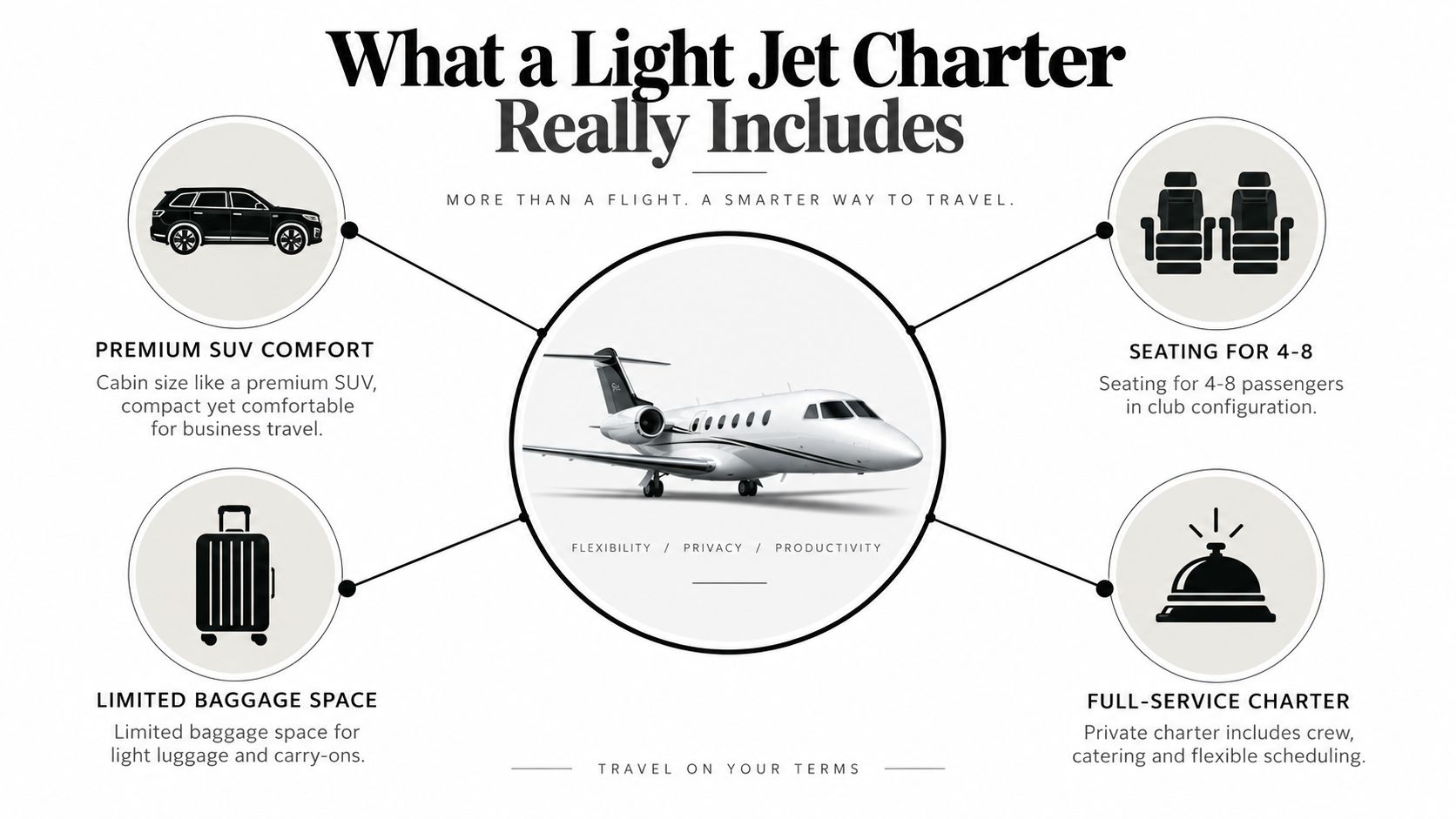
A light jet provides a private cabin for 4 to 8 passengers without the stand-up height, luggage volume, or separate areas found in larger aircraft. That makes it a practical middle choice for short and medium-haul routes, especially when a turboprop feels too limited but a midsize jet would carry more aircraft than the trip requires. Independent aviation guidance describes the category and its operating profile in this light jet category and operating profile.
Cabin comfort still varies by aircraft. Seating commonly uses a club arrangement, with passengers facing one another for conversation or work. Cabin height, lavatory design, storage, and movement space differ by model, so the category label cannot tell you whether everyone will sit comfortably for the entire flight.
Start with the cabin
Before comparing prices, confirm four practical details:
- Passenger seating: Four travelers with business bags may have plenty of room, while a full cabin changes personal space and payload flexibility.
- Baggage volume: Light jets generally suit carry-ons and lighter luggage. Skis, golf equipment, large strollers, and product samples need an aircraft-specific check.
- Cabin layout: Ask about an enclosed lavatory, power outlets, Wi-Fi, and the seating arrangement your group expects.
- Service requirements: Confirm catering, pets, children, ground transport, and special equipment before turning the quote into a booking.
Common reference models include the Citation CJ2, Citation CJ3+, and Embraer Phenom 300. They do not offer identical experiences, even when brokers place them in the same broad category. A Phenom 300 may suit someone seeking a newer-feeling cabin, while a Citation could fit a particular airport, schedule, or baggage need. The aircraft assigned to your trip matters more than the category name.
The aircraft matters more than the label
The year, model, interior configuration, connectivity, maintenance status, and operator all shape the charter. A quote that lists only “light jet” and an hourly rate leaves out the information needed for a fair comparison. Repositioning, an older cabin, or a poor baggage fit can erase the apparent saving against a turboprop or very light jet.
Safety screening belongs in the first conversation. Independent guidance describes ARGUS Platinum as requiring a current on-site audit, a functioning safety management system, and an emergency response plan. WYVERN Wingman covers safety management, pilot experience and training, maintenance, and insurance through an on-site audit, as outlined in this ARGUS and WYVERN safety-rating guide.
Ask for the specific aircraft, operator, safety rating, cabin details, baggage allowance, and inclusions. Then compare the complete trip, not only the hourly figure. That route-first check shows whether the light jet fits the passengers, luggage, airport, timing, and service requirements.
Range Speed and Passenger Capacity Explained
A light jet can look ideal on a route until six passengers, golf bags, and a strong headwind change the calculation. Range, speed, and passenger capacity work together. The aircraft must carry the people and baggage required for the trip, preserve appropriate fuel reserves, and still meet the nonstop plan.
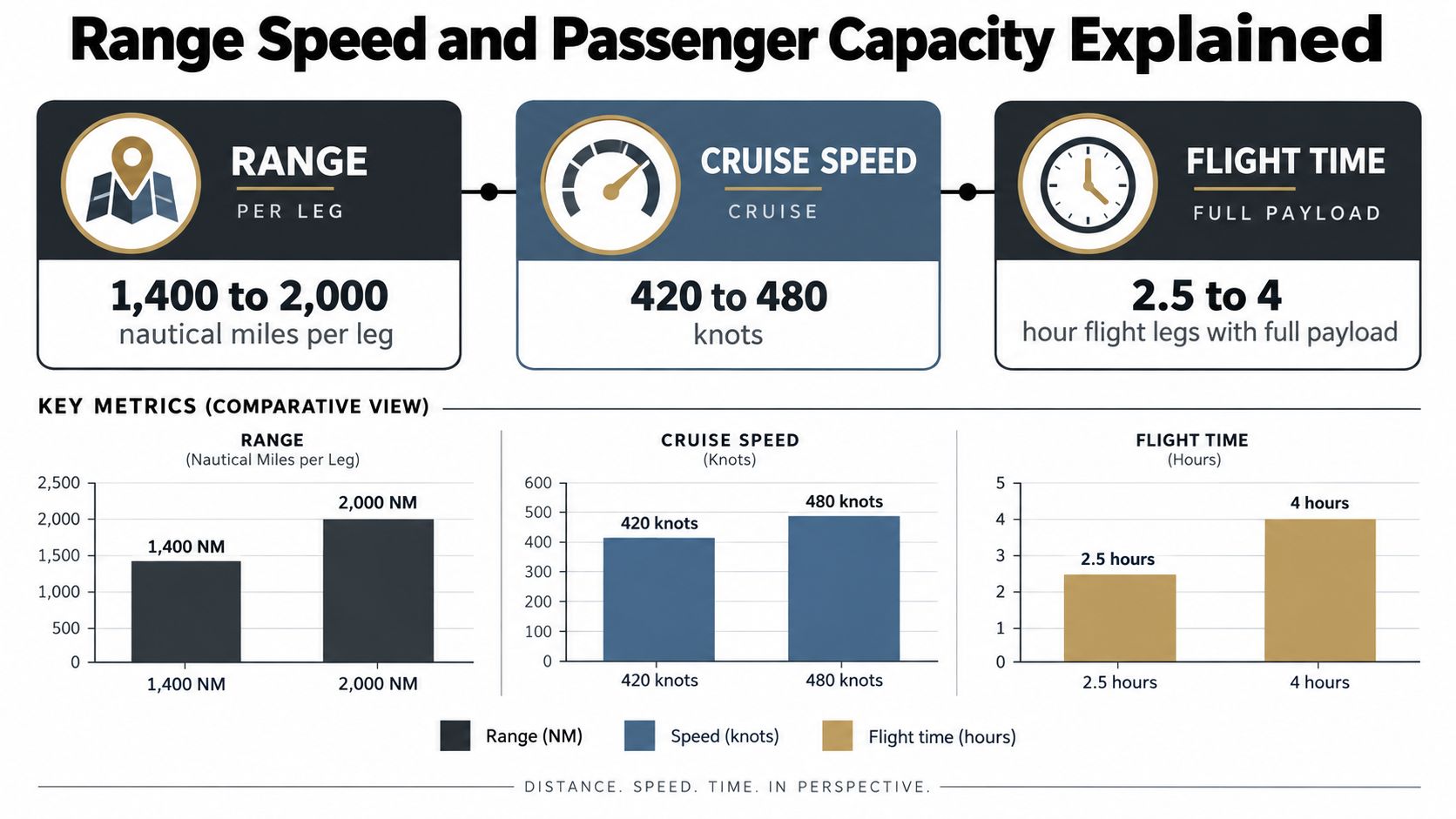
Light jets generally sit within a broad performance envelope, but the published figure is a starting point rather than a promise. Their practical mission depends on aircraft type, winds, routing, payload, runway conditions, and operating requirements. The Light jet performance guide explains how those factors shape real-world performance.
Range changes with payload
A brochure range assumes a particular operating scenario. Add passengers and heavy bags, and the aircraft has less payload flexibility. Weather, fuel reserves, runway conditions, and destination requirements can determine whether the same aircraft completes the leg nonstop.
Consider a Citation CJ2 with six passengers and golf bags on a 1,600-nautical-mile route. The aircraft may be suitable in principle, yet the operator could need a fuel stop, reduce baggage, or assign another aircraft after checking the actual conditions. A smaller group with soft bags might fit the same mission comfortably.
The car analogy is useful here. Its advertised distance assumes a defined load and driving situation. Passengers, luggage, hills, weather, and traffic change the practical result. In a jet, the adjustment may appear as a payload restriction, reduced baggage allowance, a fuel stop, or a different aircraft.
Published model figures can help create a shortlist, but they do not replace an operating review. The 2026 private jet cost guide includes reference figures for aircraft such as the Cessna Citation CJ3+ and Embraer Phenom 300. Treat those specifications as orientation, then ask the operator to confirm the specific passenger, baggage, and fuel plan.
Match the route before comparing prices
For a short regional business trip, cruise speed may preserve meeting time. On a longer sector, range and payload become just as important. A lower hourly quote can lose its advantage if the aircraft needs a stop or cannot carry the luggage the group expects.
Give the charter advisor the complete mission:
- Departure and arrival airports, plus acceptable alternatives.
- Passenger count and approximate baggage.
- Preferred departure time and return schedule.
- Whether nonstop travel is required.
- Pets, special equipment, or accessibility needs.
A four-passenger trip with soft luggage may offer several suitable aircraft. A full cabin with bulky bags can narrow the choice quickly. The right comparison is the complete route, including schedule, payload, repositioning, and cabin condition, rather than price per flight hour alone.
Route-matching insight: Speed saves time only when the aircraft can carry the required passengers and baggage without adding a fuel stop.
When a Light Jet Beats Other Aircraft Options
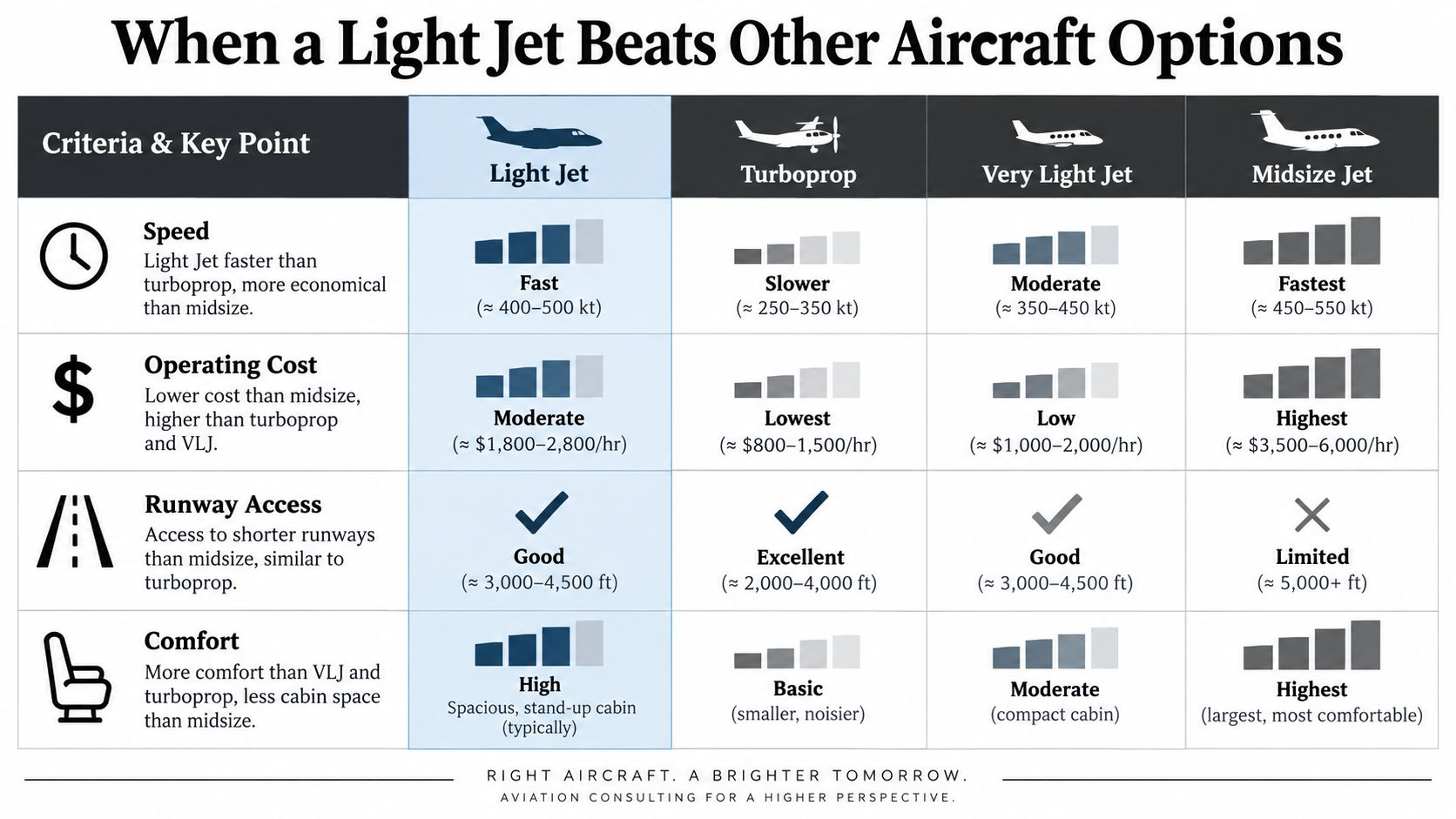
The right aircraft follows the route, passenger load, luggage, and schedule. A turboprop can make sense for a very short flight when lower operating cost matters more than cruise speed. A very light jet suits a small group with limited baggage. A light jet earns its place when faster travel, more cabin comfort, or additional payload margin improves the whole itinerary. Midsize jets become practical when space, range, or baggage matters more than the lowest trip price.
Light jets versus turboprops
Consider New York to Washington, a route that can take under about 90 minutes in the air. With flexible timing and a small party, a turboprop may cost roughly 20% to 30% less overall, making its slower cruise a reasonable trade. For a same-day meeting where every minute matters, the light jet may still justify its higher price through faster travel and a quieter work setting. (Private jet charter cost comparison)
The airport pair and aircraft location can change the answer. A turboprop may be economical when it is already nearby and the runway supports it. A light jet becomes more attractive when the group needs a polished cabin, faster cruise, or a departure time that a nearby turboprop cannot provide.
Light jets versus very light jets
Very light jets can lower the aircraft bill for a brief trip with a small party. They may also reach smaller runways, but the cabin, lavatory setup, and baggage area can be less forgiving.
New York to Chicago shows the trade more clearly. On a trip of about 2.5 hours, a light jet can save roughly 40 minutes compared with a slower option. With 4 passengers, it also provides more payload margin than a very light jet, reducing the risk that baggage or fuel planning will force a restriction. For two travelers with soft bags on a shorter hop, the very light jet may remain the cleaner fit. Add garment bags, heavier luggage, or a longer leg, and the light jet's extra room can justify the difference.
Light jets versus midsize jets
Midsize aircraft provide more cabin space, baggage capacity, and mission flexibility. That extra room costs more, so it may be unnecessary for a small regional group. It becomes useful when a light jet would require baggage limits, a fuel stop, uncomfortable seating, or a schedule compromise.
The 2026 market guide to light jet selection identifies light jets as an efficient choice for 4 to 7 passengers on trips up to about 3 hours, while noting that total pricing depends on flight hours, taxes, fees, and repositioning.
A light jet can lose its value when it is far from departure, when fixed charges dominate a short flight, or when an older cabin is compared with a newer one without accounting for comfort. The comparison should cover the complete route and operating plan, not only the hourly quote.
Light Jet Charter Cost and What Drives the Price
A light jet quote has two layers. Aircraft time is usually shown as an hourly rate. The total trip price can also include fuel, crew, taxes, airport and FBO charges, operator overhead, and repositioning. Comparing only the hourly figure is like comparing a taxi's meter rate without checking the distance or pickup charge.
Independent guidance places light jets around $2,200 to $3,200 per hour for aircraft time alone. After fuel, crew, taxes, fees, and overhead are included, all-in quotes commonly reach about $2,500 to $5,500 per flight hour, according to this light jet charter pricing guide.
Why short trips can look expensive
A two-hour mission may cost roughly $5,000 to $10,000 before ancillary charges and about $7,000 to $12,000 all-in. Federal excise tax, segment charges, and FBO handling do not fall in proportion to flight time, so a short sector carries more of these fixed costs per flight hour.
A lower hourly quote can therefore produce a higher final bill. If the aircraft must fly empty to reach your departure airport, those deadhead miles may be billed separately or included in the quoted rate. Aircraft location often matters more than a modest difference between two hourly figures.
Newer cabins carry a premium
European charter-market data found a median offered fleet build year of 2014. The analysis reported that 41% of quoted aircraft were built in 2015 or later, while about 25% were built in 2020 or later. This European charter-market fleet analysis also reported newer light jets built in 2017 or later at a median of €10,260 per hour, compared with €7,990 per hour for aircraft built before 2010, an approximate 28% premium.
Age alone does not explain the difference. Cabin condition, connectivity, installed equipment, and client demand can all affect the price. The aircraft's build year is a useful first filter, not a substitute for checking the actual cabin and inclusions.
For U.S. benchmarks, the private jet charter cost calculator guide lists the Citation CJ3+ at an estimated $3,200 to $4,000 per hour and the Phenom 300 at $3,500 to $5,000 per hour.
| Cost Component | Typical Impact on Light Jet Trip |
|---|---|
| Aircraft flight time | Forms the core of the quote and rises with route length |
| Fuel and crew | Included in many all-in quotes, but confirm the calculation |
| Taxes and airport charges | Fixed or route-specific costs weigh heavily on short missions |
| FBO handling | Varies by airport and service requirements |
| Aircraft age and cabin | Newer cabins and equipment can command a premium |
| Repositioning | A distant aircraft can raise the effective trip cost materially |
Use this private jet charter cost guide to review the variables behind a quote. Compare the total trip price, aircraft location, exact model, build year, cabin features, and included services together. The right question is not which aircraft has the smallest hourly number. It is which aircraft matches the route at the lowest practical total cost.
How to Book a Light Jet and Avoid Repositioning Fees
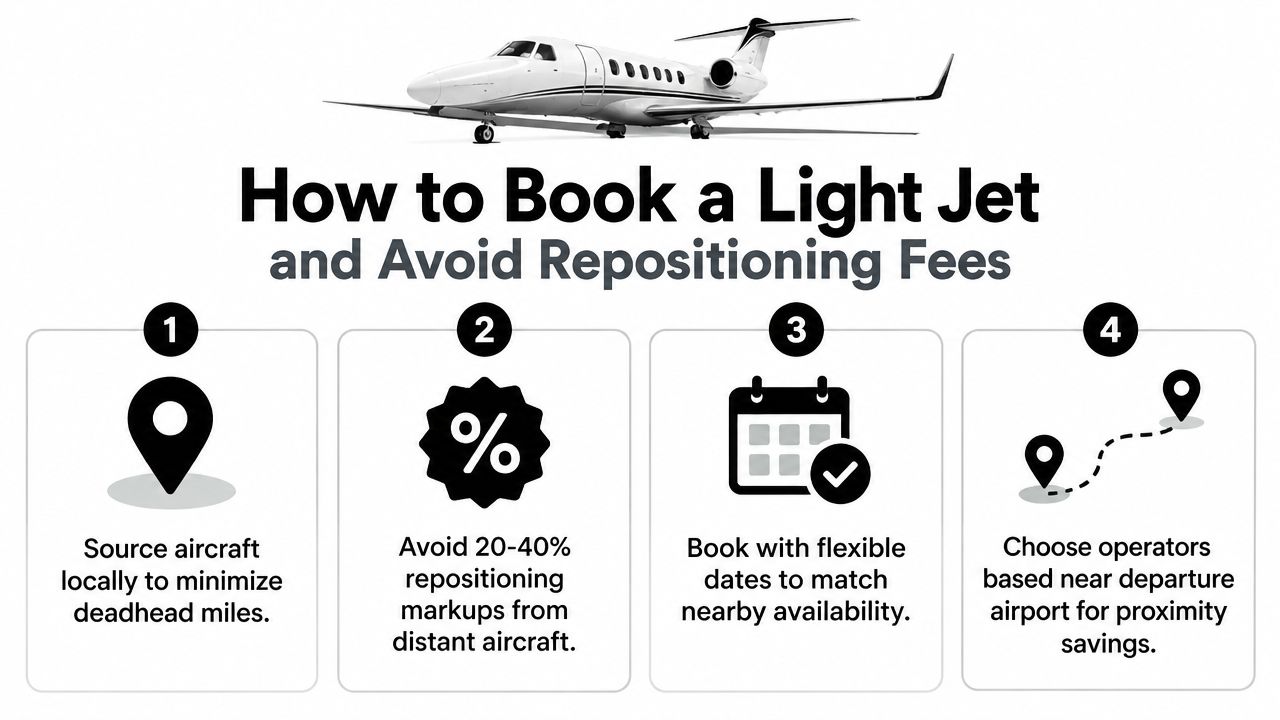
The most effective booking conversation starts with location. Ask where the aircraft is based before comparing hourly rates. An aircraft already near your departure city can avoid unnecessary deadhead flying, while a distant aircraft may add a repositioning charge that changes the economics of the entire trip.
The guide to private jet repositioning fees explains why the aircraft's empty positioning legs matter. Traditional brokers and jet card programs may add 20% to 40% repositioning markups, according to Haute Jets' publisher information. Treat that as a sourcing issue, not an unavoidable feature of light jet travel.
Use a practical booking sequence
Start with the route and timing. Give the advisor preferred airports, acceptable alternatives, departure windows, return needs, passenger count, and baggage details.
Ask for nearby aircraft first. Local sourcing can reduce deadhead miles and may produce a better total than choosing an aircraft solely because its advertised hourly rate is lower.
Compare the exact aircraft. Request the year, make, model, cabin layout, Wi-Fi status, baggage capacity, and operator name. “Light jet” isn't specific enough for a final decision.
Confirm the operational details. Verify catering, pets, ground transport, passenger information, and any special equipment before payment.
Haute Jets states that it sources from 3,500+ owner-operators across 175 countries, supports same-day availability, offers exact aircraft selection, and provides 24-hour pre-flight confirmation with a tail number and crew bios. Its model doesn't require membership or jet card fees. These are service details to verify in the written quote, just as you would verify the aircraft and operator.
Safety screening should remain separate from price shopping. Haute Jets states that its network uses WYVERN Wingman and ARGUS Gold or Platinum-rated operators. Ask which rating applies to the selected operator, whether the rating is current, and who holds operational control of the flight.
A short pre-booking checklist prevents most avoidable surprises:
- Cabin: Confirm seating, lavatory, Wi-Fi, and interior year.
- Baggage: Share dimensions and special items, not just bag count.
- Fees: Request taxes, FBO handling, crew expenses, and positioning in writing.
- Day-of-flight details: Confirm the tail number, crew information, FBO, and departure time.
A video overview can also help first-time travelers understand the booking process:
Choosing the Right Light Jet for Your Next Trip
A light jet works best when the aircraft matches the route, not when its hourly rate looks lowest. Start with the travelers, luggage, airports, and schedule. Then compare the complete quote, including repositioning and the cabin you will use.
Using the range and payload limits outlined above, apply this filter. A light jet suits regional trips when your group needs more cabin comfort and cruise speed than a turboprop or very light jet, while a midsize cabin would add space you may not need. Payload, weather, runway length, and fuel reserves still require confirmation for the specific date and aircraft.
Use this decision checklist
- Choose a very light jet for a small party and brief sector when baggage and headroom are limited priorities.
- Choose a light jet when the route benefits from faster travel and a more comfortable cabin than smaller aircraft provide.
- Consider a midsize jet when passengers, luggage, range, or onboard space create repeated compromises.
- Consider a turboprop for a very short route where airport access matters more than cruise speed.
The light jet models guide for short and mid-range business travel can help compare aircraft families. Treat the model as a starting point, because cabin age, interior condition, equipment, and actual location can change the value. An older aircraft nearby may cost less overall than a newer one that must reposition, while a newer cabin may justify a higher quote when comfort matters.
Haute Jets Journal's practical approach is to compare the exact aircraft, verify the operator, and treat repositioning as a core pricing variable. That produces a clearer decision than searching for the lowest light jet charter cost alone.
Haute Jets can source light jets from its owner-operator network, compare cabin layouts, and verify operator credentials, Wi-Fi, catering, pets, and ground transport for your route. Visit Haute Jets to request a quote and determine whether a light jet fits your regional trip.