
Most clients assume the Phenom 300 wins on prestige. It doesn't. It wins on math. It's the world's most delivered business jet, with over 730 units delivered by 2024, and it has held the title of best-selling light jet for more than a decade, according to Simple Flying's summary of the Phenom 300's market position. In charter, that matters more than branding. A popular aircraft is usually easier to source, easier to price correctly, and easier to match to a mission without compromises.
That's why serious buyers ask for a phenom 300 charter so often. It sits in the sweet spot. You get light-jet operating logic with a cabin that feels closer to what many travelers expect from a larger aircraft. You also get a platform that works well for business day trips, weekend leisure flights, and short- to mid-range family travel.
The mistake I see most often is treating the aircraft choice as the whole decision. It isn't. The aircraft matters, but the booking details matter just as much. Safety ratings, repositioning exposure, exact baggage fit, Wi-Fi reliability, and pet approval can change whether your flight feels smooth or sloppy. That's where smart clients separate a polished charter from an expensive guess.
Why the Phenom 300 Dominates Private Jet Charter
The Phenom 300 dominates because it solves the core charter problem. Most clients don't need the biggest cabin. They need the right cabin, on the right route, at the right price, without operational nonsense.
It hits the charter sweet spot
The aircraft's staying power isn't accidental. The market kept rewarding it because it does several jobs well at once. It's fast enough for executives, comfortable enough for families, and practical enough for operators who need a dependable jet for frequent missions.
A lot of charter aircraft are good in one lane and mediocre in the others. The Phenom 300 isn't perfect, but it's balanced. That balance is exactly why it became the benchmark in this category.
Practical rule: Don't choose a jet based on category labels alone. Choose it based on whether it fits your usual trip length, passenger count, and baggage profile without forcing a workaround.
Why clients keep asking for it
For many trips, this aircraft gives you what you care about:
- Reliable availability: A jet with a large installed base is easier to find in more markets.
- Business-friendly performance: It's built for regional and short-to-mid-range charter flying, not just brochure specs.
- Comfort without overbuying: You don't have to jump to a midsize aircraft every time you want a refined cabin experience.
- Operational flexibility: It's a practical answer for clients who want access to smaller airports and tighter schedules.
There's also a simple truth brokers don't always say out loud. A very good light jet often beats a mediocre midsize option for real-world charter value. If your route, group size, and luggage fit the Phenom 300 well, spending more just to say you booked “up” a category is usually wasteful.
When it's the right call
I recommend a phenom 300 charter most strongly for these use cases:
- Executive day trips where speed and schedule control matter more than a full stand-up cabin
- Couples and families who want a premium cabin without paying for excess aircraft
- Short ski, beach, or resort runs where baggage planning is manageable and airport flexibility matters
- Corporate teams that want efficiency, privacy, and a cabin suitable for working en route
If you regularly move larger groups or you want more cabin freedom on longer legs, move up. If not, the Phenom 300 is often the sharper decision.
A Look Inside the Phenom 300 Cabin
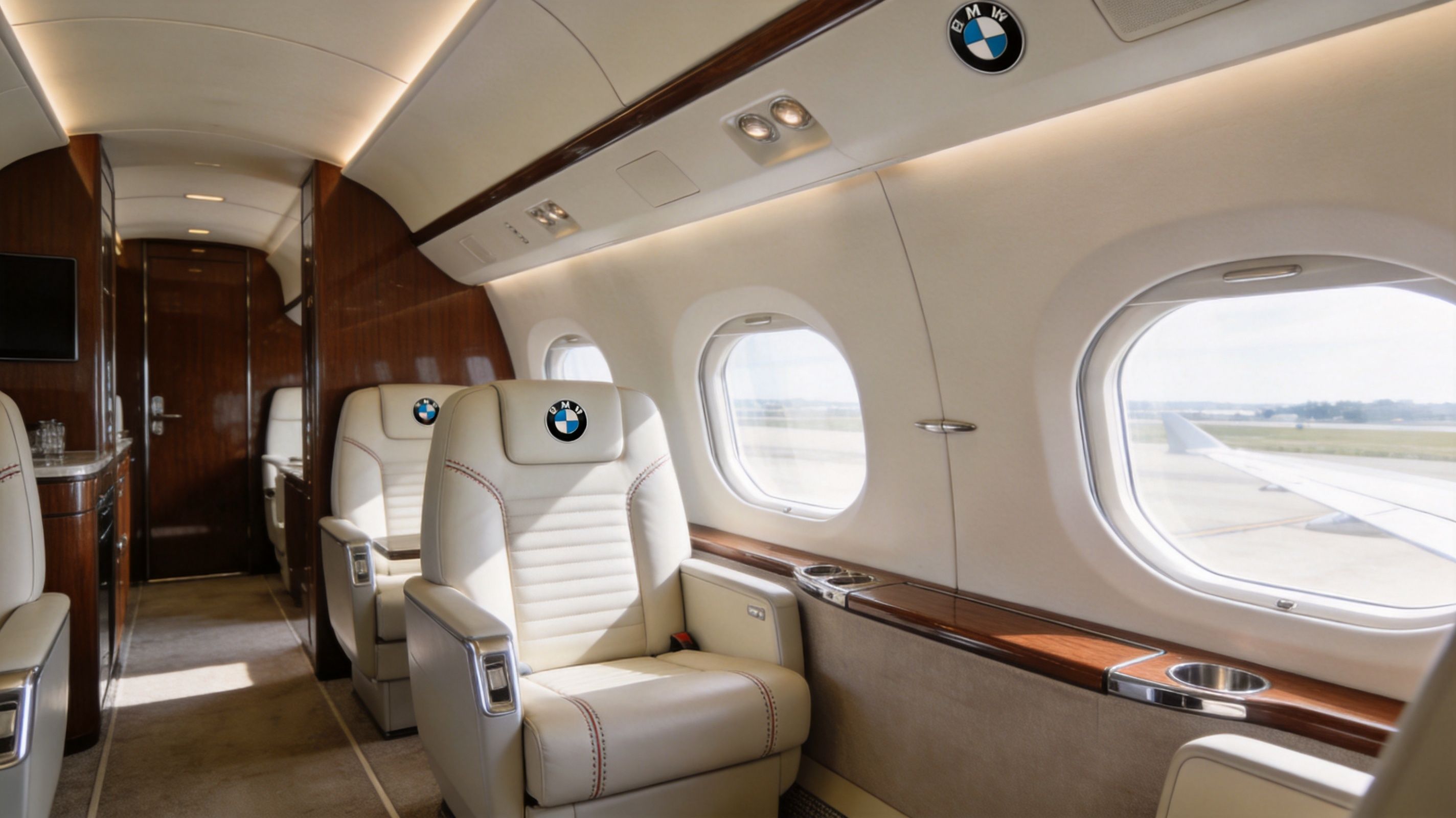
The best way to think about the Phenom 300 cabin is this: it feels well-proportioned, not oversized. That's a good thing. On the right trip, a focused cabin beats a bigger one that you don't need and don't want to pay for.
What the cabin feels like in practice
A solo executive sees one thing immediately. The cabin supports work without feeling cramped. A couple heading to a weekend destination notices something else. It feels polished, quiet, and private without the heaviness of a larger jet cabin.
For a small group, the biggest advantage is usability. Seats, tables, aisle space, and baggage planning all work well when the mission fits the aircraft. The published cabin dimensions of 4.9 x 5.1 x 17.2 ft and baggage capacity of 85 ft³ for about 8 bags come from ECS Jets' Phenom 300 charter profile, but the better takeaway is simpler: this is one of the few aircraft in its lane that rarely feels like you settled.
If you want a broader look at onboard expectations across categories, Haute Jets has a useful guide to cabin features on charter aircraft.
Comfort depends on passenger count
Clients need honesty. An aircraft can be certified for one thing and comfortable for another. Those are not the same discussion.
For the Phenom 300, I'd think about comfort like this:
- Excellent fit: Solo traveler, couple, or small executive group
- Very good fit: Family or business group with disciplined packing
- Possible but tighter: Larger group where everyone brings substantial luggage
That doesn't mean the aircraft can't handle a fuller manifest. It means you should be realistic about what kind of experience you want. If you're flying with bulky coats, ski gear, golf bags, pet carriers, and a full passenger load, your broker needs to verify the exact aircraft layout and baggage access before you commit.
The right question isn't “How many seats does it have?” It's “How many people can ride comfortably on my route with my baggage?”
Later in the buying process, I also tell clients to ask whether the specific aircraft has the amenities they care about confirmed, not assumed.
Here's a quick cabin walkthrough to ground that discussion:
The details to confirm before booking
Don't stop at generic cabin photos. Ask for trip-specific confirmation on:
- Wi-Fi: Is it installed on this exact tail, and what's the expected performance?
- Power access: Confirm outlets if you plan to work in flight.
- Lavatory setup: Important for longer legs and family travel.
- Refreshment setup: Especially if you want specific catering.
- Pet acceptance: Never assume an operator's policy matches the aircraft category.
That last point matters more than clients think. Two Phenom 300s can look similar in a brochure and feel very different in service delivery.
Performance Range and Ideal Mission Profiles
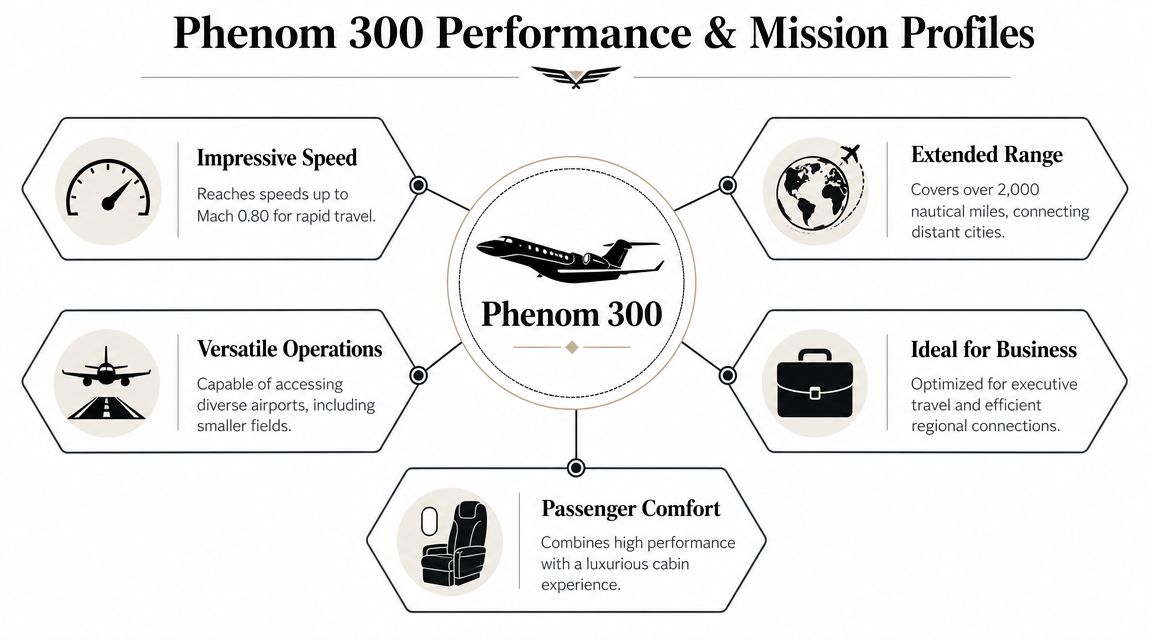
This is where the Phenom 300 earns its reputation. It isn't just popular. It's useful. The performance numbers translate cleanly into real charter planning, which is exactly what you want.
Fast enough to save time that matters
The Phenom 300's maximum cruise reaches Mach 0.80, and upgrades pushed the 300E from Mach 0.78 to Mach 0.80 while extending range to 2,010 nautical miles, according to Wikipedia's summary of the Phenom 300E updates. For clients, the practical point is simple. This jet moves quickly enough to make regional private flying feel efficient, not indulgent.
If you're comparing Embraer's light jets more broadly, this overview of the speed and range of the Phenom 100 and 300 gives useful context.
Routes where it makes sense
The aircraft is particularly well suited for the kind of flights private clients often book. Think non-stop regional business trips and leisure missions that don't justify stepping into a larger cabin category.
Examples cited in the verified material include:
- New York to Dallas
- London to Athens
- Boston to Miami
- Los Angeles to Aspen
- Miami to Aspen
- London to Reykjavik
- Cairo to Tel Aviv
- Miami to the Bahamas
These examples matter because they show the Phenom 300's real mission profile. It's not trying to be everything. It's trying to be excellent for short- to mid-range travel where speed, comfort, and airport flexibility all count.
Why the runway and altitude specs matter
A spec sheet means nothing unless it changes your trip. Here, it does.
The aircraft's short runway capability and high operating ceiling make a direct difference in how you travel:
- Shorter runway performance: Opens access to more convenient airports
- High operating altitude: Helps with smoother routing above a lot of traffic and weather
- Strong regional legs: Keeps business schedules tight and leisure travel simple
A jet that can use the airport closer to your destination often saves more time than a faster jet that can't.
That's why the Phenom 300 is so effective for executives going straight into a meeting, or families trying to avoid an extra drive after landing. It's also why this aircraft tends to punch above its size in charter value.
Understanding Phenom 300 Charter Costs
Most charter clients look at the hourly rate first. That's reasonable, but it's incomplete. The actual number is the trip total, and the gap between those two figures is where people overpay.
The hourly rate is only the starting point
Typical Phenom 300 hourly rates range from $3,800 to $5,200 in 2026, based on Air Charter Advisors' Phenom 300 pricing overview. That gives you a legitimate pricing band for planning, but it does not tell you what your trip will cost.

A broker can quote an attractive hourly figure and still hand you an expensive trip if the aircraft has to reposition. That's the detail discerning clients ask about early.
Where charter quotes get inflated
Traditional brokers often add 20% to 40% in repositioning fees, and the same source notes that local sourcing can deliver 15% to 25% average savings by cutting that waste out of the trip structure. Those are not minor differences. They can change whether a quote is fair or padded.
Here's what to ask when you review a proposal:
- Where is the aircraft based? If it's not near your departure airport, ask what ferry or repositioning cost is built in.
- Is the quote for the exact tail or a category estimate? Category pricing can hide later changes.
- What amenities are included? Wi-Fi, catering, and pet handling should be spelled out.
- What overnight or crew-related charges apply? These can matter on multi-day itineraries.
- What happens if your schedule moves? Flexibility has a cost. Better to know it in advance.
My recommendation on pricing strategy
Don't shop by hourly rate alone. Shop by all-in trip logic.
A clean quote on a locally sourced aircraft is often better than a lower-looking quote that carries deadhead exposure, vague amenity language, and broad substitution rights. That's one reason some clients use services such as Haute Jets, which states that it sources from owner-operators near the departure city to reduce repositioning and confirms aircraft-specific details before departure.
Cost discipline: Ask your broker to identify the aircraft's location relative to your departure airport before you approve the trip. If they dodge the question, move on.
The Phenom 300 is supposed to be an efficient charter choice. If the quote doesn't feel efficient, the problem usually isn't the aircraft. It's the sourcing.
Phenom 300 Compared to Other Charter Jets
The Phenom 300 is not the answer for every mission. It's the answer for a very specific band of missions where cost, comfort, and performance need to stay in balance. That's why comparison matters.
Where it sits in the market
Think of the Phenom 300 as the aircraft between two bad habits. One is booking too small and regretting it. The other is booking too much airplane and paying for space you didn't need.
Compared with a smaller light jet, the Phenom 300 usually feels more complete. Compared with a common entry-level midsize jet, it often delivers a better cost-to-mission fit on shorter sectors.
Phenom 300 vs. competitors at a glance
| Metric | Citation CJ4 | Phenom 300E | Citation Latitude |
|---|---|---|---|
| Cabin feel | More compact | Refined light jet with midsize feel | Larger midsize cabin |
| Passenger sweet spot | Smaller groups | Small groups and families | Larger groups or longer comfort missions |
| Baggage flexibility | More limited for bulky travel | Strong for its class | Better for heavier packing needs |
| Speed profile | Strong | Very strong | Strong |
| Typical trip economics | Lower category in some cases | Often the best balance | Usually higher total charter cost |
| Best use case | Efficient shorter trips | Premium regional and short-to-mid-range charter | More cabin-focused missions |
For a more aircraft-specific breakdown, this comparison of how the Embraer Phenom 300 stacks up against the competition is worth reading.
My blunt take on the trade-offs
Choose a Citation CJ4-type option when your priority is staying in a smaller category and the cabin compromise won't bother you.
Choose a Citation Latitude-type option when your trip is more about cabin freedom than operating efficiency.
Choose a Phenom 300 charter when you want the center line. That usually means:
- You care about speed, but not at any cost
- You want a more substantial cabin than a smaller light jet
- You don't need the added bulk and spend of a midsize cabin
- You want an aircraft that works for both business and leisure without feeling like a compromise
If your group is modest and your route is well inside the aircraft's comfort zone, the Phenom 300 often gives you the least regret per dollar spent.
That's the metric I care about most. Not brochure prestige. Not category labels. Regret. If you land thinking the aircraft was exactly right and the bill made sense, the booking was done properly.
Your Pre-Flight Checklist for Booking a Phenom 300
This is the section most guides skip, and it's the one that protects you. The aircraft choice gets attention. The operator details decide whether the trip is solid.
Start with safety ratings
Only about 30% of light jet operators hold Wyvern Wingman or Argus Gold/Platinum ratings, according to Acc Air Charter's Phenom 300 safety discussion. That means most operators in this category do not hold the top tier third-party safety audits clients often assume are standard.
This is not optional due diligence. Ask the broker one direct question: Is this specific operator Wyvern Wingman or Argus Gold/Platinum rated? If the answer is vague, don't book.
Confirm the aircraft, not just the category
The second mistake clients make is approving a category quote without locking down the specific aircraft details that affect the flight experience.
Use this checklist before funds are released:
Tail number confirmation Ask what aircraft you're flying, not just what category was quoted.
Crew details
Request crew names and bios before departure when available.Wi-Fi verification
Don't accept “Wi-Fi available” as enough. Ask whether it's installed and active on that exact aircraft.Pet approval
Confirm the operator allows pets, and ask about any practical handling requirements.Catering specifics
Clarify whether the quote includes standard catering, special requests, or both.Baggage review
Tell the broker exactly what you're bringing. Don't summarize.
The questions smart clients ask
Here's the short list I'd send to any broker if I were booking for myself:
- Is the operator Wyvern Wingman or Argus Gold/Platinum rated?
- Is this quote tied to a specific tail number?
- Where is the aircraft positioned now?
- Is Wi-Fi confirmed on this exact aircraft?
- Can you confirm the pet policy in writing?
- Will my baggage fit without a compromise?
- When will I receive final crew and aircraft details?
One operational standard worth insisting on is a 24-hour pre-flight confirmation that includes the tail number, crew bios, and final logistics. If your broker doesn't already do that, ask why not.
The cleanest charter experiences usually come from clients who ask precise questions early, not clients who fix problems late.
Phenom 300 Charter FAQ
Is the Phenom 300 good for business travel?
Yes. It's one of the strongest business charter choices for regional and short-to-mid-range trips. The cabin supports productive flying well, and the aircraft's speed makes same-day business itineraries practical when the route fits.
Is it comfortable for family travel?
Yes, if you're realistic about the group and baggage. For a family trip with ordinary luggage, it works very well. If you're adding oversized gear, multiple pet carriers, or a heavier packing profile, ask for exact baggage confirmation before booking.
Can I bring skis or golf clubs?
Sometimes, but never assume. This depends on the exact baggage profile of your group and the dimensions of the items. Tell your broker what you're bringing item by item and get a clear answer in writing.
How many passengers should I book it for?
The right answer is “however many fit comfortably for your mission,” not “whatever the maximum seating allows.” Smaller groups will obviously feel more relaxed. Larger groups can still work if the luggage is managed properly and the leg length is suitable.
Is Wi-Fi standard on a phenom 300 charter?
No amenity should be treated as standard unless it's confirmed on the exact aircraft. Many Phenom 300 charters offer Wi-Fi, but your broker should verify that before you sign.
Can I fly with pets?
Often yes, but pet policy is operator-specific. Ask early, especially if you're flying with a larger dog, multiple animals, or an international itinerary.
Is the Phenom 300 better than booking a midsize jet?
Sometimes. If your route, group size, and baggage needs fit comfortably, the Phenom 300 is often the sharper economic choice. If you want more room to move around or you're flying a larger group, a midsize aircraft may be the better call.
How far ahead should I book?
Earlier is better, especially around holidays, major events, and peak leisure periods. The right booking window depends on route flexibility, airport demand, and how specific you are about aircraft type and amenities.
Can I pay for a charter with cryptocurrency?
Some charter providers and payment partners can accommodate digital asset payments. If that matters to you, bring it up at the start of the quoting process so the payment path is set before the contract stage.
What's the single most important thing to ask before I book?
Ask who the operator is, whether they hold top-tier safety ratings, where the aircraft is positioned, and whether the quote is tied to a specific tail. If you get clear answers to those questions, most of the other details become much easier to manage.
If you're booking a phenom 300 charter and want the process handled with precision, contact Haute Jets for aircraft-specific sourcing, operator vetting, and a clear pre-flight confirmation process before departure.