
Light jets in 2026 typically run $2,500 to $4,000 per hour, midsize jets $4,000 to $8,000 per hour, and heavy jets start at $8,500 per hour. These figures serve as a baseline for private jet rental price 2026, but they are only a starting point because your final quote depends on how the aircraft is sourced, how the trip is structured, and whether hidden fees are buried inside the deal.
Most clients still ask the wrong question. They ask, “What’s the hourly rate?” The better question is, “What will I pay, and why?” Those are not the same thing.
That matters more in a market that’s getting bigger, busier, and more advanced. The global private jet charter services market is valued at USD 17.67 billion in 2026 and is projected to reach USD 25.79 billion by 2031, reflecting sustained demand for flexible, on-demand travel from high-net-worth individuals and corporations, according to this 2026 private jet charter market outlook.
The upside is simple. Clients now have more access to pricing than they used to. The downside is just as simple. Too many charter buyers still get sold a smooth narrative instead of a transparent quote.
The 2026 Private Aviation Market Outlook
Private aviation in 2026 isn’t a niche indulgence. It’s an active global market with serious demand from corporate travelers and private clients who want schedule control, privacy, and direct access to the right airport. That demand is why pricing has become more visible, but visibility doesn’t automatically mean clarity.
What I’m seeing is a split between transparent on-demand charter and prepackaged access models that often look simple upfront and become expensive in the fine print. If you’re booking a few flights a year, or even a lot of flights with varying route profiles, transparency matters more than branding.
What the headline rates actually tell you
The headline rates are useful if you treat them as a filter, not a promise.
- Light jets fit regional business trips and shorter leisure flights. Expect $2,500 to $4,000 per hour.
- Midsize jets sit in the practical sweet spot for many clients. Expect $4,000 to $8,000 per hour.
- Heavy jets are where international and long-haul capability starts. Expect pricing from $8,500 per hour and up.
That range gives you a framework. It doesn’t give you a finished budget.
Practical rule: Use the hourly rate to narrow the aircraft class. Use the full quote to choose the provider.
Why transparency matters more in 2026
The private jet rental price 2026 conversation is no longer just about luxury. It’s about cost discipline. Discerning flyers don’t want a mystery invoice after departure. They want to know whether they’re paying for the aircraft they selected or for a repositioning leg they never asked for.
That’s where on-demand charter has become more attractive. You can evaluate each trip on its own merits, source the right aircraft for that exact mission, and avoid locking yourself into a prepaid structure that may not serve your travel pattern.
Decoding 2026 Private Jet Charter Rates by Aircraft
Aircraft category determines your base economics. Choose too much airplane and you burn money. Choose too little and you compromise comfort, payload, baggage, or range. The smart move is to match the mission, not your ego.

A useful benchmark from this 2026 private jet charter cost guide is that midsize jets are typically quoted at USD 4,000 to 8,000 per hour, while light jets such as the Phenom 300 range from USD 2,500 to 4,000 per hour. The same source notes that light jets are the fastest-growing sub-market, with a 7.92% CAGR through 2031.
Turboprops and very light jets
These are the value tools of private aviation.
| Aircraft class | Typical 2026 hourly range | Best use case |
|---|---|---|
| Turboprop | $1,700 to $2,400 | Short regional flights, smaller airports, practical group hops |
| Very light jet | $2,000 to $2,600 | Short city pairs, smaller parties, efficient executive travel |
A turboprop is often the smartest choice when the route is short and runway access matters more than speed. A very light jet works when you want the jet experience without paying for range you won’t use.
Light and midsize jets
Here, most private charter decisions are made.
Light jet
Strong fit for regional routes and short business sectors. Models in this category work well when speed, privacy, and direct scheduling matter more than standing cabin space.Midsize jet
The category many experienced flyers return to because it balances comfort, range, and operating cost. If you’re flying a business team, carrying meaningful baggage, or want a more comfortable cabin without stepping into long-range pricing, this is often the right answer.
A midsize aircraft is usually the right choice when a light jet feels tight and a heavy jet feels unnecessary.
Super midsize and heavy aircraft
These are capability-driven choices.
| Aircraft class | Typical 2026 hourly range | Best use case |
|---|---|---|
| Super midsize | $5,000 to $10,500 | Coast-to-coast style missions, larger cabins, stronger range |
| Heavy or ultra-long-range | $8,500 to over $20,000 | International travel, larger groups, premium long-haul comfort |
Heavy aircraft should be selected for a reason. That reason can be route length, passenger count, luggage requirements, cabin expectations, or nonstop international capability. If none of those apply, you’re probably overspending.
How to choose the right category
Use this short filter before you request quotes:
- Trip length: Short regional flight, medium domestic mission, or long-haul international.
- Passenger count: The actual number traveling, not the number you might invite.
- Baggage profile: Golf clubs, ski gear, production equipment, and pets all change the aircraft conversation.
- Cabin expectation: Quick transport or full in-flight working and dining environment.
The private jet rental price 2026 answer gets much clearer once you stop shopping by brand first and start shopping by mission profile.
The Anatomy of Your Charter Quote What You Really Pay For
A charter quote is only useful if you can see every cost driver. If you cannot, you are not comparing offers. You are guessing.
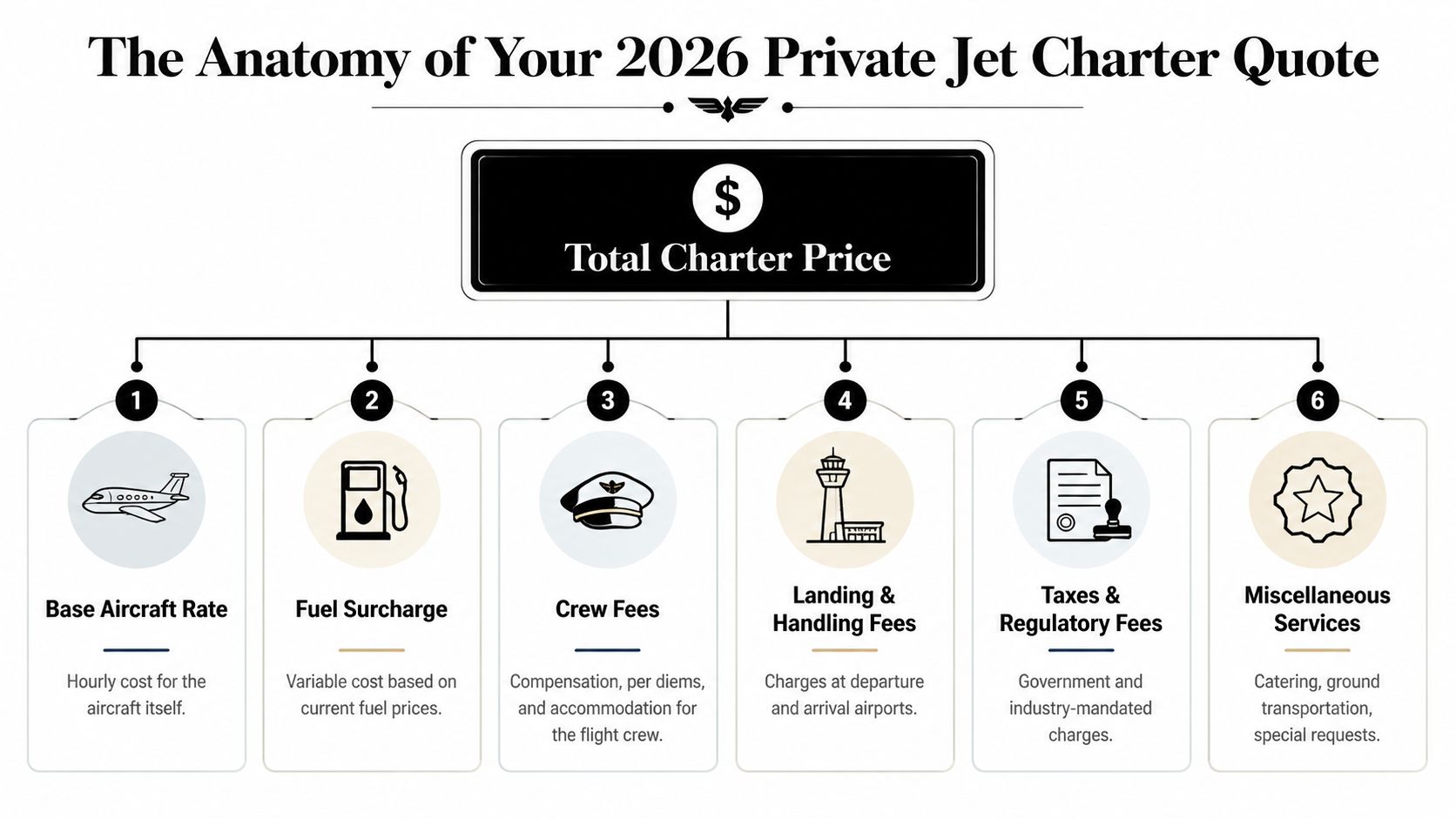
That is why on-demand charter pricing deserves a hard look in 2026. A clean quote shows what you are paying for. Many jet cards and membership programs do the opposite. They advertise a simple hourly rate, then bury the actual cost in availability rules, peak day restrictions, taxi time, and repositioning economics you never see clearly.
If you want a useful benchmark before you approve any trip, review a clear private jet pricing breakdown and insist on plain-English explanations for every line item.
The six parts of a real quote
A real charter quote usually has six cost buckets. If one is missing, ask why.
Base aircraft rate
This is the core flight charge based on aircraft type and billable time.Fuel surcharge
Some operators build fuel into the rate. Others show it separately. Either way, it affects the total and should never appear as a surprise after you commit.Crew fees
Multi-day trips, extended waits, and overnight stays can add pilot expenses, hotel costs, and daily allowances.Landing and handling fees
FBO charges, ramp fees, airport handling, and related support vary by airport. Popular business aviation hubs often cost more.Taxes and regulatory fees
Federal excise tax, segment fees, and international charges can materially change the all-in number.Trip extras
Catering, ground transportation, deicing, Wi-Fi requests, pet coordination, and special cabin services belong here.
The charge clients miss most often
Repositioning is the fee that gets ignored until the quote arrives.
You pay it when the aircraft has to fly empty to pick you up, or fly empty again after dropping you off. On-demand quotes usually show that cost directly, which is exactly how it should be. You can judge whether the aircraft is worth it, ask for a closer option, or change airports and cut the bill.
That transparency helps clients make better decisions. Opaque booking models do not. A jet card may sell you on a fixed hourly rate, then recover the economics elsewhere through aircraft sourcing, category substitutions, ferry costs hidden inside availability terms, or minimums that make short trips look more expensive than they should.
If the aircraft is not already close to your departure airport, your quote can include empty-leg cost you did not intend to buy.
What to ask before you sign
Ask these questions every time, and do not accept vague answers:
- Is the aircraft already based near my departure airport?
- Are all repositioning legs included in this quote?
- Is this an all-in number or are any airport, crew, or fuel charges still open?
- Am I booking a specific tail, or only an aircraft category?
- What minimum flight time or daily minimum is being applied?
A factual example of a more transparent sourcing model is Haute Jets. The company works from a large on-demand network and focuses on sourcing aircraft close to the trip, which can reduce unnecessary repositioning cost and make the fee stack easier to evaluate.
That is the standard you want. Clear aircraft sourcing. Clear fee disclosure. Clear accountability. If a provider cannot explain the quote in a few direct sentences, keep shopping.
Example Charter Quotes for 2026 Popular Routes
Route pricing gets real when you apply category logic to actual trips. You don’t need a theoretical rate card. You need a reasonable aircraft class, a realistic trip profile, and a quote that doesn’t hide the ugly parts.
Los Angeles to Las Vegas
This is classic light jet territory. The route is short, demand can be high around weekends and events, and there’s no reason to overbuy cabin size unless the passenger group or luggage profile demands it.
A light jet quote should feel efficient. If a short-hop itinerary suddenly looks expensive, check for repositioning, airport handling, or a minimum billing structure that’s doing the damage.
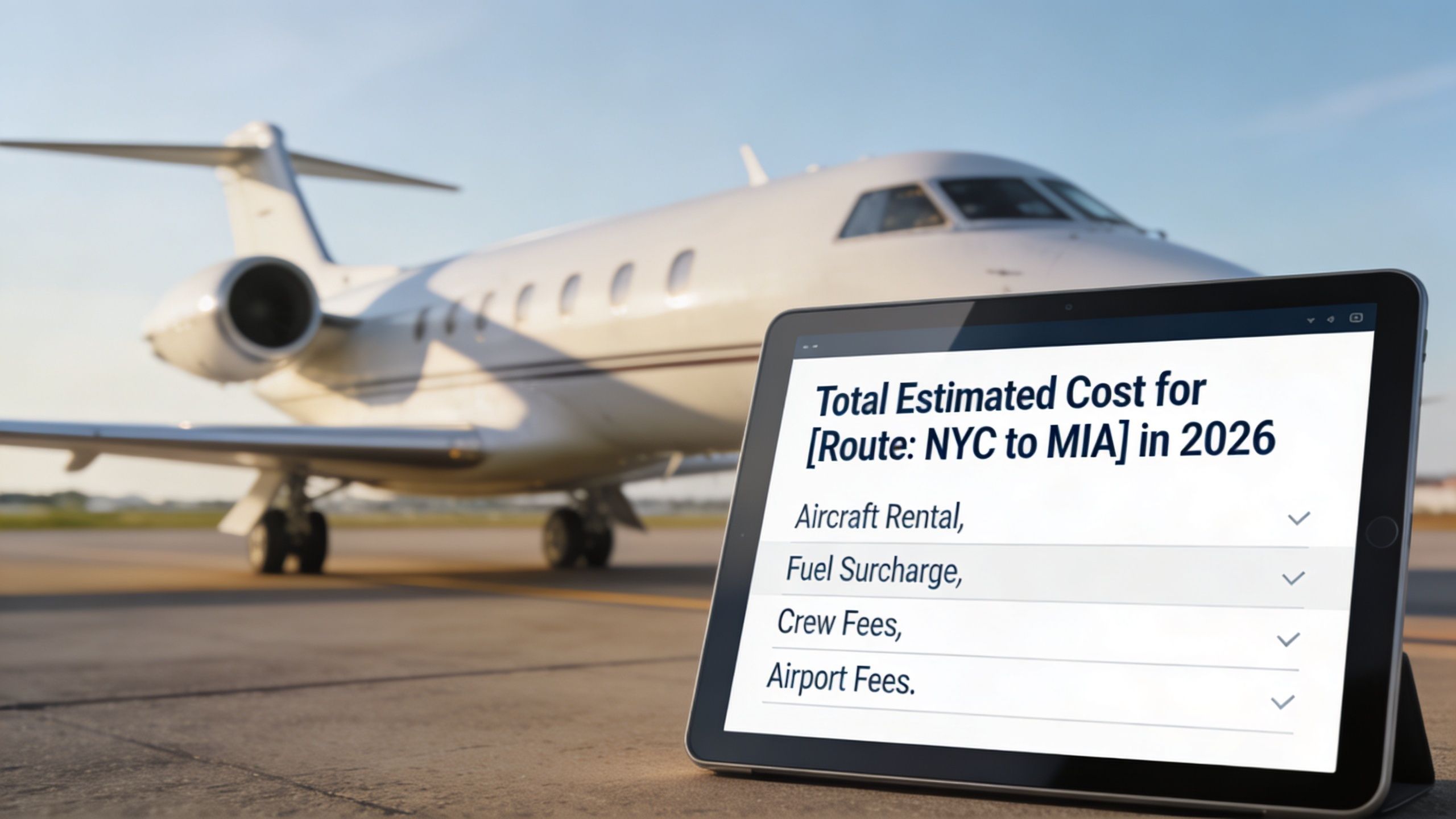
New York to Miami
Midsize jets frequently prove to be the most sensible option. You get a more comfortable cabin and a stronger trip profile for a route that many business travelers and families fly repeatedly.
A quote in this lane should be judged on three things:
- Aircraft suitability
- Whether the plane is nearby
- How clearly the fee stack is presented
A polished PDF means nothing if the economics are sloppy.
Miami to London
This is heavy jet or ultra-long-range territory. The mission requires genuine range and cabin capability, and the quote needs careful scrutiny because long-haul fees, airport handling, and international charges add complexity fast.
For a route like this, I’d prioritize the actual aircraft and operator details over the initial headline number. Long-haul private travel is where cheap-looking quotes often get expensive later.
Here’s a useful visual explainer before you compare your own options:
On popular routes, the smartest quote is rarely the lowest first number. It’s the one that still makes sense after every fee is exposed.
Choosing Your Booking Model On-Demand vs Jet Cards
Most private flyers don’t need more access products. They need fewer hidden costs.
Jet cards and memberships are often sold as convenience. Sometimes they are. But convenience without transparency is expensive convenience. If your routes vary, your passenger count changes, or your travel calendar isn’t fixed, prepaid structures can create more friction than they remove.
For a broader discussion of the tradeoffs, this comparison of private jet cards vs charters is worth reviewing before you commit capital upfront.
2026 Private Jet Access Model Comparison
| Feature | On-Demand Charter | Jet Card Program | Membership/Fractional |
|---|---|---|---|
| Upfront commitment | Usually low or none | Prepaid hours or deposits are common | Higher commitment is common |
| Pricing visibility | Trip-by-trip quote review | Can appear simple, but terms matter | Often layered and contract-driven |
| Aircraft choice | Usually broader by mission | Often category-based | More structured and less flexible |
| Best fit | Variable travel patterns | Repeat flyers who value packaged access | Clients with highly predictable usage |
| Cost control | Strong if quotes are transparent | Mixed, depends on program terms | Best when utilization is consistent |
| Hidden fee risk | Lower when sourcing is local and direct | Can be obscured by category rules and recovery fees | Can rise through contractual complexity |
My recommendation
If you fly with changing routes and changing needs, on-demand charter is usually the sharper financial decision. You buy the mission you need, not a package someone needs to sell.
Jet cards can work for clients who value predictability over optimization. But many buyers confuse predictability with savings. They are not the same. A fixed structure can still lock you into inefficient aircraft categories, limited flexibility, or fee treatment you wouldn’t accept if it were shown line by line.
What experienced buyers care about
They care about four things:
- Exact aircraft visibility
- No forced prepaid capital
- No blackout-style restrictions
- A quote that survives scrutiny
That last point is the one that matters most. If a provider can’t explain every dollar in a quote, keep shopping.
Strategies for Reducing Your Private Jet Rental Costs
Cutting charter cost isn’t about chasing the cheapest plane. It’s about removing waste from the trip design.
Source the aircraft locally
The first lever is local sourcing. If the aircraft is already near your departure point, you reduce the odds of paying for empty aircraft movement. That one decision can change the economics of the whole trip.
Match the jet to the mission
Don’t book a heavy cabin because it sounds impressive. Book it when the route, payload, or service profile requires it. Plenty of clients overpay because they buy image instead of function.
Use flexibility where it counts
You don’t need to be flexible about everything. A little flexibility on departure timing, airport choice, or trip structure can improve the quote materially. Round-trips can also make more sense than fragmented one-way bookings, depending on the schedule.
If you’re exploring tactical opportunities, this empty leg private jet guide can help you understand when opportunistic pricing fits and when it doesn’t.
The cheapest charter strategy is usually the cleanest one. Local aircraft, right-sized cabin, efficient itinerary.
Stop paying for labels
A card, a membership, or a glossy club concept doesn’t automatically lower your cost. It may just hide it better. Clients who insist on line-item transparency usually end up making better buying decisions.
Your 2026 Private Jet Booking Checklist and FAQ
A smart charter client does three things well. They choose the right aircraft class, demand quote transparency, and avoid paying for empty positioning they didn’t authorize. Do that consistently and the private jet rental price 2026 discussion becomes much easier to manage.
Booking checklist
- Define the mission clearly: Passenger count, baggage, pets, schedule, and preferred airports.
- Request the specific aircraft details: Don’t settle for category-only language if the actual tail assignment matters to you.
- Review every line item: Ask what’s included, what’s estimated, and what can still change.
- Check the sourcing logic: Ask whether the aircraft is local.
- Confirm service details early: Wi-Fi, catering, ground transport, and cabin requests should be documented before departure.
FAQ
How far in advance should I book my charter
Book as early as your schedule allows, especially around major events, holiday periods, and high-demand leisure weekends. If your dates are fixed, earlier is better because it gives you more aircraft choice and cleaner pricing.
Can I bring my pets on a private jet
Usually, yes. Pet travel is one of the major advantages of private charter, but you need to confirm the operator’s policy, documentation requirements, and any cleaning or handling conditions before you finalize the trip.
What is Sustainable Aviation Fuel SAF and can I request it
Sustainable Aviation Fuel (SAF) is an alternative aviation fuel used to support lower-carbon operations versus conventional fuel pathways. Availability depends on airport and operator logistics, but yes, clients can request SAF support when planning a trip, and that request should be discussed at quote stage rather than after booking.
If you want transparent trip-by-trip guidance instead of prepaid programs and vague fleet promises, Haute Jets offers on-demand charter access built around exact aircraft selection, local sourcing, and clear quote visibility.