You're probably trying to solve a real trip problem right now, not shopping for aviation trivia. Maybe the commercial schedule doesn't line up, maybe the destination has a short runway, or maybe the trip is only worth taking if you can land close enough to make the day work.
That's where small aircraft charter earns its place. The right airplane isn't always the biggest cabin or the fastest jet, it's the aircraft that fits the route, the runway, the weather, and the payload without forcing extra ground time or an unnecessary connection.
What Is Small Aircraft Charter
Small aircraft charter is private flying on aircraft that sit below the large-cabin jet category, most often turboprops and light jets. It's the part of private aviation that solves short regional trips, remote access flights, and travel where a commercial airline adds more friction than value.
The easiest way to understand it is by contrast. Commercial airlines optimize for fixed routes and large passenger volumes, while large-cabin private jets optimize for long range and more onboard space. Small aircraft charter sits in the middle, where flexibility, airport access, and mission fit matter more than prestige.
That distinction matters because the U.S. market isn't small or fringe. The U.S. charter flights market reached $52.6 billion in 2026, and IBISWorld says the industry includes 19,165 businesses under NAICS code 48121. IBISWorld also reports 10.9% CAGR from 2021 to 2026, which shows that charter demand is a large and expanding transportation category, not a niche behavior. You can read more about the broader category in this Haute Jets overview of aircraft charter.
Practical rule: If the trip is short, time-sensitive, or headed to a smaller airport, start by asking which aircraft fits the mission, not which aircraft looks most impressive.
In practice, that means a small aircraft charter is less about luxury theater and more about efficient access. A turboprop may be the right answer for an island hop or a remote field, while a light jet may be the better match for a same-day regional business trip.
The best first question is simple. Where do you need to land, how much do you need to carry, and how much runway does that destination give you?
Choosing the Right Aircraft for Your Mission
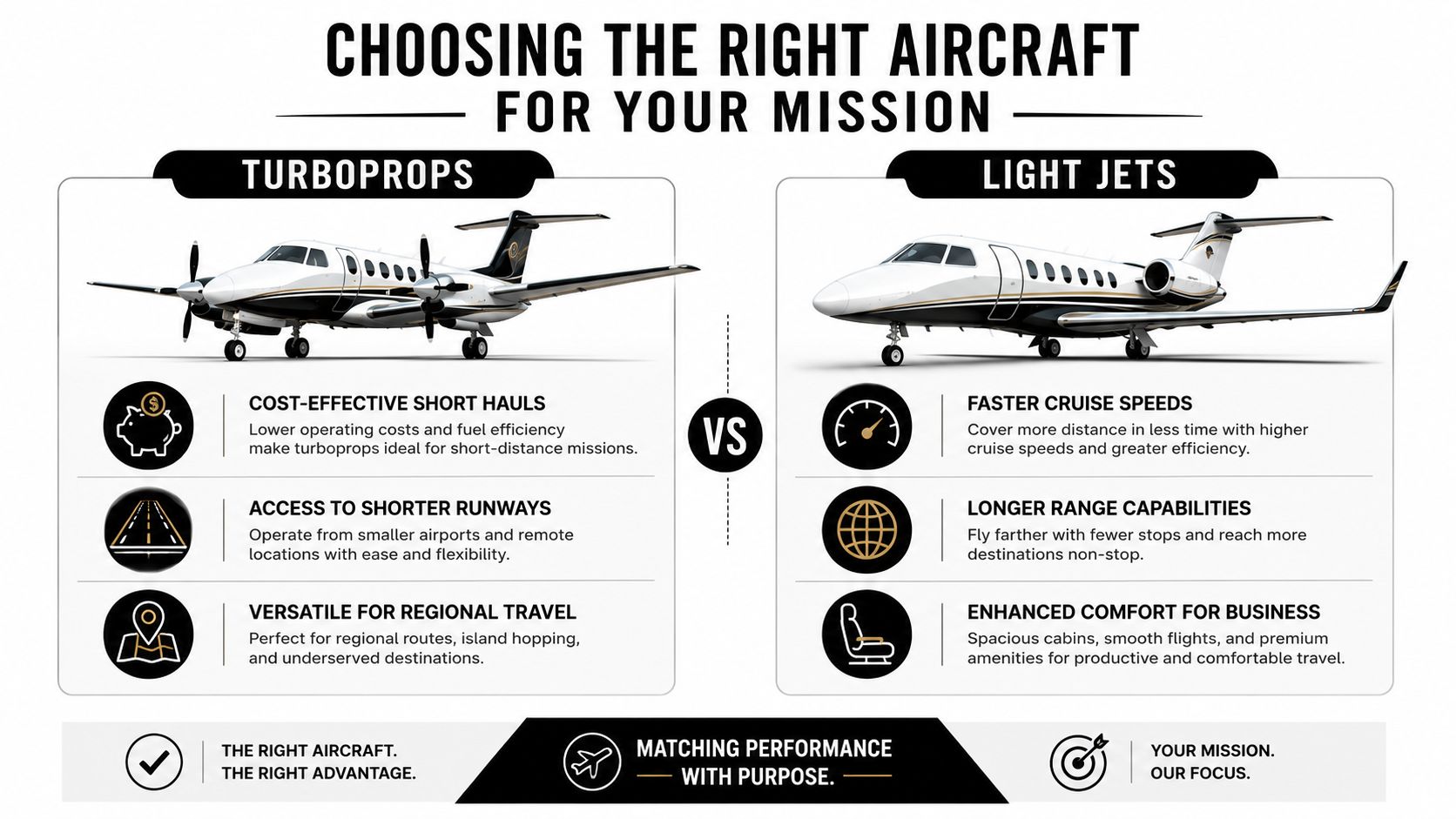
The choice usually comes down to turboprops versus light jets. That's the decision most new charter clients need, because those two categories cover most short-haul private missions without forcing you into an oversized cabin or an overpriced aircraft class.
Turboprops fit the hard-to-reach trip
Turboprops like the King Air 350 and Pilatus PC-12 are better suited for short runways and remote airfields, while very light jets are optimized for regional trips under about two hours, according to BlackJet's small-aircraft charter guidance. That's why turboprops often win on island routes, mountain airports, and destinations where runway length is the limiter.
A turboprop isn't the compromise option. On the right route, it's the more practical one because it can land where a jet can't, or where a jet would need a more restrictive runway profile. For travel to places like the Bahamas or other short-field destinations, runway access can matter more than cabin styling.
Light jets work when the route is regional and direct
Light jets are the better fit when the airports are standard, the trip is regional, and speed matters. They're typically the cleaner answer for business travel between cities that already have good airport infrastructure, especially when you want to get in, out, and back the same day.
The simplest way to understand this is:
- Choose a turboprop when runway length, remote access, or weather sensitivity is the issue.
- Choose a light jet when you want faster cruise, a more conventional business-travel profile, and direct access between regional cities.
- Choose by mission first, because runway length and payload can outweigh speed in the final decision.
Small aircraft charter is one of the few travel categories where the “slower” airplane can be the smarter premium choice.
If you want a broader primer on the aircraft side of the decision, the small private jet guide is useful background, especially before you compare specific models or request quotes.
Understanding the Drivers of Charter Costs
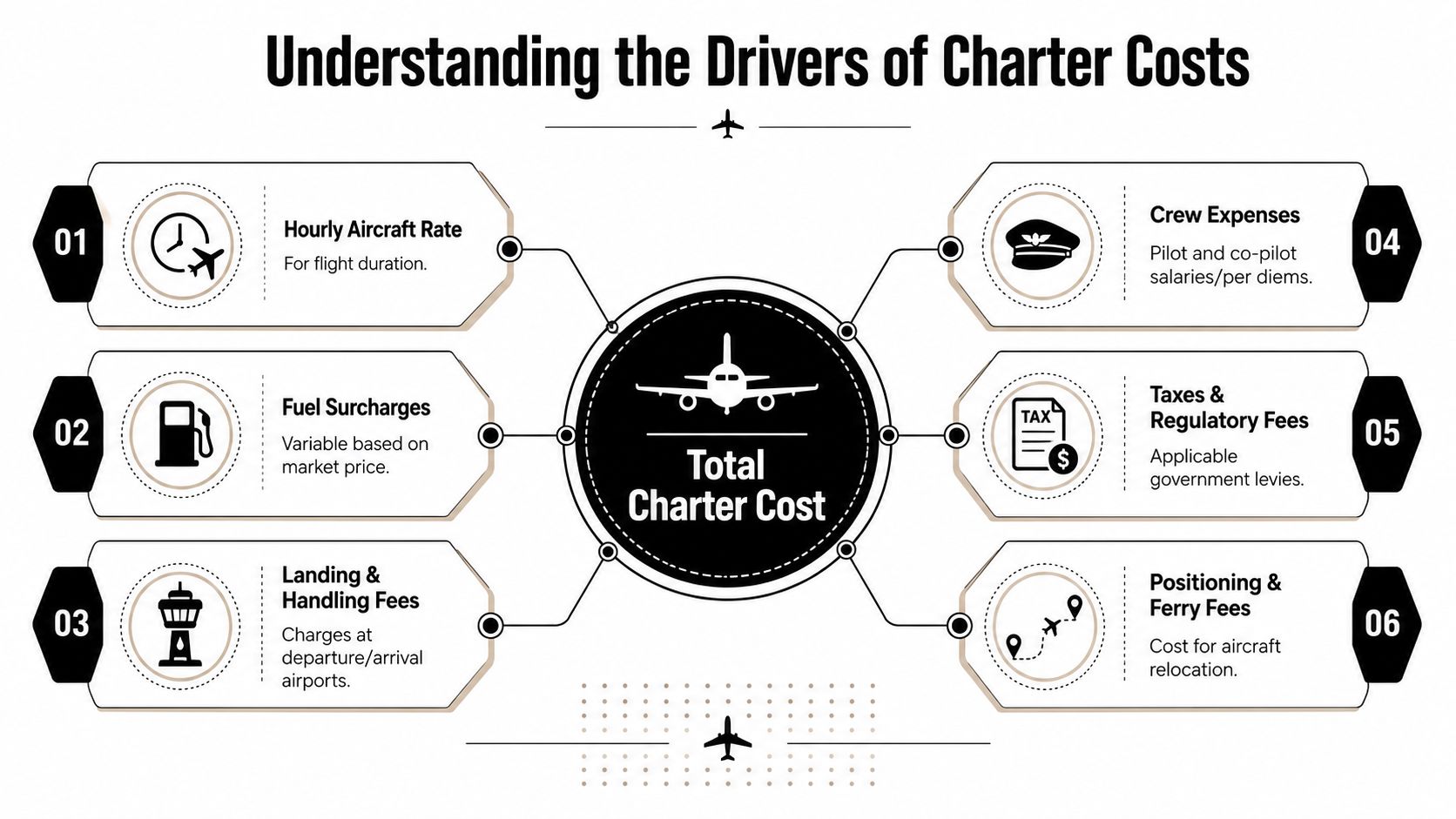
Charter pricing makes more sense once you stop treating it like a single number. A quote is usually a bundle of moving parts, and the final figure depends on how many of those parts are required for your trip.
The aircraft size matters, but it's not the whole bill
The most common misconception is that the smallest airplane is always the cheapest. In reality, chartering very small piston aircraft is rare and region-dependent, and operator availability, minimum flight times, and repositioning often matter more than aircraft size in the final price. That's why light jets and turboprops are usually the practical starting point for on-demand charter, as noted in a discussion among pilots on r/flying.
That point matters because the cheapest-looking option on paper can turn expensive once the operator has to move the aircraft to you. A plane based nearby often quotes better than a smaller aircraft that has to be ferried in empty.
What usually sits inside a quote
A serious quote normally reflects several cost buckets, even when they're not all obvious on the first pass:
- Hourly aircraft rate, the core cost tied to flight time.
- Positioning or ferry fees, when the aircraft has to reposition before your trip.
- Landing and handling charges, which vary by airport.
- Crew expenses, including overnight costs when the trip spans more than one day.
- Taxes and regulatory fees, where applicable.
- Fuel-related adjustments, depending on market and operator structure.
The useful move is to ask the broker which of those items are already included and which can still change. That question alone prevents a lot of confusion later.
For a deeper breakdown of how the invoice is assembled, this private jet charter pricing guide is worth reviewing before you compare quotes.
Practical rule: A lower base rate is only a win if the aircraft is already based near your departure point and the quote doesn't hide repositioning behind a prettier headline number.
Common Routes and Popular Use Cases
A good small aircraft charter usually solves a very specific travel problem. The best use cases are the ones where the schedule is tight, the destination is awkward, or the airport options are limited enough that commercial flying stops being efficient.
Business trips that need to happen in one day
Regional roadshows, investor meetings, and site visits are the cleanest fit for a small aircraft charter. A light jet works well when the trip is between standard airports and the primary value is in compressing door-to-door time, not in having the largest cabin on the field.
That's especially true when the itinerary includes more than one stop. The aircraft can keep the day moving without forcing a connection, a layover, or a return on the next airline departure.
Island and short-runway destinations
Turboprops are often the smarter answer for Caribbean trips, Bahamas access, and other short-field destinations. The reason is simple, the route may be too constrained for a jet to be the best tool, even if a jet feels more glamorous.
If your destination is remote, weather-sensitive, or better served by a smaller airfield, the aircraft choice should follow the runway rather than the brochure.
Ski towns and event weekends
Aspen, cultural weekends, and major sporting events tend to reward flexibility more than speed alone. A light jet can be the right balance when the airports are usable and the flight is short enough to stay efficient.
For ski travel, baggage and runway conditions deserve more attention than they get. Skis, boots, and winter weather can change the aircraft choice fast, especially if the trip starts or ends at a higher-elevation field.
The practical takeaway
The strongest use cases usually look like this:
- One-day business trips, when the priority is schedule control.
- Island access, when the runway is short or the ferry transfer is annoying.
- Mountain or remote travel, when terrain and airport limits make a turboprop smarter.
- Event travel, when timing matters more than airline frequency.
A small aircraft charter works best when it removes friction. If it still leaves you with a long ground transfer or a badly matched aircraft, the mission wasn't solved, it was just renamed.
Verifying Safety and Operator Certification

Safety checks aren't optional in charter. They're the difference between a legitimate operation and a company that only looks ready online.
The FAA states that pilots participating in a for-hire service are considered to be holding themselves out as providers of common carriage, which means they must be employed by a company operating under a certificate issued under Part 119 of the Federal Aviation Regulations or hold such a certificate themselves. In plain English, a charter flight has to be operated by a properly certificated entity, not just marketed like one, as explained in the FAA's Blackbird Statement and Q&A.
What to verify before you book
The NBAA Aircraft Charter Consumer Guide advises customers to verify the operator's valid FAA-issued air carrier certificate and review the operator's history, including its safety record and any FAA enforcement actions, before booking a flight. You should also ask who will conduct the flight, because the certificate name and number tell you which company is operationally responsible. That guidance comes directly from the NBAA consumer guide.
The FAA also tells passengers to ask whether the operator is certificated as an air carrier, request a copy of the certificate, and confirm that the operator is insured as required by U.S. Department of Transportation regulations. It even notes that passengers can verify legitimacy through the local FAA Flight Standards District Office, which makes this a concrete preflight check, not a courtesy question, in the FAA's charter passenger safety guidance.
If a broker won't clearly name the operating certificate holder, walk away.
Third-party audits matter because they help separate marketing from operational discipline. A polished website doesn't tell you how a company trains pilots, maintains aircraft, or handles oversight. The certificate, history, and audit trail do.
The safest habit is to treat safety as a document review before it becomes a travel decision. If the paperwork feels vague, the trip isn't ready.
Booking Your Flight and Saving on Costs
A good booking starts with clear trip data. The more precise you are about departure city, arrival airport, passenger count, bags, pets, and timing flexibility, the better the quote will be.
Ask for the right quote, not the fastest one
The quote should tell you which aircraft is available, where it's based, and whether repositioning is involved. That matters because a nearby aircraft can be more cost-effective than a cheaper-looking option that has to fly empty to get to you.
The scale of the market supports that kind of sourcing. Straits Research estimated the global air charter market at $33.15 billion in 2026 and projects it to reach $52.83 billion by 2034, and it also says there were over 210,000 charter flights globally in 2024 serving about 150,000 passengers. Those figures show why aircraft access, not just aircraft type, is now a central part of charter planning, according to Straits Research's market report.
Empty legs can help, but they're not a real strategy
Empty legs can look attractive because they sometimes price lower than a normal charter. The tradeoff is inflexibility, low availability, and route mismatches that often make them useless for time-sensitive travel.
A better approach is local sourcing. When the aircraft is already based near your departure point, you avoid the repositioning cost that inflates many quotes and you usually get more schedule control. That's the practical edge of a broker or operator that can search locally first rather than defaulting to a faraway tail.
What to ask before you confirm
- Where is the aircraft based? This tells you whether repositioning is likely.
- What's included in the quote? Make sure taxes, handling, and crew expenses are clear.
- How flexible is the itinerary? Flexibility often improves pricing.
- Is the aircraft the right class for the route? A bad fit creates hidden costs later.
The easiest savings usually come from smart routing, flexible timing, and choosing a nearby aircraft. Chasing the absolute lowest headline number rarely wins if the rest of the quote is built on repositioning and add-ons.
The Haute Jets Advantage for On-Demand Charter
The strongest charter setup does three things well. It matches the aircraft to the mission, keeps the quote transparent, and verifies the operator before the flight is confirmed.
Haute Jets is built around that logic. The model sources from 3,500+ owner-operated aircraft, focuses on local sourcing to reduce repositioning, and works only with operators carrying Wyvern Wingman or ARGUS Gold/Platinum ratings. It also uses a no-membership, pay-per-flight structure, which keeps the booking tied to the trip rather than to prepaid hours or long-term commitments.
That matters most on small aircraft charter because the trip has to fit the runway and the route, not just the category label. A turboprop to a short field, or a light jet for a fast regional hop, is only useful if it's sourced cleanly and operated by the right team.
You also avoid the old broker problem of paying for an aircraft you didn't choose. In a market as fragmented as the one described earlier, the ability to source the exact aircraft, confirm the operator, and match the mission is more useful than a broad promise of “private aviation.”
If you're ready to compare aircraft for an actual trip, request a custom quote from Haute Jets.