Picture this: stepping onto the tarmac, bypassing the chaos of a commercial terminal, and boarding your own aircraft. That's the power of private aviation. For anyone seriously looking into the market, you'll find a wide range of small jet aircraft for sale, from nimble Very Light Jets to more spacious Light Jets, each built for a specific purpose.
This guide is your roadmap to navigating the 2026 market from the ground up.
Your Guide to Buying a Small Jet in 2026

Deciding to buy a private jet is a game-changer, putting you in complete control of your travel and, more importantly, your time. It's the ultimate solution to the delays, long lines, and rigid schedules of commercial flying.
But getting there isn't as simple as just picking a plane. The path to ownership is lined with crucial decisions, and a misstep can be costly. This guide is built on real-world experience to help you make an intelligent purchase in today's market. We'll walk through everything from choosing the right aircraft class to the final handshake.
Understanding the Current Aviation Market
The business aviation market has been surprisingly strong lately. Despite global economic pressures and political shifts, the market entered 2026 with serious momentum. This isn't just industry talk; it signals a healthy, active environment for buyers.
Knowing how to work within this market is key. You need to understand what to look for and, just as critically, what to avoid. Our goal is to give you the practical knowledge to find a jet that truly fits your mission, whether that's quick regional trips for meetings or longer flights for family getaways.
The right small jet isn't just about the sticker price. It's about finding the perfect balance of performance, operating costs, and mission capability. The wrong plane can quickly turn into a source of unexpected expenses and logistical nightmares.
Here's a look at what we'll cover to make sure that doesn't happen:
- Decoding Jet Classes: We'll break down the real-world differences between Very Light Jets and Light Jets and who they're for.
- Total Cost of Ownership: You'll get a no-nonsense look at what it actually costs to buy and operate a private jet.
- Due Diligence: We'll cover the absolute must-do steps, from pre-purchase inspections to legal and title checks.
- Acquisition Logistics: Learn to navigate the complexities of financing, tax implications, and FAA registration.
We'll also explore how you can gain the benefits of private flight without the complexities of direct ownership, introducing a smarter, more flexible approach to flying.
Defining Your Mission: An Introduction to Small Jets
When you first dive into the world of private aviation, you'll find that "small jet" isn't a single category. It's a landscape of different aircraft, each built with a specific purpose in mind. Getting a handle on these differences is the most critical first step you can take toward a smart purchase.
Think of it this way: you wouldn't use a nimble two-seat sports car for a cross-country family road trip. The same logic holds true for jets. The two main classes you'll be looking at are Very Light Jets (VLJs) and their slightly larger siblings, Light Jets. It all comes down to matching the machine to your mission.
The Very Light Jet: Your Agile Point-to-Point Solution
The Very Light Jet, or VLJ, is your entry into private jet ownership. These are the featherweights of the jet world—incredibly efficient, nimble, and often designed for a single pilot to operate. This makes them a fantastic option for owner-pilots or businesses that need to connect regional cities without the fuss of commercial travel.
What really defines a VLJ is its mission profile:
- Passenger Load: They're perfect for 2 to 4 passengers.
- Typical Trips: Think shorter hops under 1,200 nautical miles, like zipping from New York to Chicago or Los Angeles to Las Vegas.
- Airport Access: Their biggest superpower is the ability to use thousands of smaller, local airports that larger jets can't touch. This gets you closer to your actual destination, cutting down on ground travel time.
This ability to access smaller airfields is a game-changer.
The Light Jet: The Versatile Business Workhorse
Take a step up from a VLJ, and you enter the Light Jet category. If the VLJ is a sports car, the Light Jet is a high-performance luxury sedan. It gives you more cabin space, longer legs, and better amenities, making it a true workhorse for both business and family travel.
With a Light Jet, you get a more substantial cabin that often includes a private lavatory and a small galley for refreshments—features that make all the difference on a longer flight.
A Light Jet hits the sweet spot between operational efficiency and genuine passenger comfort. It's big enough to hold a productive meeting in the sky but still small enough to keep operating costs from spiraling.
Here's what sets a Light Jet apart:
- Passenger Load: They comfortably seat 6 to 8 passengers.
- Range and Reach: These jets can handle longer legs up to 2,000 nautical miles. A coast-to-coast trip is easily doable with just one quick fuel stop.
- Cabin Comfort: Most offer a stand-up or near-stand-up cabin, which creates a far more comfortable and less confining environment for everyone on board.
Comparison of Small Jet Aircraft Classes
To help you visualize the differences, here's a quick side-by-side look at how these two classes stack up against each other.
| Attribute | Very Light Jet (VLJ) | Light Jet |
|---|---|---|
| Typical Passengers | 2–4 | 6–8 |
| Maximum Range | ~1,200 nautical miles | ~2,000 nautical miles |
| Cabin Size | Compact, intimate seating | More spacious, often with a near-stand-up cabin |
| Onboard Amenities | Basic or none | Private lavatory and small galley are common |
| Pilot Requirement | Often certified for single-pilot operation | Usually requires two pilots |
| Best For | Short regional hops, owner-pilots, maximum efficiency | Small team travel, cross-country trips, enhanced comfort |
Ultimately, choosing the right aircraft comes down to being honest about your needs. A buyer whose travel is consistently within a 500-mile radius with just one or two passengers will find a VLJ to be a brilliant and cost-effective tool.
On the other hand, if you frequently travel over 1,500 miles with a team of four or more, the added range, space, and comfort of a Light Jet are non-negotiable. To see how these specs translate to real-world aircraft, take a look at our guide on top models for short and mid-range business travel.
Calculating the True Cost of Owning a Jet
When you start looking at a small jet aircraft for sale, it's easy to focus on the sticker price. But that initial number, as big as it is, is just the beginning of the story. The true cost of ownership is a combination of that one-time acquisition expense and the ongoing operational costs that can ground new owners if they aren't prepared.
Think of it as the difference between buying a boat and actually taking it out on the water. Getting a handle on this complete financial picture is what makes ownership sustainable and, frankly, enjoyable. We'll break down the numbers so you can build a realistic budget from the get-go.
Acquisition Costs vs. Operating Costs
Let's start by splitting the costs into two buckets: what it takes to buy the jet (acquisition costs) and what it takes to fly it (operating costs).
But the real story of ownership unfolds year after year in your operating budget.
These ongoing costs can be broken down even further into fixed and variable expenses.
- Fixed Costs: These are the bills you have to pay whether you fly one hour or 300. They're predictable and form the baseline of your annual budget.
- Variable Costs: These expenses are tied directly to your flight hours. Simply put, the more you fly, the more you spend.
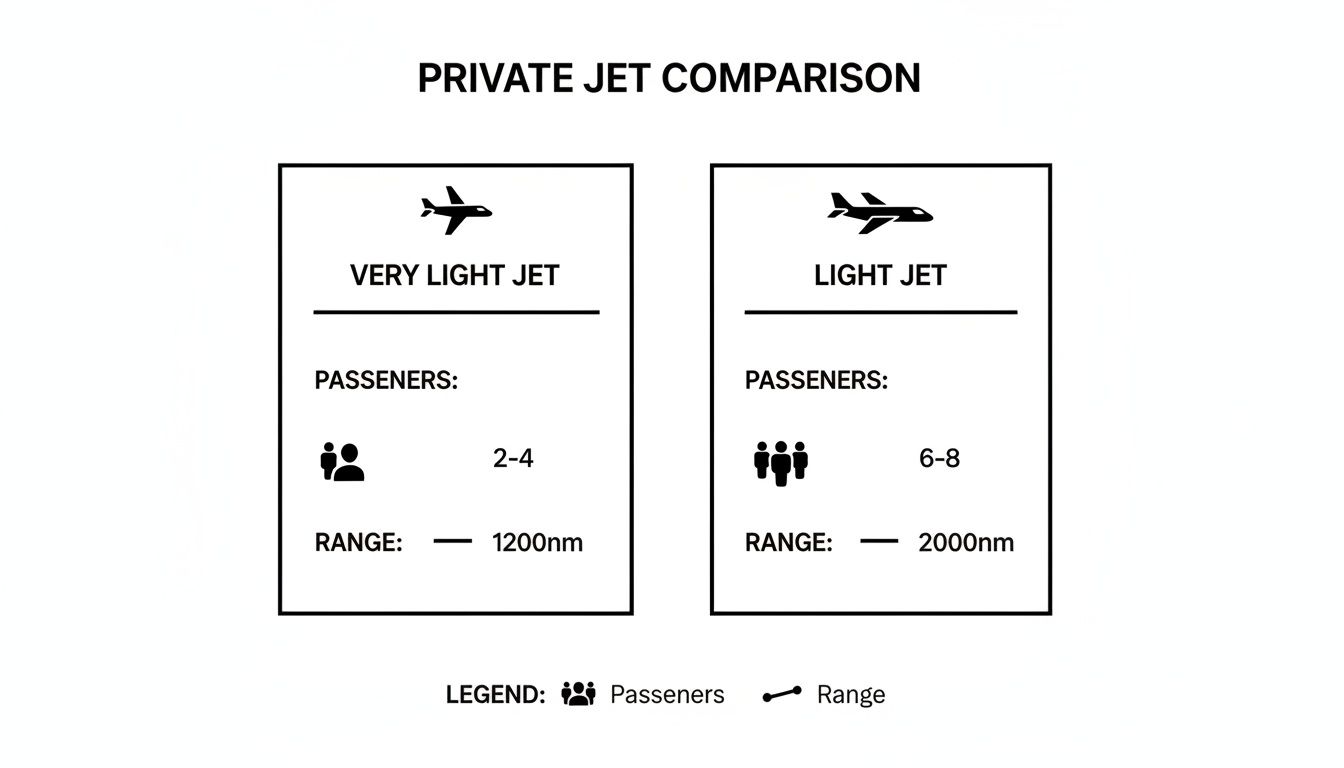
As you can see, a Light Jet's extra passenger space and longer range naturally come with more complex systems and, as a result, higher costs than a Very Light Jet.
A Sample Annual Budget for a Light Jet
To bring this all into focus, let's build a sample annual budget for a popular pre-owned light jet. We'll base this on flying 200 hours per year, which is a pretty common utilization rate for many private owners.
Fixed Annual Costs
These are the non-negotiable, recurring costs of having your jet on standby, ready to go when you are.
- Crew Salaries: A professional two-pilot crew is standard for this class of jet.
- Hangar Storage: You need to protect your multi-million dollar asset from the elements.
- Aircraft Insurance: Covering both hull and liability is mandatory.
- Crew Training: Your pilots need recurrent training every six to twelve months to stay sharp and meet safety standards.
Variable Costs (Based on 200 Flight Hours)
Now for the costs that tick up every time you take to the skies.
- Fuel: A light jet burns around 200 gallons per hour.
- Maintenance Programs: These "power-by-the-hour" programs for engines and airframes are crucial for predictable maintenance budgeting.
- Landing & Handling Fees: Every airport charges fees for landing and ground services.
- Catering & Incidentals: This bucket covers everything else, from in-flight meals to de-icing services in the winter.
The Pre-Purchase Inspection: Your Most Important Step

So, you've worked through the numbers and have a small jet aircraft for sale in your sights. Now comes the single most critical part of the entire buying process: the pre-purchase inspection, or PPI.
This isn't just kicking the tires. A PPI is an exhaustive, nose-to-tail physical and documentary investigation that confirms the jet is safe, airworthy, and—crucially—free from hidden problems that could turn your dream into a financial nightmare.
Think of it as the world's most intense home inspection for a multi-million dollar asset that flies at 500 miles per hour. A meticulous PPI is your best defense against buying a "hangar queen"—an aircraft notorious for spending more time grounded for repairs than it does in the sky. It will uncover everything from undisclosed damage history to upcoming maintenance events that could set you back hundreds of thousands of dollars.
Ultimately, the results of the PPI give you powerful leverage. Any issues found can be used to negotiate a better price or require the seller to make things right before you close. In some cases, it's your get-out-of-jail-free card, allowing you to walk away from a bad deal.
What a Real PPI Looks Like
A proper PPI is far more than a visual once-over. It's a deeply invasive process handled by certified technicians who are specialists in that exact make and model. This isn't negotiable; a Gulfstream expert might miss a key issue on a Citation, and vice versa. The inspection should always happen at a neutral, third-party facility you choose—never one suggested by the seller.
A truly thorough PPI involves several key phases:
- Physical and Engine Deep Dive: Technicians will comb over the airframe and landing gear, looking for the smallest signs of corrosion, cracks, or stress. They'll use specialized tools like borescopes to peer deep inside the engines without having to perform a full teardown.
- Systems and Avionics Checkout: Every single system gets put through its paces. This means testing flight controls, hydraulics, electrical systems, and running the entire avionics suite to make sure every screen and sensor works exactly as it should.
- Engine Ground Runs: The engines are fired up and run at various power settings on the ground. This allows technicians to check performance data against the manufacturer's specs and spot problems that are invisible when the engines are cold.
- The Acceptance Flight: This is the final exam. You or your pilot will be in the cockpit for a test flight to feel how the aircraft handles in its natural environment. It's the best way to detect subtle vibrations, odd noises, or any performance quirks that don't show up in ground tests.
A PPI is not the same as a standard annual inspection. An annual is about meeting minimum airworthiness rules. A PPI is a buyer-focused investigation into the aircraft's true condition, value, and future maintenance liabilities.
Don't Forget the Paper Trail: Logbooks and Legal Diligence
An aircraft's physical condition is only half the story. The other half is its paper trail. The logbooks are the jet's official biography, meticulously recording every flight, every repair, and every part that's ever been replaced. A professional logbook review is absolutely essential.
Your team will be hunting for:
- Complete Records: Gaps in the maintenance history are a huge red flag.
- AD Compliance: Airworthiness Directives (ADs) are mandatory safety updates from the FAA. If one was missed, the aircraft could be grounded until it's resolved.
- Damage History: Any incident, from a hard landing to a bird strike, must be clearly documented along with the certified repair work.
While the technicians are busy with the aircraft itself, your aviation attorney gets to work on the legal due diligence. This starts with a title search to verify the seller is the legal owner and to uncover any hidden liens or claims against the aircraft.
Your attorney also drafts the Purchase Agreement. This crucial document defines the terms of the sale, the scope of the PPI, and precisely what happens if any discrepancies are found. It's the legal framework that protects your deposit and gives you a clear path forward, no matter what the inspection reveals.
Financing and Regulatory Hurdles
Sorting out the financing and paperwork for a small jet can feel just as complicated as learning to fly one. It's the final stretch, though, and with the right approach, it's a straightforward path from being a prospective buyer to a fully-fledged aircraft owner. Let's break down what you need to know.
Think of it this way: you wouldn't ask your family doctor to perform heart surgery. The same logic applies to financing a jet. While your personal bank is great for mortgages, they rarely have the specialized knowledge needed for an aviation asset. Dedicated aviation lenders, however, live and breathe this stuff. They understand the real-world value of the aircraft, how it depreciates, and what ownership actually entails, which almost always results in better financing terms for you.
Securing financing is about more than just getting a "yes." It's about finding a financial partner who truly understands the asset. A good aviation lender becomes an advisor, helping you navigate everything from title insurance to international registry filings. They protect your investment long after the check is cashed.
Choosing Your Financing Path
When you're ready to secure funding, you'll generally find yourself heading down one of two roads.
- Traditional Bank Loans: If you have a deep, established relationship with a major bank, this can be an option. Be prepared, though—they often see a jet as unfamiliar collateral, which can mean more conservative loan-to-value ratios and less flexible repayment terms.
- Specialized Aviation Financing: This is a popular route, and for good reason. Aviation finance companies know the market inside and out. They can offer much longer amortization periods, sometimes up to 20 years, which significantly lowers your monthly payments. They're also skilled at structuring a loan that aligns with your business's cash flow and intended use.
Tax and Regulatory Hurdles
Once financing is in place, you have to tackle the maze of taxes and regulations. These rules aren't suggestions—they're non-negotiable, and a mistake can lead to serious fines or even keep your new jet stuck on the ground.
The first big hit to your wallet is often sales and use tax. This is a tricky one because it's typically based on where you take delivery and "base" the aircraft, which may not be where you live. This is why states like Delaware and Montana are so popular for aircraft ownership; their favorable tax laws allow for the use of trusts or LLCs to legally minimize that initial tax bite.
On the flip side, using the jet for your business can unlock powerful tax advantages, like bonus depreciation. This allows you to write off a large portion of the jet's value in the early years of ownership, creating a significant tax benefit. An aviation-savvy tax advisor is absolutely essential here to make sure you're maximizing these perks legally.
Finally, you'll work with the Federal Aviation Administration (FAA) to make it all official. This involves a few key steps:
- Registering the Aircraft: Getting the jet officially registered to you or your ownership entity with the FAA.
- Securing an N-Number: This is your jet's unique tail number, basically its license plate.
- Declaring Operational Rules: You'll need to decide if you'll fly privately under Part 91 rules or make the jet available for charter under the more demanding Part 135 regulations.
The Haute Jets Alternative to Ownership

We've walked through the immense commitment of buying a small jet. It's a complex and expensive world. But what if you could have all the perks—the speed, the privacy, the sheer convenience—without the multimillion-dollar price tag and the constant operational headaches?
There's a smarter way to fly. Imagine having a jet ready whenever you need it, but without the mortgages, the surprise maintenance bills, or the logistics of managing pilots and hangars. This is the power of on-demand charter, an approach that prioritizes access over ownership and puts you in control.
A New Model for Flying Private
Here's a dirty secret of the charter industry: many brokers and jet card programs make you pay for their logistical inefficiencies. They'll often book an aircraft based hundreds of miles away and have to fly it empty to pick you up.
We built Haute Jets specifically to eliminate that waste. Our model connects you directly with a vetted network of over 3,500+ Wyvern, ARGUS, or IS-BAO rated aircraft. By tapping into this massive fleet, we find the perfect jet that's already positioned at or near your departure airport. This direct-sourcing method cuts out the middlemen and the unnecessary fees, unlocking transparent pricing on every flight.
With Haute Jets, you're not just booking a generic "light jet." You are choosing the exact aircraft for your mission—down to the specific year, make, and model—with complete transparency. This level of control is something even many owners don't experience.
Total Flexibility and Control
This on-demand model gives you unparalleled freedom. Instead of being locked into the single aircraft you own, you can choose the right tool for the job, every time.
- Taking a quick trip for a regional meeting? A nimble Very Light Jet is the most efficient choice.
- Flying the team cross-country for a conference? We'll find a spacious Light Jet with the Wi-Fi you need to stay productive.
- Planning a family vacation to Europe? An Ultra-Long-Range jet with lie-flat seats is at your disposal.
You simply pay for each flight as you take it. There are no membership dues, no jet cards to pre-purchase, and absolutely no long-term commitments. It's a true a la carte approach that shields you from the burdens of ownership while ensuring you never overpay for more aircraft than you need. You can learn about the Haute Jets private jet charter model to see how this compares to other options in the market.
Our process is built on transparency and peace of mind. A full 24 hours before departure, you receive a detailed itinerary with the aircraft's tail number, photos, and even the bios of your flight crew. You arrive at the FBO knowing exactly what to expect. It's all the power and luxury of ownership, without ever having to buy the plane.