

The most popular advice about private-jet sustainability is also the least useful: pay to offset the flight, then call it carbon neutral. A credit can finance an emissions reduction or removal elsewhere, but it doesn't make the aircraft burn less fuel or erase the flight's full climate impact. A credible private jet carbon offset claim is not a green badge. It's a set of documents a buyer can audit.
For charter clients and corporate travel managers, the practical question isn't whether an operator offers offsets. It's what the program covers, how emissions were calculated, which project received the money, and whether the credits were retired. The difference matters for a voluntary climate contribution and for a defensible Scope 3 record.
Why Most Private Jet Carbon Offset Claims Fall Apart
A “100% carbon neutral” claim can describe a payment, not a change to the flight. The aircraft still burns fuel. If an operator buys credits from a forestry project, that purchase may support emissions reductions or removals elsewhere, but it doesn't cancel the physical exhaust from the charter or account automatically for non-CO2 warming.
Consider a client sold a “net-zero” leg. The invoice lists an offset, but the operator can't show the flight-specific emissions calculation, the project identifier, or a retirement record. The credit might be a generic forestry unit, with no clear connection to the flight beyond the company's accounting choice. That isn't enough to substantiate a strong claim.
Audit the claim, not the badge. Ask what was counted, what was financed, and what evidence proves the credit was retired.
Four questions before accepting the claim
- What emissions are included? Request direct fuel CO2 separately from any estimate of non-CO2 climate effects.
- How was the flight measured? The calculation should reflect the actual aircraft and itinerary, not a generic fee.
- What project and standard apply? Ask for the project name, identifier, registry, and verification method.
- Was the credit retired? A promise to purchase credits later isn't evidence of completed retirement.
The buyer's job is to examine each link in that chain. That approach is consistent with the wider expectation that sustainability audits no longer optional, especially when a business wants to support an environmental claim with records rather than marketing language.
Local aircraft sourcing belongs in this conversation, but it's a different intervention. Using an aircraft already near the departure city can avoid some repositioning activity before any offset is purchased. The sound order is to reduce avoidable flying first, then account for the remaining flight, and only then evaluate compensation.
How Private Jet Emissions Are Calculated
A generic hourly offset fee is a weak basis for an emissions claim. Light jets and heavy jets have different fuel requirements, and the aircraft category alone cannot establish what a particular charter emits. Require a calculation tied to the aircraft, route, payload, and documented operation before accepting the quoted offset quantity.
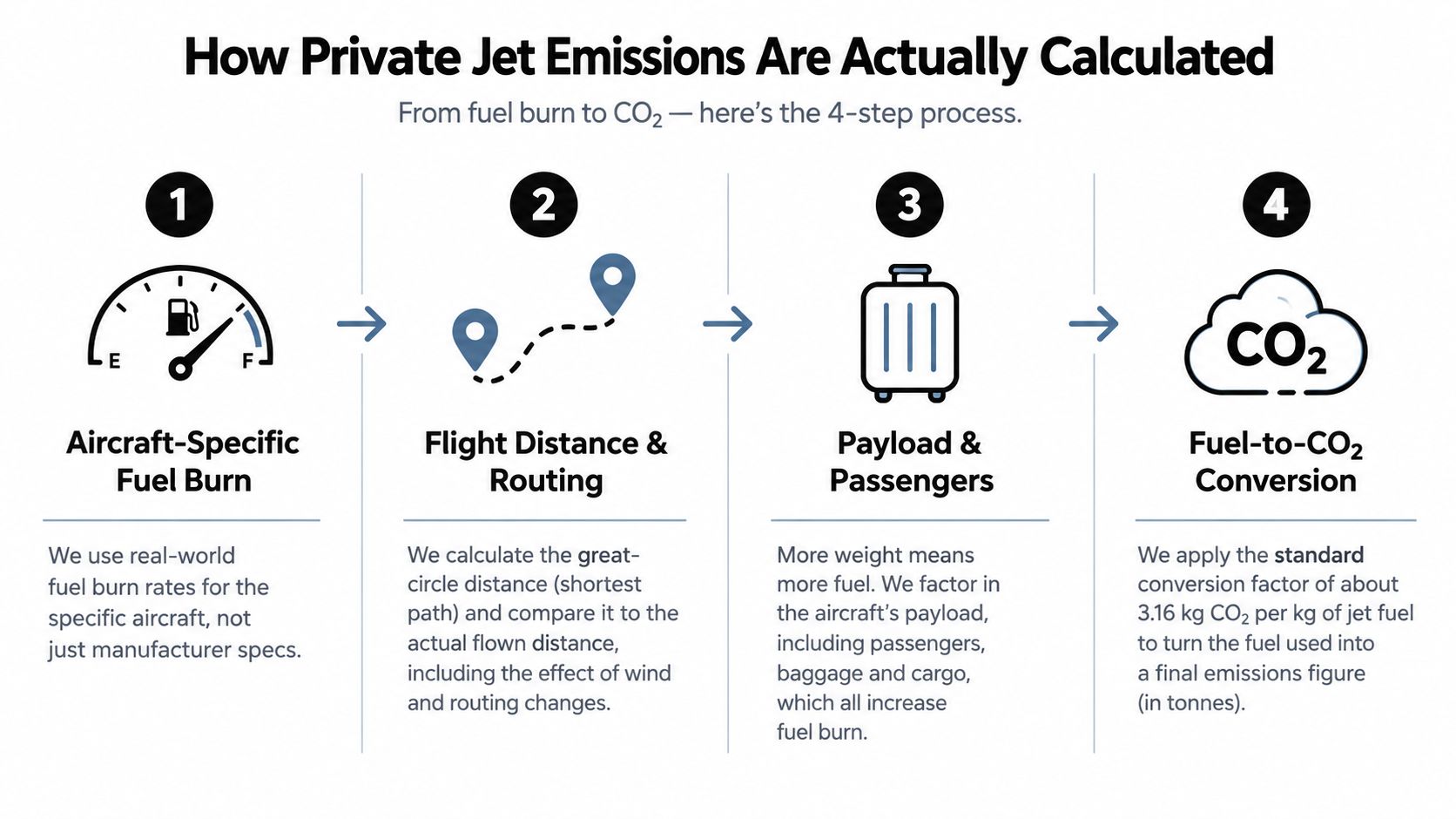
What the calculation should show
Start with aircraft-specific fuel burn. Require the provider to identify whether it used operational records or an aircraft-category estimate. An estimate should be labeled as an estimate. Check the flight distance and routing against the aircraft's itinerary, including diversions or other operational changes that affect fuel use.
Review payload and passengers separately. Weight affects fuel demand; passenger count affects how the resulting emissions are allocated among travelers. For a whole-aircraft charter, establish whether the quote reports the flight total or a per-passenger share before comparing it with another offer.
Then examine fuel uplift and its role in the method. Ask how the provider connects the fuel information to the flight activity being measured, including repositioning where relevant. The passenger itinerary alone may leave part of the aircraft's operation outside the calculation.
Keep direct CO2 and broader climate estimates separate.
If the provider applies a non-CO2 multiplier for contrails, nitrogen oxides, water vapor, or induced cirrus, require that estimate and its assumptions to be itemized. A CO2-only offset does not cover every climate effect of aviation.
A defensible quote arrives with its assumptions. Without the inputs, the final tonne figure cannot be audited.
Corporate buyers should retain the calculation alongside the booking record and invoice to support reporting and consistent comparisons between locally sourced and repositioned aircraft. Haute Jets' overview of the private jet carbon footprint helps frame the questions to raise before booking.
Require the offset documentation to reconcile the stated emissions baseline with the credit quantity and record retirement or cancellation for the client. Describe the result accurately: credits finance reductions elsewhere; they do not erase the flight's climate impact.
Offset Standards and Registries Worth Trusting
A registry name is useful, but it doesn't make every credit interchangeable. A credit associated with avoided emissions, such as a clean-cooking project, represents a different activity from a removal project. Buyers should examine the project methodology and the specific unit, not stop at a familiar standard's logo.
ICAO's CORSIA framework identifies practical quality controls: additionality, permanence, safeguards against unintended emissions increases, and independently measured and audited reductions against a defined baseline. It also calls for measures against double counting and safeguards for environmental and social risks. Use those controls as an audit lens, then check whether the project documentation addresses them.
Offset Standards Compared
| Standard | Best for | Permanence | Double-count protection |
|---|---|---|---|
| Verra VCS | A project-specific credit, whether an avoidance activity or a removal, provided the methodology and project documents fit the claim | Depends on project type and methodology. Verify the risk controls for the actual project | Check the unit and registry record for retirement status and evidence that it hasn't been claimed twice |
| Gold Standard | Project credits such as verified community or clean-cooking activities, when their stated purpose matches the buyer's claim | Depends on the activity and methodology. Don't treat an avoidance credit as a durable removal | Request the project identifier and retirement evidence, not just the standard name |
| CORSIA Eligible Emissions Units | Eligible units used for an operator's applicable CORSIA obligation | Depends on the approved program, project type, and applicable eligibility rules | Confirm that the unit meets the applicable CORSIA eligibility requirements and has been cancelled as required |
| Climate Action Reserve | Registry-based project credits where the specific protocol and project documentation fit the buyer's purpose | Project-specific. Review the relevant protocol and monitoring records | Require registry evidence showing the unit's status and retirement |
This table is a starting point, not a blanket endorsement of every project issued under a standard. A Gold Standard cookstove credit and a Verra removal credit aren't substitutes: one may represent an emissions-reduction activity, the other a removal, and their claims need different evidence.
What to request from the registry record
Ask for the project identifier, credit quantity, standard or program, and retirement record. The record should let you identify which credits were cancelled and for whose benefit. If the operator can provide only a portfolio name or a general statement about “green projects,” the claim isn't ready for corporate reporting.
CORSIA eligibility is a separate question from voluntary quality. A credit may be listed in a registry yet not qualify for a particular regulatory purpose. For a private-jet carbon offset, the buyer should match the unit to the claim being made, then retain the retirement evidence alongside the flight calculation.
SAF Versus Offsets and Why the Difference Matters
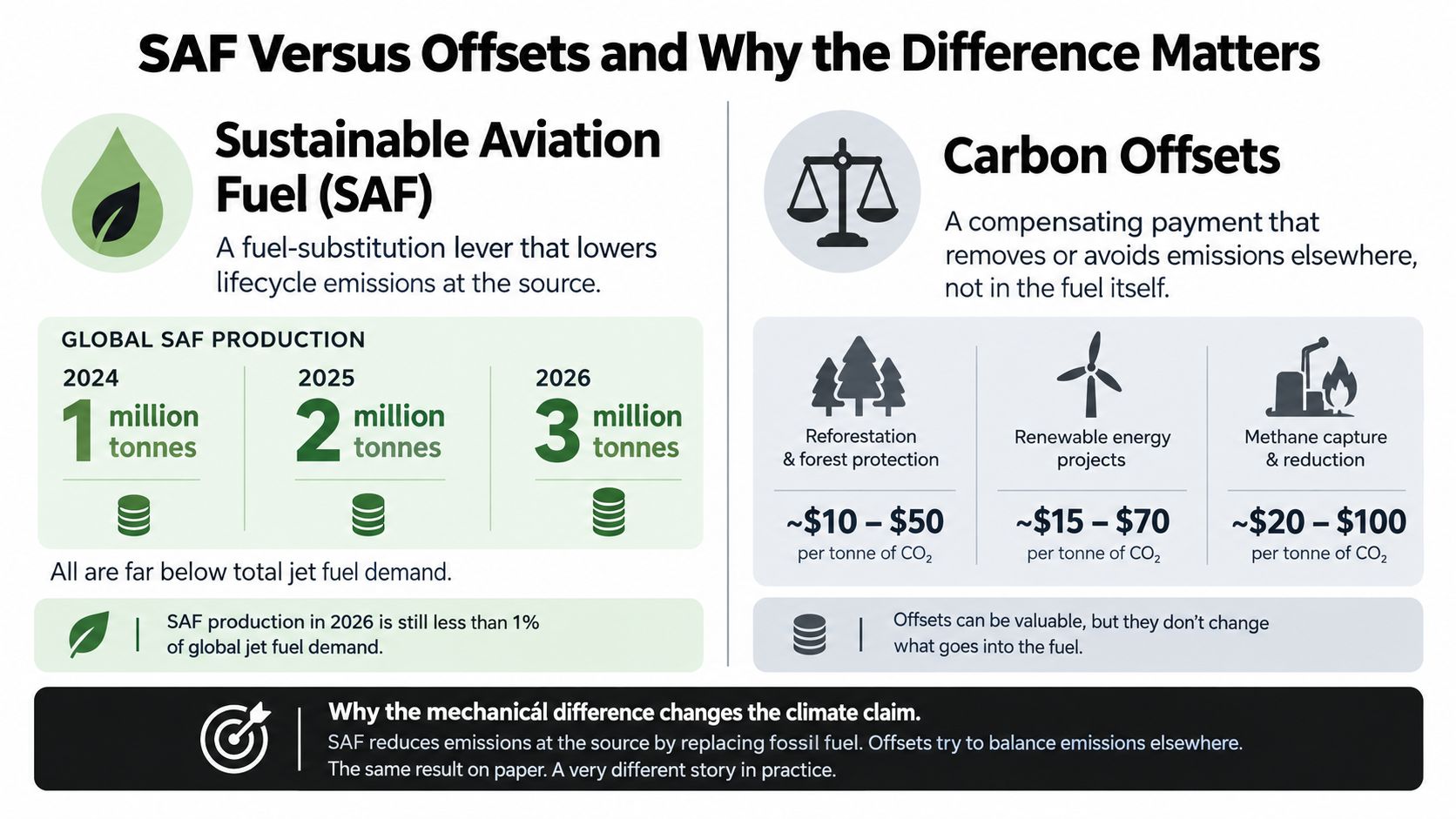
Sustainable aviation fuel (SAF) changes the fuel supply; an offset finances an activity elsewhere. That mechanical difference should be obvious in the invoice. SAF may reduce lifecycle emissions associated with the fuel pathway, while a carbon credit doesn't change what fuel the aircraft burned.
Global SAF production rose from 1 million tonnes in 2024 to 1.9 million tonnes in 2025, with 2.4 million tonnes projected for 2026. Even that projected output represented a small share of aviation fuel demand: SAF was about 0.6% of global jet-fuel use in 2025. IATA's SAF fact sheet provides the industry context for those figures.
Physical fuel and book-and-claim
A charter client may pay toward SAF without the fuel being physically loaded onto the booked aircraft. Under a book-and-claim arrangement, the environmental attribute is accounted for separately from the fuel's physical delivery. That can support demand for SAF, but the buyer should ask which batch or program is involved, how the benefit is allocated, and what prevents another party from claiming the same benefit.
CORSIA's eligibility framework provides a specific benchmark: eligible aviation fuels must show at least a 10% lifecycle greenhouse-gas reduction against a fossil-fuel reference value of 89.1 gCO2e per megajoule. The lifecycle assessment includes production, supply, use, and induced land-use-change effects where applicable. A provider should therefore disclose feedstock, production pathway, chain-of-custody, and lifecycle method before presenting a SAF benefit as a measured reduction. EASA's CORSIA guidance explains the framework.
Watch out for the unqualified statement “this flight used SAF.” It can obscure whether fuel was physically supplied, whether a book-and-claim contribution was made, and what lifecycle calculation supports the claim. Feedstock choice and land-use change can materially affect the result, so a SAF label alone doesn't prove a particular climate benefit.
For charter buyers, the cleanest record separates direct fuel CO2, any documented SAF lifecycle benefit, and credits retired for residual emissions. See Haute Jets' explainer on what sustainable aviation fuel is for a useful distinction between fuel substitution and compensation.
Use SAF and offsets deliberately. One is a fuel-supply intervention; the other is a separate climate contribution. Combining them into a single percentage without showing the calculation makes the claim harder, not easier, to verify.
What Regulations Apply to Private Jet Carbon Offset Today
CORSIA is the clearest international reference point for aviation offsetting, but it doesn't apply automatically to every private flight. ICAO adopted the scheme in 2016, with emissions reporting beginning on January 1, 2019, and offsetting obligations beginning in 2021. The scheme covers qualifying international aviation activity and participating state pairs, with voluntary participation during its early phases. ICAO's environmental report describes the framework and its milestones.
The original aim was to stabilize international aviation's net CO2 emissions at 2020 levels. ICAO later set a stricter baseline for 2024–2035 at 85% of 2019 emissions. In 2024, that change meant operators were expected to offset approximately 15.4% of covered emissions, about 55.6 million tonnes of CO2 globally. Those are sector-level figures, not a percentage to apply automatically to an individual charter.
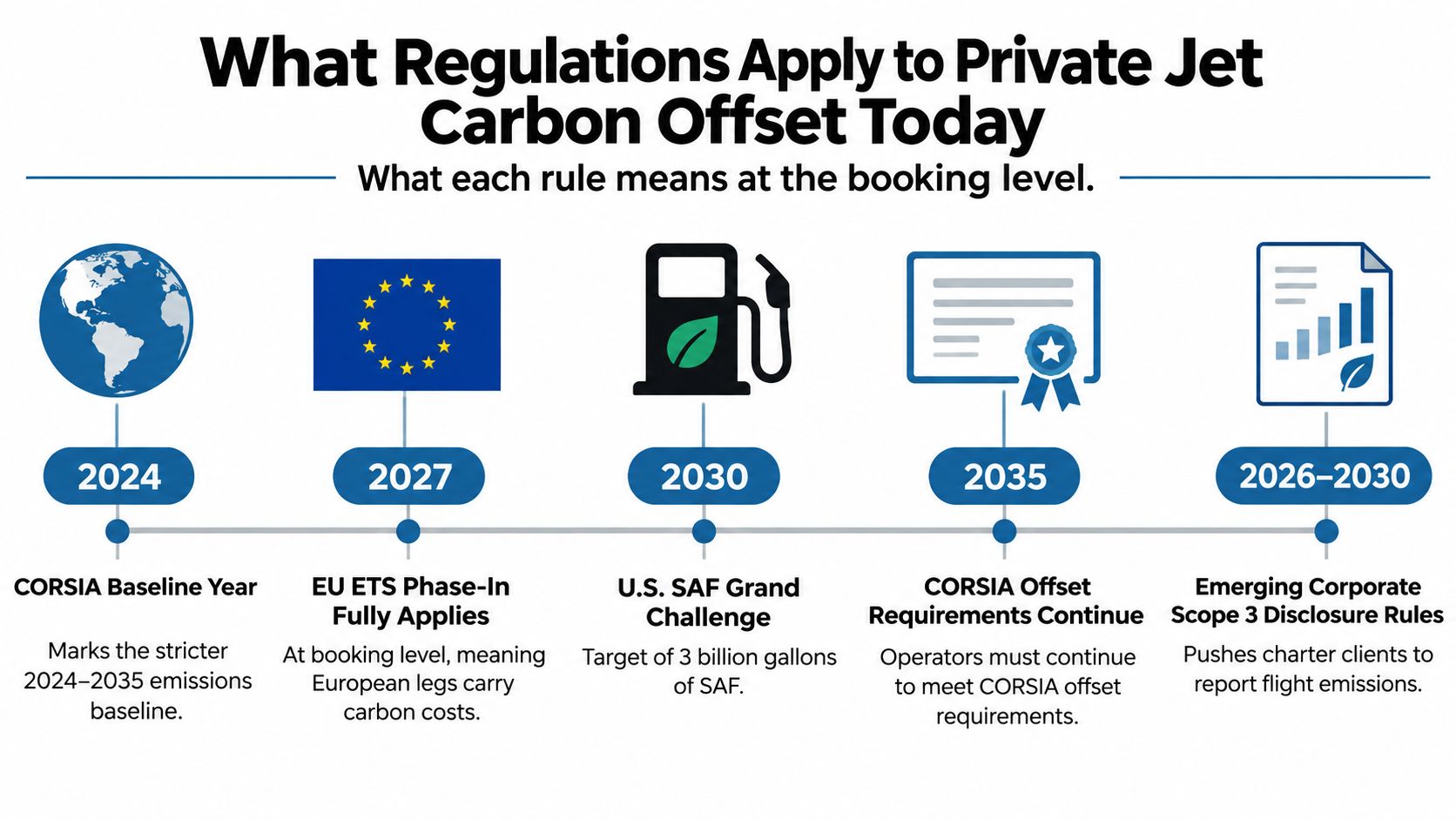
What the buyer should establish
Ask whether the operator has a compliance obligation for the particular flight, and whether the offset being sold is voluntary or regulatory. CORSIA applies to qualifying international activity under its rules. A voluntary charter contribution shouldn't be presented as proof that the flight was covered by CORSIA.
EU ETS and U.S. SAF policy should also be assessed against the actual operation and applicable rules, not inferred from a generic timeline or marketing graphic. The data available here doesn't establish the detailed applicability of those regimes to a given private charter, so request the operator's explanation and supporting documentation rather than assuming a particular requirement applies.
For business travel, maintain a consistent record of flight emissions and any associated environmental claims. Corporate Scope 3 reporting makes that distinction useful even when the passenger's charter isn't directly subject to an offset obligation. The core booking-level questions remain practical: which emissions were counted, which mechanism was used, and what proof supports the claim?
What It Costs to Offset a Private Jet Leg
A generic per-hour “green fee” is a poor basis for an offset budget. The cost should follow the flight's calculated emissions and the price per credit, with any administration charge shown separately. Request those components before accepting the total. An offset finances reductions or removals elsewhere; paying the invoice does not erase the flight's climate impact.
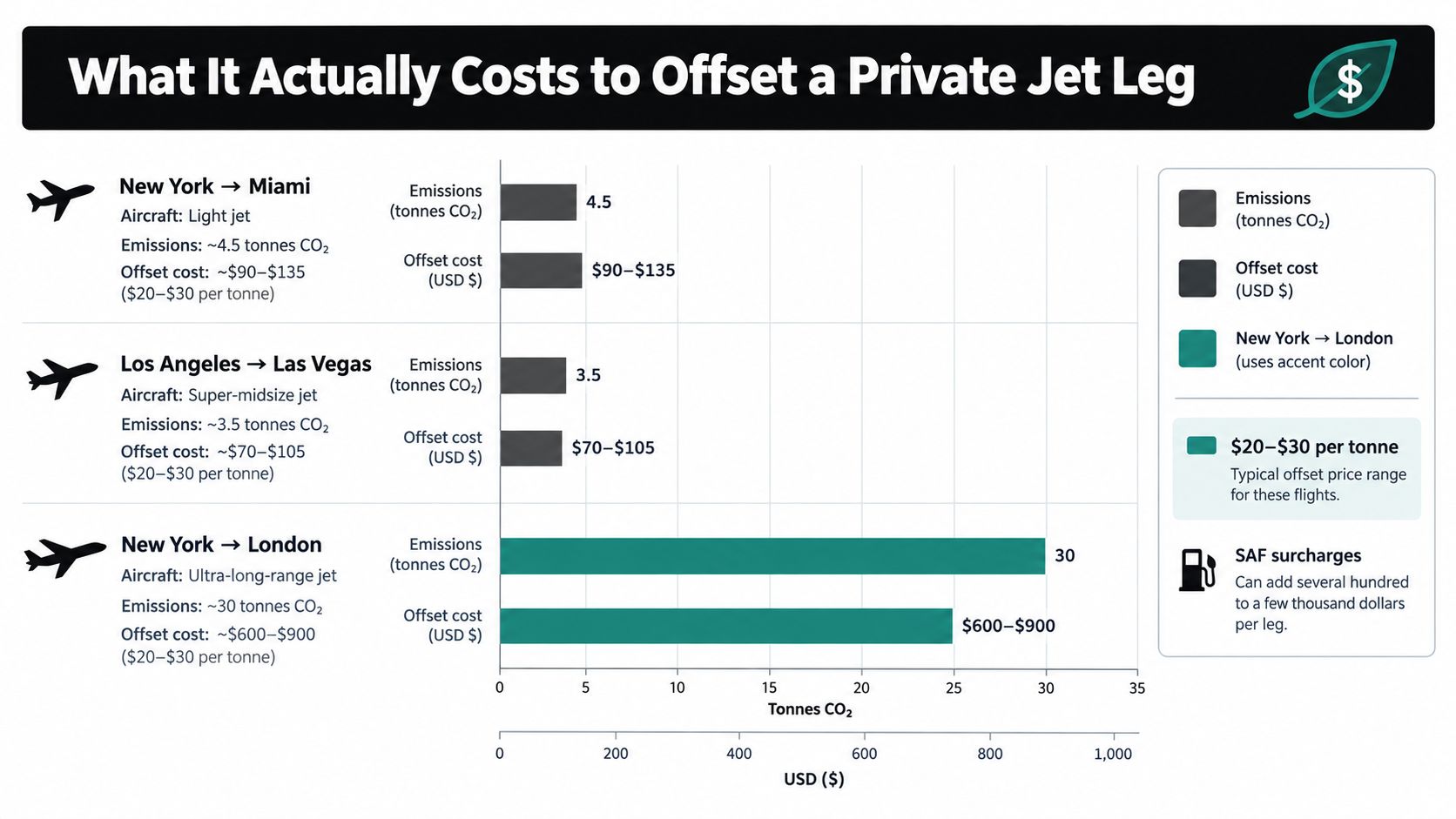
The route figures in this infographic are illustrative estimates. They are useful for understanding the calculation, but they cannot establish the emissions or offset price for your booking. Aircraft, itinerary, routing, payload, fuel burn, and repositioning all affect the result. Ask for a flight-specific estimate rather than budgeting from the chart.
Compare the levers, not just the invoice total
Keep SAF contributions and offset purchases separate.
Haute Jets' article on eco-friendly private jets discusses variability in SAF lifecycle benefits and price. A SAF premium does not translate into a fixed surcharge for every charter. The amount depends on the fuel pathway, the contribution structure, and whether the offer involves physical fuel or a book-and-claim arrangement. Request the quantity covered and the basis for the charge before comparing it with an offset offer.
A combined “green fee” conceals those distinctions. Require separate line items for SAF, credits, and any service charges, with the relevant fuel or emissions quantity beside each. A lower invoice total is not evidence of a stronger environmental claim. Compare the scope of each purchase and the supporting documentation, then decide whether the price is justified.
Aircraft sourcing belongs in the budget discussion too. Haute Jets describes finding aircraft near the departure city as a way to avoid repositioning fees. Ask whether a locally positioned aircraft can reduce avoidable flying before paying to compensate for it. A saving on the charter invoice must not be presented as an equivalent percentage reduction in emissions.
Budget against evidence, not labels. Establish the flight's emissions, price the documented SAF contribution separately, and assess the cost of eligible, retired credits.
For corporate buyers, retain the flight emissions and the environmental purchases as distinct budget and reporting entries. The defensible sequence is to reduce avoidable activity, assess documented fuel substitution, and purchase credits for residual emissions without claiming that the payment makes the leg climate-neutral.
How to Verify Any Private Jet Carbon Offset Claim
Treat each offset claim as a file that should be complete before the invoice closes. A buyer should be able to trace the flight from its emissions method to the project record and retirement evidence. If the operator can't provide that chain, don't repeat the claim in corporate reporting as though it were independently substantiated.
The five records to request
- Flight calculation: The methodology and inputs, including aircraft, fuel use, distance, routing, payload, and treatment of repositioning.
- Emissions breakdown: Direct fuel CO2 shown separately from any estimate of non-CO2 effects or upstream fuel emissions.
- Project identification: The project name, identifier, standard, and whether the activity represents an avoidance, reduction, or removal.
- Retirement details: The quantity of units retired and the retirement date.
- Registry evidence: A record that lets the client confirm the credits were cancelled or retired for the stated purpose.
A fleet-level claim such as “we offset everything” doesn't answer whether your flight was measured or how its credits were assigned. Other warning signs include “green projects” with no project ID, a promise of future retirement, and a single combined figure that blurs direct CO2 with non-CO2 effects.
Haute Jets states that its charter clients can select specific aircraft and receive flight details before departure. For an offset workflow, the useful standard is to connect those booking details to the emissions methodology and then to the credit record, so a corporate travel manager can retain the same evidence chain with the invoice. Don't assume a broker has done this because it offers an offset option. Ask for the records.
Operators are investing in real-time emissions dashboards in response to corporate Scope 3 reporting demands, making per-flight methodology and credit-retirement evidence an operational requirement rather than a courtesy, as described in this business-aviation sustainability report. A complete, auditable file is more useful than a broad neutrality statement that can't be tied to the charter.
A Practical Decision Framework and Where Haute Jets Fits
Apply the levers in order: avoid unnecessary flying, reduce repositioning through local aircraft sourcing, substitute lower-carbon fuel or more efficient equipment where evidence supports the claim, then compensate for residual emissions. Haute Jets sources from 3,500+ Wyvern and Argus-rated aircraft across 175 countries and offers local sourcing; those network details are described on its site. For broader trip-planning ideas, see sustainable travel tips.
The decisive climate choice is the aircraft and operator you select. Offsets are cleanup, not strategy.
For a charter built around the right aircraft, local sourcing, and documentation you can review, visit Haute Jets. Ask for a flight-specific emissions breakdown and supporting offset or SAF records when you request a quote, so your environmental claim is backed by evidence.