

Private aviation produced approximately 15.6 million tonnes of direct carbon dioxide emissions in 2023, and that figure rose 46% versus 2019 (BBC reporting on the flight-tracking analysis). That's the right place to start, because the private jet carbon footprint isn't a vague symbol of luxury, it's a measurable emissions profile shaped by aircraft type, routing, occupancy, and whether the trip includes repositioning.
The useful question for affluent travelers isn't whether private flying has impact. It does. The core issue is how to measure that impact accurately, so a charter buyer can distinguish between a right-sized trip, a wasteful one, and an itinerary that incurs extra climate cost at altitude.
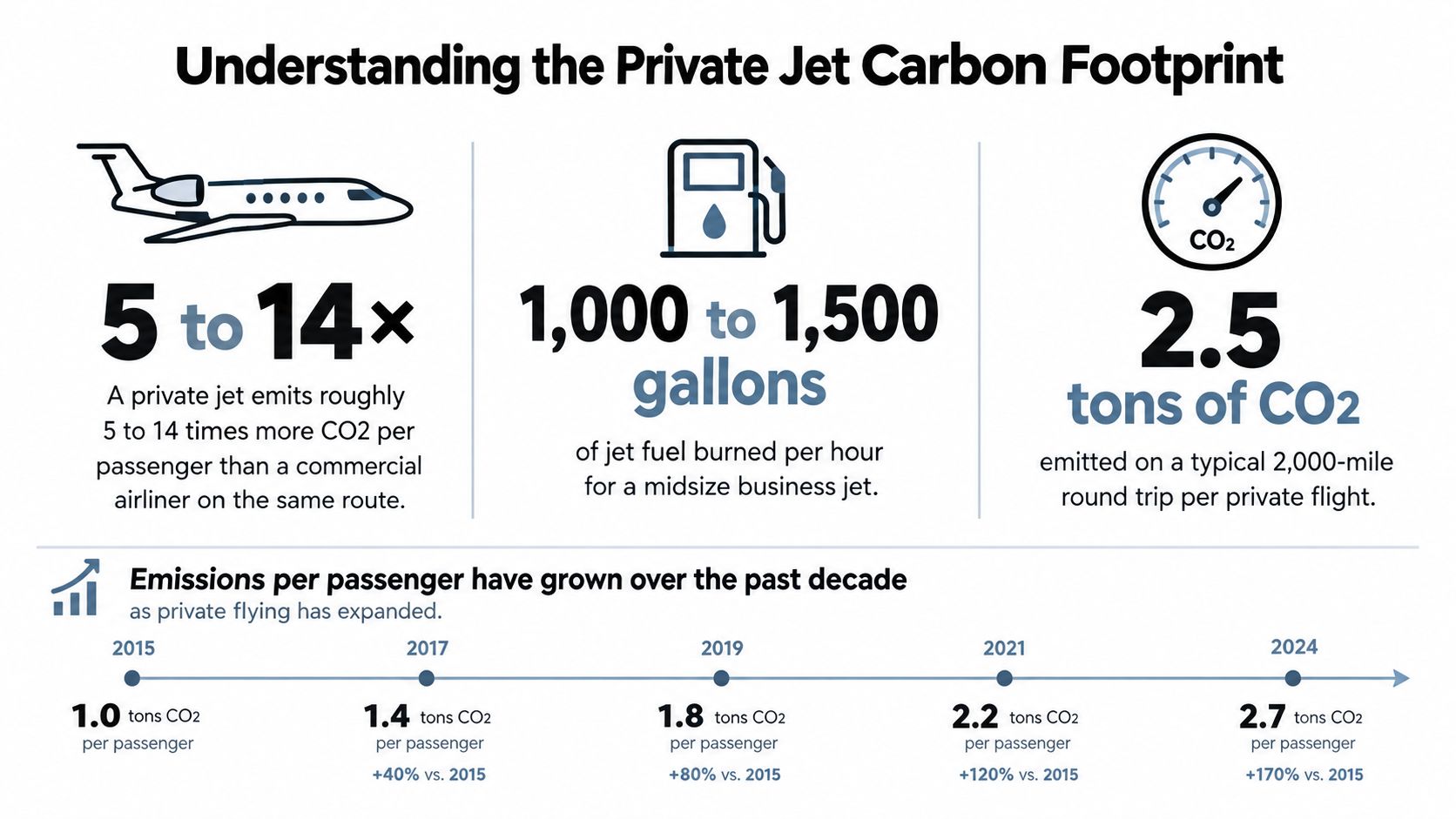
Understanding the Private Jet Carbon Footprint
The scale is large enough to change the conversation. Analysts working from flight-tracking data for 18,655,789 flights by 25,993 registered business-jet aircraft estimated that private aviation produced 15.6 million tonnes of direct CO2 in 2023, or about 3.6 tonnes per flight on average. The same analysis put the figure at the annual emissions of roughly 3.7 million petrol cars and found emissions were up 46% from 2019 (BBC reporting on the study). For high-net-worth travelers, that makes the carbon question a measurement problem, not a branding one.
What the footprint measures
A private flight's footprint begins with direct fuel burn, then converts that fuel into carbon dioxide. Under ICAO-style accounting, aircraft type, distance, load factor, and passenger allocation all affect the result, because the same jet can produce a very different footprint depending on how many seats are occupied (ICAO methodology). That is why a total-trip figure and a per-passenger figure can lead to different conclusions.
Practical rule: If a provider only gives you a generic “private jet average,” you are not getting a useful emissions number.
Occupancy and repositioning explain most of the variation between flights on the same route. The sector serves an estimated 0.003% of the world's population, yet it still generates millions of tonnes of CO2 every year, so broad averages hide more than they reveal. A lightly loaded aircraft on a short mission, an empty repositioning leg, and a longer trip with a fuller cabin should not be treated as the same climate event.
For a broader disclosure framework, ESG Consulting on carbon reporting shows how businesses approach traceability and reporting. For private aviation, the useful takeaway is direct: route, aircraft model, occupancy, and empty-leg use shape the footprint far more than the label “private jet” ever does.
How Aircraft Type and Routing Dictate Emissions
A charter flight's emissions are determined long before takeoff. The aircraft's fuel burn, the planned route, the cruise profile, and whether the plane needs to reposition all change the total trip outcome. For short missions, the fixed phases of flight, taxi, climb, and descent loom larger, so the footprint can look disproportionate even when the actual cruise distance is modest.
Why right-sizing matters
The Citation XLS is a useful concrete example. Haute Jets Journal describes it as burning approximately 485 gallons of fuel per hour and reaching a maximum cruise speed of 483 knots (Citation XLS specifications). That means the emissions story is tied directly to hourly burn and mission duration, not just cabin prestige.
For a traveler, that creates a straightforward decision tree:
- Match the cabin to the group size. A larger aircraft isn't automatically better if the payload and runway needs are small.
- Check route length against aircraft range. A short hop on an aircraft designed for a much larger mission can waste fuel capacity.
- Ask about positioning. A jet already near departure often avoids extra ferry mileage.
- Compare total trip fuel, not just category. Two aircraft in the same class can still have different burn profiles.
The same principle applies to every tail number. A generic estimate can't tell you whether the aircraft is carrying extra fuel for a longer mission, whether the route is direct, or whether the plane has to fly empty before it picks up passengers. That's why the most credible carbon discussion is grounded in the actual aircraft and the actual itinerary, not in broad marketing language.
For a practical budgeting angle, Haute Jets also has a relevant internal discussion on private jet gas cost, which is useful because fuel cost and carbon intensity move together when the mission is inefficient.
The smallest aircraft that safely fits the mission is often the most defensible choice, because it avoids paying for unused lift, cabin volume, and extra fuel capacity.
Comparing Private Aviation to Commercial and First Class
The most common comparison is also the easiest to oversimplify. Private aviation generally has a much higher per-passenger footprint than scheduled commercial flying because the same fuel burn is spread across a much smaller cabin. Commercial aircraft, by contrast, divide emissions across many more travelers, so load factor changes the outcome materially.
A 2023 analysis of 27.45 million commercial flights found that a modeled 10,000-km flight emitted 57 g CO2 per passenger-kilometer when full, but 109 g when half full (Nature analysis). That's a powerful reminder that commercial aviation isn't a single number either. A fuller plane is cleaner per passenger than a half-empty one, even when the aircraft and route are the same.
| Travel Mode | Load Factor | Approximate g CO2 per pax-km |
|---|---|---|
| Commercial flight | Full | 57 |
| Commercial flight | Half full | 109 |
| Private aviation | Low occupancy | Higher than commercial on comparable routes |
That table keeps the comparison honest. It shows why a half-empty commercial flight can narrow the gap, but it doesn't erase the basic structural difference. Private cabins usually carry far fewer people, so each traveler inherits a larger share of the fuel burn.
Why first class still isn't a straight comparison
First class occupies more space per traveler than economy, so its per-passenger footprint is higher than a standard seat. Still, the aircraft is usually carrying many more people than a private charter, which means the total fuel burn is shared far more widely. The comparison is therefore not “luxury seat versus luxury jet.” It's shared aircraft efficiency versus individualized aircraft use.
A fair comparison always needs three variables together, total CO2, passenger count, and route length.
That's why a private jet on a short route can look especially carbon-intensive. The fixed phases of flight matter more, and there are fewer passengers to divide the result. The right question isn't whether private aviation is “bad” in the abstract, it's whether a specific trip is using an aircraft that fits the mission and the load.
The Hidden Impact of Non-CO2 Effects at Altitude
Fuel-burn CO2 is only part of the climate picture. Academic reviews note that non-CO2 effects such as contrails and nitrogen oxides are especially significant at cruise altitude, which means direct CO2 alone understates a flight's total warming impact (UCL review). That matters for private aviation because much of the sector's prestige flying happens high enough in the atmosphere for these effects to become relevant.
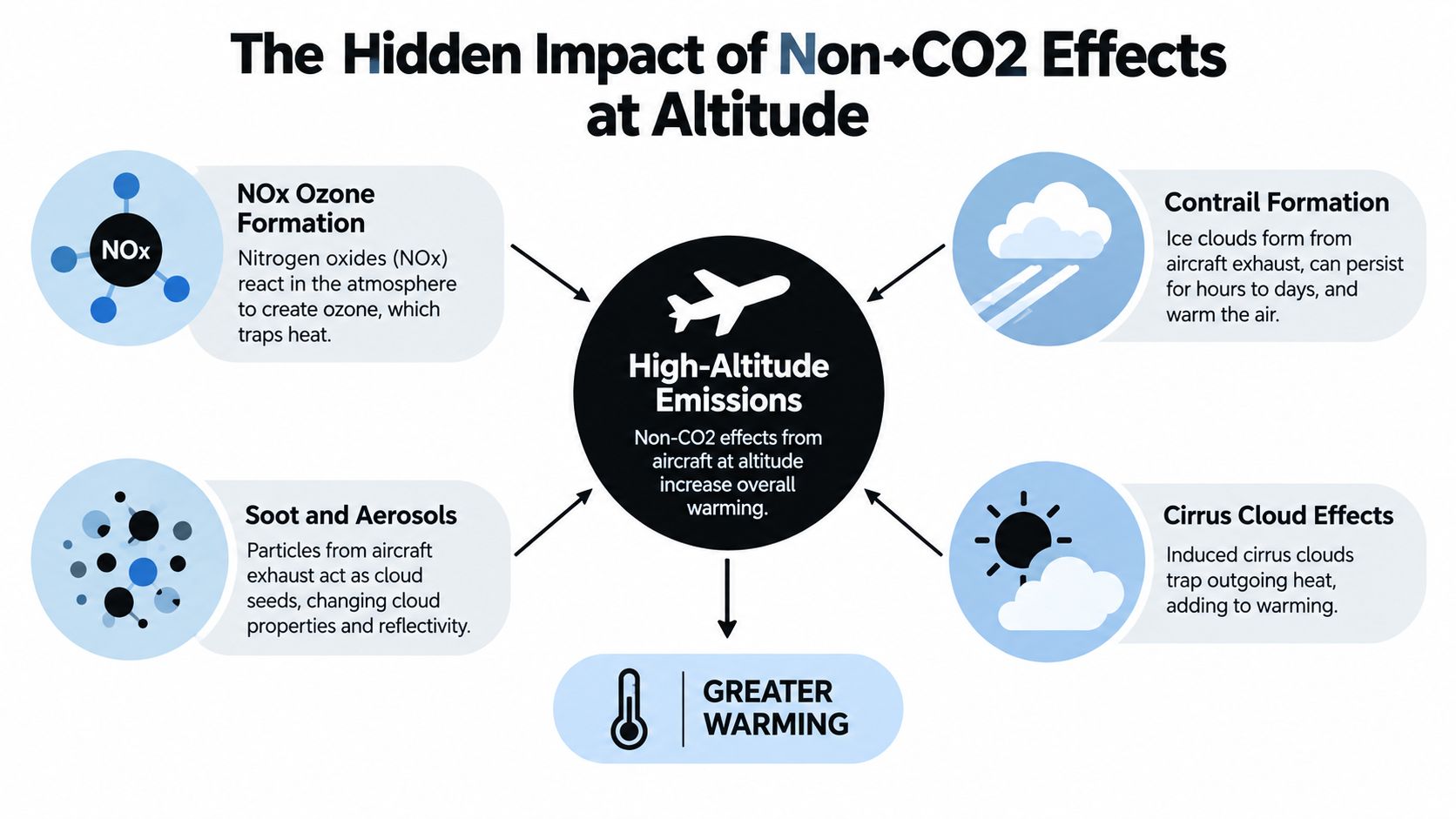
Why altitude changes the climate outcome
At cruise altitude, aircraft interact with colder, thinner air, and that's where contrails and related effects can form. Those effects don't behave like a simple fuel tally, which is why a single multiplier can create false precision. The uncertainty cuts both ways, though. Ignoring non-CO2 effects makes the footprint look smaller than it really is.
This is the question high-net-worth travelers should ask operators: are they reporting operational CO2 only, or giving a separate estimate for broader climate impact? The answer tells you a lot about how transparent the provider really is. A trip's climate profile shouldn't be reduced to one convenient number if the aircraft is producing warming effects beyond fuel burn.
What to ask before booking
- Route profile: Was the aircraft flying a direct mission or a repositioning-heavy itinerary?
- Aircraft type: Does the operator identify the actual tail number or model?
- Occupancy assumptions: Are passenger loads clearly stated?
- Accounting boundary: Does the figure include only fuel CO2, or broader altitude effects?
That last point is the most important one. A clean-looking calculator can still omit the climate effects that matter most at altitude. If a provider can't explain what's included, the number isn't very useful.
Practical Strategies to Reduce Your Flight Footprint
There's no serious sustainability case for pretending private aviation can be perfectly clean. There is, however, a strong case for making each trip less wasteful. The best levers are the ones that improve utilization and reduce avoidable fuel burn before the aircraft ever leaves the ground.
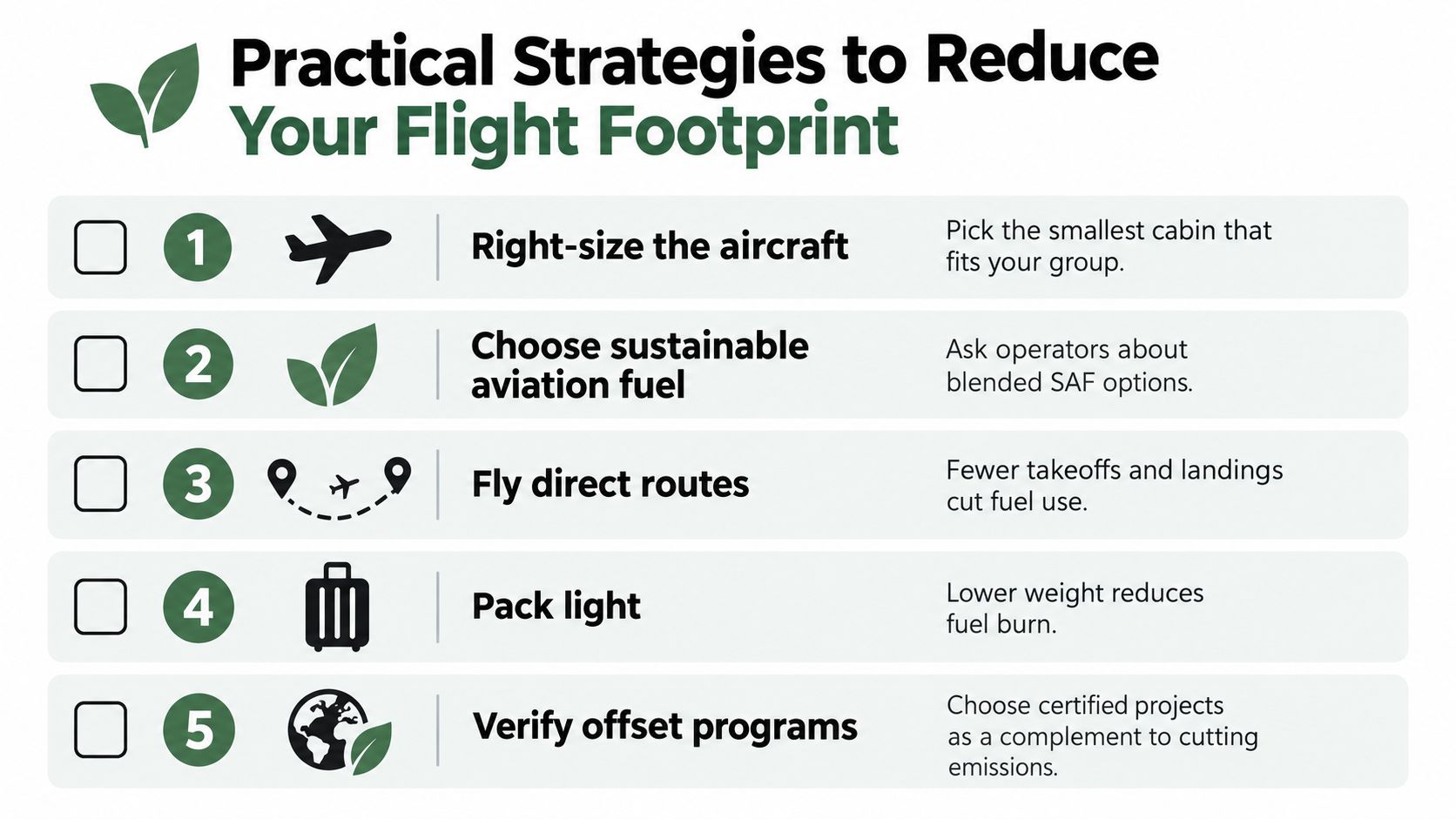
The highest-value moves
The ICAO methodology makes the load factor issue plain. A private flight carrying four passengers generally produces roughly twice the CO2 per passenger as the same aircraft carrying eight (ICAO methodology). Passenger utilization is therefore not a side issue, it's one of the main drivers of per-traveler emissions.
Practical actions that change the footprint include:
- Right-size the aircraft. Choose the smallest cabin that safely meets the mission.
- Maximize occupancy. Shared itineraries spread fuel burn across more travelers.
- Avoid needless short sectors. When rail or scheduled aviation is practical, the climate case often improves.
- Reduce ferry legs. Aircraft positioned near departure avoid extra empty mileage.
- Treat weight precisely. Every unnecessary kilogram still has to be carried.
For travelers who want a broader lifestyle angle on emissions reduction, reduce your carbon footprint offers a relevant consumer-facing lens. The principle is the same across travel and daily life, cut avoidable waste first, then think about offsets or other secondary measures.
The embedded video below is a useful reminder that sustainability discussions around aviation work best when they stay concrete and operational.
Choosing a better itinerary isn't about sacrificing convenience. It's about refusing to pay the emissions penalty for inefficiency that a better booking decision could have avoided.
Leveraging Empty Legs and Sustainable Aviation Fuel
Empty legs and sustainable aviation fuel are two of the few mitigation tools that can change outcomes right now, but they solve different problems. One improves utilization. The other changes the fuel itself. Neither is magic, and both need to be understood on their own terms.
What an empty leg really does
Booking an empty-leg flight improves the environmental efficiency of an already-planned repositioning flight by adding passengers to a journey that would otherwise operate without them (Haute Jets Journal on empty legs). That doesn't erase the aircraft's emissions. It does mean the emissions are shared more efficiently across travelers instead of being assigned to an empty cabin.
That distinction matters. An empty leg is not the same as scheduling a brand-new trip just because a seat is available. The environmental value comes from using capacity that was already going to be flown.
Why SAF matters
Haute Jets Journal describes sustainable aviation fuel as one of the main measures being used to reduce aviation's environmental impact, while keeping existing turbine engines and fueling infrastructure in service (SAF overview). That drop-in compatibility is the reason SAF is so relevant to private aviation. It fits into the current fleet, rather than waiting for a full propulsion reset.
For readers who want the mechanics in more detail, the internal explainer on what is sustainable aviation fuel is the natural follow-up.
Empty legs improve how emissions are allocated. SAF changes the fuel source itself. A serious sustainability strategy usually needs both.
The broader takeaway is that mitigation in private aviation is incremental, not absolute. If the aircraft is going to fly, the question is how to lower the emissions per traveler and how to reduce the need for unnecessary new flights in the first place.
Transparency and Best Practices for High-Net-Worth Travelers
A private jet's reported carbon footprint is only useful if the inputs are visible. A credible provider should identify the aircraft, the route, the passenger count, and whether the estimate includes only direct fuel CO2 or a broader emissions boundary.
What rigorous reporting should include
A solid carbon estimate should be tied to the actual tail number or aircraft model, the planned routing, the passenger count, and whether the trip includes positioning sectors. Operational choices also matter. Higher-altitude cruise can reduce aerodynamic drag and fuel burn in some flight profiles, so flight planning affects the footprint as much as the aircraft brochure does.
For charter buyers, that means asking direct questions before confirming a trip:
- Which aircraft is assigned, exactly?
- Is the route direct or does it include repositioning?
- How many passengers are expected?
- Are non-CO2 effects disclosed separately?
Those questions do not make private flying disappear. They make it easier to separate a well-planned itinerary from a wasteful one.
For buyers who want to evaluate offset programs alongside efficiency gains, see the private jet carbon offset reference. Travelers who want a charter option with fleet sourcing, aircraft selection, and itinerary transparency can also compare the broader booking model offered by Haute Jets. In this market, the footprint depends on the exact aircraft and mission, so specificity is part of basic due diligence.
A practical standard for buyers
High-net-worth travelers should ask for the aircraft, the routing, the passenger load, and the treatment of non-CO2 effects in the same conversation. If a provider cannot answer those points clearly, the emissions estimate is too coarse to guide a real comparison.