
You're booking a private flight. The schedule matters. The aircraft matters. The service matters. Increasingly, one more question matters too: how do you reduce the environmental impact of the trip without compromising safety, range, or convenience?
That's where sustainable aviation fuel enters the conversation. For many charter clients, SAF sits in an awkward category. It sounds promising, but also vague. It gets mentioned in glossy sustainability language, yet few articles explain what it means when you're choosing an aircraft, reviewing an itinerary, or asking your broker what's possible at your departure airport.
Private aviation clients don't need abstract climate talking points; they need operational clarity. Can SAF be used in the aircraft flying them today? Does it require special equipment? Is it available everywhere? Does buying SAF reduce emissions in a direct way, or is it just another branding exercise?
A good place to start is with the broader idea of understanding responsible travel. In aviation, responsibility rarely looks like a perfect solution. It usually looks like better decisions within real-world constraints. SAF is important for exactly that reason. It isn't a theory. It's a working fuel already used in aviation.
Introduction The New Standard in Responsible Aviation
For a private charter client, sustainability can't be allowed to become a synonym for inconvenience. If an option adds complexity, creates uncertainty, or introduces risk, it won't become standard practice. SAF stands out because it avoids that trap.

Sustainable aviation fuel is a drop-in replacement for conventional jet fuel. It can be blended with traditional jet fuel up to 50% and used in today's aircraft without engine modifications, while reducing lifecycle greenhouse gas emissions by up to 80%, according to Shell's overview of SAF in aviation.
That single fact cuts through a lot of confusion. SAF doesn't require a new private jet design. It doesn't require airports to tear out fuel systems. It doesn't ask the passenger to accept a shorter range aircraft or a different cabin standard. In practical terms, it works inside the aviation system we already have.
Why clients are hearing more about SAF now
Private aviation is under more scrutiny than ever. Clients know that time efficiency and privacy have real value, but they also know flights have an environmental cost. The old answer was often carbon offsets alone. Those may still play a role, but many discerning travelers now want something closer to the aircraft itself.
SAF meets that expectation better than most alternatives because it addresses the fuel side of the equation. That makes it more concrete. You're not just funding a separate environmental project somewhere else. You're supporting a lower lifecycle emissions fuel used within aviation.
SAF matters because it lets clients ask for a cleaner aviation input, not just a compensating action after the flight.
What this changes for private charter decisions
For a charter client, the key shift is simple. Sustainability is no longer a vague preference. It can become part of the booking conversation, just like aircraft age, cabin layout, catering, or Wi-Fi.
If you've been following the broader shift toward premium travel with lower impact, Haute Jets has already explored that theme in its piece on sustainable luxury in private aviation. SAF is where that idea becomes operational.
The rest of the discussion comes down to four practical questions. What SAF is. How it's made and approved. Where the climate benefit is real and where the marketing gets ahead of the facts. And what a private client can do on the next trip.
Understanding Sustainable Aviation Fuel at Its Core
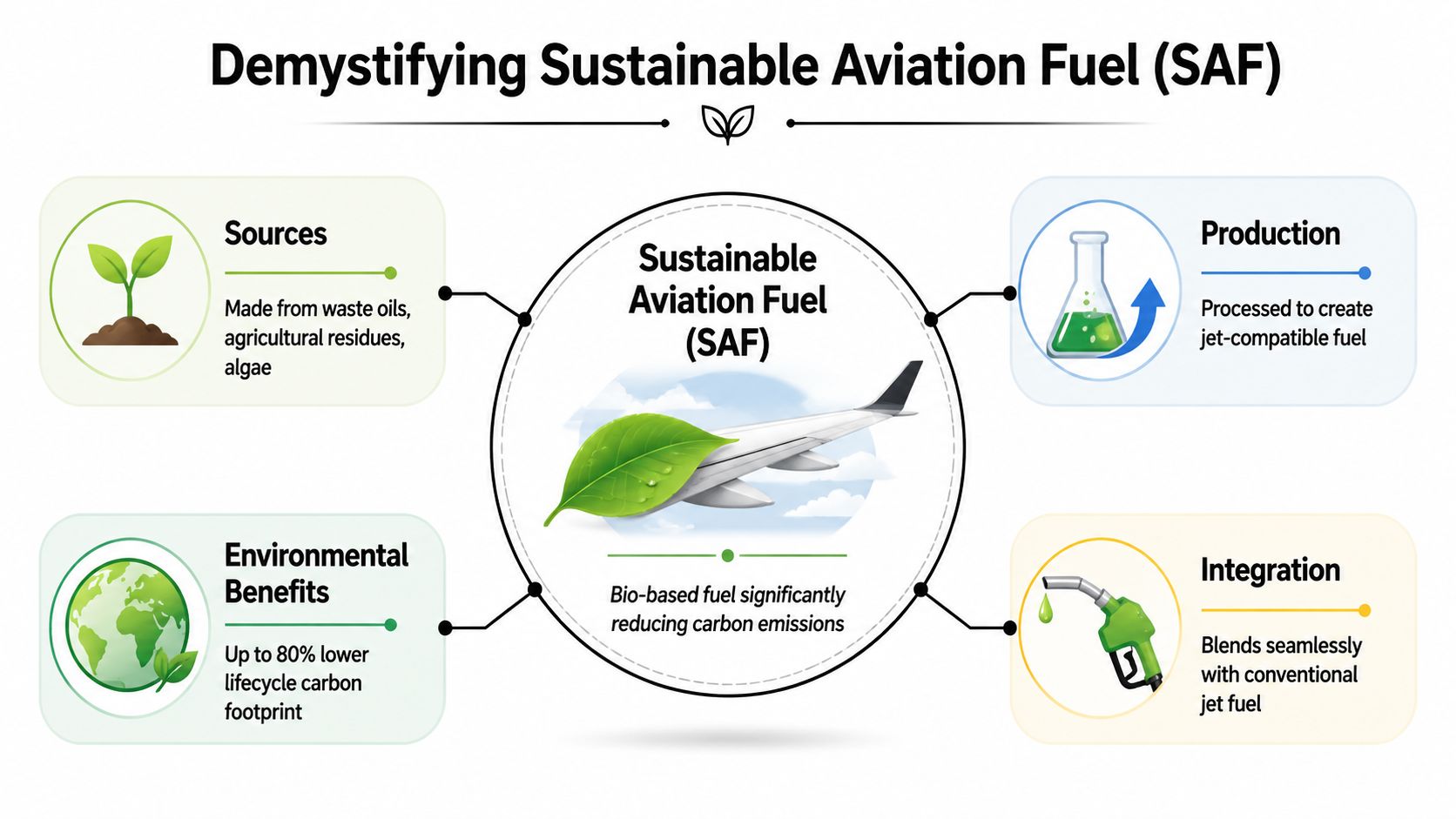
The simplest definition of what is sustainable aviation fuel is this: SAF is a category of jet fuels made from non-conventional sources that can reduce lifecycle greenhouse-gas emissions compared with standard fossil jet fuel.
For a private charter client, that definition matters because SAF is often discussed too loosely. It is not a single product with one origin, one recipe, or one climate outcome. It is a broad umbrella, much like renewable electricity. Wind, solar, and hydropower all produce power, but they do not work the same way or carry the same tradeoffs. SAF follows that same pattern.
SAF starts with feedstock
Every SAF story begins with the raw material used to make it. Depending on the production route, that starting point can include used cooking oil, waste fats, municipal solid waste, agricultural residues, non-food crops, or synthetic inputs made from captured carbon and hydrogen.
That is why two fuels can both qualify as SAF and still differ in practical terms. One may be made mainly from waste oils. Another may come from a synthetic process tied to a very different energy source and supply chain. Both can be legitimate aviation fuels. Their climate profile, scalability, and cost story can still be quite different.
For charter clients, this is the first useful filter. If an operator says it uses SAF, the next question is what kind.
The primary benefit is in lifecycle emissions
A common point of confusion is where SAF helps. The aircraft engine still burns fuel during flight. SAF does not remove in-flight CO2 emissions in the simple way some marketing language suggests.
The claim is about lifecycle emissions. That means the full chain tied to the fuel: how the feedstock was sourced, how the fuel was produced, what energy was used in processing, how it was transported, and then how it was used on the aircraft.
A practical comparison helps here. Two identical charter flights can depart on the same aircraft type, fly the same route, and burn the same volume of fuel in the air. If one flight is matched with SAF produced from lower-emissions inputs and processes, its total climate impact across the fuel lifecycle can be lower even though the engines operated in a familiar way.
Here's a useful explainer before going further:
That distinction is more than technical wording. It is how you separate a serious SAF claim from a vague sustainability pitch. A supplier should be able to explain the basis for the lifecycle reduction, not just say the fuel is cleaner.
Key distinction: SAF can lower the fuel's overall lifecycle footprint. It does not make a flight zero-emissions.
Why private aviation clients should care about that nuance
Private aviation buyers are in a different position from most airline passengers. You can ask questions before the trip is booked, and those questions affect what is purchased in your name.
A useful SAF conversation should move past a simple yes-or-no claim and get into specifics such as:
- What production pathway is involved: Waste-based SAF and synthetic eSAF are different products with different constraints.
- What share of the fuel is SAF: The renewable portion depends on approved blending rules, not marketing preference.
- How the emissions claim is calculated: A credible answer refers to lifecycle accounting, with clear boundaries and documentation.
Those three questions will not turn every charter client into a fuel specialist. They will help you tell the difference between meaningful action and polished language.
How SAF Is Made and Certified for Flight
Aviation doesn't get to improvise with fuel. That's true in commercial operations and even more so in the world of private charter, where clients expect absolute confidence in safety, performance, and consistency. That's why the certification framework matters as much as the sustainability claim.
The core rule is straightforward. SAF is a family of fuels standardized under ASTM D7566, which approves production pathways and sets blend limits. Once the approved SAF is blended with conventional Jet A or Jet A-1 and released under ASTM D1655, it is treated as standard jet fuel, as explained by the U.S. Alternative Fuels Data Center summary of sustainable aviation fuel.
What the pathway names actually mean
Clients often see acronyms like HEFA or ATJ and assume they need a chemistry degree to make sense of them. You don't. The useful way to read them is by grouping them into broad production families.
- Waste oils and fats routes often include HEFA-style pathways.
- Biomass conversion routes can include Fischer-Tropsch style pathways.
- Alcohol conversion routes include ATJ pathways.
- Synthetic or power-to-liquid routes sit in the eSAF conversation.
- Coprocessing routes involve renewable inputs processed alongside conventional refinery streams.
The acronym tells an engineer a lot. For a client, the key point is simpler: different approved methods can produce SAF, but every one of them has to fit within a strict aviation standard before it reaches an aircraft.
Common Sustainable Aviation Fuel Pathways under ASTM D7566
| Pathway | Common Feedstocks | Max Blend % | Lifecycle CO2 Reduction |
|---|---|---|---|
| HEFA | Waste oils, fats, residues | 50% | Can vary by feedstock and production route |
| FT | Biomass or waste-based carbon sources | 50% | Can vary by feedstock and production route |
| ATJ | Alcohol-based intermediate feedstocks | 50% | Can vary by feedstock and production route |
| CHJ | Bio-based oils and related inputs | 50% | Can vary by feedstock and production route |
| Coprocessing routes | Renewable and conventional refinery inputs | 5% | Can vary by feedstock and production route |
Not every pathway has the same blend ceiling. Current approved routes commonly allow 10%, 50%, or 5% blends depending on the specification, based on the ASTM framework summarized by the same AFDC resource already cited above.
Why blend limits matter
This is one of the most misunderstood parts of SAF. A charter client may hear “the flight used SAF” and assume the aircraft flew entirely on renewable fuel. Usually, that isn't what happened.
Today, approved SAF is commonly blended with conventional jet fuel. The delivered fuel therefore contains a renewable share and a fossil share. The exact allowed percentage depends on the certified pathway. That's not a flaw. It's how the industry maintains safety and compatibility while increasing renewable content inside a tightly controlled fuel system.
The important reassurance for passengers is operational, not symbolic. Approved SAF blends work within existing engines, fuel systems, and airport infrastructure.
Why this matters in private aviation
Private aviation clients tend to ask better operational questions than the average traveler. They should. If you're selecting a specific aircraft and operator, fuel credibility should sit in the same category as maintenance records and crew qualifications.
That's also why discussions about cleaner charter should stay grounded in standards, not slogans. If you want a broader look at how sustainability is entering business aviation practice, Haute Jets has a related article on the eco-friendly evolution of private aviation.
What should reassure a client is that SAF doesn't bypass aviation discipline. It goes through it.
The Reality of SAF Cost Supply and Climate Impact
SAF is promising, but it isn't limitless and it isn't simple. Consequently, many glossy summaries lose credibility. They present SAF as if the only missing ingredient were good intentions. In reality, the hard questions are feedstock, production scale, and distribution.
A useful starting point is this: the sustainability of SAF depends heavily on the feedstock. Current production relies heavily on waste oils and fats, and those inputs are constrained. Long-term scale is expected to depend more on power-to-liquid eSAF made from renewable electricity, water, and captured CO2, though that remains in early stages, according to SkyNRG's discussion of SAF pathways and sustainability tradeoffs.
Why supply feels limited today
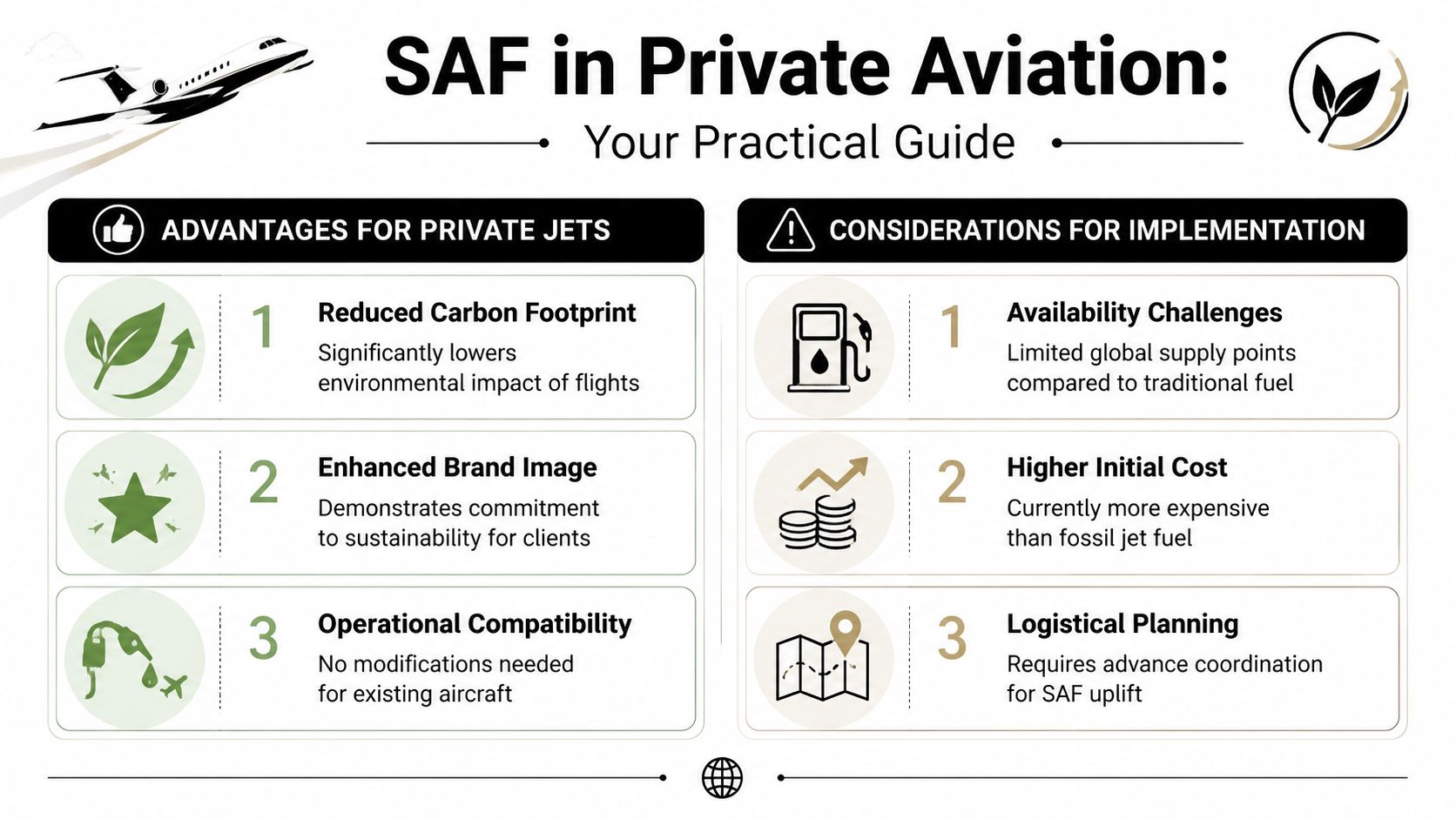
For private clients, the practical consequence is uneven availability. Some airports and suppliers are further along than others. Some regions can physically deliver SAF into the airport fuel system. Others can't.
That doesn't mean the market is stagnant. It means SAF is still moving from an early supply base, dominated by waste and residue feedstocks, toward more scalable future pathways. The transition is real, but incomplete.
Why “sustainable” needs scrutiny
Not all sustainability claims deserve equal trust. A credible SAF discussion should acknowledge tradeoffs such as feedstock scarcity, land-use concerns, and the gap between near-term waste-based supply and longer-term synthetic fuels.
Here are the questions worth asking when someone markets a SAF solution:
- What feedstock is behind it: Waste-based inputs are different from crop-based or synthetic pathways.
- Is the claim about lifecycle impact: If not, the explanation is probably oversimplified.
- Is this physical fuel or an accounting claim: Both can matter, but they aren't the same thing.
A serious SAF conversation includes limits. If a provider talks only about benefits and never about supply constraints, you're hearing marketing first and operations second.
Where book and claim fits
One term clients increasingly encounter is book and claim. In plain language, this means the environmental attribute of SAF can be allocated to a buyer even if the exact physical molecules aren't pumped into that buyer's aircraft at their departure airport.
Why use a system like that? Because fuel logistics are messy. Aircraft move constantly. Airports differ in infrastructure and local supply. A traveler may want to support SAF even when their departure point doesn't have physical uplift available.
That doesn't make book and claim meaningless. It makes it an accounting tool designed to work around real fuel-distribution limits. The key is documentation and transparency. A client should understand whether they're paying for direct physical SAF uplift or supporting SAF through a verified allocation mechanism.
For a wider view of the private flight sustainability context, including the operational limits involved, Haute Jets has also covered the environmental impact of private jets and available solutions.
Using SAF in Private Aviation A Practical Guide
You are reviewing charter options for a transatlantic trip. The aircraft can fly it. The schedule works. Then a new question enters the booking conversation: can this trip include SAF, and if so, what does that mean for this specific flight?
That question matters more in private aviation than many clients expect. In commercial travel, the passenger usually buys a seat inside a system they cannot influence. In charter, the client has more control over the request, more visibility into the operator, and a better chance of getting a clear operational answer.
What using SAF can look like on a charter trip
For a charter client, SAF usually shows up in one of two ways.
The first is physical uplift. The aircraft takes fuel at an airport where SAF is available, and the trip uses an approved blend as part of normal fueling. This is the most direct version because the fuel enters the aircraft serving your mission.
The second is participation through a SAF purchasing program connected to your flight activity. In that case, the environmental benefit is documented and allocated even if your departure airport cannot supply SAF on the day of travel. It works like reserving renewable electricity in a grid you cannot trace wire by wire. The value depends on the records, the certification, and the honesty of the explanation.
That is why a practical SAF discussion in private aviation should stay grounded in trip details, not slogans.
A useful conversation usually covers:
- Where the aircraft will fuel: departure airport, destination, or a planned fuel stop
- What form of SAF is available: direct physical uplift or a documented allocation program
- How the purchase is recorded: confirmation of volume, pathway, and attribution
- Who is arranging it: the operator, the broker, the FBO, or the fuel supplier
SAF versus carbon offsets
Clients often ask whether SAF is just another version of offsetting. It is not.
An offset usually pays for emissions reduction or carbon removal somewhere outside the flight itself. SAF addresses the fuel side of aviation. That distinction matters because many charter clients want the action tied more closely to the aircraft they are paying to operate.
Offsets can still have a role. But if your goal is to support lower-emissions flying within aviation's own fuel system, SAF is usually the stronger first question to ask.
Why SAF matters so much in private aviation
Private aircraft face the same basic constraint as the rest of aviation. They need high energy density liquid fuel, especially for longer sectors, heavy payloads, and business-critical schedules. Battery aircraft may serve some short missions over time, but they do not solve today's long-range charter requirements. Hydrogen is even further from routine use in this market.
So for clients flying now, SAF is the practical lever that fits the aircraft already in service.
That is the key private aviation point many broader SAF articles miss. The issue is not whether SAF solves every climate problem. It does not. The issue is whether a charter client can do something real today, within current aircraft and fuel rules. In many cases, yes, but only if you ask the right operational questions and get a documented answer.
One example is the way charter providers present sustainability options during booking. Haute Jets is one provider that includes SAF and related sustainability topics in client discussions, alongside other brokers and operators that help customers check availability, documentation, and operator practices before confirming a trip.
How to Take Action on Your Next Charter Flight
A lot of SAF discussion stays theoretical. That's a mistake. The value of understanding what is sustainable aviation fuel is that it gives you better questions and better filters when you book.
You don't need to become a fuel specialist. You do need to know how to test whether a charter provider is giving you a real answer.
Questions worth asking before you confirm the trip
Use direct language. Ask these in writing if possible.
Can this flight use physical SAF?
Ask whether SAF is available at the departure airport, destination, or planned fuel stop.If physical uplift isn't available, do you offer a SAF book-and-claim option?
This distinguishes direct fuel use from an allocation-based sustainability purchase.What documentation will I receive?
You want confirmation of what was purchased, how it was attributed, and whether it was tied to a certified SAF pathway.Which operator on this quote has the strongest SAF capability or sustainability program?
When comparing aircraft options, this can become a real differentiator.
What a strong answer sounds like
A good provider usually answers in operational terms. They'll tell you whether the airport can supply SAF, whether a fueler or FBO participates, whether the operator supports an SAF program, and how the purchase is recorded.
A weak answer sounds vague. It leans on broad corporate sustainability language without saying what happens on your specific itinerary.
How to think about the decision
You don't have to treat sustainability as an all-or-nothing test. A more useful framework is:
- Start with the flight you need
- Ask whether SAF can be incorporated directly
- If not, evaluate a transparent SAF allocation option
- Use offsets, if at all, as a secondary tool rather than the main story
The most practical charter clients don't ask for perfection. They ask for credible progress, documented clearly.
The client's role is bigger than it looks
Demand matters in private aviation because charter bookings are highly customized. When clients ask about SAF, they change the conversation inside the broker, the operator, and the fuel supply chain. They signal that sustainability isn't a decorative line item. It's part of the purchase decision.
That's the right way to think about SAF today. Not as a miracle. Not as a marketing badge. As a better fuel option, governed by real standards, with real limits, that private aviation clients can start requesting now.
If you want help evaluating SAF options on an upcoming itinerary, Haute Jets can assist with charter planning, aircraft selection, and practical questions around sustainability requests so you can compare your options with clearer operational detail.