
764 business jets were delivered worldwide in 2024, supporting a $22.8 billion business-aviation market that continued expanding despite supply constraints. Yet only 34% of corporate travel programs can pass a limited-assurance audit of their trip-level emissions data.
That contrast defines the core corporate-aviation challenge. Companies can access more aircraft, routes, and operating models than ever, but many still lack a defensible method for deciding when private flying creates business value, how much a mission really costs, and whether its emissions records can withstand scrutiny. A corporate jet is therefore not just a transport purchase. It's a decision involving capital, productivity, safety governance, procurement discipline, and Scope 3 evidence.
The State of Corporate Aviation in 2024
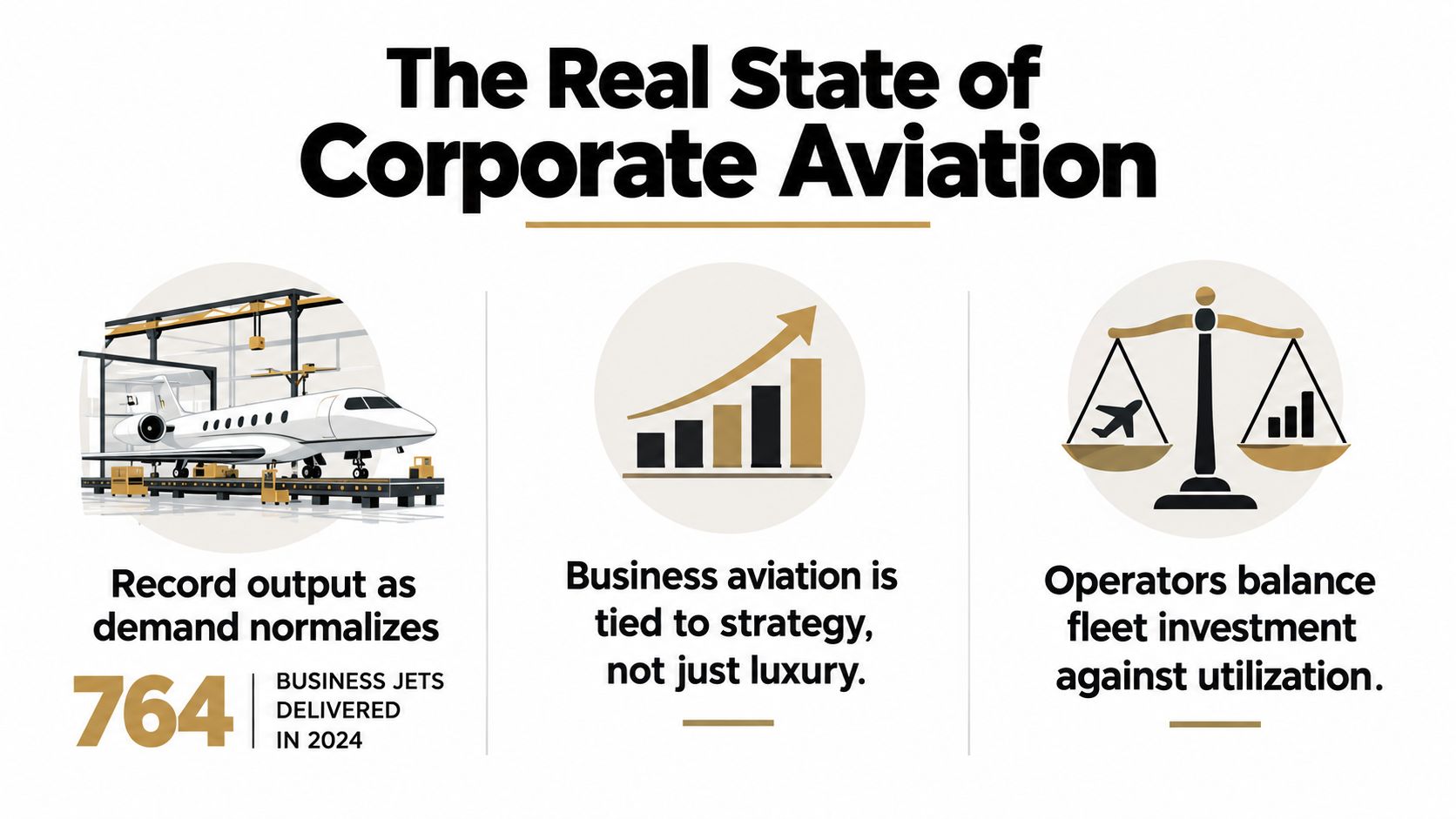
Manufacturers delivered 764 business jets worldwide in 2024, up from 730 in 2023, while business-jet billings reached approximately $22.8 billion, according to the 2024 GAMA aircraft shipment and billing report. Supply-chain constraints, engine delays, and production limits still affected parts of the market. For corporate travel committees, the figures indicate sustained investment, but they do not establish whether private aviation creates value for a specific company.
The sector extends beyond aircraft sales. It connects manufacturers with airports, maintenance organizations, flight operations, crew training, and business services. Its wider contribution to Europe was estimated at approximately $114 billion and about 440,000 jobs in an Oxford Economics study commissioned by industry associations, as reported by Aviation Week.
A global access problem
Fleet geography changes the procurement analysis. Europe represented roughly 26% of the global business-jet fleet in 2009, declining to 20% in 2014, 14% in 2019, and 13% in 2024, according to the Aviation Week analysis. The shift does not remove European access to private aviation. It does mean that programs serving several jurisdictions need wider operator access and stronger local sourcing.
A committee arranging flights between Europe, North America, the Middle East, and other regions should assess more than aircraft displayed in one local market. Its review should cover operating authority, maintenance standards, crew qualifications, airport access, pricing logic, and the quality of records supplied across jurisdictions.
The business case also requires a mission-level decision model. A flight could support a site visit, customer negotiation, investor roadshow, or urgent operational intervention. The relevant test is whether the mission improves the business outcome enough to justify its full cost, governance requirements, and emissions-accounting burden. That calculation should also produce evidence suitable for Scope 3 reporting, rather than relying on a generic aircraft category or cabin preference.
Practical rule: Treat corporate aviation as a governed transport capability. Convenience can support approval, but it is not sufficient evidence of business value.
Procurement teams developing internal aviation knowledge may need structured training on aircraft operations and regulatory responsibilities. CASA RePL corporate packages provide a relevant external resource for staff building familiarity with aviation requirements.
Comparing Charter, Fractional, and Ownership Models
The right access model depends less on executive preference than on utilization pattern, control requirements, and cost visibility. A company with irregular international travel can create unnecessary fixed costs by owning an aircraft, while a company with recurring, high-utilization routes may sacrifice control and scheduling certainty through purely on-demand charter.
| Model | Capital intensity | Operational control | Best fit |
|---|---|---|---|
| On-demand charter | Low upfront commitment, trip-based spending | Low to moderate, depending on provider and aircraft selection | Irregular, seasonal, or geographically varied travel |
| Fractional ownership | Shared capital commitment plus ongoing fees | Scheduled access with program rules | Repeated flying where access priority matters |
| Full ownership | Highest capital and fixed-cost exposure | Highest control over aircraft and configuration | Consistent utilization and stable mission patterns |
Charter prioritizes flexibility
On-demand charter lets a company match aircraft type to the mission. A short regional trip may call for a turboprop, while an intercontinental itinerary may require a larger, longer-range aircraft. This avoids forcing every mission into the capabilities and cost structure of one owned aircraft.
The trade-off is variability. Availability, positioning, airport charges, fuel, crew expenses, and the selected aircraft can change the final quotation. Travel managers should preserve competing options and compare complete mission costs rather than treating the hourly rate as a budget.
Companies considering this model can review the operational scope of corporate jet charter while keeping their own procurement criteria separate from any provider's marketing language.
Fractional access exchanges capital for predictability
Fractional programs can make sense when a company flies recurring routes and needs more predictable access than an open charter market provides. The company shares aircraft-related commitments with other participants, which can reduce the burden of managing an entire aircraft while introducing contract rules, scheduling conditions, and program fees.
The key diligence question is whether the guaranteed access matches the travel calendar. A program can look efficient on forecast utilization but become expensive if executives fly less than planned or if the preferred aircraft category isn't available when demand peaks.
Ownership creates control, not automatic efficiency
Full ownership provides the greatest influence over configuration, crew structure, operating procedures, and availability. It also places fixed obligations on the company, including crew, hangar, insurance, training, maintenance planning, and subscriptions. Those costs remain relevant even when the aircraft is idle.
A finance committee should model at least three scenarios: expected utilization, lower-than-expected utilization, and a disruption scenario involving maintenance or restricted access. Ownership becomes more defensible when routes are stable and the organization can absorb operational responsibility. Charter is generally better suited to uncertain demand, while fractional access occupies the middle ground for companies that need recurring availability without managing a complete aviation operation.
Building a Corporate Aviation Policy That Works
A corporate aviation policy should answer one question before anyone compares aircraft: what business outcome justifies this trip? Rising travel scrutiny favors approvals tied to revenue growth, customer engagement, operational delivery, or another documented corporate objective. Executive convenience may support the itinerary, but it shouldn't stand alone as the business case.

Start with an approval record
Require the requester to record the purpose of travel, travelers, destination sequence, timing constraints, commercial alternatives considered, and expected business outcome. The record doesn't need to become an essay. It needs enough information for finance, legal, safety, and sustainability reviewers to understand why private aviation was selected.
A useful approval form should distinguish between:
- Business necessity: A customer meeting, site visit, operational response, or confidential engagement that requires the proposed itinerary.
- Time value: Executive hours recovered, meetings enabled, or delay avoided through the selected routing.
- Alternative assessment: Whether commercial aviation, rail, ground transport, or a different private-flight structure could achieve the same objective.
- Governance status: The approving executive, cost center, traveler eligibility, and any exception rationale.
Add thresholds without creating loopholes
Policies can establish approval thresholds based on trip cost, traveler role, mission urgency, or the number of employees traveling. The exact thresholds should reflect the company's budget and risk tolerance rather than an industry-wide template.
Use a higher review standard for discretionary travel, international missions, unusual aircraft requests, and itineraries that include empty repositioning sectors. Require a clear exception owner when the trip falls outside normal rules. That prevents “urgent” from becoming a permanent category for avoidable convenience.
A defensible policy doesn't prohibit private flying. It makes the decision traceable.
Link duty of care to procurement
The approval process should verify the operator's legal authority, aircraft details, crew information, maintenance status, passenger documentation, and emergency contacts. Procurement should retain the quotation, final itinerary, operator credentials, and post-flight invoice so that the company can reconcile what was approved with what was flown.
Sustainability belongs in the same record. Capture aircraft type, route, passenger count, fuel or emissions methodology, and any market-based environmental claim. If the company buys SAF attributes or offsets, document them separately from operational emissions. That distinction helps the board understand what physically occurred during the flight and what contractual environmental claim the company purchased afterward.
Understanding True Charter Costs and Empty Legs
An hourly aircraft rate is only one input in a charter quotation. The actual mission cost can include fuel surcharges, airport landing and handling fees, crew salaries and travel expenses, repositioning, government taxes, and passenger segment fees, as detailed in the private jet charter cost guide.
That distinction changes procurement behavior. If two providers quote different aircraft rates, the lower hourly figure may disappear once one quotation includes positioning, handling, or crew expenses and the other does not. A travel manager should request an itemized quote with the same route, passenger count, aircraft category, fuel assumptions, and tax treatment.
Positioning can dominate the comparison
A Boston to Teterboro example illustrates the issue. A repositioning charge of $8,000 increased an estimated total from $12,900 without repositioning to $20,900 with it, according to the Haute Jets charter cost analysis. The lesson isn't that every repositioning fee will have the same effect. It's that the aircraft's location before and after the mission can materially change the economics.
For U.S. domestic flights, the same source identifies a 7.5% Federal Excise Tax and a $4.50 passenger segment fee. It also gives crew per diems of approximately $200 to $600 per crew member per day. Those figures should be treated as quotation inputs, not universal totals, because route, jurisdiction, aircraft, and operator practices vary.
Empty legs trade price for control
An empty-leg flight is a repositioning segment that an aircraft must operate without its original paying passengers. When timing and regulations permit, an operator can sell that otherwise unoccupied segment to another traveler. Industry estimates cited by Haute Jets Journal's empty-leg guide place availability at up to 3,000 empty-leg flights worldwide at a given time, with estimates of roughly 30% of private-jet flights and other charter estimates ranging from 30% to 50%.
Discounts can reach 75% from standard charter rates, but the buyer accepts a constrained schedule. The route, departure time, and destination are determined by the original repositioning mission. That makes an empty leg attractive for flexible leisure or project travel, but less suitable for a board meeting, customer commitment, or operational event where timing is part of the business value.
Cost-control test: Compare the full mission invoice, the value of traveler time, and the cost of schedule uncertainty. A cheaper seat isn't cheaper if it causes the company to miss the meeting that justified the trip.
Safety Standards and Verifiable Emissions Data
Safety and sustainability create different evidence requirements, but corporate travel committees should manage them together. Safety diligence asks whether the operator and aircraft are authorized, maintained, and competently crewed. Emissions diligence asks whether the company can reconstruct the flight and explain how its reported figure was calculated.
The FAA-backed Aviation Safety Information Analysis and Sharing program combines millions of safety records from hundreds of operators and covers corporate and business aviation sectors under Parts 91, 91k, 125, and 135, as described by the National Business Aviation Association's safety-data guidance. That model supports proactive analysis of recurring precursors, rather than relying only on accident history.
Use ratings as screening evidence
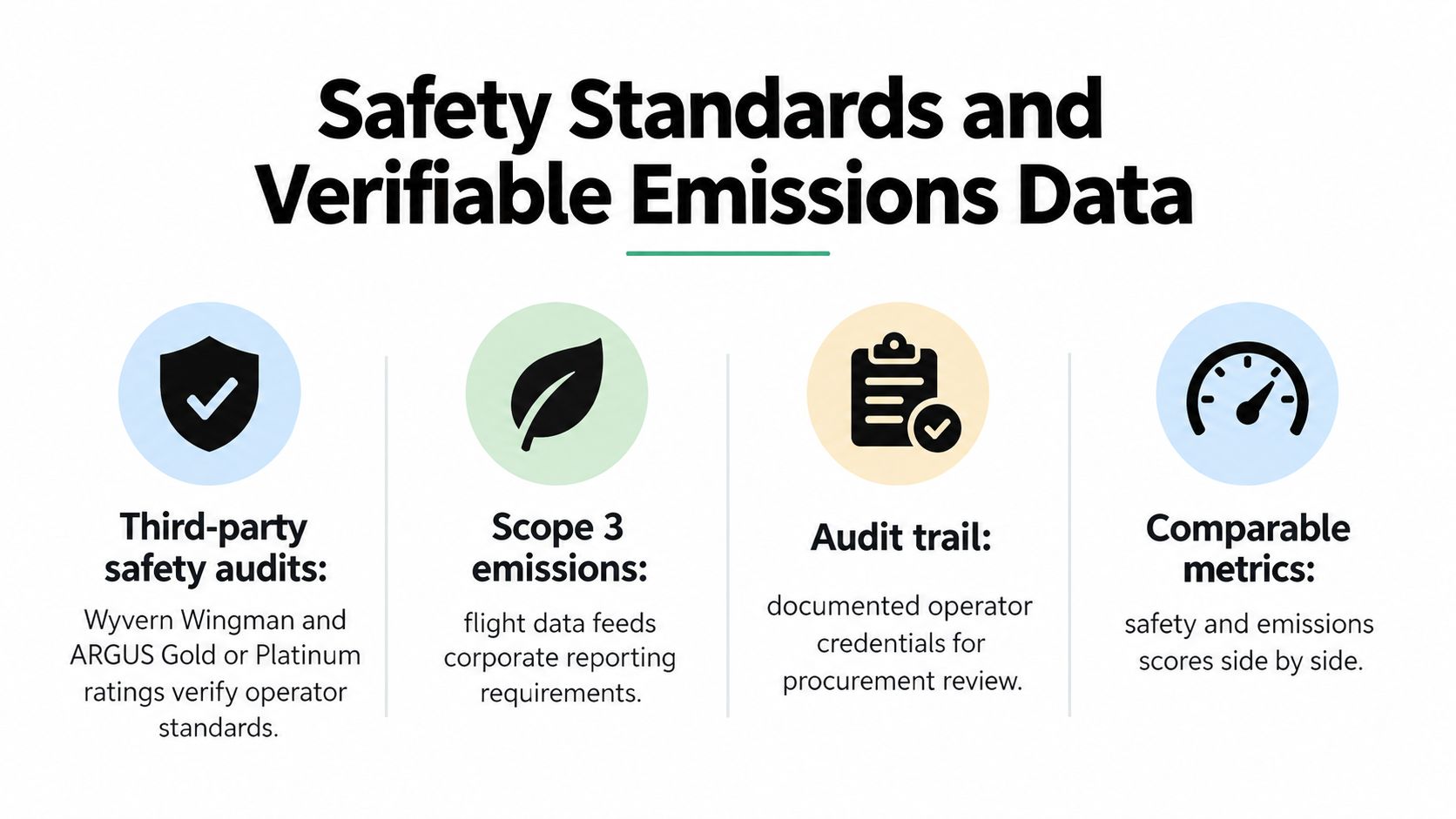
Third-party programs such as Wyvern Wingman and ARGUS Gold or Platinum can help procurement teams screen operators. They shouldn't replace direct verification of the operating certificate, aircraft records, crew qualifications, maintenance-reporting discipline, recent incidents, or enforcement history.
A committee can make the review auditable by retaining:
- The operator certificate and jurisdiction.
- Aircraft registration and model information.
- Crew qualification and experience records supplied for the mission.
- Maintenance and service-difficulty information where available.
- Third-party audit or rating documentation.
- The operator's safety-management indicators and reporting practices.
A provider's safety label is evidence about a screening process. It isn't a substitute for the company's own duty of care.
Build emissions records around the flight
The emissions problem is less about finding a polished environmental claim and more about preserving complete trip data. Recent reporting indicates that 71% of corporate travel programs capture per-trip CO2e, but only 34% can pass a limited-assurance audit, largely because travel data is incomplete and emissions factors are inconsistent, according to Travel Code's business-travel analysis.
For each charter flight, record the tail number, aircraft type, route, fuel uplift where available, passenger load, empty repositioning sectors, ground transport boundary, SAF certificate, and calculation methodology. The company should also record whether the figure represents operational emissions, an allocated passenger result, or a market-based claim.
ICAO's Carbon Emissions Calculator uses aircraft type, route-specific data, passenger load factors, and cargo carried. Those variables prevent misleading comparisons between a full aircraft and a lightly occupied one, or between a direct flight and a mission involving an empty repositioning leg. ICAO's long-term assessment also treats technology, operational improvement, and cleaner fuels as separate levers. In its 2050 scenario, sustainable aviation fuels, lower-carbon aviation fuels, and other cleaner energies produce a 53% reduction in residual international-aviation CO2 emissions beyond technology and operational improvements.
SAF can support a lower-carbon strategy, but it can't repair missing flight records. The reliable sequence is operational data first, methodology second, and environmental claims third.
For a provider-screening example, the private-jet safety overview can help readers understand how third-party ratings fit into a broader charter review. The committee should still verify the specific operator and aircraft for every approved mission.
Integrating On-Demand Wholesale Sourcing
A corporate program doesn't have to choose between uncontrolled spot buying and a long-term membership. A third approach uses on-demand sourcing while applying the same controls as any other supplier category: approved operators, itemized quotes, documented safety credentials, emissions fields, and post-flight reconciliation.
The practical advantage is local aircraft matching. A sourcing team can compare an aircraft already near the departure airport with one that must reposition from another market. That distinction matters because the repositioning sector may add cost without increasing the passenger's business value.

The Haute Jets network states that it sources aircraft from owner-operators worldwide, with every network operator holding Wyvern Wingman or ARGUS Gold or Platinum ratings. It also states that the network includes more than 3,500 aircraft across 175 countries and offers direct-to-owner pricing without membership or jet-card fees, as described in its business-travel aircraft sourcing material.
Apply procurement controls to every flight
The sourcing method should feed a standard purchase workflow. A travel manager can request aircraft alternatives, compare the total mission cost, verify operator credentials, and document the selected option. Finance can then reconcile the approved quote against the final invoice, while sustainability teams receive the flight data required for reporting.
Organizations developing broader supplier governance can use guidance on enterprise procurement and supply chain to connect aviation buying with existing approval, risk, and vendor-management processes. Corporate aviation shouldn't operate as an exception outside the company's procurement architecture.
The following video provides additional context for evaluating private-aviation access and aircraft sourcing:
A governed on-demand model works best when the committee keeps the decision criteria stable even when the itinerary changes. The approved supplier can remain flexible on aircraft, route, and timing, while the company remains firm on safety verification, cost transparency, emissions evidence, and business-purpose documentation.
Haute Jets offers on-demand access to owner-operator aircraft across international markets, with sourcing based on the selected mission rather than a required membership or jet-card commitment. Review your recurring routes, approval records, and emissions-data gaps, then visit Haute Jets to request an aircraft comparison that your corporate travel committee can evaluate against those criteria.