

A charter client stepping out of a Gulfstream cabin and into an Airbus Corporate Jet often notices the difference before anyone mentions range. The aisle feels wider, the ceiling feels more like a room, and the cabin can be divided into places to work, dine, and sleep instead of treating every seat as part of one compact lounge.
That difference matters because an ACJ is not just a business jet with extra seats. It's a corporate aircraft built around missions that may involve long distances, larger groups, secure government travel, or a cabin that needs to function as a private residence and office at the same time. The right way to evaluate the family is therefore not to start with the largest number on a specification sheet. Start with the mission, then consider the variant, range, cabin, airport requirements, and charter economics.
Why the Airbus Corporate Jet Family Exists
A traditional large-cabin business jet can be an excellent choice for a small executive team travelling between major cities. It becomes less straightforward when the same trip involves a delegation, a security team, medical support, several work areas, or passengers who need to remain onboard for an intercontinental sector.
Airbus formally entered the business jet market in 1997 with the Airbus Corporate Jetliner program. The first ACJ family aircraft were based on the A319 platform, and the segment later expanded into narrowbody and widebody aircraft for government, VIP, and corporate missions. Airbus's ACJ320neo overview describes a business that has grown into a mature global niche, with more than 210 aircraft in service, more than 120 customers, and more than 30 years of experience.
A useful way to understand the category is to compare two hypothetical bookings. A small executive group may value a compact aircraft, a smaller airport, and a fast turnaround above all else. A head-of-state delegation may instead need separated living areas, secure meetings, sleeping arrangements, and enough cabin volume for people who aren't travelling as ordinary passengers.
The mission comes first
The ACJ family exists for the second kind of problem. Its airframes come from Airbus narrowbody and widebody platforms, which gives designers more usable cabin volume than most conventional business jets. That volume can support a conference area in one part of the aircraft, a private suite farther forward, and a social or dining area between them.
Practical rule: Don't ask which ACJ is the most impressive. Ask which aircraft gives your passengers the right amount of space without carrying a cabin they won't use.
The vocabulary becomes easier once the mission is clear. Variants describe the airframe and its operating role. Range determines whether the aircraft can complete the route as planned. Cabin design determines whether the trip feels like transport or a productive private environment. Charter economics include more than the hourly aircraft rate, because airport choice, repositioning, crew planning, and interior configuration can change the practical value of the booking.
From ACJ to ACJneo to ACJ350
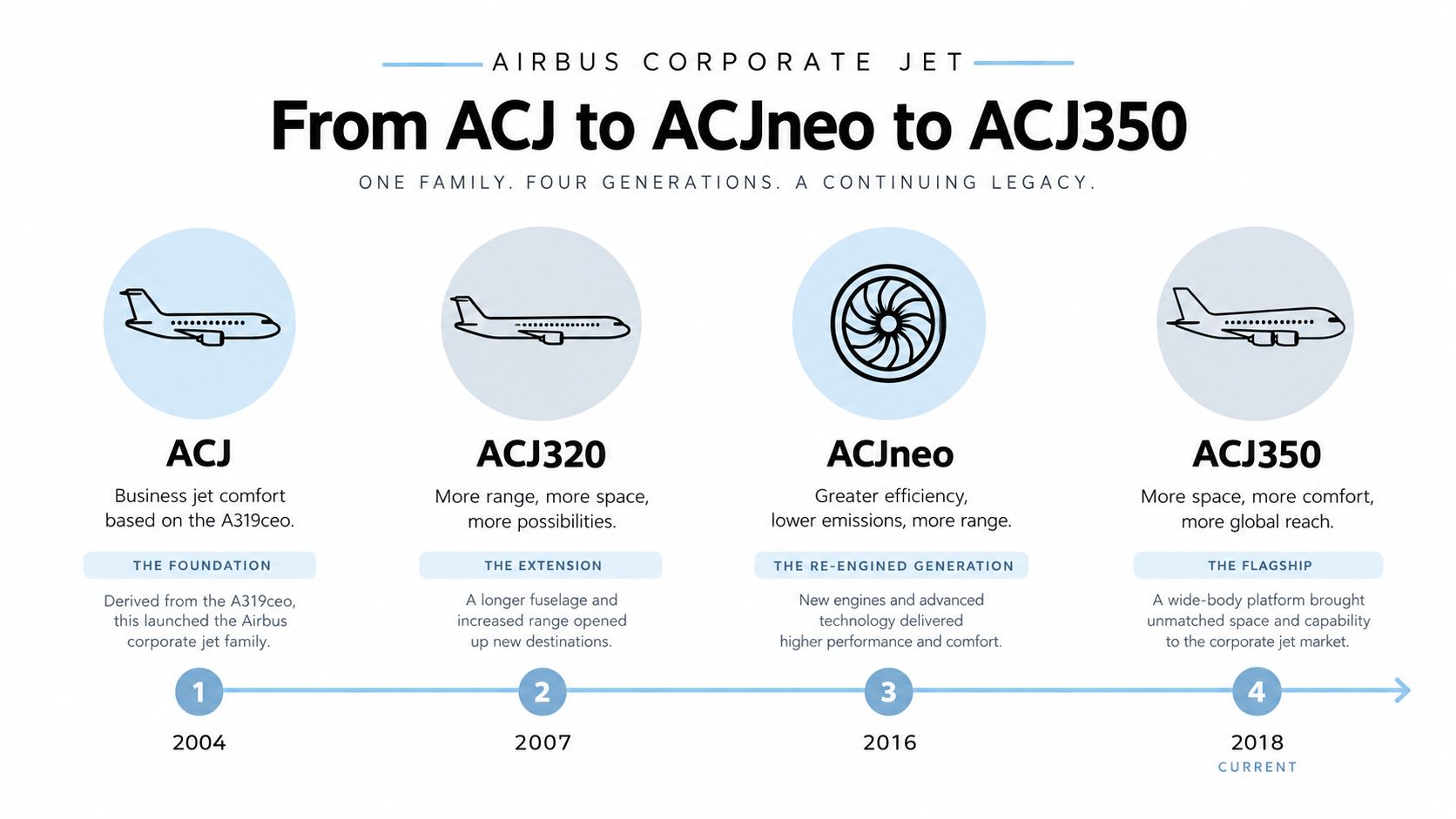
The ACJ family is easiest to follow as a progression from Airbus narrowbody airframes to a much larger widebody platform. The original program used the A319 as its foundation, which gave corporate operators access to a cabin substantially larger than a conventional business jet while retaining an aircraft designed for airline-style operations.
The family then broadened with aircraft based on different members of the Airbus range. The purpose wasn't to create a longer list of model names. Each airframe gives an operator a different balance of cabin volume, route capability, passenger count, airport access, and interior flexibility.
A simple way to read the family tree
The original ACJ introduced the idea of adapting an Airbus narrowbody for private, government, and corporate use. The ACJ320 extended that concept for clients who needed a larger or longer-range platform. Other members of the family addressed different combinations of cabin size and mission requirements, rather than forcing every client into one standard configuration.
The current range includes the ACJneo family, which is based on the A320neo platform, and the ACJ350, which represents the widebody end of the portfolio. The ACJneo concept is suited to clients who want a large, flexible cabin without moving to the physical scale of a widebody. The ACJ350 is for missions where multiple cabin zones, very long sectors, and a substantial passenger complement justify the larger aircraft.
The ACJneo specifications show why the family occupies a distinct category. Airbus lists a 3.7-metre cabin width, 96 square metres of cabin floor area, and a maximum range of 11,100 kilometres with eight passengers, with a maximum cruise altitude of 41,000 feet. Those figures describe a platform with enough spatial volume for proper zoning, not merely a row of premium seats.
At the other end, the ACJ350 technical profile lists a 5.61-metre cabin width, 51.04-metre cabin length, and 270 square metres of cabin floor area. Its maximum range is 20,550 kilometres with 25 passengers, and Airbus specifies a maximum cruise altitude of 43,000 feet.
The important operational lesson is that the Airbus lineage can simplify familiarity for organisations already operating Airbus aircraft. Common design logic, established maintenance ecosystems, and an aircraft family approach can matter to fleet planners. Those benefits don't eliminate the need to examine the individual operator, completion, aircraft records, and crew qualifications, but they help explain why ACJs appeal to professional flight departments as well as private owners.
ACJneo and ACJ350 Side by Side
A corporate shuttle carrying a small delegation has different needs from a head-of-state aircraft moving advisers, staff, and guests across continents. The ACJneo and ACJ350 reflect those different missions. The neo is a large-cabin narrowbody for clients who want meaningful separation onboard without operating a widebody. The ACJ350 is suited to intercontinental travel where several groups must work, rest, and meet at the same time.
The main distinction is not merely the headline range figure. It is the zoning ceiling. The ACJneo can support two or three working areas, provided the layout is planned carefully. The ACJ350 gives designers enough room for a principal's suite, a conference room, and a staff area to operate simultaneously without forcing everyone through the same circulation space.
That difference affects how the aircraft feels during a mission. On a corporate shuttle, passengers may spend much of the flight together, so a flexible lounge and practical work area can be sufficient. On a head-of-state or VVIP mission, privacy becomes part of the operating plan. A principal may rest while advisers confer, security personnel remain nearby, and other passengers continue working.
| Metric | ACJ320neo | ACJ350 |
|---|---|---|
| Cabin floor area | 96 m², according to Airbus | 270 m², according to Airbus |
| Cabin width | 3.7 m | 5.61 m |
| Maximum range | 11,100 km with 8 passengers | 20,550 km with 25 passengers |
| Maximum cruise altitude | 41,000 ft | 43,000 ft |
| Best understood as | Large-cabin narrowbody for long-range corporate missions | Widebody platform for very long-range, multi-zone travel |
The figures in the table come from Airbus's ACJ350 specifications and describe the published aircraft profiles. They do not, by themselves, confirm that a particular charter aircraft has the same seating plan, cabin equipment, or operating limits. The installed interior can change how effectively the available space supports a mission.
The airport plan may also decide between the two. A larger aircraft can offer more cabin separation and longer sectors, while requiring closer checks of parking, handling, customs arrangements, runway suitability, and local operating restrictions. A charter client should confirm those details before treating the brochure range as a complete trip plan.
The ACJ Two-Twenty is offered in several completion configurations. Request the installed layout for the specific tail before comparing it with the neo or the 350. For broader context on how large private aircraft differ by mission and cabin scale, see this guide to big private planes.
Inside the Cabin
A client may want to hold a meeting while another passenger eats, and a third rests without leaving the cabin. In a smaller business jet, one area often has to serve all those purposes in sequence. An ACJ gives the designer more room to assign separate parts of the cabin different jobs, so the aircraft can support several activities at once.
That zoning matters more than floor area alone. A shuttle arrangement may prioritize an open lounge and easy circulation. An intercontinental corporate mission may need a proper dining area, workstations, and sleeping spaces. A head-of-state or VVIP aircraft may require controlled privacy between principals, staff, guests, and security personnel. The right cabin is therefore the one that matches the mission, not just the variant with the largest published dimensions.
Three zones, several operating styles
A first-pass layout usually considers three functional areas:
- Work: A conference table, private office, or meeting area for passengers who need to continue working in flight.
- Dine: A dedicated setting for meals and conversation, with galley equipment suited to the planned service level.
- Rest: Private seating or sleeping arrangements that allow passengers to withdraw from the social part of the cabin.
These zones can overlap in a smaller completion, while a larger aircraft may keep them separate. A family office might request a secure work area, a principal's private suite, and a guest lounge. A government or VVIP mission may need one group to confer while another sleeps. The benefit comes from allowing those activities to coexist without forcing every passenger into the same room.
Natural light, window placement, galley capacity, lavatories, baggage access, and acoustic treatment shape how the cabin works in practice. Two aircraft with the same model designation can feel very different because their owners selected different furniture, partitions, and service areas. Ask for the cabin plan and photographs of the specific aircraft, rather than relying on a generic model image.
| Variant | Cabin Length (m) | Cabin Width (m) | Cabin Height (m) | Typical Zones |
|---|---|---|---|---|
| ACJneo family | Confirm for the specific tail | 3.7 m | Confirm for the specific tail | Work, dining, and rest zones can be arranged according to the completion |
| ACJ Two-Twenty | Confirm for the specific tail | Confirm for the specific tail | Confirm for the specific tail | Confirm the installed layout for the specific aircraft |
| ACJ350 | 51.04 m | 5.61 m | Confirm for the specific tail | Multiple living, meeting, dining, and private areas are possible |
The private jet interior guide can help a charter client assess seating, storage, lighting, and privacy before requesting a quote. The quote should still identify the exact tail number and installed interior. A spacious aircraft may feel open and social, or divided into several enclosed zones, depending on the completion.
Customization Programs and Typical Outfit Costs
An ACJ is usually delivered as an aircraft platform that still needs a finished VIP interior. The completion process turns the airframe into a usable private environment, and that process can be relatively straightforward or highly bespoke.
The first decision is the layout definition. The client and design team decide how many passengers the cabin should support, how much space belongs to work and rest, whether the principal needs a private suite, and how much room should remain for circulation. That decision affects nearly every later choice, including furniture, lighting, lavatories, galley equipment, and storage.
From airframe to finished cabin
The process commonly follows five broad stages:
- Airframe delivery: The aircraft arrives as the base platform that will receive its corporate interior.
- Completion planning: Airbus Corporate Jets and approved completion partners coordinate the design, engineering, and certification path.
- Cabin design: The client selects a catalog layout or commissions a more individual floorplan.
- Installation: Cabin furniture, furnishings, systems, connectivity equipment, and finish materials are installed.
- Certification and delivery: The completed aircraft undergoes the required inspections and approvals before entering service.
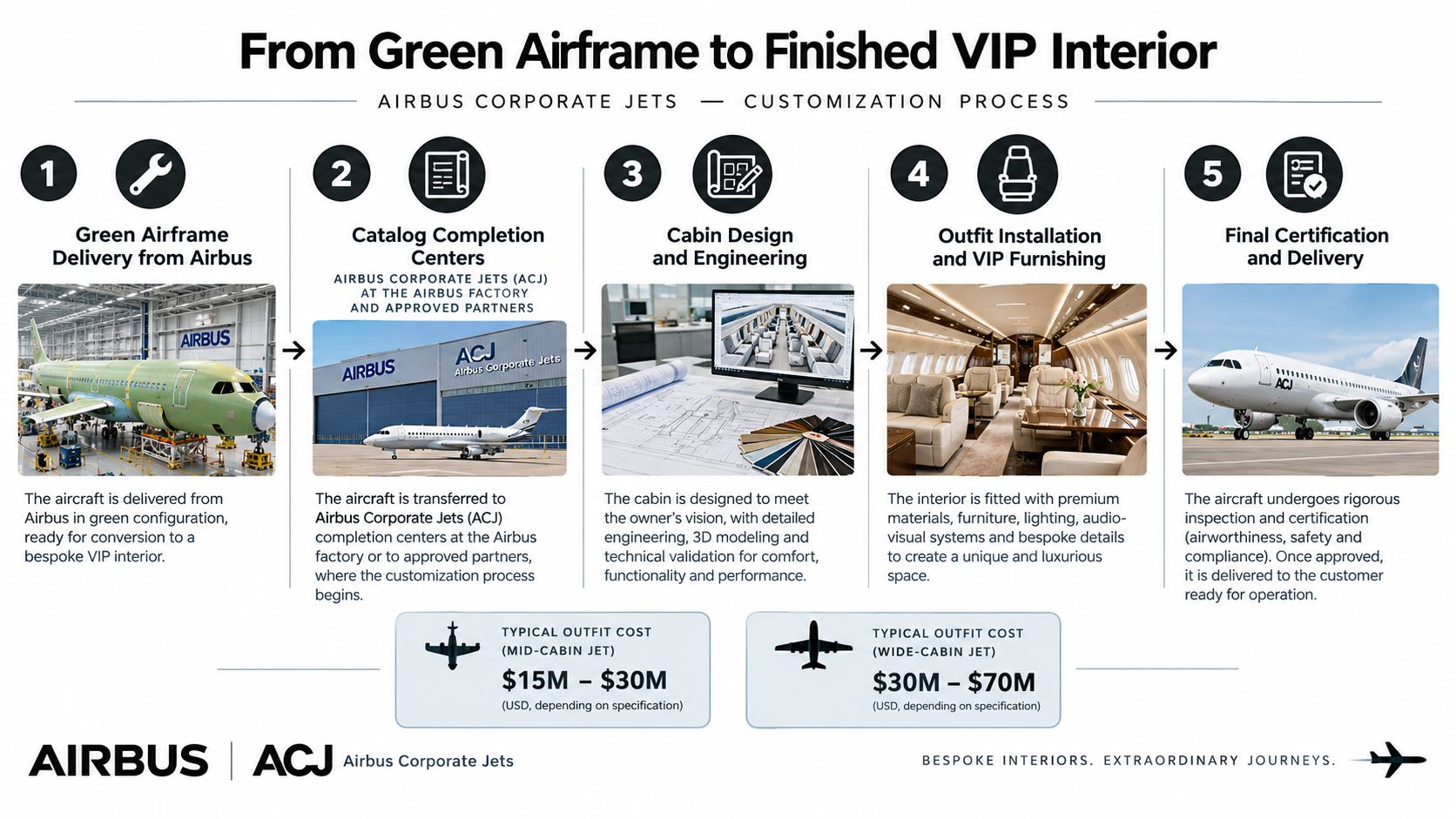
Catalog interiors can shorten decision-making because the layout and engineering approach are already familiar to the completion organisation. A bespoke program gives the client greater control over materials, furniture, lighting, communications, and privacy arrangements, but every special request can add design, integration, and certification work.
No verified cost range is provided in the available Airbus data, so a responsible buyer shouldn't treat a generic outfit figure as a quote. The final price depends on the aircraft, materials, avionics, connectivity, furniture, certification jurisdiction, and the degree of engineering required to integrate the chosen systems.
Resale considerations begin during the design stage. A highly personal interior may suit its first owner perfectly but limit the next buyer's options. A well-documented completion, recognised workmanship, maintainable materials, and supportable equipment can make the aircraft easier to evaluate later.
Connectivity and the Flying Office
A large cabin only becomes a productive office if passengers can communicate reliably. Airbus announced EASA certification for Gogo Galileo FDX on ACJs in May 2026, with promised in-flight connectivity of up to 195 Mbps through Eutelsat OneWeb's low-Earth-orbit network. Airbus's ACJ newsroom also covers ACJ Connect Link and expanded support capabilities.
For passengers, the practical question isn't the name of the antenna. It's whether the connection supports the work they need to do. That can include video meetings, secure VPN access, live news, cloud documents, passenger Wi-Fi, and communications between a principal and an office on the ground.
Productivity depends on the installation
A connectivity system must be considered alongside cybersecurity, network management, coverage, and data sovereignty. A government passenger may need encrypted communications and strict control over where information travels. A family office may care more about reliable access to advisers, financial systems, and document platforms. A corporate shuttle may treat the cabin as working time for the entire flight.
The ACJ's advantage is the combination of physical and digital utility. A passenger can leave a meeting area, take a private call, review documents, and rest without having to convert one small space into several incompatible uses. That makes connectivity part of the cabin's operating value, not just an entertainment feature.
Independent coverage and Airbus announcements can change as systems receive new approvals, so the installed equipment must always be confirmed for the specific aircraft. Ask whether the quoted aircraft has the connectivity system advertised, whether service is active on the intended route, and what support is available if the system is unavailable.
Industry indicators also show why operators are paying closer attention to this issue. Airbus reports that 85% of surveyed financiers and brokers in Asia expect purchases of large business jets to rise through 2030, while 62% believe 65% to 70% of new business-jet spending from 2025 to 2034 will concentrate in large and long-range aircraft. These are projections and survey findings reported by Airbus, not guarantees for any individual aircraft or charter booking.
When an Airbus Corporate Jet Beats a Traditional Business Jet
A leadership team flying across continents, a delegation travelling together, and a head-of-state delegation have different requirements. The right aircraft depends on the mission, not just on the largest published cabin figure. An ACJ earns consideration when the itinerary is defined by people, distance, or both at once, and when passengers need the cabin to support several activities during the flight.
Start with the intended use.
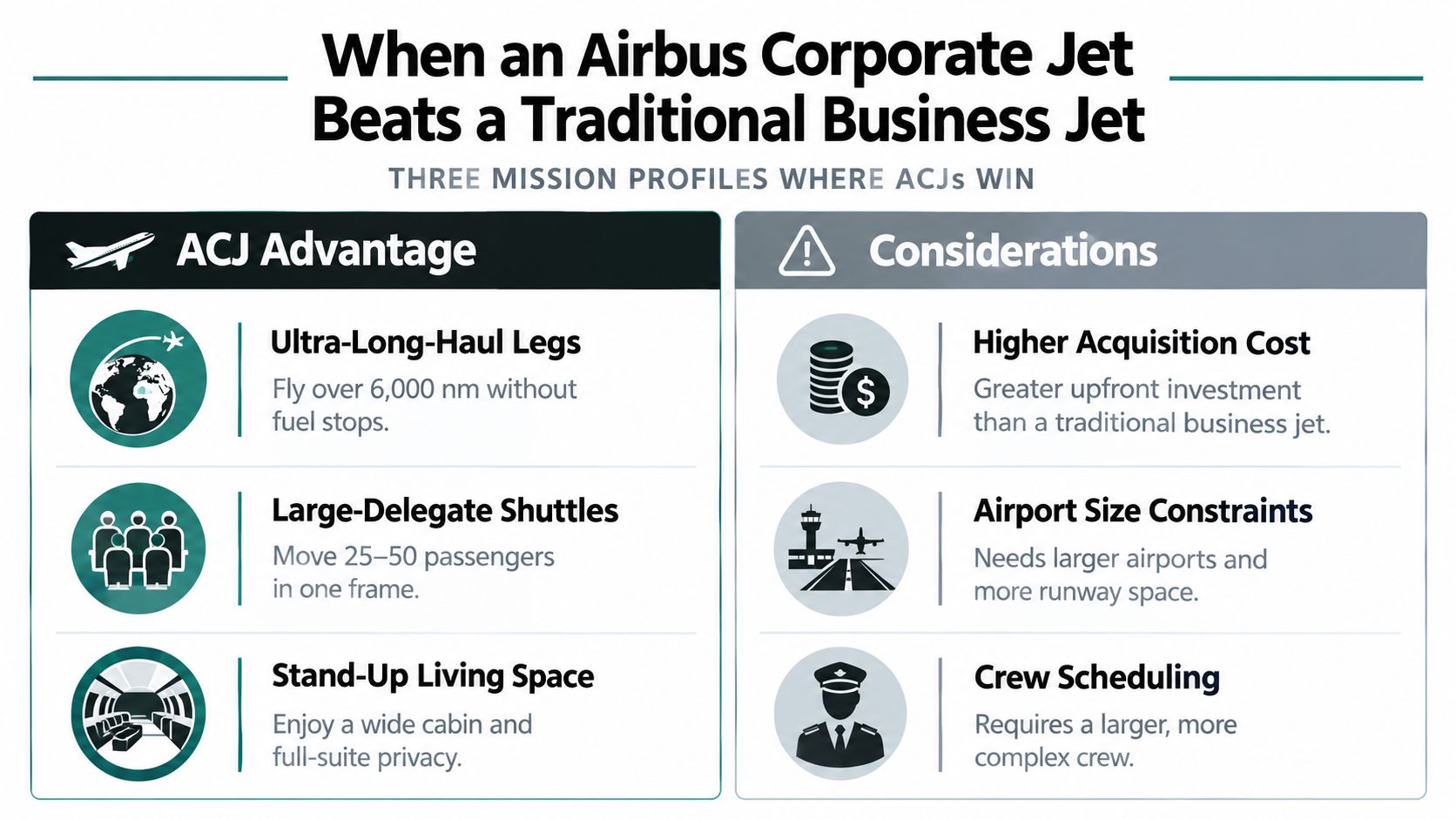
- Ultra-long-haul travel: The ACJneo and ACJ350 support long-range missions, as shown by the range figures discussed earlier. The useful distinction is how each platform keeps multiple cabin zones available during a long sector, rather than requiring one small space to serve every purpose. The ACJneo product information provides the relevant aircraft context.
- Large-delegate movement: An ACJ can keep a corporate or government group on one aircraft while separating meetings, meals, rest, and private conversation. That arrangement works like a mobile suite of rooms, rather than a single shared lounge.
- Head-of-state and VVIP work: A widebody cabin can accommodate privacy, meetings, rest, security planning, and specialist equipment without forcing every activity into the same undivided space.
The comparison with a large-cabin business jet is a question of proportion. A Gulfstream G700 or Bombardier Global 7500 may suit a compact executive itinerary better, particularly on a shorter route or when airport access matters more than cabin volume. Those aircraft can reduce cabin overhead and simplify the operating model for a small passenger group. An ACJ becomes more useful when the aircraft must carry a working programme, several passenger groups, or a longer schedule.
Choose the ACJ when the aircraft needs to carry a programme, not just passengers.
Airport access remains the practical trade-off. The largest ACJs require coordination around infrastructure, handling, parking, and crew planning. A smaller jet may reach an airport closer to the final destination, even though it offers less room onboard.
This BBJ versus ACJ private jet comparison offers another way to frame the two categories. The final choice should follow the route, passenger list, airport pair, cabin use, and operating schedule.
Booking and Charter Questions to Ask
An ACJ charter quote should identify an aircraft, not just an aircraft category. The model name tells you where the airframe sits in the family. It doesn't tell you the actual cabin, equipment, year of manufacture, maintenance status, or passenger configuration offered for your trip.
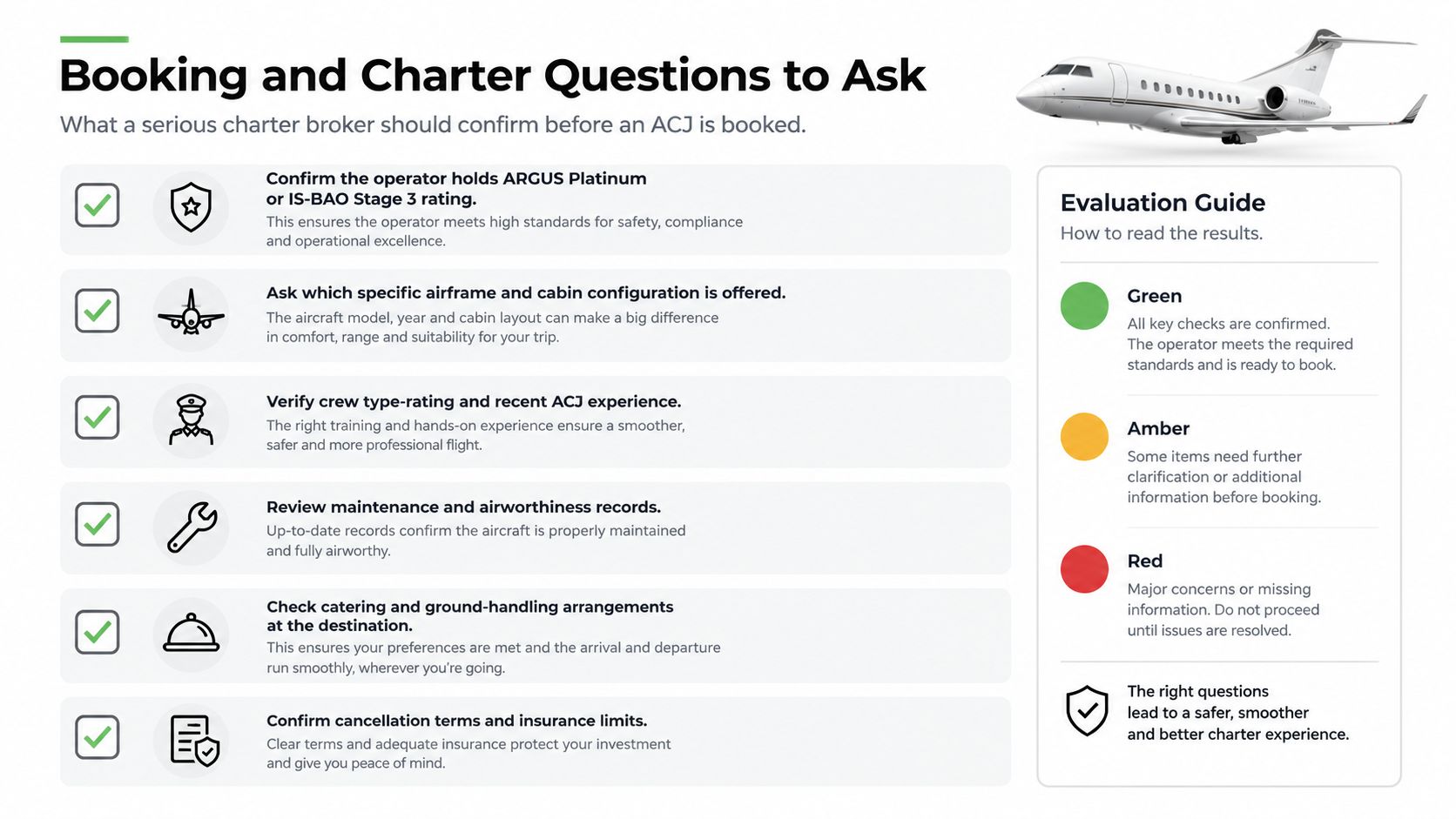
Start with the operator. Ask whether the operator holds an ARGUS Platinum or IS-BAO Stage 3 rating, and request the relevant safety and operational information. Those credentials should be part of a broader review, not a substitute for asking about the crew, maintenance programme, insurance, and regulatory authority.
Questions for the broker
- Which aircraft is offered? Confirm whether the proposed tail is an ACJ319, ACJ320neo, ACJ350, or another ACJ variant.
- What is the year of manufacture? Ask for the aircraft's age and current operational status.
- What cabin will passengers use? Request the actual floorplan, certified passenger count, sleeping arrangements, lavatory details, galley specification, and baggage information.
- What's included in the quote? Clarify repositioning legs, landing fees, handling, catering, ground transportation, crew accommodation, and other operational charges.
- Which connectivity system is installed? Ask whether the aircraft uses Ka-band, L-band, Gogo Galileo, or another system, and whether service is available along the planned route.
- How is the crew planned? Confirm type ratings, recent ACJ experience, crew rest arrangements, and the operator's plan for long overwater sectors.
- What approvals apply to the route? Ask about ETOPS or equivalent overwater approvals where relevant, along with permits and destination handling.
- What happens if the aircraft changes? The contract should explain substitutions, cancellation rights, schedule changes, insurance limits, and service recovery.
ACJ availability can be narrower than availability for conventional business jets because the aircraft are individually configured and fewer may match a particular date, passenger requirement, and routing. Begin with the actual mission rather than assuming that every ACJ listing offers the same cabin or range.
The following video offers additional visual context for clients comparing large-cabin aircraft and private charter arrangements:
Haute Jets can help clients compare on-demand aircraft by specific year, make, model, and cabin layout, including large-cabin options suited to ACJ-style missions, with operators screened through Wyvern and ARGUS ratings. Visit Haute Jets to request an aircraft match based on your route, passenger needs, connectivity requirements, and repositioning exposure.