

Fuel surprises clients more than almost any other line item in charter. Many expect the aircraft category, flight time, and airport fees to matter. They don't expect fuel to be the number that shifts the quote the most.
That matters because private jet gas cost isn't just about how much a jet burns in the air. The bigger swings usually come from where the aircraft fuels, what the local FBO charges, and whether you're also paying to move an empty aircraft into position before your trip begins.
The Single Biggest Variable in Your Charter Quote
Fuel can dominate a private charter budget faster than most new clients realize. Some industry guidance puts private jet fuel at over half of total operating expenses, and a jet burning 300 gallons per hour can spend about $1,350 to $2,100 per flight hour on fuel alone, before crew, maintenance, and landing fees are added, according to FlyUSA's private jet fuel cost overview.

That single fact changes how you should read a charter quote. Fuel isn't background noise. It's one of the main reasons two trips that look similar on paper can price very differently in the market.
Clients often focus first on visible upgrades like catering, cabin finish, or ground transport. Those matter. But if you're trying to understand why one quote is lean and another feels inflated, fuel is where the answer usually sits. A useful primer is this private jet charter pricing breakdown from Haute Jets Journal.
What clients can actually influence
You can't control the energy market. You can control the decisions that determine how much fuel exposure your trip carries.
That usually comes down to three levers:
- Aircraft size: Bigger cabins and longer-range jets burn more.
- Airport selection: Fuel posted at the airport can be far above broad regional averages.
- Positioning strategy: If an empty aircraft has to fly in for you, you're often paying for that fuel too.
Practical rule: If you want to lower a quote, look at fuel exposure before you look at luxury add-ons.
The clients who consistently spend more wisely aren't aviation obsessives. They understand that fuel is dynamic, local, and negotiable through better trip design.
Deconstructing the Price per Gallon
Jet fuel pricing confuses people because they expect it to work like car fuel. It doesn't. The gallon that ends up on your charter quote is the product of several layers, and the last layer is often the one that hurts most.
At a basic level, the price reflects the underlying fuel market, the cost to move and store fuel, and the airport-side markup added by the provider selling it on the field. In private aviation, that seller is often the FBO, or fixed-base operator.
Why the airport matters so much
An FBO isn't just a fuel pump. It's the private terminal, ramp handler, service provider, and fuel seller. That means the price on the truck often includes not just fuel economics, but airport economics.
At busy private airports, especially in premium metro markets, posted Jet A can be materially higher than broader averages. One industry example highlighted that some major U.S. airports were reported at over $10 per gallon, and noted that airport-level fuel pricing can push a midsize jet on a short leg into a very expensive fuel bill, as discussed in Elevate Jet's analysis of high airport fuel prices.
That's why the same aircraft can produce very different trip economics depending on where it uplifts fuel.
The three layers inside a gallon
Think of private jet gas cost as a stacked bill:
Commodity cost
This is the market value of jet fuel itself. It moves with broader energy conditions and can change quickly.Logistics cost
Fuel has to be refined, transported, stored, and delivered at the airport. Remote or capacity-constrained locations usually carry more friction.FBO markup and local fees Concerning FBO markup and local fees, private aviation diverges sharply from consumer fuel buying. Premium airports and low-competition fields can command prices that have little resemblance to national averages.
If a client asks why the quote changed but the route didn't, I look at the fuel airport before I look anywhere else.
Why there isn't one “normal” private jet gas cost
Even when broad market conditions look calm, local pricing can swing because airports don't buy, store, and sell fuel the same way. One FBO may be competitive to attract traffic. Another may know it serves a captive market.
That's also why comparing online “average jet fuel price” articles can be misleading. Those averages don't necessarily reflect the specific field, operator arrangement, or fuel stop strategy attached to your trip.
A note on SAF
Some clients ask about Sustainable Aviation Fuel. It can be part of the conversation, but it doesn't simplify pricing. Availability depends on airport and supplier, and where it is offered, it typically comes with a premium versus conventional fuel. The practical takeaway is simple. If SAF matters to your trip, confirm airport availability early and ask how it affects the final quote rather than assuming it's interchangeable.
How Aircraft Choice Impacts Fuel Consumption
Aircraft selection is the cleanest fuel decision you'll make. Everything after that gets more complicated.
The reason is straightforward. Fuel burn climbs as you move up the cabin and range ladder, but not in a neat, linear way. The jump from a light jet to a larger cabin aircraft isn't just about more seats and longer legs. It changes your hourly fuel exposure in a meaningful way.
Typical fuel burn and cost by private jet class
Published operator guidance places light jets at roughly 100 to 150 gallons per hour, midsize jets at 200 to 250 gallons per hour, and heavy jets at 300 to 400 gallons per hour. Using a representative $5 to $8 per gallon range, that means a light jet might spend $500 to $1,200 per flight hour on fuel, while heavy jets can exceed $1,500 to $3,200 per hour, according to BlackJet's private jet fuel cost guide.
| Aircraft Class | Popular Models | Typical Fuel Burn (Gallons/Hour) | Estimated Hourly Fuel Cost |
|---|---|---|---|
| Light Jet | Phenom 300, Citation CJ series | 100 to 150 | $500 to $1,200 |
| Midsize Jet | Citation XLS family, Hawker class aircraft | 200 to 250 | Qualitatively higher than light jets |
| Heavy Jet | Challenger and large-cabin categories, Global family | 300 to 400 | $1,500 to $3,200 |
That's why “just get me something bigger” is often the most expensive sentence in charter planning.
A practical example clients understand quickly
The Embraer Phenom 300 is a good reference point because it sits in a category many clients book. Industry reporting citing Conklin & de Decker data places the Phenom 300 at about 183 gallons per hour, while the Bombardier Global 7500 burns 528 gallons per hour. At $4.82 per gallon, that works out to roughly $883 per hour for the Phenom 300 and $1,563 per hour for the Global 7500 before other operating costs, as outlined in Private Jet Card Comparisons' fuel burn analysis.
If you want to see how one of the most requested light jets fits into this category, the Phenom 300 aircraft profile on Haute Jets is a useful reference for mission planning.
What works and what doesn't
A right-sized aircraft usually wins on short and mid-range missions. It controls fuel burn without creating a comfort problem.
What doesn't work is choosing by cabin photo alone. Clients do this all the time on leisure routes, especially when they assume the next aircraft class up is only a modest increase. It often isn't.
Best practice: Match the aircraft to the mission, not the aspiration. Range, baggage, runway needs, and passenger count should lead. Cabin prestige comes after that.
The trade-off is real
Larger aircraft earn their keep when you need nonstop range, a taller cabin, more luggage capacity, or a true business setup for a longer mission. But if your route doesn't require those advantages, the fuel bill becomes pure overhead.
That's the heart of private jet gas cost. The aircraft decision isn't cosmetic. It sets the baseline for every other fuel choice that follows.
The Hidden Drivers of Your Final Fuel Bill
A large share of fuel cost swings has nothing to do with how far you fly. Airport selection, FBO pricing, and aircraft repositioning often move the number more than clients expect, especially on short and mid-range charters.
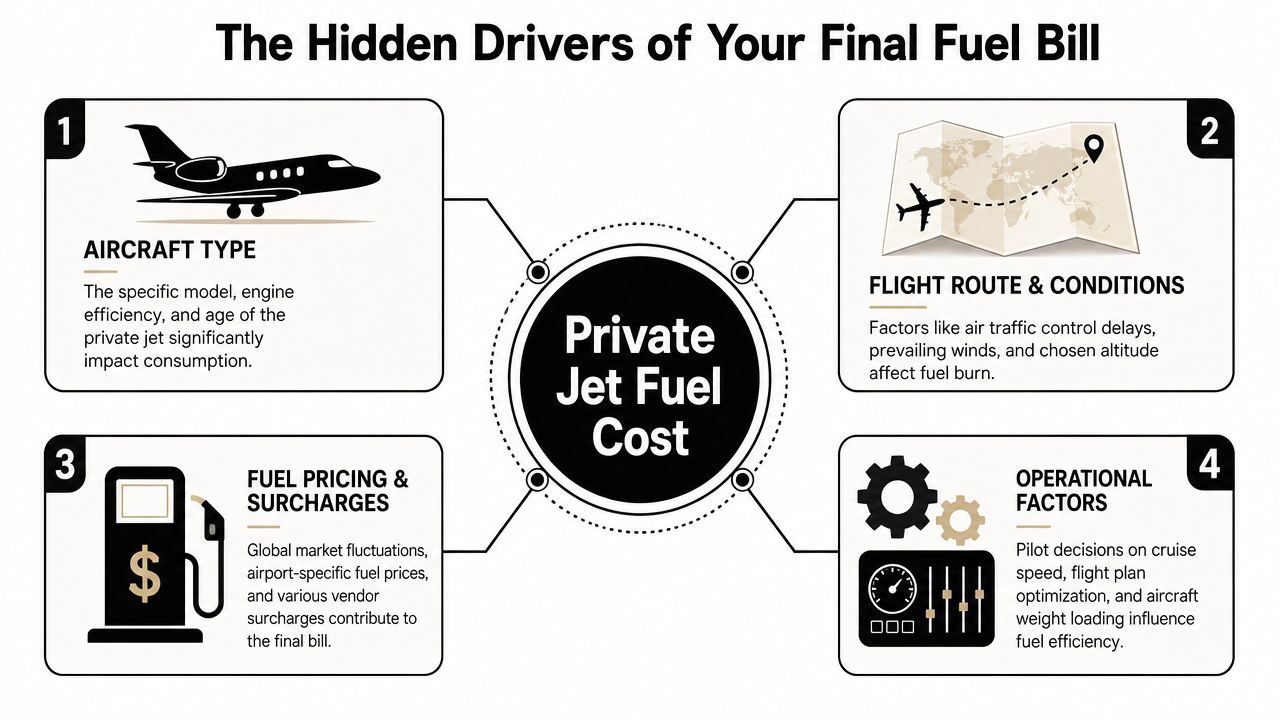
Airport spreads are often bigger than people expect
The same aircraft on the same route can carry a meaningfully different fuel bill depending on where it departs and where it uplifts fuel. Broad regional averages are useful for context, but they do not tell you what the operator will pay at a specific private terminal.
That matters most at business aviation airports with limited competition or premium convenience pricing. A client may compare two nearby departure airports and expect near-identical quotes. In practice, one field may have far higher posted Jet A rates, stronger minimums, or fewer options to source fuel competitively.
This is one reason airport choice deserves more attention than it gets.
The route matters beyond mileage
Distance is only the starting point. Dispatch looks at the actual mission profile, because fuel burn changes with operating conditions, not just the city pair.
A few factors regularly change the final number:
- Payload: More passengers, bags, golf clubs, skis, or dense cargo increase weight and fuel use.
- Weather and routing: Headwinds, reroutes, and holding can add meaningful burn.
- Taxi and congestion: Longer ground delays at busy airports turn into real fuel spend.
- Fuel stop planning: The best place to buy fuel is not always the departure airport or destination.
For example, a New York to Los Angeles private jet charter route may look straightforward on paper, but the fuel economics change quickly if the aircraft starts from another airport, faces winter headwinds, or is forced into an expensive uplift point.
Fuel markets still affect your quote
Fuel is a live operating cost. IATA's Fuel Price Monitor regularly shows week-to-week swings in global jet fuel pricing, which means operator exposure can change even when your itinerary does not, as shown in IATA's current fuel monitor.
Clients usually notice this on trips quoted days apart. Same route. Same aircraft category. Different fuel assumptions.
Repositioning is often the cost clients miss first
Many charter quotes vary significantly depending on aircraft positioning. If the aircraft is not already near your departure airport, it may need an empty repositioning leg to pick you up, and often another one after drop-off depending on the schedule.
Those flights burn fuel just like the occupied leg. If the nearest available aircraft is based far away, your fuel exposure rises before your trip even begins. I see this most often when travelers shop only by cabin category and not by aircraft location. The airplane may be suitable, but poorly placed.
FBO markups can outweigh small differences in fuel burn
Clients often spend a lot of time comparing aircraft burn rates, then overlook the place where a large part of the bill is set. The FBO.
Private terminals can carry substantial markups, handling fees, and local pricing differences. On some trips, choosing a nearby alternate airport or sourcing fuel differently has more impact than shaving a small amount off hourly burn. That is the practical advantage of local sourcing. It cuts exposure where the quote is most vulnerable.
At Haute Jets, that is the part worth watching closely. A smart charter strategy is not just picking an efficient aircraft. It is pairing the right aircraft with the right airport and the right fuel plan so convenience does not subtly become overhead.
Sample Fuel Cost Calculations for Popular Routes
It helps to run the math in plain English. Not because clients need to build their own dispatch sheet, but because a simple calculation shows how private jet gas cost builds up fast.
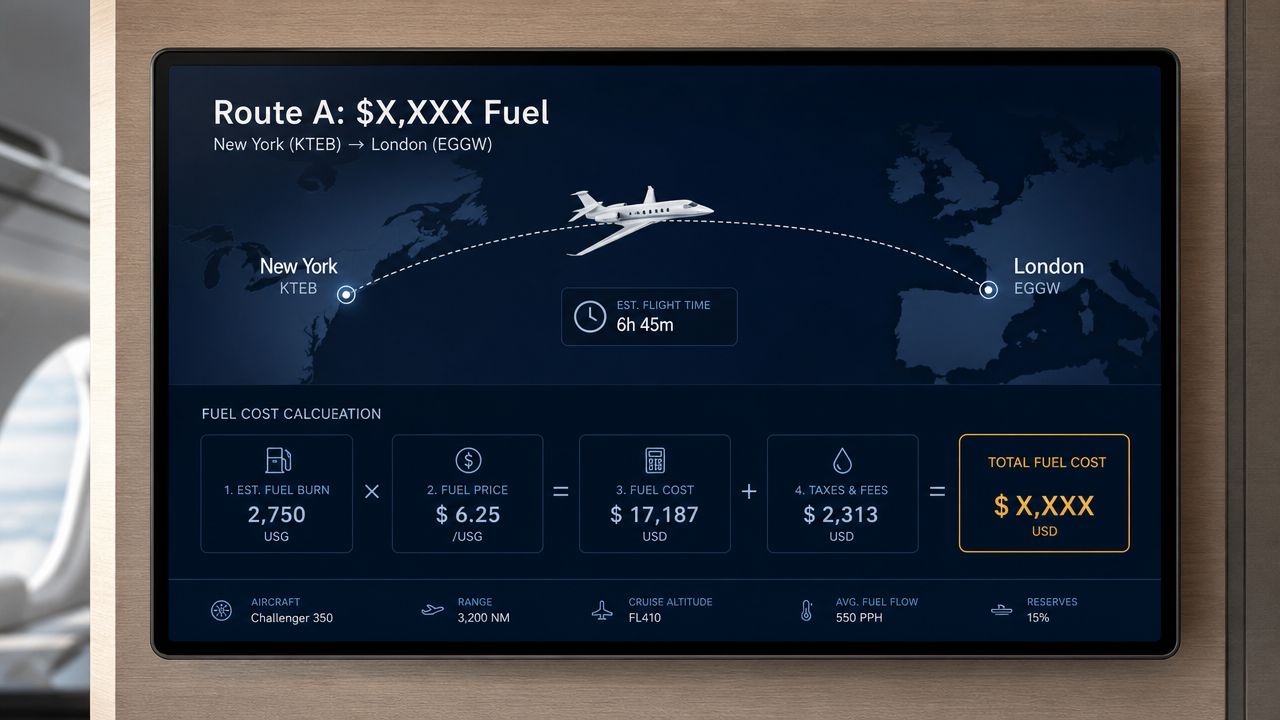
The basic formula is straightforward:
Flight time × gallons per hour × price per gallon = estimated fuel cost
That's not a full charter quote. It doesn't include crew, maintenance reserves, airport fees, or repositioning. But it shows why even a small shift in fuel price or aircraft category changes the economics quickly.
Example one Los Angeles to Las Vegas on a light jet
For a short hop, a light jet is usually where clients get the best balance of cabin comfort and fuel discipline. A commonly requested option in this range is the Phenom 300, which industry reporting places at about 183 gallons per hour, as cited earlier.
Using that burn rate, the estimate looks like this:
- Aircraft: Light jet, using Phenom 300 burn reference
- Burn rate: 183 gallons per hour
- Fuel price assumption: qualitative market range already discussed above
- Result: Fuel remains meaningful even on a short mission, but the lighter aircraft keeps exposure lower than moving up a cabin class
The lesson isn't merely the exact route time. It's that on shorter missions, over-aircrafting the trip can be an expensive habit. If the mission only needs a light jet, stepping into a larger cabin often raises the bill without creating practical value.
For travelers comparing longer domestic options, the New York to Los Angeles route guide from Haute Jets shows how mission length changes aircraft logic.
Example two New York to Miami on a heavier mission profile
For a longer business trip, clients often start looking at midsize or super-midsize aircraft for comfort, baggage, and cabin productivity. Here the fuel sensitivity becomes more obvious because total flight hours are greater.
Use a generic midsize planning framework:
- Choose a midsize aircraft category.
- Apply a burn assumption inside the published 200 to 250 gallons per hour band discussed earlier.
- Multiply by actual projected flight time.
- Then test what happens if the departure airport uses higher posted fuel than an alternate field nearby.
That final step is where the quote often changes. Not because the trip changed, but because the fuel airport did.
On long domestic routes, airport strategy can matter almost as much as aircraft strategy.
A short visual walkthrough helps if you want to see how charter buyers think about trip pricing in practice:
What these examples actually prove
Clients often ask for exact fuel totals too early. Exactness comes later, after routing, weather, airport selection, and operator availability are confirmed.
What matters first is the shape of the cost:
- Short route plus light jet usually controls fuel well.
- Longer route plus larger aircraft creates more exposure.
- High-priced airport fuel can lift the bill sharply even if nothing else changes.
- Repositioning can make a trip look expensive before your occupied leg even starts.
That's why experienced charter planning starts with mission fit and airport logic, not just an aircraft photo and an hourly rate.
How to Meaningfully Reduce Your Fuel-Related Costs
Most fuel savings advice is too generic to help a real charter client. “Choose an efficient plane” is true, but incomplete. The better question is which changes move the final invoice.
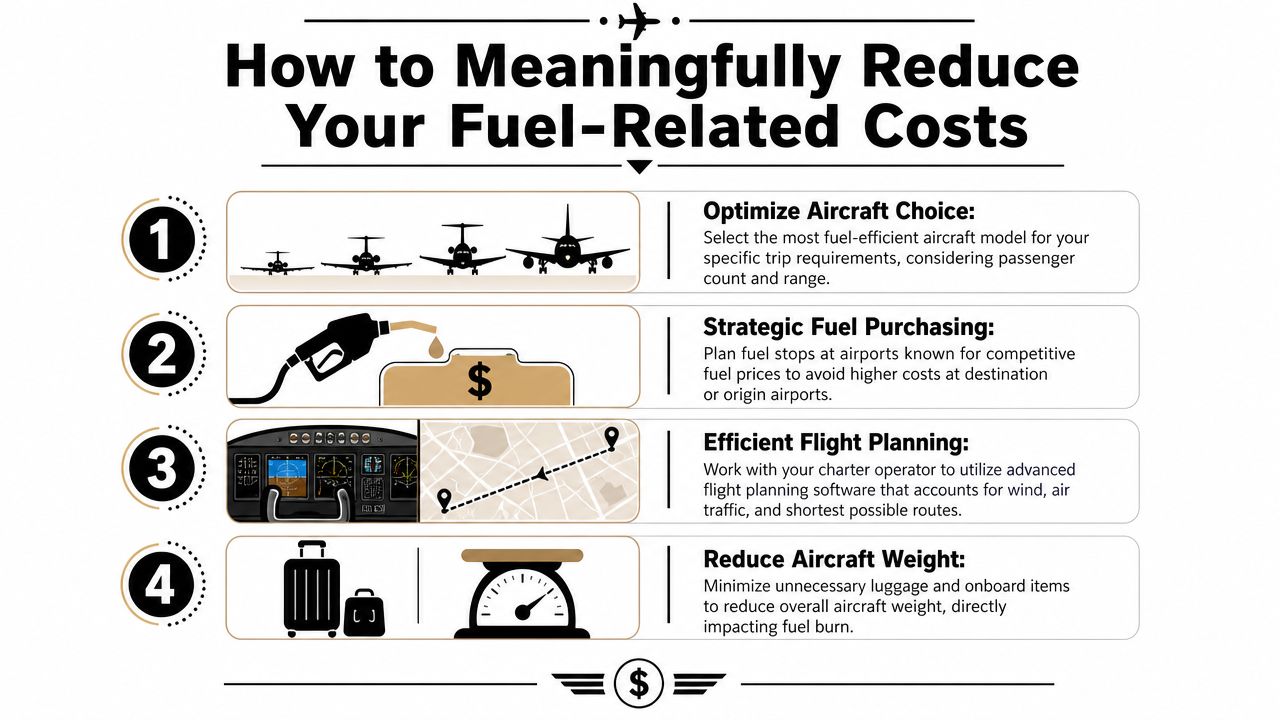
Start with the easiest wins
Some fuel-related decisions are simple and worth making every time:
- Right-size the aircraft: If a light jet handles the mission, don't pay heavy-jet fuel economics for style alone.
- Stay flexible on airports: Nearby alternates can produce better fuel economics than the most obvious private terminal.
- Pack with discipline: Excess bags and unnecessary onboard items won't transform a quote, but they do add weight.
Those are worthwhile. They just aren't the whole story.
The biggest waste is often empty flying
The most expensive fuel is frequently burned without you on board.
When a charter aircraft has to reposition from another city to pick you up, the operator is still paying for fuel, crew time, and aircraft utilization on that empty leg. In many quotes, that repositioning is the hidden layer that makes a trip feel overpriced.
Clients often become frustrated, and rightly so. They think they're paying for a one-leg mission. In reality, they may be covering multiple flight segments because the aircraft wasn't local to begin with.
What works better than chasing a lower posted fuel price
A lot of buyers focus on per-gallon optimization alone. That helps, but it's often not the main lever.
The more effective sequence is:
Source an aircraft near departure
This limits or removes empty repositioning fuel burn.Choose the smallest aircraft that still does the mission cleanly
Don't compromise safety, range, or baggage needs. But don't buy more cabin than the route requires.Use smarter airport options when practical
If a secondary airport gives the same ground outcome with better fuel economics, it deserves a serious look.Build trips efficiently
Multi-stop days, avoidable waiting, and awkward sequencing can all create extra fuel exposure.
Advisory note: The cheapest-looking hourly rate can become the most expensive trip if the airplane has to come from somewhere else.
What doesn't work
Clients sometimes try to cut the wrong things. They'll spend time negotiating minor onboard extras while ignoring a costly departure airport or an aircraft that has to ferry in from far away.
That approach rarely saves much.
Other weak tactics include:
- Choosing by category label only: Two aircraft in the same broad class can create different operational outcomes.
- Ignoring local airport options: A premium FBO may be convenient, but convenience can come with expensive uplift.
- Waiting too long to book: Late booking reduces flexibility around aircraft placement and airport strategy.
The strategic takeaway
If you want to lower private jet gas cost in a meaningful way, remove avoidable flying first. That means reducing ferry legs, controlling aircraft size, and being smart about where fuel is purchased.
That's the difference between trimming around the edges and changing the economics of the trip.
Fly Smarter By Understanding Your Fuel Bill
Fuel rarely becomes expensive for one simple reason. It gets expensive when small operational choices stack up inside the quote, often in places a first-time charter client never sees.
The main advantage is not memorizing average jet fuel prices. It is asking whether the trip was built intelligently in the first place. A well-built quote reflects aircraft availability near your departure point, practical airport selection, and fuel purchasing that is handled with local market awareness instead of convenience pricing. That is where meaningful savings show up.
I tell clients to judge a charter quote by how much avoidable flying and avoidable markup it contains.
That standard matters because two trips that look nearly identical on paper can price very differently once the sourcing strategy is revealed. One broker may pull the first available aircraft and accept the fuel terms attached to it. Another may source closer to the departure airport, use a better local fuel option, and reduce the extra burn that otherwise raises the total bill. The cabin experience can be the same. The cost outcome often is not.
Haute Jets is built around that second approach. By sourcing aircraft through a global network of owner-operators near the point of need, Haute Jets helps reduce repositioning exposure and the fuel waste that comes with it, while still giving clients access to the exact aircraft they want and to Wyvern and ARGUS-rated operators. If you want a quote that reflects real trip economics, not just availability, explore Haute Jets.