

A transatlantic private jet charter typically costs $75,000 to $250,000 one-way, depending on aircraft class, route, and season. Most heavy-jet routes land between $120,000 and $150,000 when all fees are included, although the final invoice can move well outside that range.
You may be comparing two quotes for what appears to be the same New York to London trip. Both aircraft may be described as heavy jets, both may offer nonstop service, and both may depart within the same window. Yet one quote shows $87,000, while another climbs above $120,000 before catering, ground arrangements, or other trip-specific charges are finalized.
That difference usually isn't a mistake. It reflects aircraft positioning, airport selection, crew requirements, permits, handling, taxes, and the operator's pricing model. The headline number is only useful when you know exactly what's included.
Understanding the Real Transatlantic Private Jet Cost
Two passengers can request nearly identical New York to London itineraries and receive sharply different proposals. One may be based on an aircraft already positioned near the departure airport. Another may require the operator to move an empty aircraft into place, retain the crew overnight, and secure a more expensive arrival airport. The aircraft category may look similar on paper, but the operating plan isn't.
Published market examples illustrate the gap. A New York to London heavy-jet charter has been quoted at about $87,000, while broader North America to Western Europe estimates reach $120,000 to $250,000 or more for heavy and ultra-long-range aircraft, depending on routing and trip conditions. The published transatlantic charter pricing guide also identifies aircraft class, flight-hour rates, handling, permits, landing fees, and taxes as major components of the final bill.

The base rate isn't the trip price
A charter proposal often begins with an aircraft and an estimated number of occupied flight hours. That figure doesn't necessarily include every cost incurred before departure or after landing. International missions can involve several airports, countries, service providers, and regulatory authorities, each adding a line item.
Aircraft positioning creates one of the largest differences. If the chosen jet is already close to New York, the operator may avoid moving it from another city. If it isn't, the client may absorb some or all of that repositioning. The same principle applies on the European side if the aircraft needs to continue elsewhere after dropping passengers.
Airport choice matters just as much. A convenient business airport may have higher landing or handling charges than a less congested alternative. A broker who quotes only a city pair without naming the departure and arrival airports hasn't given you enough information to judge the offer.
Practical rule: Treat an unitemized quote as an estimate, not a final transatlantic private jet cost.
Before approving a flight, ask for the aircraft registration or exact model, departure and arrival airports, estimated flight hours, positioning plan, crew expenses, permits, handling, landing charges, taxes, and cancellation terms. You can also compare the proposal with a broader private jet charter cost breakdown, but the most reliable comparison remains an itemized quote for your exact dates.
The objective isn't always to select the lowest number. A lower quote may involve a fuel stop, a less convenient airport, limited schedule flexibility, or a less suitable cabin. The right comparison measures the total cost against the time, comfort, reliability, and aircraft capability you actually require.
Primary Factors Driving Transatlantic Charter Pricing
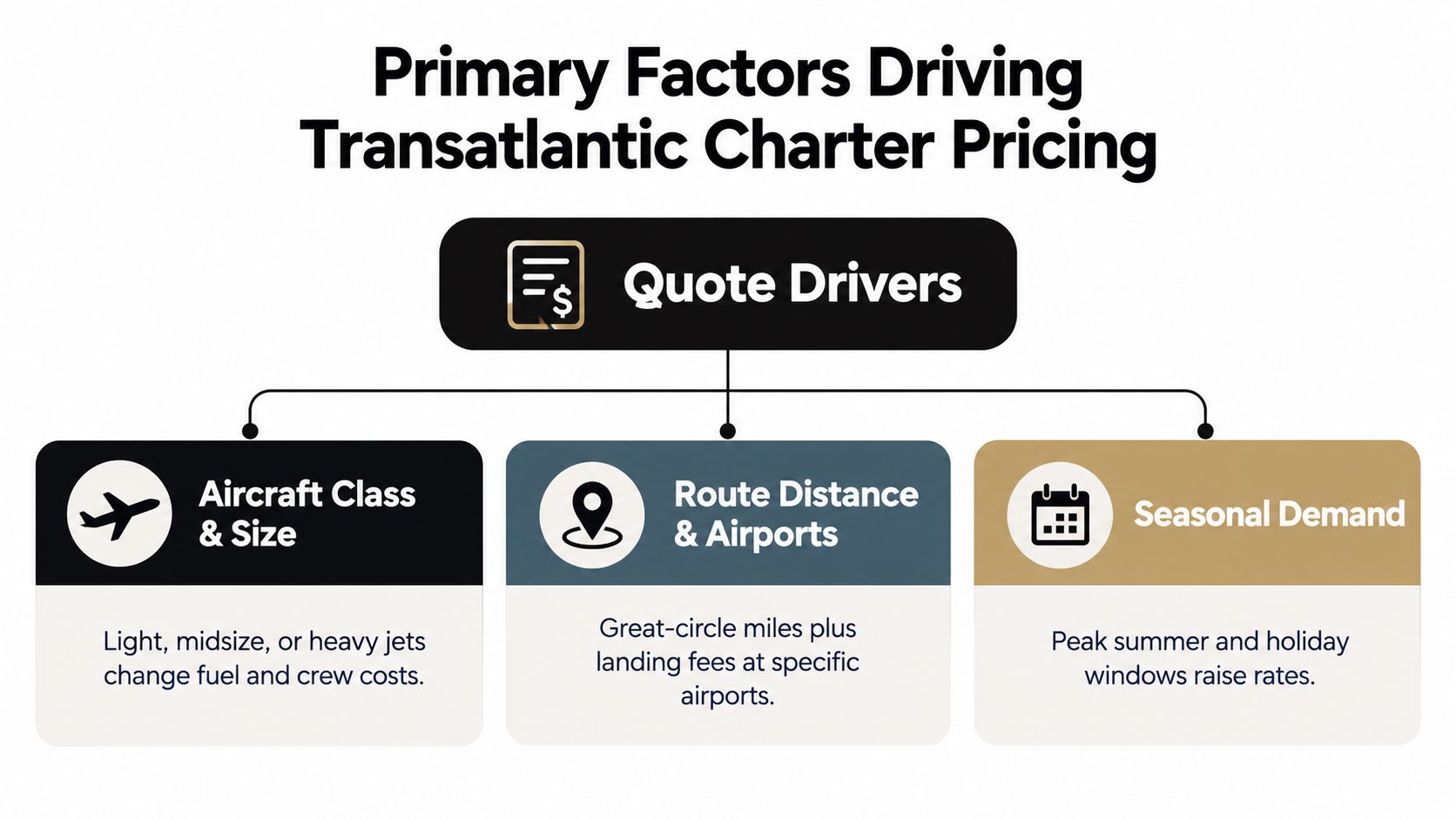
Three variables shape nearly every transatlantic quote: aircraft class, route design, and demand at the time of travel. They interact rather than operate independently. Selecting a smaller aircraft may lower the aircraft rate, but a fuel stop can introduce additional crew time, airport charges, and schedule complexity.
Aircraft class and size
Heavy and ultra-long-range jets suitable for Atlantic crossings commonly carry flight-hour rates around $8,000 to $10,000, according to the industry guide to transatlantic private jet pricing. That rate reflects fuel burn, maintenance, crew requirements, cabin size, and the aircraft's ability to complete the mission without an operationally inconvenient stop.
A Gulfstream G550 and a Challenger 350 aren't interchangeable just because both can serve business travelers. The G550 offers a larger cabin and stronger long-range capability, while a Challenger 350 may make sense for a smaller group on a shorter route or an itinerary where a technical stop is acceptable. The correct choice depends on passenger count, baggage, nonstop requirements, weather margins, and the importance of arriving at a specific time.
Route and airport selection
Distance is only the beginning. Dispatchers also assess prevailing winds, available alternates, runway requirements, airport operating hours, permits, and crew duty limits. A route from the US East Coast to Western Europe may be operationally straightforward, while a West Coast departure can require a larger aircraft and a more involved positioning plan.
Airport selection can change the quote without changing the destination. A private terminal closer to the city may cost more to use, while a secondary airport may reduce congestion and ground-transfer time. Ask whether the quoted airports are fixed or whether the operator can substitute another field later.
The aircraft also influences the route. A nonstop itinerary may require a heavy or ultra-long-range jet. A midsize aircraft may reduce the initial aircraft cost but introduce a technical stop, which changes both timing and the total operating plan.
Seasonal demand
Rates also respond to the availability of suitable aircraft and crews. Summer leisure traffic, major sporting events, holiday travel, and popular European destinations can reduce inventory. When several clients request similar aircraft on similar dates, the most convenient options disappear first.
That doesn't mean every quote during a busy period is inflated. It means you should secure the aircraft before evaluating only the headline rate. A broker who waits until the preferred jet is unavailable may offer a cheaper substitute that doesn't meet your nonstop, baggage, or cabin requirements.
Fuel is another cost driver worth separating from the hourly rate. The guide to private jet fuel costs explains why aircraft size and mission length affect the underlying economics. Request confirmation of whether the quoted fuel assumption is fixed, adjustable, or subject to a surcharge.
A fair quote makes these trade-offs visible. You should be able to see what you're paying for in aircraft capability, route convenience, and schedule certainty rather than discovering those differences after the contract is signed.
Aircraft Categories and Their Transatlantic Price Ranges
Not every private jet is a practical Atlantic aircraft. A light jet may be perfectly suited to an intra-European connection but unsuitable for a nonstop crossing. A super-midsize aircraft may work on a shorter East Coast route, while a heavy jet provides greater comfort and operational margin for a longer or weather-sensitive itinerary.
The following comparison focuses on how each category performs in a transatlantic planning conversation. Prices remain indicative because the final quote depends on aircraft availability, positioning, airports, season, and fees.
| Aircraft Category | Example Models | One-Way Price Range | Range Capability |
|---|---|---|---|
| Light jets | Citation CJ family, Phenom 300 | Generally not a practical nonstop transatlantic category | Usually requires multiple stops and isn't normally selected for the full crossing |
| Midsize and super-midsize jets | Challenger 350, Citation Longitude | Lower than heavy-jet pricing when the route and operating plan permit | May handle shorter crossings, but a fuel stop can be necessary |
| Heavy jets | Gulfstream G550, Challenger 650 | Commonly falls within the broader $120,000 to $250,000+ transatlantic market band | Designed for nonstop service on many North America to Europe routes |
| Ultra-long-range jets | Gulfstream G650, Global 7500 | Premium end of the transatlantic market, with pricing driven by range and cabin specification | Offers the strongest nonstop capability and the greatest cabin flexibility |
Matching the aircraft to the mission
The cheapest category isn't automatically the least expensive solution. A midsize jet that requires a stop can add handling, crew, fuel, and schedule costs. It may still be sensible for a flexible group, but it shouldn't be compared with a nonstop heavy jet on price alone.
Heavy jets remain the practical reference point for many East Coast to Europe missions. They generally provide enclosed lavatories, larger baggage capacity, work areas, and sleeping options. The Gulfstream G550, for example, is often considered when passengers value nonstop capability and a spacious cabin rather than only the lowest aircraft rate.
Ultra-long-range aircraft command a premium because they combine distance capability with a more expansive onboard environment. They make more sense when the itinerary is long, the group carries substantial luggage, or passengers need to work and rest during the crossing. A selection of ultra-long-range jets can help clarify the difference between choosing a category and choosing a particular cabin configuration.
The practical question is simple: do you need the aircraft's full capability? If you don't need maximum range, a heavy jet may offer the right balance. If a fuel stop creates a serious business or personal cost, paying for greater range can be the more economical decision overall.
Real Route Examples and Pricing Benchmarks
A broad transatlantic private jet cost range becomes more useful when applied to actual departure cities. Published examples show that the origin can change the bill substantially, even when the destination remains in Western Europe.
Indicative one-way prices include approximately $65,000 from New York, $75,000 from Miami, and around $115,000 from Los Angeles, according to published route and charter pricing examples. Those figures are reference points, not guaranteed offers. Aircraft positioning, the exact airport pair, season, and the final fee structure can move the quote in either direction.
What the route examples reveal
New York benefits from deep aircraft availability and frequent business aviation traffic to Europe. Miami can produce a different result because the route profile, aircraft supply, and destination mix differ. Los Angeles adds distance and often calls for an ultra-long-range aircraft, which helps explain the higher indicative figure.
Specific city-pair examples make the distinction clearer:
- New York to London: About $75,000 on a heavy jet in one published example.
- Los Angeles to Paris: Roughly $110,000 on an ultra-long-range jet in another published example.
- New York to London: A separate market reference places a large-jet charter around $87,000.
These examples aren't contradictory. They represent different aircraft, assumptions, operators, and quote structures. The New York to London figure may exclude or handle certain charges differently from another proposal, while the Los Angeles to Paris example reflects a longer mission and a higher-capability aircraft.
The useful benchmark isn't one advertised number. It's the relationship between the city pair, aircraft capability, and all-in inclusions.
When reviewing your own proposal, ask whether the price is based on the aircraft's current location or includes positioning. Confirm whether the quote is for a one-way mission or accounts for the aircraft's next assignment. Also ask whether the arrival airport is fixed, because a change from a convenient business airport to a more distant alternative can alter the value of the trip even if it lowers the operating cost.
Hidden Fees That Inflate Your Transatlantic Quote
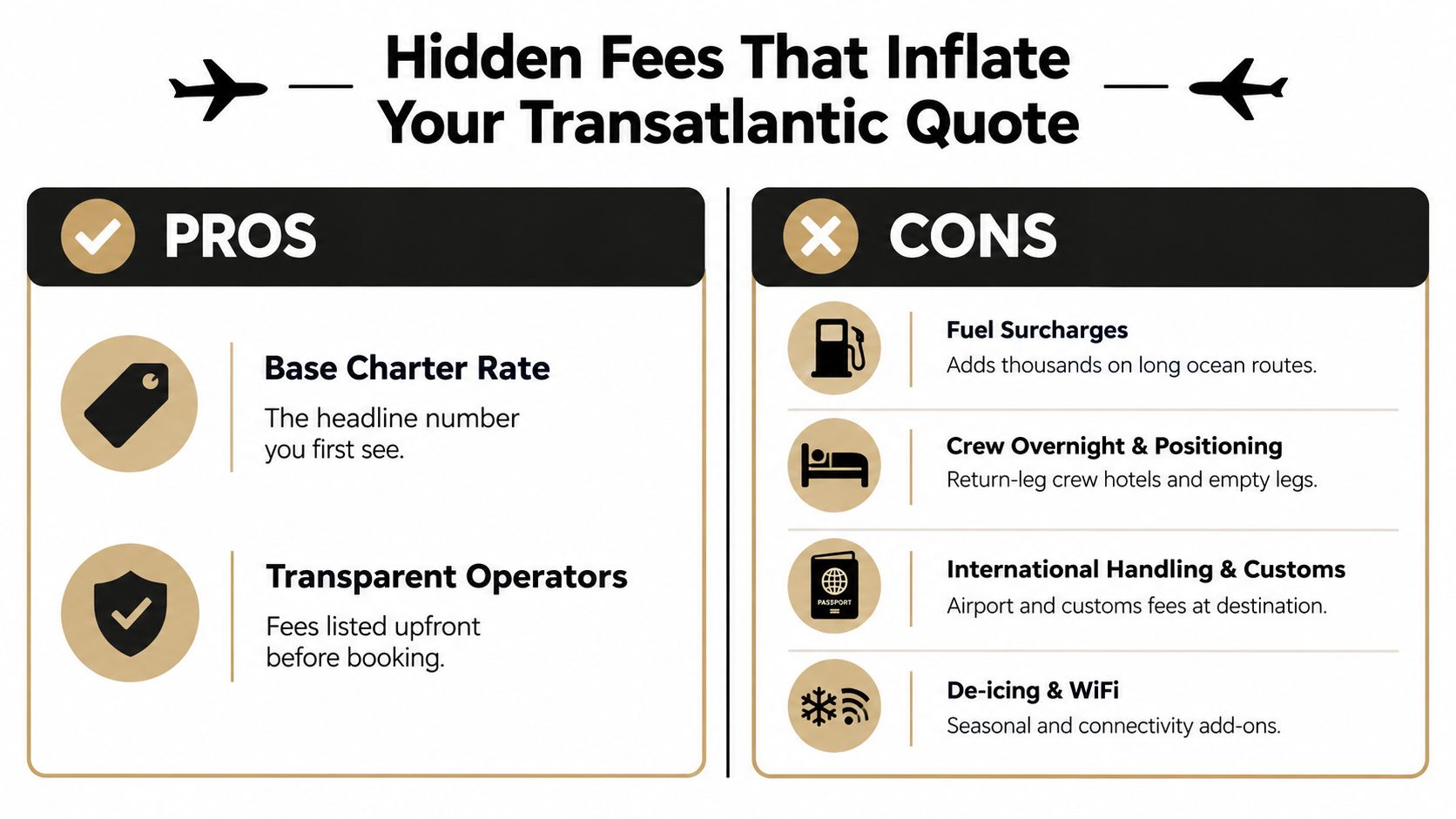
The most uncomfortable pricing conversations usually involve charges that weren't obvious in the first proposal. International and transatlantic flights can include landing, overflight, handling, customs, immigration, and fuel-related costs. A neutral private jet charter cost guide estimates that international extras can add $5,000 to $15,000 to a transatlantic charter total.
That range isn't a universal cap. Complex itineraries, multiple stops, difficult airport access, unusual permits, or substantial changes can push the final amount higher. The only dependable protection is a written breakdown.
Landing and handling charges
Landing fees are assessed by the departure and arrival airports. Premium business aviation airports may charge more because of demand, facilities, operating restrictions, or location. Fixed Base Operators can also charge handling, parking, passenger service, and ramp fees.
Handling charges cover the local services needed to receive and dispatch the aircraft. They may include ground support, baggage assistance, passenger processing, and facility use. Ask whether the proposal includes both sides of the Atlantic or only the departure airport.
Overflight permits and international processing
A transatlantic route can cross or interact with several jurisdictions. Operators may need overflight permissions, flight-plan coordination, and documentation support. These requirements are usually managed behind the scenes, but the cost can appear on the invoice.
Customs and immigration facilitation can also carry a charge, especially when the itinerary uses a private terminal or requires special coordination. Your broker should explain whether these services are included, estimated, or billed at cost.
Fuel, crew, and trip-specific additions
Fuel surcharges can apply when the operator's pricing assumptions change or when the itinerary has unusual fuel requirements. Ask whether fuel is included at a fixed assumption and what happens if the operator needs to uplift at a more expensive airport.
Crew overnight expenses can arise when the aircraft remains at the destination or the return schedule prevents the crew from operating home immediately. Catering, connectivity, de-icing, special baggage handling, and ground transportation may also sit outside the base aircraft rate.
Use this checklist before signing:
- Request line items: Ask for every fee category, even when the broker expects it to be small.
- Confirm assumptions: Verify airports, passenger count, baggage, catering, and schedule.
- Ask about change orders: Find out how weather, airport substitutions, or schedule changes affect the invoice.
- Separate optional services: Ground cars, upgraded catering, and special onboard requests should be clearly identified.
A transparent operator won't object to these questions. Vague wording such as “fees as incurred” deserves clarification before payment.
Cost-Saving Strategies That Actually Work
The most effective savings strategy isn't always the most dramatic discount. It's the one that lowers the total mission cost without forcing you to accept an unusable schedule or aircraft.
Empty-leg flights receive the most attention because they can be offered at 25% to 75% below a comparable one-way charter. Recent independent guidance places heavy-jet empty legs around $9,000 to $25,000 and ultra-long-range empty legs around $12,000 to $18,000, as described in this empty-leg flight guide.
Why empty legs often disappoint
An empty leg exists because an aircraft needs to reposition for another assignment. That makes the route and timing secondary to the original paying trip. The aircraft may not be available on your preferred date, the departure airport may be inconvenient, and the operator may cancel or change the opportunity if the underlying itinerary changes.
The discount is real when the mission fits. The problem is reliability. Empty legs are opportunistic and route-specific, not a dependable transatlantic shopping channel.
A low advertised price can also conceal practical costs. You may need to pay for ground transportation to a distant airport, accept an inconvenient departure time, or arrange a separate return flight. Once those compromises are valued carefully, the cheapest headline offer may no longer be the cheapest practical choice.
Local sourcing is more dependable
Local sourcing addresses a different cost problem. Instead of searching for any aircraft that can serve the route, the charter team looks first for a suitable aircraft near the departure city. That approach can reduce or remove the repositioning leg that traditional brokers sometimes pass through to the client.
Haute Jets states that it sources from 3,500+ owner-operators across 175 countries and that local sourcing can eliminate repositioning fees that inflate traditional charter quotes by 20% to 40%. The benefit isn't merely a lower line item. A nearby aircraft can also reduce operational complexity and make the proposed schedule easier to confirm.
The trade-off is that local availability doesn't guarantee your preferred model, cabin layout, or exact departure time. A good sourcing process should compare several suitable aircraft rather than forcing a local option that doesn't meet the mission.
For a dependable quote, give the charter team your passenger count, luggage requirements, preferred airports, date flexibility, nonstop requirement, and tolerance for schedule changes. Then compare a locally sourced aircraft with any empty-leg opportunity on an all-in basis, including reliability and return arrangements.
Haute Jets provides on-demand private jet charter without memberships or prepaid jet-card hours, sourcing aircraft from its international owner-operator network and allowing clients to select the specific aircraft and cabin configuration. Visit Haute Jets to request a transatlantic quote that separates aircraft, positioning, airport, and international charges before you commit.